

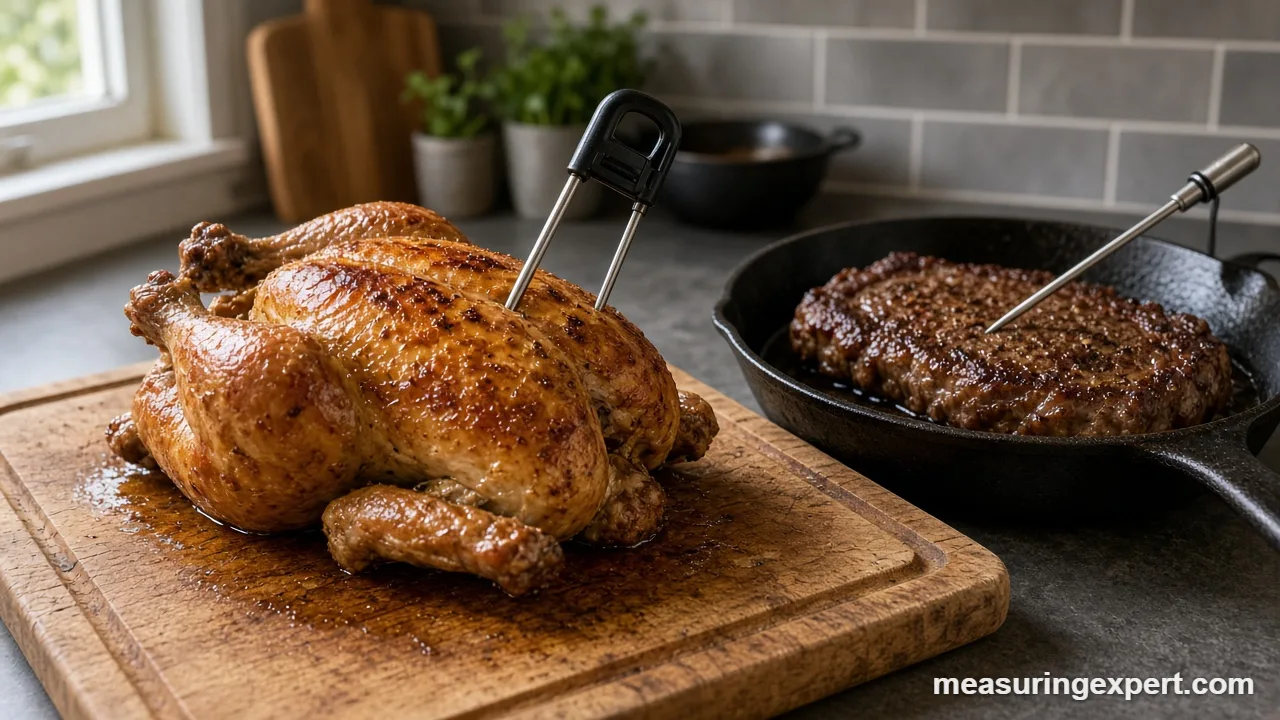
The best food thermometer for most kitchens is the ThermoWorks Sizzle, because it reads in about 2 seconds, is rated to +/-0.9 F across cooking temperatures and is fully waterproof. What decides your pick is simple: how fast it reads, how accurate it stays, and whether you need a quick probe or a leave-in one.
In short: buy the Sizzle for accuracy, the Alpha Grillers for a tight budget, and the Taylor 1470 for roasts you leave in the oven.
As an Amazon Associate, Measuring Expert earns from qualifying purchases. Our picks are based on research, specifications and owner feedback, not paid placement.
Specifically, this guide covers instant-read and corded probe thermometers for meat, fish, eggs and leftovers. For app-connected probes, see our best wireless meat thermometer roundup instead.
Best Budget
Best Leave-In Probe
Quick Answer: Which Food Thermometer Fits You?
- ThermoWorks Sizzle: about 2-second reads, IP67 and a NIST-traceable certificate.
- TempPro TP19H: 1-second reads, a magnet and motion wake.
- Lavatools Javelin PRO Classic: a big auto-rotating screen for left or right hands.
- Taylor 1470 Probe and Timer: a leave-in probe and alarm for roasts and turkey.
- Escali DHP4: NSF and IPX7 for commercial-style washing.
- Alpha Grillers Instant Read: a waterproof folding probe that costs little.
- Lavatools Javelin: a slim pocket probe for small kitchens and travel.
On This Page
- Comparison chart
- The 7 picks, reviewed
- How we chose
- USDA safe temperatures
- Thermometer types
- Specs that matter
- Temperature converter
- How to take a reading
- Calibration checks
- Do and don’t
- Honest limits
- FAQ
- Final pick
Best Food Thermometer Comparison Chart
First, scan the chart for the job you care about. Then jump to the review for the measuring details.
| # | Image | Product | Best For | Standout Feature | Amazon |
|---|---|---|---|---|---|
| 1 | 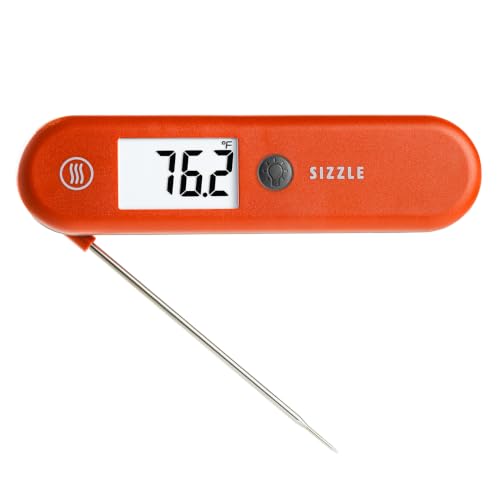 | ThermoWorks Sizzle | Most home cooks who want proven accuracy | NIST-traceable certificate and IP67 body | View |
| 2 | 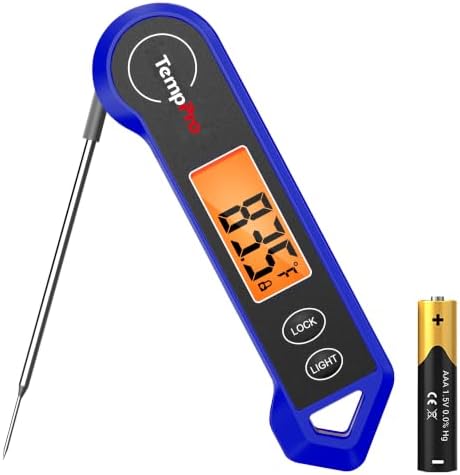 | TempPro TP19H | Grilling and everyday cooking on a budget | 1-second reads with motion wake and a magnet | View |
| 3 |  | Lavatools Javelin PRO Classic | Left-handed cooks and food-safety minded kitchens | Large auto-rotating 2 in display, NSF listed | View |
| 4 | 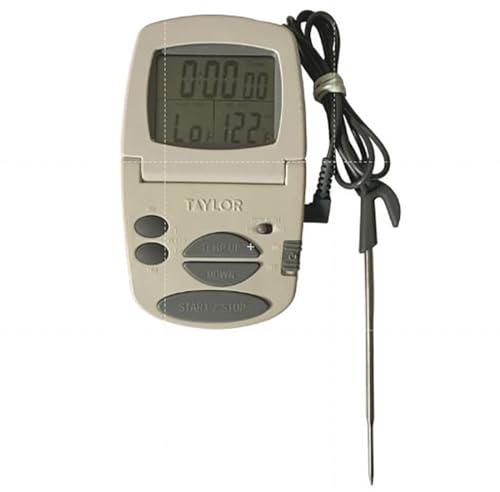 | Taylor 1470 Probe and Timer | Oven roasts, turkey and long cooks | Leave-in probe on a 4 ft cord with target alarm | View |
| 5 | 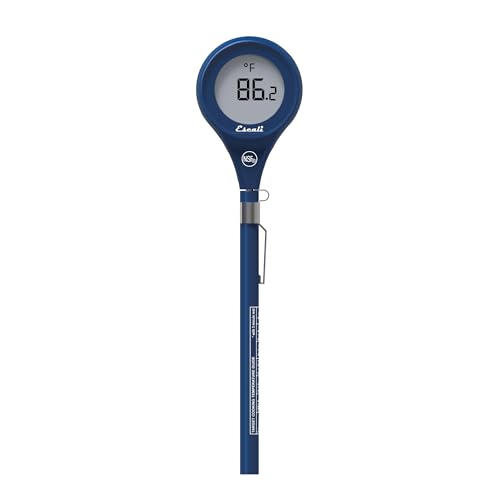 | Escali DHP4 | Food trucks, catering and heavy washing | IPX7 waterproof and NSF certified | View |
| 6 |  | Alpha Grillers Instant Read | Low-cost grilling and gifts | IP67 folding probe with recalibration | View |
| 7 | 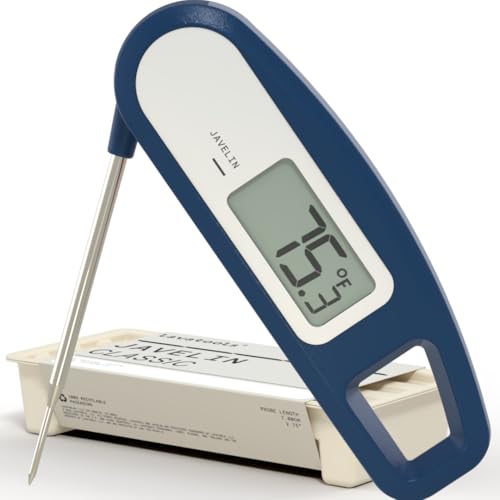 | Lavatools Javelin | Small kitchens and travel | Slim folding body with a 2.75 in probe | View |
The 7 Best Food Thermometer Picks, Reviewed
We start with the most accurate all-rounder. After that come value models, a leave-in probe, a commercial pick and two compact, low-cost options.
Best Overall
1. ThermoWorks Sizzle Digital Meat Thermometer
Best for: cooks who want lab-style accuracy, a fully waterproof body and a calibration certificate in the box.
ThermoWorks makes the Thermapen, so the Sizzle comes from a brand that lives and breathes probe accuracy. For most kitchens, it is the best food thermometer here. ThermoWorks rates it at plus or minus 0.9 F (0.5 C) from -4 to 248 F (-20 to 120 C), which covers every USDA safe minimum temperature. In addition, each unit ships with a NIST-traceable calibration certificate, so you know where it started.
The 4.5 in (114 mm) probe tapers from 0.12 in to 0.06 in, which means a small hole in a thin chicken breast. Also, readings take about 2 seconds. Moreover, the backlit display flips 180 degrees, and you can switch between 0.1 and 1 degree resolution.
- Range: -58 to 572 F (-50 to 300 C)
- Accuracy: +/-0.9 F from -4 to 248 F; +/-4 F outside that span
- Response: about 2 seconds; 4.5 in tapered probe
- IP67 waterproof; 2 AAA batteries rated up to 5,000 hours
- Auto-rotating backlit display; 0.1 or 1 degree resolution
Pros
- Tight, published accuracy across the cooking range
- Also, a NIST-traceable certificate comes in the box
- Besides, the IP67 body survives a rinse under the tap
Cons
- However, it costs more than budget folding probes
- Accuracy widens to +/-4 F above 248 F, so frying is less precise
- No leave-in probe or alarm for roasts
Skip it if: you mostly roast large cuts in the oven; a leave-in probe with an alarm, like the Taylor below, fits that job better.
Best Value
2. TempPro (ThermoPro) TempSwift PLUS TP19H
Best for: grillers who want a 1-second reading, a magnet and motion wake at a mid-range price.
ThermoPro now sells under the TempPro name, and the TP19H is its flagship folding instant-read model. TempPro lists a 1-second response, so you spend less time with your hand over the grill. In addition, the unit turns on when you open the probe and wakes when you pick it up.
For accuracy, TempPro states plus or minus 0.9 F (0.5 C) from 14 to 212 F (-10 to 100 C). That covers safe cooking temperatures, although the spec does not cover frying heat. Also, the 4 in (103 mm) probe is long enough for thick steaks. A lock button holds the reading, so you can step back from the heat before you read it.
- Range: -58 to 572 F (-50 to 300 C)
- Accuracy: +/-0.9 F from 14 to 212 F
- Response: 1 second; 4 in stainless probe
- IP65; one AAA battery; magnetic back and hang hole
- Backlit display that rotates 180 degrees; lock function
Pros
- Above all, it gives fast 1-second reads
- Also, motion wake and auto sleep save battery
- In addition, a magnet keeps it on the grill or fridge
Cons
- Still, IP65 means rinse only, not a full dunk
- However, the accuracy spec stops at 212 F
- Boxes may still show the older ThermoPro name
Skip it if: you need a fully submersible probe for a commercial kitchen; pick the Escali DHP4 instead.
Best Rotating Display
3. Lavatools Javelin PRO Classic
Best for: left-handed cooks and anyone who reads the screen from odd angles.
The Javelin PRO Classic is built around its screen. Lavatools fits a 2 in backlit, anti-fog display that rotates to match how you hold it. So, whether you probe a roast from the left or reach across a smoker, the numbers stay upright.
Lavatools rates it at plus or minus 0.9 F (0.5 C) from -4 to 302 F (-20 to 150 C), with a full range of -40 to 482 F (-40 to 250 C). Meanwhile, readings typically take 2 to 3 seconds. In addition, the unit carries NSF certification, and one CR2032 coin cell is rated for more than 4,000 hours. On the other hand, the IP65 rating means splash resistance, not submersion.
- Range: -40 to 482 F (-40 to 250 C)
- Accuracy: +/-0.9 F from -4 to 302 F
- Response: typically 2 to 3 seconds
- 2 in backlit, auto-rotating display; hold function
- IP65 splash resistant; NSF, CE and RoHS; CR2032 battery
Pros
- Easy-to-read, rotating 2 in screen
- Also, accuracy spec runs to 302 F
- NSF listing suits shared kitchens
Cons
- Splash resistant only, so never submerge it
- Besides, coin cells are less common than AAA
- However, it is slower than the 1 to 2 second models
Skip it if: you want the fastest possible reading; the TP19H and Sizzle are quicker.
Best Leave-In Probe
4. Taylor Precision 1470 Digital Cooking Thermometer and Timer
Best for: oven roasts, whole birds and smoked cuts where you want an alarm instead of opening the door.
Not every food thermometer is a quick-dip tool. Taylor’s 1470 series is a probe thermometer: the 6 in (15 cm) steel probe stays in the meat, while a 4 ft (1.2 m) silicone cord runs out of the oven door to a base unit. As a result, you watch the internal temperature climb without letting heat escape. Moreover, Taylor rates the cord to 485 F (250 C).
First, you set a target, and the alarm sounds when the food reaches it. Also, a timer counts up to 24 hours, and a magnet holds the base on the oven door. Taylor lists a range of 32 to 392 F (0 to 200 C), which covers roasting and smoking. However, FSIS notes that oven-cord thermometers cannot be calibrated, so check it in ice water now and then and replace it if it drifts.
- Range: 32 to 392 F (0 to 200 C)
- 6 in stainless probe; 4 ft silicone cord safe to 485 F
- Target-temperature alarm plus a 24-hour timer
- Magnetic base; two AAA batteries included
- Step-down probe tip, per the listing
Pros
- Leave-in probe means no guessing on long cooks
- Also, the alarm frees you from the oven door
- In addition, it doubles as a kitchen timer
Cons
- Too slow and bulky for quick spot checks
- However, it cannot be recalibrated
- The cord can be pinched or kinked in a tight door
Skip it if: you mostly cook steaks, burgers and chicken breasts; an instant-read model is faster for thin foods.
Best for Food Service
5. Escali DHP4 Easy Read Waterproof Digital Thermometer
Best for: caterers, food trucks and home cooks who wash tools hard and want an NSF-certified probe.
Escali, part of San Jamar, builds tools for commercial kitchens. In contrast, the DHP4 is a straight-probe pocket design rather than a folding one. Its 4.7 in (120 mm) stainless probe ends in a 1.8 mm step-down tip, so it reaches the center of a thick roast or a deep pot of chili. Also, it is NSF certified and IPX7 waterproof, so it handles sanitizer buckets and sink washing.
Overall, the range runs from -58 to 572 F (-50 to 300 C), which covers frozen food checks, cold holding and hot oil. The listing names 4-second readings and a backlit display, while an auto-off helps the battery last. However, the seller page we opened did not list an accuracy figure. Therefore, check it in an ice bath when it arrives, as you should with any new probe.
- Range: -58 to 572 F (-50 to 300 C)
- 4.7 in stainless probe with 1.8 mm step-down tip
- IPX7 waterproof; NSF certified
- Backlit display; about 4-second readings, per the listing
- Auto-off to save battery
Pros
- Fully waterproof for sink washing
- Also, NSF certification suits inspected kitchens
- Moreover, the long probe reaches deep pots and roasts
Cons
- No published accuracy figure on the page we opened
- Straight probe needs its sleeve for pocket carry
- Slower than the fastest folding models
Skip it if: you want a published accuracy spec; the Sizzle and Javelin PRO state theirs.
Best Budget
6. Alpha Grillers Instant Read Meat Thermometer
Best for: occasional grillers and first-time buyers who want a waterproof folding probe for little money.
Alpha Grillers is a long-running budget favorite, and it covers the basics well. The brand lists a 1 to 2 second response and an IP67 waterproof rating, so you can wash it under running water. In addition, the display has a bright blue backlight for night grilling. It arrives pre-calibrated, and it also has a recalibration feature if it drifts.
That calibration option matters because cheap thermometers age. However, Alpha Grillers does not publish an accuracy figure or a full range on its product page. As a result, we suggest an ice-water check on day one and every few months after.
- Response: 1 to 2 seconds, per Alpha Grillers
- IP67 waterproof; washable under running water
- Backlit display
- Pre-calibrated, with a recalibration feature
Pros
- Low cost for a waterproof folding probe
- Also, you can recalibrate it yourself
- Likewise, the backlight helps at night
Cons
- No published accuracy or range on the brand page
- However, the build feels lighter than premium models
- Also, the display does not auto-rotate
Skip it if: you cook for a crowd every week; a model with a stated accuracy spec is a safer bet.
Best Compact
7. Lavatools Javelin Digital Instant Read Thermometer
Best for: apron pockets, camping kits and small kitchens that want a slim, NSF-listed probe.
In comparison, the original Javelin is the smaller sibling of the PRO. It folds into a slim body with a 2.75 in (7 cm) probe, according to its listing. Lavatools gives it the same accuracy rating as the PRO: plus or minus 0.9 F (0.5 C) from -4 to 302 F. In addition, it carries NSF, CE and RoHS certifications.
However, the trade-off is speed. Lavatools now lists a typical 4 to 5 second response, while the Amazon title says 3 seconds. Also, the short probe can struggle with a thick roast or a whole turkey thigh. For burgers, chops and fish, however, it is more than enough.
- Range: -40 to 482 F (-40 to 250 C)
- Accuracy: +/-0.9 F from -4 to 302 F
- Response: typically 4 to 5 seconds, per Lavatools
- 2.75 in folding probe; IP65 splash resistant
- CR2032 battery rated for 4,000+ hours; no calibration needed
Pros
- Slim and light for pockets and kits
- Also, it shares the PRO’s accuracy spec
- In addition, battery life is long
Cons
- Slower readings than most picks here
- However, the short probe limits deep cuts
- Second Lavatools pick, so similar styling to the PRO
Skip it if: you already own the Javelin PRO; the two overlap.
How We Chose the Best Food Thermometer
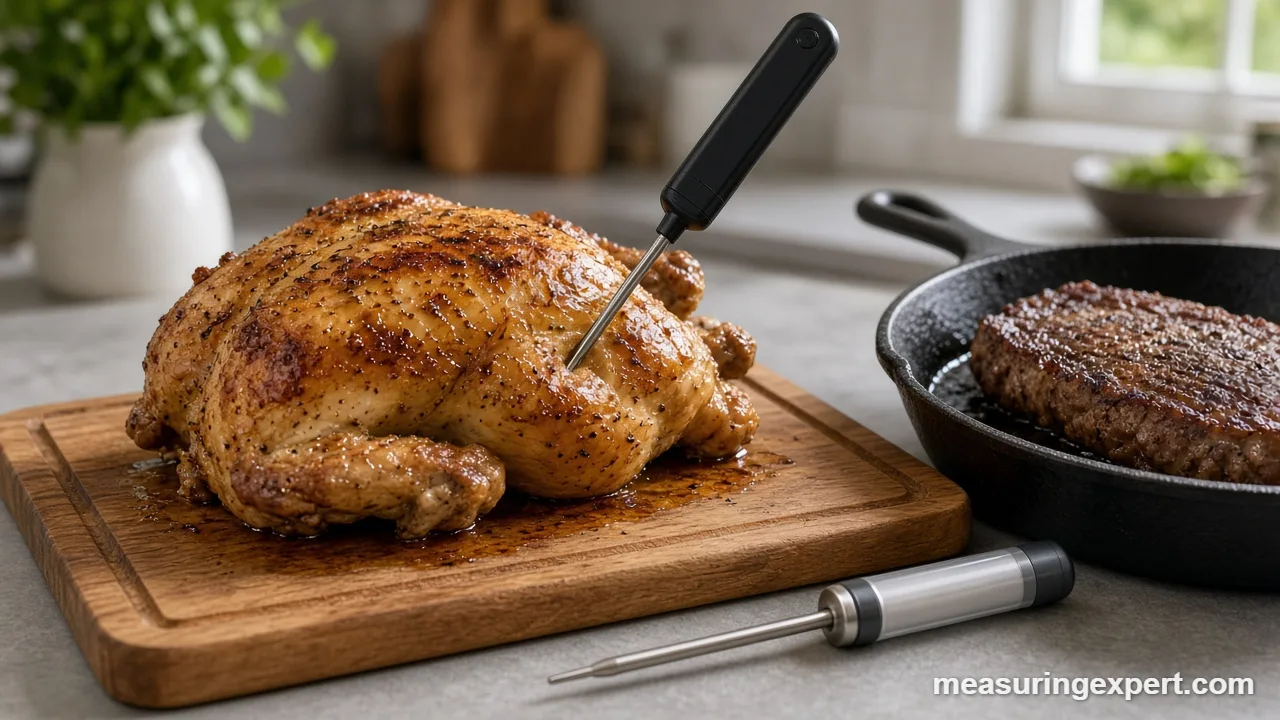
To be clear, we did not run hands-on tests. Instead, these picks are research-based. We read manufacturer spec pages, food-safety guidance and owner feedback, and then we scored each model on the same measuring criteria.
- Published accuracy: a stated tolerance, such as +/-0.9 F, ranked higher than vague claims.
- Accuracy span: we checked that the spec covers 145 to 165 F, where food safety is decided.
- Speed: faster reads mean less heat on your hand and less time with the oven open.
- Calibration: also, models you can check and adjust earned credit.
- Durability: IP65 or better, NSF listing and long battery life all counted.
- Brand and variety: finally, we picked established brands, at most two per brand, and covered distinct uses.
For the safety side, we used the USDA FSIS kitchen thermometer guide and the federal safe minimum internal temperature chart. Specs come from pages such as the ThermoWorks Sizzle spec page, Lavatools, TempPro and Taylor.
USDA Safe Minimum Temperatures to Check With Your Food Thermometer
Of course, a thermometer is only useful when you know the target. USDA FSIS calls a food thermometer the only reliable way to confirm a safe internal temperature, because color can fool you. For example, a burger can brown before it reaches 160 F. Therefore, use this chart as your checklist.
| Food | Safe minimum | Rest time |
|---|---|---|
| Beef, veal, lamb, goat and bison steaks, roasts, chops | 145 F (62.8 C) | 3 minutes |
| Pork steaks, roasts and chops; raw ham | 145 F (62.8 C) | 3 minutes |
| Ground beef, pork, veal and lamb; sausage | 160 F (71.1 C) | None |
| Poultry: whole, parts, ground, giblets, stuffing | 165 F (73.9 C) | None |
| Egg dishes such as quiche or frittata | 160 F (71.1 C) | None |
| Fish, whole or fillet | 145 F (62.8 C) | None |
| Leftovers and casseroles | 165 F (73.9 C) | None |
| Precooked ham, reheated | 165 F (73.9 C); 140 F (60 C) if packaged in a USDA-inspected plant | None |
| Rabbit and venison | 160 F (71.1 C) | None |
Instant-Read, Leave-In or Dial: Food Thermometer Types Compared
FSIS sorts kitchen thermometers by how they sense heat. In turn, the sensor type sets the speed, and speed changes how you use the tool.
| Type | Typical speed | Calibrate? | Best use |
|---|---|---|---|
| Thermocouple (digital) | 2 to 5 seconds | Yes | Thin cuts, grilling, frequent checks |
| Thermistor (digital) | About 10 seconds | Some models | Everyday cooking, thick and thin foods |
| Oven cord probe (digital) | Continuous | No | Roasts and whole birds in the oven |
| Instant-read dial (bimetal) | 15 to 20 seconds | Usually | Thick foods near the end of cooking |
| Oven-safe dial (bimetal) | 1 to 2 minutes | Usually | Left in roasts and soups |
| Pop-up timer | One-time | No | Backup only; still check with a probe |
If you also want to watch oven air temperature, see our best oven thermometer guide, because air and food temperatures are different measurements.
Specs That Matter When You Shop for the Best Food Thermometer
At first, spec sheets can look alike. However, a few numbers decide how well the best food thermometer for you will measure.
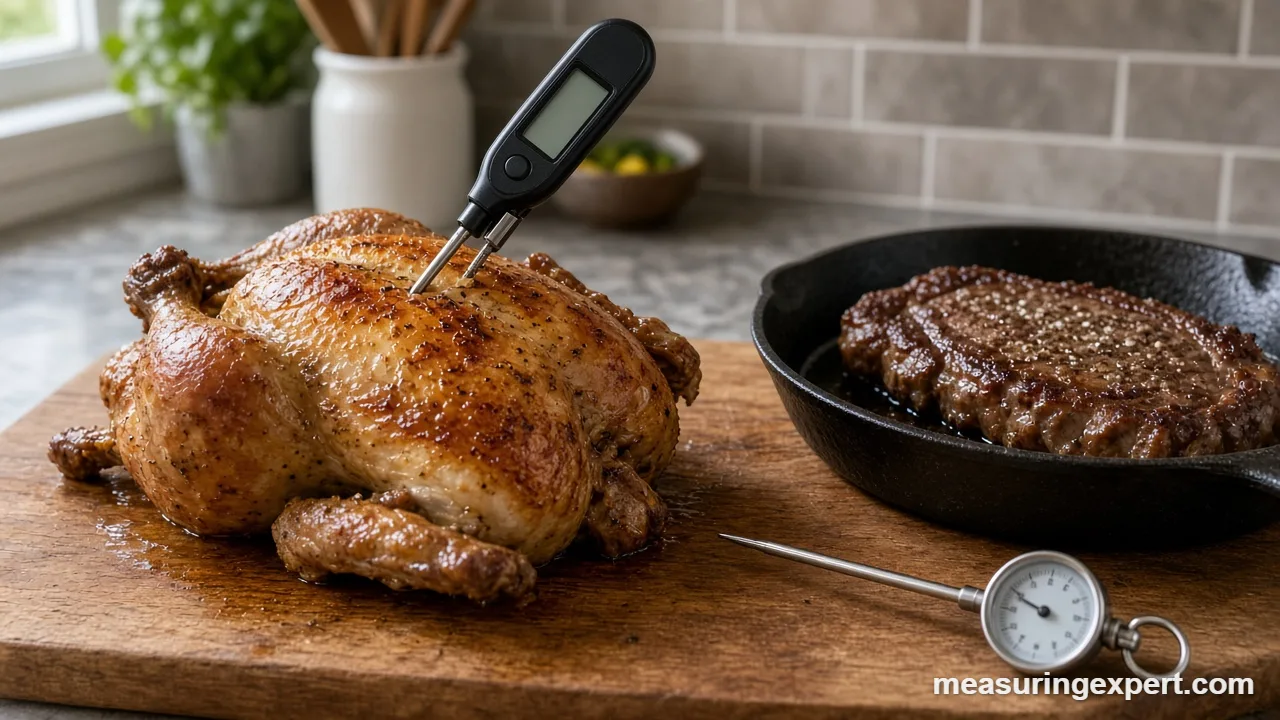
- Accuracy and its span: look for a tolerance such as +/-0.9 F (0.5 C), and check the range it covers. The Sizzle’s spec runs to 248 F, while the Javelin’s runs to 302 F.
- Resolution: this is the smallest step on the screen, such as 0.1 degree. It is not the same as accuracy, so a 0.1 display can still be off by 2 F.
- Range: -58 to 572 F covers freezer checks and frying oil. In contrast, a 32 to 392 F range suits roasting.
- Response time: 1 to 3 seconds feels instant. Slower probes are fine for roasts but tiring over a hot grill.
- Probe length and tip: a long, thin step-down tip reaches the center of thick cuts and leaves a small hole.
- Water rating: IP65 means splash resistant; IP67 and IPX7 mean the body survives brief submersion.
Fahrenheit and Celsius Temperature Converter
Many recipes list Celsius, while US charts use Fahrenheit. Use this converter to switch a target temperature before you cook. For baking-specific conversions, see our Fahrenheit to Celsius baking guide.
How to Take an Accurate Reading With a Food Thermometer
Even the best food thermometer gives a wrong answer if the tip sits in the wrong spot. Follow these steps every time.
- Pick the right tool. Use an instant-read probe for steaks, burgers and chicken pieces. For roasts and whole birds, use a leave-in probe with a cord.
- Check calibration first. Test the thermometer in ice water. It should read 32 F (0 C) after about 30 seconds in a well-stirred glass.
- Insert into the thickest part. Push the tip to the center of the thickest part, away from bone, fat and gristle. For thin foods, go in from the side.
- Wait for the reading to settle. Hold the probe still until the number stops changing. Then move it a little deeper and shallower to find the lowest reading.
- Compare with the USDA chart. Read the lowest value against the FSIS safe minimum, such as 165 F for poultry or 160 F for ground beef.
- Rest and clean. Let whole cuts of beef, pork, veal and lamb rest for 3 minutes. Finally, wash the probe with hot, soapy water before the next food.
For whole poultry, FSIS suggests checking the innermost thigh, the innermost wing and the thickest part of the breast. Similarly, check egg dishes and casseroles in several places, since the center heats last.
Calibration Checks for Your Best Food Thermometer
Over time, a thermometer can drift after a drop or years of use. So, check it when it is new, and then every few months. FSIS describes two simple tests.
- Ice water: fill a tall glass with ice, add water and stir. Next, submerge at least 2 in of the stem without touching the glass. After 30 seconds, it should read 32 F (0 C).
- Boiling water: bring clean water to a rolling boil and dip the probe in the same way. At sea level, it should read 212 F (100 C). However, water boils at a lower temperature at altitude, so the ice test is more reliable for most homes.
If the reading is off and your model has a calibration feature, adjust it. If it cannot be adjusted, note the offset and add or subtract it. Finally, replace any thermometer that is off by more than a few degrees. Our precision in cooking measurements article explains why small errors add up.
Food Thermometer Do and Don’t Tips
Honest Limits of Even the Best Food Thermometer
To begin with, a thermometer reads one point, not the whole piece of food. As a result, a thick roast can be safe at the tip and cooler a half inch away.
Also, many accuracy specs cover only part of the full range. For example, the Sizzle widens to +/-4 F above 248 F. So, for candy stages and frying, a dedicated candy thermometer may be more precise.
Finally, FSIS notes that most food thermometers are accurate within 2 to 4 F. That is why cooking a little past the minimum, then resting, gives you a sensible margin.
Best Food Thermometer FAQ
What is the best food thermometer for most home cooks?
For most home cooks, the best food thermometer is a fast instant-read probe with a published accuracy spec. Our top pick, the ThermoWorks Sizzle, is rated at plus or minus 0.9 F from -4 to 248 F and ships with a NIST-traceable certificate.
What temperature should chicken reach?
USDA FSIS lists 165 F (73.9 C) for all poultry, including whole birds, parts, ground poultry and stuffing. Check the thickest part of the breast and the innermost thigh and wing.
What is the safe temperature for steak and pork chops?
FSIS lists 145 F (62.8 C) for steaks, roasts and chops of beef, pork, veal and lamb, followed by a 3-minute rest. Ground beef and ground pork need 160 F (71.1 C).
How accurate should a food thermometer be?
FSIS says most food thermometers are accurate within 2 to 4 F. Better instant-read models state plus or minus 0.9 F (0.5 C) over the cooking range, which gives you more margin near a safe minimum.
How do I calibrate a food thermometer?
Use the ice-water method. Fill a glass with ice and water, stir, and submerge at least 2 in of the stem without touching the glass. After 30 seconds, it should read 32 F (0 C). Adjust it if it has a calibration feature.
Can I leave an instant-read thermometer in the oven?
No. Instant-read thermometers are meant for quick checks near the end of cooking. Their bodies are not oven safe. For roasts that cook for hours, use a leave-in probe with a heat-rated cord, such as the Taylor 1470.
Is a thermocouple better than a thermistor?
Thermocouples are usually faster, reading in about 2 to 5 seconds according to FSIS, and they can be calibrated. Thermistors take longer, often about 10 seconds. For thin foods and grilling, speed helps.
Where do I put the probe in a burger or chicken breast?
Insert the probe through the side so the tip sits in the center of the thickest part. Avoid bone, fat and gristle, because they give false readings.
Can I use a meat thermometer for candy and frying oil?
Yes, if its range is high enough. Several picks here read up to 572 F. However, some accuracy specs only cover up to 212 to 302 F, so a dedicated candy thermometer is still more precise for sugar stages.
Is the best food thermometer the same as the best wireless one?
Not always. A wired or instant-read probe is cheaper and has no app or signal to manage. Wireless probes suit long smokes. See our best wireless meat thermometer guide for that style.
Bottom Line: Our Best Food Thermometer Pick
For most cooks, the ThermoWorks Sizzle is the best food thermometer here. After all, it pairs a published +/-0.9 F spec with about 2-second reads, an IP67 body and a calibration certificate. If you are on a budget, the Alpha Grillers covers the basics, while the Taylor 1470 handles long roasts. Pocket-size options live in our best pocket thermometer guide.
Black Friday is coming: shop the deals with Prime
9 thoughts on “7 Best Food Thermometers for 2026: Instant-Read and Probe Picks”