

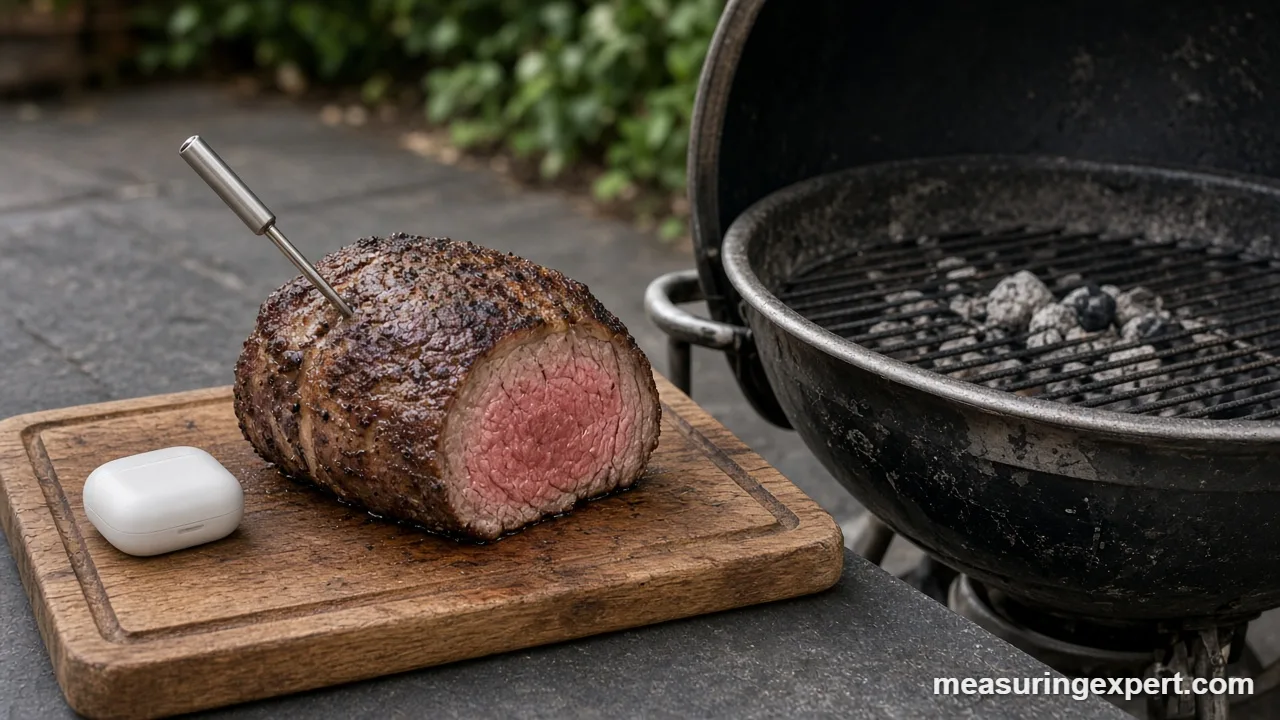
The best wireless meat thermometer for most cooks is the TempPro TempSpike Plus, a cable-free probe with up to 600 ft of Bluetooth range and +/-1.8 F accuracy. Beyond that, your choice comes down to how many probes you need, whether you want Wi-Fi, and how tight an accuracy rating you will pay for.
In short: get the TempSpike Plus for everyday cooks, the TempSync TP08S if you want no app, and the Typhur Sync Gold Dual for pro-level accuracy.
As an Amazon Associate, Measuring Expert earns from qualifying purchases. Our picks are based on research, specifications and owner feedback, not paid placement.
Best Overall
Best Budget
Quick Answer: Which Wireless Meat Thermometer Fits You?
- Everyday all-rounder: TempSpike Plus, a cable-free probe with a booster and a 600 ft range.
- Top accuracy: Typhur Sync Gold Dual, rated +/-0.5 F with six sensors per probe.
- Guided cooking: MEATER Plus, whose app tells you when to pull and rest the meat.
- High heat: CHEF iQ Sense, a 0.19 in probe rated to 1,000 F.
- Many cuts at once: INKBIRD INT-14-BW, with four wireless probes and a screen base.
- No app at all: TempSync TP08S, an RF receiver with two wired probes.
- Key rule: pull meat by the USDA safe minimum temperature, not by the clock, because cook times vary.
On This Page
- All picks at a glance
- The 7 picks, reviewed
- How we chose
- Wireless thermometer types
- Specs that matter
- USDA safe temperatures and converter
- How to use a wireless probe
- Checking accuracy
- Do and Don’t
- Honest limits
- FAQ
- Bottom line
Best Wireless Meat Thermometer Picks at a Glance
First, here is every pick in one row each. Then the reviews below explain the range, sensors and accuracy behind each choice.
| # | Product | Best For | Standout Feature | Amazon |
|---|---|---|---|---|
| 1 | TempPro TempSpike Plus (TP970) | Most home cooks | 600 ft Bluetooth range, no hub needed | View |
| 2 | Typhur Sync Gold Dual | Serious BBQ and long smokes | +/-0.5 F accuracy and Sub-1G radio | View |
| 3 | MEATER Plus | Beginners who like step-by-step help | Guided Cook app and finish-time estimates | View |
| 4 | CHEF iQ Sense (2 Probes) | Searing, rotisserie and air fryers | 1,000 F heat rating and 0.19 in probe | View |
| 5 | INKBIRD INT-14-BW (4 Probes) | Big cooks and several cuts at once | 4 wireless probes plus a screen base | View |
| 6 | ThermoMaven P2 | Two cuts with Wi-Fi alerts | 2 probes, smart base and Wi-Fi | View |
| 7 | TempPro TempSync (TP08S) | No-app cooks and tight budgets | RF receiver with 500 ft range | View |
The 7 Best Wireless Meat Thermometer Options, Reviewed
First, we ranked these by how well each one serves a typical home cook, so the all-round models come first and the specialists follow. If you mostly want a phone-linked probe, also see our Bluetooth food thermometer picks.
Best Overall
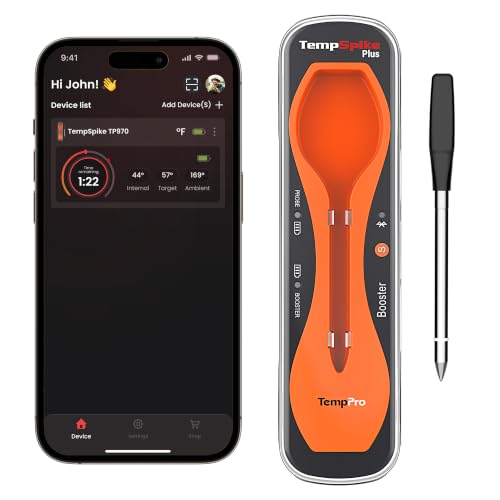
1. TempPro TempSpike Plus (TP970)
Best for: Home cooks who want one truly wire-free probe that just works on a grill, smoker or oven.
The TempSpike Plus is the pick we would hand to most people shopping for the best wireless meat thermometer. First, there is no cable at all: the probe goes into the meat, and the booster sits nearby and relays the signal. As a result, you can close a smoker lid or oven door with nothing in the way. Also, TempPro lists up to 600 ft of Bluetooth range, although walls and a closed grill lid cut that down.
On the measurement side, for example, the probe has one internal sensor and one ambient sensor, both NTC thermistors. The internal range is 14 to 212 F (-10 to 100 C), and the stated accuracy is plus or minus 1.8 F (1.0 C). In addition, the probe is rated IP67, and a full charge lasts 40+ hours. So one charge covers even a long brisket cook.
- Range: up to 600 ft over Bluetooth 5.2 (no Wi-Fi)
- Internal sensor: 14 to 212 F (-10 to 100 C), accuracy +/-1.8 F (1.0 C)
- Probe: 0.21 in x 4.17 in (5.4 x 106 mm), IP67
- Battery: probe 40+ hours; booster 3+ months per charge
- App for iOS and Android with presets for 9 meat types and USDA guidance
Pros
- No hub, router or Wi-Fi setup
- Long range for a Bluetooth model
- Booster doubles as the storage case
Cons
- Only one probe in this version
- No screen on the booster (the TP971 adds one)
- Range drops through walls and lids
Skip it if: you cook several cuts at once, or similarly, if you want to check temps from outside the house.
Best Pro Pick
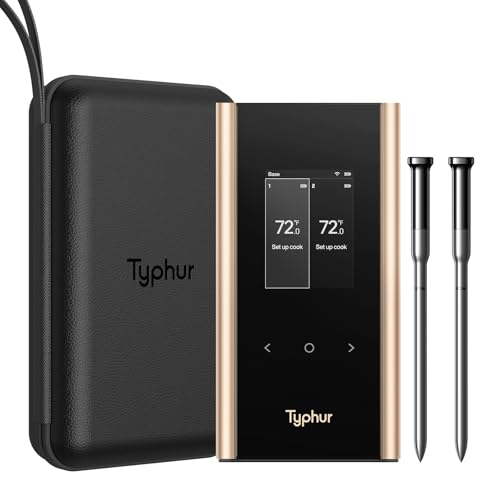
2. Typhur Sync Gold Dual
Best for: Pitmasters and data fans who want the tightest accuracy and the most reliable signal.
The Sync Gold Dual is the high-end choice here, and its numbers explain why. First, each probe carries six sensors: five internal and one ambient. As a result, that spread helps the system find the true coldest point in a thick roast. Moreover, Typhur rates internal accuracy at plus or minus 0.5 F (0.3 C), NIST-verified, and ships a calibration certificate.
In addition, the base talks to the probes over Bluetooth, 2.4 GHz Wi-Fi and Sub-1G radio. As a result, Typhur claims up to 3,000 ft in open space and 700 ft in closed space. Besides, the base has a 2.4 inch color screen, so you can read temps without a phone. Meanwhile, the ambient sensor is rated to 932 F (500 C), which suits searing and kamado cooks.
- 2 probes, 6 sensors each (5 internal + 1 ambient)
- Internal 32 to 221 F (0 to 105 C); ambient up to 932 F (500 C)
- Accuracy: +/-0.5 F (0.3 C) internal, NIST-verified with certificate
- Range: up to 3,000 ft open, 700 ft closed; Bluetooth, Wi-Fi and Sub-1G
- Battery: 50+ hours per charge; probes IPX8 and dishwasher safe
Pros
- Tightest accuracy rating in this list
- Strong signal through grills and walls
- Screen on the base, so no phone needed
Cons
- Costs much more than single-probe models
- Wi-Fi works on 2.4 GHz only
- Base is only splash resistant (IPX2)
Skip it if: you grill a few steaks a month, because a simpler probe does that job fine.
Best Guided Cooking
3. MEATER Plus

Best for: Newer cooks who want the app to tell them when to pull the meat and how long to rest it.
First, the probe has two sensors: one reads the meat, up to 212 F, and the other reads the air around it, up to 527 F. Because the app knows both numbers, it can estimate how long the cook has left.
Above all, the app is the main draw. For example, its Guided Cook System walks you through a cut and doneness, then alerts you when to remove it. However, the Plus connects over Bluetooth only, with up to 165 ft of range in good conditions. Also, the charger runs on one AAA battery, and the probe lasts 24+ hours per charge.
- Two sensors: internal up to 212 F (100 C), ambient up to 527 F (275 C)
- Range: up to 165 ft (about 50 m) over Bluetooth
- Probe battery: 24+ hours; charger uses 1 AAA battery
- Dishwasher safe probe; water resistant
- MEATER app with Guided Cook System and finish-time estimator
Pros
- Very easy app for first-timers
- Finish-time estimates help plan meals
- Charger block also extends the range
Cons
- Shorter range than newer models
- Ambient limit is lower than some rivals
- One probe only
Skip it if: you want a screen on the base, because the Plus relies on your phone.
Best for High Heat
4. CHEF iQ Sense (2 Probes)
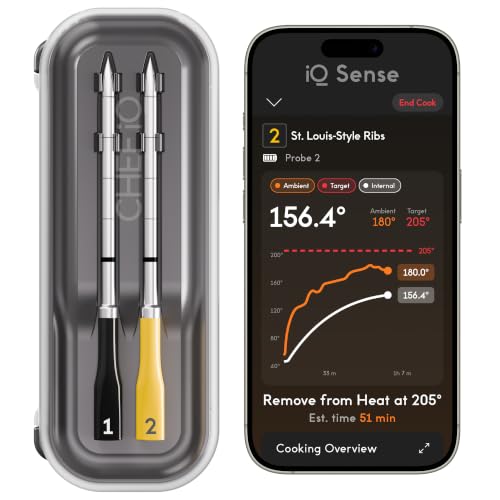
Best for: Cooks who sear hot, use an air fryer or spin a rotisserie and want a thin probe that leaves a small hole.
The CHEF iQ Sense stands out for two numbers. First, the probe is only 0.19 in thick, so it fits thin chops and fish without shredding them. Second, CHEF iQ rates the probe to 1,000 F (537 C), which is far beyond what most smoker probes can take.
In addition, each probe has four internal sensors plus one ambient sensor. As a result, the app reads the lowest internal value, which is the number that matters for food safety. The probes connect to a Smart Hub over Bluetooth 5, and the hub joins your Wi-Fi. So range is effectively unlimited while the hub stays online. Also, CHEF iQ states accuracy within 1 F.
- Probe: 0.19 in thick, 4.75 in long; heat safe to 1,000 F (537 C)
- 4 internal sensors + 1 ambient sensor per probe
- Internal range 32 to 212 F (0 to 100 C); accuracy within 1 F
- Smart Hub with Wi-Fi, Bluetooth and a speaker; USB-C charging
- Waterproof, dishwasher-safe probes
Pros
- Thin probe leaves a small hole
- Very high heat rating for hot cooks
- Hub has a speaker for alerts
Cons
- Needs the hub and Wi-Fi for long range
- USB charging brick not included
- No temperature screen on the hub
Skip it if: you want to read temps at a glance, since the hub has no screen.
Best Multi-Probe
5. INKBIRD INT-14-BW (4 Probes)

Best for: Hosts who smoke a brisket, a pork butt and a few chickens in the same session.
Four wireless probes in one kit is the reason to pick the INT-14-BW. Specifically, each probe has two sensors, one for the food and one for the ambient air. In other words, you can track four cuts and four grill zones at once. Also, the base has a backlit LCD and a magnetic back, so it can stick to the side of a grill.
For measurement, INKBIRD lists an internal range of 14 to 212 F (-10 to 100 C), an ambient range up to 572 F (300 C) and accuracy of plus or minus 1.8 F (1 C). In addition, the probes are IP67 and dishwasher safe. Meanwhile, they run about 25 hours per charge and refill in about 25 minutes. Note that the base joins 2.4 GHz Wi-Fi only.
- 4 wireless probes, each with food and ambient sensors
- Internal 14 to 212 F (-10 to 100 C); ambient up to 572 F (300 C)
- Accuracy: +/-1.8 F (1 C)
- Bluetooth up to 300 ft unobstructed (BLE 5.4) plus 2.4 GHz Wi-Fi
- Probes IP67, dishwasher safe, about 25 hours per charge
Pros
- Four probes for the price of one kit
- Screen base with magnetic mount
- Wi-Fi for checking from anywhere
Cons
- Large base takes counter space
- +/-1.8 F is looser than the premium picks
- No 5 GHz Wi-Fi support
Skip it if: you only ever cook one roast at a time, because the extra probes then go unused.
Best Smart Base Value
6. ThermoMaven P2
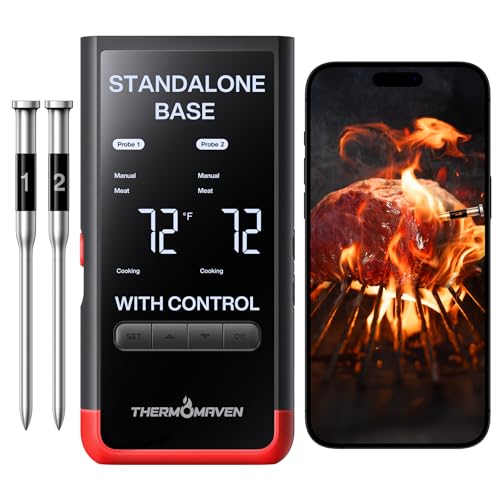
Best for: Cooks who want two probes, a base unit and Wi-Fi alerts without paying premium prices.
The ThermoMaven P2 is a two-probe kit built around a smart base. For example, ThermoMaven says it can track two cooks at once and connects over both Bluetooth and Wi-Fi. So you can watch a roast in the oven and a chicken on the grill from the same app.
Currently, the Amazon listing describes 2 probes, a smart base and 6 sensors. However, we could not open a full spec sheet from the maker during our research. Therefore, check the listing for the exact range, accuracy and heat ratings before you buy.
- 2 wireless probes with a smart base
- Bluetooth and Wi-Fi connection
- Listing describes 6 sensors
- Tracks two cooks at the same time
Pros
- Two probes at a mid-range level
- Base plus Wi-Fi means no phone babysitting
- Fits oven, grill and smoker cooks
Cons
- Fewer published specs than rivals
- Accuracy rating not confirmed on the maker page
- Smaller brand with a shorter track record
Skip it if: you want a published accuracy rating you can check against a NIST certificate.
Best Budget
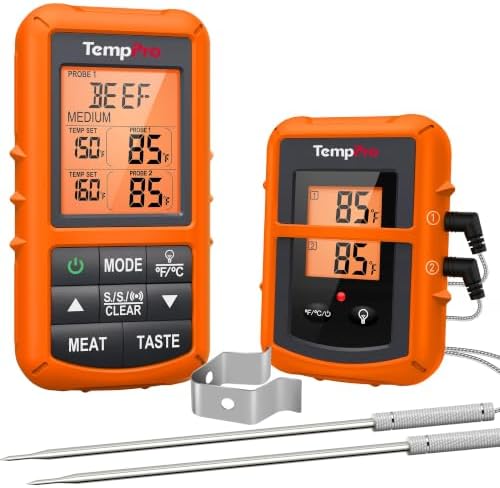
7. TempPro TempSync (TP08S)
Best for: Cooks who do not want an app at all and prefer a handheld receiver with a screen.
Not every wireless thermometer needs a phone. Instead, the TP08S uses a transmitter by the grill and a handheld receiver that you carry. In fact, the link runs over 915 MHz radio, and TempPro lists up to 500 ft in ideal conditions. Because there is no app, there is nothing to pair, update or log in to.
The trade-off, however, is wires. First, the two stainless probes are 8 in long and plug into the transmitter by cable, with about 49 in of total wired length. On the plus side, the range is wide, from 14 to 572 F (-10 to 300 C), and accuracy is plus or minus 1.8 F (1.0 C). So one probe can read the meat while the other reads the pit.
- RF link at 915 MHz (US), up to 500 ft in ideal conditions
- Range: 14 to 572 F (-10 to 300 C); accuracy +/-1.8 F (1.0 C)
- 2 wired stainless probes, 8 in long; about 49 in total wired length
- Backlit receiver LCD shows two temps at once
- Power: 2 AAA batteries each in transmitter and receiver
Pros
- No app, no pairing, no account
- Second probe can track pit temperature
- Runs on cheap AAA batteries
Cons
- Probes are wired to the transmitter
- No IP rating listed
- No phone alerts or cook history
Skip it if: you want a truly cable-free probe or alerts on your phone.
How We Chose the Best Wireless Meat Thermometer Picks
We did not run hands-on tests for this guide. Instead, our picks are research-based. First, we read the spec pages from MEATER, Typhur, CHEF iQ, INKBIRD and TempPro. Next, we compared those numbers with the advice from the USDA Food Safety and Inspection Service on kitchen thermometers. Finally, we weighed common owner feedback about signal drops, app bugs and battery life.
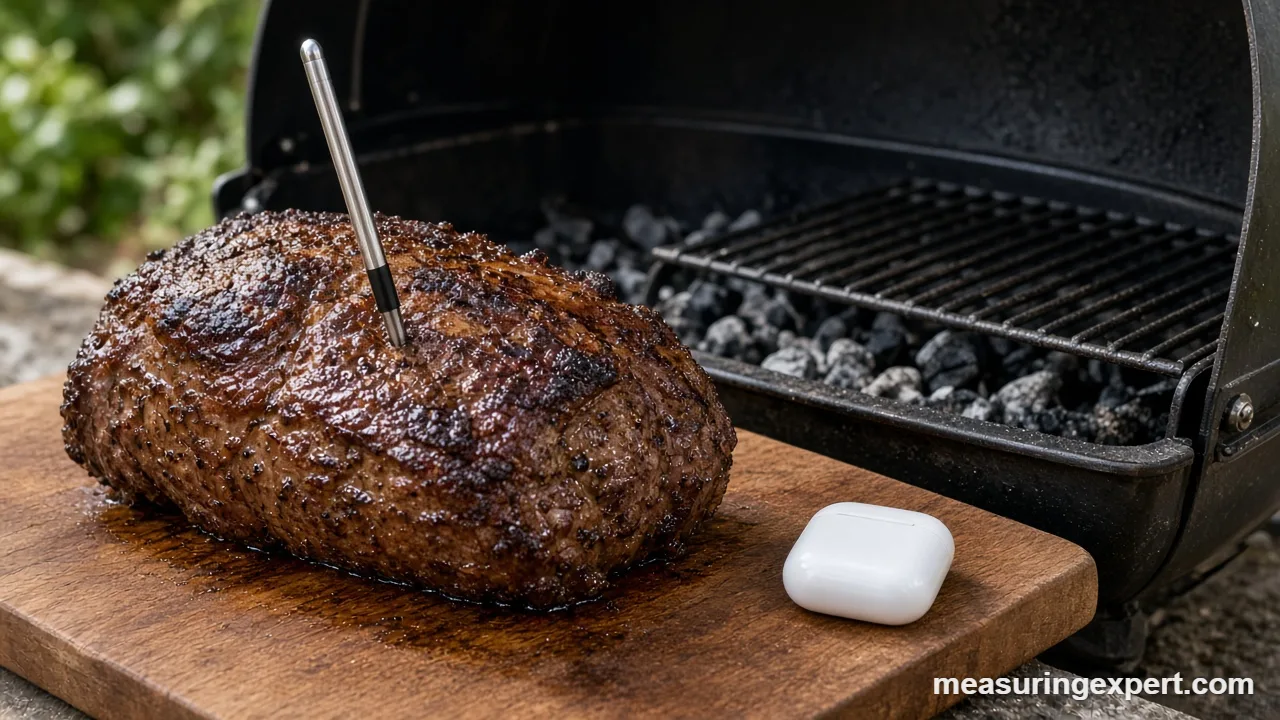
Then, in short, we scored each model on five points:
- Accuracy: a published rating, ideally plus or minus 1 F or better.
- Sensor layout: how many internal sensors each probe has, plus an ambient sensor.
- Real range: stated range, and how the radio copes with a closed grill or oven.
- Heat limits: the internal and ambient ratings for searing, smoking and roasting.
- Ease of use: setup steps, screen or no screen, battery life and cleanup.
Similarly, we left out listings that only sell spare probes or sensors. In addition, we capped each brand at two picks, so the list covers different styles of cook.
Types of Wireless Meat Thermometer Compared
“Wireless” can mean three quite different designs. So, before you compare brands, decide which type suits how you cook.
| Type | How it works | Good for | Watch out for |
|---|---|---|---|
| Truly wireless probe (Bluetooth) | The whole probe goes in the meat; a booster or phone receives the signal | Rotisserie, ovens, smokers with tight lids | Range drops through metal and walls |
| Truly wireless probe + Wi-Fi base | Probes talk to a base; the base joins your home Wi-Fi | Long smokes when you leave the house | Most bases need 2.4 GHz Wi-Fi |
| RF transmitter + wired probes | Wired probes plug into a transmitter that sends to a handheld receiver | No-app cooks and tight budgets | Cables must exit the lid or door |
In practice, the truly wireless probe is the most convenient. However, an RF unit with wired probes can read hotter pit temps, because the electronics stay outside the cooker.
Specs That Matter When You Shop
Therefore, start with the measurement specs, and only then look at the app.
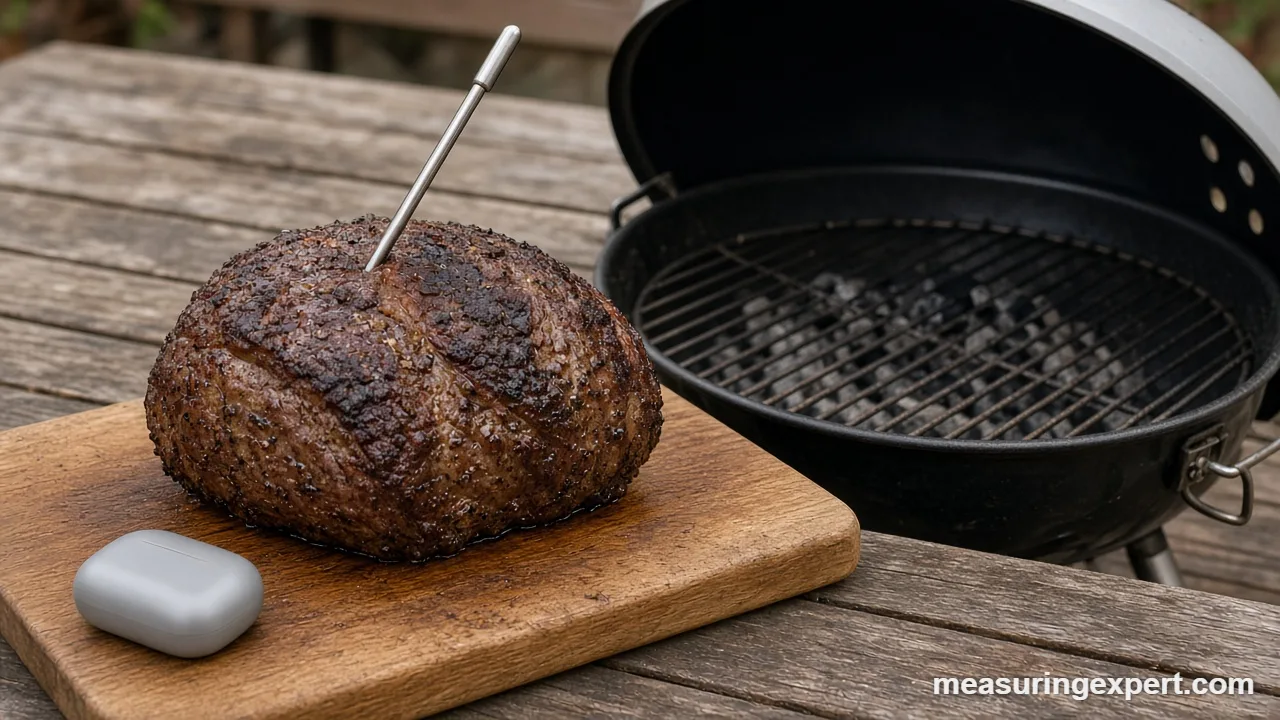
Accuracy and resolution
Accuracy is how close the reading is to the true temperature. For example, +/-1.8 F means a true 145 F could show anywhere from 143.2 to 146.8 F. By contrast, resolution is the smallest step the display shows, often 0.1 or 1 F. However, a fine resolution does not make a probe accurate, so always check the accuracy line.
Internal sensors and ambient sensors
To begin with, the internal sensor reads the food. Meanwhile, the ambient sensor at the handle end reads the air in the cooker. In addition, some probes stack several internal sensors along the shaft. As a result, the app can report the lowest reading, which is usually the true center of the meat.
Temperature limits
Most truly wireless probes cap the internal reading near 212 F (100 C), because the battery sits inside the probe. Meanwhile, the ambient end is rated much higher, from 527 F (275 C) on the MEATER Plus to 1,000 F (537.8 C) on the CHEF iQ Sense. So check both numbers if you sear hot or use a kamado.
Range and radio
Bluetooth range claims assume open air. However, a closed steel grill blocks a lot of signal, so expect less. On the other hand, Sub-1G radio, used by Typhur, travels farther through obstacles. Wi-Fi bases, by contrast, give you alerts anywhere your phone has data.
Water rating and cleanup
First, look for an IP67 or IPX8 rating on the probe if you want to rinse it or use the dishwasher. In addition, check that the base or booster has some splash rating, since grills live outdoors.
USDA Safe Temperatures for Your Best Wireless Meat Thermometer
A thermometer is only useful if you know the target. Fortunately, the USDA FSIS sets safe minimum internal temperatures, also shown on the FoodSafety.gov chart. Below, we list the key ones in Fahrenheit and Celsius.
| Food | Safe minimum (F) | Safe minimum (C) | Rest time |
|---|---|---|---|
| Beef, pork, veal, lamb steaks, chops and roasts | 145 F | 63 C | 3 minutes |
| Fresh or smoked raw ham | 145 F | 63 C | 3 minutes |
| Fish (whole or fillet) | 145 F | 63 C | None |
| Ground beef, pork, veal and lamb | 160 F | 71 C | None |
| Egg dishes | 160 F | 71 C | None |
| All poultry, including ground poultry and stuffing | 165 F | 74 C | None |
| Leftovers and casseroles | 165 F | 74 C | None |
| Precooked ham from a USDA-inspected plant (reheat) | 140 F | 60 C | None |
Note, however, that USDA rounds the Celsius values. For instance, 145 F is exactly 62.8 C, and 165 F is 73.9 C. So if your app or recipe uses the other scale, use the converter below. For oven settings, our Fahrenheit to Celsius baking guide has a full chart.
How to Use a Wireless Meat Thermometer
In fact, placement matters more than the brand. So follow these steps for a true reading.
- First, charge the probe fully and pair it with the app or base before the meat goes on.
- Next, insert the probe into the thickest part of the meat, away from bone, fat and gristle.
- Push it past the safety line so the ambient sensor stays out of the meat.
- Set the alert at the USDA safe minimum for that food, and plan a 3 minute rest for steaks, chops and roasts.
- Then keep the booster, base or phone within range, and avoid placing it behind metal.
- When the alert sounds, confirm the reading in a second spot with an instant-read thermometer.
- Finally, rest the meat as needed, then wash and dry the probe before charging it again.
For whole poultry, check the thigh, the wing joint and the thickest part of the breast. Similarly, insert the probe sideways into thin chops and burgers so the tip reaches the center.
Checking the Accuracy of a Wireless Meat Thermometer
In general, most truly wireless probes cannot be adjusted. Still, you can check them with the USDA ice water test. First, fill a glass with ice and water and stir. Next, submerge at least 2 in of the probe tip without touching the glass, and wait at least 30 seconds. After that, the reading should be 32 F (0 C).
A boiling water check works too, but water boils below 212 F at altitude. So use the ice test as your main check. If a probe reads more than its rated accuracy away from 32 F, contact the maker. For a deeper look at tolerance and error, read our guide to precision in cooking measurements.
Do and Don’t
Honest Limits of Wireless Probes
Even so, the best wireless meat thermometer still has limits. First, range claims are measured in open air, so a thick steel smoker can cut them sharply. Second, finish-time estimates are guesses, because they depend on the cooker staying steady. In addition, a probe that sits too close to the surface reads high and can end a cook early.
Also, internal sensors on truly wireless probes usually top out near 212 F. Therefore, they are not meant for deep frying or candy work. For those jobs, a wired probe or a dedicated instant-read tool from our best food thermometer guide fits better.
Best Wireless Meat Thermometer FAQ
What is the best wireless meat thermometer for most people?
For most home cooks, the TempPro TempSpike Plus is the best pick. It has no cables, up to 600 ft of Bluetooth range and an IP67 probe. Also, it needs no Wi-Fi setup.
How accurate is the best wireless meat thermometer?
Most models are rated between +/-0.5 F and +/-1.8 F. For example, Typhur rates the Sync Gold at +/-0.5 F, while INKBIRD and TempPro list +/-1.8 F. Either is close enough for USDA safe temperatures.
What temperature should meat reach for safety?
USDA FSIS lists 145 F (63 C) with a 3 minute rest for whole cuts of beef, pork, veal and lamb. Ground meats need 160 F (71 C), and all poultry needs 165 F (74 C).
Can I leave a wireless probe in the oven or smoker?
Yes, leave-in use is the whole point. However, keep the ambient end within its rated limit, and never let the handle touch a flame or a hot grate.
Does the best wireless meat thermometer need Wi-Fi?
No. Instead, Bluetooth models like the TempSpike Plus and MEATER Plus work without Wi-Fi. You only need Wi-Fi if you want alerts away from home, and most bases use 2.4 GHz only.
How far can the best wireless meat thermometer reach?
Overall, stated ranges run from about 165 ft for the MEATER Plus to 3,000 ft in open space for the Typhur Sync Gold. In practice, a closed metal grill and house walls cut that distance a lot.
Are wireless meat thermometer probes dishwasher safe?
Many are. For instance, the MEATER Plus, CHEF iQ Sense and INKBIRD INT-14-BW list dishwasher-safe probes. Still, check the manual, and never put a base or charger in the dishwasher unless it is rated for it.
How do I check if my meat thermometer is accurate?
First, use the USDA ice water test. Then submerge at least 2 in of the probe in stirred ice water for 30 seconds, and it should read 32 F (0 C). If it is off by more than its rated accuracy, contact the maker.
Why does my wireless probe read lower than an instant-read thermometer?
Often, the probe may sit off-center, or the instant-read tip may be closer to the surface. So check both in the thickest part, away from bone, and trust the lowest reading.
Is a best wireless meat thermometer worth it over a wired one?
It is if you roast, smoke or use a rotisserie, because there is no cable to pinch in a lid. However, a wired RF model costs less and reads hotter pit temps.
Bottom Line: Our Best Wireless Meat Thermometer Pick
For most cooks, the TempPro TempSpike Plus (TP970) is the best wireless meat thermometer to buy. Above all, it has no cables, a long Bluetooth range and an IP67 probe, and it needs no hub or Wi-Fi setup. However, pick a multi-probe kit for big gatherings, and choose the Typhur if accuracy is your top priority.
3 thoughts on “7 Best Wireless Meat Thermometer Picks for Grilling, Smoking and Roasting”