

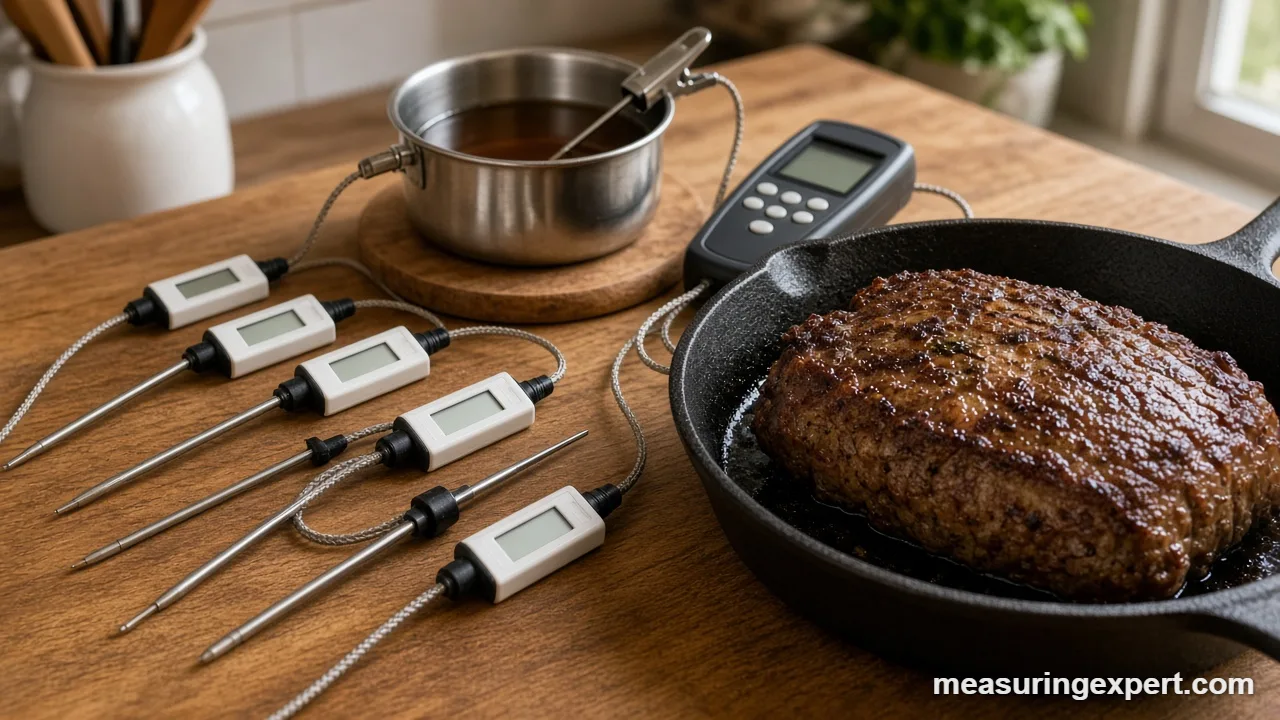
The best temperature probe for most cooks is the ThermoWorks DOT, a leave-in alarm probe with a 47-inch cable and published accuracy of +/-1.8 F. What decides your pick is the job: leave-in roasting, quick spot checks, candy and frying, or pro-grade thermocouple work.
In short: DOT for roasts and smokers, TP16 on a budget, Fluke 52 II for thermocouple precision, and a thin-tip pocket probe for burgers and fish.
As an Amazon Associate, Measuring Expert earns from qualifying purchases. Our picks are based on research, specifications and owner feedback, not paid placement.
Best Overall
Best Budget
Best Pro
Quick Answer: Which Probe Fits Your Job
- Overall: ThermoWorks DOT, a simple leave-in probe with one alarm and a heat-rated cable.
- Budget: ThermoPro TP16, which pairs a leave-in probe with a 99-hour timer.
- Pro and lab work: Fluke 52 II, a dual-input K-type thermocouple meter.
- Food-service logs: Cooper-Atkins DFP450W, with an alarm plus max, min and hold.
- Thin foods: CDN DTT450, whose 1.5 mm tip suits patties and fillets.
- Candy and frying: ThermoPro TempDip, a pot-clip probe that reads up to 572 F.
- Air and ducts: Klein Tools ET05, a pocket probe with min, max and average modes.
On This Page
- Comparison table
- The picks, reviewed
- How we chose
- Thermistor, thermocouple or RTD
- Tolerance classes explained
- Probe styles
- Specs that matter
- Temperature converter
- How to use a probe
- Calibration and care
- Do and don’t
- Honest limits
- FAQ
- Bottom line
Best Temperature Probe Comparison Table
First, scan the table. Then jump to a full review for specs, pros and cons.
| # | Image | Product | Best For | Standout Feature | Amazon |
|---|---|---|---|---|---|
| 1 |  | ThermoWorks DOT | Roasts, smokers and ovens | 47 in cable rated to 700 F | View |
| 2 |  | ThermoPro TP16 (TempTrack CORE) | Budget leave-in cooking | Probe plus 99 h 59 min timer | View |
| 3 |  | Fluke 52 II | Pro, lab and process checks | Two thermocouple inputs with T1-T2 | View |
| 4 |  | Cooper-Atkins DFP450W | Kitchen managers and HACCP | Alarm plus max, min and hold | View |
| 5 | 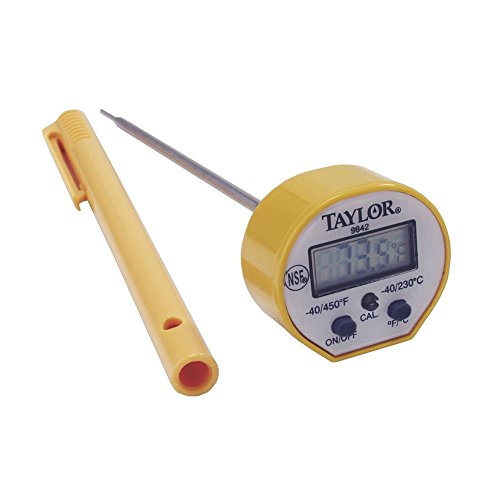 | Taylor 9842 | Line cooks with deep pans | 5 in stem with 1.5 mm tip | View |
| 6 |  | CDN DTT450 ProAccurate | Burgers, fillets and chops | 1.5 mm thin tip, field calibration | View |
| 7 | 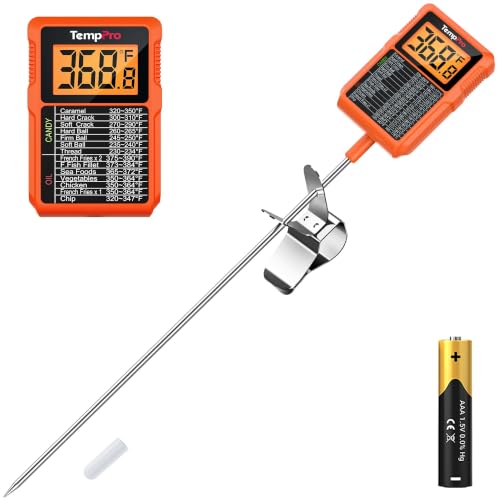 | ThermoPro TempDip (TP510) | Candy, jam and deep frying | Pot clip and IPX5 body | View |
| 8 |  | Klein Tools ET05 | HVAC air and duct checks | Hold, min, max and average | View |
Looking for a fast fold-out model instead? See our guide to the best food thermometer. If you want a cable-free probe that lives inside the meat, read our best wireless meat thermometer picks.
The 8 Best Temperature Probe Picks, Reviewed
Each review lists only specs we could confirm from the maker or a reliable spec sheet; when a number was missing, we left it out.
Best for Leave-In Cooking
1. ThermoWorks DOT
Best for: home cooks who roast, smoke or bake and want one clear alarm when the center of the food hits a target.
The DOT does one job well. You push the penetration probe into the thickest part of the meat, run the braided cable out of the oven, and set a single high alarm. When the food reaches that number, a 70 dB beeper sounds, so the oven stays closed.
ThermoWorks publishes a tiered accuracy spec, which is rare at this level. The DOT reads within +/-1.8 F (+/-1 C) from -4 to 248 F, so it is tight across the whole doneness range for meat. Above 392 F the tolerance widens to +/-5.4 F (+/-3 C). In addition, the cable is rated to 700 F (370 C), while the probe handle is rated to 644 F (340 C).
- Range: -58 to 572 F (-50 to 300 C)
- Accuracy: +/-1.8 F (+/-1 C) from -4 to 248 F
- Probe: 4.5 in (114 mm), tip tapering to 2 mm; cable 47 in (1.2 m)
- Housing: IP65 splash-resistant, excluding the probe jack
- Power: 2 x AAA, rated up to 5,000 hours
Pros
- Accuracy is published for every range band
- Braided cable also handles high heat
- Works with other ThermoWorks Pro-Series probes
Cons
- Only one channel, so one roast at a time
- No timer or app, unlike pricier units
- Probe jack is not sealed against water
Skip it if: you cook several cuts at once and need to watch each one; a multi-channel unit suits that better.
Best Budget
2. ThermoPro TP16 (TempTrack CORE)
Best for: cooks on a budget who want a leave-in probe and a kitchen timer in one device.
First, note that the TP16 is a long-running wired probe, now sold under the TempPro name. Then a stainless probe goes in the roast, and the cable leads to a backlit LCD with a magnet and a stand. ThermoPro lists accuracy of +/-1.8 F (+/-1 C), which matches the DOT on paper. Also, the probe tolerates up to 716 F (380 C), even though the display only reads to 572 F.
The timer counts up to 99 hours and 59 minutes, so it covers a long brisket as well as a short bake. However, the range starts at 32 F, so it will not check a freezer.
- Range: 32 to 572 F (0 to 300 C)
- Accuracy: +/-1.8 F (+/-1 C)
- Probe heat limit: 716 F (380 C)
- Timer: 99 h 59 min count-down and count-up
- Power: 1 x AAA
Pros
- Costs less than most leave-in probes
- Timer and alarm share one unit, so less clutter
- Magnet and stand for easy mounting
Cons
- Range does not go below freezing
- Single probe, so no ambient channel
- Cable can kink at the door seal
Skip it if: you need to verify cold storage; pick a probe that reads below 32 F instead.
Best Pro Thermocouple
3. Fluke 52 II
Best for: technicians, labs, brewers and serious cooks who want a true thermocouple meter that accepts interchangeable probes.
The Fluke 52 II is not a kitchen gadget. Instead, it is a handheld meter with two thermocouple inputs, so you choose the probe for the job: immersion, surface, air or penetration. Also, it reads type J, K, T and E thermocouples. For type K, Fluke lists a range of -200 to 1,372 C, although the practical limit depends on the probe you attach. Meanwhile, the two included 80PK-1 bead probes suit air and general checks.
Accuracy above -100 C is +/-(0.05% of reading + 0.3 C). So at 200 C (392 F), the meter itself adds only about +/-0.4 C (0.7 F). In addition, the T1-T2 mode shows the difference between two points, such as supply and return water. Finally, an electronic offset lets you correct a known probe error.
- Inputs: 2 (T1, T2), types J, K, T, E
- Accuracy: +/-(0.05% + 0.3 C) above -100 C
- Resolution: 0.1 C below 1,000
- Display: backlit dual readout with MIN, MAX, AVG and T1-T2
- Power: 3 x AA, about 1,000 hours typical
Pros
- Accepts any compatible J, K, T or E probe
- Differential T1-T2 readout
- Offset to correct a probe error
Cons
- Included bead probes are not food probes
- Large and costly for casual cooking
- No alarms, unlike the cooking picks
Skip it if: you only cook dinner; a food probe with an alarm is simpler.
Best for Food-Service Logs
4. Cooper-Atkins DFP450W
Best for: kitchen managers who record temperatures and want an alert when food drifts out of range.
This pocket probe adds a temperature alarm plus max, min and hold modes. In addition, Cooper-Atkins rates it at +/-2 F (+/-1 C) with 0.1-degree resolution. That matches the Food Code limit for Fahrenheit food thermometers. Furthermore, its reduced tip reads in under 6 seconds, and the IPX7 body survives a full wash.
It belongs to the maker’s “Accurate for Life” line, which relies on stored calibration rather than a field adjustment.
- Range: -40 to 450 F (-40 to 232 C)
- Accuracy: +/-2 F (+/-1 C); resolution 0.1 degree
- Stem: 4.75 in (121 mm) with a reduced tip
- Rating: IPX7 and NSF listed
Pros
- Alarm sounds when food drifts out of range
- Max, min and hold modes
- Washable IPX7 body
Cons
- Reads slower than a thermocouple
- No field calibration if it drifts, so you replace it
Skip it if: speed matters more to you than logging features.
Best Long Stem
5. Taylor 9842 Waterproof Pocket Probe
Best for: line cooks who need to reach the center of a stockpot or roast but still want a thin tip.
The Taylor 9842 is also a common sight in commercial kitchens. Its 5-inch stem steps down to a 1.5 mm tip, so one probe can reach deep into a hotel pan and still read a thin chicken breast. Also, the case is waterproof and antimicrobial, which helps when you sanitize between checks.
Taylor publishes few accuracy details, so run an ice-point check when it arrives and at the start of each shift.
- Range: -40 to 450 F
- Stem: 5 in with a 1.5 mm step-down tip
- Case: waterproof and antimicrobial
Pros
- Long stem, yet still a thin tip
- Waterproof commercial case
- Widely used in food service
Cons
- Few published accuracy details
- No backlight listed, so dim grills are harder
Skip it if: you need a calibration certificate for audits.
Best Thin Tip
6. CDN DTT450 ProAccurate Thin Tip
Best for: cooks and food handlers who check burgers, fish fillets and chops.
A thin food lacks the depth a thick probe needs. The DTT450 solves this with a 1.5 mm tip, the small diameter that food codes ask for with thin items. In addition, CDN lists a 4-second response and one-button field calibration. As a result, you can reset it after an ice-point test.
On the other hand, the stem is short at 2.75 in (7 cm). It therefore suits skillets and sheet pans better than deep pots.
- Range: -40 to 450 F (-40 to 230 C)
- Tip: 1.5 mm; stem 2.75 in (7 cm)
- Rating: IPX7 and NSF certified
- Power: 1 x LR44 button cell
Pros
- True thin tip for thin foods
- Field calibration button
- Pocket sheath with clip
Cons
- Short stem, so deep pots are awkward
- No backlight
Skip it if: you mostly cook large roasts; a leave-in probe fits that job.
Best for Candy and Frying
7. ThermoPro TempDip (TP510)
Best for: candy makers, jam makers and anyone who deep-fries on the stove.
Sugar syrup and hot oil are immersion jobs, so placement matters. The TempDip clips to the side of the pan, so the tip stays submerged while you stir. ThermoPro lists a range of -58 to 572 F (-50 to 300 C) and accuracy of +/-0.9 F (+/-0.5 C). In addition, the IPX5 rating means you can rinse it under the tap.
Also, keep the tip off the bottom of the pan. Otherwise, it reads the hot metal instead of the syrup or oil.
- Range: -58 to 572 F (-50 to 300 C)
- Accuracy: +/-0.9 F (+/-0.5 C)
- Mount: pot clip for hands-free immersion
- Rating: IPX5; power 1 x AAA
Pros
- Hands-free pot clip
- Tight stated accuracy
- Rinse-safe IPX5 body
Cons
- Reads slower than a thermocouple
- Not a leave-in oven probe, since the base sits on the pot
Skip it if: you need an alarm across the room; a cabled alarm probe suits that.
Best for Air and HVAC
8. Klein Tools ET05
Best for: HVAC techs, electricians and homeowners who check supply air, return air and duct temperatures.
The ET05 is a tradesperson’s air and surface probe, not a food tool. For instance, it has a 3-inch stainless probe, and the sheath doubles as a handle for reaching into vents. Klein rates it at +/-2.7 F (+/-1.5 C) at room temperature. That is looser than the food picks, yet it is fine for comparing air on both sides of a coil. Plus, it adds hold, max/min and average modes with a backlight.
- Range: -40 to 482 F (-40 to 250 C)
- Accuracy: +/-2.7 F (+/-1.5 C) at room temperature
- Probe: 3 in stainless steel with sheath handle
- Functions: hold, max/min, average, backlight
Pros
- Hold, min/max and average modes
- Backlit screen for attics
- Sheath also works as a handle
Cons
- Accuracy is looser than the food models
- No waterproof rating listed
Skip it if: you need Food Code accuracy for kitchen logs.
How We Chose the Best Temperature Probe
To be clear, we did not run hands-on tests. Instead, we compared published specifications, maker manuals, dealer spec sheets and owner feedback. Then we sorted the candidates by job.
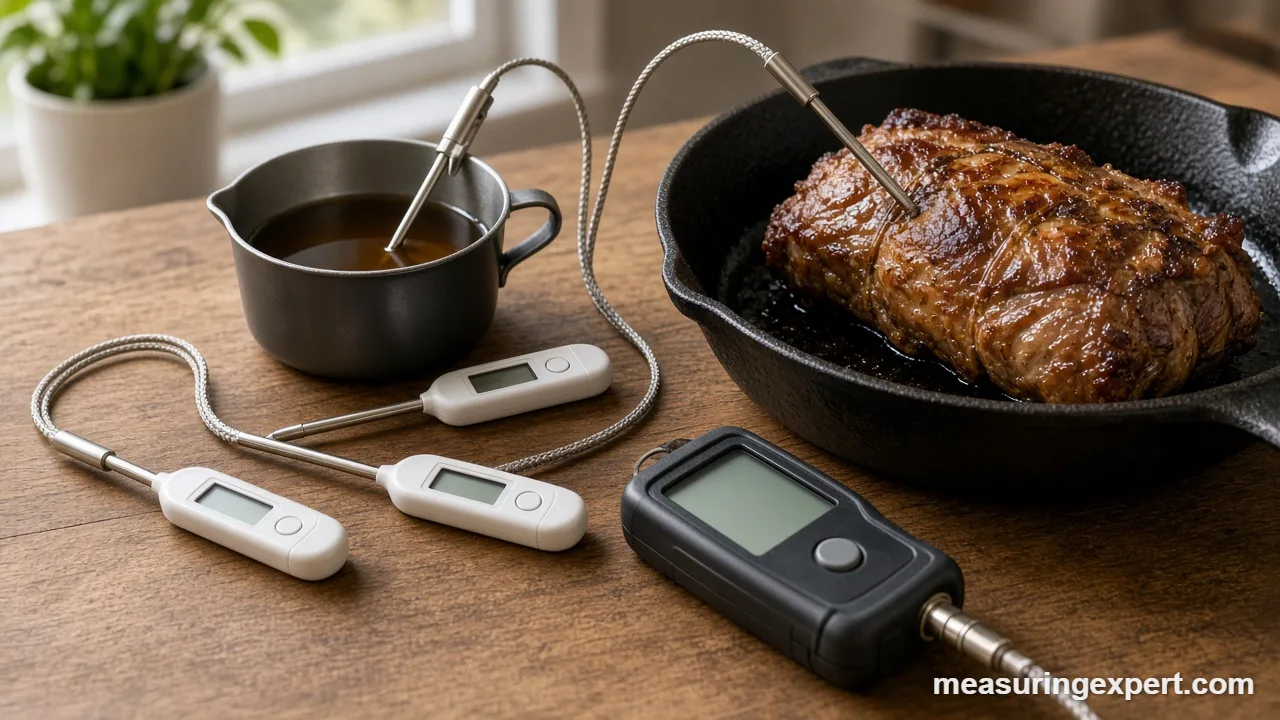
- Published accuracy: we favored makers that state accuracy by range, not just one headline number.
- Right sensor for the job: thermistors for steady food readings, thermocouples for speed and very high heat.
- Probe geometry: tip diameter, stem length and cable heat rating decide where a probe can go.
- Calibration path: an ice-point check should be easy, and a field adjustment is a plus.
- Durability: IP ratings, NSF listings and replaceable probes count in busy kitchens.
Our sources include the USDA FSIS guide to kitchen thermometers, the ThermoWorks DOT spec page and the Fluke 52 II spec sheet.
Thermistor, Thermocouple or RTD: What Sits Inside the Tip
Every temperature probe hides one of three sensors near its tip, and each trades speed, range and stability in a different way.
| Sensor | How it works | Strengths | Weak spots | Typical use |
|---|---|---|---|---|
| Thermistor | Resistance changes sharply with heat | Stable, low cost, good accuracy near food temperatures | Limited top range; slower reads | Leave-in cooking probes, pocket probes |
| Thermocouple (type K) | Two joined metals make a small voltage | Very fast, very wide range, tiny tips possible | Needs good electronics; probe tolerance adds up | Fast food checks, ovens, kilns, HVAC, labs |
| RTD (Pt100) | Platinum resistance rises in a known curve | Most stable and repeatable | Slower, larger and costlier | Labs, process lines, reference checks |
According to the USDA, a thermocouple reads in about 2 to 5 seconds, while a thermistor takes about 10 seconds. Also, both can work for thin and thick foods. Meanwhile, an oven-cord probe stays in the food the whole time, which is why the DOT and TP16 suit roasts.
Data loggers record readings over hours or days for fermentation, cold storage audits and long smokes. Still, a logger is only as good as its probe.
Tolerance Classes and the Best Temperature Probe
Unlike food probes, industrial probes are sold by tolerance class, defined in two standards. Specifically, IEC 60584-1 covers thermocouples, while IEC 60751 covers platinum RTDs. Food probes rarely quote a class, yet the numbers explain why a meter and its probe each add error.
| Sensor and class | Tolerance | Valid range |
|---|---|---|
| Type K, Class 1 | +/-1.5 C, or +/-0.004 x |t| above 375 C | -40 to 1,000 C |
| Type K, Class 2 | +/-2.5 C, or +/-0.0075 x |t| above 333 C | -40 to 1,200 C |
| Pt100, Class A | +/-(0.15 + 0.002 x |t|) C | -30 to 300 C (thin film) |
| Pt100, Class B | +/-(0.3 + 0.005 x |t|) C | -50 to 500 C (thin film) |
Here is a worked example. A Class 1 type K probe at 200 C (392 F) may be off by +/-1.5 C (2.7 F). In comparison, a Class 2 probe may be off by +/-2.5 C (4.5 F). Similarly, a Pt100 Class A sensor at 100 C allows only +/-0.35 C, while Class B allows +/-0.8 C. The class values come from the published IEC 60584 thermocouple tolerance table.
Next, add the meter. The Fluke 52 II adds about +/-0.4 C at 200 C. Therefore, the probe usually dominates the total error. So the offset feature helps: if a probe reads 1 C high, subtract it.
Best Temperature Probe Style: Immersion, Surface or Air
The probe shape matters as much as the sensor inside it.
- Penetration probes have a sharp, often stepped-down tip. So they go into meat, cheese, dough or soil. The DOT, TP16 and the pocket probes are this type.
- Immersion probes sit in liquids such as oil, syrup, brine or water baths. They need enough stem under the surface, so the TempDip uses a pot clip.
- Surface probes have a flat or spring-loaded tip that presses on griddles, pipes and molds.
- Air probes have an open or caged tip that reads air quickly. As a result, they measure pit temperature, oven air and HVAC ducts.
Specs That Decide the Best Temperature Probe
Accuracy and resolution. Accuracy is how close the reading sits to the true value. By contrast, resolution is just the smallest digit on the screen. A display that shows 0.1 F can still be off by 2 F, so always read the accuracy line first. Also, check whether the spec covers your range: the DOT is +/-1.8 F near meat temperatures but +/-5.4 F above 392 F.
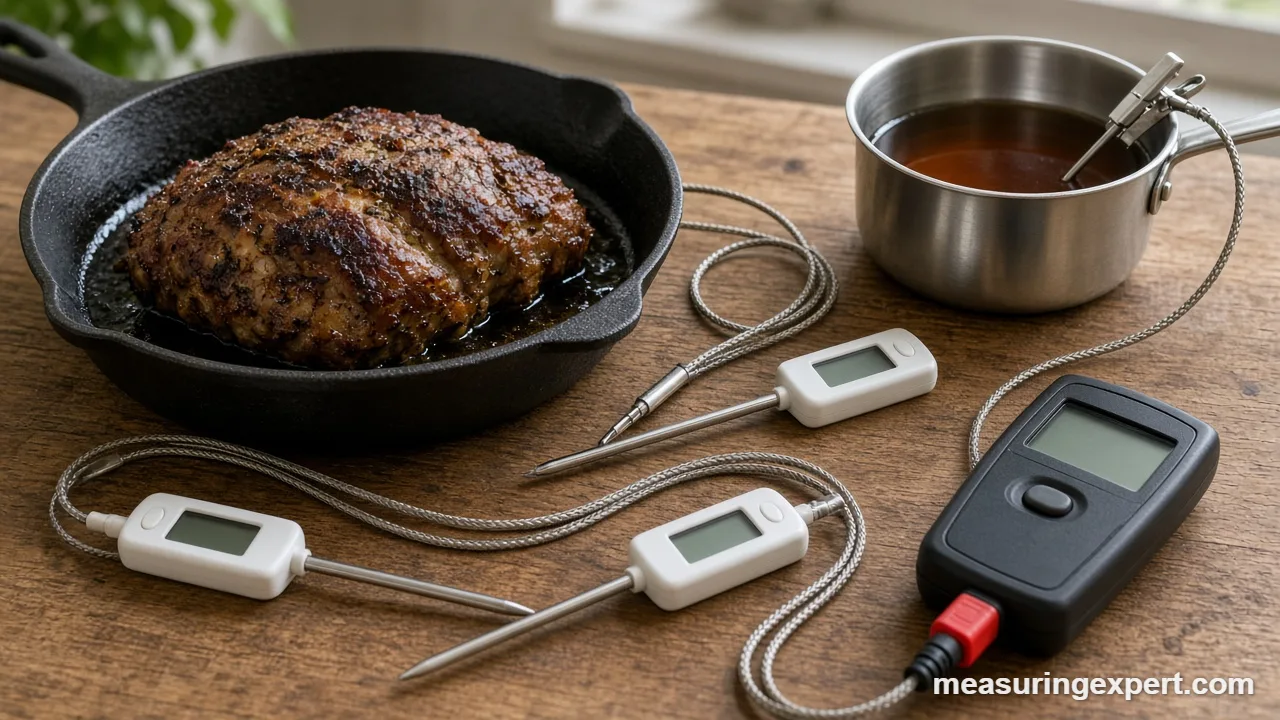
Range and heat ratings. There are three different limits to look for. First, the display range is what the screen can show. Second, the probe rating is how hot the tip and cable can get without damage. Finally, the operating range is where the base unit itself must live, which is often only 32 to 122 F. So never leave the display unit on a hot grill lid.
Tip size and stem length. A thin tip reads thin food and reacts faster. Meanwhile, a long stem reaches the center of a roast or a deep pot. The USDA notes that a thermocouple needs only about 1/4 inch of depth, while a dial needs 2 to 3 inches.
Water resistance and power. IPX7 means the body survives a short dunk, while IPX5 covers rinsing. In addition, look at the probe jack, which is often the weak point.
Temperature Converter for Probe Readings
Most probes switch between F and C, but recipes, lab sheets and spec pages often mix the two. Use this converter to check a reading or a spec limit. For baking temperatures, see our Fahrenheit to Celsius baking guide.
How to Use a Temperature Probe Step by Step
Good technique matters as much as a good probe, so follow these steps for a leave-in or spot-check probe. For a deeper walkthrough, read how to use a digital thermometer for cooking.
- Check the probe in a glass of ice water first; it should read 32 F (0 C) after about 30 seconds.
- Then insert the tip into the thickest part of the food, away from bone, fat and gristle.
- Push thin foods such as patties and chops in from the side, so the sensor reaches the center.
- Route a leave-in cable through the hinge side of the door and keep the base unit away from heat.
- Set the alarm a few degrees below your target, since many foods keep rising as they rest.
- Also confirm the final reading in a second spot on large or uneven foods.
- Finally, wash the probe with warm soapy water, keeping the jack and cable end dry.
For safety targets, the USDA lists 145 F for whole cuts of beef, pork, veal and lamb plus a 3-minute rest, 160 F for ground meats and 165 F for all poultry.
Calibrating and Caring for the Best Temperature Probe
A probe drifts after drops and heat shocks, so test it on a schedule.
- Ice point: fill a glass with ice, add water and stir. Then submerge at least 2 inches of stem without touching the glass. It should read 32 F (0 C).
- Boiling point: use clean, boiling water. At sea level it should read 212 F (100 C), but the boiling point drops as altitude rises.
- Adjust or offset: use the calibration button on models like the CDN DTT450, or the offset on the Fluke 52 II.
- Cable care: avoid sharp kinks and direct flame, because a damaged cable is a common cause of wild readings.
The USDA also notes that oven-cord probes generally cannot be calibrated. In that case, check them in ice water anyway, and replace the probe if it reads off.
Do and Don’t With a Temperature Probe
Do
- Match the probe style to the job: penetration, immersion, surface or air.
- Check the accuracy spec for the range you actually use, not just the headline.
- Keep a spare probe or battery for long cooks, since both can fail mid-smoke.
- Log readings when you cook for groups or customers.
Don’t
- Submerge a probe jack or base unit that has no water rating.
- Let a cable touch a burner, coal bed or broiler element.
- Rest a tip against bone, the pan floor or the pot wall, because metal reads hotter than food.
- Trust a reading before the number stops moving.
Honest Limits of Even the Best Temperature Probe
No probe reads the true temperature of a whole object. Instead, it reads the small zone around its tip. As a result, the outside of a roast can be far hotter than the center.
Next, stated accuracy assumes a steady temperature, so fast-changing oil or a windy grill adds error the spec sheet does not show.
Finally, food probes are not certified lab instruments unless they ship with a calibration certificate.
Best Temperature Probe FAQ
What is the best temperature probe for most home cooks?
For most home cooks, the best temperature probe is a leave-in model with an alarm, such as the ThermoWorks DOT. It stays in the food, so you can watch the reading without opening the oven.
Is a thermocouple or thermistor probe more accurate?
Either can be accurate. However, thermocouples are faster and cover a wider range, while thermistors are stable and affordable near food temperatures. The published accuracy spec matters more than the sensor type.
What does Class 1 mean on a K-type thermocouple?
Under IEC 60584-1, a Class 1 type K thermocouple is within +/-1.5 C from -40 to 375 C. Class 2 allows +/-2.5 C, so Class 1 is the tighter grade.
Can I leave a temperature probe in the oven?
Yes, if it is a leave-in probe with a heat-rated cable, like the DOT or TP16. Keep the base unit outside the oven, and do not exceed the probe or cable heat rating.
How do I know if my best temperature probe is still accurate?
Do an ice-point test. First, submerge at least 2 inches of the stem in stirred ice water for about 30 seconds. It should read 32 F (0 C); if not, adjust or replace it.
What is the difference between an immersion and a surface probe?
An immersion probe sits in a liquid and needs enough stem under the surface. A surface probe has a flat or spring tip that presses on a solid surface, such as a griddle or pipe.
Why does my probe read differently in two spots?
Food heats unevenly, and also the tip reads only a small zone. So check the thickest part and a second spot, and keep the tip away from bone and fat.
Can I use a food probe for HVAC or lab work?
You can for rough checks, but a meter like the Fluke 52 II or an HVAC probe like the Klein ET05 adds hold, min, max and differential modes. Lab work also calls for a probe with a known tolerance class.
How hot can a temperature probe cable get?
It depends on the model. For example, the DOT cable is rated to 700 F, and the TP16 probe tolerates up to 716 F. Check the rating before you use a probe near a broiler or coals.
Do I need a thin-tip probe?
You need one if you cook thin foods such as burgers, fish fillets and chops. A 1.5 mm tip, as on the CDN DTT450 or Taylor 9842, reaches the center of thin food faster.
Bottom Line on the Best Temperature Probe
For most kitchens, the ThermoWorks DOT is the best temperature probe: it is simple, heat-rated and backed by a clear accuracy spec. If money is tight, the TP16 adds a timer for less. Meanwhile, pros who need any probe style should step up to the Fluke 52 II.
Black Friday is coming: shop the deals with Prime
2 thoughts on “8 Best Temperature Probes for Cooking, BBQ and Pro Checks (2026)”