

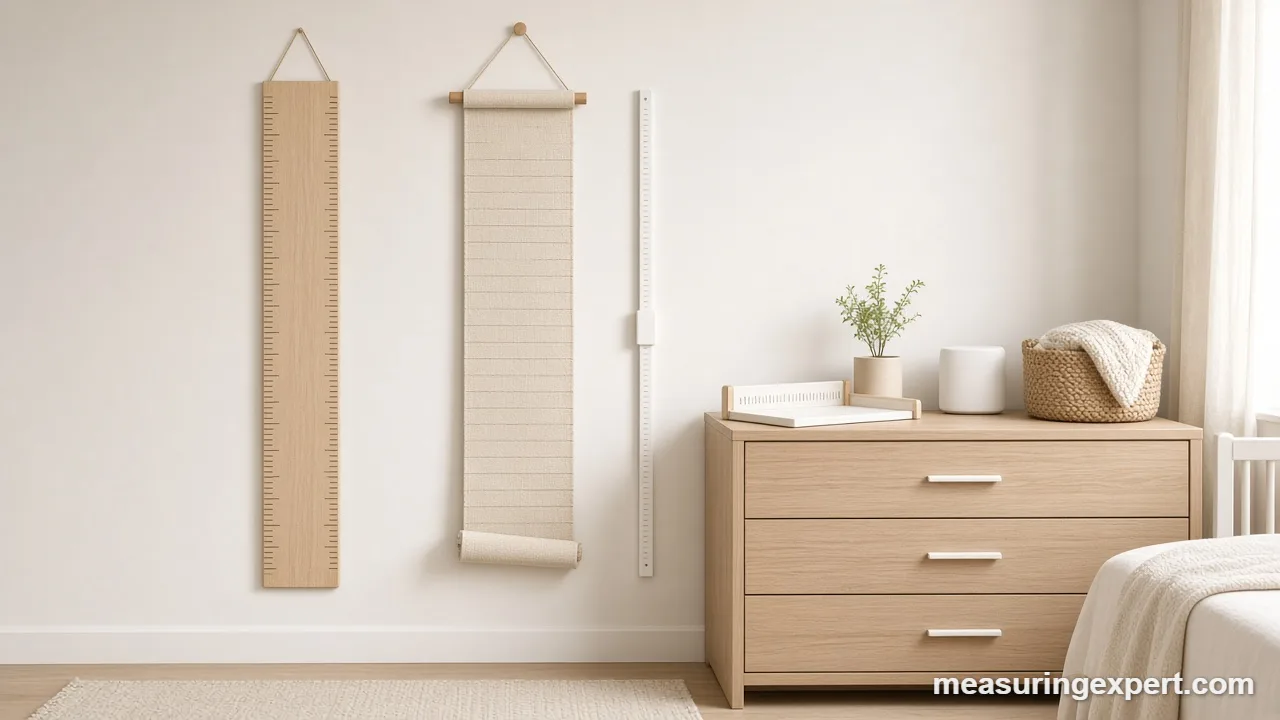
The best child growth chart for most families is the Back40Life wooden ruler, because a rigid board hangs flat and keeps its scale true for years. However, the right pick depends on whether you want a keepsake for the wall, a clinic-grade stadiometer for exact numbers, or a length board for a baby.
In short: hang a Back40Life ruler for memories, pick MIBOTE canvas on a budget, and use a seca 213 stadiometer when the exact number matters.
As an Amazon Associate, Measuring Expert earns from qualifying purchases. Our picks are based on research, specifications and owner feedback, not paid placement.
Best Overall
Best Budget
Best Pro
Quick Answer: The Best Child Growth Chart by Need
- Keepsake wall ruler: Back40Life wooden growth chart ruler.
- Lowest cost and removable: MIBOTE canvas chart, 79 x 7.9 in.
- Room decor with a theme: Headwaters Studio snowboard board.
- Exact readings at home: seca 213 portable stadiometer, 1 mm marks.
- Permanent wall stadiometer: Health o meter 205HR height rod.
- Babies under 2: a seca 416 board or the Hopkins Measure Mat II.
On This Page
- Summary Table
- The Picks, Reviewed
- How We Chose
- Growth Chart Types Compared
- How to Measure Height Accurately
- Height Converter
- Mounting a Wall Chart at the Right Height
- Honest Limits
- FAQ
- Bottom Line
Best Child Growth Chart Picks at a Glance
| # | Image | Product | Best For | Standout Feature | Amazon |
|---|---|---|---|---|---|
| 1 | 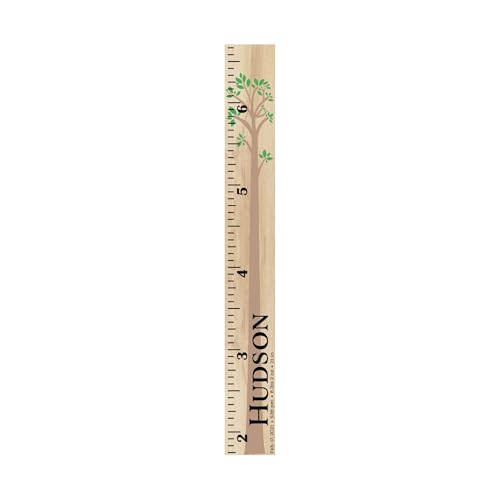 | Back40Life The Hudson Wooden Growth Chart Ruler | Families who want a keepsake ruler that hangs flat and lasts for years | Rigid wood board in a giant-ruler style | View |
| 2 |  | MIBOTE Canvas Growth Height Chart | Renters and new parents who want a light, removable chart | Roll-up canvas, 79 x 7.9 in | View |
| 3 | 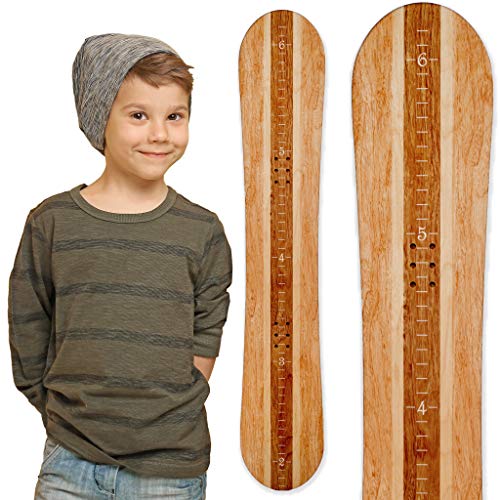 | Headwaters Studio Snowboard Growth Chart | Outdoor families who want a growth chart that doubles as room art | Wood board shaped like a snowboard | View |
| 4 |  | seca 213 Portable Stadiometer | Parents who want clinic-style height readings at home | 1 mm graduation from 20 to 205 cm | View |
| 5 | 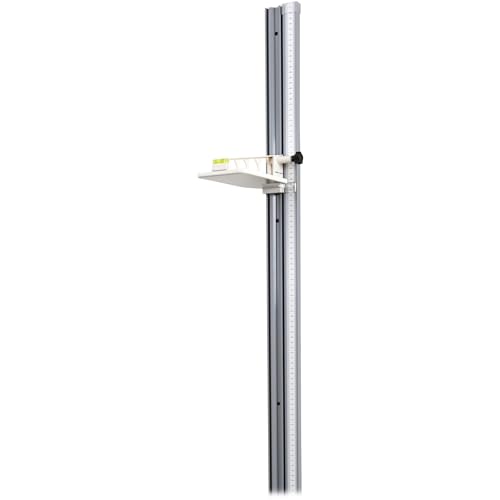 | Health o meter 205HR Wall-Mounted Height Rod | Homes, schools and clinics that want a permanent stadiometer | Fold-down headpiece and 1/16 in marks | View |
| 6 |  | seca 416 Infantometer | Tracking babies under 2 years, who should be measured lying down | Locking foot piece on guide rails | View |
| 7 |  | Hopkins Infant Measure Mat II | Home visits and parents who want a light, packable length mat | Color-coded marks to cut reading errors | View |
The Best Child Growth Chart Options, Reviewed
We grouped the picks from decor charts to medical tools. First come three wall charts, then two stadiometers, and finally two boards for babies who cannot stand yet.
Best Overall
1. Back40Life The Hudson Wooden Growth Chart Ruler
Best for: Families who want a keepsake ruler that hangs flat and lasts for years.
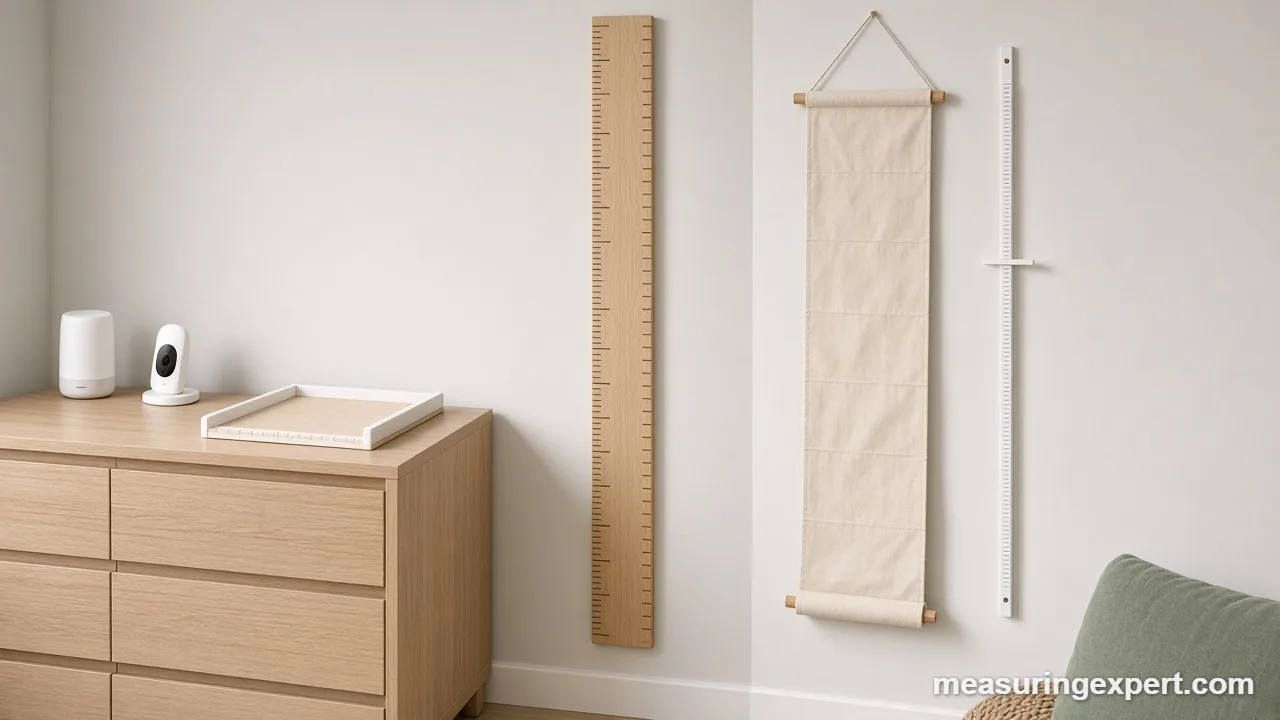
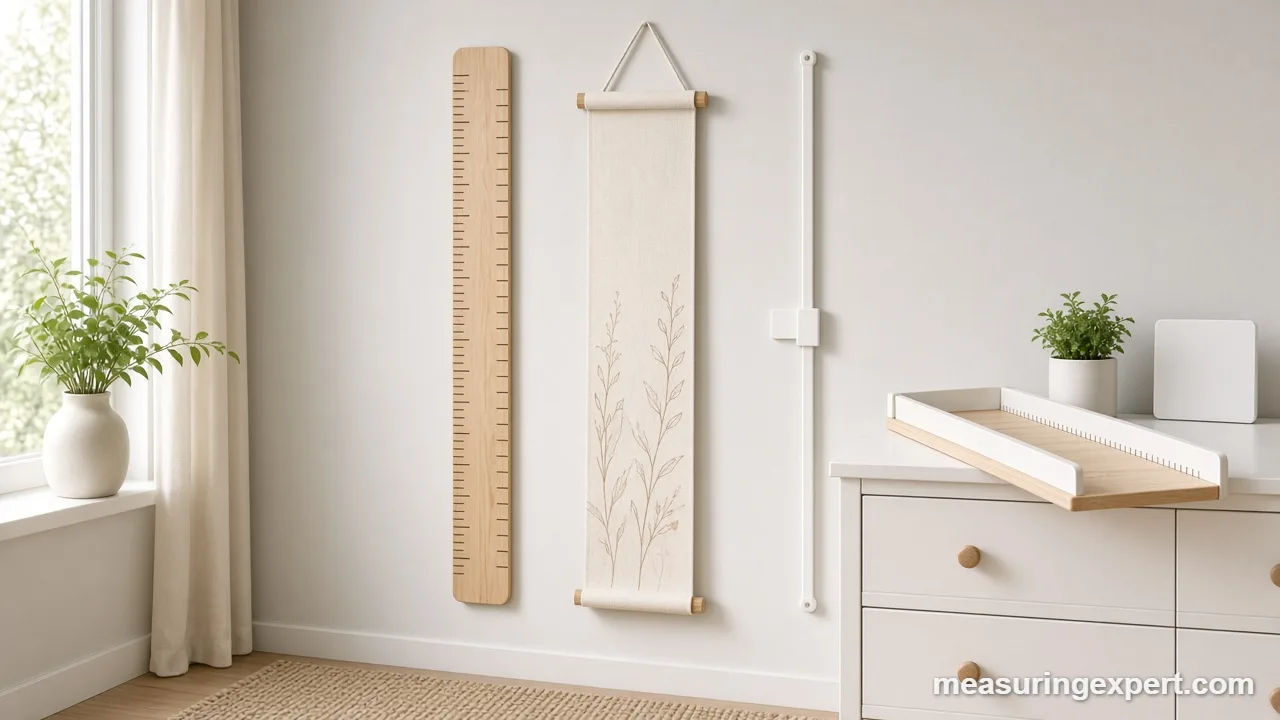
Back40Life makes the classic oversized wooden ruler that many parents picture when they think of a growth chart. This model, The Hudson, is a painted wooden board in that same ruler style. Because the board is rigid, it hangs flat against the wall, so the numbers do not curl, sag or stretch the way fabric can.
However, a wooden ruler chart only reads true if you hang it at the right height. Most boards start their scale above the floor, so you must mount the bottom edge at the offset the maker prints in its instructions. In addition, the brand sells separate vinyl marker kits, which let you label each reading without writing on the wood. If you move house, you simply take the board with you, and every mark comes along.
- Style: solid board shaped like a giant ruler
- Finish: painted wood (The Hudson design)
- Personalized family-name versions sold on the maker site
- Optional vinyl marker kits sold separately
Pros
- Rigid board keeps the scale straight
- Moves with you when you change homes
- Keepsake look that suits most rooms
Cons
- Reads wrong if mounted at the wrong height
- Heavier to hang than canvas
- Few published technical specs
Skip it if: you rent and cannot drill or use heavy-duty hooks on your walls.
Best Budget
2. MIBOTE Canvas Growth Height Chart
Best for: Renters and new parents who want a light, removable chart.
MIBOTE prints its growth chart on canvas with a black-and-white ruler design. The listing gives the size as 79 by 7.9 inches, or about 200.7 by 20.1 cm, so the scale runs long enough for most kids into the teen years. Also, the chart rolls up, which makes it easy to store or pack for a move.
On the other hand, fabric can stretch or hang crooked, and that shifts every reading on it. So treat it as a record of milestones and take the actual number with a flat headpiece and a steel tape, as the CDC advises. In addition, the brand sells the same chart in animal, giraffe and letter prints if black and white feels too plain.
- Size: 79 x 7.9 in (about 200.7 x 20.1 cm), per the listing
- Material: canvas, removable from the wall
- Design: black-and-white ruler print
- Other prints: animal, giraffe and letters
Pros
- Low cost and very light
- Easy to take down and roll up
- Leaves walls in good shape
Cons
- Fabric can sag or stretch over time
- Needs careful leveling when you hang it
Skip it if: you want a chart that will hold its exact height for a decade.
Best Themed Decor
3. Headwaters Studio Snowboard Growth Chart
Best for: Outdoor families who want a growth chart that doubles as room art.
Headwaters Studio turns the growth chart into a piece of themed decor. This one is a wood board cut in the shape of a snowboard, with a blonde finish. The listing gives the size as 56 by 10 inches and 0.25 inch thick, which is about 142.2 by 25.4 cm and 6 mm thick.
Because the board is shorter than a 6 ft ruler, its scale has to start well above the floor. Therefore, you need to mount it at the height the maker specifies before the first mark. Meanwhile, the brand also sells a surfboard version that you can personalize, so siblings can get matching boards in different styles.
- Size: 56 x 10 x 0.25 in (about 142.2 x 25.4 x 0.6 cm), per the listing
- Material: wood, blonde finish
- Shape: snowboard; a surfboard version is also sold
- Mounting: hangs above the floor at a set offset
Pros
- Looks like art, not a measuring tool
- Rigid board keeps marks in place
- Fits ski and board-sport themed rooms
Cons
- Shorter board, so the offset must be exact
- Theme may not suit every room
Skip it if: you prefer a plain ruler look or want a chart that starts at the floor.
Best for Accuracy
4. seca 213 Portable Stadiometer
Best for: Parents who want clinic-style height readings at home.
If you care more about the number than the look, a stadiometer is the right tool. The seca 213 comes from a German maker of medical scales and measuring systems. According to seca, it reads from 20 to 205 cm (8 to 81 in) with a 1 mm (1/8 in) graduation. As a result, it matches the precision the CDC asks for when you record height.
Also, the 213 stands on its own large floor plate, so you do not need to mount anything on the wall. The rod comes apart into sections for storage, and a headpiece slides down to rest flat on the crown. In short, it removes the two biggest home errors: a tilted book and a crooked wall chart.
- Range: 20 to 205 cm (8 to 81 in), per seca
- Graduation: 1 mm (1/8 in)
- Weight: 2.4 kg (5.3 lb)
- Setup: free-standing floor plate, no wall mounting
- Rod splits into sections; carry handle built in
Pros
- Medical-grade precision at home
- No drilling, and it packs away
- Scale reads from the side during use
Cons
- Clinical look, not decor
- Costs much more than a wall chart
Skip it if: you mainly want a keepsake chart for the nursery wall.
Best Wall-Mounted
5. Health o meter 205HR Wall-Mounted Height Rod
Best for: Homes, schools and clinics that want a permanent stadiometer.
The Health o meter 205HR is a wall-mounted height rod made of high-strength polymer. According to distributor CME Corp, its tape reads up to 90 in, or about 228.6 cm, with fine 1/16 in graduations. A headpiece about 8 in deep folds down to rest on the head, so you get a true right angle without a book.
Next, you fix it to the wall with the supplied hardware. Once you mount it at the correct height, it stays calibrated to the floor, and every child in the house can use it. However, it suits a hallway or playroom better than a nursery, since it looks like clinic equipment.
- Tape reads to 90 in (about 228.6 cm), per CME Corp
- Graduation: 1/16 in (about 1.6 mm)
- Body: high-strength polymer, about 55.3 in tall
- Headpiece: about 8 in deep, folds away
- Mounting: wall hardware included
Pros
- Permanent and always ready to use
- Fine 1/16 in markings
- Folding headpiece gives a square reading
Cons
- Needs careful mounting at the right height
- Plain clinical styling
Skip it if: you cannot drill into your walls.
Best Infant Length Board
6. seca 416 Infantometer
Best for: Tracking babies under 2 years, who should be measured lying down.
Babies under two years old are measured lying down, not standing. For that job, the seca 416 is a rigid length board with a trough-shaped bed and raised sides. According to seca, it reads from 33 to 100 cm (13 to 39 in) with a 1 mm (1/16 in) graduation.
In addition, the foot piece rolls on two guide rails and locks in place. So you can lift a wriggly baby off the board first and read the length afterward. On the other hand, the board weighs 3.8 kg (8.3 lb) and measures about 43 in long, so it needs a table and some storage space.
- Range: 33 to 100 cm (13 to 39 in), per seca
- Graduation: 1 mm (1/16 in)
- Size: 43.4 x 6.7 x 15.8 in; weight 3.8 kg (8.3 lb)
- Locking foot piece; for babies up to 2 years
Pros
- Rigid board gives repeatable lying length
- Lock lets you read after the baby moves
- Raised sides help keep the baby straight
Cons
- Bulky for a small apartment
- Outgrown at about age two
Skip it if: your child already stands steadily on their own.
Best Roll-Up Infant Mat
7. Hopkins Infant Measure Mat II
Best for: Home visits and parents who want a light, packable length mat.
Hopkins Medical Products makes this flexible mat for measuring babies lying down. According to the MDMaxx spec sheet, it reads up to 39 in (99 cm) in 1/8 in steps, in both inches and centimeters. It weighs about 21 oz (595 g), so it rolls up and slips into a bag.
Also, the markings are color coded and tied to symbols, which the maker says reduce reading errors. Instructions in English, French and Spanish are printed on the mat. Still, a soft mat lacks the fixed foot stop of a rigid board, so two people make the job much easier.
- Range: up to 39 in (99 cm)
- Graduation: 1/8 in; inch and cm scales
- Size: about 4 ft 4.5 in x 12 in (135 x 31 cm)
- Weight: about 21 oz (595 g); antimicrobial surface
Pros
- Light and easy to pack
- Color-coded marks are easy to read
- Wipes clean between uses
Cons
- Flexible mat can shift on soft surfaces
- Coarser 1/8 in steps than a seca board
Skip it if: you want a rigid board with a locking foot piece.
How We Chose the Best Child Growth Chart
We did not test these products by hand. Instead, our picks are research-based. We compared maker spec pages, distributor spec sheets, product listings and patterns in owner feedback. We also checked each tool against the measuring method the CDC describes for measuring children at home.
Here is what we weighed:
- Scale accuracy: a graduation of 1/8 in or 1 mm or finer, since that is the level the CDC asks you to record.
- Stability: rigid boards and rods that will not sag, stretch or tilt over the years.
- Range: enough height to follow a child from toddler to teen, or the right span for infant length.
- Ease of use: a clear zero point, readable numbers and a way to get a square reading at the crown.
- Brand track record: established makers, with no more than two products per brand.
For example, the stadiometer specs come straight from the seca 213 product page and the matching seca 416 page. Where a maker did not publish a figure, we left it out rather than guess.
Best Child Growth Chart Types Compared
Not every height tool does the same job. So before you choose the best child growth chart for your family, decide whether you want memories, precision or both.
| Type | Typical precision | Strength | Weak point |
|---|---|---|---|
| Wooden ruler chart | Usually 1/4 to 1 in marks | Rigid, keepsake, portable between homes | Must hang at the exact offset |
| Canvas or fabric chart | Usually 1/4 to 1 in marks | Cheap, light, renter friendly | Can stretch, sag or hang crooked |
| Wall-mounted stadiometer | 1/16 to 1/8 in (1 to 3 mm) | Fixed zero point and square headpiece | Needs drilling; clinical look |
| Portable stadiometer | 1 mm (1/8 in) | Free-standing, no wall needed | Takes space when set up |
| Infant length board or mat | 1 mm to 1/8 in | Measures babies lying down | Outgrown at about age two |
Decor charts and medical tools often work best together. For instance, many parents take the reading with a stadiometer or a flat book and a steel tape, then copy the mark onto the decorative chart.
How to Measure Height Accurately at Home
The steps below follow the method the CDC gives for home measuring. As a result, your numbers will be close to what a clinic would record.
- Prepare your child. Remove shoes, bulky clothes, hats and hair clips, and undo any hairstyle that sits on top of the head.
- Pick the right spot. Stand on a firm floor such as tile or wood, not carpet, next to a flat wall with no baseboard molding in the way.
- Set the posture. Have your child stand with feet flat and together, legs straight, arms at the sides, shoulders level and eyes looking straight ahead.
- Check the contact points. Ideally the head, shoulders, buttocks and heels touch the wall, although body shape means not all of them always do.
- Lower a flat headpiece. Hold a rigid ruler or hardback book against the wall at a right angle and lower it until it rests firmly on the crown.
- Mark and measure. Lightly mark where the headpiece meets the wall, then measure from the floor to the mark with a metal tape measure.
- Record the result. Write down the height to the nearest 1/8 inch or 0.1 cm, along with the date.
For babies under two, use a length board or mat instead. In that case, one adult holds the head against the fixed head piece while a second adult straightens the legs and slides the foot piece up to the heels.
Height Converter: Inches to Centimeters
Wall charts often show inches, while pediatric growth charts and seca tools use centimeters. So use this converter to switch between them before you plot a reading.
Mounting the Best Child Growth Chart at the Right Height
A wall chart is only as accurate as its mounting. Most wooden and canvas charts do not start at zero. Instead, the lowest number printed on the chart sits some distance above the floor, so the bottom edge must hang at exactly that offset.
First, find the offset in the maker instructions, or read the lowest number on the scale. Next, measure up from the floor with a steel tape and mark that height on the wall. Then hold the chart so the matching number lines up with your mark, and check it with a level before you fix it in place.
Also, measure from the floor itself, not from the top of a baseboard. Finally, double-check the setup by measuring an adult with both the chart and a steel tape. If the two numbers differ by more than 1/4 in (about 6 mm), adjust the chart.
Care and Calibration Tips
- Recheck the mount yearly: screws loosen and fabric stretches, so compare the chart with a steel tape now and then.
- Keep canvas dry: humidity can warp fabric charts, which shifts the scale.
- Wipe stadiometers gently: use a soft cloth so the printed scale does not wear off.
- Store infant boards flat: a bent board or creased mat gives short readings.
- Write down every reading: a dated log matters more than the mark on the wall.
Do and Don’t When You Measure
Honest Limits of Even the Best Child Growth Chart
Even the best child growth chart cannot tell you whether your child is growing normally. A pediatrician plots height on standard growth curves, together with weight and, for babies, head size. So use your chart as a record and a conversation starter, not as a diagnosis.
In addition, small differences between home readings are normal. For example, a change of 1/4 in can come from posture alone. Therefore, look at the trend over several months rather than a single number. To round out the picture, you can track weight with one of the picks in our best baby scale guide and head size with a tape from our best head circumference tape roundup. Meanwhile, for waist and body sizes, our body measuring tape picks cover flexible tapes.
Frequently Asked Questions
What is the best child growth chart for accurate readings?
For accuracy, a stadiometer such as the seca 213 is the best child growth chart choice, because it reads to 1 mm and uses a flat headpiece. By contrast, decorative wall charts work well for memories but depend on careful mounting.
How high should I hang a growth chart?
Hang it so the lowest number on the scale sits at that exact height above the floor. Most charts start above zero, so measure the offset from the floor with a steel tape and check the result with a level.
Is a canvas chart the best child growth chart for renters?
Yes, canvas charts are light and removable, so they suit renters. However, fabric can stretch or sag over time. So take the real reading with a flat headpiece and a steel tape, then copy the mark onto the chart.
How often should I measure my child?
Every few months is enough for a home record, for example on birthdays and half birthdays. Your pediatrician will also measure height at regular well-child visits.
Why do babies get measured lying down?
Children under two years old usually cannot stand straight and still, so they are measured for length while lying on a board. As a result, infant length is often a bit longer than standing height at the same age.
Should my child wear shoes when measured?
No. Shoes, hats, thick socks and hair clips all add height, so the CDC advises removing them before you measure.
Is the best child growth chart also a good gift?
Yes, a personalized wooden ruler such as the Back40Life chart makes a popular baby shower or birthday gift. Even so, check that it includes clear mounting instructions.
Can I move a wooden growth chart to a new house?
Yes. That is the main advantage of a board over pencil marks on a door frame. Just remount it at the same offset so the old marks stay correct.
How precise should a home height reading be?
The CDC asks you to record height to the nearest 1/8 inch or 0.1 cm. However, small changes of a quarter inch can come from posture, so look at the trend over time.
Can a growth chart replace a pediatric checkup?
No. A chart only records height, while a pediatrician compares height, weight and other signs against standard growth curves. Use the chart as a record to share at checkups.
Bottom Line: Our Best Child Growth Chart Pick
For most families, the Back40Life The Hudson Wooden Growth Chart Ruler is our top pick, because a rigid board hangs flat, moves with you and turns height checks into a keepsake. However, if you want the exact number, pair it with a seca 213 stadiometer, or use a seca 416 board while your child is still a baby.
Black Friday is coming: shop the deals with Prime
1 thought on “Best Child Growth Chart Picks for 2026: Wall Rulers, Stadiometers and Infant Boards”