

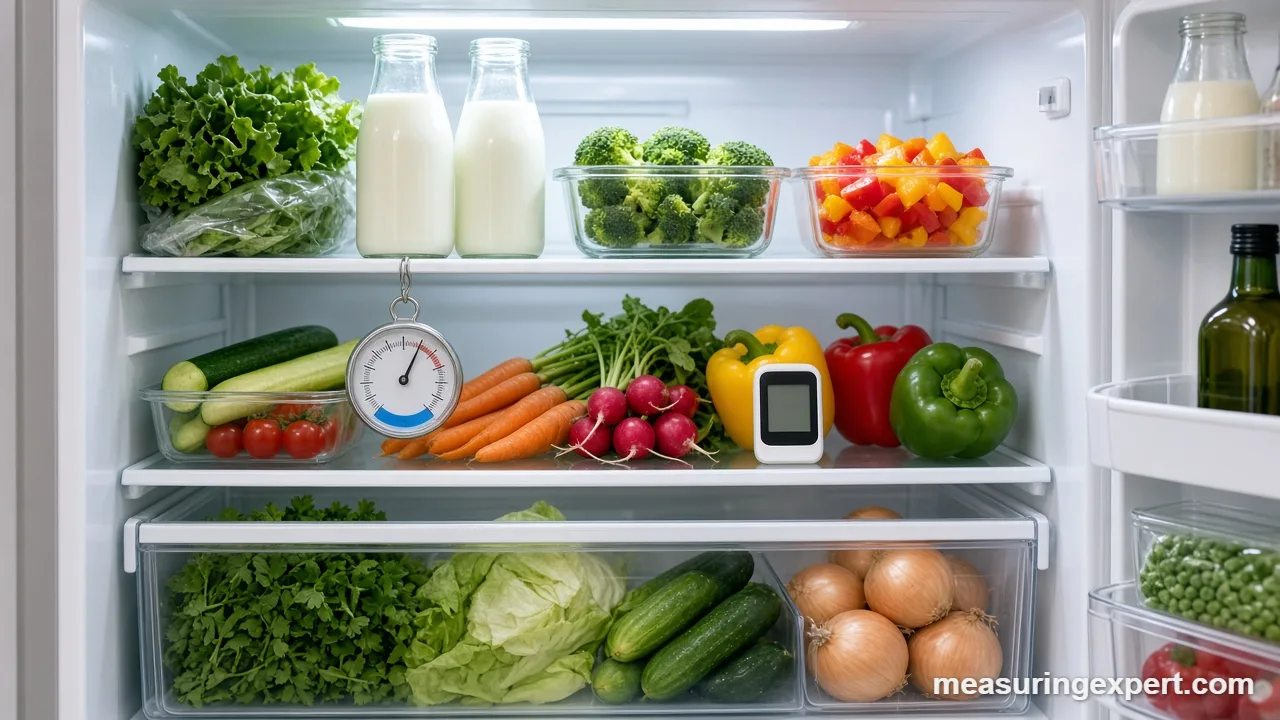
The best refrigerator thermometer for most homes is the AcuRite 00515M, because two wireless sensors watch the fridge and freezer at once and sound an alarm when either drifts. Your choice comes down to type: dial, digital or wireless, plus range, accuracy and whether you need alerts away from home.
In short: get the AcuRite 00515M for everyday use, the TempPro TempAir pair on a budget, and the Traceable 4548 when you need a certified, buffered probe.
As an Amazon Associate, Measuring Expert earns from qualifying purchases. Our picks are based on research, specifications and owner feedback, not paid placement.
Best Overall
Best Budget
Quick Answer: The Best Refrigerator Thermometer for Your Kitchen
- Most homes: AcuRite 00515M, with fridge and freezer sensors and alarms.
- Tight budget: TempPro TempAir 2-Pack, a backlit digital pair.
- Clinics and labs: Traceable 4548, with a glycol bottle probe and certificate.
- No batteries: Taylor 5924 or the tougher Rubbermaid FGR80DC dial.
- Phone alerts: GoveeLife WiFi H5108 for remote monitoring.
- Mini fridges: Geevon Small 2-Pack, compact and IP65 rated.
- Loud local alarm: GoveeLife Bluetooth H5111 with an 80 dB buzzer.
On This Page
- Comparison table
- The 8 picks, reviewed
- How we chose
- Dial vs digital vs wireless
- Safe fridge and freezer temperatures
- Specs that matter
- How to place and check it
- Accuracy checks and care
- Honest limits
- FAQ
- Bottom line
Best Refrigerator Thermometer Picks Compared
| # | Image | Product | Best For | Standout Feature | Amazon |
|---|---|---|---|---|---|
| 1 | 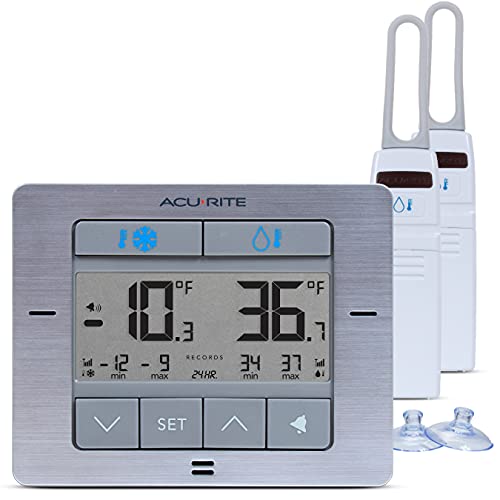 | AcuRite 00515M | Home kitchens that want both compartments on one screen | Two wireless sensors with high and low alarms | View |
| 2 |  | TempPro TempAir 2-Pack | A cheap digital pair for fridge and freezer | Backlit LCD with a 24-hour max and min record | View |
| 3 |  | Traceable 4548 Jumbo | Clinics, labs, vaccine and medicine storage | Glycol bottle probe with a NIST-traceable certificate | View |
| 4 | 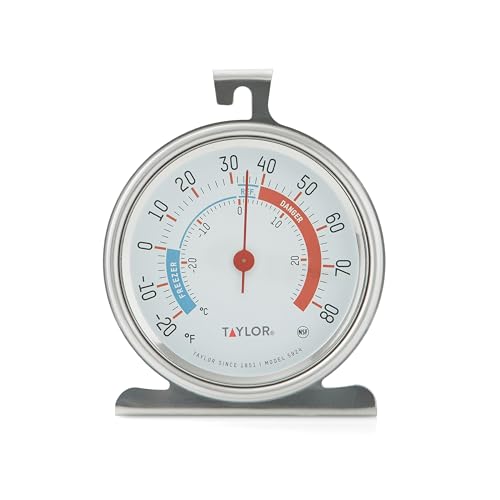 | Taylor 5924 Dial | A battery-free check that works anywhere | Large stainless dial with safe-zone markings | View |
| 5 |  | Rubbermaid FGR80DC | Restaurant walk-ins and reach-in coolers | NSF-listed stainless dial with a shatter-resistant lens | View |
| 6 |  | GoveeLife WiFi H5108 | Remote phone alerts for several fridges and freezers | App alerts, LCD on each sensor and 2 years of data export | View |
| 7 |  | Geevon Small 2-Pack | Mini fridges, coolers and crowded door shelves | IP65 housing in a small body with a max and min reset | View |
| 8 |  | GoveeLife Bluetooth H5111 | A local buzzer plus app history, without Wi-Fi | 80 dB buzzer on each sensor and a -40 to 158 F range | View |
The 8 Best Refrigerator Thermometer Options, Reviewed
Best Overall
1. AcuRite 00515M Wireless Fridge and Freezer Thermometer
Best for: Households that want to watch the fridge and the freezer at the same time, without opening either door.
The AcuRite 00515M is our pick for the best refrigerator thermometer for most homes. Also, it pairs one display with two wireless sensors, one for the fridge and one for the freezer. As a result, you read both compartments from the counter, and the cold air stays inside.
In addition, each sensor has its own minimum and maximum alarm. The manual sets the defaults at 33 to 40 F for the fridge and -20 to 32 F for the freezer, and you can change them. An alert only fires after a reading stays out of range for more than 5 minutes, so a quick door opening will not set it off. Finally, the display shows a rolling 24-hour high and low, and you can add a calibration offset if an ice-water check shows a small error.
- Sensor range: -40 to 99 F (-40 to 37.2 C)
- Wireless: 433 MHz, up to 75 ft (23 m); sensors report every 60 seconds
- Alarms: programmable high and low for each sensor, with a 5-minute delay
- Memory: rolling 24-hour high and low, plus all-time records
- Power: 3 AA in the display; AA in each sensor (lithium for the freezer below -4 F)
Pros
- Watches fridge and freezer at once
- Alarm delay cuts false alerts
- Also allows a calibration offset
Cons
- However, there is no phone app
- Display must sit in a room between 32 and 122 F
- Walls and metal shorten the 75 ft range
Skip it if: You want alerts on your phone while you are away; a Wi-Fi model such as the GoveeLife set does that.
Best Budget
2. TempPro TempAir TP110 Fridge Thermometer, 2-Pack
Best for: Budget buyers who want a clear digital number in both compartments and a backlight for dim shelves.
TempPro is the newer name for ThermoPro, and the listing notes that either brand may ship. The TempAir comes as a pair, so one unit goes in the fridge and one in the freezer. Also, its large LCD has a backlight, which helps on a dark lower shelf.
In addition, each unit stores the high and low of the past 24 hours. The IPX6 housing handles splashes and condensation, and you can stand it on a shelf, stick it to metal or hang it from a rack. However, the range stops at -4 F (-20 C). That is fine for a home freezer near 0 F, but it is too narrow for a deep chest freezer set colder than that.
- Range: -4 to 122 F (-20 to 50 C)
- Display: large backlit LCD
- Memory: high and low for the past 24 hours
- Housing: IPX6 water resistant
- Mounting: stand, magnet or hook; batteries included
Pros
- Two units for the price of a pair of dials
- Backlight helps on dim shelves
- Also easy to mount three ways
Cons
- However, no alarm
- Range bottoms out at -4 F
- Spec listings state accuracy differently, so check it in ice water
Skip it if: Your freezer runs below -4 F or you need an audible alarm.
Best Pro
3. Traceable 4548 Jumbo Fridge/Freezer Thermometer
Best for: Clinics, pharmacies, labs and serious home users who need a documented reading and a probe that ignores door-opening spikes.
The Traceable 4548 is built for logbooks, not just kitchens. Its sensor sits inside a small bottle of glycol, so the reading follows the temperature of the stored product rather than the air that rushes in when the door opens. In addition, the probe hangs on a 10 ft cable, so the jumbo display stays outside the unit.
In addition, each unit ships with a serial-numbered certificate from an ISO 17025 lab accredited by A2LA, with traceability to NIST standards. It also shows the current, minimum and maximum probe readings at once, and its alarm triggers above or below a set point you choose in 1 degree steps.
- Range: -58 to 158 F (-50 to 70 C); resolution 0.1 degree
- Accuracy: +/-1 C (about +/-1.8 F)
- Probe: solid-state sensor in a 1 x 2.5 in glycol bottle on a 10 ft cable
- Display: 1.5 in digits; min, max, probe and room readings
- Calibration: individually serial-numbered Traceable certificate
Pros
- Glycol bottle buffers door-opening spikes
- Calibration certificate included
- Also readable from across a room
Cons
- However, it costs far more than a home dial
- Cable must pass the door seal
- Certificate will eventually need renewing for regulated use
Skip it if: You only need a quick weekly check of a home fridge; a dial or a basic digital unit is enough.
Best Dial
4. Taylor 5924 Classic Dial Fridge/Freezer Thermometer
Best for: Anyone who wants a simple analog fridge thermometer with no batteries, buttons or settings.
A dial thermometer is the classic way to check a fridge, and the Taylor 5924 is a strong example. It has a stainless steel case, a glass lens and a dial face of about 3 in, which is large for this type. Also, its colored zones flag the safe ranges, so a quick glance tells you whether to act.
Because it needs no power, it keeps working during an outage. Also, it reads -20 to 80 F, and it can hang from a wire shelf or stand on its own. However, a dial has coarse markings, so it suits a pass-or-fail check better than a precise log.
- Range: -20 to 80 F
- Dial: about 3 in face; stainless case with glass lens
- Mounting: hangs or stands
- Listed as NSF certified
- Power: none needed
Pros
- No batteries, so it works in a power cut
- Large, easy-to-read face
- Also NSF listed for food service
Cons
- However, coarse graduations
- No min or max memory
- Glass lens needs care
Skip it if: You want a decimal reading or a record of overnight swings.
Best Commercial Dial
5. Rubbermaid Commercial FGR80DC Monitoring Thermometer
Best for: Restaurants, food trucks and busy home kitchens that want a tough dial that shrugs off knocks.
Rubbermaid Commercial lists the FGR80DC under NSF Standard 2 for food equipment, and the case is stainless steel. Unlike the Taylor, its lens is shatter-resistant, so it is a safer choice near open food in a busy kitchen.
Similarly, it reads -20 to 80 F (-30 to 30 C) on a dual scale, and it hangs or stands. In addition, Rubbermaid backs it with a 3-year limited warranty.
- Range: -20 to 80 F (-30 to 30 C), dual scale
- Build: stainless steel with a shatter-resistant lens
- Listed under NSF Standard 2
- Mounting: hangs or stands
- Warranty: 3-year limited
Pros
- Tough, shatter-resistant build
- NSF listed for food service
- Also no batteries to replace
Cons
- However, no memory or alarm
- Coarse dial markings
- No accuracy figure on the maker page
Skip it if: You need alarms or a recorded history for inspections.
Best Smart
6. GoveeLife WiFi H5108 Fridge Thermometer, 4-Pack
Best for: People with a garage freezer, a beverage fridge or a rental unit who want a phone alert when a temperature drifts.
Each GoveeLife H5108 sensor has its own LCD and a wired probe, so you can read it on the spot and also check it in the app. However, remote alerts and history run through Govee’s Wi-Fi gateway (model H5151), which links up to 10 sensors and connects on 2.4 GHz Wi-Fi only.
A delay of 1 to 10 minutes keeps a quick door opening from triggering an alert. In addition, Govee lists +/-0.9 F (+/-0.5 C) accuracy and a -40 to 158 F range, so it covers a deep freezer too. For more app-based options, see our smart thermometer guide.
- Range: -40 to 158 F; accuracy +/-0.9 F (+/-0.5 C)
- Alerts: app push alerts with a 1 to 10 minute delay
- Gateway: H5151, 2.4 GHz Wi-Fi, up to 10 sensors
- Data: graphs and export for the past 2 years
- Power: 2 AAA per sensor; magnetic back
Pros
- Alerts reach you away from home
- Wide range covers deep freezers
- Also two years of exportable history
Cons
- However, 2.4 GHz Wi-Fi only
- Remote features depend on the gateway
- More setup than a plain dial
Skip it if: You do not want an app or a Wi-Fi device in the kitchen.
Best Compact
7. Geevon Small Digital Fridge Thermometer, 2-Pack
Best for: Anyone with a mini fridge, a wine cooler or a packed fridge door where a big dial will not fit.
The Geevon Small is a compact digital unit sold as a pair. It reads -22 to 122 F (-30 to 50 C), and three buttons handle power, the C and F toggle, and a max and min reset.
Its IP65 housing resists spray and condensation, so it copes with a damp crisper or a cooler full of ice melt. In addition, a magnet, a stand and a hook give you several ways to place it. Geevon lists +/-2 F accuracy, which is fine for a safety check but looser than the AcuRite or Govee.
- Range: -22 to 122 F (-30 to 50 C)
- Accuracy: +/-2 F (as listed)
- Housing: IP65
- Buttons: power, C and F, max and min reset
- Mounting: magnet, stand or hook
Pros
- Small enough for mini fridges
- IP65 handles condensation
- Also reaches -22 F for deeper freezers
Cons
- However, looser +/-2 F accuracy
- No backlight or alarm
- Small digits are harder to read from afar
Skip it if: You want a backlit screen or an alarm; the TempPro or AcuRite fit better.
Best Loud Alarm
8. GoveeLife Bluetooth H5111 Fridge Sensor, 2-Pack
Best for: People who want a loud local alarm and phone graphs at home, with Wi-Fi alerts only as a later add-on.
Unlike the H5108, the GoveeLife H5111 has no screen. Instead, each sensor talks to your phone over Bluetooth and sounds its own 80 dB buzzer when the temperature leaves your set range. So, someone in the house hears the problem even if no phone is nearby.
Govee lists the same -40 to 158 F range and +/-0.9 F (+/-0.5 C) accuracy as the Wi-Fi model, with 0.1 F resolution. However, remote alerts need the separate H5151 gateway, which is not included. Without it, the app updates only when your phone is in Bluetooth range.
- Range: -40 to 158 F (-40 to 70 C)
- Accuracy: +/-0.9 F (+/-0.5 C); 0.1 F resolution
- Alarm: built-in 80 dB buzzer
- Power: 4 AAA included
- Remote access: needs the H5151 gateway (sold separately)
Pros
- Loud buzzer works without Wi-Fi
- Wide range for deep freezers
- Also stores app history
Cons
- However, no on-device display
- Away-from-home alerts need an extra gateway
- Bluetooth range is limited by fridge walls
Skip it if: You want to glance at a number on the shelf; pick a model with a screen.
How We Chose the Best Refrigerator Thermometer Picks
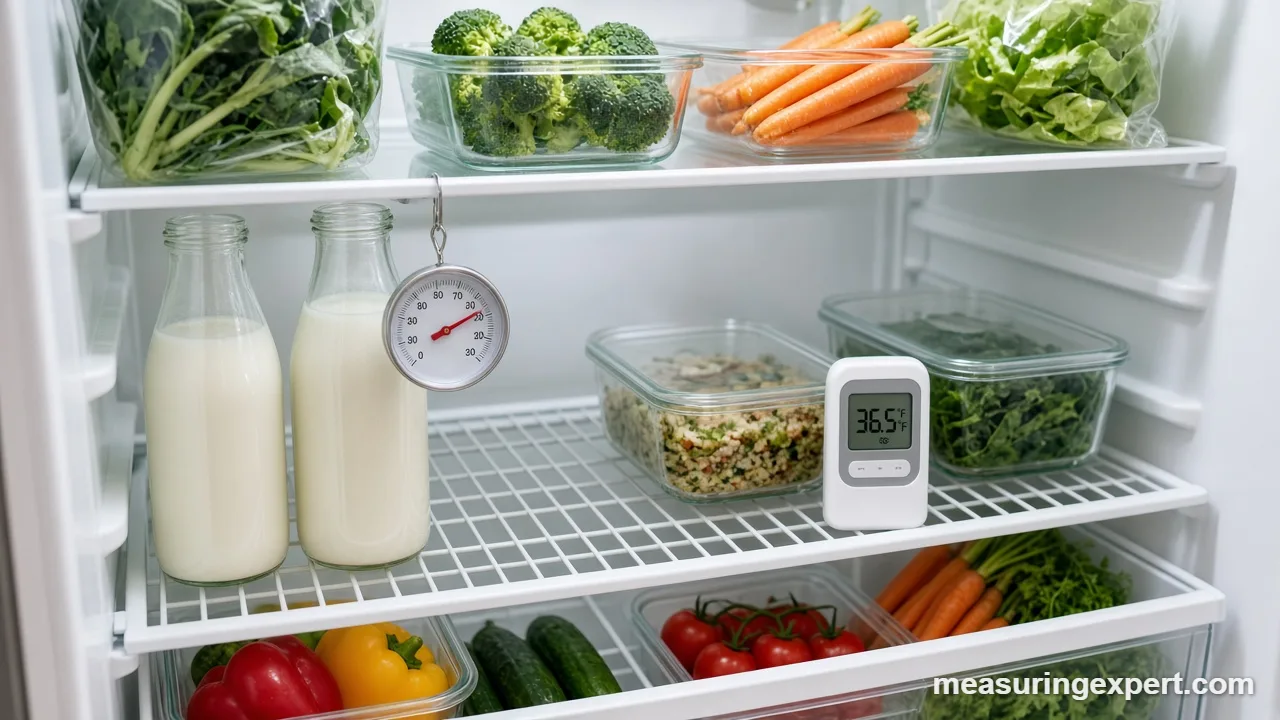
To be clear, we did not run hands-on tests for this list. Instead, our picks are research-based. First, we read maker manuals and spec sheets, such as the AcuRite 00515M instruction manual, the Rubbermaid Commercial product page and the Traceable 4548 spec sheet. Then we compared them with FDA and CDC food safety targets and read owner feedback for drift and fogged screens.
After that, we scored each model on five points:
- Range that fits: the low end had to reach at least -4 F, so a 0 F freezer reads inside the scale.
- Published specs: a stated range at minimum; a stated accuracy, resolution or certificate earned extra credit.
- Readability: large digits, a backlight, a bold dial or a remote display, since you should check it at a glance.
- Warnings: alarms, max and min memory or app alerts that catch a problem you did not see happen.
- Brand support: established makers with current product pages and manuals.
Finally, we dropped unbranded multi-packs, near-duplicates and models we already cover in our glass thermometer guide and smart thermometer guide.
Dial vs Digital vs Wireless: Picking the Best Refrigerator Thermometer Type
Every refrigerator thermometer does the same basic job, yet the three types suit different kitchens. In short, a dial is simple, a digital unit is precise, and a wireless set warns you.
| Type | How it reads | Strengths | Weak spots | Example here |
|---|---|---|---|---|
| Dial (bimetal) | A coiled metal strip turns a needle | No batteries; works in a power cut | Coarse marks; no memory | Taylor 5924, Rubbermaid FGR80DC |
| Digital stand-alone | Electronic sensor and LCD | Decimal reading; max and min | Batteries; screen can fog | TempPro TempAir, Geevon Small |
| Wireless display | Sensors send to an outside screen | Read without opening the door; alarms | Range limits; more batteries | AcuRite 00515M |
| App or Wi-Fi | Sensors report to a phone | Alerts away from home; history | Setup; 2.4 GHz Wi-Fi gateway | GoveeLife H5108, H5111 |
| Buffered probe | Sensor sits in a glycol bottle | Tracks product temperature; certificate | Cost; cable through the seal | Traceable 4548 |
As a rule, a dial is enough for a weekly check of one home fridge. However, a garage freezer or stored medicine calls for memory or alarms.
Safe Temperatures to Check With a Fridge Thermometer
The FDA says to keep the refrigerator at or below 40 F (4 C) and the freezer at 0 F (-18 C). It also calls an appliance thermometer the best way to know those temperatures.
| Compartment | Target | Exact Celsius | Practical setting |
|---|---|---|---|
| Refrigerator | 40 F or below | 4.4 C | Aim for about 37 F (2.8 C) to leave a margin |
| Freezer | 0 F or below | -17.8 C | 0 F or a little colder |
| Too cold for a fridge | 32 F | 0 C | Lettuce and drinks start to freeze |
Note that the FDA rounds 40 F to 4 C, while the exact value is 4.4 C. Similarly, 0 F is exactly -17.8 C, often rounded to -18 C. So if your thermometer reads in the other scale, convert it below.
Power cuts are the big test. According to the CDC, a closed fridge keeps food cold for about 4 hours, a full freezer for about 48 hours and a half-full one for about 24 hours. Afterward, check the thermometer, and throw out perishable food that sat above 40 F for more than 4 hours. For storage times by food, see how long salmon lasts in the fridge and how long yogurt can sit out.
Specs That Separate the Best Refrigerator Thermometer From the Rest
Spec sheets for fridge thermometers are short. Even so, a few numbers tell you most of what you need.
- Range: the low end must sit below your freezer. For example, the TempPro stops at -4 F, which covers a 0 F kitchen freezer, while a chest freezer at -10 F needs a sensor that reaches -40 F.
- Accuracy vs resolution: accuracy is how close the reading is to the truth, and resolution is the smallest step shown. So a screen that shows 0.1 F can still be off by 2 F.
- Air sensor vs buffered probe: an air sensor jumps each time the door opens. A glycol bottle, however, responds slowly, much like a jar of food.
- Memory and alarms: max and min memory shows the warmest point since your last reset, and alarms warn you while it happens.
- Durability and power: an IP65 or IPX6 rating helps a digital unit survive condensation. Also, AcuRite calls for lithium cells in a freezer sensor below -4 F.
How to Place and Check a Fridge Thermometer
Above all, placement matters as much as the model you buy. So follow these steps for a reading you can trust.
- First, put the thermometer in the middle of the fridge, on a shelf near the front, not on the door or against the back wall.
- Next, place a second unit or sensor in the center of the freezer, between packages rather than on top of them.
- After that, wait at least 8 hours, or overnight, before you trust the first reading or change the dial.
- Also, read it before you open the door for long, ideally first thing in the morning.
- If the fridge reads above 40 F, turn the control one step colder and check again after another 8 hours.
- Then set any alarms to your target band, such as 34 to 40 F for the fridge and -10 to 5 F for the freezer.
- Finally, check the reading at least once a week and after any power cut.
The back of most fridges runs colder and the door runs warmer, so a front-center spot gives a fair middle value.
Accuracy Checks and Care for Fridge Thermometers
A refrigerator thermometer can drift, so test it a few times a year. The simplest check is an ice-water bath, because a well-stirred mix of ice and water sits at 32 F (0 C).
- Ice bath: fill a glass with crushed ice, top it with cold water, stir and wait 3 minutes.
- Probe models: dip the probe or bottle in the ice water and read it after it settles.
- Air sensors: seal the unit in a zip bag first, then push the bag into the ice water.
- Compare: a good unit reads within its stated accuracy of 32 F.
- Adjust: use a calibration offset if the model has one, as the AcuRite does; otherwise, note the error.
Honest Limits of Any Fridge Thermometer
A thermometer measures one spot, not the whole fridge. As a result, a crowded shelf or a blocked vent can leave a warm pocket that your sensor never sees.
Likewise, batteries, frost and knocks can shift any unit over time. Therefore, the ice-water check above is worth five minutes every few months.
Fridge Thermometer FAQ
What is the best refrigerator thermometer for most homes?
For most homes, the best refrigerator thermometer is the AcuRite 00515M. It uses two wireless sensors, one in the fridge and one in the freezer, and it sounds an alarm when either stays out of range for more than 5 minutes.
What temperature should a fridge thermometer read?
It should read 40 F (4 C) or below in the fridge and 0 F (-18 C) in the freezer, according to the FDA. In practice, many people aim for about 37 F in the fridge to leave a safety margin.
Where should I put a fridge thermometer?
First, put it in the middle of the fridge on a shelf near the front. Avoid the door, which runs warmer, and the back wall, which runs colder. In the freezer, place it in the center between packages.
Is the best refrigerator thermometer a digital one?
Usually, yes. A digital unit shows decimals and often lists its accuracy, such as +/-0.9 F. A dial has coarse marks, so it works best as a pass-or-fail check. However, a dial needs no batteries, so it keeps working in a power cut.
How do I test a fridge thermometer for accuracy?
Use an ice-water bath. First, fill a glass with crushed ice, add cold water, stir and wait 3 minutes. Then put the probe, or the unit sealed in a zip bag, into the water. It should read close to 32 F (0 C).
How long should I wait before reading a new fridge thermometer?
Wait at least 8 hours, or overnight, before you trust the first reading. Similarly, wait another 8 hours after you change the fridge control, because the air and food take time to settle.
Can one thermometer cover both the fridge and the freezer?
A single stand-alone unit cannot be in both places at once. So buy a pair, or choose a wireless set such as the AcuRite 00515M, which has one sensor for each compartment and one display outside.
Do I need a Wi-Fi fridge thermometer?
Only if you want alerts when you are away. For example, a garage freezer or a rental fridge can fail unnoticed for days. In that case, a Wi-Fi model such as the GoveeLife H5108 sends a phone alert. Otherwise, a dial or basic digital unit is enough.
What is the best refrigerator thermometer for medicine or vaccines?
Choose one with a buffered probe and a calibration certificate, such as the Traceable 4548. Its sensor sits in a small glycol bottle, so it follows the temperature of stored products rather than brief air spikes when the door opens.
What is the best refrigerator thermometer for a mini fridge?
In general, a compact digital unit fits best. For example, the Geevon Small is small enough for a door shelf, reads -22 to 122 F and resists condensation with an IP65 housing.
Bottom Line: The Best Refrigerator Thermometer for Most Kitchens
For most homes, the AcuRite 00515M Wireless Fridge and Freezer Thermometer is the best refrigerator thermometer to buy. It watches the fridge and the freezer at once, keeps a 24-hour high and low, and sounds an alarm before food sits warm for long. However, choose the Taylor 5924 if you want a battery-free dial, or the GoveeLife H5108 if you need alerts on your phone.
Black Friday is coming: shop the deals with Prime