

The best glass thermometer for most buyers is the SP Bel-Art H-B Easy-Read, a mercury-free, NIST-traceable lab stem with a black-on-yellow column that is easy to read. However, the right pick depends on the job: lab liquids, candy and frying, cold storage or fever checks.
In short: get the H-B Easy-Read for lab work, the Taylor 5978N for candy, and the Geratherm for battery-free fever checks.
As an Amazon Associate, Measuring Expert earns from qualifying purchases. Our picks are based on research, specifications and owner feedback, not paid placement.
Best Overall


Best for Body

Quick Answer: Which Best Glass Thermometer Fits Your Job?
- Lab baths and food processing: H-B Easy-Read, total immersion and traceable to NIST.
- Students on a budget: United Scientific THPC02, a 12 in. partial immersion stem.
- Candy and frying: Taylor 5978N, 100 to 400 F with a pan clip.
- Recipes in both scales: Escali AHC3, with F and C on the column.
- Deep pots: Taylor 5983N, a 12 in. stainless paddle.
- Fever checks without batteries: Geratherm, filled with Galinstan.
- Fridges and freezers: H-B DURAC in a steel case; or, for decor, the AcuRite Galileo set.
On This Page
- Comparison table
- The 8 picks, reviewed
- How we chose
- Types compared
- Why mercury is gone
- Partial vs total immersion
- ASTM and NIST-traceable labels
- Temperature converter
- How to read one
- Ice water check
- Honest limits
- FAQ
- Bottom line
Best Glass Thermometer Comparison Table
First, find your use in the Best For column. Then jump to the review for range, immersion and accuracy details.
| # | Product | Best For | Standout Feature | Amazon |
|---|---|---|---|---|
| 1 | H-B Easy-Read -10 to 110 C | Labs, classrooms and food processing | Black Enviro-Safe fill on a yellow back, NIST-traceable | View |
| 2 | United Scientific THPC02 | Students and general lab use | 12 in. partial immersion stem with a depth ring | View |
| 3 | Taylor 5978N | Candy, syrup and frying at home | 8 in. non-mercury tube with pan clip and safety cap | View |
| 4 | Escali AHC3 | Cooks who use F and C recipes | F and C column plus a sheath with sugar stage guide | View |
| 5 | Taylor 5983N | Large batches and deep frying | 12 in. stainless paddle with insulated handle | View |
| 6 | Geratherm Mercury-Free | Fever checks without batteries | Galinstan fill, a mercury-free liquid metal | View |
| 7 | H-B DURAC Fridge/Freezer | Fridges, freezers and cold rooms | Dual scale -40 to 80 F in a steel case | View |
| 8 | AcuRite Galileo 00795A2 | Desks, shelves and gifts | Galileo floats plus a storm glass barometer | View |
The 8 Best Glass Thermometer Picks, Reviewed
Above all, every pick below is mercury-free. We start with lab stems, move to the kitchen, and end with clinical, cold storage and decorative glass.
Best Overall
1. SP Bel-Art H-B Easy-Read Lab Thermometer, -10 to 110 C, Total Immersion
Best for: Lab techs, teachers and food processors who need a clear, traceable reading in water baths and liquids.
The SP Bel-Art H-B Easy-Read is our pick as the best glass thermometer for most lab-style work. First, it fixes the main problem with glass: reading the thin line. Instead of red liquid on white, it uses a black liquid against yellow, lead-free back glass, so the column stands out. In addition, the fill is SP Bel-Art’s Enviro-Safe liquid, which the maker describes as non-toxic and biodegradable.
This version is a total immersion model with a -10 to 110 C (14 to 230 F) range. So you dip it until the top of the column is just above the liquid. For the -10 to 110 C Easy-Read general purpose models, SP Bel-Art lists 1 C divisions and +/-1 C accuracy, and it states traceability to NIST.
- Range: -10 to 110 C (14 to 230 F)
- Immersion: total
- Accuracy: +/-1 C; 1 C divisions (SP Bel-Art data for this range)
- Fill: black Enviro-Safe liquid on yellow, lead-free back glass
- Traceable to NIST, per SP Bel-Art
Pros
- Above all, the black-on-yellow column is easy to read
- Non-toxic, biodegradable fill
- Traceable to NIST
Cons
- Celsius only
- Total immersion takes care in shallow pots
- Glass, so it needs a case
Skip it if: you mainly work in shallow liquids, since a partial immersion model is easier to use there.
Best Budget Lab
2. United Scientific THPC02 Red Spirit-Filled Lab Thermometer

Best for: Students, hobby chemists and homebrewers who want a classic lab stem with a clear partial immersion mark.
United Scientific supplies school and teaching labs, and the THPC02 is its basic red spirit stem. To begin with, it is 12 in. (305 mm) long, and it reads in 1 C steps. Importantly, it is a partial immersion design, and a small ring on the stem shows how deep to dip it. As a result, you do not need to guess the depth or apply a stem correction for routine work.
In addition, Fisher Scientific lists a non-roll triangle and a reusable plastic storage tube. However, sellers state the range differently. The Amazon title shows -10 to 150 C, while Fisher lists -10 to 110 C, so check the scale printed on the stem when it arrives.
- Length: 12 in. (305 mm)
- Divisions: 1 C
- Immersion: partial, with a depth ring on the stem
- Fill: red spirit
- Extras: non-roll triangle and plastic storage tube
Pros
- Clear partial immersion ring
- Non-roll triangle helps on benches
- Also comes with a storage tube
Cons
- No accuracy figure on the catalog page
- Range differs between sellers
- Red-on-white is harder to read than Easy-Read
Skip it if: you need a stated tolerance or a calibration certificate for audits.
Best for Candy
3. Taylor 5978N Classic Line Glass Candy and Deep Fry Thermometer
Best for: Home cooks who make fudge, caramel, jam or fried foods and want a simple glass tube on the pot.
The Taylor 5978N is a plain, proven candy and deep-fry thermometer. Specifically, it reads 100 to 400 F (about 40 to 200 C), which covers every sugar stage and normal frying oil. Also, the adjustable pan clip holds it on the side of the pot, so your hands stay free to stir.
In addition, the 8 in. glass tube is non-mercury, and it ships with a safety cap. The storage sleeve also carries a quick cooking temperature chart. Because the tube is short, though, it suits saucepans better than deep stock pots.
- Range: 100 to 400 F (about 40 to 200 C)
- Length: 8 in. glass tube
- Fill: non-mercury
- Adjustable pan clip and safety cap
- Sleeve with a cooking temperature chart
Pros
- Covers all candy and frying temperatures
- Hands-free pan clip
- Also a compact size for small pots
Cons
- Short tube for deep pots
- No metal guard around the glass
- No accuracy figure in retailer data
Skip it if: you fry in a deep pot or turkey fryer, since a 12 in. paddle reaches better.
Best Dual Scale
4. Escali AHC3 Candy and Deep Fry Glass Tube Thermometer
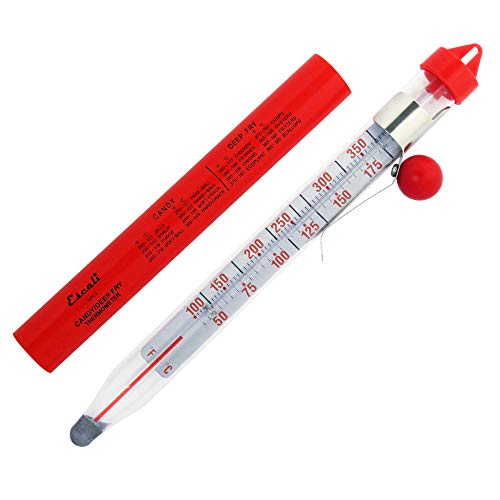
Best for: Bakers and candy makers who switch between US and metric recipes and like a printed guide close at hand.
The Escali AHC3 is a glass tube thermometer with both Fahrenheit and Celsius on the column. Overall, it reads 100 to 392 F (40 to 200 C). Meanwhile, a stainless steel pot clip holds it in place, and a heat-resistant wood knob lets you move it without a towel.
Besides, its red storage sheath doubles as a reference card. For example, it lists target temperatures for jelly, fudge, soft ball, hard crack and French fries. The Amazon listing also calls it NSF certified, and Escali backs it with a 2-year limited warranty, according to retailer data.
- Range: 100 to 392 F (40 to 200 C)
- Scales: Fahrenheit and Celsius
- Length: about 8.5 in.
- Stainless pot clip with a wood knob
- Sheath with candy and frying reference temperatures
Pros
- Dual scale saves conversions
- Helpful sugar stage guide on the sheath
- Also dishwasher safe, per retailer data
Cons
- Top of range is 392 F, not 400 F
- Short for deep fryers
- Wood knob needs care
Skip it if: you need a long reach into a big fry pot.
Best for Deep Pots
5. Taylor 5983N Candy, Jelly and Deep Fry Paddle Thermometer

Best for: Cooks who fry in deep pots or make big batches of jam and need the glass tube protected.
The Taylor 5983N mounts a spirit-filled glass tube on a 12 in. stainless steel paddle. So the paddle protects the tube from spoons and pot walls. Moreover, it reads 100 to 400 F (about 50 to 200 C), and the large print helps when steam fogs the view.
In addition, an insulated handle with a built-in pan clip keeps your hand away from the oil. As a result, it is a safer pick than a bare tube for deep pots. However, the paddle takes more room in a small saucepan.
- Range: 100 to 400 F (about 50 to 200 C)
- Length: 12 in. paddle
- Spirit-filled glass tube
- Insulated handle with built-in pan clip
- Large-print scale
Pros
- Paddle shields the glass tube
- Long reach for deep pots
- Also easy-read large print
Cons
- Bulky in small pans
- Paddle takes longer to clean
- No accuracy figure in retailer data
Skip it if: you mostly cook small batches in a 1 qt saucepan.
Best for Body Temperature
6. Geratherm Mercury-Free Oral Glass Thermometer, 2-Pack
Best for: Families who want a battery-free fever thermometer that reads like the old mercury type.
Geratherm makes one of the few clinical glass thermometers still widely sold in the US. Instead of mercury, it uses Galinstan, a liquid metal alloy of gallium, indium and tin. According to the FDA device database, it reads 35.5 to 42 C (about 96 to 108 F) and typically reaches its peak in about 3 minutes by mouth.
Furthermore, Geratherm states +0.1/-0.15 C accuracy for its Classic glass thermometer. Similarly to mercury types, it holds the peak until you shake it down. In fact, Geratherm says the reset takes about 60 seconds of firm wrist shakes, so plan for that. For more on body temperature units, see our guide to medical units of measurement.
- Range: 35.5 to 42 C (about 96 to 108 F)
- Fill: Galinstan (gallium, indium, tin)
- Accuracy: +0.1/-0.15 C (Geratherm Classic data)
- Oral reading time: about 3 minutes
- Plastic case; two thermometers in the pack
Pros
- No mercury and no batteries
- Holds the peak reading
- Also a 2-pack for a spare
Cons
- Slow compared with digital
- Shaking down takes effort
- Glass can break if dropped
Skip it if: you check a squirming child often, since a fast digital model is easier.
Best for Cold Storage
7. SP Bel-Art H-B DURAC Liquid-in-Glass Refrigerator/Freezer Thermometer

Best for: Kitchens, clinics and labs that log fridge and freezer temperatures every day.
Unlike the lab stems above, the H-B DURAC fridge and freezer thermometer puts a glass tube inside a steel case. As a result, it survives shelf bumps better than a bare stem. Also, it reads -40 to 27 C (-40 to 80 F), so it covers both a fridge near 37 F and a freezer near 0 F.
Equally important, SP Bel-Art lists +/-1 C (+/-2 F) accuracy, with 1 C and 2 F divisions. Also, the red organic fill is mercury-free. At 124 mm (4.9 in.) long, it fits on a shelf or door bin without taking much space.
- Range: -40 to 27 C (-40 to 80 F)
- Accuracy: +/-1 C (+/-2 F)
- Divisions: 1 C and 2 F
- Fill: red organic liquid
- Case: steel; 124 mm (4.9 in.) long
Pros
- Steel case protects the glass
- Dual scale for logs and inspectors
- Also small enough for door bins
Cons
- No min/max memory
- Small print in a dark fridge
- No calibration report included
Skip it if: you need min/max or alarm logging, since a digital data logger does that.
Best Decorative
8. AcuRite 00795A2 Galileo Thermometer with Glass Globe Barometer

Best for: Anyone who wants a working science piece on a desk or shelf rather than a precise instrument.
The AcuRite 00795A2 pairs an 11 in. Galileo thermometer with a hand-blown globe storm glass. Notably, in the Galileo tube, weighted glass bulbs float or sink as the liquid density changes with temperature. According to AcuRite, it reads 64 to 80 F (about 18 to 27 C) with +/-2 F accuracy.
Meanwhile, the storm glass is a Goethe-style barometer. A low water level in the spout signals high pressure and fair weather, while a high level signals low pressure. However, it shows a trend, not a number, so treat it as a fun forecast rather than a gauge.
- Galileo range: 64 to 80 F (about 18 to 27 C)
- Accuracy: +/-2 F
- Size: 11 in. H x 9 in. W x 4.5 in. D
- Storm glass barometer with a wooden base
- Indoor display piece
Pros
- Two classic science tools in one set
- Clear AcuRite reading guide
- Also a strong gift choice
Cons
- Narrow 64 to 80 F range
- Storm glass needs refilling
- Not a precise thermometer
Skip it if: you need a reading outside room temperatures or better than +/-2 F.
How We Chose the Best Glass Thermometer Picks
We did not run hands-on tests. Instead, these picks are research-based. First, we read maker spec pages, catalog data and government guidance. Next, we weighed owner feedback on readability, breakage and drift. Finally, we scored each model on the points below.
- Mercury-free fill: every pick uses spirit, organic liquid or Galinstan. We skipped mercury models, since safer fills now do the same job.
- Stated accuracy and divisions: a clear tolerance, such as +/-1 C, ranked higher than vague “precise” claims.
- Clear immersion marking: lab models had to state partial or total immersion, because that rule decides whether the reading is right.
- Traceability: NIST-traceable or individually calibrated options earned extra credit for lab and food-safety work.
- Fit for the job: clips, sheaths, cases and range had to match real use, from syrup to freezers.
- Brand spread: we kept to two models per brand and skipped look-alike generic listings.
Our sources include the NIST page on mercury thermometer alternatives, the EPA overview of mercury thermometers, and the SP Bel-Art spec page for its Easy-Read general purpose thermometer. We also read Taylor, Escali, Geratherm and AcuRite product data.
Glass Thermometer Types Compared
Before you shop, match the type to the job. In short, the same glass tube idea shows up in five very different tools.
| Type | Fill | Typical range | Main use |
|---|---|---|---|
| Lab liquid-in-glass | Spirit or organic liquid | About -20 to 150 C (-4 to 302 F) | Water baths, teaching labs, process checks |
| Candy and deep-fry | Spirit | About 100 to 400 F (40 to 200 C) | Syrup stages, frying oil |
| Refrigerator and freezer | Organic liquid | About -40 to 27 C (-40 to 80 F) | Cold storage logs |
| Clinical (fever) | Galinstan | About 35.5 to 42 C (96 to 108 F) | Body temperature |
| Galileo | Clear liquid with weighted glass bulbs | About 64 to 80 F (18 to 27 C) | Room display and decor |
So pick the scale first, and then the brand.
Why the Best Glass Thermometer Is Now Mercury-Free
For decades, mercury was the default fill. However, that has changed. According to NIST, there is no longer any scientific reason to use mercury thermometers, and NIST stopped calibrating them on March 1, 2011. In addition, the EPA notes that a broken fever thermometer releases mercury vapor, and it says at least 13 states restrict mercury fever thermometer sales.
As a result, modern glass thermometers use three main fills:
- Spirit or organic liquid: usually dyed red, blue or black. It is cheap and safe, so most lab, candy and fridge models use it.
- Galinstan: a liquid metal alloy of gallium, indium and tin. Clinical thermometers such as Geratherm use it because it behaves like mercury in a fine tube.
- Enviro-Safe type fills: SP Bel-Art sells a black, non-toxic, biodegradable liquid for its Easy-Read line.
Spirit columns can separate, though. If you see a gap in the line, the reading is wrong until you rejoin it. Also, store spirit thermometers upright, because that keeps the column whole.
Partial vs Total Immersion: Read the Stem Before You Dip
In fact, this is the detail most buyers miss. Every lab glass thermometer is calibrated for a set immersion depth, and the stem tells you which one.
| Marking | How deep to place it | Example |
|---|---|---|
| Partial immersion | Down to the etched line or ring, often 76 mm (3 in.) or 50 mm (2 in.) | H-B DURAC general purpose, United Scientific THPC02 |
| Total immersion | Until the top of the liquid column sits just above the surface | H-B Easy-Read -10 to 110 C total immersion |
| Complete immersion | The whole thermometer goes in | Some special lab and bath models |
Why does it matter? Because the liquid in the exposed stem sits at room temperature, not at the bath temperature. So it expands less, and the reading drifts. For example, spirit fills expand about 0.001 per degree C, roughly six times more than mercury did. Therefore, a total immersion thermometer read with 50 degrees of column sticking out into air 30 C cooler can read about 1.5 C low (0.001 x 50 x 30). In short, follow the line on the stem, or apply a stem correction.
ASTM, NIST-Traceable and Calibrated: What the Labels Mean
Generally, lab listings stack these terms together. However, they mean different things.
- ASTM: the thermometer is built to an ASTM pattern, such as those in ASTM E1. As a result, the bulb, scale and immersion depth match a standard test method.
- NIST-traceable: the maker checked the design or batch against reference standards with an unbroken chain back to NIST. It does not mean NIST tested your unit.
- Individually calibrated: your specific thermometer was checked at set points, and it ships with a report of corrections. This is the strongest claim, and it usually costs more.
For home kitchens, none of this is required. On the other hand, labs, food plants and audited cold rooms often need at least a traceable thermometer with a dated certificate. For more on how lab units fit together, see our guide to measurement units in chemistry.
Celsius, Fahrenheit and Kelvin Converter
Of course, many glass thermometers show only one scale. So use this converter when a recipe, lab method or doctor gives the other one.
For example, the soft ball candy stage near 235 F is about 113 C. For oven and baking swaps, see our Fahrenheit to Celsius baking chart.
How to Read a Glass Thermometer Accurately
Indeed, good technique matters as much as the tool. Follow these steps for lab, kitchen or fridge use.
- Inspect the column: check for cracks and for gaps in the liquid line before each use.
- Find the immersion mark: look for a ring, a line or the words “partial” or “total” on the stem.
- Place it at the right depth: dip to the line for partial immersion, or nearly to the column top for total immersion.
- Keep the bulb clear: make sure the bulb does not touch the pot, beaker or shelf, because contact skews the reading.
- Wait for the column to settle: give it time until the line stops moving, often a minute or more in liquids.
- Read at eye level: line your eye up with the top of the liquid to avoid parallax error.
- Record and clean: note the reading, then rinse the stem and store it upright in its case.
Check Your Glass Thermometer in Ice Water
In general, glass thermometers drift less than cheap dial types. Still, a quick ice point check catches a damaged unit.
First, fill a glass with crushed ice, and then top it with cold water. Next, stir and wait about three minutes. Finally, place the thermometer at its marked immersion depth and read it. It should show 0 C (32 F) within its stated tolerance. A boiling check also works, but water boils lower at altitude, roughly 1 F less for every 500 ft. So the ice point is the more reliable home test.
If it is off, look for a split column first. Otherwise, note the offset and correct readings, or replace the unit.
Honest Limits of Glass Thermometers
Glass is precise and needs no battery. However, it breaks when dropped, and it reads slower than a digital probe. For fever checks, the EPA points to digital thermometers as the main alternative, so a glass clinical model suits people who prefer no batteries rather than speed. If you want a dial instead of a tube, our best analog thermometer guide covers bimetal dial types too.
Best Glass Thermometer FAQ
What is the best glass thermometer overall?
For most lab and food uses, the SP Bel-Art H-B Easy-Read is our top pick. It reads -10 to 110 C, uses a non-toxic black fill on yellow glass, and SP Bel-Art states +/-1 C accuracy with traceability to NIST.
Are glass thermometers more accurate than digital ones?
Not always. For example, a good lab glass thermometer holds about +/-1 C for years without a battery. However, quality digital probes match or beat that and read faster. So glass wins on stability and simplicity, while digital wins on speed.
Do glass thermometers still contain mercury?
Most new ones do not. NIST stopped calibrating mercury thermometers in 2011, and many states restrict mercury fever thermometers. Today, glass models use spirit, organic liquid or Galinstan instead.
What does partial immersion mean on a thermometer?
It means the thermometer was calibrated with only part of the stem in the liquid, usually down to an etched line or ring at 76 mm (3 in.) or 50 mm (2 in.). So you dip it to that line, and the rest of the stem stays in the air.
What is the difference between partial and total immersion?
A total immersion thermometer must sit in the liquid until the top of the column is just above the surface. By contrast, a partial immersion one goes in only to its marked line. If you use the wrong depth, the reading can be off by a degree or more.
What does NIST-traceable mean on the best glass thermometer?
It means the thermometer was checked against standards that link back to NIST through an unbroken chain. However, NIST did not test your unit. For audits, ask for an individual calibration report as well.
Can I use a lab glass thermometer for candy?
You can if its range reaches the sugar stages, about 230 to 310 F. Still, a candy thermometer is easier, because it has a pan clip, a longer reach and a printed guide. Also, never use a lab thermometer in your mouth after kitchen use.
How do I fix a separated spirit column?
First, hold the thermometer upright and tap the bulb end gently on a padded surface. You can also warm the bulb slowly so the liquid rises into the gap and rejoins. Then check it in ice water before you trust it again.
Is a Galinstan glass thermometer safe for fever checks?
Yes. Galinstan is a liquid metal alloy of gallium, indium and tin, and makers use it to replace mercury. If one breaks, stop using it, collect the glass carefully, and clean up the liquid, since it can stain.
How should I store the best glass thermometer?
Store it upright in its case or sheath, away from heat and direct sun. Upright storage keeps spirit columns whole. In addition, never cool a hot glass tube under cold water, since thermal shock can crack it.
Bottom Line: The Best Glass Thermometer to Buy
For most buyers, the SP Bel-Art H-B Easy-Read Lab Thermometer, -10 to 110 C, Total Immersion is the best glass thermometer. After all, it pairs a non-toxic, easy-read column with traceability to NIST and a +/-1 C tolerance. However, choose the Taylor 5978N or Escali AHC3 for candy, the H-B DURAC for fridges, or the Geratherm for fever checks.
1 thought on “Best Glass Thermometer: 8 Mercury-Free Picks for Lab, Kitchen and Fever Checks”