

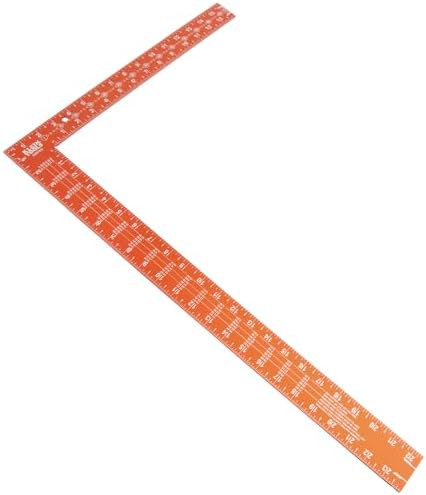
The best framing square for most people is the Klein Tools 935FSQ, a light 24 x 16 in aluminum square with etched rafter tables. However, the right pick depends on three things: whether you need full rafter tables, whether you prefer stiff steel or rust-proof aluminum, and how true the corner is out of the box.
In short: buy the Klein 935FSQ for all-round framing, the Johnson CS9 for learning rafter tables, the POWERTEC 80008 on a budget, and add a Swanson Speed Square for saw cuts.
As an Amazon Associate, Measuring Expert earns from qualifying purchases. Our picks are based on research, specifications and owner feedback, not paid placement.
Best Overall
Best Budget
Best for Rafters

Quick Answer: Which One to Buy
- All-round framing: Klein 935FSQ, light aluminum with etched rafter tables.
- Learning the rafter table: Johnson CS9, steel with rafter, brace, octagon and board-foot tables.
- Wet sites: Empire e1190 or Channellock 8100-1624FS, since aluminum will not rust.
- Tight budget: POWERTEC 80008, but check it for square on arrival.
- Metric or shop work: Empire 100IM, an 8 x 12 in inch and metric square.
- Saw guide and roof angles: a Swanson S0101 Speed Square beside your framing square.
On This Page
- Comparison table
- The 8 picks, reviewed
- How we chose
- Parts and scales of a framing square
- How to read the rafter table
- Roof pitch angle calculator
- Steel vs aluminum
- How to check a square for square
- Care and truing
- Honest limits
- FAQ
- Bottom line
Best Framing Square Picks Compared
First, find your job in the table, then jump to the review.
| # | Product | Best For | Standout Feature | Amazon |
|---|---|---|---|---|
| 1 | Klein Tools 935FSQ Aluminum Framing Square | Framers and remodelers who want one full-size square | Double laser-etched scales plus rafter tables | View |
| 2 | Johnson Level CS9 Steel Framing Square | Roof framing and traditional layout | Rafter, brace, octagon and board-foot tables | View |
| 3 | Stanley 45-910 Steel Rafter Square | Carpenters who want the Essex board measure | Embossed figures with Essex, octagon, brace and rafter scales | View |
| 4 | Empire e1190 True Blue Aluminum Framing Square | Layout in wet or humid sites | Laser-etched scales with ARC-SCRIBE radius holes | View |
| 5 | Channellock 8100-1624FS Aluminum Framing Square | Stable layout on sheet goods | Certified 90-degree corner on a wide body | View |
| 6 | POWERTEC 80008 Steel Framing Square | Budget buyers and occasional framers | Stamped rafter and conversion tables on steel | View |
| 7 | Empire 100IM Steel Carpenter Square (8 x 12 in) | Shop work, cabinets and metric users | Inch and metric scales on a small square | View |
| 8 | Swanson S0101 Speed Square (7 in) | Saw guide and quick roof angles | Common, hip, valley and jack rafter marks | View |
The 8 Best Framing Square Options, Reviewed
We sorted the list by job. Specifically, picks 1 to 6 are full-size 24 x 16 in framing squares, pick 7 is a compact 8 x 12 in square, and pick 8 is a rafter square that most framers carry alongside one.
Best Overall
1. Klein Tools 935FSQ Aluminum
Best for: Framers, remodelers and serious DIYers who want a light, full-size 24 x 16 in square with tables they can read in bright sun.
Overall, the Klein 935FSQ is the best framing square for most buyers because it pairs a light aluminum body with full layout data. Specifically, Klein etches the rafter tables and an octagon scale into the blade, so you can lay out common rafters without a phone.
In addition, the blade is 0.122 in (about 3.1 mm) thick, which is thicker than many stamped steel squares. As a result, it resists casual bending, even though it weighs only about 13 oz (372 g).
- Anodized aluminum, 24 x 16 in (61 x 40.6 cm)
- Thickness 0.122 in; weight 13.12 oz (372 g)
- Double laser-etched marks in 1/8, 1/10, 1/12 and 1/16 in
- Rafter tables and octagon scale etched into the square
- Hang hole; imperial scales only
Pros
- Light for a full-size square
- Etched marks will not wear off like paint
- High-visibility orange finish
Cons
- No metric scale
- Aluminum corners dent if dropped
- No Essex board-foot table listed
Skip it if: you work in metric, because every scale on it is in inches.
Best for Rafter Tables
2. Johnson Level CS9 Steel
Best for: Roof framers and students of traditional carpentry who want every classic table on a stiff steel blade.
If you plan to learn the rafter table properly, then the CS9 is the square to learn on. First, it carries rafter tables, brace tables, octagon scales and board-foot tables. Next, Johnson thermal-bonds the numbers to the steel, so they stay readable longer than plain paint.
Because the blade is 1/8 in (3.2 mm) steel, it naturally feels heavier than aluminum. However, steel can rust if you leave it wet, so wipe it dry and give it a light coat of oil now and then.
- Steel; body 24 x 2 in, tongue 16 x 1-1/2 in
- Thickness 1/8 in (3.2 mm)
- Graduations 1/8, 1/10, 1/12 and 1/16 in
- Rafter, brace, octagon and board-foot tables
- Thermal-bonded numbers and graduations
Pros
- Full set of traditional tables
- Stiff, flat steel blade
- Standard body and tongue widths match textbooks
Cons
- Heavier than aluminum
- Can rust without care
- Bonded numbers are not as permanent as etching
Skip it if: you carry your square on a roof all day, because a light aluminum model is easier on your arm.
Best Classic Steel
3. Stanley 45-910 Steel Rafter Square

Best for: Carpenters who like a traditional hardened steel square and want the Essex board measure for quick lumber estimates.
Stanley has sold steel rafter squares for generations, and similarly, the 45-910 follows that classic pattern. For example, it carries an Essex board measure, an octagon scale, a brace scale and a rafter table on one 24 x 16 in blade. Also, the graduations and figures are embossed, which gives them some depth, so they do not rub off as quickly as printed marks.
- Hardened steel, 24 x 16 in
- Essex board measure, octagon scale, brace scale and rafter table
- Embossed graduations and figures
- Buffed finish with clear lacquer for rust resistance
Pros
- Every classic table, including Essex
- Embossed marks with real depth
- Long-running Stanley design
Cons
- Heavier than aluminum
- Plain steel color is harder to read in low light
- Lacquer wears over time
Skip it if: you want high-contrast laser marks, since the Klein or Empire are easier to read at a glance.
Best Aluminum Alternative
4. Empire e1190 True Blue Aluminum

Best for: Builders who work outdoors in damp weather and want a rust-proof, laser-etched square with a long warranty.
Today, Empire layout tools are sold through Milwaukee Tool, and the e1190 is made from anodized aluminum. As a result, it will not rust, which matters on decks and in coastal work. Also, the high-visibility marks are laser etched, so heavy use will not wear them away.
However, the listings we checked mention conversion tables rather than full rafter tables.
- Anodized aluminum, 16 x 24 in
- Laser-etched marks in 1/8, 1/10, 1/12 and 1/16 in
- Conversion tables on the blade
- ARC-SCRIBE for marking radii
- Limited lifetime warranty
Pros
- Will not rust or corrode
- Etched marks last
- Radius scribing built in
Cons
- No full rafter table listed
- Aluminum edges nick more easily than steel
- Branding varies between Empire and Milwaukee listings
Skip it if: you cut a lot of rafters from the table, because the Johnson CS9 carries the full set.
Best Wide Body
5. Channellock 8100-1624FS Aluminum

Best for: Cabinet and remodel carpenters who mark plywood and want a light square that sits stable on the panel.
First, Channellock certifies the corner at 90 degrees. Next, the body is wider than usual, which, as Channellock notes, gives more stability for layout.
Also, at 0.1 in (2.5 mm) thick and about 0.77 lb (349 g), it is one of the lighter full-size squares here. However, it carries an integrated conversion table rather than rafter tables. So, it suits panel and wall layout better than roof cutting.
- Anodized aluminum alloy, 24 x 16 x 0.1 in
- Weight 0.77 lb (349 g)
- Laser-etched 1/8, 1/10, 1/12 and 1/16 in graduations
- Certified 90-degree corner
- Integrated conversion table
Pros
- Certified square from the factory
- Wide body sits stable
- Very light
Cons
- No rafter tables
- Newer to this category than Stanley or Johnson
- Imperial only
Skip it if: you need rafter tables, because this one only lists conversions.
Best Budget
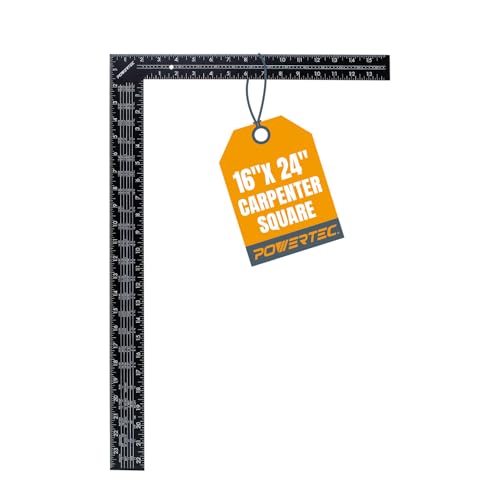
6. POWERTEC 80008 Steel
Best for: DIYers and occasional framers who want a steel square with rafter tables at a low cost.
For a budget pick, the POWERTEC 80008 covers the basics. For instance, it uses the standard 24 x 2 in body and 16 x 1-1/2 in tongue, and the rafter and conversion tables are stamped into the steel.
However, the blade is 1/16 in (1.6 mm) thick, half the thickness of the Johnson CS9. As a result, it can flex or bend if you drop it or pry with it. So, check it with the flip test when it arrives, and again after any fall.
- Steel with black finish; body 24 x 2 in, tongue 16 x 1-1/2 in
- Thickness 1/16 in (1.6 mm)
- Face: 1/8 and 1/16 in plus octagonal index; back: 1/10, 1/12 and 1/16 in
- Stamped rafter and conversion tables
- Rafter instructions included
Pros
- Low cost with real rafter tables
- Standard body and tongue widths
- Instructions help beginners
Cons
- Thin blade bends more easily
- Dark finish can hide marks in dim light
- Check for square on arrival
Skip it if: you are hard on tools, because a thicker steel or aluminum blade holds square longer.
Best Compact and Metric
7. Empire 100IM Steel (8 x 12 in)

Best for: Woodworkers and DIYers who want a small steel square for shop work, and anyone who measures in millimeters.
Instead of a 24 in blade, the Empire 100IM shrinks the framing square to 8 x 12 in (about 20 x 30 cm), so it fits in a tool bag and works inside cabinets. In addition, it carries both inch and metric markings, which none of the full-size picks here do.
Because it is 1/16 in (1.6 mm) steel, it is light but not very stiff. Therefore, treat it as a layout and checking tool for smaller parts, not a rafter square.
- Steel, 8 x 12 in (20 x 30 cm)
- Thickness 1/16 in
- Inch (SAE) and metric markings
- Epoxy finish to prevent rust
Pros
- Inch and metric on one square
- Fits in a tool bag
- Rust-resistant coating
Cons
- Too short for rafters or stair stringers
- Thin blade
- No rafter tables
Skip it if: you frame roofs or stairs, since the short legs cannot step off a full stringer.
Best Rafter Square Companion
8. Swanson S0101 Speed Square (7 in)

Best for: Framers and roofers who want a pocket rafter square to guide a circular saw and mark pitch cuts fast.
Strictly speaking, a Speed Square is a triangle, not an L-shaped framing square. For example, the S0101 works as a try square, miter square, saw guide, line scriber and protractor. Also, it carries gradations for common, hip, valley and jack rafters.
In addition, the die-cast aluminum body is 3/16 in (4.8 mm) thick, so it makes a solid fence for a circular saw. Also, Swanson includes its pocket blue book of roof cut numbers.
- Die-cast aluminum alloy, 7 in, 3/16 in thick
- Five functions: try, miter, saw guide, scriber and protractor
- Common, hip, valley and jack rafter gradations
- 1/4 in scribing notches; blue book included
Pros
- Excellent circular saw guide
- Fast pitch and angle marking
- Thick, tough body
Cons
- Only 7 in long
- Cannot check large corners
- Different system from the framing square table
Skip it if: you need to check a wall corner or sheet of plywood, because 7 in is too short.
How We Chose the Best Framing Square
To be clear, we did not run hands-on shop tests. Instead, our picks are research-based. First, we read manufacturer spec pages from Klein, Johnson, Channellock and Milwaukee (Empire), plus trade supplier listings for Stanley and POWERTEC. Next, we compared material, thickness, graduations and which tables each blade carries. Then, we weighed owner feedback about readability and squareness on arrival. Finally, we dropped unbranded listings with no specs.
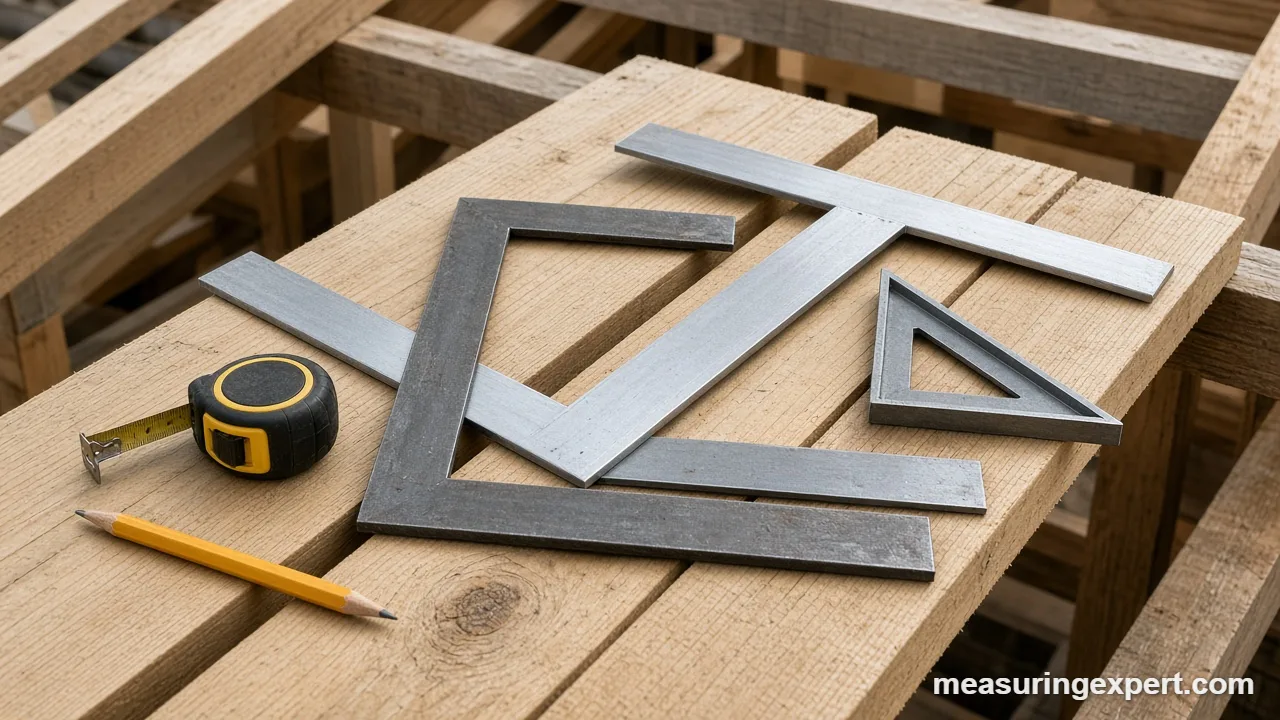
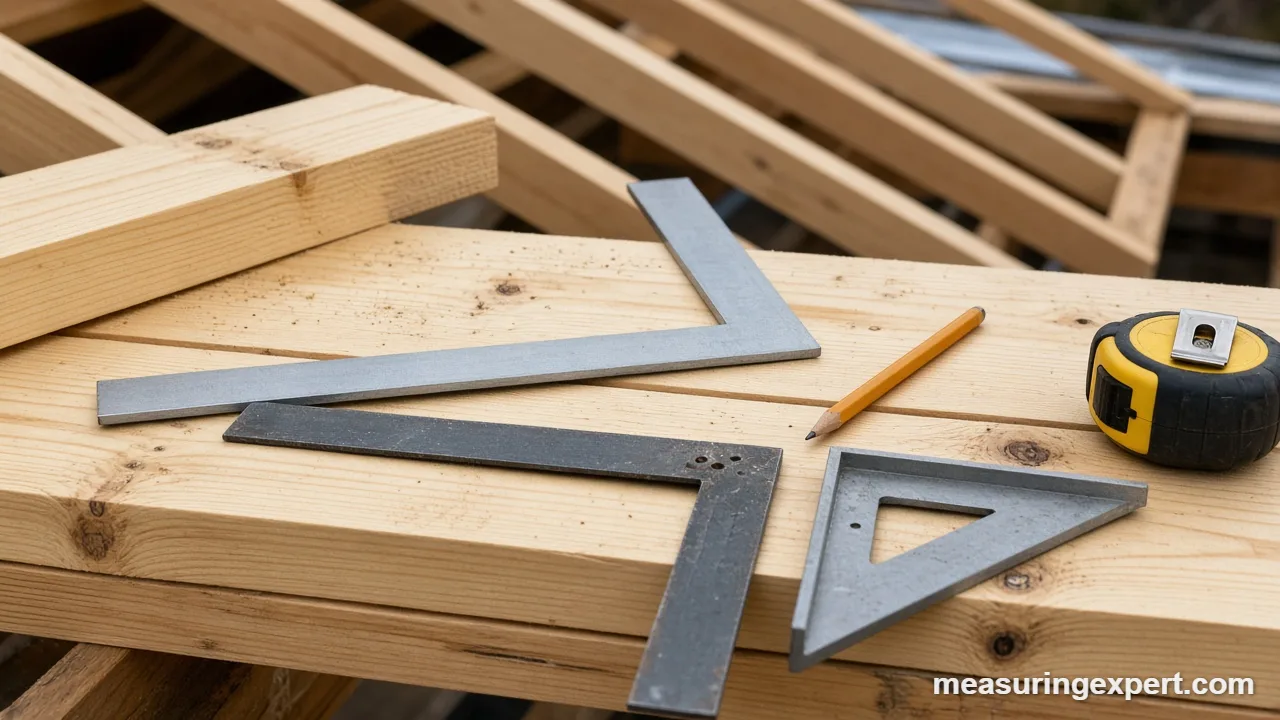
- Tables: rafter, brace, octagon and Essex board-foot tables, or only conversions?
- Material and thickness: how stiff the blade is and whether it can rust.
- Marking method: laser etched, embossed, stamped or bonded, because that decides how long the numbers last.
Parts and Scales: Body, Tongue and Heel
Basically, a framing square, also called a steel square or rafter square, is an L-shaped rule. Specifically, the long leg is the body (or blade), usually 24 in long and 2 in wide. Meanwhile, the short leg is the tongue, usually 16 in long and 1-1/2 in wide. Finally, the outside corner where they meet is the heel. Also, the side with the maker’s name is the face, and the other side is the back.
In addition, most full-size squares carry four inch scales. Typically, the 1/16 and 1/8 in scales handle everyday layout. Meanwhile, the 1/12 in scale lets 1 in stand for 1 ft on scaled drawings, and the 1/10 in scale suits plans in tenths of a foot.
For metric users, note that the inch is defined as exactly 25.4 mm, as the NIST length units page explains. So, a 24 in body is 609.6 mm, and a 16 in tongue is 406.4 mm. If you need a refresher on reading rules, our guide on how to measure length covers the basics.
How to Read the Rafter Table on the Best Framing Square
First, the rafter table sits on the face of the body. Next, across the top, the inch numbers 2 to 18 stand for the roof’s rise in inches per 12 in of run, so the column under “6” is a 6-in-12 roof. Then, each line down the table gives a different value for that pitch. Most tables carry six lines: common rafter length per foot of run, hip or valley length per foot of run, jack differences at 16 in and 2 ft on center, and the side cuts of jacks and of hips or valleys.
In fact, every number comes from the Pythagorean theorem. For example, a common rafter on a 6-in-12 roof rises 6 in for every 12 in of run, so its length per foot of run is the square root of (12 squared + 6 squared), or 13.42 in. Similarly, a hip runs diagonally, so it covers 16.97 in of run for every 12 in of common run, which gives 18.00 in per foot at 6-in-12. We computed the values below; your square should show the same figures, rounded.
| Pitch (rise in 12) | Roof angle | Common rafter per ft of run | Hip or valley per ft of run | Jack difference, 16 in OC | Jack difference, 24 in OC |
|---|---|---|---|---|---|
| 4 in 12 | 18.43 degrees | 12.65 in | 17.44 in | 16.87 in | 25.30 in |
| 6 in 12 | 26.57 degrees | 13.42 in | 18.00 in | 17.89 in | 26.83 in |
| 8 in 12 | 33.69 degrees | 14.42 in | 18.76 in | 19.23 in | 28.84 in |
| 10 in 12 | 39.81 degrees | 15.62 in | 19.70 in | 20.83 in | 31.24 in |
| 12 in 12 | 45.00 degrees | 16.97 in | 20.78 in | 22.63 in | 33.94 in |
Worked Example: A 6-in-12 Shed Roof
For example, a shed is 12 ft wide with a 6-in-12 gable roof, so each common rafter has a run of 6 ft. First, read 13.42 in under the “6” column. Next, multiply: 13.42 x 6 = 80.5 in, or about 6 ft 8-1/2 in (2.05 m). Note that this is the line length from ridge center to the outside of the wall plate. After that, subtract half the ridge board thickness and add the overhang. In short, the table replaces a calculator with one multiplication.
However, the side cut lines work differently. For instance, at 6-in-12 the side cut of jacks reads about 10-3/4. So, you hold 12 on the tongue and 10-3/4 on the body along the edge of the rafter, then mark along the body for the angled cheek cut.
Roof Pitch Angle Calculator
First, enter a pitch as inches of rise per 12 in of run. The calculator then returns the roof angle in degrees and the slope in percent, which helps when you set a miter saw or a bevel gauge.
Formula: angle = arctan(rise / 12). For example, arctan(6 / 12) = 26.57 degrees. For checking angles on finished work, our angle ruler picks and magnetic angle finders read the result directly.
Steel vs Aluminum: Which Makes the Best Framing Square?
In short, neither metal is simply better. Instead, each trades weight against stiffness and care. For example, steel is dense and stiff, so a thin steel blade still lies flat. However, plain steel rusts. Aluminum, by contrast, is about one third as dense as steel, so makers use a thicker blade to stay rigid. Also, anodized aluminum does not rust, and laser etching cuts the marks into it permanently.
| Factor | Steel | Aluminum |
|---|---|---|
| Weight | Heavier for the same size | Lighter, even with a thicker blade |
| Rust | Rusts without a finish and care | Anodized finish will not rust |
| Marks | Stamped, embossed or bonded | Usually laser etched |
| Drop damage | Bends, but can often be trued | Dents and nicks; hard to true |
| Typical thickness | 1/16 to 1/8 in (1.6 to 3.2 mm) | About 0.1 to 0.122 in (2.5 to 3.1 mm) on our picks |
| Best for | Rafter tables, shop use, truing | Outdoor and wet sites, all-day carrying |
So, choose steel for the classic tables and the option to true the corner yourself. Otherwise, choose aluminum for outdoor work. Either way, the best framing square is one that stays square, so check it often.
How to Check a Square for Square (the Flip Test)
In fact, a new square can arrive out of true, and a dropped one often is. Fortunately, a pencil and a straight edge are enough, because flipping the square doubles any error.
- First, find a straight reference edge, such as a factory edge of a plywood sheet or a jointed board.
- Next, hold the body of the square tight against that edge, with the tongue across the panel.
- Then draw a sharp, thin pencil line along the outside edge of the tongue.
- After that, flip the square over so the other face is up, and put the body back on the same edge.
- Then slide the tongue up to the line you drew, so its edge meets the line at the reference edge.
- Now look at the far end of the tongue. If it matches the line, the square is true.
- Finally, if there is a gap, measure it and divide by two. That half-gap is the real error over the tongue length.
For example, a 1/32 in (0.8 mm) gap at the end of a 16 in tongue means the square is out by 1/64 in over 16 in. In other words, that is about 0.06 degrees. For framing, most carpenters therefore accept that. For cabinets, however, you will want a truer tool, such as a machinist or T-square ruler for long panel lines.
Care, Storage and Truing a Steel Square
Above all, most squares go out of true from one thing: a fall onto the heel. So, hang your square on a nail or a wall hook, and never use it as a pry bar. Also, wipe steel squares dry and oil them lightly, and keep aluminum squares away from heavy tools that nick the edges.
If a steel square fails the flip test, carpenters often true it with a center punch. First, scribe a line from the inside corner to the heel. Then, a punch mark near the heel spreads the metal there and opens the angle, while a punch near the inside corner closes it. Next, make one light strike, re-test, and repeat. However, do not try this on aluminum, and stop if the blade starts to bow.
Honest Limits of Any Layout Square
Above all, a framing square is a layout tool, not a precision instrument. For one thing, makers rarely publish a squareness tolerance. Also, a 24 in blade cannot check a long wall, so measure both diagonals of the frame with a tape instead. Finally, the rafter table assumes a level wall plate and a simple gable or hip, so complex roofs still need careful math or plans.
Even so, the body and tongue form a 16 x 24 in triangle whose diagonal is about 28.84 in (732.6 mm), which gives a quick self-check with a tape.
Best Framing Square FAQ
What size is the best framing square?
For framing, 24 x 16 in is the best framing square size, because the body spans a stud bay and steps off rafters and stringers. For shop work, an 8 x 12 in square is easier to handle.
Is the best framing square steel or aluminum?
It depends on the job. Steel is stiffer and can be trued with a punch, but it rusts. Aluminum is lighter and rust-proof, yet it dents if dropped.
How do I know if my square is true?
Use the flip test. First, draw a line along the tongue with the body on a straight edge. Then flip the square and line it up again. Any gap at the far end is twice the real error.
What does the rafter table show?
In short, it is a printed chart of rafter lengths and cut numbers. The top numbers are inches of rise per 12 in of run, and the lines below give common, hip and jack rafter lengths per foot of run plus side cuts.
Does the best framing square need rafter tables?
Only if you cut roofs or learn traditional layout. For walls, decks and sheet goods, a square with conversion tables works fine.
What is the difference between a framing square and a speed square?
A framing square is a large L-shaped rule, usually 24 x 16 in, for corners, rafters and stairs. By contrast, a speed square is a 7 in triangle used mainly as a saw guide and for angles.
Can I fix a square that is out of true?
Often, yes, if it is steel. Carpenters use light center-punch marks near the heel to open the angle or near the inside corner to close it, and re-test after each strike. However, aluminum squares are best replaced.
What are the 1/12 and 1/10 scales for?
The 1/12 in scale lets 1 in stand for 1 ft, so you can scale roof drawings directly. Meanwhile, the 1/10 in scale suits plans in tenths of a foot.
How do I find roof pitch with the best framing square?
Hold the square level against a rafter with 12 on the body, then read where the rafter edge crosses the tongue. That number is the rise per 12 in of run, so 6 means a 6-in-12 pitch, or about 26.57 degrees.
Is it accurate enough for cabinets?
Generally, it is fine for marking cuts, but not for final checks. So, run the flip test, and use a machinist square for precise cabinet corners.
Bottom Line on the Best Framing Square
Overall, the Klein Tools 935FSQ is the best framing square for most buyers, because it is light, etched for life and still carries rafter tables. Still, choose by job: the Johnson CS9 or Stanley 45-910 for traditional steel tables, the Empire e1190 or Channellock for wet sites, and the POWERTEC 80008 on a budget. Finally, whatever you buy, run the flip test before the first cut.
1 thought on “Best Framing Square for 2026: 8 Steel and Aluminum Picks for Rafters and Layout”