

The best T-square ruler for most people is the Alvin ALT24, a 24-inch aluminum drafting T-square graduated in 16ths on both edges. However, the right choice depends on the job: drafting and art boards, full drywall sheets, or fine woodworking layout each call for a different blade length and build.
In short: pick the Alvin ALT24 for the drawing board, the Johnson JTS48HD for 4-foot drywall sheets, and the Woodpeckers Saddle T-Square for marking lines on boards in the shop.
As an Amazon Associate, Measuring Expert earns from qualifying purchases. Our picks are based on research, specifications and owner feedback, not paid placement.
Best Overall

Best for Drywall

Best for Woodworking

Quick Answer: Which Tool Fits Your Work?
- Alvin ALT24: a graduated aluminum T-square for drafting tables, art boards and school studios.
- STAEDTLER Mars 970 10: a 24-inch aluminum drafting T-square from a long-running drawing brand.
- Westcott AT-24: a simple 24-inch aluminum option for students and casual craft work.
- Johnson JTS48HD: a 48-inch drywall T-square with an extra-thick 3/16-inch blade.
- Swanson AD124: an adjustable 48-inch drywall square with detents at 30, 45, 60 and 75 degrees.
- Woodpeckers Saddle T-Square: a machined aluminum T-rule that hooks over a board edge.
- INCRA T-Rule (300 mm): a metric marking rule with pencil holes down to 1/4 mm.
On This Page
- Comparison table
- The 9 picks, reviewed
- How we chose
- Three kinds of T-square
- Specs that matter
- Blade length converter
- How to check a T-square for square
- Do and don’t
- Honest limits
- FAQ
- Bottom line
Best T-Square Ruler Comparison Table
First, find your type of work in the table. After that, jump to the review for blade length, graduations and build details.
| # | Product | Best For | Standout Feature | Amazon |
|---|---|---|---|---|
| 1 | Alvin ALT24 | Drafting and art | Graduated in 16ths on both sides | View |
| 2 | STAEDTLER Mars 970 10 | Drawing boards | Aluminum blade in 24 in or 36 in | View |
| 3 | Westcott AT-24 | Students on a budget | Plain 24-inch aluminum build | View |
| 4 | Johnson JTS48HD | Drywall sheets | 3/16-inch extra-thick blade, 16-inch marks | View |
| 5 | Swanson AD124 | Angled drywall cuts | Pivoting head with four angle detents | View |
| 6 | Johnson RTS24 RockRipper | Ripping narrow strips | Perforated blade guides a knife point | View |
| 7 | Woodpeckers Saddle T-Square | Woodworking layout | Wraps over the board edge | View |
| 8 | INCRA T-Rule 300 mm | Metric precision marking | Pencil holes at 1, 1/2 and 1/4 mm | View |
| 9 | WEN ME851R | Pocket marking | 1 mm holes every 1/32 inch | View |
The 9 Best T-Square Ruler Picks, Reviewed
To start, we grouped the picks by job. Picks 1 to 3 are drafting and art T-squares, picks 4 to 6 are drywall T-squares, and picks 7 to 9 are woodworking T-rules. Also, if you need a carpenter’s framing square or a speed square, see our separate guide to the best framing square.
Best for Drafting and Art
1. Alvin ALT24 Aluminum Graduated
Best for: Drafting tables, architecture and design students, and art boards up to about 24 inches wide.
To begin with, Alvin has made drafting tools for decades, and the ALT series is its graduated aluminum T-square. We think it is the best T-square ruler for most buyers because it works as both a straightedge and a scale. In other words, you can slide it along the board edge and read a length at the same time, which saves a trip to a separate ruler.
The blade is about 1.5 inches (38 mm) wide and 1.6 mm thick, according to Alvin. As a result, it stays flat on paper without the bulk of a wood blade. In addition, it is graduated in 16ths of an inch on both sides with high-contrast white markings, so you can read it with the head on either side. Finally, Alvin sells the same design in 12, 18, 24, 30 and 36 inch lengths, so you can match it to your board.
- Length: 24 in (61 cm); also 12, 18, 30 and 36 in
- Blade: aluminum, about 1.5 in wide and 1.6 mm thick
- Scale: 1/16-inch graduations on both edges
- Markings: high-contrast white
Pros
- Doubles as a ruler and a straightedge
- Thin blade sits flat on paper
- Five lengths in the same design
Cons
- No metric scale listed
- Too light for scoring drywall
- A dropped head can knock it out of square
Skip it if: you cut drywall or plywood; a heavier drywall T-square such as the Johnson JTS48HD is built for knife work.
Best Classic Drafting Brand
2. STAEDTLER Mars Aluminium 970 10

Best for: Drafters and illustrators who already use STAEDTLER Mars drawing tools and want a matching T-square.
Similarly, STAEDTLER is a German maker of pencils and technical drawing tools, and the Mars line is its professional range. The Mars 970 10 is the aluminum T-square in that line. Also, STAEDTLER lists it in two sizes: 24 inches (61 cm) and 36 inches (91 cm). So, it suits a standard student board as well as a larger studio table.
We include it as a solid alternative to the Alvin, especially if you prefer to keep a single brand of drawing instruments. However, STAEDTLER’s own page lists little detail about the scale, so check the product photos for the graduations you need before you buy. Also, the Amazon listing describes a calibrated blade, which you should confirm with the flip test later in this guide.
- Model: Mars Aluminium 970 10
- Sizes: 24 in (61 cm) or 36 in (91 cm)
- Blade: aluminum
- Line: STAEDTLER Mars technical drawing range
Pros
- Established technical drawing brand
- Long 36-inch size for big boards
- Light aluminum blade
Cons
- Few published scale details
- Not meant for knife cutting
Skip it if: you need clear, published graduations on both edges; choose the Alvin ALT24 instead, since it lists them.
Best Budget Drafting
3. Westcott AT-24 Aluminum

Best for: Students, hobby artists and crafters who need straight, parallel lines on a budget.
Also, Westcott is a well-known school and office brand, and the AT-24 is its 24-inch aluminum T-square. Overall, it is a plain tool, which is fine for a first drawing class, lettering guidelines or matting artwork. In fact, a T-square only needs to do two things well: stay straight and stay square.
Because the published details are thin, you should treat it as a basic straightedge. First, check that the head and blade are at 90 degrees when it arrives. Next, read the scale against a good steel rule before you trust it for measured work. If it passes both checks, it will draw parallel lines as well as a pricier tool.
- Model: AT-24
- Length: 24 in (61 cm)
- Build: aluminum blade and head
Pros
- Simple and light for a school bag
- Familiar office and school brand
Cons
- Few published specs
- Check squareness before first use
- Not a drywall tool
Skip it if: you need a scale you can trust for measured drawings; the Alvin ALT24 is the safer pick instead.
Best for Drywall
4. Johnson Level JTS48HD (48 Inch)
Best for: Hanging drywall, cutting sheathing and squaring across 4-foot sheets.
A drywall T-square has a 48-inch blade because standard gypsum board is 4 feet (1.22 m) wide. As a result, one pass of the knife cuts all the way across a sheet. The Johnson JTS48HD is the heavy-duty version of Johnson’s drywall square. According to Johnson, it has a 3/16-inch (4.8 mm) blade made from heat-treated aluminum, joined to the head with a high-strength rivet process.
However, the scale is practical, not fine. Johnson uses thermal-bonded 1/8-inch graduations, readable in both directions, plus 16-inch center marks for stud layout. In addition, the anodized finish resists corrosion. So, it is a tough tool for framing and drywall, but it is not a drafting instrument.
- Length: 48 in (122 cm); a 54-inch JTS54HD also exists
- Blade: heat-treated aluminum, 3/16 in thick
- Scale: thermal-bonded 1/8-inch graduations, both directions
- Layout: 16-inch on-center marks
- Warranty: 1 year
Pros
- Thick blade resists knife wander
- Stud marks speed up layout
- Bonded markings last longer than paint
Cons
- Fixed 90-degree head only
- 1/8-inch scale is too coarse for fine work
- Bulky to store
Skip it if: you often cut angles in drywall, because the Swanson AD124 adjusts instead.
Best Adjustable Drywall
5. Swanson AD124 Adjustable (48 Inch)

Best for: Drywall around stairs, sloped ceilings and other angled cuts.
For reference, Swanson makes the original Speed Square, and the AD124 is its 48-inch adjustable drywall square. First, the head pivots off the blade for off-square cuts. Moreover, Swanson says impressed detents lock the head at 30, 45, 60 and 75 degrees, so common angles repeat without a protractor. When you are done, the head folds flat for storage.
Second, the blade is 1/4 inch (6.4 mm) thick aluminum, which Swanson says rides the knife without flexing. Also, the markings are thermo-bonded, so they should outlast cheap printed scales. On the other hand, the tool weighs 3.45 lb (1.56 kg). Therefore, it feels solid on a sheet, but it is heavier than a fixed square.
- Length: 48 in (122 cm)
- Blade: 1/4-inch thick aluminum
- Head: pivots, with detents at 30, 45, 60 and 75 degrees; folds flat
- Weight: 3.45 lb (1.56 kg)
Pros
- Covers square and angled cuts
- Folds flat for the truck
- Thick, stiff blade
Cons
- A pivot can drift if not locked
- Heavier than fixed squares
- Check 90 degrees often
Skip it if: you only make square cuts; a fixed square holds 90 degrees with less fuss, so buy one instead.
Best for Ripping Strips
6. Johnson Level RTS24 RockRipper

Best for: Scoring long, narrow strips of drywall to a set width.
By contrast, the RockRipper is a 24-inch T-square with a twist. Its blade is perforated, and Johnson says the holes (1/16-inch offset) accept a utility knife point. So, you set the head against the sheet edge, put the knife in the hole at your width, and pull the tool down the sheet. In short, it acts like a marking gauge for drywall.
In addition, the molded high-impact head has a hand grip and a board guide. Meanwhile, the blade is extruded aluminum with screened, thermal-bonded black 1/8-inch and 1/16-inch graduations. Because it is only 24 inches long, it pairs well with a 48-inch square rather than replacing one.
- Length: 24 in (61 cm)
- Blade: extruded aluminum, perforated for a knife point
- Scale: 1/8-inch and 1/16-inch graduations
- Head: molded, with hand grip and board guide
Pros
- Fast, repeatable strip widths
- Compact for a tool bag
- Finer scale than most drywall squares
Cons
- Too short for full-width cuts
- Holes limit widths to the blade length
Skip it if: you only need one square; instead, start with a 48-inch model.
Best for Woodworking
7. Woodpeckers Saddle Model (12 Inch)
Best for: Furniture makers who mark lines across and around the edges of boards.
To begin with, Woodpeckers is an American maker of precision woodworking tools. For example, its Saddle T-Square is milled from one solid block of aircraft-grade aluminum, then anodized red. Unlike a flat T-square, it has a 3/4-inch (19 mm) deep reference edge that hooks over the board. As a result, you can carry a line from the face onto the edge without moving the tool.
For marking, pencil guide holes sit 1/32 inch (0.8 mm) apart and are sized for a mechanical pencil tip. Also, the edges are beveled at 30 degrees, which puts the laser-engraved scale close to the wood and reduces parallax. Finally, Woodpeckers sells it in 4, 6, 8 and 12 inch lengths.
- Length: 12 in (30 cm); also 4, 6 and 8 in
- Body: machined aircraft-grade aluminum, anodized
- Marking: pencil holes every 1/32 in
- Edge: 3/4-inch deep saddle reference edge
- Scale: laser-engraved, white on red
Pros
- Saddle edge wraps over the board
- Beveled scale cuts parallax
- Pencil holes give repeatable lines
Cons
- Short reach for wide panels
- Costs more than stamped tools
- Needs a 0.5 mm-class pencil for the holes
Skip it if: you need to mark angles other than 90 degrees; see our best angle ruler guide.
Best Metric Precision
8. INCRA Precision Metric (300 mm)

Best for: Metric woodworkers and model makers who want fine, repeatable lines.
First of all, INCRA T-Rules are thin marking rules with a small head and rows of micro-fine holes and slots. To use one, you put a pencil in a hole and slide the rule along the edge to draw a parallel line. According to INCRA, the metric versions place holes at full, half and quarter millimeters. In addition, end slots let you mark a set distance from the end of a board.
Specifically, the 300 mm T-RULE300M is the long metric model. INCRA also makes 6, 12 and 18 inch imperial versions with holes at 1/16, 1/32 and 1/64 inch. Note that INCRA recommends a 0.5 mm mechanical pencil, because a thick lead cannot reach the hole bottoms.
- Model: T-RULE300M (300 mm)
- Marking holes: 1 mm, 1/2 mm and 1/4 mm
- End slots: for distances from the board end
- Pencil: 0.5 mm mechanical recommended
Pros
- Very fine metric steps
- Holes remove pencil-angle error
- Thin profile reads close to the work
Cons
- Small head is easy to tip
- Only metric in this size
- Holes clog with graphite dust
Skip it if: you work in inches, because INCRA’s imperial 12-inch T-Rule is the better match.
Best Pocket T-Rule
9. WEN ME851R Pocket Marker
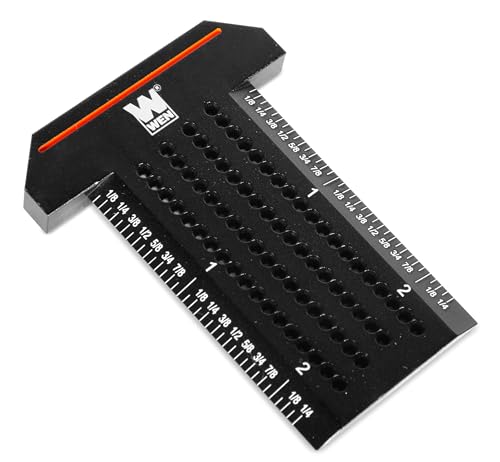
Best for: Marking mortises, hinge recesses and short parallel lines.
Similarly, WEN is a popular power tool brand, and the ME851R is a small marking T-ruler that fits in a pocket or the palm of your hand. In addition, WEN machines it from anodized aluminum on a CNC mill. More importantly for layout, it has 1 mm holes spaced every 1/32 inch (0.8 mm). So you can draw a line at an exact distance from an edge, then shift one hole and draw another.
In short, think of it as a short, low-cost entry into hole-style marking rules. However, it is not a drafting T-square, and it will not reach across a panel.
- Body: CNC-machined anodized aluminum
- Marking: 1 mm holes every 1/32 in
- Size: pocket-sized
Pros
- Easy to carry on site
- Low cost way to try hole marking
- Rust-resistant finish
Cons
- Short reach
- Few published dimensions
Skip it if: you need a full-length rule; choose the Woodpeckers or INCRA picks instead, because they reach farther.
How We Chose the Best T-Square Ruler Picks
We did not test these tools by hand. Instead, we compared published specifications on maker pages, such as Alvin’s T-square range, Johnson Level’s JTS48HD page and INCRA’s T-Rule page. We also read owner feedback for patterns, such as heads that loosen or scales that wear off.
Then, we scored each tool on five points:
- Fit for the job: blade length that matches a drawing board, a 4-foot sheet or a board edge.
- Scale quality: graduation size, readability and whether markings are bonded or engraved.
- Squareness: how the head joins the blade (riveted, cast or machined in one piece).
- Durability: blade thickness and finish.
- Brand support: established makers with published specs; we skipped unbranded listings.
Finally, we avoided overlap with our framing square and angle tool guides, so this list sticks to true T-squares and T-rules.
Drafting, Drywall or Woodworking: Which Type Do You Need?
Overall, all T-squares share one idea: a head that rides along a straight edge and a blade fixed at 90 degrees to it. However, the three types solve very different problems.
| Type | Typical length | Typical scale | Main job |
|---|---|---|---|
| Drafting / art T-square | 18 to 42 in (46 to 107 cm) | 1/16 in, sometimes mm | Parallel horizontal lines on a drawing board |
| Drywall T-square | 48 or 54 in (122 or 137 cm) | 1/8 or 1/16 in | Square knife cuts across gypsum board |
| Woodworking T-rule | 3 to 18 in (8 to 46 cm) | 1/32 to 1/64 in, or 1/4 mm | Marking lines parallel to a board edge |
For instance, a drafting T-square has a thin blade, so it lies flat and lets a pencil or pen run along the edge. In contrast, a drywall square has a thick blade so a utility knife cannot climb over it. Similarly, woodworking T-rules are short and precise, and many replace the printed edge with pencil holes. For a broader look at layout tools, read our guide to tools to measure length.
What Makes the Best T-Square Ruler Accurate
A T-square is a measuring tool, so judge it like one. Below are the specs that decide accuracy.
Squareness of head to blade: Every line you draw depends on this angle. In fact, an error that looks tiny at the head grows along the blade. For example, a 0.1 degree error moves the end of a 48-inch blade about 0.084 inch (2.1 mm). On a 24-inch blade, the same error is about 0.042 inch (1.1 mm). So, longer blades demand a stiffer joint.
Graduations: To begin with, drafting scales are in 1/16 inch (1.6 mm). Drywall squares often use 1/8 inch (3.2 mm), because a knife cut is not finer than that. Meanwhile, marking rules go to 1/32 inch (0.8 mm) or even 1/64 inch (0.4 mm). Also check whether marks are bonded, engraved or just printed, since printed marks wear first.
Blade thickness and edge: Generally, thin blades (around 1.6 mm) suit pens and pencils. In contrast, thick blades (3/16 to 1/4 inch, about 4.8 to 6.4 mm) suit knives. In addition, a beveled edge brings the scale closer to the surface, which cuts parallax error when you read it at an angle.
Units: Most US tools are inch-only, however. If you draw in millimeters, choose a metric rule such as the INCRA 300 mm, or use the converter below to translate lengths.
Blade Length Converter (Inches to cm and mm)
Use this tool to compare blade lengths and graduations across inch and metric tools. For instance, enter 48 to see a drywall square’s length in centimeters.
The math is exact: 1 inch equals 25.4 mm by definition. Therefore, a 24-inch T-square is 609.6 mm long, and a 1/32-inch hole spacing is 0.79375 mm. For more ways to measure, see our guide on how to measure length.
How to Check the Best T-Square Ruler for Square
Even the best T-square ruler can arrive out of square or get knocked out later. Fortunately, you can check it in a few minutes with only a pencil and a straight board edge.
- First, hold the head firmly against a straight edge of a drawing board or a factory-edge sheet.
- Next, draw a long, fine line along the blade with a sharp pencil.
- Then flip the T-square over, like turning a page, so the head rides the same edge from the other face.
- Now line the blade up with the start of your first line and draw a second line.
- After that, measure the gap between the two lines at the far end of the blade.
- Finally, halve that gap to get the real error, because the flip doubles it.
As a result, if the lines match, the tool is square. If not, a riveted or screwed head can sometimes be adjusted, but a cast or machined one should go back to the seller.
Do and Don’t for Daily Use
Honest Limits to Keep in Mind
A T-square only gives a square line when its head rides a straight edge. So, if your drawing board or the factory edge of a sheet is not straight, every line will follow the error. Also, a T-square marks right angles only. For miters, rafters and stair cuts, an adjustable square or a protractor-style tool is better.
In addition, no T-square removes reading error. Instead, read the scale straight on, use a sharp pencil, and mark with a fine tick rather than a thick line. Most of all, on a jobsite, measure twice before you cut, because a 1/8-inch scale cannot fix a wrong number.
Best T-Square Ruler FAQ
What is the best T-square ruler for beginners?
For most beginners, the Alvin ALT24 is a good first choice. It is light, 24 inches long and graduated in 16ths on both edges, so it works as a straightedge and a ruler.
What size T-square do I need?
First, match the blade to your work. For example, a 24-inch square suits most drawing boards, while drywall needs 48 inches to cross a 4-foot sheet in one pass.
Can I cut drywall with a drafting model?
No, it is not a good idea, because a thin drafting blade lets the knife ride over the edge, so use a thick drywall square such as the Johnson JTS48HD.
Is a T-square the same as a framing square?
No. A T-square has a head that rides along an edge, while a framing square is an L-shaped tool with two arms for layout and rafters.
How accurate is the best T-square ruler?
Above all, it depends on the head joint and the scale. Use the flip test to check squareness, and compare the scale with a trusted steel rule.
Is aluminum or wood better for the blade?
In general, aluminum resists warping and is easy to clean. On the other hand, wood blades with clear edges are pleasant for ink work, but they can warp if stored badly.
What is a T-rule in woodworking?
In short, a T-rule is a short marking rule with a small head. Many have pencil holes, so you can draw a line at an exact distance from an edge.
How do I store the best T-square ruler?
Ideally, hang it by the blade or lay it flat. Above all, never stand it on the head, because a fall can knock the joint out of square.
Does the best T-square ruler measure in metric?
Some do. Most US drafting and drywall squares are inch-only, so choose a metric rule such as the INCRA 300 mm T-Rule if you work in millimeters.
Why are my lines not parallel?
This happens because the head is not pressed firmly to the edge, or because the edge itself is not straight. Also check the tool with the flip test.
Bottom Line: Our Top Pick
For drafting, art and school use, the Alvin ALT24 is the best T-square ruler for most people, thanks to its thin aluminum blade and 1/16-inch scale on both edges. For drywall, choose the Johnson JTS48HD; for wood layout, choose the Woodpeckers Saddle T-Square.
1 thought on “Best T-Square Ruler for Drafting, Drywall and Woodworking (2026)”