

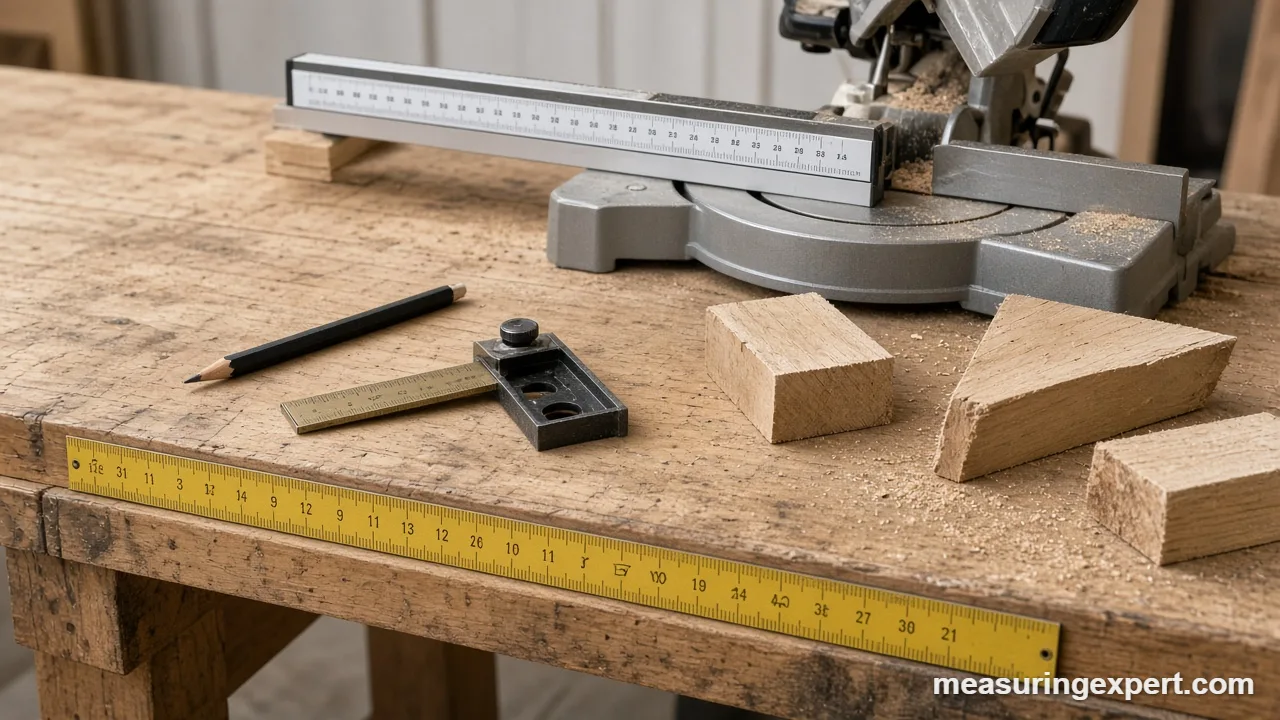
The best tape ruler for most shops is the Kreg KMS7723, a 12 ft self-adhesive steel scale with 1/16 in marks that cuts to length with scissors. However, the right pick depends on three things: which way the numbers must read, whether you need metric, and whether the strip should stay put or peel off.
In short: stick the Kreg on your bench or saw station, get the WIN TAPE strip on a tight budget, and choose the FastCap Standard/Metric tape if you work in both inches and millimeters.
As an Amazon Associate, Measuring Expert earns from qualifying purchases. Our picks are based on research, specifications and owner feedback, not paid placement.

Best Budget

Best Dual Scale
Quick Answer: The Best Tape Ruler for Each Job
- Workbench or miter station: Kreg KMS7723 (right-to-left) or its KMS7724 twin (left-to-right).
- Tight budget: WIN TAPE Workbench Ruler, a 24 in strip with inch and cm marks.
- Inches plus millimeters: FastCap Peel and Stick Standard/Metric tape.
- T-track jigs: Rockler Easy-Fit T-Track Tape Measure Insert Kit.
- Router table or sled: Starrett Tape Measure Stix S1, a 6 ft strip.
- Crafts and cutting mats: iCraft PeelnStick, which peels off cleanly.
- Classroom and labels: Scotch Expressions Ruler Print Masking Tape.
Looking for something else? A retractable blade lives in our best tape measure guide, and soft tapes for body sizes are in the best sewing measuring tape roundup. Meanwhile, jobsite tapes with wide standouts are covered in our construction measuring tape picks. This page sticks to flat rulers on a roll.
On This Page
- Comparison table
- The 7 picks, reviewed
- How we chose
- Tape ruler vs tape measure
- Specs that matter
- Length calculator
- How to install one
- Keeping it accurate
- Do and don’t
- Honest limits
- FAQ
- Bottom line
Best Tape Ruler Comparison Table
First, find the job that matches yours. Then check the standout feature, and finally jump to the full review.
| # | Product | Best For | Standout Feature | Amazon |
|---|---|---|---|---|
| 1 | Kreg KMS7723 Self-Adhesive Measuring Tape | Workbenches, miter saw stations and Kreg track setups | Steel, 1/16 in marks, cuts with scissors | View |
| 2 | WIN TAPE Workbench Ruler | Short bench scales and quick-check stations | Inch and cm on one 24 in strip | View |
| 3 | FastCap Peel and Stick Standard/Metric Tape | Shops that work in both inches and millimeters | Flat steel tape with SpeedTape adhesive | View |
| 4 | Rockler Easy-Fit T-Track Tape Measure Insert Kit | Jigs, fences and stop blocks that ride in T-track | Scale insert made to sit in track | View |
| 5 | Starrett Tape Measure Stix S1 | Router tables, sleds and small jigs | Wide 3/4 in strip, 6 ft long | View |
| 6 | iCraft PeelnStick Removable Ruler Tape | Cutting mats, craft tables and temporary layouts | Repeating 12 in inch + cm sections | View |
| 7 | Scotch Expressions Ruler Print Masking Tape | Classroom displays, labels and rough marking | Paper masking tape with ruler print | View |
The 7 Best Tape Ruler Picks, Reviewed
In short, each pick below fills a different role. So instead of seven versions of the same strip, you get one for each common setup, from a saw station to a classroom wall.
Best for workbenches
1. Kreg KMS7723 Self-Adhesive Measuring Tape
Best for: Miter saw stations, assembly benches and Kreg Top Trak setups where you want a long, permanent scale.
The Kreg KMS7723 is our pick as the best tape ruler for most shops. Specifically, it is a 12 ft steel strip, 1/2 in (13 mm) wide, with 1/16 in graduations. In addition, Kreg describes the surface as highly scuff-resistant, which matters on a bench where boards slide over it all day.
However, note the direction. According to Kreg’s KMS7723 page, this model reads right to left, while the KMS7724 reads left to right. Therefore, decide where your zero sits before you order. Also, Kreg says the tape fits the recess on top of its Top Trak and Heavy-Duty Trak, and you can trim it with scissors.
- Length: 12 ft (3.66 m)
- Width: 1/2 in (13 mm)
- Graduations: 1/16 in
- Material: steel with self-adhesive backing
- Reading: right to left (KMS7724 for left to right)
Pros
- Long 12 ft roll covers a full saw station
- Steel holds its length better than paper or vinyl
- Cuts with scissors, so trimming is easy
Cons
- Inch scale only
- Easy to order the wrong direction
- Adhesive is permanent once pressed down
Skip it if: You need metric marks, because this scale is inch-only.
Best on a budget
2. WIN TAPE Workbench Ruler
Best for: A short scale on a bench edge, a drill press table or a quick check station.
Simply put, the WIN TAPE Workbench Ruler is a basic adhesive-backed strip. Also, the listing gives it 24 in (61 cm) of length, with inch and centimeter marks that read right to left. As a result, it suits short measurements where you set the part against a stop on the right and read toward the left.
Because it is only 24 in long, though, think of it as a reference scale rather than a fence scale. For example, it works well on the front edge of a bench for checking dowels, cutoffs and hardware. However, it will not cover a long rip fence.
- Length: 24 in (61 cm)
- Scales: inches and centimeters
- Reading: right to left
- Mounting: adhesive backing
Pros
- Inch and metric on one strip
- Short length is easy to place straight
- Low cost way to add a bench scale
Cons
- Only 24 in long
- One reading direction
- Adhesive can weaken in dusty or oily shops
Skip it if: You want a scale for a full table saw rail, since you would need several strips end to end.
Best dual-scale tape
3. FastCap Peel and Stick Standard/Metric Tape
Best for: Cabinet shops and makers who read plans in millimeters but still think in inches.
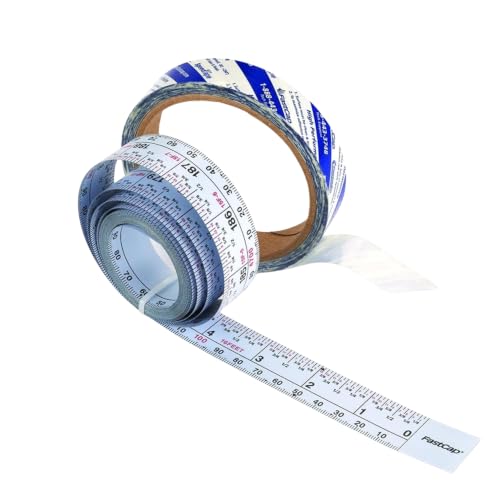
For context, FastCap is a well known name in cabinet shops, and its peel and stick tapes are a common fence upgrade. The FastCap Peel and Stick page describes a flat steel tape that comes with its own SpeedTape adhesive, sized so it does not hang over the edge. In addition, this version adds a metric scale, so you can switch systems without a conversion chart.
Also, a flat steel tape behaves like the blade in a regular tape measure. Therefore, it reads to the same fine marks, and it does not stretch the way vinyl can. Before you buy, though, confirm the length and reading direction on the listing, because FastCap sells several styles.
- Type: flat steel tape
- Scales: standard (inch) and metric
- Adhesive: FastCap SpeedTape, included
- Brand: FastCap, a cabinetmaking tool maker
Pros
- Inch and metric side by side
- Steel blade resists stretch
- Adhesive is sized to the tape
Cons
- Several styles make ordering confusing
- Stock can be spotty
- Two scales mean a busier face to read
Skip it if: You never use metric, since a single-scale strip is easier to read at a glance.
Best for T-track
4. Rockler Easy-Fit T-Track Tape Measure Insert Kit
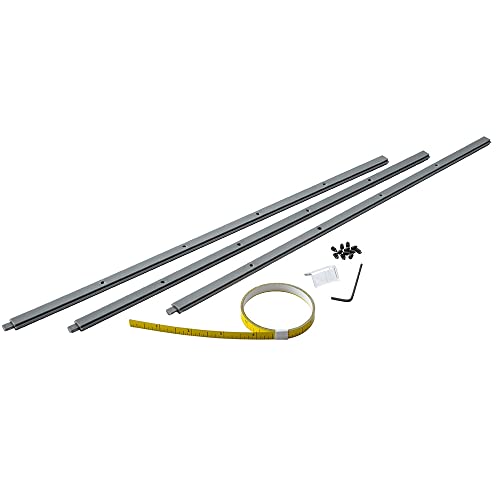
Best for: Drill press fences, router fences and stop blocks that already ride in T-track.
Rockler sells this kit as a scale insert for its T-track, and the listing names it a left-to-right model. In other words, the numbers grow as you move away from the zero on the left. If you build jigs around T-track, this is the cleanest way to add a scale, because the insert sits in the track rather than on a separate surface.
In addition, mounting the scale in the track keeps it right where the stop block slides. As a result, you read the stop position directly instead of measuring from the stop to the blade each time. Still, check the track profile you own first, since the kit is sized for a specific track.
- Type: tape measure insert for T-track
- Reading: left to right
- Brand: Rockler, a woodworking supply company
Pros
- Scale sits right where the stop slides
- Tidy fit on a T-track jig
- Saves measuring from stop to blade
Cons
- Only useful if you have matching track
- One reading direction
Skip it if: Your jigs use a plain wood fence, since a regular stick-on strip is simpler.
Best short strip
5. Starrett Tape Measure Stix S1
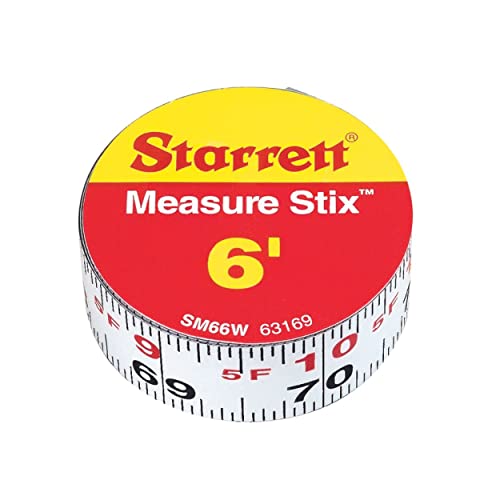
Best for: Router tables, crosscut sleds and other jigs where a 6 ft strip is plenty.
For reference, Starrett has made precision rules for well over a century, and the Tape Measure Stix line puts a tape scale on an adhesive strip. The S1 is 3/4 in wide and 72 in (6 ft, about 1.83 m) long, per the listing. Moreover, that extra width gives the numbers more room, so they are easier to read from a step back.
Also, a 6 ft strip is a sensible size for sleds and small fences. For example, you can cut it into two or three pieces for different jigs. Starrett also sells other Stix styles, such as the S12, so match the style to the reading direction you need.
- Size: 3/4 in x 72 in (19 mm x 1.83 m)
- Style: S1
- Mounting: adhesive strip
Pros
- Wide face for easy reading
- Handy 6 ft length for jigs
- Trusted maker of precision rules
Cons
- Style codes are not self-explanatory
- Too short for long saw rails
Skip it if: You need more than 6 ft of continuous scale, because the Kreg roll is twice as long.
Best removable
6. iCraft PeelnStick Removable Ruler Tape

Best for: Cutting mats, craft tables and temporary layouts that should not leave residue.
The iCraft PeelnStick roll is 1/2 in wide and 10 yd (about 9.1 m) long. The scale repeats every 12 in with inch and centimeter marks, and the roll has tear perforations every 12 in, per the listing. As a result, you can tear off exactly one foot at a time without scissors.
Above all, the key feature is the removable adhesive. As a result, you can stick it to a table edge, a shelf or a quilting frame, then move it later. However, a repeating scale restarts at zero every foot, so it is not meant for long continuous measurements.
- Roll: 1/2 in x 10 yd
- Scale: 12 in repeating, inch and cm
- Perforations: every 12 in
- Adhesive: removable
Pros
- Peels off without a fight
- Tears cleanly at each foot
- Long roll covers many tables
Cons
- Scale restarts every 12 in
- Not a steel scale, so less durable
- Narrow 1/2 in face
Skip it if: You need a long continuous scale for a saw fence.
Best for classrooms
7. Scotch Expressions Ruler Print Masking Tape
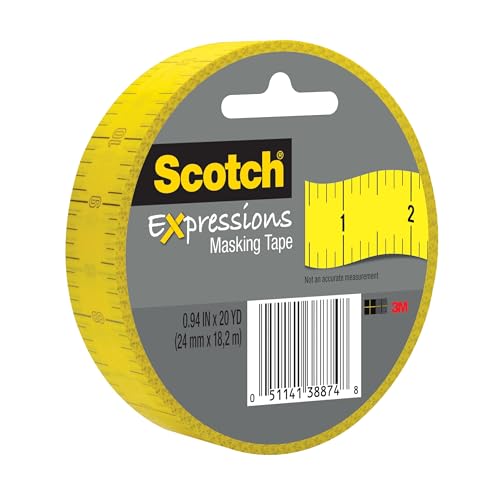
Best for: Teachers, kids’ projects, labels and rough layout on walls or floors.
In contrast, this is the only pick that is more decoration than instrument. Scotch makes it as yellow masking tape with a ruler print, 0.94 in wide and 20 yd long. Because it is paper masking tape, it tears by hand and comes off most smooth surfaces.
Instead, use it for growth charts, number lines, classroom tables and taped-out floor plans. However, do not cut wood to it. After all, paper can stretch as you pull it off the roll, so the printed inches may drift from true inches over a long run.
- Size: 0.94 in x 20 yd
- Material: paper masking tape
- Color: yellow with ruler print
Pros
- Tears by hand
- Fun and easy for kids
- Works for labels and layout
Cons
- Not a precision scale
- Paper can stretch while applying
Skip it if: Any measurement on it will turn into a cut, since a steel strip is far more reliable.
How We Chose the Best Tape Ruler Picks
To be clear, we did not test these strips by hand. Instead, our picks are research-based. First, we looked for established brands with clear model names. Next, we checked maker pages, such as Kreg and FastCap, for length, width, graduations and reading direction. Then we read owner feedback for patterns, such as adhesive failure, printing errors and stretch.
We also kept each pick distinct. So the list covers a long bench roll, a short budget strip, a dual-scale tape, a track insert, a jig strip, a removable craft roll and a classroom tape. Finally, we left out soft sewing tapes and retractable tapes, because they have their own guides. When we could not confirm a spec, we left it out.
Tape Ruler vs Tape Measure: Which Type Do You Need?
People use the two names loosely, so first it helps to split them by how they work. A tape ruler stays still, and the work comes to it. In contrast, a tape measure travels to the work. Next, the table below sorts the common types.
| Type | Material | Typical use | Strength | Weak spot |
|---|---|---|---|---|
| Stick-on steel tape | Steel | Saw stations, benches, fences | Holds length, fine marks | Permanent once stuck |
| Track insert | Steel or printed strip | T-track jigs and stops | Reads stop position directly | Needs matching track |
| Removable ruler tape | Paper or film | Crafts, mats, temporary layout | Moves without residue | Less durable |
| Ruler print masking tape | Paper | Classrooms, labels | Tears by hand | Not precise |
| Retractable tape measure | Steel blade | Rooms, lumber, site work | Portable, long reach | Hook play |
| Soft tape | Fiberglass or vinyl | Body and fabric | Wraps around curves | Can stretch |
If you need to measure things away from the bench, a retractable tape is still the right tool. Otherwise, a stick-on steel strip is the default choice for any fixed station.
Specs That Decide the Best Tape Ruler
Overall, a stick-on scale has fewer specs than a digital tool. Still, the few that exist decide whether it helps or hurts your work.
Reading direction
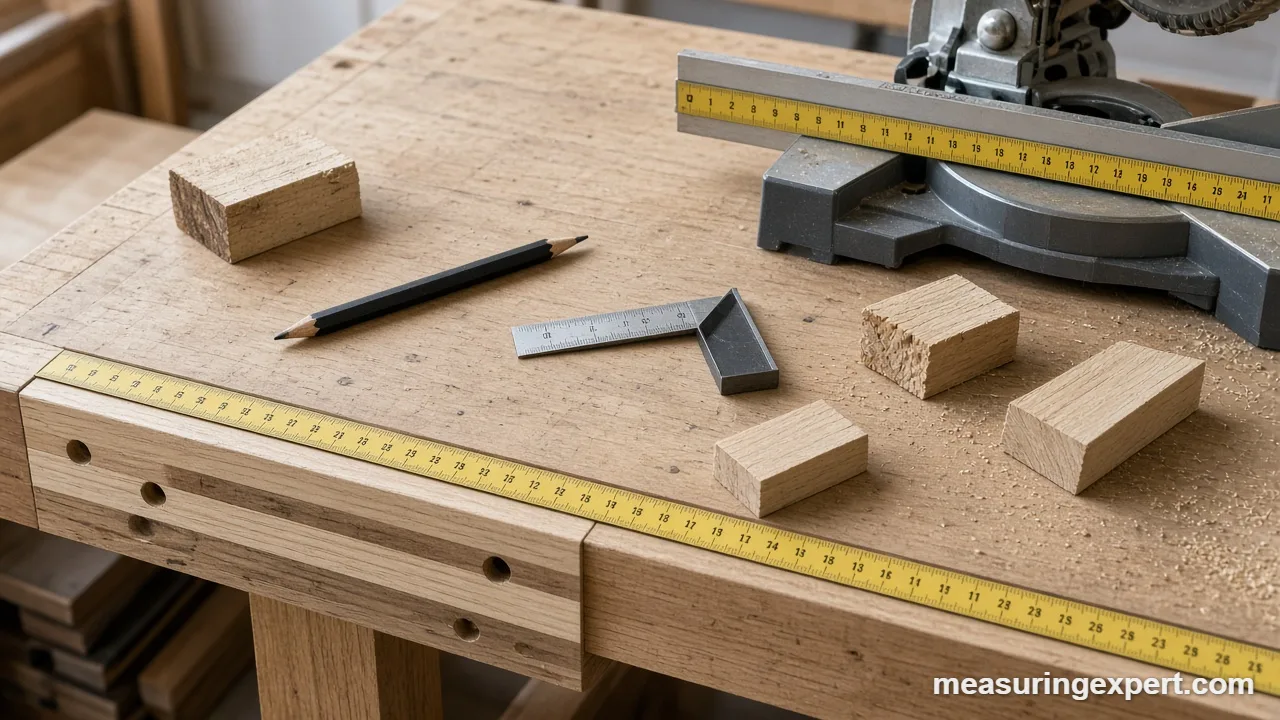
Left-to-right means the numbers grow toward the right. Similarly, right-to-left means they grow toward the left. So stand where you will read the scale, find your zero point, and pick the direction in which numbers grow as you move away from it. For example, a miter saw with a stop to the left of the blade needs a right-to-left scale on the left wing.
Graduations and resolution
Most steel strips mark every 1/16 in, which is about 1.6 mm. Meanwhile, some metric scales mark every millimeter. However, finer marks only help if your eyes and your cursor can use them. In practice, 1/16 in is the right step for most woodworking.
Width and backing
Narrow 1/2 in strips fit in track recesses and tight edges. On the other hand, wider 3/4 in strips have larger numbers, which are easier to read. Meanwhile, the backing decides how long the strip stays put: permanent adhesive for steel, removable adhesive for crafts.
Units and material
One inch is exactly 25.4 mm, as NIST explains on its length units page. Therefore, a dual scale is not a convenience trick, since both systems agree exactly. As for material, steel holds its length well, while paper and vinyl can stretch as you apply them. In addition, steel grows slightly with heat, by roughly 0.8 mm over 12 ft for a 20 C (36 F) swing, which is too small to matter in most shops.
Inch to Metric Length Calculator
For instance, use this calculator to convert a reading from your tape ruler into centimeters, millimeters or feet. For example, enter 24 in to check the length of a short bench strip.
To learn more about units, see our guide on how to measure length, or check a quick example such as 10 cm to inches.
How to Install the Best Tape Ruler on a Bench or Fence
In practice, a stick-on scale is only as accurate as its zero. So follow these steps, and take your time with the first few inches.
- Choose the reading direction so the numbers grow as you move away from the blade, bit or stop.
- Clean the surface with isopropyl alcohol and let it dry fully.
- Set a stop block or square at a known distance, such as exactly 10 in, from the blade or zero point.
- Then peel only the first few inches of backing and align that mark with your reference.
- Next, press the strip down a little at a time, using a straightedge to keep it straight.
- After that, trim the end with scissors or snips and round the cut corner.
- Finally, test cut a piece, measure it with a trusted rule and shift the cursor or strip if the cut is off.
Keeping a Stick-On Scale Accurate
Admittedly, a tape ruler has no battery or sensor, yet it can still drift out of true. Most often, however, the strip itself is fine, and the problem is the cursor, the stop or the blade.
- Check monthly: make a test cut, measure it with a trusted steel rule, and compare it to the scale.
- Recheck after changes: a new blade, a moved fence or a bumped stop can shift the zero.
- Wipe gently: use a dry cloth or a little mineral spirits, because harsh solvents can lift the print.
- Watch the edges: if a corner lifts, press it down or trim it before it catches and peels.
Also, adjust the cursor, not the strip, when you can. After all, moving a hairline cursor takes a minute, while moving an adhesive strip often ruins it.
Do and Don’t for Adhesive Rulers
Honest Limits of a Tape Ruler
Of course, even a good strip has limits. First, it is fixed, so it cannot measure a room or a curved part. Second, its accuracy depends on your install, so a crooked or offset strip adds the same error to every cut. Third, adhesives age, especially near heat, dust and finish overspray. Finally, a printed scale is not a calibrated standard, so for close tolerance work, check against a quality steel rule or a trusted tape blade on a regular basis.
Best Tape Ruler FAQ
What is the best tape ruler for a workbench?
For most benches, the best tape ruler is the Kreg KMS7723 or its left-to-right twin, the KMS7724. Also, both are 12 ft steel strips with 1/16 in marks and self-adhesive backing. However, if you also work in millimeters, the FastCap Standard/Metric tape is the better fit.
What is the difference between a tape ruler and a tape measure?
Basically, a tape ruler is a flat scale that stays in one place, usually stuck to a bench, fence or table. A tape measure is a retractable blade in a case that you carry to the work. In short, one is a fixed reference and the other is a portable tool.
Should I buy a left-to-right or right-to-left tape ruler?
In general, pick the direction in which the numbers grow as you move away from your zero point. For example, if the blade or stop is on the left and you measure toward the right, choose left-to-right. If you measure toward the left, choose right-to-left.
How accurate is the best tape ruler?
The printed scale on a good steel tape ruler is usually readable to 1/16 in (about 1.6 mm). In practice, though, accuracy depends more on how you install it. A strip set even a little off zero adds the same error to every cut, so check it against a known reference.
Can I cut a stick-on tape ruler to length?
Yes. Kreg says its steel tapes cut with scissors, and most steel and paper strips cut the same way. Also, file or round the cut corner so it does not catch fingers or rags.
Does the best tape ruler come in metric?
Yes. Several picks show both scales, including the FastCap Standard/Metric tape, the WIN TAPE strip and the iCraft roll. Since one inch is exactly 25.4 mm, a dual scale lets you check plans in either system without a calculator.
How do I remove an adhesive tape ruler without residue?
First, warm the strip with a hair dryer for about a minute to soften the adhesive. Next, peel it back slowly at a low angle. Finally, clean any residue with mineral spirits or an adhesive remover that is safe for your surface.
Is ruler print masking tape accurate enough for woodworking?
No, not for cuts. Masking tape is paper, so it can stretch, wrinkle or shift as you apply it. Instead, use it for labels, rough layout and classroom displays, and use a steel tape ruler for anything you will cut to.
Is the best tape ruler good for sewing?
Of course, a stick-on tape ruler works well on a cutting table or a sewing cabinet edge. However, it cannot wrap around a body. So for body and garment measurements, use a soft sewing tape instead.
What length of best tape ruler should I buy for a table saw?
First, measure the longest rip you plan to make and add a little. For example, a 12 ft roll covers most front rails with spare length for a miter station. Meanwhile, a 24 in or 6 ft strip suits router tables, sleds and small jigs.
Bottom Line: The Best Tape Ruler to Buy
For most benches and saw stations, the Kreg KMS7723 Self-Adhesive Measuring Tape is the best tape ruler, thanks to its 12 ft steel roll and 1/16 in marks. Alternatively, order the KMS7724 if you need left-to-right reading. Meanwhile, choose the FastCap tape for metric, and the iCraft roll for crafts.