

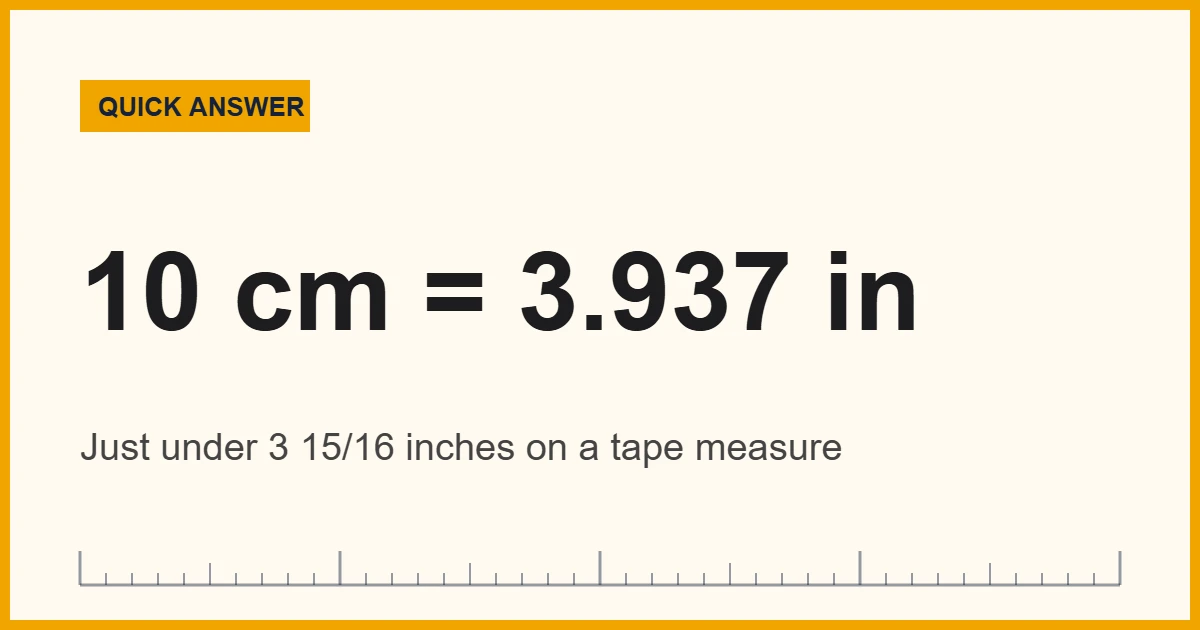
10 cm equals exactly 3.937 inches (3.93700787 in to be precise), because one inch is exactly 2.54 centimeters, so you simply divide 10 by 2.54. On a tape measure, it sits just a hair short of 3 15/16 inches. It is also 100 millimeters, about 0.328 feet, or about 0.109 yards.
Convert 10 cm (or Any Length) to Inches
Want a different number? First, type any value in the box below and choose your unit. The converter then uses the exact inch definition and also shows the nearest 1/16-inch fraction, so you can find the mark on a ruler right away.
For example, centimeters show up everywhere: on product boxes, sewing patterns, school rulers, medical charts and almost every item made outside the United States. Inches, meanwhile, still rule American tape measures and hardware stores. So a quick, reliable way to move between the two saves a lot of second-guessing.
The good news, however, is that this conversion is not an estimate. In fact, since July 1, 1959, the inch has been exactly 25.4 millimeters, which makes it exactly 2.54 cm. The US National Institute of Standards and Technology (NIST) explains this on its SI units of length page, noting that the inch comes from the 1959 yard and is exactly equivalent to 25.4 mm. As a result, every centimeter-to-inch answer on this page comes from one division.
In the sections below, you will first find a chart from 1 to 30 cm. After that, you will see how to find this length on an inch ruler, which everyday objects come close to that length, and finally where rounding can trip you up.
How the 10 cm to Inches Math Works
In short, the formula is: inches = centimeters / 2.54. Therefore, for ten centimeters you get 10 / 2.54 = 3.937007874… inches. The decimal keeps going, so most people round it to 3.94 inches, or 3.937 inches when they need a bit more precision.
Similarly, going the other way is just as easy. That is, multiply inches by 2.54 to get centimeters. For example, 4 inches is 10.16 cm, which is why this length feels like “almost 4 inches” when you hold a ruler.
| Ten centimeters expressed as | Value | How it is calculated |
|---|---|---|
| Inches (exact decimal) | 3.93700787 in | 10 / 2.54 |
| Inches (nearest 1/16) | 3 15/16 in (3.9375 in) | 3.937 x 16 = 62.99, so 63/16 |
| Millimeters | 100 mm | 10 x 10 |
| Meters | 0.1 m | 10 / 100 |
| Feet | 0.328 ft | 3.937 / 12 |
| Yards | 0.109 yd | 3.937 / 36 |
In addition, notice how close the fraction is. Three and fifteen-sixteenths of an inch equals 10.0013 cm, so the error is about one hundredth of a millimeter. In practice, no tape measure or ruler can show a gap that small.
10 cm and Other Values: Centimeters to Inches Chart
Specifically, this chart covers 1 to 30 cm, the range of a standard school ruler. Moreover, each decimal value is rounded to three places, and the fraction column shows the nearest 1/16 inch. Also, feel free to print this page and keep the chart near your workbench or sewing table.
| 1 to 10 cm | 11 to 20 cm | 21 to 30 cm |
|---|---|---|
| 1 cm = 0.394 in (3/8) | 11 cm = 4.331 in (4 5/16) | 21 cm = 8.268 in (8 1/4) |
| 2 cm = 0.787 in (13/16) | 12 cm = 4.724 in (4 3/4) | 22 cm = 8.661 in (8 11/16) |
| 3 cm = 1.181 in (1 3/16) | 13 cm = 5.118 in (5 1/8) | 23 cm = 9.055 in (9 1/16) |
| 4 cm = 1.575 in (1 9/16) | 14 cm = 5.512 in (5 1/2) | 24 cm = 9.449 in (9 7/16) |
| 5 cm = 1.969 in (1 15/16) | 15 cm = 5.906 in (5 7/8) | 25 cm = 9.843 in (9 13/16) |
| 6 cm = 2.362 in (2 3/8) | 16 cm = 6.299 in (6 5/16) | 26 cm = 10.236 in (10 1/4) |
| 7 cm = 2.756 in (2 3/4) | 17 cm = 6.693 in (6 11/16) | 27 cm = 10.630 in (10 5/8) |
| 8 cm = 3.150 in (3 1/8) | 18 cm = 7.087 in (7 1/16) | 28 cm = 11.024 in (11) |
| 9 cm = 3.543 in (3 9/16) | 19 cm = 7.480 in (7 1/2) | 29 cm = 11.417 in (11 7/16) |
| 10 cm = 3.937 in (3 15/16) | 20 cm = 7.874 in (7 7/8) | 30 cm = 11.811 in (11 13/16) |
Is a 30 cm Ruler a Full Foot?
Also, notice that 30 cm is a little shorter than a foot. Because a foot is 30.48 cm, a 30 cm ruler comes up about 1/2 cm short of 12 inches. For bigger values in feet, see our guide to how many feet 60 inches is.
Everyday Objects That Are About 10 cm Long
After all, numbers are easier to picture when you can compare them with something in your hand. However, most household items only come close, so treat these as reference points, not exact gauges.
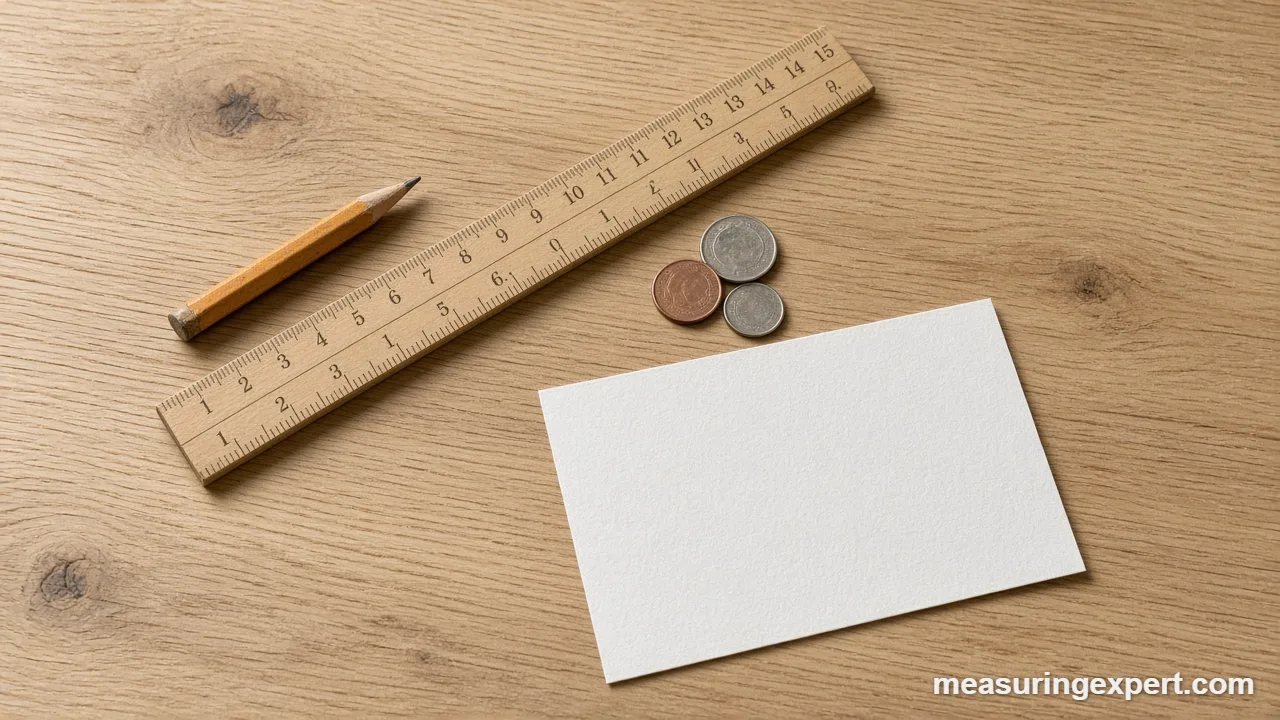
- The short side of a 4 x 6 photo. Indeed, four inches is 10.16 cm, just 1.6 mm longer.
- Four US quarters in a row. For instance, the US Mint lists the quarter at 0.955 inch (24.26 mm) across, according to its coin specifications. So four quarters edge to edge measure about 9.7 cm.
- Five pennies in a row. A penny is 19.05 mm wide, so five of them span about 9.5 cm.
- A credit card, plus a little. Standard bank cards are 85.6 mm long, so ten centimeters is roughly a card and a half-inch more.
- A CD or DVD, minus a bit. Discs are 12 cm across, so ten centimeters covers about five-sixths of the width.
Similarly, many adult palms measure somewhere around 8 to 9 cm across the knuckles. Still, hands vary a lot, so use your own palm only for rough estimates.
Recommended Tools for Measuring Centimeters and Inches
Above all, a dual-scale ruler or tape takes the conversion out of the job. First, look for one with centimeters on one edge and inches in 1/16 steps on the other. Next, check that the markings are printed or etched clearly and start right at the end of the blade. Finally, a digital caliper helps when you need millimeter precision on small parts.


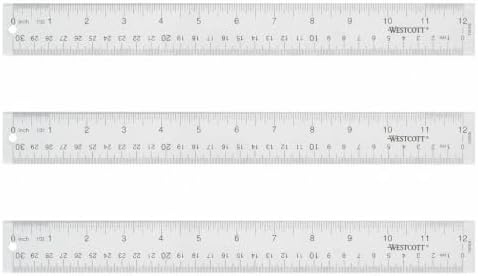
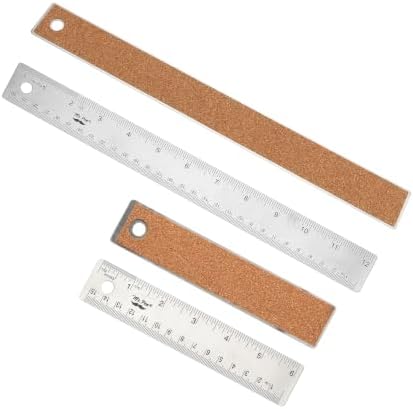
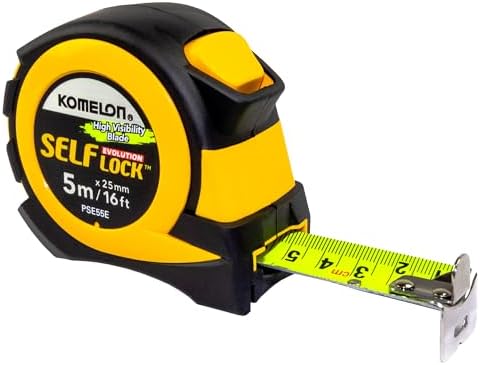
As an Amazon Associate, Measuring Expert earns from qualifying purchases.
10 cm, 10 mm and 10 Inches: Common Mix-Ups
In fact, most conversion errors come from reading the wrong unit, not from bad arithmetic. For instance, a ruler shows centimeters as numbered lines and millimeters as the small ticks between them, so one slip changes a length by a factor of ten.
| People confuse | Actual size | In inches |
|---|---|---|
| 10 mm (1 cm) | One numbered space on a cm ruler | about 0.394 in (3/8 in) |
| 10 cm (100 mm) | Ten numbered spaces | about 3.937 in (3 15/16 in) |
| 10 inches | 25.4 cm | 10 in |
| 1 decimeter (dm) | Same as 100 mm | about 3.937 in |
How to Measure 10 cm With an Inch Ruler
No metric ruler nearby? You can still mark it very closely with an ordinary inch ruler or tape. Here is how:
- Find the 3-inch mark. First, start from the zero end of the ruler, not the edge of the case or hook.
- Count on to the 3 7/8 line. In other words, it sits two small ticks before the 4-inch line.
- Move one more sixteenth. Then the next small tick is 3 15/16 inches, which equals 10.0013 cm.
- Mark it with a sharp pencil. Of course, a thin line keeps the error smaller than the line itself.
- Check against 4 inches. Finally, your mark should sit just 1/16 inch (1.6 mm) before the 4-inch line.
- Use the converter for other lengths. Likewise, enter any centimeter value above to get the nearest 1/16 mark.
Converting Centimeters: Do and Don’t
Do
- Divide by 2.54 for an exact inch value.
- Round to 3 15/16 in when using an inch tape.
- Read the ruler straight on, not at an angle.
- Keep extra decimals until the final step.
- Write the unit next to every number.
Don’t
- Treat ten centimeters as a full 4 inches for precise work.
- Confuse the mm ticks with the cm numbers.
- Measure from the worn end of an old ruler.
- Round twice when converting back and forth.
- Assume a 30 cm ruler is a full foot.
Honest Limits of Metric to Inch Conversions
The math itself is exact, but real measurements are not. For one thing, most household rulers have a resolution of 1 mm or 1/16 inch. So any reading carries about half of that as possible error. Moreover, printed rulers can stretch or shrink slightly with heat, and cheap tapes may be off by a millimeter over their length.
Rounding, on the other hand, is the other trap. If you round it to 4 inches and then convert back, you end up with 10.16 cm. Then do that across several pieces, and the error adds up quickly. In short, keep the decimal value (3.937 in) in your notes and only round when you finally mark or cut.
When an Exact Measurement Matters
For crafts or a quick sketch, of course, “about 4 inches” is fine. However, a few jobs need the real number:
- Sewing and quilting. Seam allowances and pattern pieces repeat, so small errors stack up across a garment.
- Woodworking and 3D printing. For example, a 1.6 mm gap can stop a joint or a printed part from fitting.
- Health readings. Also, clinics record many body measurements in centimeters. In that case, rely on the numbers your provider gives you rather than converting them yourself.
10 cm in Inches: Frequently Asked Questions
How many inches is 10 cm exactly?
Exactly 3.937007874 inches, because 10 divided by 2.54 gives that value. However, most people round it to 3.94 inches.
Is 10 cm the same as 4 inches?
No. Four inches is 10.16 cm, so 10 cm is about 1.6 mm (1/16 inch) shorter than 4 inches.
What is 10 cm as a fraction of an inch?
The closest 1/16-inch fraction is 3 15/16 inches. That fraction equals 10.0013 cm, so it is almost perfect.
How many millimeters are in ten centimeters?
There are 100 millimeters in 10 centimeters, since each centimeter holds 10 millimeters.
How many feet is ten centimeters?
About 0.328 feet. Divide 3.937 inches by 12 to get the value in feet.
What everyday object is about ten centimeters long?
The short side of a 4 x 6 photo is close, at 10.16 cm. Four US quarters lined up edge to edge also measure about 9.7 cm.
How do I convert centimeters to inches?
First, divide the centimeter value by 2.54. For example, 25 cm / 2.54 = 9.843 inches.
How do I convert inches to centimeters?
Likewise, multiply the inch value by 2.54. So 6 inches x 2.54 = 15.24 cm.
Is ten centimeters bigger than 3 inches?
Yes. Three inches is 7.62 cm, so ten centimeters is about 2.38 cm (just under 1 inch) longer.
Why is an inch exactly 2.54 cm?
In 1959, the US and other English-speaking countries agreed on a common yard of exactly 0.9144 meter. As a result, the inch became exactly 25.4 mm.
The Bottom Line
To sum up, 10 cm equals 3.937 inches, which is just under 4 inches and almost exactly 3 15/16 inches on a tape measure. The value never changes, because the inch has been exactly 2.54 cm since 1959.
So when you need a different length, divide centimeters by 2.54, or simply use the converter at the top of this page. In addition, it gives you the decimal and the nearest ruler fraction in one step.