

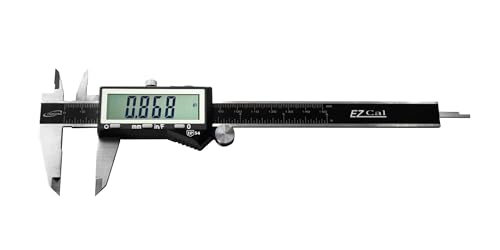
The best caliper for most people is the iGaging IP54 Digital Caliper 0-6 inch, because it reads inches, millimeters and fractions, resists dust and splashes, and is rated to 0.001 in. Still, the right type depends on three things: whether you want a battery, how far you must reach, and how wet your shop gets.
In short: get the iGaging IP54 for all-round work, the Mitutoyo 505-742J for a battery-free dial, and the WEN 10764 if money is tight.
As an Amazon Associate, Measuring Expert earns from qualifying purchases. Our picks are based on research, specifications and owner feedback, not paid placement.
Best Overall
Best Dial
Best Budget

Best Caliper Picks at a Glance
- iGaging IP54 0-6 in: the all-rounder, with fractions and dust and splash sealing.
- Mitutoyo 505-742J: a 0.001 in dial caliper that never needs a battery.
- WEN 10764: an IP54 digital caliper at an entry-level price.
- Mitutoyo 530-104: a dual-scale vernier with no gears or electronics.
- Starrett 798A-12/300: a 12 in IP67 caliper for coolant-soaked shops.
- Fowler 52-008-712 and iGaging 24 in: extra reach for big parts, in dial and long-jaw digital form.
- NEIKO 01407A: a simple first caliper with a 1/128 in fraction mode.
On This Page
- Comparison table
- The 8 picks, reviewed
- How we chose
- Caliper types compared
- Specs in plain terms
- Reading vernier and dial scales
- How to measure with a caliper
- Millimeter to inch converter
- Calibration and care
- Where calipers fall short
- FAQ
- The verdict
Compare Every Best Caliper Pick
First, scan this table for the type and reach you need. Then jump to the matching review below.
| # | Product | Best For | Standout Feature | Amazon |
|---|---|---|---|---|
| 1 | iGaging IP54 Digital Caliper 0-6 in | Most buyers | IP54, inch/mm/fraction display | View |
| 2 | Mitutoyo 505-742J Dial Caliper | Battery-free precision | 0.001 in dial, 0.1 in per turn | View |
| 3 | WEN 10764 Digital Caliper | Tight budgets | IP54 at an entry price | View |
| 4 | Mitutoyo 530-104 Vernier Caliper | Lifetime toolbox caliper | Dual 0.05 mm and 1/128 in scales | View |
| 5 | Starrett 798A-12/300 IP67 Caliper | Wet shops, 12 in parts | IP67 inductive encoder | View |
| 6 | Fowler 52-008-712 Premium Dial Caliper | Large parts, no battery | Shockproof 12 in dial | View |
| 7 | iGaging Absolute Origin Heavy Duty 24 in | Very large parts | 24 in reach, absolute origin | View |
| 8 | NEIKO 01407A Digital Caliper | First-time buyers | Fractions to 1/128 in | View |
The 8 Best Caliper Choices, Reviewed
This list spans every common caliper type: digital, dial, vernier and long-jaw. So the versatile tools come first, and the specialists follow. If you already know you want an electronic model, our best digital caliper guide goes deeper on that type.
Best Overall
1. iGaging IP54 Digital 0-6 in
Best for: home shops, makers and machinists who want one caliper that handles almost everything.
In short, this is the tool we would hand to most readers first. It reads decimal inches, millimeters and fractions, so it suits both metalwork and woodwork. In addition, the IP54 rating means the head resists dust and splashing water. This matters in a garage, because sawdust and damp air are common there.
iGaging lists its 6-inch IP54 calipers at 0.0005 in (0.01 mm) resolution, 1/128 in in fraction mode and 0.001 in (0.02 mm) accuracy. Also, a single CR2032 cell powers the display. So for everyday jobs, from drill bits to bolt diameters, it gives shop-grade readings without a pro price.
- Range: 0 to 6 in (0 to 150 mm).
- Display: decimal inch, mm and fractions to 1/128 in.
- Resolution: 0.0005 in (0.01 mm); rated accuracy 0.001 in (0.02 mm).
- Protection: IP54 against dust and splashes.
- Power: one CR2032 cell.
Pros
- Three reading modes cover metric, decimal and fractional work.
- IP54 sealing for dusty or damp shops.
- Also, published accuracy matches many pricier tools.
Cons
- Still needs a battery, unlike a dial or vernier.
- Also, a capacitive scale can misread when soaked.
Skip it if: you measure parts wet with coolant all day; the Starrett 798A-12 is built for that.
Best Dial
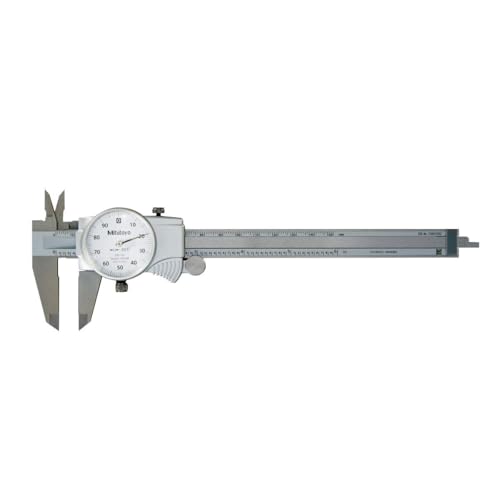
2. Mitutoyo 505-742J Dial
Best for: machinists and mechanics who want a fast analog readout that never needs a battery.
A dial caliper adds a gear rack and a needle to a plain beam. As a result, you read whole tenths of an inch on the beam and thousandths on the dial. Of these, Mitutoyo’s 505-742 is a classic. Its needle makes one full turn per 0.1 in of travel, so each of the 100 dial marks equals 0.001 in.
Mitutoyo rates it at plus or minus 0.001 in over 0 to 6 in. Moreover, distributors describe a high-shock-protection dial movement, a smooth slide and lock screws for both the bezel and the slider. Because there is no electronics, it works the moment you pick it up. For more analog options, see our full best dial caliper guide.
- Range: 0 to 6 in.
- Graduation: 0.001 in; 0.1 in per dial revolution.
- Accuracy: plus or minus 0.001 in.
- Measures outside, inside, depth and step.
- Lock screws for the bezel and the slide.
Pros
- No battery, ever.
- Needle makes trends easy to spot while you adjust a part.
- Respected maker with a long service record.
Cons
- Inch only; there is no metric scale on this model.
- A hard drop or grit in the rack can upset the dial.
Skip it if: you work mostly in millimeters; a digital model switches units with one press.
Best Budget
3. WEN 10764 Digital
Best for: DIYers, students and 3D printer owners who want a sealed digital caliper for little money.
Typically, cheap calipers skip any dust or water rating. However, the WEN 10764 carries IP54, which is rare at this level. So it copes better with a dusty bench or a damp garage than most entry tools. It also ships with a storage case and a two-year warranty.
The display steps in 0.0005 in and switches between inches and millimeters. Meanwhile, a CR2032 cell runs it. WEN does not publish an accuracy figure on the listing we checked, so check it against a known reference before you trust it on close-fit work.
- Range: 0 to 6 in (0 to 150 mm).
- Resolution: 0.0005 in.
- Protection: IP54 against splashes, oil and dust.
- Power: one 3 V CR2032 cell.
- Includes a case; two-year warranty.
Pros
- IP54 at an entry-level price.
- Simple inch and mm switching.
- Also, the warranty beats many rivals in this class.
Cons
- No published accuracy spec.
- No fraction mode for woodworkers.
Skip it if: you need a stated accuracy for paid or inspected work.
Best Vernier
4. Mitutoyo 530-104 Vernier

Best for: students, hobby machinists and anyone who wants a caliper with no gears and no battery.
In fact, a vernier is the oldest and simplest caliper design. It uses two engraved scales instead of a dial or a screen. Therefore, nothing can run flat, skip a tooth or short out. Mitutoyo’s 530-104 reads 0.05 mm on its metric scale and 1/128 in on its inch scale.
Mitutoyo rates it at plus or minus 0.05 mm over 0 to 150 mm. In addition, the vernier plate is set at a shallow angle to cut parallax, and a lock screw holds the slide. Reading it takes practice; however, the skill also helps you read any other scale. Our step-by-step reading guide is further down this page.
- Range: 0 to 150 mm (0 to 6 in).
- Graduation: 0.05 mm and 1/128 in.
- Accuracy: plus or minus 0.05 mm.
- Slide lock screw; stainless steel.
Pros
- Nothing to break, charge or replace.
- Teaches real scale-reading skills.
- Also very compact in a toolbox.
Cons
- Slow to read and hard on tired eyes.
- Coarser than a 0.01 mm digital readout.
Skip it if: you take dozens of readings a day; a digital or dial model is far faster.
Best Pro
5. Starrett 798A-12/300 IP67

Best for: production machinists who need a 12-inch reach and readings that survive coolant.
Most digital calipers sense position with a capacitive scale, and water upsets that design. By contrast, the Starrett 798A uses an induction-type linear encoder. As a result, coolant, chips and dust affect it far less. The IP67 rating also means it can survive short immersion.
Starrett rates it at plus or minus 0.001 in over the full 0 to 12 in range. In metric, accuracy is plus or minus 0.02 mm up to 100 mm and 0.03 mm beyond that. It also has a fine adjustment, a slide lock, zero at any position and a 30-minute auto-off. Finally, its outside jaws reach about 2.5 in (63.5 mm) deep.
- Range: 0 to 12 in (0 to 300 mm).
- Resolution: 0.0005 in (0.01 mm).
- Accuracy: plus or minus 0.001 in; 0.02 to 0.03 mm.
- Protection: IP67 against coolant, water and dust.
- Outside jaw depth: about 2.5 in (63.5 mm).
Pros
- Sealed and coolant-proof.
- Holds 0.001 in accuracy across 12 in.
- Fine adjust and slide lock for repeat checks.
Cons
- Costs several times more than hobby calipers.
- Also, a 12-inch beam is clumsy for small parts.
Skip it if: you only measure dry parts under 6 in; the iGaging covers that for far less.
Best 12-Inch Dial
6. Fowler 52-008-712 Premium Dial

Best for: fabricators, woodworkers and mechanics who measure stock longer than 6 in.
After all, a 6-inch caliper runs out of room fast on lumber, pipe or engine parts. So Fowler’s premium dial model doubles the reach to 12 in (304.8 mm). Like the Mitutoyo, its needle turns once per 0.1 in, with 0.001 in marks. In addition, Fowler says the shockproof design prevents dial backlash.
Fowler rates it at plus or minus 0.002 in, which is typical for a longer beam. Also, it has four-way jaws, a thumb roll for quick setting and a knurled lock. For close-tolerance parts, hold the part near the beam, because long jaws magnify any tilt.
- Range: 0 to 12 in.
- Graduation: 0.001 in; 0.1 in per revolution.
- Accuracy: plus or minus 0.002 in.
- Shockproof dial, knurled lock and thumb roll.
- Solid stainless steel; case included.
Pros
- Twice the reach of a standard caliper.
- No battery to fail mid-job.
- Also, the lock holds a setting for repeat checks.
Cons
- Looser accuracy than the 6-inch tools.
- Inch only, so metric work needs math.
Skip it if: you rarely measure past 6 in; the shorter Mitutoyo dial is lighter and tighter.
Best Long-Jaw
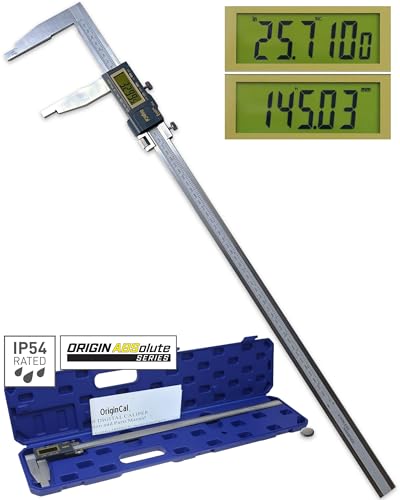
7. iGaging Absolute Origin Heavy Duty 24 in
Best for: welders, millwrights and pattern makers who measure big castings, plate and pipe.
Long-jaw calipers fill the gap between a tape measure and a 12-inch caliper. For example, this heavy-duty iGaging reaches 24 in (609.6 mm). Its jaws are also much longer than those of a 6-inch tool, so it can reach past flanges and lips. Moreover, the absolute origin scale remembers zero after power-off.
iGaging lists 0.0005 in (0.01 mm) resolution, IP54 sealing and an SPC/USB data port. However, distributor sheets quote accuracy between 0.001 in and 0.002 in (0.02 to 0.05 mm). So plan around the looser figure over the full length. It runs on a CR2032 cell.
- Range: 0 to 24 in (0 to 600 mm).
- Resolution: 0.0005 in (0.01 mm).
- Absolute origin scale; inch and metric modes.
- Protection: IP54.
- Data: SPC/USB output port.
Pros
- Reaches parts no 12-inch caliper can.
- Keeps its origin when switched off.
- Also logs readings through the data port.
Cons
- Heavy, and awkward for one-hand use.
- Long beams flex, so technique matters.
Skip it if: your parts fit within 12 in; a shorter caliper is easier to hold square.
Best for Beginners
8. NEIKO 01407A Digital
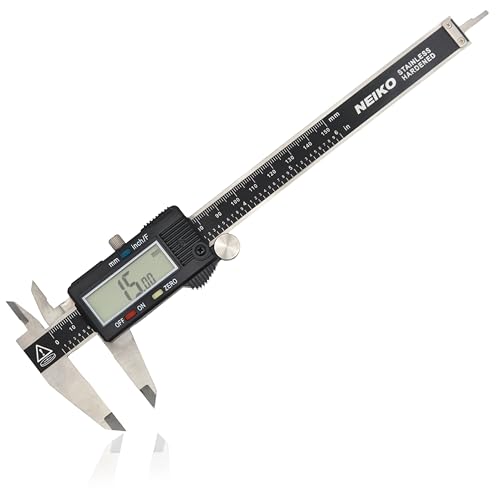
Best for: beginners and hobbyists who want a simple stainless caliper with a fraction readout.
For years, the NEIKO has been a common first caliper, and for good reason. First, it measures outside, inside, depth and step sizes over 0 to 6 in (0 to 150 mm). In addition, it switches between decimal inches, millimeters and fractions down to 1/128 in, or about 0.2 mm.
The display steps in 0.0005 in (0.01 mm), and NEIKO claims 0.001 in (0.02 mm) accuracy. Also, it runs on an LR44 cell, and a spare comes in the box. However, some owners report that it wakes in the case and drains the cell. So remove the battery if it will sit for weeks.
- Range: 0 to 6 in (0 to 150 mm).
- Units: inch, mm and fractions to 1/128 in.
- Resolution: 0.0005 in (0.01 mm).
- Power: LR44 cell, with a spare.
Pros
- Fraction mode for tape-measure thinking.
- Easy to learn.
- Also includes a fine adjustment roller.
Cons
- No dust or splash rating.
- Some units drain the battery in storage.
Skip it if: you work in dusty or damp places; the iGaging or WEN have IP54 sealing.
How We Chose the Best Caliper for Each Job
To be clear, we did not run hands-on lab tests. Instead, these picks are research-based. First, we listed calipers of every type from established makers such as Mitutoyo, Starrett, iGaging, Fowler, WEN and NEIKO. Next, we read manufacturer and distributor spec sheets and kept only the specs we could confirm there. Finally, we weighed long-term owner feedback on drift, battery drain and build quality.
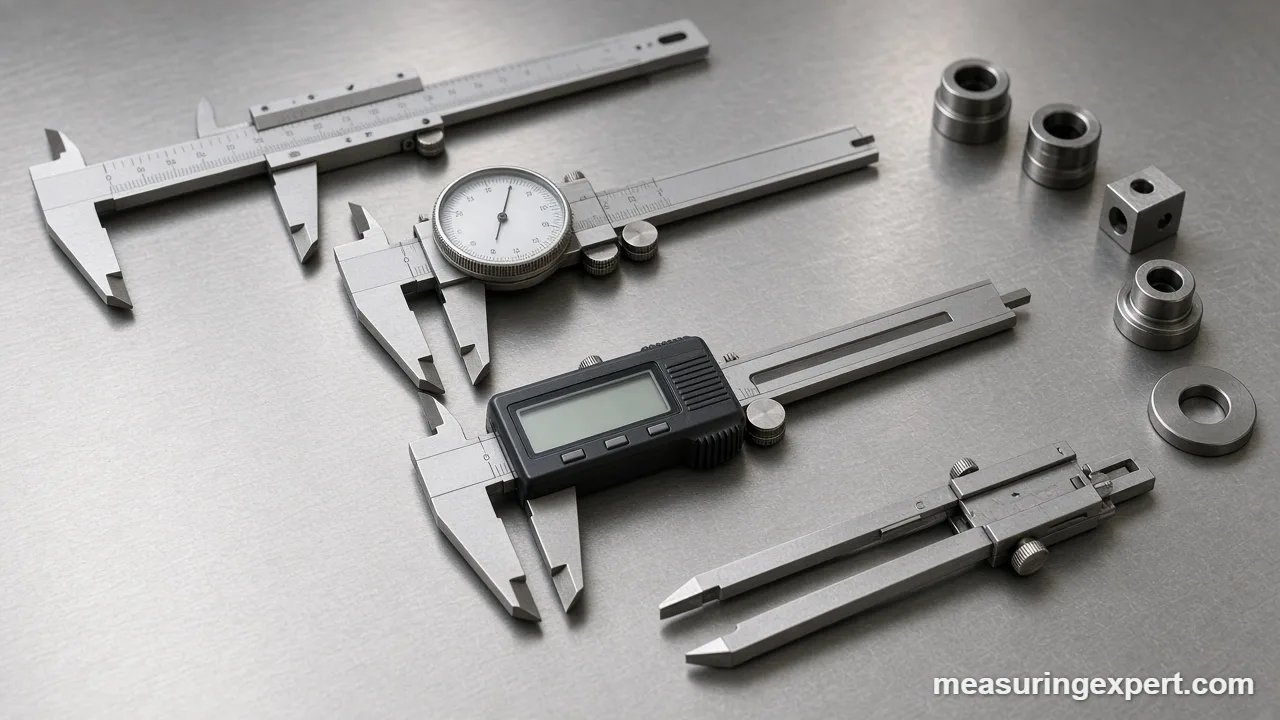
We then scored each tool on published accuracy, graduation, range, jaw reach, sealing and power. We also capped the list at two models per brand and dropped unbranded clones. In addition, we made sure each slot covers a different need, so you will not find two near-identical tools here. For background, we used the scope of ASME B89.1.14, the US standard for specifying and calibrating vernier, dial and digital calipers.
Vernier, Dial, Digital or Long-Jaw: Finding the Best Caliper Type
In general, all four types take the same four measurements: outside, inside, depth and step. However, they differ in how you read them and what can go wrong. So match the type to your habits, not just your budget.
| Type | Typical graduation | Power | Best at | Watch out for |
|---|---|---|---|---|
| Vernier | 0.02 to 0.05 mm; 0.001 in or 1/128 in | None | Rough use, long storage, teaching | Slow reading, parallax |
| Dial | 0.001 in or 0.02 mm | None | Fast analog readings, spotting trends | Rack damage from drops or grit |
| Digital | 0.0005 in or 0.01 mm | Button cell or rechargeable | Speed, unit switching, zero anywhere | Dead cells; liquid on capacitive scales |
| Long-jaw | Same as its readout type | Depends on readout | Big parts, reaching past flanges | Beam flex and tilt error |
For most people, a digital model is the easiest to learn. In contrast, a vernier or dial lives happily in a drawer for years and works the moment you pick it up. Meanwhile, long-jaw tools are specialists; buy one only when your parts demand it. For a wider view of length tools, read our guide to measuring length.
Key Specs Explained in Plain Terms
A caliper is a tool for linear measurement. Even so, the numbers on the box can mislead you. Here is what each spec really tells you.
- Graduation or resolution: the smallest step you can read, such as 0.01 mm. However, it is not the same as accuracy.
- Accuracy: how close the reading sits to the true size. For example, 6 in tools are often rated at 0.001 in, while 12 in tools are often rated at 0.002 in.
- Range: the largest size the jaws can open to. Also note that longer beams flex more.
- Jaw depth: how far the jaws reach from the beam. Therefore, deep jaws suit wide flanges and thick walls.
- Scale type: incremental digital scales need a fresh zero. In contrast, absolute scales remember the origin.
- IP rating: IP54 means dust protected and splash resistant. Similarly, IP67 means dust tight and safe for brief immersion.
- Units: metric, decimal inch and fractions. By definition, 1 in equals exactly 25.4 mm, as NIST explains.
How to Read a Vernier or Dial Scale
Of course, digital screens do the math for you. However, vernier and dial scales need a short routine. Once you learn it, though, you can read any analog caliper in seconds.
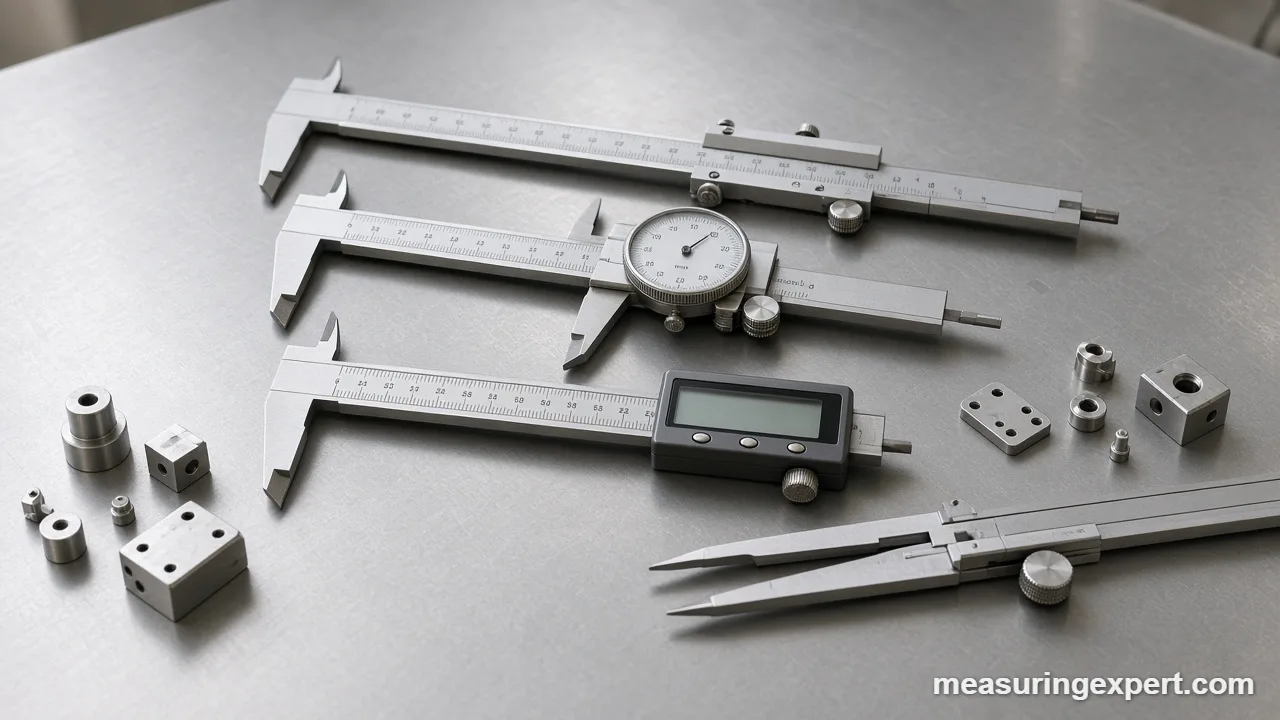
Metric vernier (0.05 mm): first, find where the vernier zero sits on the main scale. Say it sits just past 23 mm. Next, look along the vernier for the one line that aligns best with any main-scale line. If that is line 7, multiply 7 by 0.05 mm to get 0.35 mm. Finally, add the two parts: 23 + 0.35 = 23.35 mm.
Inch vernier (1/128 in): the main scale is marked in 1/16 in, and each vernier line adds 1/128 in. For instance, if the zero sits past 1 3/16 in and line 3 aligns, the reading is 1 3/16 + 3/128 = 1 27/128 in. That equals about 1.2109 in, or 30.76 mm.
Dial (0.001 in, 0.1 in per turn): first, read whole tenths on the beam. Then add the needle reading in thousandths. So if the jaw edge sits past 1.3 on the beam and the needle points at 47, the size is 1.347 in, or about 34.21 mm.
How to Take a Reliable Caliper Measurement
These steps apply to every caliper type above. Still, read your own manual, because controls differ.
- Clean the jaw faces and the beam with a dry, lint-free cloth.
- Close the jaws and confirm zero: press zero on a digital caliper, or check that the dial or vernier zero lines up.
- Open the jaws past the part, then close them gently until both faces touch.
- Hold the caliper square to the part and measure as close to the beam as you can.
- For a bore, use the inside jaws and rock slightly to find the largest reading.
- For depth, rest the beam end on the top face and slide until the rod touches bottom.
- Lock the slide if needed, read the value and record it with its unit.
In short, light and steady pressure gives the most repeatable result. By contrast, too much force springs the jaws, and soft parts squash.
Millimeter to Inch Converter for Your Readings
Vernier and dial calipers often read in just one system. So use this converter when a drawing calls for the other unit. Enter a reading in millimeters to see it in inches, centimeters and mils.
Notice that “150 mm” and “6 in” are close but not equal: 6 in is 152.4 mm. For a worked example, our 10 cm to inches page walks through the math.
Calibration and Care Habits That Last
Above all, good habits matter more than the price tag. First, check zero every time you pick up the tool. Second, verify it now and then against a gauge block or a known standard at a few points across the range. If a reading misses by more than the rated accuracy, clean the tool and test again before you trust it.
Also, keep the beam clean and lightly oiled with instrument oil. Next, store the caliper with the jaws slightly open so the faces are not stressed. For digital models, remove the cell before long storage, because a leaking cell can ruin the board. Finally, keep dial racks free of grit, since one chip can make the needle jump.
Where Even the Best Caliper Falls Short
To begin with, a caliper is a general-purpose tool. Its jaws sit off to the side of the scale, so any tilt or jaw flex adds error. This offset is known as Abbe error, and it grows with long jaws. As a result, a 24 in long-jaw tool needs more care than a 6 in one.
In addition, a fine display does not guarantee a fine result. A screen may show 0.01 mm, yet the tool may only be good to 0.02 or 0.03 mm. Likewise, soft foam, rubber and thin plastic compress under the jaws. So for tight tolerances, use a micrometer instead.
Best Caliper FAQ
What is the best caliper for most people?
For most buyers, the best caliper is the iGaging IP54 Digital Caliper 0-6 in. It reads inches, millimeters and fractions, carries an IP54 rating and is rated at 0.001 in (0.02 mm) accuracy.
Which is better: a vernier, dial or digital caliper?
Each type can be accurate. For instance, digital is fastest and switches units, dial needs no battery and shows trends, and vernier has no moving parts to fail. So pick by how often you measure and where.
What is the best caliper for machinists?
For dry work, a 0.001 in dial such as the Mitutoyo 505-742J is a strong choice. For coolant and long parts, the IP67 Starrett 798A-12/300 is the best caliper on our list.
How accurate is a typical caliper?
A good 6 in caliper is usually rated at plus or minus 0.001 in (0.02 to 0.03 mm). Longer models are often rated at 0.002 in (0.05 mm), and a 0.05 mm vernier is coarser still.
What is a long-jaw caliper used for?
A long-jaw caliper has deeper jaws and often a longer beam. As a result, it can reach over flanges, lips and thick walls that a standard 6 in caliper cannot reach.
Is a 6 inch or 12 inch caliper the best caliper size?
In most cases, a 6 in (150 mm) caliper covers bench work and is easier to hold square. Choose 12 in or longer only if you often measure bigger parts.
How do you read a vernier caliper?
Read the main scale at the vernier zero, then find the vernier line that best aligns with a main-scale line. Multiply that line number by the vernier step, such as 0.05 mm, and add it.
How often should a caliper be calibrated?
Check zero every time you use it and verify against a gauge block on a regular schedule. In addition, many shops send calipers out for certified calibration once a year.
Can a caliper replace a micrometer?
Not for tight tolerances. A caliper is versatile, but a micrometer measures closer because its anvils sit in line with the scale, so it suffers less from tilt and jaw flex.
What is the best caliper for woodworking?
Woodworkers often think in fractions; therefore, a caliper with a fraction mode helps. The iGaging IP54 and the NEIKO 01407A both read fractions down to 1/128 in.
The Verdict: Our Best Caliper Pick
For most readers, the iGaging IP54 Digital Caliper 0-6 in is the best caliper, thanks to its three reading modes, IP54 sealing and 0.001 in rating. On the other hand, if you never want to buy a battery, the Mitutoyo 505-742J dial is the classic choice. And for coolant or long parts, the Starrett 798A-12/300 is worth the extra cost.
4 thoughts on “Best Caliper Picks for 2026: Vernier, Dial, Digital and Long-Jaw”