

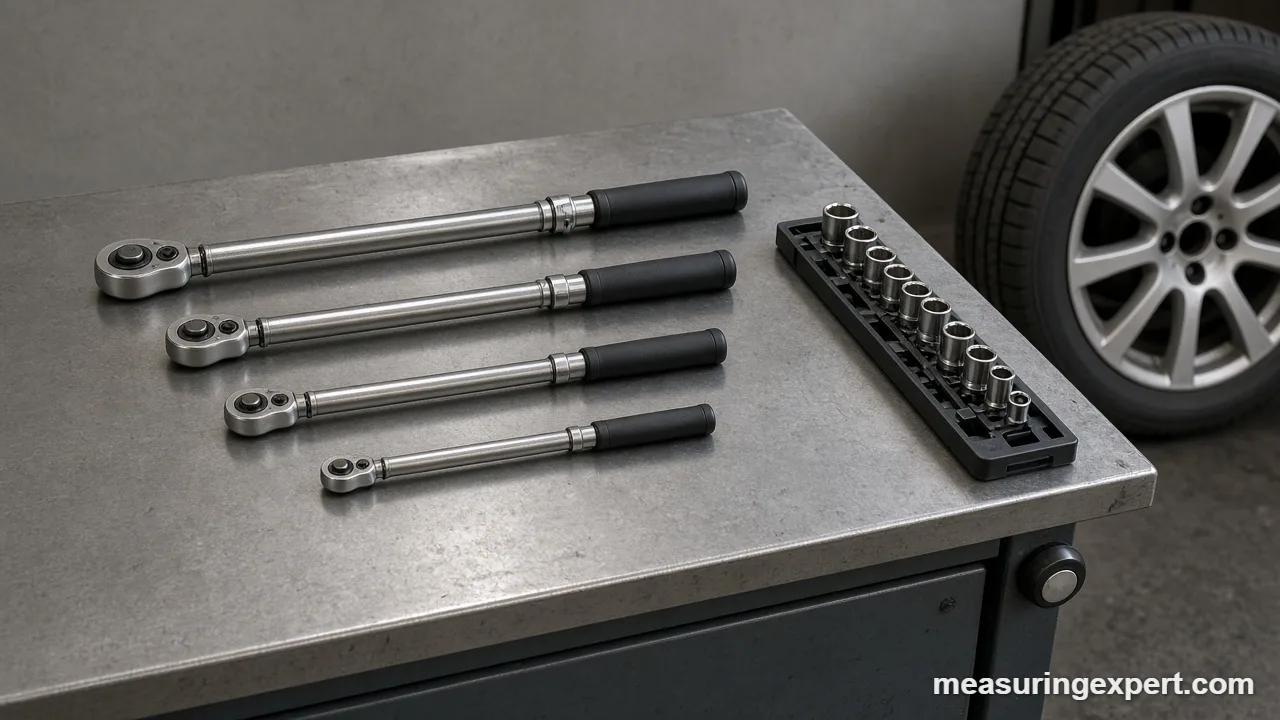
The best torque wrench for most garages is the TEKTON TRQ52402, a 1/2 in. click wrench rated +/-3% in both directions with a serialized certificate. However, the right choice depends on your fastener specs: match the drive size and range to the job, and keep the target in the middle of the scale.
In short: TEKTON TRQ52402 for cars, LEXIVON LX-183 on a budget, ACDelco ARM601-34 for digital readings, and Feedback Sports or Park Tool for bikes.
As an Amazon Associate, Measuring Expert earns from qualifying purchases. Our picks are based on research, specifications and owner feedback, not paid placement.
Best Overall
Best Budget

Best Digital

Quick Answer: The Best Torque Wrench by Job
- Cars and light trucks: the TEKTON TRQ52402 covers 40 to 200 ft-lb at +/-3%.
- Tight budget: the LEXIVON LX-183 also reaches down to 10 ft-lb with a certificate.
- Digital readout: the ACDelco ARM601-34 kit shows four units and beeps at the target.
- Engines and motorcycles: the GEARWRENCH 85062M is a 3/8 in. wrench for 10 to 100 ft-lb.
- Big trucks: the Precision Instruments C3FR250F split beam reaches 250 ft-lb, so it suits big truck bolts.
- Bikes: pair the Feedback Sports Range Click (2 to 14 N-m) with the Park Tool TW-6.2 (10 to 60 N-m).
On This Page
- Comparison table
- The 9 picks, reviewed
- How we chose
- Click, beam, split-beam and digital
- Matching range and drive size
- Torque unit converter
- How to use a torque wrench
- Adapters and extensions
- Care and calibration
- Honest limits
- FAQ
- Bottom line
Best Torque Wrench Comparison Table
First, scan the table for your drive size and job. Then read the reviews below for the range and accuracy behind each pick.
| # | Product | Best For | Standout Feature | Amazon |
|---|---|---|---|---|
| 1 | TEKTON TRQ52402 (1/2 in. Drive) | Lug nuts and most car work | Serialized ISO 6789 certificate, both directions | View |
| 2 | LEXIVON LX-183 (1/2 in. Click) | Occasional DIY use | Low entry point of 10 ft-lb | View |
| 3 | ACDelco ARM601-34 Digital Combo | Metric specs and mixed units | Two digital wrenches with four units | View |
| 4 | CDI 1503MFRMH (1/2 in. Click) | Daily shop use | ASME and ISO 6789 compliance with certificate | View |
| 5 | GEARWRENCH 85062M (3/8 in. Drive) | Engine and motorcycle work | 10 to 100 ft-lb in a 3/8 in. drive | View |
| 6 | Precision Instruments C3FR250F Split Beam | Trucks and high-torque bolts | Split-beam design with no spring to reset | View |
| 7 | TEKTON TRQ50402 (1/4 in. Drive) | Low in-lb specs | 20 to 200 in-lb with certificate | View |
| 8 | Park Tool TW-6.2 Ratcheting Click | Bike shops and home mechanics | Fine 0.25 N-m adjustment | View |
| 9 | Feedback Sports Range Click Set | Carbon bikes and travel kits | 2 to 14 N-m with 13 bits in a fold-up case | View |
The 9 Best Torque Wrench Picks, Reviewed
We start with car wrenches, because most readers need one for wheels and brakes. Next come the digital, pro and heavy-duty picks. Finally, we cover small-fastener and bike tools.
Best Overall
1. TEKTON TRQ52402 (1/2 in. Drive)
Best for: drivers and home mechanics who torque wheels, brakes and suspension parts on cars and light trucks.
The TEKTON TRQ52402 is our best torque wrench for most garages. It covers 40 to 200 ft-lb (about 54 to 271 N-m), which spans typical lug nut and suspension specs. In addition, TEKTON rates it within +/-3% in both clockwise and counterclockwise use. As a result, it also handles the odd left-hand thread.
On the measuring side, each wrench also ships with a serialized certificate. TEKTON checks it at 40, 120 and 200 ft-lb, to ISO 6789-1:2017 and ASME B107.300-2021. Besides, the scale reads in 1 ft-lb steps, and the 90-tooth head needs only a 4 degree swing. However, the scale is ft-lb only, so convert any N-m spec first.
- Range: 40 to 200 ft-lb (about 54 to 271 N-m)
- Accuracy: +/-3% clockwise and counterclockwise
- Drive: 1/2 in., 90-tooth head with 4 degree swing arc
- Length: 19.1 in. overall (15.3 to 16.3 in. effective)
- Includes: calibration certificate, case and a 1/2 to 3/8 in. reducer
Pros
- Tight +/-3% rating in both directions
- Certificate matches the engraved serial number
- Fine 4 degree swing, so it fits cramped wheel wells
Cons
- Scale shows ft-lb only
- Starts at 40 ft-lb, so it is too big for small bolts
Skip it if: most of your work is under 40 ft-lb, for example valve covers, bikes or motorcycle trim.
Best Budget
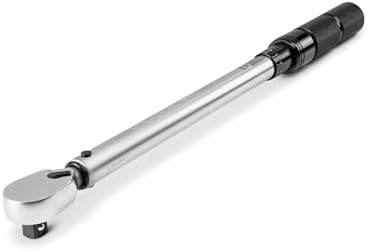
2. LEXIVON LX-183 (1/2 in. Click)
Best for: weekend DIYers who need one affordable 1/2 in. wrench for wheels and general car jobs.
The LEXIVON LX-183 is a simple click wrench with a wide range. It runs from 10 to 150 ft-lb (13.6 to 203.5 N-m), so it reaches lower than the TEKTON. Also, LEXIVON ships it pre-calibrated with a certificate and a traceable serial number.
However, the trade-off is accuracy. LEXIVON lists +/-4%, which is normal for a click wrench but looser than our top pick. For example, at 100 ft-lb the true torque may sit anywhere from 96 to 104 ft-lb. That is fine for wheels, but it is still a reason to stay in the middle of the scale.
- Range: 10 to 150 ft-lb (13.6 to 203.5 N-m)
- Accuracy: +/-4%, pre-calibrated
- Drive: 1/2 in., reversible ratchet head
- Build: chrome vanadium gear head with black finish
Pros
- Wide range, so one wrench does a lot
- Certificate with serial number
- Low cost for a click wrench
Cons
- +/-4% is looser than the TEKTON
- Some owners report it only measures in one direction
Skip it if: you need counterclockwise torque readings or a tighter accuracy rating.
Best Digital
3. ACDelco ARM601-34 Digital Combo
Best for: mechanics who switch between N-m and ft-lb specs and want a buzzer instead of a click.
The ACDelco ARM601-34 is a kit of two digital wrenches. The 3/8 in. tool covers 5 to 50 N-m (3.7 to 37 ft-lb), while the 1/2 in. tool covers 20 to 200 N-m (14.8 to 147.5 ft-lb). As a result, one kit spans most car and motorcycle fasteners, so you rarely need a third wrench.
Digital wrenches also change the reading method. Instead of a spring, a strain gauge measures the load, and a buzzer sounds at the target. ACDelco rates it at +/-2% clockwise and +/-3% counterclockwise, from 20% of full scale up. In addition, it shows kg-cm, N-m, in-lb and ft-lb, with Peak and Trace modes.
- Ranges: 5 to 50 N-m (3/8 in.) and 20 to 200 N-m (1/2 in.)
- Accuracy: +/-2% CW, +/-3% CCW, from 20% to full scale
- Units: kg-cm, N-m, in-lb and ft-lb
- Modes: Peak and Trace, with buzzer alert
- Power: 4 AAA batteries per wrench (not included)
Pros
- Tighter +/-2% clockwise rating
- Unit switching, so there are no conversion errors
- Two drive sizes in one kit
Cons
- Needs batteries to work
- Electronics can fail after drops, so handle it with care
Skip it if: you want a tool that still works with dead batteries in a cold barn.
Best Pro Click
4. CDI 1503MFRMH (1/2 in. Click)

Best for: professional techs and serious hobbyists who want a shop-grade click wrench from a Snap-on company.
CDI is the torque division of Snap-on, and the 1503MFRMH is one of its core click wrenches. It covers 20 to 150 ft-lb on a micro-adjustable, dual-scale handle. In addition, each one is serialized and ships with a calibration certificate.
CDI rates it at +/-4% clockwise and +/-5% counterclockwise. It also meets or exceeds ASME B107.14 and ISO 6789. Even so, that is not tighter than the TEKTON on paper. However, shops buy CDI for its service network and steady results after years of use.
- Range: 20 to 150 ft-lb
- Accuracy: +/-4% CW, +/-5% CCW
- Drive: 1/2 in., 19 in. long
- Scale: dual scale, micro-adjustable
- Standards: ASME B107.14 and ISO 6789, with certificate and case
Pros
- Pro-grade build and support
- Certified and serialized
- Measures in both directions
Cons
- Costs more than DIY brands
- However, paper accuracy is no better than cheaper picks
Skip it if: you torque wheels twice a year; the TEKTON or LEXIVON will do.
Best 3/8 in. Drive
5. GEARWRENCH 85062M (3/8 in. Drive)

Best for: anyone working on engines, motorcycles or brake calipers where specs fall between 10 and 100 ft-lb.
A 3/8 in. drive fits the sockets you use most on engines and bikes. So the GEARWRENCH 85062M fills the gap between a small in-lb wrench and a big 1/2 in. tool. For example, it reads 10 to 100 ft-lb in 1 ft-lb steps.
GEARWRENCH rates it at +/-3% clockwise from 20% to 100% of full range. That detail matters, because accuracy below 20 ft-lb is not covered. Also note that it is not sold with a certificate, and its calibration warranty runs 90 days.
- Range: 10 to 100 ft-lb, 1 ft-lb steps
- Accuracy: +/-3% clockwise, 20% to 100% of range
- Drive: 3/8 in. fixed head, 18 in. long
- Standard: ASME B107.300
- Storage: blow-molded case
Pros
- Ideal for engine bolts because of the 3/8 in. drive
- Tight clockwise rating
- Knurled aluminum handle
Cons
- No calibration certificate
- Clockwise only
Skip it if: you need counterclockwise readings or a certificate for work records.
Best Heavy Duty
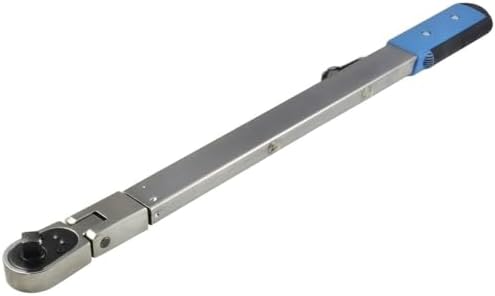
6. Precision Instruments C3FR250F Split Beam
Best for: truck owners and fleet techs who torque big fasteners all day.
The Precision Instruments C3FR250F uses a split-beam mechanism instead of a coil spring. Therefore, there is no spring under load, and you do not need to wind it down after each use. Instead, you set it with fingertip force, from the bottom of the scale to the top.
It covers 40 to 250 ft-lb (about 54 to 339 N-m) in 5 ft-lb steps. In addition, the flex ratchet head reaches awkward bolts, and the 19 in. effective length gives good leverage. Finally, Precision Instruments builds it in the USA from forged steel.
- Range: 40 to 250 ft-lb, 5 ft-lb steps
- Drive: 1/2 in. flex ratchet head
- Length: 22-1/8 in. overall, 19 in. effective
- Design: split beam, so no reset is needed
Pros
- No spring, so nothing to wear or reset
- High range for trucks
- Flex head for tight spots
Cons
- 5 ft-lb steps are coarse
- Long and heavy, so it is awkward for small jobs
Skip it if: most of your specs are under 50 ft-lb.
Best for Small Fasteners
7. TEKTON TRQ50402 (1/4 in. Drive)

Best for: anyone torquing small bolts on engines, guns, drones, bikes or electronics housings.
Small bolts strip fast, so they need a small wrench. The TEKTON TRQ50402 covers 20 to 200 in-lb (about 2.3 to 22.6 N-m). Similarly, like its bigger sibling, it is rated within +/-3% in both directions.
It also ships with a serialized certificate. TEKTON tests it at 20, 120 and 200 in-lb. In addition, the kit adds a 1/4 in. hex bit holder and a 1/4 to 3/8 in. adapter. Therefore, it drives bits as well as sockets.
- Range: 20 to 200 in-lb (about 2.3 to 22.6 N-m)
- Accuracy: +/-3% CW and CCW
- Drive: 1/4 in., 90-tooth head
- Length: 10.1 in. overall
- Includes: certificate, bit holder, 3/8 in. adapter and case
Pros
- Precise for small fasteners, since it starts at 20 in-lb
- Bit holder included
- Certificate included
Cons
- in-lb scale only
- Too small for anything above 16 ft-lb
Skip it if: your specs are in ft-lb above 17 ft-lb.
Best for Bikes
8. Park Tool TW-6.2 Ratcheting Click

Best for: cyclists who service cranks, cassettes, bottom brackets and pedals at home.
Bike specs usually come in N-m, so the Park Tool TW-6.2 reads in N-m first. It covers 10 to 60 N-m (88 to 530 in-lb), which suits crank bolts and cassette lockrings. Also, you can adjust it in 0.25 N-m steps.
Park Tool rates it at +/-4%, and it registers torque on both left- and right-hand threads. For example, that helps with left-hand pedal threads. However, carbon stem and seatpost bolts often need 4 to 6 N-m, which is below its range.
- Range: 10 to 60 N-m (88 to 530 in-lb)
- Adjustment: 0.25 N-m steps
- Accuracy: +/-4%
- Drive: 3/8 in. ratcheting
- Length: 362 mm (14.25 in.)
Pros
- N-m scale matches bike specs
- Also reads left-hand threads
- From a top bike tool maker
Cons
- However, it is too big for 4 to 6 N-m carbon parts
- Pricier than generic kits
Skip it if: you mainly tighten small stem and seatpost bolts; get a 2 to 14 N-m tool instead.
Best Compact
9. Feedback Sports Range Click Set

Best for: riders with carbon parts who need low, exact settings in a kit that packs small.
The Feedback Sports Range Click covers 2 to 14 N-m. In other words, that is where stems, seatposts and brake levers live. You can set it in 0.17 N-m steps, and a 72-tooth magnetic ratchet works in both directions.
Also, Feedback Sports rates it at +/-4% for 4,000 cycles. Furthermore, the set adds 13 S2 steel hex and Torx bits in a fold-up case. As a result, it rides along to races and trailheads.
- Range: 2 to 14 N-m (about 18 to 124 in-lb)
- Adjustment: 0.17 N-m steps
- Accuracy: +/-4% for 4,000 cycles
- Ratchet: 72-tooth, dual direction
- Includes: 13 hex and Torx bits in a TPU case
Pros
- Right range for carbon parts
- Small, so it travels well
- Bits included
Cons
- Too low for cranks, so pair it with a bigger wrench
- Bit drive only, no socket drive
Skip it if: you work on cars; it tops out at 14 N-m.
How We Chose the Best Torque Wrench Picks
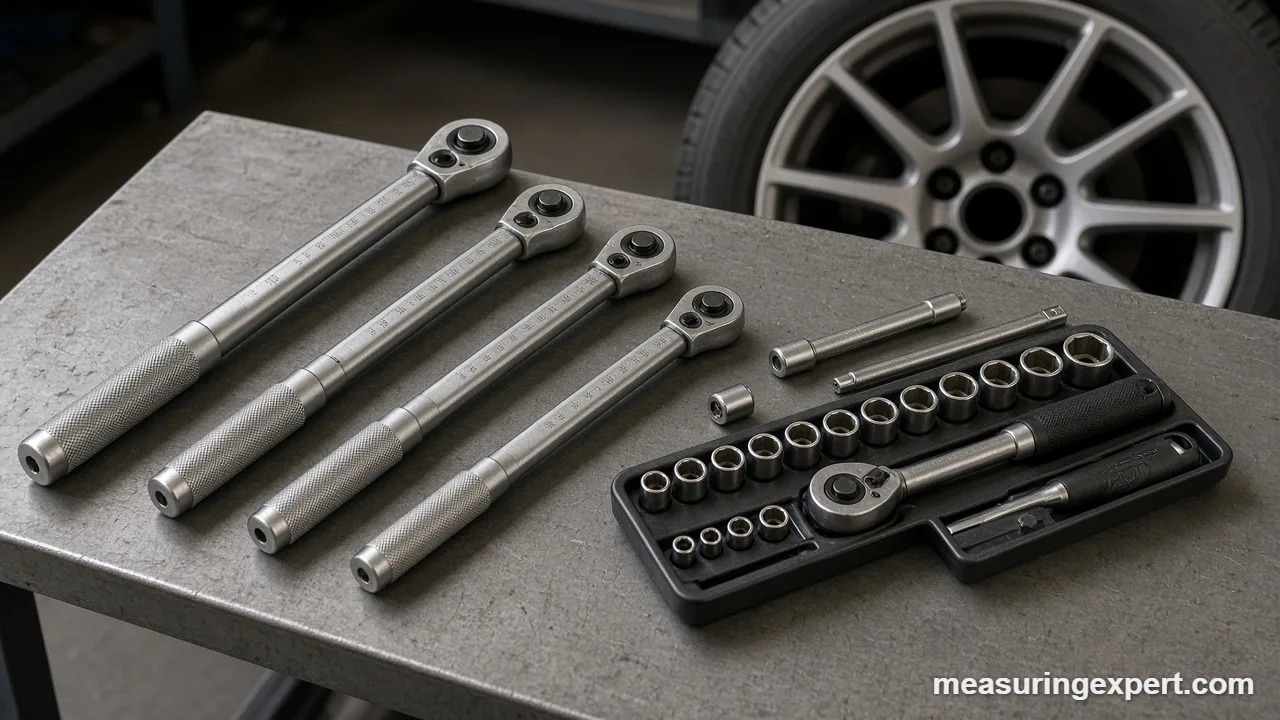
We did not run hands-on tests. Instead, these picks are research-based. First, we read maker spec pages and manuals, checked torque standards, and weighed owner feedback. Finally, we scored each wrench on the points below.
- Published accuracy: a stated tolerance, and the part of the range it covers, earned credit.
- Calibration proof: serialized certificates and named standards, such as ISO 6789 or ASME B107, counted in favor.
- Useful range: we looked for ranges that put common specs in the middle of the scale.
- Use case spread: we covered cars, trucks, engines, small fasteners and bikes, with no more than two models per brand.
Our sources include maker pages from TEKTON, LEXIVON, GEARWRENCH and Park Tool, distributor spec sheets for CDI and ACDelco, and the NIST torque conversion factors.
Click, Beam, Split-Beam or Digital: Which Best Torque Wrench Type?
In short, every torque wrench measures the same thing: force times distance. Still, each type senses and signals that load in a different way, so the choice changes how you work.
| Type | How it measures | Signal | Best use |
|---|---|---|---|
| Click (micrometer) | A spring holds a pivot until the set load | Click and small handle break | Most car and engine work |
| Split beam | A second beam trips at the set load, with no loaded spring | Click | Heavy daily use, trucks |
| Beam (deflecting) | A pointer shows how far the main beam bends | You read a scale | Cheap backup, checking others |
| Digital | A strain gauge senses the load | Beep, light or vibration | Mixed units, logging, metric specs |
Click wrenches: the best torque wrench type for most garages
A click wrench is the best torque wrench type for general use. First, you set a value. Then you pull and stop at the click. Also, it needs no batteries. However, the spring inside relaxes and wears with use, so it needs a calibration check over time.
Digital wrenches and strain gauges
By contrast, a digital wrench shows the live load on a screen. As a result, it can switch units and warn you before the target. On the other hand, batteries, cold and drops can affect the electronics.
Beam and split-beam designs
A plain beam wrench has no spring to wear, so it holds its accuracy well. However, you must read the pointer straight on, which is hard in tight spots. Meanwhile, a split-beam wrench gives a click without a loaded spring. Therefore, it does not need winding down after use.
How to Match Range and Drive Size
In fact, range matters more than brand. Most makers state accuracy only from 20% to 100% of full scale. For instance, GEARWRENCH states its 85062M rating that way. Therefore, a 10 to 100 ft-lb wrench is not reliable at 12 ft-lb, even though the scale goes there.
| Drive | Typical range | Common jobs |
|---|---|---|
| Bit driver | 2 to 14 N-m (18 to 124 in-lb) | Bike stems, seatposts, scope rings |
| 1/4 in. | 20 to 200 in-lb (2.3 to 22.6 N-m) | Small engine covers, sensors, trim |
| 3/8 in. | 10 to 100 ft-lb (13.6 to 135.6 N-m) | Engines, motorcycles, bike cranks |
| 1/2 in. | 40 to 250 ft-lb (54 to 339 N-m) | Lug nuts, suspension, axle nuts |
In practice, two wrenches cover most homes: a 3/8 in. or 1/4 in. for small work and a 1/2 in. for wheels. Similarly, cyclists do best with a low 2 to 14 N-m tool plus a 10 to 60 N-m wrench. If you work on small screws, our best torque screwdriver guide covers even lower ranges.
Torque Unit Converter (ft-lb, in-lb, N-m)
Service manuals often mix units, while many wrenches show only one. So convert first, and then set the scale. The NIST factors are 1 ft-lb = 1.355818 N-m and 1 in-lb = 0.1129848 N-m.
For example, a 5 N-m spec equals about 44.3 in-lb. To learn more about the unit itself, read our guide on what Nm means in measurement.
How to Use a Torque Wrench, Step by Step
Of course, good technique matters as much as the tool. Next, follow these steps for wheels, engines or bikes.
- Find the spec: Look up the torque value and its unit in the service manual, and note whether it is for dry or lubricated threads.
- Pick the right wrench: Choose a wrench where the spec sits between 20% and 100% of its range, ideally near the middle.
- Prepare the threads: First, clean the threads, and then apply lubricant or thread locker only if the spec calls for it.
- Set the value: Turn the handle or press the buttons until the scale shows the target, then lock the handle if it has a lock.
- Snug the fasteners: Run all bolts down by hand first, then snug them in a star or cross pattern.
- Pull smoothly: Hold the center of the grip and pull at a right angle in one steady motion until it clicks or beeps, then stop.
- Make a final pass: Finally, go around the pattern once more at the full value to confirm each fastener.
- Reset and store: Wind a spring wrench down to its lowest setting and store it in its case.
Adapters, Crowfoots and the Best Torque Wrench Setting
A straight socket extension does not change the reading, because it sits on the axis of the bolt. In contrast, a crowfoot or offset adapter adds length to the wrench. As a result, the bolt sees more torque than the scale shows.
Use this formula when the adapter points straight out from the head: setting = target x L / (L + E). In this formula, L is the wrench’s effective length and E is the added length. For example, with a 50 ft-lb target, a 15 in. wrench and a 2 in. crowfoot, set 50 x 15 / 17 = 44.1 ft-lb. If you turn the crowfoot 90 degrees to the handle, the added length is close to zero, so no change is needed.
For the physics behind this, see our guide on how to measure and calculate torque.
Care and Calibration of Your Torque Wrench
Above all, a torque wrench is a measuring instrument, so treat it like one. In turn, these habits keep the readings honest.
Do
- Wind spring click wrenches down to the lowest marked setting after use.
- Keep the wrench in its case, away from grit and solvents.
- Check calibration about once a year or every 5,000 cycles, as ISO 6789 practice suggests.
Don’t
- Never use it to break loose a seized bolt.
- Avoid dropping it, because a drop can shift the spring or damage a sensor.
- Don’t wind the handle below the lowest mark or past the top.
- Never add a cheater bar to the handle.
Meanwhile, between lab checks, you can compare two wrenches at the same setting. If they disagree by more than their combined tolerance, then send one out for service. In addition, our page on metric vs imperial units helps when specs and scales do not match.
Honest Limits of Even the Best Torque Wrench
A torque wrench measures turning force, not bolt tension. However, tension is what holds parts together. In fact, friction in the threads and under the head uses up much of the torque. So dirty, dry or oiled threads give different clamp loads at the same reading.
For this reason, manuals say whether a spec is for dry or lubricated threads. In addition, some modern engines use torque-plus-angle steps. In that case, follow the angle step exactly, because a torque wrench alone will not get it right.
Best Torque Wrench FAQ
What is the best torque wrench for most people?
For most car owners the best torque wrench is a 1/2 in. click model such as the TEKTON TRQ52402. After all, it covers 40 to 200 ft-lb, is rated +/-3% in both directions, and ships with a calibration certificate.
What size torque wrench do I need for lug nuts?
Use a 1/2 in. drive wrench. Car and light truck lug nut specs usually sit well inside a 40 to 200 ft-lb or 10 to 150 ft-lb range. Always check your owner’s manual for the exact value and units.
Are digital torque wrenches more accurate than click wrenches?
Often, but not always. The ACDelco ARM601-34 is rated +/-2% clockwise, while many click wrenches are rated +/-3% or +/-4%. Even so, calibration and correct use matter more than the type.
How accurate is a torque wrench?
Most click wrenches are rated +/-3% to +/-4% clockwise. Makers usually apply that rating only from 20% to 100% of full scale, so stay out of the bottom fifth of the range.
How do I convert ft-lb to N-m?
Multiply ft-lb by 1.355818 to get N-m. For example, 100 ft-lb equals 135.6 N-m. For in-lb, multiply by 0.1129848; 12 in-lb equals 1 ft-lb.
Which best torque wrench works for bikes?
Bikes usually need two ranges. A 2 to 14 N-m tool such as the Feedback Sports Range Click handles carbon stems and seatposts, while the Park Tool TW-6.2 covers 10 to 60 N-m for cranks and cassettes.
How often should a torque wrench be calibrated?
A common rule from ISO 6789 practice is once a year or every 5,000 cycles, whichever comes first. Also check it sooner after a drop or if results seem off.
Should I store a click torque wrench at zero?
Wind a spring click wrench down to its lowest marked setting, not below it. As a result, the spring can relax. Split-beam wrenches such as the Precision Instruments C3FR250F do not need this.
Can I use a torque wrench to loosen bolts?
No. Instead, use a breaker bar or ratchet to loosen fasteners. Otherwise, heavy loosening loads can overload the mechanism and shift the calibration.
Does an extension change torque wrench readings?
A straight socket extension does not. However, a crowfoot or adapter that adds length to the wrench does. In that case, set the wrench lower, because the adapter adds leverage.
Bottom Line on the Best Torque Wrench
For most car owners, the TEKTON TRQ52402 is the best torque wrench to buy: it covers lug nuts and suspension bolts, is rated +/-3% both ways, and arrives with a certificate. Then add a 3/8 in. or 1/4 in. wrench for smaller bolts. Similarly, cyclists should pair a 2 to 14 N-m tool with a 10 to 60 N-m wrench. Above all, keep your spec in the middle of the range and check calibration each year.
3 thoughts on “Best Torque Wrench for Cars, Trucks and Bikes: 9 Picks for 2026”