

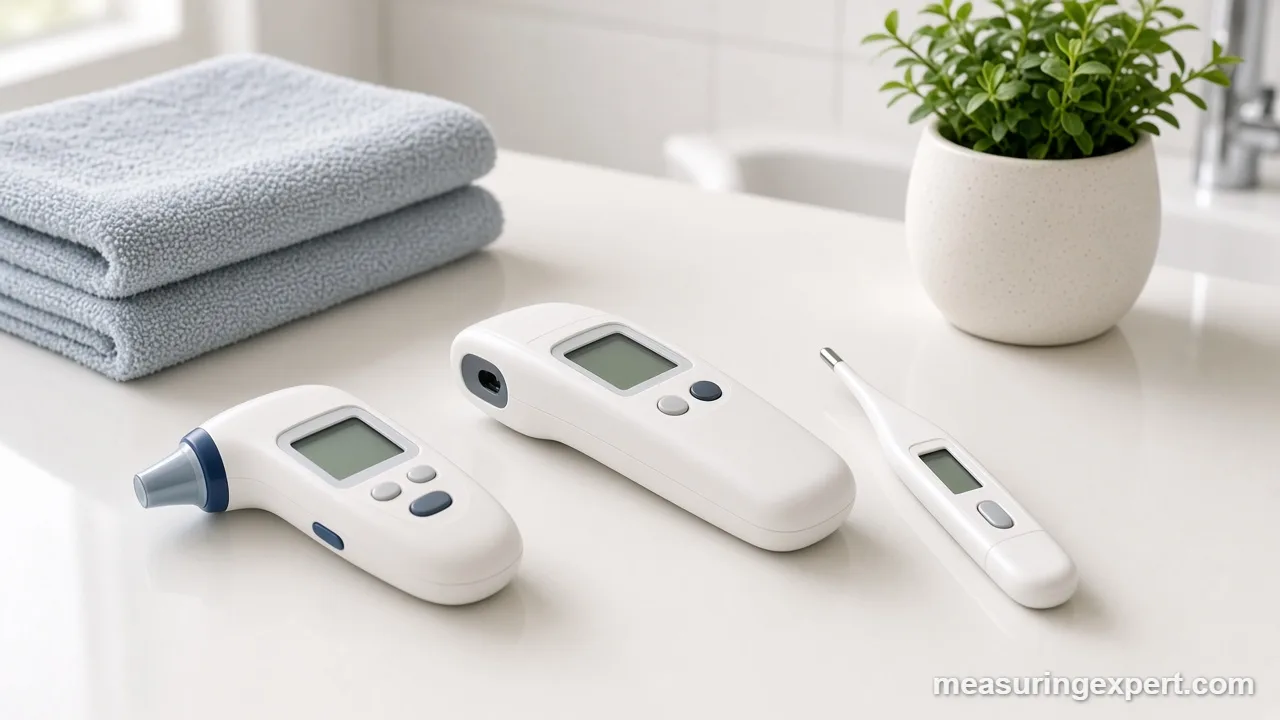
The best thermometer for most families is the Braun ThermoScan 7, an ear model with a pre-warmed tip and age-based fever colors. Still, the right choice depends on age. For example, babies under 3 months need a rectal reading, while older kids and adults can use ear, forehead or oral models.
In short: pick the Braun ThermoScan 7 for the family, the Vicks SpeedRead on a budget, and the Exergen TAT-2000C for a quick forehead scan.
As an Amazon Associate, Measuring Expert earns from qualifying purchases. Our picks are based on research, specifications and owner feedback, not paid placement.
Best Overall


Best Forehead

Quick Answer: Best Thermometer Picks at a Glance
- Braun ThermoScan 7: an ear model with Age Precision fever colors and a night light.
- Vicks SpeedRead: a low-cost stick that reads in about 8 seconds.
- Exergen TAT-2000C: a temporal artery scanner you can use from birth.
- Frida Quick-Read Rectal: a short, flexible probe made for newborns.
- Frida 3-in-1 Infrared: ear, forehead and touchless modes with 40-reading memory.
- Braun ThermoScan 5, Safety 1st Rapid Read and Easy@Home Basal: value ear, toddler stick and fertility picks.
On This Page
- Comparison chart
- The 8 picks, reviewed
- How we chose
- Reading site by age
- Thermometer types compared
- Specs explained
- Fever converter
- How to take a reading
- Care and accuracy checks
- Honest limits
- FAQ
- Bottom line
Best Thermometer Comparison Chart
First, scan this chart to narrow the list. Next, read the reviews below for the measurement details behind each pick.
| # | Product | Best For | Standout Feature | Amazon |
|---|---|---|---|---|
| 1 | Braun ThermoScan 7 (IRT6520) | Most families | Age Precision fever colors, pre-warmed tip | View |
| 2 | Vicks SpeedRead V912US | Budget buyers | About 8-second reading, stated +/-0.2 F accuracy | View |
| 3 | Exergen TAT-2000C | Forehead readings at any age | Temporal artery scan with 8-reading memory | View |
| 4 | Frida Quick-Read Digital Rectal | Newborns and infants | Flexible tip with an insertion stopper | View |
| 5 | Frida 3-in-1 Infrared | Busy households | Ear, forehead and touchless modes | View |
| 6 | Braun ThermoScan 5 (IRT6500) | Value ear readings | ExacTemp light and beep guidance | View |
| 7 | Safety 1st Rapid Read 3-in-1 | Toddlers and a spare | Flexible tip and over-insertion gauge | View |
| 8 | Easy@Home Digital Basal | Fertility charting | Reads to 1/100th of a degree | View |
The 8 Best Thermometer Picks, Reviewed
We start with the all-round family pick. Next come the budget and forehead options, then the baby models, and finally the specialty picks.
Best Overall
1. Braun ThermoScan 7 (IRT6520)
Best for: families with kids over 6 months and adults who want a fast, guided ear reading.
The ThermoScan 7 is the best thermometer for most homes because it removes guesswork. First, you set an age band: 0 to 3 months, 3 to 36 months, or 36 months to adult. After that, the backlit screen turns a color that matches the fever level for that age. As a result, a parent at 3 a.m. does not need to remember a chart.
On the measuring side, a pre-warmed tip helps. A cold tip can cool the ear canal and pull a reading down, so Braun warms it first. In addition, the ExacTemp system helps you seat the probe correctly. Also, disposable lens filters keep each reading clean, and a built-in night light helps you read the screen in a dark room.
- Age Precision: three age bands with color-coded fever guidance
- Tip: patented pre-warmed tip with ExacTemp positioning
- Memory: stores 9 readings so you can track a fever
- Display: large backlit LCD plus a night light
- Power: two AA batteries, included with disposable probe covers
Pros
- Fever colors adjust to the age you select
- Pre-warmed tip supports steady readings
- Easy to read when the room is dark
Cons
- Needs a fresh lens filter for each reading
- Ear readings are not advised for babies under 6 months
- Costs more than a stick thermometer
Skip it if: your main patient is a newborn; a rectal model like the Frida Quick-Read is the better fit.
Best Budget
2. Vicks SpeedRead V912US
Best for: anyone who wants a cheap, fast stick thermometer for the medicine cabinet.
In fact, a plain digital stick is still one of the most dependable tools you can own. The SpeedRead reads in about 8 seconds, and Vicks states an accuracy of +/-0.2 F (about +/-0.1 C). Moreover, that is a clear, published figure, which many low-cost models skip. So for the money, it is the best thermometer for basic oral or underarm checks.
The Fever InSight screen also helps. It glows green for no fever, yellow for slightly raised, and red for fever. However, read the number as well, because the color bands are general. Also, the body is waterproof, so you can rinse it, and it turns itself off to save the battery.
- Reading time: about 8 seconds
- Stated accuracy: +/-0.2 F
- Sites: oral, rectal or underarm
- Display: Fever InSight green, yellow and red backlight
- Body: waterproof, with automatic shut-off
Pros
- Low cost with a published accuracy spec
- Faster than most stick models
- Rinse-clean waterproof body
Cons
- Rigid tip is less comfortable than a flexible one
- Oral readings work only when a child can hold still
Skip it if: you need one-second readings on a sleeping child; a forehead or ear model is quicker.
Best Forehead
3. Exergen TAT-2000C Temporal Artery Thermometer
Best for: parents who want a gentle forehead reading that works from newborns to grandparents.
The TAT-2000C does not just point at the forehead. Instead, you slide the probe from the center of the forehead to the hairline, then touch the neck behind the earlobe while you hold the button. In other words, the scan looks for the temporal artery, which sits close to the skin. According to Exergen, the method is backed by more than 100 published clinical studies.
Because the AAP says temporal artery readings can be used at all ages, this is the best thermometer for a mixed household with a baby. In addition, it stores the last 8 readings, glows softly for night checks, and has a silent mode. Meanwhile, the 9-volt battery is included, and Exergen backs it with a 5-year warranty.
- Method: temporal artery scan, forehead to hairline
- Ages: newborn and up, so one device covers the family
- Memory: last 8 readings
- Size: 1.8 x 7.0 x 1.5 in (4.6 x 17.8 x 3.8 cm), 0.4 lb (about 181 g)
- Power: one 9 V battery, included; 5-year warranty
Pros
- Works for newborns and adults too
- No ear canal or mouth needed
- Silent mode helps while kids sleep
Cons
- The scan technique takes practice
- Sweat or a hat can skew the reading
- Uses a 9 V battery rather than AA cells
Skip it if: you want a point-and-shoot touchless reading; the scan needs skin contact.
Best for Newborns
4. Frida Quick-Read Digital Rectal Thermometer

Best for: new parents who need the most accurate reading for a baby under 3 months.
Rectal readings are the reference method for infants, so a dedicated rectal model belongs in every nursery kit. The Frida Quick-Read has a short, flexible tip and a stopper that limits how far it goes in. As a result, nervous parents can focus on keeping the baby calm instead of on depth.
Next, it reads in about 10 seconds and keeps the last 10 results. Also, the backlit screen helps during night feeds. However, Frida calls the body water-resistant rather than waterproof, so wipe it clean instead of soaking it.
- Reading time: about 10 seconds
- Tip: flexible, with an insertion stopper
- Memory: up to 10 readings
- Display: large backlit screen
- Materials: BPA-free and latex-free; water-resistant
Pros
- Rectal accuracy for the youngest babies
- Stopper helps prevent going too deep
- Memory tracks a fever over a night
Cons
- Less useful once kids outgrow rectal checks, so its life is short
- Water-resistant, but not waterproof
Skip it if: your youngest child is already past toddler age.
Best Multi-Mode
5. Frida 3-in-1 Ear, Forehead and Touchless Infrared

Best for: households that want one fast infrared tool for kids, adults and bath water.
This Frida model packs three modes into one body. Ear mode reads inside the canal, forehead mode reads the skin, and touchless mode checks a room, a surface or a bottle. Plus, each reading takes about one second. So it suits a squirmy toddler who will not sit still for a stick.
Similarly, the screen changes color for a high reading, and the alert beep can be turned off. Also, it stores up to 40 past readings, which helps you chart a fever over several days. Remember, though, that infrared readings are screening tools. Confirm a worrying number with a second method.
- Modes: ear, forehead and touchless object
- Reading time: about 1 second, faster than a stick
- Fever alert: color change with optional sound
- Memory: up to 40 readings
- Includes: storage pouch
Pros
- Faster than stick models
- Three uses in one device, so it saves drawer space
- Large memory for fever tracking
Cons
- Results vary when technique slips
- No published accuracy figure on the product page
Skip it if: you want a stated accuracy spec; the Vicks or Exergen gives more detail.
Best Value Ear
6. Braun ThermoScan 5 (IRT6500)
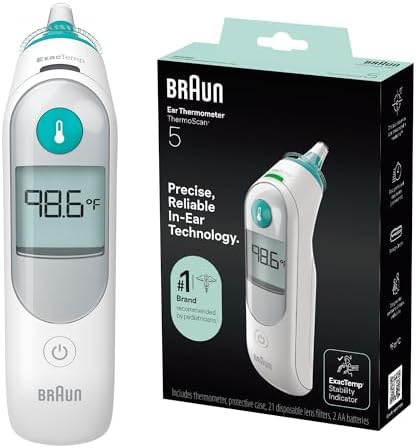
Best for: buyers who want Braun ear technology without the extra features of the ThermoScan 7.
The ThermoScan 5 shares the core ideas of its bigger sibling. It uses a pre-warmed tip, and ExacTemp gives a light and a beep once the probe sits correctly. Indeed, that feedback matters, because a probe that points at the canal wall instead of the eardrum reads low.
On the other hand, what you give up is comfort at night. The LCD has no backlight, and there are no age-based fever colors. Even so, it stores 9 readings, takes two AA batteries, and ships with lens filters. Braun also lists a 3-year limited warranty.
- Guidance: ExacTemp light and beep
- Tip: pre-warmed for accuracy
- Memory: 9 readings
- Power: two AA batteries, included
- Warranty: 3-year limited
Pros
- Same positioning help as pricier Braun models
- Simple one-button use, especially for beginners
- Lens filters included, so you can start right away
Cons
- No backlight, so night checks are harder
- No age-based fever colors
- Filters add a cost over time, too
Skip it if: you often take readings in the dark; the ThermoScan 7 is easier then.
Best for Toddlers
7. Safety 1st Rapid Read 3-in-1

Best for: parents of toddlers who want a soft-tip stick for rectal or underarm use.
The Rapid Read is a simple digital stick with two helpful details. First, the tip is flexible, so rectal checks are more comfortable. Second, an over-insertion gauge shows how far to go. Besides, it reads in about 8 seconds and beeps when it is done.
In short, it is a solid backup to keep in a diaper bag or at a grandparent’s home. Safety 1st does not list memory, water resistance or an accuracy figure, though. So treat it as a plain stick and confirm odd readings.
- Reading time: about 8 seconds
- Sites: oral, underarm or rectal
- Tip: flexible, with an over-insertion gauge
- Signal: beeps when the reading is complete
- Included: storage case and battery
Pros
- Flexible tip for comfort
- Depth gauge for rectal use
- Low cost, so it works as a spare
Cons
- Fewer published specs than rivals
- No fever color alert, unlike the Vicks
Skip it if: you want memory recall or a published accuracy spec.
Best for Fertility
8. Easy@Home Digital Basal Body Thermometer

Best for: people who chart waking temperature to track ovulation.
Basal body temperature shifts by only a few tenths of a degree, so ordinary fever thermometers are too coarse. This Easy@Home model reads to 1/100th of a degree, and Easy@Home lists accuracy of +/-0.05 C (+/-0.10 F). As a result, that extra digit makes small trends visible.
Timing matters, too. The maker says the basal mode takes about 60 to 120 seconds, while a rapid mode takes about 8 to 12 seconds. Therefore, take your basal reading in bed, before you get up. Also, the backlit LCD and memory recall make that easier in a dim room.
- Resolution: 1/100th of a degree
- Stated accuracy: +/-0.05 C (+/-0.10 F)
- Basal mode: about 60 to 120 seconds
- Rapid mode: about 8 to 12 seconds
- Display: backlit LCD with memory recall
Pros
- Fine resolution for charting
- Published accuracy figure
- Two modes for basal or quick checks
Cons
- Basal mode takes longer than a fever check
- Not meant as the family fever thermometer
Skip it if: you only need to check for fever.
How We Chose the Best Thermometer
We did not run hands-on tests. Instead, our picks are research-based. First, we read maker spec pages, pediatric guidance and federal advice, and we weighed owner feedback. Then we scored each model on these points:
- Reading site: we matched each pick to the ages the AAP says that method suits.
- Published specs: a stated accuracy, reading time or memory earned extra credit; where a maker lists none, we say so.
- Ease of use: guidance features such as ExacTemp, depth stoppers and backlit screens count, because poor technique causes most bad readings.
- Hygiene: we noted waterproof bodies, lens filters and probe caps.
- Variety: we covered ear, forehead, stick, rectal and basal types, with no more than two models per brand.
Our sources include the American Academy of Pediatrics guide on how to take a child’s temperature, the FDA page on non-contact infrared thermometers, and spec pages from Braun, Exergen, Vicks, Frida, Safety 1st and Easy@Home.
Which Reading Site Fits Each Age?
In practice, age matters more than brand. The AAP ranks methods by how well they track core temperature in children, and its advice shapes every pick above.
| Age | Best method | Also fine | Avoid |
|---|---|---|---|
| Birth to 3 months | Rectal | Temporal artery, armpit to screen | Ear, oral |
| 3 to 6 months | Rectal | Temporal artery, armpit | Ear, oral |
| 6 months to 4 years | Rectal or ear | Temporal artery, armpit | Oral |
| 4 years to adult | Oral | Ear, temporal artery, armpit | None in particular |
In addition, the AAP says not to use glass mercury thermometers at all. If one is still in a drawer, ask your local waste service how to dispose of it safely.
Ear, Forehead, Stick or Basal: Picking the Best Thermometer Type
Basically, each type measures heat at a different spot. As a result, each type has its own speed, comfort and trust level.
| Type | What it reads | Typical speed | Main trade-off |
|---|---|---|---|
| Digital stick | Mouth, armpit or rectum by contact | About 8 to 10 seconds | Works only when the patient stays still |
| Ear (tympanic) | Infrared heat from the eardrum area | A few seconds | Results drift when aim or earwax is off |
| Temporal artery | Infrared scan over the forehead artery | A few seconds | Takes practice before results are steady |
| Non-contact forehead | Infrared heat from forehead skin | About 1 second | Sensitive to the room, especially drafts and sun |
| Basal | Oral, to 1/100th of a degree | About 1 to 2 minutes | Slower, since it is built for charting |
For most homes, the best thermometer setup is two tools. For example, keep an ear or forehead model for quick checks and a digital stick to confirm a worrying number.
Thermometer Specs, Explained in Plain Terms
Accuracy. In short, this tells you how close a reading sits to the true value. A stated +/-0.2 F (+/-0.1 C), as on the Vicks SpeedRead, is a useful benchmark. If a maker gives no number, treat the reading as a guide and recheck odd results.
Resolution. Typically, fever thermometers show tenths of a degree. Basal models show hundredths, because ovulation shifts are small. However, more digits do not mean more accuracy, so look for both specs.
Reading time. Stick models often predict the final value from the early rise in heat. Meanwhile, infrared models read in a second or two. Faster is kinder to kids, but only if you hold the device correctly.
Units and memory. A F/C switch helps when you follow advice written in Celsius. Memory, from 8 to 40 readings in our list, lets you show a doctor how a fever changed.
Environment. The FDA says non-contact models should rest in the room for 10 to 30 minutes before use. It also lists a working range of about 60.8 to 104 F (16 to 40 C) with humidity under 85 percent. For a broader look at how clinical values are written, see our guide to medical units of measurement.
Fever Converter: Fahrenheit, Celsius and Kelvin
Many guides quote fever in Celsius, while US screens often show Fahrenheit. So use this converter to check any reading.
The math is short: C = (F – 32) x 5/9, and F = C x 9/5 + 32. For example, the common fever line of 100.4 F works out to exactly 38.0 C. Our page on units of measurement in science covers the Kelvin scale as well.
How to Get an Accurate Reading, Step by Step
These general steps apply to most home thermometers. Still, always follow the manual for your model.
- Wait after activity: Let the person rest for about 15 minutes after exercise, a bath, or a hot or cold drink.
- Let the device settle: Keep the thermometer in the same room for 10 to 30 minutes, as the FDA advises for infrared models.
- Prepare the site: Make sure the forehead is clean, dry and uncovered, or fit a new lens filter or probe cover.
- Position with care: Aim an ear probe toward the eardrum, scan a temporal model across the forehead, or seat a stick under the tongue.
- Hold still: Keep the device steady until it beeps, and keep a child calm during the reading.
- Record and recheck: Write down the number and time, then repeat once if the result seems odd.
Care, Cleaning and Accuracy Checks
Even the best thermometer is a small sensor, so a little care keeps it honest.
- Clean after each use: wipe the probe with rubbing alcohol, and rinse only models the maker calls waterproof.
- Change filters: use a fresh lens filter on ear models, because a dirty lens reads low.
- Swap weak batteries: a low battery can cause errors, so replace it when the icon appears.
- Run a side-by-side check: take two readings in a row, or compare with a second thermometer.
- Label it: keep any rectal thermometer for rectal use only.
Honest Limits of Any Best Thermometer
Of course, a thermometer measures heat; it cannot tell you why a fever is there. In addition, normal temperature varies by person and by time of day. The FDA notes that some studies put normal between about 97 F and 99 F (36.1 to 37.2 C), not just 98.6 F. So a single reading is one clue, not a diagnosis.
Likewise, infrared models add their own error. Drafts, sunlight, sweat and poor aim can all shift a result. Therefore, confirm any reading that will change a decision with a second method.
Best Thermometer FAQ
What is the best thermometer for a family?
For most families the best thermometer is an ear model like the Braun ThermoScan 7, paired with a rectal stick for babies under 3 months. The ThermoScan 7 adjusts its fever colors to the age you select.
What is the best thermometer for a newborn?
A digital rectal thermometer is the best choice for babies under 3 months, according to the AAP. The Frida Quick-Read has a flexible tip and a stopper that limits depth.
Are forehead thermometers accurate?
Temporal artery models such as the Exergen TAT-2000C can be used at all ages, per the AAP. Non-contact models are fast but sensitive to the room, sweat and aim, so confirm worrying readings.
At what age can I use an ear thermometer?
The AAP advises ear thermometers from 6 months and up. Before that age, though, the ear canal is too narrow for a reliable reading.
What temperature counts as a fever?
The AAP generally defines a fever as 100.4 F (38.0 C) or higher. Call a doctor at once if a baby 2 months or younger reaches that level.
Is the best thermometer for adults different from one for kids?
Adults and children over 4 can use an oral digital stick, which is cheap and dependable. Ear and forehead models work for both, so one device often covers the whole family.
Why do two readings in a row differ?
Small changes in probe angle, ear wax, sweat or room temperature shift infrared readings. So rest the device, clean the probe, and repeat; a gap of a few tenths is normal.
How do I convert a fever from Celsius to Fahrenheit?
Multiply the Celsius value by 9/5, then add 32. For example, 38.0 C equals 100.4 F, and 40.0 C equals 104.0 F.
What is a basal body thermometer?
A basal thermometer reads to 1/100th of a degree so you can chart small waking-temperature shifts for fertility tracking. As a result, it is slower than a fever thermometer by design.
Should I still keep a mercury thermometer?
No. The AAP says not to use glass mercury thermometers because they can break and release toxic mercury. Replace it with a digital model.
Bottom Line: The Best Thermometer for Most Homes
For most households, the Braun ThermoScan 7 is the best thermometer to own: its pre-warmed tip, guided positioning and age-based fever colors make a good reading easy. Add a Frida Quick-Read if you have a baby under 3 months, or choose the Vicks SpeedRead if you simply want a cheap, dependable stick. Above all, learn each person’s normal range and call a doctor when a reading worries you.
2 thoughts on “Best Thermometer 2026: 8 Accurate Picks for Babies, Kids and Adults”