

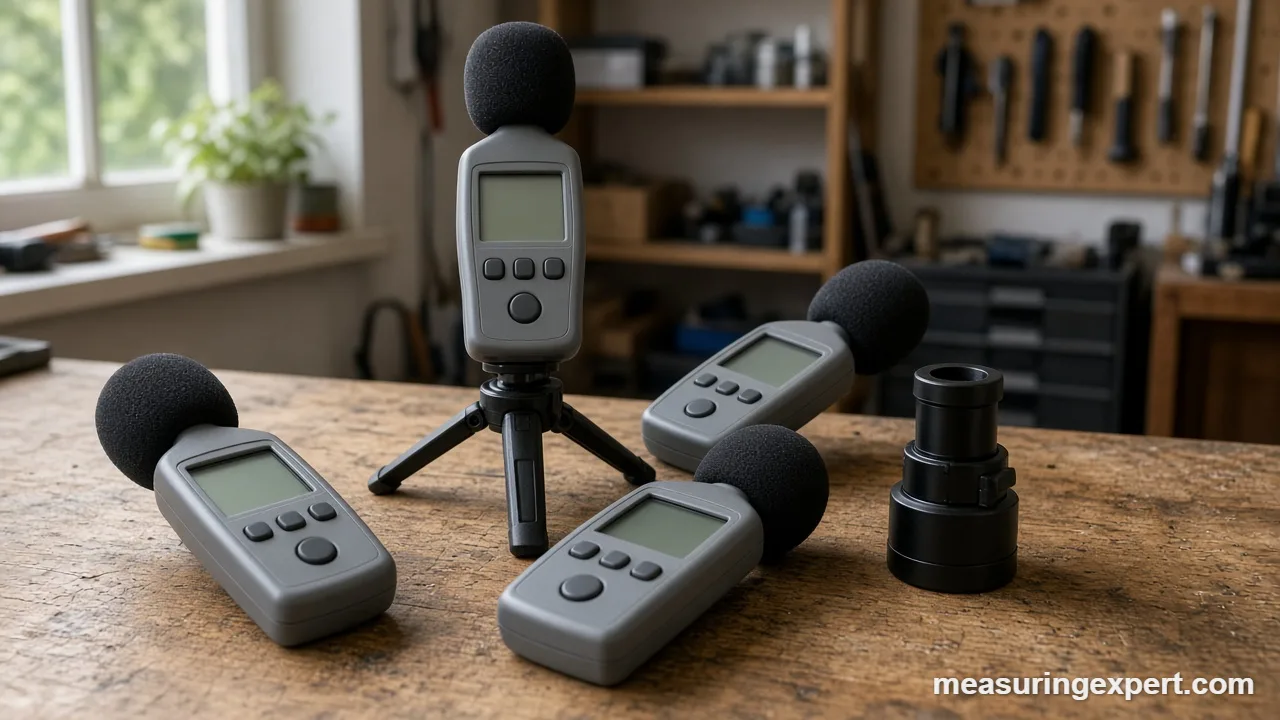
The best sound level meter for most buyers is the Extech 407732-KIT, because it pairs a Type 2 meter with a 94 dB calibrator so you can trust each reading. However, the right choice depends on whether you need a quick spot check, a logged record over hours, or a pro meter for live sound.
In short: get the Extech 407732-KIT for trusted readings, the Protmex PT6708 on a budget, and the Galaxy Audio CM-170 for Class 2 logging.
As an Amazon Associate, Measuring Expert earns from qualifying purchases. Our picks are based on research, specifications and owner feedback, not paid placement.
Best Overall
Best Budget

Best Pro

Quick Answer: Which Meter Fits Your Noise Problem?
- Trusted readings for work: the Extech 407732-KIT with its own calibrator.
- Noise that rises and falls: the REED R8060 and its fast bar graph.
- A record over hours: the Amprobe SM-20-A or the Galaxy Audio CM-170.
- Live music and PA systems: the Galaxy Audio CM-140.
- Readings on your phone: the UNI-T UT353BT.
- Low-cost home checks: the Protmex PT6708 or TopTes TS-501B.
On This Page
- Comparison table
- The 9 picks, reviewed
- How we chose
- How decibels work
- Class 1, Class 2 and phone apps
- Specs that matter
- How to take a reading
- Noise exposure limits
- Calibration, care and honest limits
- FAQ
- Bottom line
Best Sound Level Meter Comparison Table
| # | Product | Best For | Standout Feature | Amazon |
|---|---|---|---|---|
| 1 | Extech 407732-KIT Sound Level Meter Kit | Most buyers who want trusted numbers | Type 2 meter plus a 94 dB, 1 kHz calibrator | View |
| 2 | REED Instruments R8060 Sound Level Meter with Bargraph | Watching changing noise | Type 2, plus or minus 1.4 dB, AC/DC output | View |
| 3 | Amprobe SM-20-A Sound Meter | Logging noise over time | 14,000-record memory with USB download | View |
| 4 | Galaxy Audio CM-170 Handheld SPL Meter | Class 2 logging and outputs | IEC 61672-1 Class 2 with 64,000-record log | View |
| 5 | Galaxy Audio CM-140 Checkmate SPL Meter | Bands, churches and PA setup | Three ranges, alarm and AC output | View |
| 6 | Extech 407730 Digital Sound Level Meter | Simple shop and home checks | Fast analog bar graph with 0.1 dB digits | View |
| 7 | UNI-T UT353BT Mini Sound Level Meter | Phone app and pocket size | Bluetooth link to the iENV app | View |
| 8 | Protmex PT6708 Sound Level Meter | Low-cost spot checks | Auto-ranging 30-130 dB with bar graph | View |
| 9 | TopTes TS-501B Sound Level Meter | Noisy neighbors and home use | Large 2.25 in backlit screen | View |
The 9 Best Sound Level Meter Picks, Reviewed
Each pick covers a different job. Also, every spec comes from the maker’s page or manual.
Best Overall
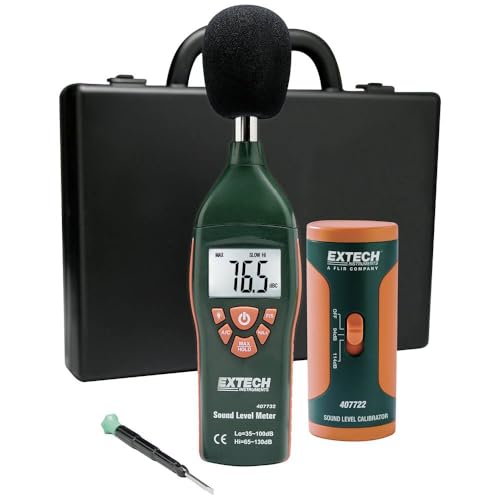
1. Extech 407732-KIT Sound Level Meter Kit
Best for: safety officers and serious hobbyists who want a Type 2 meter they can check before each session.
Extech pairs its 407732 meter with the 407722 calibrator in one case. As a result, you get what most cheap meters skip: a known 94 dB tone at 1 kHz that shows whether the reading has drifted. That makes it the best sound level meter for most people who need numbers they can defend.
The meter meets ANSI and IEC 651 Type 2 standards and covers 35 to 130 dB in two ranges (35 to 100 dB low and 65 to 130 dB high). Extech lists accuracy at plus or minus 1.5 dB. Also, it has Max Hold, Data Hold and a backlit display.
- Standard: ANSI and IEC 651 Type 2
- Range: 35 to 130 dB (low 35-100 dB, high 65-130 dB)
- Listed accuracy: plus or minus 1.5 dB
- Included calibrator: 407722, 94 dB at 1 kHz
Pros
- Calibrator in the box, so you can field-check every session
- Type 2 rating also suits general workplace surveys
- Two ranges keep quiet and loud readings in scale, too
Cons
- However, no data logging or PC link
- Range switch is manual, so you change it yourself
Skip it if: you need a logged record of noise over a shift; instead, look at the Amprobe SM-20-A or Galaxy Audio CM-170.
Best Bargraph
2. REED Instruments R8060 Sound Level Meter with Bargraph

Best for: HVAC techs and engineers who watch noise rise and fall or feed a chart recorder.
Overall, REED builds the R8060 as a compact IEC Type 2 meter with a fast digital bar graph under the main number. Because the bar moves faster than the digits, you can see a fan cycle or a passing truck as it happens.
The meter covers 30 to 130 dB in three ranges, with a 60 dB span per range, and REED lists accuracy at plus or minus 1.4 dB. It also offers A and C weighting, Fast and Slow response, Min/Max hold and AC/DC outputs.
- Standard: IEC Type 2
- Range: 30 to 130 dB, three ranges
- Listed accuracy: plus or minus 1.4 dB
- Weighting: A and C; Fast and Slow
Pros
- Bar graph shows fast swings, while the digits lag
- Analog outputs also let you log with other gear
- Tight listed accuracy for a Type 2 meter
Cons
- Still, it has no internal memory
- Range changes are manual, too
Skip it if: you want a meter that stores readings on its own; the Amprobe SM-20-A keeps 14,000 records.
Best Data Logger
3. Amprobe SM-20-A Sound Meter
Best for: anyone who must show how loud a space was over hours, such as a shop floor or a home by a busy road.
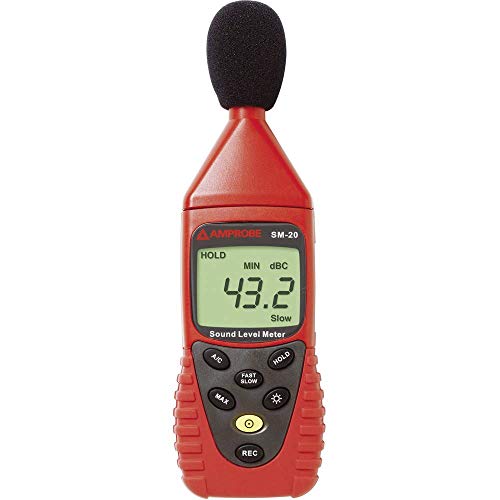
Amprobe rates the SM-20-A to IEC 651 and ANSI S1.4 Type 2. However, its real draw is the 14,000-record internal memory, with logging intervals from 1 second to 8 hours. Then you pull the data to a PC over USB.
The meter auto-ranges from 30 to 130 dB on A weighting (35 to 130 dB on C) with 0.1 dB resolution. Also, it offers Fast (125 ms) and Slow (1 s) response and covers 31.5 Hz to 8 kHz.
- Standard: IEC 651 and ANSI S1.4 Type 2
- Range: 30 to 130 dBA, 35 to 130 dBC, auto-ranging
- Resolution: 0.1 dB
- Memory: 14,000 records, 1 s to 8 h intervals
Pros
- Auto-ranging, so no range switching
- Long intervals also cover a full day
- USB download makes simple reports easy
Cons
- Amprobe does not list an accuracy figure on its spec page
- Its 9 V battery also limits very long runs
- Frequency range stops at 8 kHz, so high whine is out
Skip it if: you need the largest log and a DC output; the Galaxy Audio CM-170 stores 64,000 records.
Best Pro
4. Galaxy Audio CM-170 Handheld SPL Meter
Best for: sound engineers and acoustic consultants who want a modern Class 2 meter with a large log.
First, Galaxy Audio rates the CM-170 to IEC 61672-1 Class 2 and ANSI S1.4 Type 2. It auto-ranges from 30 to 130 dB, and Galaxy lists accuracy at plus or minus 1.4 dB.
In addition, the CM-170 logs 64,000 records with a clock, so each reading carries a time stamp. You also get a fast 30-segment bar graph, an over/under alarm, AC and DC outputs and Windows software.
- Standard: IEC 61672-1 Class 2; ANSI S1.4 Type 2
- Range: 30 to 130 dB, auto or manual
- Listed accuracy: plus or minus 1.4 dB
- Memory: 64,000 records with clock; USB and software
Pros
- Current IEC 61672-1 Class 2 rating
- Large log, and each record is also time-stamped
- Both AC and DC outputs, too
Cons
- However, it costs more than most picks here
- Also, batteries are not in the box
Skip it if: you only need spot checks; a simpler meter such as the Protmex PT6708 covers that.
Best for Live Sound
5. Galaxy Audio CM-140 Checkmate SPL Meter

Best for: church tech teams, band engineers and DJs who police stage and house levels.
The CM-140 comes from a pro audio brand, so it is built for mixing. It splits the scale into three ranges (Lo 32-80 dB, Med 50-100 dB and Hi 80-130 dB), and it adds an over/under alarm for your limit.
Galaxy rates it to IEC 651 and ANSI S1.4 Type 2 with plus or minus 1.5 dB accuracy at 94 dB, 1 kHz. Also, it has A and C weighting, Fast and Slow response and an AC output. On top of that, a 9 V battery lasts about 70 hours.
- Standard: IEC 651 and ANSI S1.4 Type 2
- Range: 32 to 130 dB in three ranges
- Listed accuracy: plus or minus 1.5 dB
- Frequency range: 31.5 Hz to 8 kHz
Pros
- Over/under alarm suits mixing at a set limit
- Long battery life, so it lasts through event days
- C weighting also helps judge bass-heavy music
Cons
- However, it has no data memory
- Galaxy listed it on backorder when we checked
Skip it if: you need records for a complaint or report; pick a logging meter instead.
Best Classic
6. Extech 407730 Digital Sound Level Meter

Best for: DIYers, teachers and maintenance staff who want a simple, well-known meter.
Overall, the 407730 is one of the longest-running basic meters in the Extech line. It measures 40 to 130 dB with 0.1 dB resolution, and a fast analog bar graph sits under the number.
Extech lists basic accuracy at plus or minus 2 dB, which is looser than the Type 2 picks above. Still, it offers A and C weighting, Fast and Slow response and an AC analog output.
- Range: 40 to 130 dB
- Resolution: 0.1 dB
- Listed accuracy: plus or minus 2 dB
- Weighting: A and C; Fast and Slow
Pros
- Simple controls, so first-time users cope fine
- Bar graph also tracks quick changes
- A NIST-certified version is sold, too
Cons
- However, it starts at 40 dB, so it misses very quiet rooms
- Accuracy is also looser than Type 2 meters
Skip it if: you measure quiet bedrooms or offices below 40 dB; the UNI-T or Amprobe reach 30 dB.
Best Smart
7. UNI-T UT353BT Mini Sound Level Meter
Best for: renters and students who want readings on a phone from a pocket-size meter.
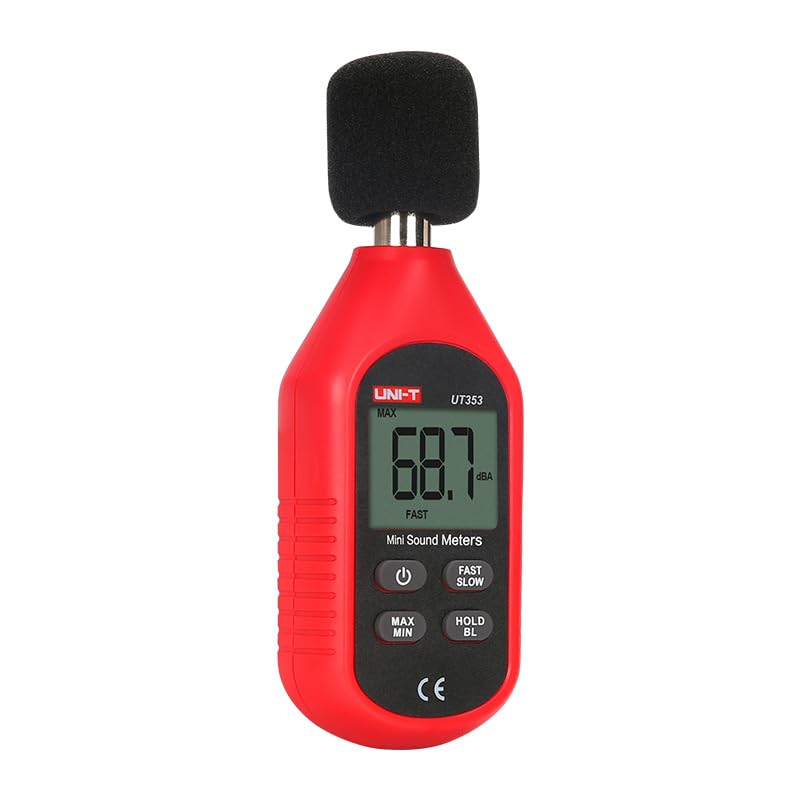
UNI-T makes the UT353 in two versions, and the BT model adds Bluetooth to the iENV phone app. Check that you select the BT version on the listing, because the plain UT353 has no app link.
Both versions measure 30 to 130 dB on A weighting with 0.1 dB resolution, and UNI-T lists accuracy at plus or minus 1.5 dB. Next, the meter offers Fast (125 ms) and Slow (1 s) response, data hold and max/min.
- Range: 30 to 130 dBA
- Listed accuracy: plus or minus 1.5 dB
- Frequency response: 31.5 Hz to 8 kHz
- Connection: Bluetooth to the iENV app (BT version)
Pros
- Phone app view and saving on the BT model
- Light at 116 g (4.1 oz), so it fits a pocket
- A windscreen is also included
Cons
- A weighting only, so there is no C reading for bass
- Also, the listing covers two versions
Skip it if: you need C weighting for music or machinery; the REED R8060 offers A and C.
Best Budget
8. Protmex PT6708 Sound Level Meter
Best for: home users who want quick, low-cost checks of appliances, rooms or a home theater.
The PT6708 covers the basics for little outlay. It reads 30 to 130 dBA (35 to 130 dBC). Also, auto-ranging picks the right 50 dB window for you. In addition, the manual lists plus or minus 1.5 dB at 94 dB and 1 kHz.
However, the same manual lists plus or minus 5 dB at 8 kHz, so treat high-pitched readings with care. It also has A and C weighting, Fast and Slow response, MAX hold and a fast analog bar.
- Range: 30 to 130 dBA, 35 to 130 dBC, auto-ranging
- Listed accuracy: plus or minus 1.5 dB at 1 kHz
- Resolution: 0.1 dB
- Frequency range: 30 Hz to 8 kHz
Pros
- Auto-ranging, so it stays simple
- A and C weighting, too, at a low cost
- Also, a fast analog bar
Cons
- However, accuracy falls off at high frequencies
- Also, no Type or Class rating is listed
- So, it is not suitable for legal or compliance work
Skip it if: your reading may end up in a complaint or report; a Type 2 meter with a calibrator is safer.
Best for Home
9. TopTes TS-501B Sound Level Meter
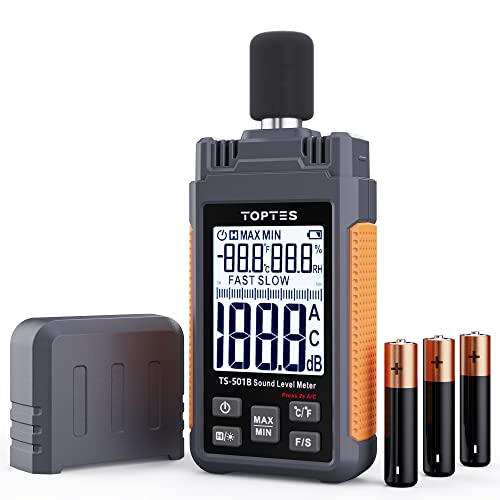
Best for: households checking neighbor noise, a nursery or a home workshop.
The TS-501B puts a 2.25 in backlit LCD on a bright orange body. It reads 30 to 130 dB with A and C weighting, and it has MAX/MIN and data hold.
Even so, TopTes does not publish a Type or Class rating for this meter. Therefore, use it for trends and comparisons at home rather than for formal measurements.
- Range: 30 to 130 dB
- Weighting: A and C
- Display: 2.25 in backlit LCD
- Functions: MAX/MIN and data hold
Pros
- Big, bright screen, so it is easy to read
- Simple button layout, too
- Also offers A and C weighting
Cons
- However, no published accuracy class
- Also, no memory or app
Skip it if: you need a log of noise over a night; a logging meter like the Amprobe SM-20-A fits better.
How We Chose the Best Sound Level Meter
We did not run hands-on lab tests. Instead, we built this list from research. First, we read maker spec pages and manuals from Extech, REED, Amprobe, Galaxy Audio, UNI-T and Protmex. Next, we checked IEC and ANSI class ratings and read owner feedback for patterns such as drift or confusing menus. Finally, we confirmed each listing is a complete meter.
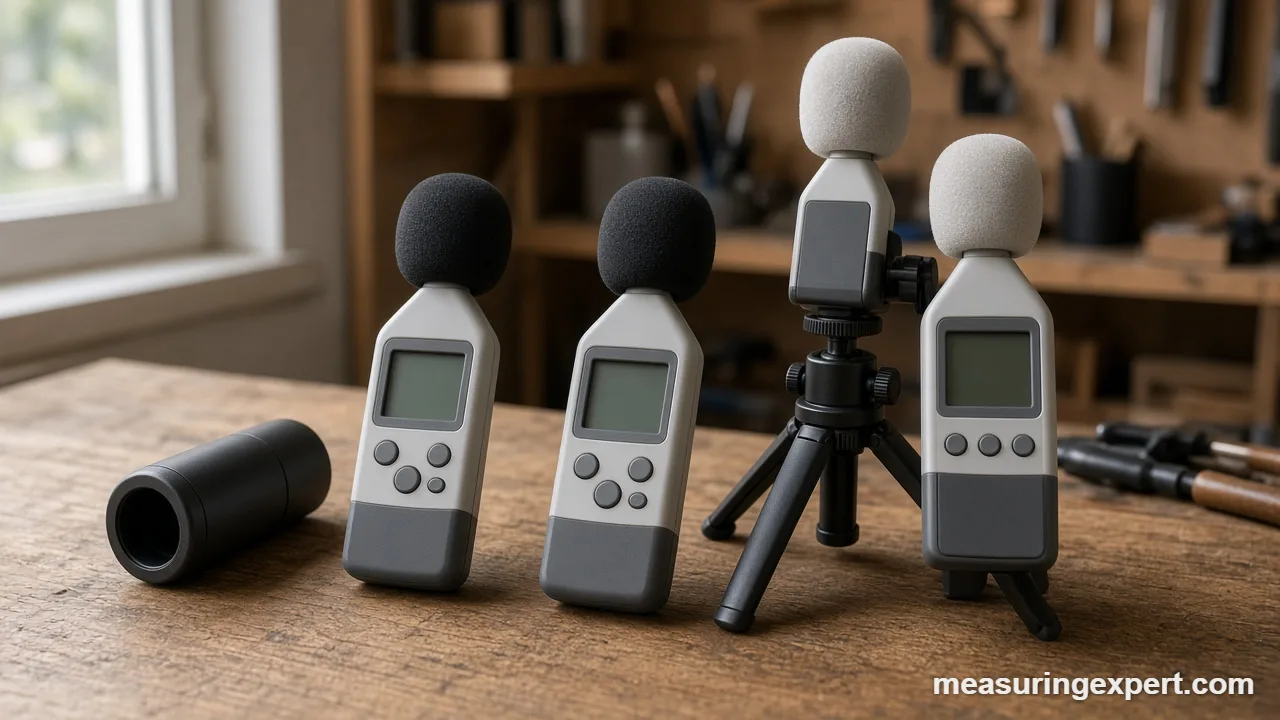
Next, these were the main criteria:
- Class or Type rating: a published IEC 61672-1 Class 2 or IEC 651 Type 2 rating counts for a lot.
- Listed accuracy: we favored meters with a stated tolerance, such as plus or minus 1.4 or 1.5 dB.
- Proof of accuracy: for example, a calibrator, a NIST option or electronic calibration.
- Records: memory, USB, an app or analog outputs for people who need a record.
Finally, we also capped each brand at two picks.
How Decibels Work (and Why Two Meters Disagree)
To begin, a sound level meter measures sound pressure and shows it in decibels. Because the scale is logarithmic, the numbers do not add up the way you might expect. For example, two machines that each read 80 dB together read about 83 dB, not 160 dB. In the same way, a 10 dB rise means ten times more sound energy, and most people hear it as roughly twice as loud.
| Change in reading | Sound energy | What you notice |
|---|---|---|
| +1 dB | about 1.26 times | Barely noticeable, even side by side |
| +3 dB | about 2 times | Just noticeable; halves the safe time under NIOSH |
| +5 dB | about 3.2 times | Clear change; halves the time under OSHA rules |
| +10 dB | 10 times | So, it sounds about twice as loud |
| +20 dB | 100 times | Then it sounds about four times as loud |
Even two good Type 2 meters can differ by a decibel or two. As a result, compare readings from the same meter in the same spot. See the volume of a sound for more on the dB scale.
Weighting also changes the number. For instance, A weighting (dBA) trims low and very high pitches to match how the ear hears everyday sound. In contrast, C weighting (dBC) keeps more of the bass. Therefore, a subwoofer or diesel engine reads higher in dBC than in dBA.
Class 1 vs Class 2 vs Phone Apps
First, the meter class tells you how tight its tolerances are. The current standard, IEC 61672-1, uses Class 1 and Class 2, while the older IEC 651 and ANSI S1.4 use Type 1 and Type 2. In short, Class 1 is the precision grade and Class 2 is the general-purpose grade.
| Type | Typical use | Strengths | Trade-offs |
|---|---|---|---|
| Class 1 / Type 1 | Environmental, legal and lab work | Tightest tolerances, wider frequency range | High cost; also often needs lab calibration |
| Class 2 / Type 2 | Workplace surveys, HVAC, audio, home | Solid accuracy, yet at a fair cost | However, looser at very low and high pitches |
| Unrated budget meter | Casual checks and comparisons | Low cost, so it is simple to start | No published tolerance, so drift is a risk |
| Phone app | Rough checks on the go | Free or cheap; also always with you | Phone mics vary, so results can shift |
For most readers, a Class 2 or Type 2 meter is the best sound level meter choice. After all, it costs far less than Class 1, yet it gives readings that hold up for safety checks and audio work.
Specs That Decide the Best Sound Level Meter for You
Spec sheets for decibel meters look alike at first glance. However, a few lines tell you most of what you need to know.
| Spec | What it means | What to look for |
|---|---|---|
| Accuracy and class | How close the reading stays to the true level | A stated tolerance, such as plus or minus 1.5 dB, and a Class 2 or Type 2 rating |
| Range | The quietest and loudest levels it can read | 30 dB for quiet rooms, 130 dB for shops and concerts |
| Resolution | The smallest step on the display, not the error | 0.1 dB is standard, but it is not the same as accuracy |
| Frequency range | The pitches the mic and circuit handle | 31.5 Hz to 8 kHz covers speech, machines and most music |
| Time weighting | How fast the number reacts | Fast (125 ms) for bursts, Slow (1 s) for steady noise |
| Logging and outputs | How you keep a record | Memory with time stamps, USB, an app or AC/DC outputs |
| Power and build | Run time and handling | Battery life, plus a tripod thread and also a foam windscreen |
So, weigh the class rating first, and treat the rest as features that fit your job.
How to Take an Accurate Noise Reading
Even a good meter gives poor numbers if you hold it badly. So, follow these steps each time.
- Check the battery and settings. First, fit a fresh battery, then set A weighting and Slow response for general noise.
- Field-check the meter. Next, place the calibrator on the mic and confirm it reads the calibrator level, such as 94 dB, before you start.
- Fit the windscreen. Push the foam ball over the mic, because even light wind can add several decibels.
- Position the meter. Then hold it at arm’s length or use a tripod, about 1.5 m (5 ft) high and at least 1 m (3 ft) from walls.
- Point the mic at the source. Also, aim the mic toward the noise source and keep your body out of the sound path.
- Read and record. Watch for 30 to 60 seconds, then note the max, the typical level, the time and the place.
- Check the meter again. Finally, repeat the calibrator check at the end to confirm the meter did not drift.
For more on measuring loudness without a dedicated meter, see our guide on how to measure sound volume.
Noise Exposure Limits Your Meter Helps You Check
In practice, a meter is most useful when you compare its reading to a known limit. In the US, the OSHA noise standard sets a permissible limit of 90 dBA over 8 hours and requires a hearing program at 85 dBA. OSHA uses a 5 dB exchange rate, so each 5 dB rise halves the allowed time. By contrast, NIOSH recommends a stricter 85 dBA over 8 hours with a 3 dB exchange rate.
| Daily exposure time | OSHA limit (5 dB rule) | NIOSH recommendation (3 dB rule) |
|---|---|---|
| 8 hours (full shift) | 90 dBA | 85 dBA |
| 4 hours | 95 dBA | 88 dBA |
| 2 hours | 100 dBA | 91 dBA |
| 1 hour | 105 dBA | 94 dBA |
| 30 minutes | 110 dBA | 97 dBA |
| 15 minutes | 115 dBA | 100 dBA |
Still, keep in mind that a handheld meter shows the level at one moment and one spot. So, for a formal exposure study, safety teams use dosimeters or logging meters over a full shift. For a real-world example, see how loud a cooler noise level can get at home.
Calibration, Care and Honest Limits
Over time, every meter drifts a little with heat and knocks. That is why pros check the meter with a field calibrator before and after each session. Specifically, the calibrator fits over the mic and plays a fixed tone, often 94 dB at 1 kHz. Then, if the meter reads off by more than a few tenths, you adjust it (if it allows) or send it for lab calibration.
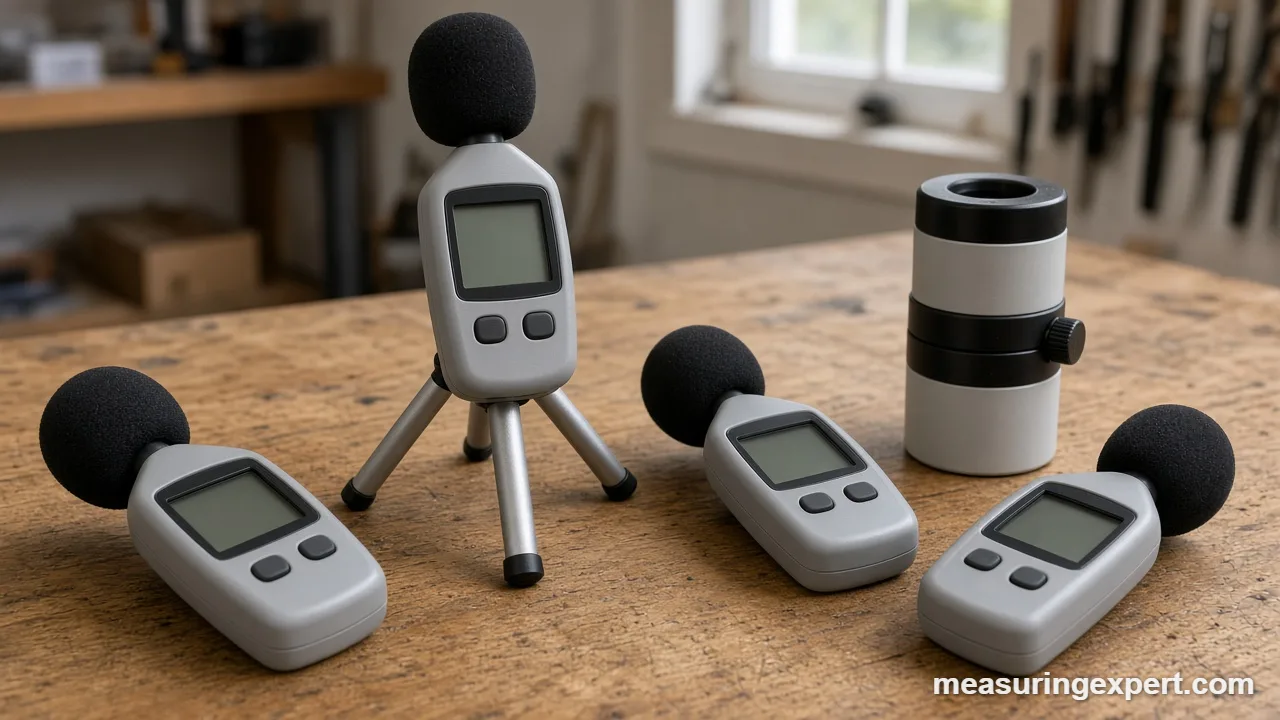
Honest limits of a handheld meter
Clearly, a handheld meter is a strong tool, but it has limits. First, it reads the sound at the mic, not at your ear or your neighbor’s wall. Second, reflections from walls and your own body can add or cancel a few decibels. Third, wind and handling noise can spike a reading. Finally, most local noise rules and legal cases call for set methods and calibrated meters, so a cheap meter alone may not settle a dispute.
Best Sound Level Meter FAQ
What is the best sound level meter for home use?
For most homes, the Extech 407732-KIT gives trusted, checkable numbers. However, on a tight budget, the Protmex PT6708 handles simple spot checks.
What does a sound level meter actually measure?
Simply put, it measures sound pressure level, which compares the pressure swing of a sound to a reference of 20 micropascals. As a result, you see the level in decibels (dB), a log scale where every 10 dB step means ten times more sound energy.
Should I use A or C weighting?
Use A weighting (dBA) for most noise and hearing checks, because it follows how the ear hears. Use C weighting (dBC) for music, engines and other bass-heavy sound.
What is the difference between Fast and Slow response?
Fast response averages over 125 ms, so it follows quick changes. In contrast, Slow response averages over 1 second, so it steadies a jumpy reading.
Is a Class 1 meter the best sound level meter for everyone?
No, because Class 1 meters have tighter tolerances and cost far more, so they suit lab, legal and environmental work. Instead, most safety, home and audio checks are well served by a Class 2 or Type 2 meter.
Can a phone app replace the best sound level meter?
Not fully, because phone microphones and software vary, so app readings can drift. Therefore, a dedicated meter stays more consistent.
Do I need a calibrator with the best sound level meter?
If your readings matter for safety or reports, yes. A field calibrator plays a known tone, often 94 dB at 1 kHz, so you can confirm the meter before and after each session.
What is the best sound level meter for noisy neighbors?
Pick a meter with logging, such as the Amprobe SM-20-A, so you can show levels over time. After all, a single reading proves little.
What is the best sound level meter for live music?
The Galaxy Audio CM-140 suits live sound, because it has three ranges, C weighting and an over/under alarm. For logged shows, the CM-170 adds a 64,000-record memory.
How loud is too loud?
OSHA requires a hearing program at 85 dBA over 8 hours and sets its limit at 90 dBA. Meanwhile, NIOSH recommends 85 dBA over 8 hours, and every 3 dB above that halves the safe time.
Bottom Line: Our Best Sound Level Meter Pick
For most readers, the Extech 407732-KIT is the best sound level meter, because a Type 2 meter plus a 94 dB calibrator gives you numbers you can check and defend. Meanwhile, the Protmex PT6708 suits small budgets, and the Galaxy Audio CM-170 suits pros.
1 thought on “Best Sound Level Meter: 9 Picks for Accurate Noise Readings (2026)”