

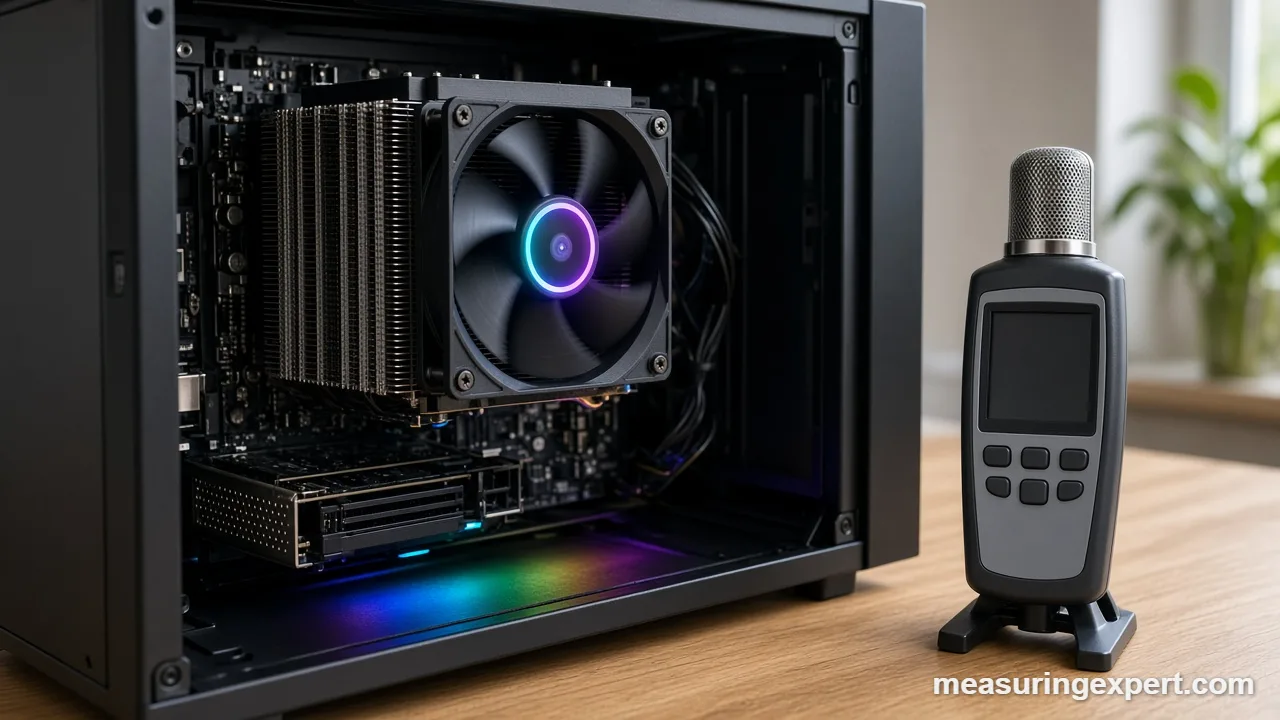
Cooler noise level is rated in decibels, usually A-weighted decibels written dB(A), which follow sound pressure the way human ears hear it. Some makers also list sones, a loudness unit where 1 sone equals 40 phons. Because the decibel scale is logarithmic, +10 dB sounds roughly twice as loud.
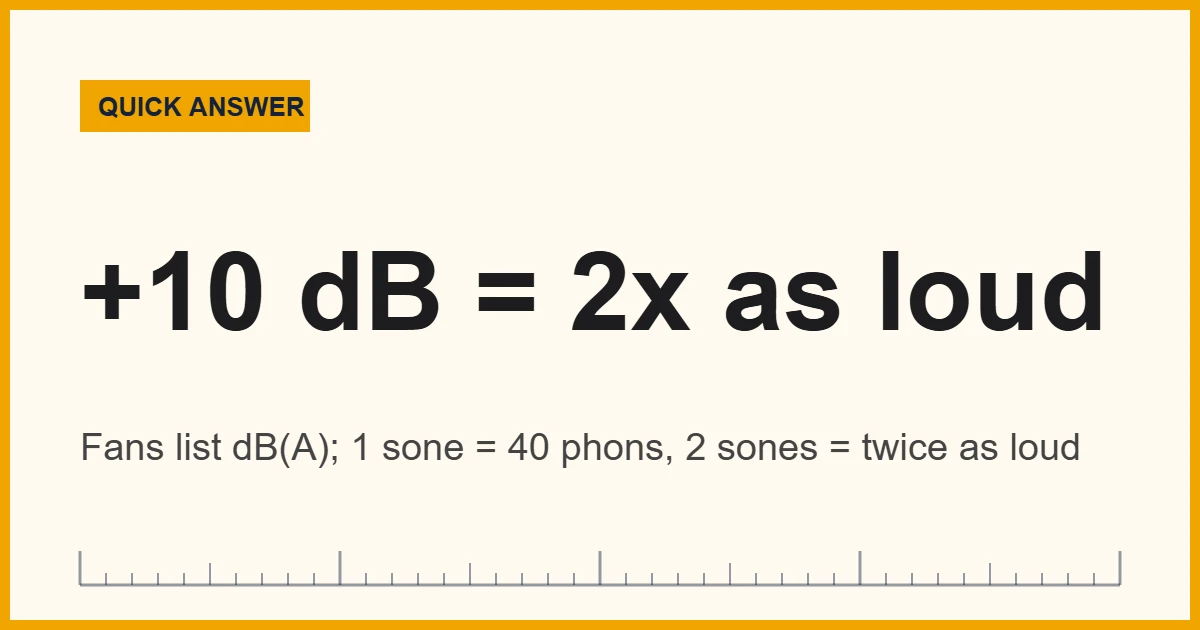
A CPU cooler box, a case fan listing or a room air cooler manual will usually show one small number for noise, such as “22.6 dB(A)” or “1.5 sones”. That number looks precise. In practice, however, it only makes sense once you know which unit it uses, how the maker measured it, and what a few decibels really mean to your ears.
Decibel Basics in One Minute
First of all, the decibel is not a fixed amount like a meter or a gram. Instead, it is a ratio on a logarithmic scale. For sound in air, 0 dB matches a reference pressure of 20 micropascals, roughly the faintest sound a young, healthy ear can detect. So every 20 dB step means ten times more sound pressure, and every 10 dB step means ten times more sound energy.
In short: dB(A) tells you sound pressure weighted for human hearing, sones tell you perceived loudness, and neither number from one brand lines up neatly with a number from another brand.
In addition, standards bodies define how noise testing should work. For example, the ECMA-74 standard for computer and telecom equipment describes how labs measure A-weighted sound power and the sound pressure at the operator’s seat. Fan makers, however, are free to use simpler in-house methods.
So this guide explains both units, the test conditions behind a rating, and a fair way to compare coolers yourself.
Cooler Noise Level in Pascals: Convert Sound Pressure
No calculator converts decibels directly here, so this one uses the closest match: a pressure converter. After all, sound is a tiny pressure wave, and 1 pascal of sound pressure equals about 94 dB. Enter a sound pressure in pascals to see it in kilopascals, psi and other pressure units, then use the table below it to link pascals to decibels.
| Sound pressure level | Sound pressure | What it is like |
|---|---|---|
| 0 dB | 0.00002 Pa (20 µPa) | Reference threshold of hearing |
| 20 dB | 0.0002 Pa | Rustling leaves, very quiet room |
| 30 dB | 0.00063 Pa | Quiet bedroom at night |
| 40 dB | 0.002 Pa | Quiet office or library |
| 60 dB | 0.02 Pa | Normal conversation |
| 94 dB | about 1.0 Pa | Common calibrator tone for sound meters |
| 120 dB | 20 Pa | Close to a siren, painful |
The formula is simple: sound pressure in Pa = 0.00002 x 10^(dB / 20). For example, 40 dB gives 0.00002 x 100 = 0.002 Pa.
Recommended Tools for Checking Cooler Noise Level
A sound level meter lets you compare coolers in your own room instead of trusting the box. First, look for A-weighting and a “slow” response mode, because fan noise is steady. Next, check the lowest reading: many low-cost meters start at 30 dB or 40 dB, so they cannot read a very quiet fan. Also, a meter with a tripod thread makes it easy to keep the same distance every time.

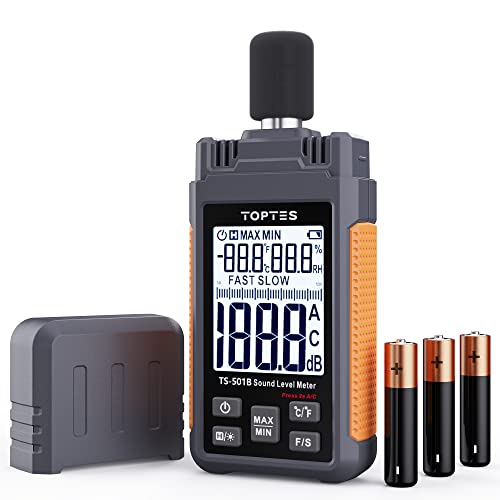


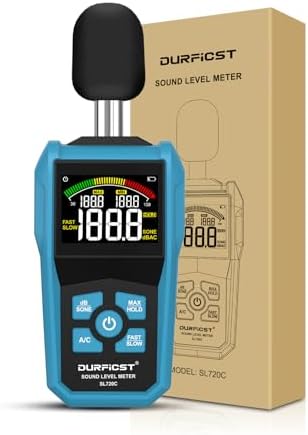
As an Amazon Associate, Measuring Expert earns from qualifying purchases.
- First, most cooler specs use dB(A), an A-weighted sound pressure level.
- Sones measure perceived loudness; 1 sone is 40 phons and 2 sones sound twice as loud.
- Adding 10 dB sounds about twice as loud, while 3 dB doubles the sound energy.
- Two identical fans side by side add about 3 dB, not double the number.
- Also, test distance, room, fan speed and mounting all change the result.
- Ratings from different brands rarely use the same method, so compare reviews that test coolers side by side.
- Finally, for a fair home test, keep the meter, distance and room the same for every cooler.
dB(A) vs Sones: The Two Units on a Spec Sheet
PC fans, CPU coolers and graphics card coolers almost always list noise in dB(A). Bathroom exhaust fans, range hoods and some HVAC products in the US, by contrast, often list sones. Room air coolers and portable evaporative coolers usually follow the decibel style. Both units describe the same sound; however, they answer different questions.
| Unit | What it measures | Scale | Where you see it |
|---|---|---|---|
| dB (SPL) | Raw sound pressure level | Logarithmic, 20 µPa reference | Lab data, acoustics |
| dB(A) | Sound pressure weighted for human hearing | Logarithmic | CPU coolers, case fans, air coolers |
| Bel (B) | Sound power level, often A-weighted | 1 B = 10 dB | Laptops and servers (declared values) |
| Phon | Loudness level, matched to a 1 kHz tone | Logarithmic | Hearing research |
| Sone | Perceived loudness | Linear: 2 sones = twice as loud | Bathroom fans, range hoods |
To begin with, the “A” in dB(A) refers to a filter. Human ears hear quiet low bass and very high treble poorly, so the A curve turns those frequencies down before the meter adds everything up. As a result, a deep hum may read lower in dB(A) than it feels.
How Sones Work
Sones, meanwhile, aim to match what you hear. For example, one sone equals the loudness of a 1 kHz tone at 40 dB. After that, every 10 phons doubles the sone value, so 2 sones match 50 phons and 4 sones match 60 phons.
| Sones | Phons (loudness level) | How it compares with 1 sone |
|---|---|---|
| 0.5 sone | 30 phons | Half as loud |
| 1 sone | 40 phons | Reference |
| 2 sones | 50 phons | Twice as loud |
| 4 sones | 60 phons | Four times as loud |
Why +10 dB Sounds About Twice as Loud
In effect, decibels compress a huge range of pressures into small, handy numbers. Because of that, adding decibels works differently from adding grams or inches.
| Change in level | Sound energy | Sound pressure | Perceived loudness |
|---|---|---|---|
| +3 dB | About 2x | About 1.41x | A small, noticeable step |
| +6 dB | About 4x | About 2x | Clearly louder |
| +10 dB | 10x | About 3.16x | Roughly twice as loud |
| +20 dB | 100x | 10x | Roughly four times as loud |
So a cooler rated at 35 dB(A) sounds roughly twice as loud as one rated at 25 dB(A), not 40% louder. Similarly, two identical fans running together add about 3 dB, because their sound energy doubles. Two fans at 25 dB(A) therefore give about 28 dB(A), not 50. For a deeper look at amplitude and loudness, see what determines the volume of a sound.
How Manufacturers Measure Cooler Noise Level
A typical cooler noise level rating comes from a microphone placed a set distance from the fan, often 1 m, in a very quiet test room. Ideally, that room is anechoic or semi-anechoic, which means its walls absorb echoes. Then the fan usually runs at full speed with no heatsink, case or filter in the way.
Several details shape the final number:
- Distance. In open space, halving the distance adds about 6 dB. As a result, a reading taken at 30 cm is much higher than one at 1 m.
- Fan speed. Specs nearly always show maximum RPM. In daily use, however, a PWM fan often runs far slower and quieter.
- Mounting. A bare fan on a soft stand sounds different from the same fan screwed to a radiator or a thin case panel.
- Background noise. The room must sit well below the fan’s level. Otherwise, the meter partly reads the room.
- Measurement type. Some brands quote sound pressure at a point, while others derive a value from total sound power.
Formal standards such as ECMA-74 and ISO 7779 set out these steps for whole computers. In contrast, few fan brands say which standard, if any, they follow.
Why Cooler Noise Level Ratings Are Not Comparable Across Brands
Two boxes can show the same cooler noise level of “25 dB(A)” and still sound quite different. One brand may test at 1 m, while another tests closer and then corrects the figure. Also, one may use a better test room, a different fan speed, or a sound power figure instead of sound pressure. In addition, some listings round down or quote the lowest speed only.
Frequency content matters too, because ears react to pitch. For example, a fan with a tonal whine or a motor tick can annoy you more than a slightly louder fan with smooth, broadband “whoosh”. Therefore, a single dB(A) number cannot capture that character.
What Is a Quiet Cooler Noise Level?
There is no official cutoff, but these rough bands help when you read specs taken at about 1 m:
- Under about 20 dB(A): close to silent in most homes.
- About 20 to 30 dB(A): quiet; usually hidden by normal room sound.
- About 30 to 40 dB(A): audible in a quiet room, fine for gaming with headphones.
- Above 40 dB(A): clearly noticeable; you will hear it over soft music.
The old idea that every good cooler sits “below 30 dB” is a useful start. Still, the speed the fan actually runs at in your PC matters more than its maximum rating.
How to Measure Cooler Noise Level at Home
You do not need a lab to compare the cooler noise level of two models fairly. Instead, you need consistency. Our guide on how to measure sound volume covers meters and apps in more detail.
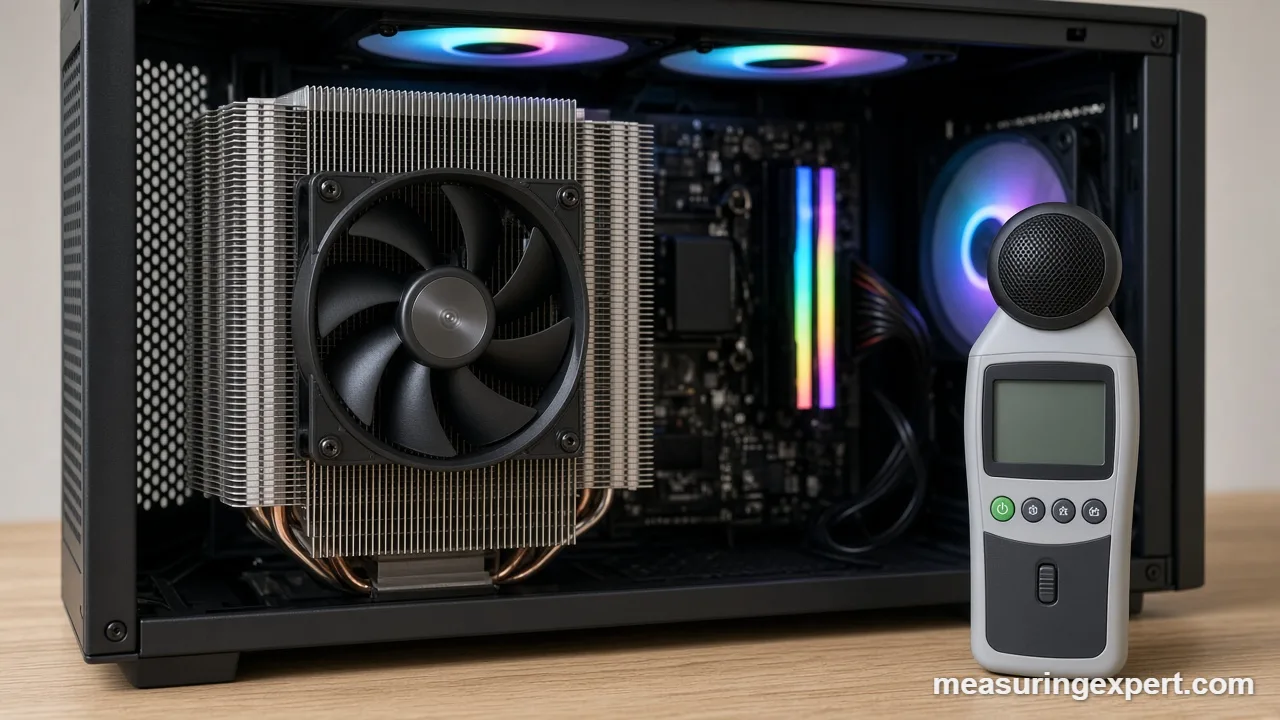
- Pick the quietest time and room. Turn off other fans, air conditioning and appliances, then note the background reading.
- Set the meter to A-weighting and slow response. Both settings suit steady fan noise because it barely changes.
- Fix the distance. Mount the meter on a tripod, for instance 50 cm or 1 m from the cooler, and keep it there.
- Run the cooler at a set speed. Then use the same fan curve or fixed RPM for every test.
- Record for 30 to 60 seconds. Next, write down the average reading rather than a brief peak.
- Repeat and compare. Finally, swap in the next cooler and test it the same way.
Do and Don’t When Comparing Coolers
Do
- Compare ratings taken with the same method.
- Check the fan speed behind each number.
- Listen for whine, rattle and clicking, not just loudness.
- Keep meter distance identical between tests.
- Remember that +10 dB is roughly twice as loud.
Don’t
- Add decibels like ordinary numbers.
- Assume two brands’ 25 dB(A) labels sound alike.
- Trust a phone app below about 30 dB without checking it.
- Convert dB(A) to sones with a simple formula.
- Forget that cases, filters and radiators add noise.
Honest Limits of Noise Ratings
A cooler noise level on a spec sheet is a lab snapshot, not a promise for your desk. For example, your case, your room’s hard surfaces and the distance to your ears all change what you hear. In addition, the A-weighting curve is a compromise, so it underrates low hums. Similarly, phone sound meter apps vary widely, because phone microphones and software differ. In short, use ratings to shortlist coolers, then rely on side-by-side reviews or your own consistent test to decide.
When to Call a Professional
Overall, a home meter is fine for comparing PC fans. However, some jobs need a calibrated instrument and a trained person. For instance, workplace noise exposure, building code checks and noise complaints involving a landlord or neighbor call for an acoustic consultant or industrial hygienist. The US National Institute for Occupational Safety and Health sets a recommended exposure limit of 85 dBA over an eight-hour workday, far above any desktop cooler.
Cooler Noise Level FAQs
What unit measures cooler noise level?
Most coolers list noise in A-weighted decibels, written dB(A) or dBA. Some fans and hoods use sones, which describe perceived loudness instead.
What does dB(A) mean on a fan?
It is a sound pressure level with an A-weighting filter that copies how human ears hear. As a result, it turns down low bass and very high treble.
Is a lower cooler noise level always better?
Usually, yes, but sound character matters too. A slightly louder fan with smooth airflow noise can feel quieter than one with a whine.
How many decibels louder is twice as loud?
About 10 dB. For example, a 35 dB(A) cooler sounds roughly twice as loud as a 25 dB(A) cooler.
What is a sone?
A sone is a unit of perceived loudness. One sone equals a 1 kHz tone at 40 dB, and 2 sones sound twice as loud.
Can I convert dB(A) to sones?
Not exactly. The phon to sone formula works for a pure 1 kHz tone, while fan noise covers many frequencies, so any conversion is only rough.
Why do two fans add only 3 dB?
Two identical fans double the sound energy, so doubling energy adds about 3 dB on the logarithmic scale.
Why are cooler noise level ratings different between brands?
Brands use different test distances, rooms, fan speeds and methods. For instance, some quote sound pressure, while others derive values from sound power.
Is 30 dB loud for a PC cooler?
No. About 30 dB(A) is quiet, similar to a quiet bedroom at night, though you may hear it in a silent room.
Can a phone app measure cooler noise level?
Roughly. Phone apps work for big differences; however, most struggle below about 30 dB and are not calibrated.
The Bottom Line
In summary, coolers list noise in dB(A), a logarithmic, A-weighted sound pressure level, and sometimes in sones, a loudness unit where 2 sones sound twice as loud. Because of the log scale, +10 dB sounds roughly twice as loud and two equal fans add only 3 dB.
Finally, treat box ratings as rough guides, because every brand tests a little differently. For a real comparison, trust side-by-side reviews or test each cooler yourself with the same meter, distance and fan speed.