

The volume of a sound is set mainly by its amplitude: how far the air pressure swings above and below normal as the wave passes. Bigger swings carry more energy, so they sound louder. We measure that loudness in decibels (dB), and the level you hear also drops with distance and shifts with pitch.
Every sound is a pressure wave. For instance, a guitar string, a speaker cone or your vocal cords push on nearby air, and that push travels outward as tiny squeezes and stretches. When those squeezes are strong, your eardrum moves more and your brain reports a loud sound. When they are weak, however, you hear something soft.
In short: amplitude decides how loud a sound is at the source, while distance, frequency and the room decide how loud it seems where you stand. Frequency, by contrast, sets the pitch. As a result, a high note and a low note can have exactly the same volume.
Tiny Pressure Changes, Huge Range
The pressure changes involved are tiny. For example, a sound pressure of 1 pascal (Pa) is already about 94 dB, roughly as loud as a lawn mower close up. Even so, 1 Pa is only about one hundred-thousandth of normal air pressure. Because the ear handles such a huge range, acousticians use the logarithmic decibel scale instead of raw pascals.
The National Institute for Occupational Safety and Health (NIOSH) explains that the scale is logarithmic, so a sound 10 dB louder is ten times more intense. In addition, it treats 85 dBA and above as hazardous noise. That single fact explains why a few extra decibels matter so much for your hearing.
Below, you will find a sound pressure converter, a decibel chart, the distance rule, a comparison of loudness, intensity and pitch, and finally a step-by-step method for measuring noise yourself.
Convert the Pressure Behind the Volume of a Sound
There is no single unit for loudness, so this converter works with the physical quantity underneath it: sound pressure. First, enter a pressure in pascals and compare it with psi, kilopascals, atmospheres and other units. Then use the formula below the chart to turn pascals into decibels.
To get decibels from a pressure, use dB SPL = 20 x log10(p / 0.00002 Pa). The reference, 20 micropascals, is roughly the quietest 1,000 Hz tone a young, healthy ear can detect. So 2 Pa gives 20 x log10(100,000) = 100 dB.
Recommended Sound Level Meters for Measuring the Volume of a Sound
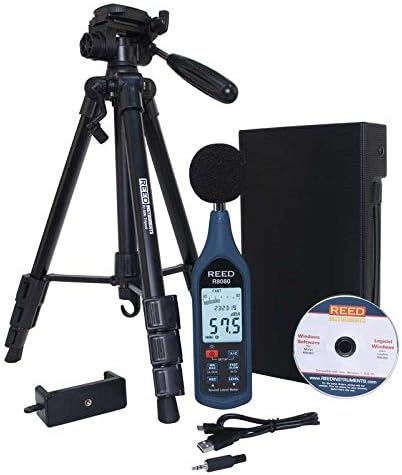
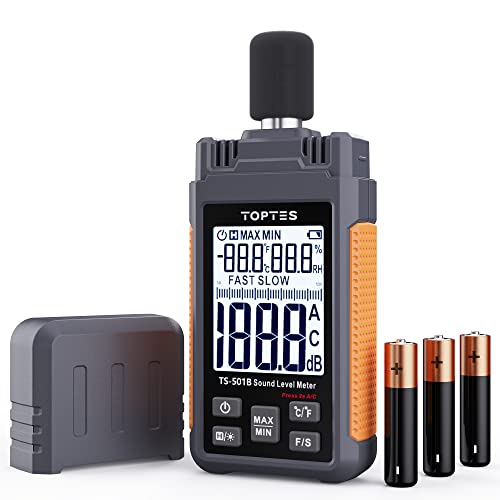
A phone app gives a rough idea of noise, but a dedicated sound level meter is more consistent. First, look for A and C frequency weighting, because A-weighting matches how people hear. Next, check for fast and slow response modes and a max-hold button. Also, a stated range of about 30 to 130 dB covers everything from a quiet bedroom to a loud concert. For a deeper comparison, see our roundup of the best sound level meters.




As an Amazon Associate, Measuring Expert earns from qualifying purchases.
Key Takeaways
- Amplitude (the size of the pressure swing) is the main factor behind loudness.
- Decibels compare a sound pressure with 20 micropascals on a logarithmic scale.
- Each 10 dB step means 10 times the intensity and sounds about twice as loud.
- Outdoors, doubling your distance from a small source lowers the level by about 6 dB.
- Frequency sets pitch, not volume, although ears are most sensitive from about 2,000 to 5,000 Hz.
- Two equal sources together add only about 3 dB, not double the decibels.
- Long exposure at or above 85 dBA can damage hearing, according to NIOSH and NIDCD.
How Amplitude Sets the Volume of a Sound
Picture a speaker cone. When you turn up the amplifier, the cone moves farther in and out on each cycle. As a result, it squeezes the air harder and leaves a deeper low-pressure zone behind. That larger pressure swing is the amplitude, and it is the main thing that decides the volume of a sound.
Amplitude and energy are also linked in a simple way. The intensity of a sound, meaning the power flowing through each square meter, grows with the square of the pressure amplitude. So if you double the pressure swing, the intensity rises four times. In decibel terms, then, that doubling adds about 6 dB.
The quietest sound most young adults can hear carries an intensity of about one trillionth of a watt per square meter. Meanwhile, a level of 120 dB carries about 1 watt per square meter, a trillion times more. Because of that enormous span, a linear scale would be useless for everyday work.
Decibels: The Scale Behind Loudness
The decibel is a ratio, not a fixed amount like a meter or a gram. A reading of 60 dB means the sound pressure is 1,000 times the 20-micropascal reference. Likewise, 80 dB means 10,000 times the reference pressure. Each 20 dB step multiplies the pressure by 10.
Next, this chart pairs common sounds with typical levels. The NIDCD figures come from its guide to noise-induced hearing loss; the pressure column is computed with the formula above.
| Sound | Typical level | Sound pressure |
|---|---|---|
| Threshold of hearing (1,000 Hz) | 0 dB | 0.00002 Pa |
| Rustling leaves, quiet whisper | about 20 to 30 dB | 0.0002 to 0.0006 Pa |
| Normal conversation (NIDCD) | 60 to 70 dBA | 0.02 to 0.06 Pa |
| Long-exposure hazard level (NIOSH) | 85 dBA | about 0.36 Pa |
| Motorcycles and dirt bikes (NIDCD) | 80 to 110 dBA | 0.2 to 6.3 Pa |
| Sirens (NIDCD) | 110 to 129 dBA | 6.3 to 56 Pa |
| Fireworks show (NIDCD) | 140 to 160 dBA | 200 to 2,000 Pa |
Two rules help you read any decibel number. First, adding 10 dB multiplies the intensity by 10, and most listeners judge it roughly twice as loud. Second, adding 3 dB doubles the intensity, which is just about the smallest change many people notice in everyday listening. That is also why two identical machines running together read only about 3 dB higher than one.
How Distance Changes the Volume of a Sound
Sound spreads out as it travels, much like ripples on a pond. Outdoors, energy from a small source spreads over a growing sphere, so the same power covers more and more area. This is known as the inverse square law, so if you double the distance, the intensity drops to one quarter. In decibels, that works out to about 6 dB less for every doubling of distance.
| Distance from source | Level (100 dB at 1 m) |
|---|---|
| 1 m (3.3 ft) | 100 dB |
| 2 m (6.6 ft) | 94 dB |
| 4 m (13.1 ft) | 88 dB |
| 8 m (26.2 ft) | 82 dB |
| 16 m (52.5 ft) | 76 dB |
| 32 m (105 ft) | 70 dB |
Indoors, the drop is smaller, because walls, floors and ceilings reflect sound back toward you. Similarly, a long line of traffic acts more like a line source, so its level falls by only about 3 dB per doubling of distance. Even so, stepping back from a loud machine is one of the easiest ways to protect your ears. If you are curious how far sound travels each second, see our guide to how fast the speed of sound is.
Why Frequency Changes Perceived Loudness
Frequency is the number of pressure cycles per second, measured in hertz (Hz). It sets pitch rather than volume. However, human ears are not equally sensitive at every pitch. We hear best between about 2,000 and 5,000 Hz, which is where many speech sounds sit. Consequently, a 3,000 Hz beep can seem louder than a 100 Hz hum at the same decibel level.
The international standard ISO 226 maps this effect as equal-loudness contours. In particular, these curves show how many decibels each frequency needs to sound as loud as a 1,000 Hz reference tone. At low levels the curves are steep, so deep bass needs much more energy before you notice it. That is also why music sounds thin when you play it very quietly.
The old idea that “higher frequencies are always louder” is therefore wrong. Also, very high tones, above roughly 10,000 Hz, get harder to hear with age. In fact, frequencies above about 20,000 Hz are inaudible to people no matter how strong they are.
Loudness vs Intensity vs Pitch: What Each One Means
People often use these words as if they meant the same thing. In reality they do not, and the difference explains most confusion about the volume of a sound.
| Term | What it describes | Unit | Main driver |
|---|---|---|---|
| Amplitude | Size of the pressure swing | pascal (Pa) | How hard the source vibrates |
| Intensity | Power per unit area | W/m² | Amplitude squared, distance |
| Sound level | Pressure or intensity on a log scale | dB, dBA | Amplitude, distance, room |
| Loudness | How strong a sound seems to a listener | phon, sone | Level, frequency, duration |
| Pitch | How high or low a note seems | hertz (Hz) | Frequency |
In other words, amplitude and intensity are physical facts you can measure with an instrument. Loudness, on the other hand, happens in the listener. Two people can hear the same 70 dB tone and judge its loudness differently, especially if one of them has some hearing loss.
Other Factors: Duration, Sources and Surroundings
A few more things shape what reaches your ears:
- Duration. Very short sounds, under about a fifth of a second, seem quieter than the same level held longer.
- Number of sources. Ten equal machines read about 10 dB higher than one, not ten times the decibels.
- Interference. Waves in step reinforce each other, while waves out of step partly cancel. Noise-canceling headphones use this trick.
- Surfaces. Hard, bare rooms echo and sound louder; carpets, curtains and soft furniture absorb sound.
- Barriers. A solid wall or earth bank between you and the source blocks much of the energy.
One claim in older articles deserves a correction. The size of a gas container does not set how loud sounds are in normal listening. Instead, what matters is how hard the source vibrates and how the sound travels to you. Gas volume is a separate topic, covered in our guide on how to measure the volume of gas.
How to Measure the Volume of a Sound
You can measure noise at home, at work or at a concert with a sound level meter or a calibrated app. These steps give repeatable results.
- Choose your instrument. Use a sound level meter, or a phone app paired with an external calibrated microphone for better accuracy.
- Set A-weighting. Select dBA so the reading matches human hearing and safety limits.
- Pick the response time. Use slow response for steady noise and fast response for changing sounds such as music or traffic.
- Hold the meter at ear height. Keep it at arm’s length, pointed at the source, and away from your body and nearby walls.
- Record for at least 30 seconds. Note the average and the maximum, because a single glance can miss peaks.
- Write down the distance. A reading means little without it, since the level falls about 6 dB per doubling outdoors.
Do and Don’t When Checking Noise Levels
Do
- Note the distance with every reading.
- Use dBA for hearing-safety checks.
- Take several readings and compare them.
- Wear hearing protection above 85 dBA.
- Check the meter against a calibrator if you have one.
Don’t
- Add decibels like ordinary numbers.
- Trust an uncalibrated phone app for legal or workplace limits.
- Cover the microphone with your hand or a case.
- Measure in strong wind without a foam windscreen.
- Assume a high-pitched sound is always the louder one.
Honest Limits of Decibel Readings
A decibel number looks exact, but it hides several choices. For one thing, the weighting (A, C or none) can change a reading by many decibels when there is a lot of bass. Moreover, phone microphones vary from model to model, so two phones in the same room may disagree. Similarly, distance and room reflections matter too.
Perceived loudness is also personal. The rule that 10 dB sounds “twice as loud” is an average from listening tests, not a law. For example, age, hearing loss and even fatigue change how loud a sound seems. Therefore, treat home readings as a guide, and rely on a calibrated Class 1 or Class 2 meter whenever a number has legal weight.
When Loud Sounds Need a Professional
Some situations call for expert help. For example, workplaces with noisy equipment may need a noise survey by an industrial hygienist. OSHA sets its permissible exposure limit at 90 dBA for an 8-hour day. It also requires a hearing conservation program once average exposure reaches 85 dBA. Similarly, ringing in the ears, muffled hearing or ear pain after loud noise are reasons to see a doctor or audiologist.
Neighbor or traffic noise disputes are another case, too. After all, local noise rules usually specify how and where to measure, so an acoustic consultant gives you data that will hold up.
Frequently Asked Questions About the Volume of a Sound
What determines the volume of a sound?
Mainly the amplitude, meaning the size of the pressure swing in the wave. Distance from the source, the frequency of the sound and the surroundings then change how loud it seems where you are.
What are the two main factors that affect the volume of a sound?
The two biggest factors are amplitude and distance. A larger amplitude makes a sound louder, and moving away makes it softer, by about 6 dB per doubling of distance outdoors.
Does frequency affect the volume of a sound?
Frequency sets pitch, not physical volume. However, ears are most sensitive from about 2,000 to 5,000 Hz, so sounds in that range can seem louder than very low or very high sounds at the same level.
Is the volume of a sound measured in decibels?
Yes. Sound level is measured in decibels (dB), usually dBA for noise and hearing safety. The scale compares the sound pressure with 20 micropascals on a logarithmic scale.
How much louder is 10 dB?
An increase of 10 dB means 10 times the sound intensity. Most listeners judge it as about twice as loud.
Why do two speakers not double the decibels?
Decibels are logarithmic. Two equal sources double the intensity, which adds only about 3 dB. For example, two 80 dB speakers together give about 83 dB.
Does amplitude change the pitch of a sound?
No. Amplitude changes loudness only. Pitch depends on frequency, so a note played softly or loudly keeps the same pitch.
How loud is too loud?
NIOSH and NIDCD say long or repeated exposure at or above 85 dBA can cause hearing loss. Sounds at or below 70 dBA are unlikely to harm hearing, even after long exposure.
Can a phone measure the volume of a sound?
A phone app can give a rough reading. For better accuracy, use a sound level meter or an app with a calibrated external microphone.
Why does music sound quieter in a carpeted room?
Soft surfaces absorb sound instead of reflecting it. As a result, less reflected energy reaches your ears, so the same speaker sounds quieter than in a bare room.
The Bottom Line
To sum up, the volume of a sound comes down to amplitude: bigger pressure swings carry more energy and sound louder. Meanwhile, decibels put that energy on a manageable scale, where every 10 dB means ten times the intensity. Distance, frequency and the room then shape what actually reaches your ears.
So if you want a quieter space, reduce the source, move away from it or add soft surfaces. Finally, if you want a number, measure in dBA at a stated distance, and protect your hearing whenever levels stay above 85 dBA.
1 thought on “What Determines the Volume of a Sound? Amplitude, Decibels and Distance”