

To measure an angle with a theodolite, set it up over the corner point, level it, sight the first target and zero the horizontal circle. Then turn to the second target and read the angle. Finally, repeat the pair with the telescope flipped (face right) and average both results to cancel most instrument errors.
A theodolite is a precision telescope that turns on two axes. As a result, it reads horizontal angles (left and right) and vertical angles (up and down) to a few seconds of arc. Surveyors, builders and engineering students use one to lay out property corners, square up foundations, set out roads and work out the height of things they cannot reach.
The method looks fiddly at first, but it follows a fixed rhythm. First, you center and level the instrument over a point. Next, you sight a backsight target and set the horizontal circle to zero. After that, you swing to the foresight and record the reading. Finally, you transit the telescope, repeat the same pointings on the other face, and take the mean. Every good theodolite habit exists to protect that mean from small setup and instrument errors.
In short: center, level, focus, zero on the first target, read the second, then repeat on the opposite face and average.
Where This Method Comes From
Survey courses teach exactly this routine. For example, the civil engineering surveying notes from the Indian Institute of Technology on measuring a horizontal angle describe zeroing on one station, reading the other, and then repeating face left and face right because the mean cancels instrument errors.
Below, you will find a height calculator, a parts overview, the full setup and measuring steps, how to read zenith angles, and what the accuracy numbers on a spec sheet really mean.
Find a Height From a Theodolite Vertical Angle
One of the most common jobs for a theodolite is trigonometric heighting. Measure the level distance to the base of a building, tree or pole, then read the vertical angle to its top. Enter both values below. Also, type your instrument height (the height of the telescope axis above the ground) in the eye height box.
The tool uses height = distance x tan(angle) + instrument height and assumes level ground. Most electronic models show a zenith angle by default, so subtract the zenith reading from 90 degrees to get the elevation angle first.
Recommended Tools for Theodolite Angle Work
A theodolite only performs as well as the gear around it. First, pick a sturdy tripod with a flat head that matches the instrument’s 5/8 in x 11 thread. Next, add a plumb bob or rely on the built-in optical or laser plummet for centering. In addition, a range pole or target lets you sight a point you cannot see directly. Also, check the spec sheet for the angle accuracy before you buy, because a 2-second and a 20-second instrument suit very different jobs.

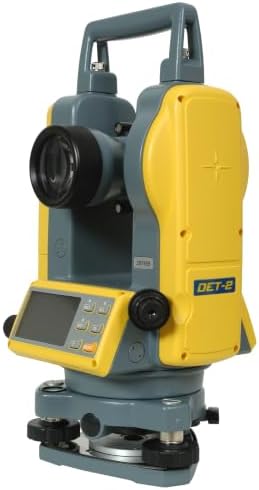
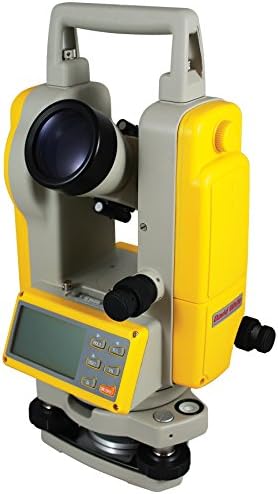


As an Amazon Associate, Measuring Expert earns from qualifying purchases.
Key Takeaways
- A theodolite measures horizontal and vertical angles; it does not measure distance on its own.
- Center over the point first, then level with the foot screws and plate bubble.
- Zero the horizontal circle on the backsight and read the angle at the foresight.
- Always measure on both faces and average to cancel collimation and axis errors.
- Most instruments show zenith angles: 90 degrees is level, below 90 is up.
- A 1-second error shifts a line about 0.48 mm at 100 m (0.006 in at 100 ft).
- Boundary and legal work needs a licensed surveyor, not just a good instrument.
What a Theodolite Actually Measures
Think of the instrument as a telescope mounted on a turntable that also tilts. The turntable rotates around the vertical axis, so the horizontal circle reads directions around the horizon. Meanwhile, the telescope tilts around the horizontal (trunnion) axis, so the vertical circle reads how far up or down you are looking.
An angle is simply the difference between two directions. For instance, if the backsight reads 0 degrees and the foresight reads 47 degrees 18 minutes 22 seconds, the angle between them is 47 degrees 18 minutes 22 seconds. In decimal form, that is about 47.3061 degrees. Our guide to converting degrees to radians shows how to switch units when a formula needs radians.
Older optical models use glass circles that you read through a small microscope. Modern digital versions use electronic encoders and an LCD, so you read the angle directly. Either way, the instrument reports angles in degrees, minutes and seconds (DMS) or in gons, where a full circle is 400 gon and 1 gon equals 0.9 degrees.
Theodolite vs Total Station vs Transit Level
People often mix these instruments up, because they look alike on a tripod. However, they do different jobs, and the difference decides which one you should rent or buy.
| Instrument | Measures | Typical use |
|---|---|---|
| Theodolite (optical or digital) | Horizontal and vertical angles | Layout, alignment, angle checks, teaching |
| Total station | Angles plus distance (built-in EDM) and coordinates | Full surveys, staking, as-built work |
| Transit level | Horizontal angles roughly, elevations with a rod | Site grading, basic building layout |
| Auto (dumpy) level | Height differences only, on a level line | Floor levels, footings, drainage |
In other words, a total station is a theodolite with a distance meter and a computer added. So, if you need distances too, pair the theodolite with a steel tape or a laser distance meter, or step up to a total station.
Parts You Need to Know
- Tribrach and foot screws: the base plate with three screws for leveling.
- Plate (tubular) bubble and circular bubble: show when the vertical axis stands truly vertical.
- Optical or laser plummet: points straight down so you can center over the station mark.
- Horizontal clamp and tangent screw: lock the rotation and make fine side-to-side moves.
- Vertical clamp and tangent screw: lock the tilt and make fine up-and-down moves.
- Telescope with crosshairs: has an eyepiece focus for the crosshairs and a main focus for the target.
- Display or reading microscope: shows the horizontal (HA or Hz) and vertical (VA or V) readings.
How to Set Up and Measure a Horizontal Angle
This is the standard method for one angle measured on both faces. Allow about 15 minutes for your first setup; with practice, it takes far less.
- Set the tripod over the point. Spread the legs evenly, keep the head roughly level, and push the feet firmly into the ground.
- Center the instrument. Attach it to the tripod, look through the plummet, and turn the foot screws until the plummet sits on the station mark.
- Level roughly with the legs. Lengthen or shorten the tripod legs to center the circular bubble.
- Level precisely with the foot screws. Turn the plate bubble parallel to two screws and center it, then rotate 90 degrees and center it with the third screw.
- Recheck centering. Loosen the instrument slightly, slide it over the mark if needed, and level again.
- Sight the backsight on face left. Point at the first target, clamp, use the tangent screw to bisect it, and set the horizontal reading to 0 degrees.
- Turn to the foresight. Release the clamp, swing clockwise to the second target, bisect it, and record the reading.
- Change to face right. Transit the telescope, rotate 180 degrees, and sight the backsight and foresight again, recording both readings.
- Average the two angles. Subtract each backsight from its foresight, then take the mean of the face left and face right results.
Worked Example: A Theodolite Angle on Both Faces
Here is a worked example. On face left, the backsight reads 0 degrees 00 minutes 00 seconds and the foresight reads 47 degrees 18 minutes 24 seconds. On face right, the backsight reads 180 degrees 00 minutes 10 seconds and the foresight reads 227 degrees 18 minutes 30 seconds, so that angle is 47 degrees 18 minutes 20 seconds. Therefore, the mean angle is 47 degrees 18 minutes 22 seconds.
Reading Vertical and Zenith Angles
Most modern instruments measure vertical angles from straight up, which surveyors call the zenith angle. So a level line reads 90 degrees, a line pointing up reads less than 90, and a line pointing down reads more. To get the elevation angle, subtract the zenith reading from 90 degrees.
The two faces help here too. On face right, the zenith reading for the same target should equal 360 degrees minus the face left reading. For example, suppose face left reads 84 degrees 15 minutes 20 seconds and face right reads 275 degrees 44 minutes 52 seconds. Together they add up to 360 degrees 00 minutes 12 seconds, so the index error is half the excess, or 6 seconds. As a result, the corrected zenith angle is 84 degrees 15 minutes 14 seconds, and the elevation angle is 5 degrees 44 minutes 46 seconds.
For a quick slope reading without the full setup, a hand clinometer is faster. Our explainer on how a clinometer measures angles covers that simpler tool.
Accuracy, Precision and Resolution on a Theodolite Spec Sheet
Spec sheets usually list angle accuracy as 1, 2, 5, 7, 10 or 20 seconds, often quoted to the DIN 18723 or ISO 17123-3 standard. That figure is a standard deviation for a direction measured on both faces under good conditions. According to this explanation of DIN angle specs, it describes pointing precision at about 68% confidence, not a guarantee for every field reading.
| Term | What it means on a theodolite |
|---|---|
| Accuracy | How close the mean reading is to the true angle |
| Precision | How closely repeated pointings agree with each other |
| Resolution (least count) | The smallest step the display shows, such as 1 or 5 seconds |
To see what a spec means on the ground, convert it to a sideways offset. One second of arc is about 0.000004848 radians. Consequently, every second of error shifts a line by about 0.48 mm per 100 m, or roughly 0.006 in per 100 ft.
| Angle error | Offset at 50 m | Offset at 100 m | Offset at 100 ft |
|---|---|---|---|
| 1 second | 0.24 mm | 0.48 mm | 0.006 in |
| 5 seconds | 1.21 mm | 2.42 mm | 0.029 in |
| 10 seconds | 2.42 mm | 4.85 mm | 0.058 in |
| 20 seconds | 4.85 mm | 9.70 mm | 0.116 in |
Do and Don’t in the Field
Do
- Push each tripod leg firmly into the ground.
- Remove parallax before every series of pointings.
- Bisect targets as low as you can see them.
- Measure every angle on both faces.
- Write readings down at once, with face and target.
Don’t
- Lift the instrument by the telescope.
- Force a clamp or turn a tangent screw against its stop.
- Leave the tripod unattended on a busy site.
- Sight through heat shimmer over hot pavement if you can avoid it.
- Trust a reading after someone bumps a leg; level and start again.
Honest Limits of a Theodolite
Even a perfect instrument cannot beat a poor setup. For example, a centering error of a few millimeters matters far more on a short 10 m sight than on a long one. Likewise, a soft tripod on hot asphalt slowly twists, and heat shimmer makes targets dance. Because of this, real field results often fall short of the spec sheet number.
A theodolite also only gives you angles. To turn angles into positions, you still need distances, a known starting direction and some arithmetic. In addition, both faces cancel collimation and trunnion axis errors, but they cannot cancel a tilted vertical axis caused by poor leveling. Finally, any instrument drifts over time, so it needs a regular check and, for professional work, calibration by a service center.
If you only need rough angles for a deck, a fence or a school project, a protractor or digital angle finder is often enough. See how to measure angles with a protractor for the simple version.
When to Call a Licensed Surveyor
Practice on your own lot is a great way to learn. However, some jobs carry legal or structural weight, and those belong with a professional. Call a licensed land surveyor for property lines, easements, subdivision plats and anything that may end up in a dispute or a deed. Similarly, bring in a surveyor or engineer for foundation layout on a new building, road and drainage grades, and structural monitoring.
Also, send the instrument to a calibration lab or authorized service center if the two faces disagree by more than the manual allows, or after a drop.
Theodolite FAQs
What is a theodolite used for?
It measures horizontal and vertical angles. Surveyors and builders use it to set out lines and corners, check alignment, and work out heights and positions with trigonometry.
Can a theodolite measure distance?
No, not on its own. You need a tape or laser distance meter, or a total station, which adds a distance meter to the angle readings.
Why measure on both faces?
The mean of face left and face right readings cancels collimation error, trunnion axis error and vertical index error, so the result is more accurate than either face alone.
What does a 90 degree vertical reading mean on a theodolite?
Most instruments show zenith angles, so 90 degrees means the telescope is level. Readings below 90 point upward and readings above 90 point downward.
How accurate is a theodolite?
Construction models are usually rated at 5 to 20 seconds of arc, and survey models at 1 to 2 seconds. In practice, setup and weather often limit accuracy more than the spec does.
How do you level a theodolite?
Center the circular bubble with the tripod legs. Then turn the plate bubble parallel to two foot screws, center it, rotate 90 degrees and center it with the third screw.
What is the difference between a theodolite and a transit?
A transit is an older, simpler instrument whose telescope can flip over. A theodolite reads angles more precisely, often with digital encoders, and usually includes an optical or laser plummet.
Can a beginner use a theodolite?
Yes, with patience. Practice centering and leveling first, then measure a known angle, such as a building corner, on both faces until your results repeat.
What is a gon?
A gon, or grad, is an angle unit where a full circle is 400 gon. One gon equals 0.9 degrees, and some European instruments display gon by default.
How do you find a building’s height with a theodolite?
Measure the level distance to the base, read the elevation angle to the top, then multiply the distance by the tangent of the angle and add the instrument height.
The Bottom Line
To sum up, using a theodolite comes down to a repeatable routine: center, level, focus, zero on the backsight, read the foresight, then repeat on the other face and average. That last step matters most, because it quietly removes the largest instrument errors.
Start with simple angles you can check, such as a square building corner, and keep clear notes. Then use the calculator above to turn vertical angles into heights. For boundaries and structural layout, however, hire a licensed surveyor.
1 thought on “How to Use a Theodolite for Angle Measurement: Step-by-Step Guide”