


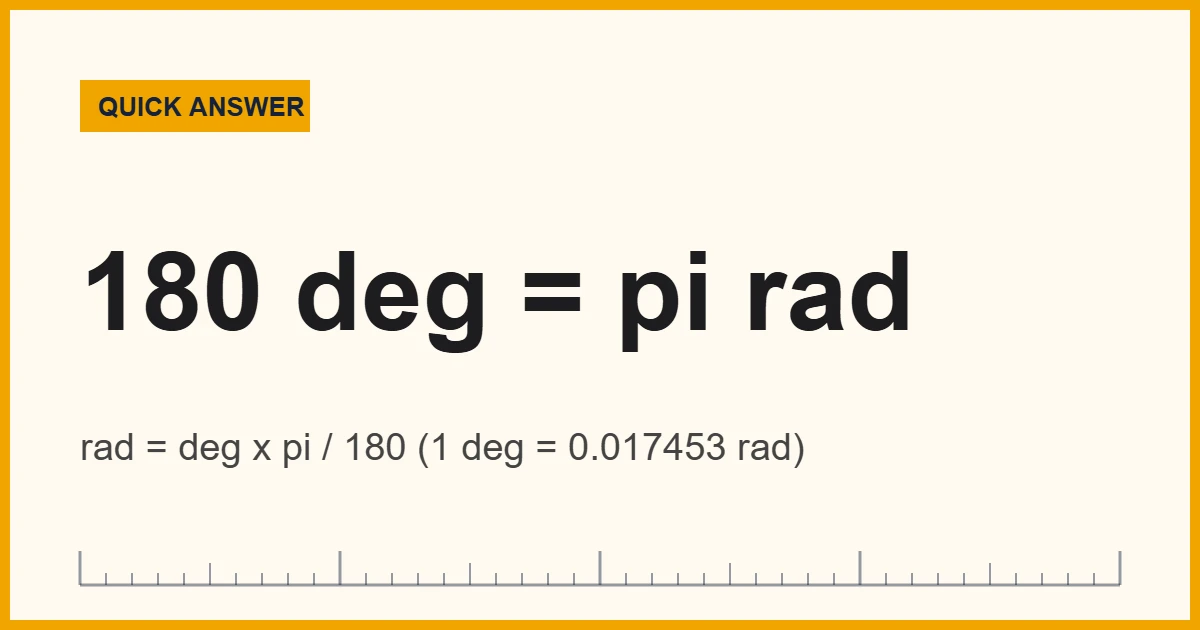
To convert degrees to radians, multiply the angle in degrees by pi and divide by 180: rad = deg x pi / 180. So 1 degree is about 0.017453 rad, 90 degrees is pi/2 (about 1.5708 rad), and 180 degrees is exactly pi (about 3.1416 rad). One full turn of 360 degrees equals 2 pi radians.
Degrees are the angle unit most people learn first. For example, a protractor, a miter saw and a roof pitch chart all use them. Radians, however, are the unit that math and physics actually prefer, so sooner or later you need to switch between the two. In fact, the switch is just a single multiplication.
A radian measures an angle by arc length. To see how, picture a circle with a radius of 1 inch (or 1 cm). If you walk along the edge for exactly one radius, the angle you sweep out at the center is 1 radian. Because the whole circumference is 2 pi times the radius, a full circle holds 2 pi radians. Meanwhile, that same full circle holds 360 degrees, and this is where the conversion factor comes from.
In short: 360 degrees = 2 pi rad, so 180 degrees = pi rad, and therefore 1 degree = pi/180 rad.
This is not just a rule of thumb, because the National Institute of Standards and Technology (NIST), the US agency that keeps the official unit definitions, lists the radian as the SI derived unit of plane angle in its SI unit guide (SP 811). In the same guide, its table of units outside the SI defines the degree as exactly (pi/180) rad.
Next, you will find a converter, a full chart from 0 to 360 degrees, worked examples, and the mistakes that trip up students and engineers alike.
Convert Degrees to Radians, Grade and Pitch
First, enter an angle in degrees. The box then shows the same slope as a percent grade and as a roof pitch (rise per 12 of run), which is handy for building work. For the radian value, multiply your degrees by 0.0174533, or simply read it from the chart further down.
Recommended Tools for Degrees to Radians Work
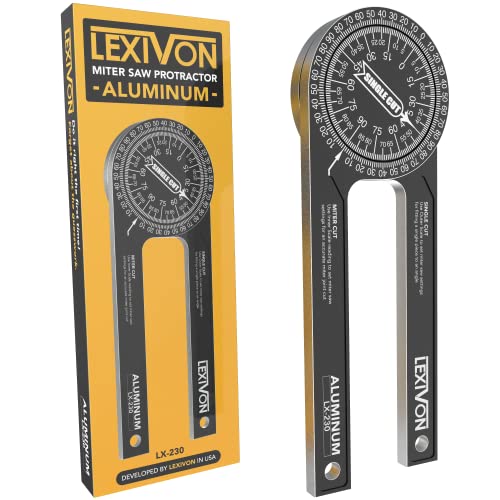
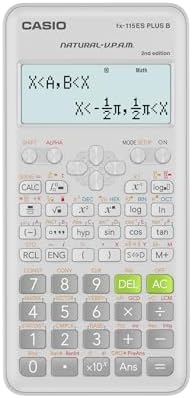
Of course, you can do every conversion on this page with a pencil. Still, a good scientific calculator makes it faster, and it also lets you switch the angle mode between DEG and RAD. For example, the models below all have a pi key and a degree/radian mode setting, according to their manufacturer listings. In addition, a digital angle gauge or a metal protractor is useful when the angle starts on a real object, such as a board or a pipe.




As an Amazon Associate, Measuring Expert earns from qualifying purchases.
Key Takeaways
- The formula is rad = deg x pi / 180.
- Similarly, the reverse formula is deg = rad x 180 / pi.
- 1 degree is about 0.0174533 rad, while 1 rad is about 57.2958 degrees.
- Common angles convert to neat fractions: 30 degrees = pi/6, 45 degrees = pi/4, 90 degrees = pi/2.
- The radian is the SI derived unit of plane angle; the degree is accepted for use alongside it.
- Also, check that your calculator is in the right mode before using sin, cos or tan.
- Finally, keep pi as a symbol until the last step for the most accurate answer.
What Is a Radian, Really?
First of all, a degree is an arbitrary slice: someone long ago split the circle into 360 equal parts. A radian, by contrast, comes from the circle itself. In other words, it is the angle at which the arc length equals the radius. Since both of those are lengths, their ratio therefore has no unit at all. That is why NIST describes the radian as a special name for the number one, written m/m, which is used to make clear that a number is an angle.
This natural definition is the reason radians show up everywhere in higher math. For instance, the arc length of a circle is simply s = r x theta when theta is in radians. Similarly, the area of a sector is (1/2) x r squared x theta. Calculus formulas, such as the derivative of sin x being cos x, also only work in their simple form with radians. As a result, physics uses radians for rotation, waves and oscillation, and so do engineering and computer graphics.
In practice, one radian is a fairly large angle: about 57.3 degrees. So a full circle holds just over six of them (6.2832, to be exact enough for most work).
The Degrees to Radians Formula, Explained
First, start from the one fact everyone agrees on: half a circle is 180 degrees and also pi radians. Then, dividing both sides by 180 gives the value of one degree.
rad = deg x pi / 180
In other words, you multiply by the conversion factor pi/180, which is about 0.0174533. To go the other way, flip the factor: multiply radians by 180/pi, which is about 57.2958.
A simple memory trick also helps here. Basically, you want the unit you are leaving to cancel out. Degrees to radians means degrees must go on the bottom, so the factor is pi over 180. Radians to degrees means pi must go on the bottom, so the factor is 180 over pi.
Degrees to Radians Chart
Overall, this chart covers the angles you meet most often in trigonometry and on the unit circle. In addition, each value was computed from the exact formula; the decimals are rounded to four places.
| Degrees | Radians (exact) | Radians (decimal) | Where you see it |
|---|---|---|---|
| 0° | 0 | 0 | Starting line |
| 1° | pi/180 | 0.0175 | Conversion factor |
| 15° | pi/12 | 0.2618 | Hour hand moving for 30 minutes |
| 30° | pi/6 | 0.5236 | 30-60-90 triangle |
| 45° | pi/4 | 0.7854 | Miter joint, 100% grade |
| 60° | pi/3 | 1.0472 | Equilateral triangle |
| 90° | pi/2 | 1.5708 | Right angle |
| 120° | 2pi/3 | 2.0944 | Hexagon corner |
| 135° | 3pi/4 | 2.3562 | Octagon corner |
| 150° | 5pi/6 | 2.6180 | Unit circle |
| 180° | pi | 3.1416 | Straight angle |
| 270° | 3pi/2 | 4.7124 | Three-quarter turn |
| 360° | 2pi | 6.2832 | Full turn |
Print this chart or save it to your phone; it covers most homework and shop problems. Also, angles between 180 and 360 degrees are reflex angles, which our guide on what a reflex angle is and how to measure it explains in more detail.
How to Convert Degrees to Radians Step by Step

- Write down the angle in degrees. If it has minutes or seconds, first turn them into decimal degrees (divide minutes by 60 and seconds by 3,600).
- Multiply by pi. Keep pi as a symbol for an exact answer, for example 45 pi.
- Divide by 180. This gives you 45 pi / 180.
- Simplify the fraction. Divide the top and bottom by their greatest common factor; here that is 45, so the result is pi/4.
- Convert to a decimal if you need one. Replace pi with 3.14159 or use the pi key: pi/4 is about 0.7854 rad.
- Sanity-check the size. Because 1 rad is about 57 degrees, the radian number should always be a bit less than one-fiftieth of the degree number.
Worked Examples
To practice, here are four conversions that cover the common cases. Each one follows the same steps, so the pattern quickly becomes routine.
Example 1: 30 Degrees to Radians
First, multiply by pi and divide by 180: 30 x pi / 180 = 30 pi / 180. Next, divide top and bottom by 30. The exact answer is pi/6, which is about 0.5236 rad.
Example 2: 135 Degrees
Start with 135 x pi / 180. Then, because the greatest common factor of 135 and 180 is 45, the fraction simplifies to 3 pi / 4. As a decimal, that is about 2.3562 rad.
Example 3: 10 Degrees 30 Minutes
First, turn the minutes into degrees: 30 / 60 = 0.5, so the angle is 10.5 degrees. Then 10.5 x pi / 180 = 7 pi / 120, which is about 0.1833 rad. This one also comes up in surveying and navigation, where angles are often written in degrees and minutes.
Example 4: Converting 1.2 Radians Back to Degrees
Next, go the other way. Multiply by 180 and divide by pi: 1.2 x 180 / pi is about 68.75 degrees. As a check, 1.2 rad should be a little more than one radian (57.3 degrees), and it is.
Finally, here is why it matters. For a wheel with a 10-inch radius, a 60-degree turn is pi/3 rad. So a point on the rim travels 10 x pi/3, or about 10.47 inches (26.6 cm). That arc-length shortcut only works once the angle is in radians.
Degrees, Radians, Gradians and Grade Compared
In fact, students often mix up angle units with slope units. So this table separates the ones you are most likely to see on a calculator, a drawing or a road sign.
| Unit | Full circle | Right angle | Typical use |
|---|---|---|---|
| Degree (°) | 360 | 90 | Everyday angles, protractors, tools |
| Radian (rad) | 2pi (6.2832) | pi/2 (1.5708) | Math, physics, programming |
| Gradian (gon, grad) | 400 | 100 | Some surveying instruments; the GRAD calculator mode |
| Turn (revolution) | 1 | 1/4 | Rotation speeds (rpm) |
| Percent grade | not an angle unit | undefined (vertical) | Roads, ramps; 45° = 100% |
Percent grade is rise divided by run, times 100. Therefore it does not scale evenly with the angle: 30 degrees is about 57.7%, but 45 degrees is exactly 100%. Luckily, the converter above handles that tangent step for you. For field use, our guide to how a clinometer measures angles covers slope readings in more depth.
Do and Don’t
Do
- Keep pi as a symbol until the final step.
- Simplify fractions such as 90/180 to 1/2.
- Convert minutes and seconds to decimal degrees first.
- Check your calculator mode before using trig keys.
- Estimate the answer first, so mistakes stand out.
Don’t
- Use 180/pi when going from degrees to radians.
- Round pi to 3.14 in precise engineering work.
- Confuse GRAD mode with RAD mode.
- Treat percent grade as an angle in degrees.
- Drop the degree symbol from a degree value.
The Calculator Mode Mistake
The most common error is not the formula at all. Instead, it is a calculator left in the wrong mode. For example, sin 30 should equal 0.5 when 30 means degrees. In RAD mode, however, the calculator reads 30 as 30 radians and returns about -0.988. Even worse, nothing on the screen warns you, apart from a small DEG or RAD label.
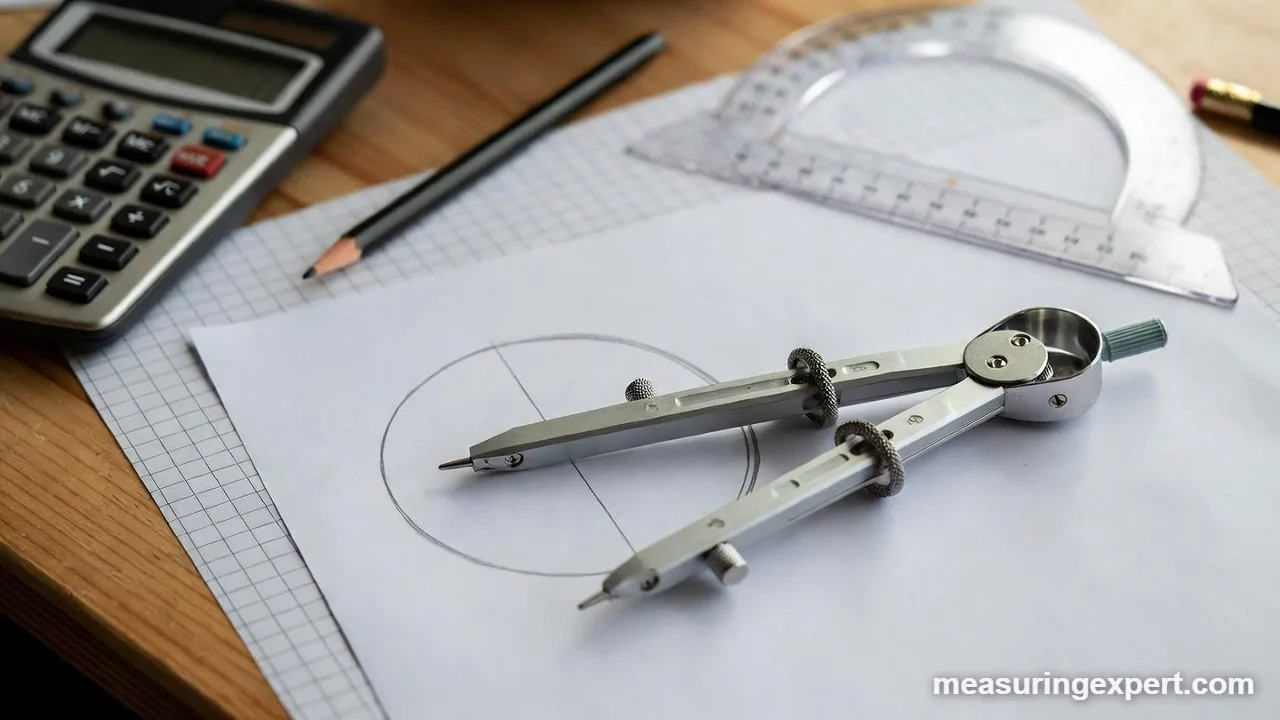
Similarly, spreadsheets and most programming languages make the same assumption. In Excel, Google Sheets, Python and JavaScript, SIN() and Math.sin() expect radians. So you either convert first or use a helper: Excel has RADIANS() and DEGREES(), and Python has math.radians() and math.degrees().
Honest Limits of Degrees to Radians Conversions
The conversion itself is exact, because the degree is defined as pi/180 rad. Even so, every decimal answer is rounded, since pi never ends. For example, 0.7854 is a rounded form of pi/4. Admittedly, that is fine for homework and shop work. Yet rounding early, say using 3.14 for pi, adds an error of about 0.05% that can grow in long chains of calculations.
Also, the conversion can only be as good as the angle you started with. A school protractor typically reads to about 1 degree, which is roughly 0.017 rad. So quoting that reading as 0.785398 rad suggests far more precision than you really have. In short, match your decimal places to how well you measured.
When to Call a Professional
Converting units is easy. However, getting a safe structural or mechanical answer from those units is not. So if the angle feeds into stair stringers, roof framing, a load calculation, a CNC program or a survey boundary, have the numbers checked by a licensed engineer, surveyor or experienced tradesperson. Likewise, if your angle instruments disagree with each other, a calibration lab can check them against a traceable standard.
Degrees to Radians FAQs
What is the formula for degrees to radians?
Multiply the angle in degrees by pi and divide by 180. Written out, rad = deg x pi / 180, which is about deg x 0.0174533.
How many radians are in one degree?
One degree equals pi/180 rad, which is about 0.017453 rad. So it takes about 57.3 degrees to make one radian.
What is 90 degrees in radians?
90 degrees equals pi/2 radians, or about 1.5708 rad. That is a right angle.
What is 180 degrees to radians?
180 degrees is exactly pi radians, about 3.1416 rad. This equality is the basis of the whole conversion.
What is 360 degrees in radians?
A full circle of 360 degrees equals 2 pi radians, about 6.2832 rad.
How do you convert radians to degrees?
Multiply the radians by 180 and divide by pi. For example, pi/3 rad x 180 / pi = 60 degrees.
Why do we convert degrees to radians in math?
Radians come from the circle itself, so formulas for arc length, sector area and calculus derivatives work in their simplest form only with radians.
How do I convert 10 degrees 30 minutes to radians?
First change it to 10.5 degrees. Then 10.5 x pi / 180 = 7 pi / 120, which is about 0.1833 rad.
Is the radian an SI unit?
Yes. The radian is the SI derived unit of plane angle, with the symbol rad. The degree is a non-SI unit accepted for use with the SI.
Why does my calculator give the wrong sine after degrees to radians work?
It is probably in the wrong angle mode. Switch to DEG if you type degrees, or to RAD if you type radians, and then test with sin 30 degrees = 0.5.
Degrees to Radians: The Bottom Line
To sum up, converting degrees to radians takes one step: multiply by pi and divide by 180. Because 180 degrees is exactly pi radians, 90 degrees becomes pi/2, 45 degrees becomes pi/4, and a full 360-degree turn becomes 2 pi. Keep pi as a symbol for exact answers, and round only at the end.
Finally, most real-world errors come from the calculator mode, not the math. So check DEG or RAD before you press sin, cos or tan, and keep the chart above handy for the angles you use most. For slopes and roof pitch, the converter at the top of the page does the rest.
8 thoughts on “How to Convert Degrees to Radians: Formula, Chart and Worked Examples”