
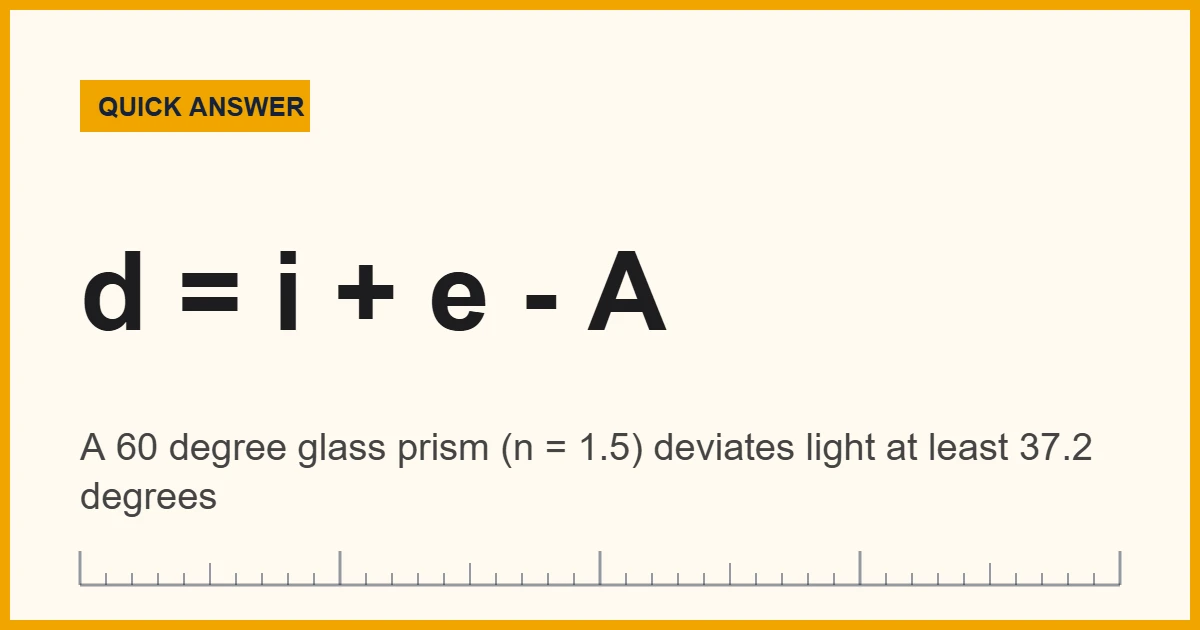
The angle of deviation is the angle between the ray that enters a prism and the ray that leaves it. For a prism with apex angle A, it equals i + e – A (incidence plus emergence minus apex). For example, a 60 degree glass prism (n = 1.5) turns light by at least about 37.2 degrees.
Shine a narrow beam into a glass prism and it comes out pointing somewhere else. Also, that change of direction has a name and a number. In optics, physicists call it the deviation, and they measure it in degrees from the original path of the light to the new one.
In short: draw the incoming ray and the outgoing ray, extend them until they cross, and measure the angle between them with a protractor. Alternatively, a school or lab spectrometer reads the same angle off a graduated circle, often to a fraction of a degree. In general, the result depends on three things: the apex angle of the prism, its refractive index, and the angle at which the light hits the first face.
The idea also matters well beyond the classroom. For example, the HyperPhysics reference site at Georgia State University explains that the minimum deviation of a prism can be used to find the refractive index of its glass, which is one of the classic ways to characterize optical materials. Eye doctors, meanwhile, measure deviation in a related unit, the prism diopter.
Below, you will first find a converter. After that, this guide covers the formula, a worked example, a step-by-step lab method, and finally the mistakes that throw readings off.
Convert an Angle of Deviation to Prism Diopters
First, enter a deviation in degrees. Then the converter shows the same angle as a percent grade, and because a prism diopter is also 100 x tan(angle), the Grade row is the value in prism diopters. So 1 degree is about 1.75 prism diopters. However, ignore the Pitch row; it is for roofs.
- The angle of deviation is the angle between the incident ray and the emergent ray.
- For a prism: deviation = i + e – A, and inside the glass r1 + r2 = A.
- Deviation first falls, then rises, as the angle of incidence grows.
- The lowest value, the minimum deviation, happens when the ray passes through symmetrically.
- At minimum deviation, n = sin((A + Dm)/2) / sin(A/2).
- Blue light deviates more than red light, which is why a prism makes a spectrum.
- Eye care uses prism diopters: 1 prism diopter shifts an image 1 cm at 1 m.
The Angle of Deviation Formula
A prism bends light twice. First, the ray refracts toward the normal as it enters the glass. Then it refracts away from the normal as it leaves through the second face. Each bend adds to the total turn, so the overall deviation is the sum of the two separate deviations.
deviation (d) = i + e – A
r1 + r2 = A
sin i = n sin r1 and sin e = n sin r2
Here, i is the angle of incidence on the first face, e is the angle of emergence from the second face, A is the apex (refracting) angle of the prism, r1 and r2 are the angles inside the glass, and n is the refractive index. Also, all angles are measured from the normal, the line at 90 degrees to each face, not from the surface itself.
For a thin prism (apex angle under about 10 degrees) and light arriving close to the normal, the formula simplifies to d = (n – 1) x A. Therefore, a 10 degree prism of glass with n = 1.5 deviates light by about 5 degrees.
Angle of Deviation: A Worked Example
First, take an equilateral glass prism, so A = 60 degrees, with a refractive index of 1.5. Next, send a ray in at i = 40 degrees.
- Inside angle at face one: sin r1 = sin 40 / 1.5, so r1 = 25.37 degrees.
- Inside angle at face two: r2 = 60 – 25.37 = 34.63 degrees.
- Exit angle: sin e = 1.5 x sin 34.63, so e = 58.47 degrees.
- Total: d = 40 + 58.47 – 60 = 38.47 degrees.
By contrast, the older version of this page used i = 40, e = 60 and A = 30 degrees to get 70 degrees. The arithmetic of i + e – A works, but those three angles only fit together for a material with a refractive index near 2.9, which is far above any ordinary glass (and even above diamond, at about 2.42). As a result, real numbers always come from Snell’s law at both faces, as shown above.
| Angle of incidence i | Angle of emergence e | Angle of deviation d |
|---|---|---|
| 30° | 77.10° | 47.10° |
| 35° | 66.00° | 41.00° |
| 40° | 58.47° | 38.47° |
| 45° | 52.38° | 37.38° |
| 48.59° | 48.59° | 37.18° (minimum) |
| 60° | 38.88° | 38.88° |
| 70° | 32.87° | 42.87° |
| 80° | 29.17° | 49.17° |
Again, these values are for A = 60 degrees and n = 1.5. Moreover, below about i = 27.9 degrees, the ray hits the second face beyond the critical angle and reflects back inside instead of leaving.
Recommended Tools for Measuring the Angle of Deviation
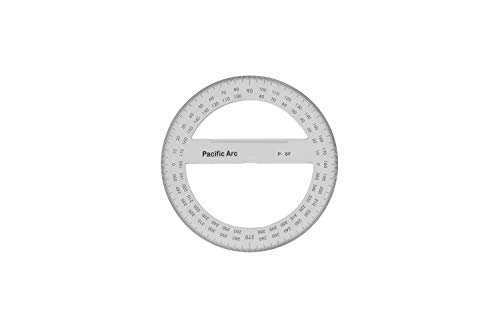
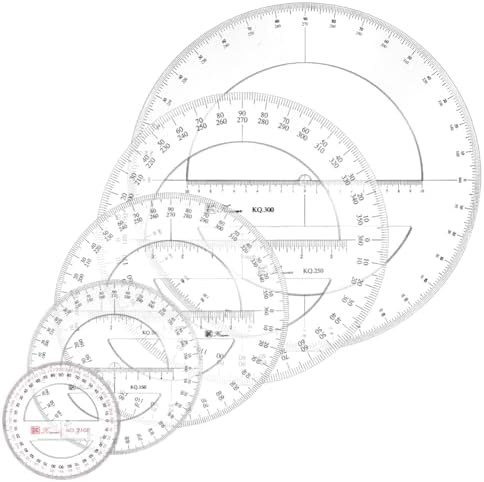
For the pin method, you only need a solid glass prism, a sheet of paper on a soft board, pins, a sharp pencil and a clear protractor. In addition, a set of optics demo parts helps if you want a visible beam, and a spectroscope lets you see how each color spreads out after the prism. Choose a prism with polished faces and sharp edges, because chips and scratches scatter the beam.


As an Amazon Associate, Measuring Expert earns from qualifying purchases.
How to Measure the Angle of Deviation Step by Step
In fact, this is the classic pin method used in school physics labs. Also, it works with any solid triangular prism, and it needs no light source other than normal room light.
- Trace the prism. Put the prism on white paper pinned to a soft board and draw around it. Label the corners so you know which angle is the apex.
- Draw a normal and an incident ray. Remove the prism, draw a normal at a point on one face, and use the protractor to draw a ray at your chosen angle of incidence, for example 40 degrees.
- Place two pins on the incident ray. Put the prism back exactly on its outline, then push two pins upright on the ray, at least 5 cm apart.
- Sight through the second face. Look into the opposite face with one eye near paper level. Then place two more pins so that they line up exactly with the images of the first two.
- Draw the emergent ray. After that, remove the prism and the pins, and join the last two pin holes with a straight line up to the prism face.
- Extend both rays and measure. Extend the incident ray forward and the emergent ray backward until they cross. The angle between them is the angle of deviation; read it with the protractor.
- Repeat and plot. Finally, repeat for several angles of incidence, such as 30 to 60 degrees in 5 degree steps, and plot deviation against incidence. The lowest point of the curve is the minimum deviation.
Tips for Accurate Pin Readings
Measuring Deviation With a Spectrometer
In a teaching lab, however, a spectrometer replaces the pins. First, its collimator sends a parallel beam into the prism. Then its telescope swings on a circular scale with a vernier. Next, you read the telescope position with the prism in place and again with the prism removed. The difference between the two readings is the angle of deviation.
Minimum Angle of Deviation and Refractive Index
If you turn a prism slowly while watching the beam, the exit ray swings toward the original path, stops, and then swings back. In other words, that turning point is the minimum deviation, Dm. At that moment, the ray passes through the prism symmetrically, so i = e and r1 = r2 = A/2. Inside an equilateral prism, the ray then runs parallel to the base.
n = sin((A + Dm) / 2) / sin(A / 2)
So if you measure Dm = 37.2 degrees with a 60 degree prism, n = sin(48.6) / sin(30) = 1.50. Because the minimum is a flat turning point, a small error in setting the prism changes the reading very little. That is why labs use the minimum, and not any other point on the curve, to find refractive index. For liquids and gemstones, a refractometer does a similar job; our guide to the best refractometer covers handheld models.
| 60° prism made of | Refractive index (approx.) | Minimum deviation |
|---|---|---|
| Water (hollow prism) | 1.333 | 23.6° |
| Glass, n = 1.5 | 1.50 | 37.2° |
| Crown glass (yellow light) | 1.517 | 38.6° |
| Dense flint glass | 1.62 | 48.2° |
| Diamond | 2.42 | none: light cannot pass through |
However, the diamond row surprises people. After all, its critical angle is only about 24.4 degrees, so at 60 degrees the light reflects inside instead of passing through. Indeed, gem cutters use exactly that effect to make a stone sparkle.
What Changes the Angle of Deviation
Altogether, four things set the angle of deviation for a given ray:
- Angle of incidence. As the table above shows, deviation falls to a minimum and then rises again. So a bigger angle of incidence does not always mean a bigger deviation, which is a common misconception.
- Apex angle. Similarly, a larger apex angle gives a larger deviation. For n = 1.5, the minimum deviation is about 15.7 degrees for a 30 degree prism, 25.1 degrees for 45 degrees, and 37.2 degrees for 60 degrees.
- Refractive index. Likewise, denser optical materials bend light more. For instance, a water prism deviates far less than a glass one of the same shape.
- Wavelength (color). Glass has a slightly higher index for blue light than for red. In crown glass, the minimum deviation at 60 degrees is about 38.4 degrees for red light and 39.1 degrees for blue, and that gap of under one degree spreads white light into a spectrum.
Angle of Deviation vs Related Terms
Several optics terms sound alike, and textbooks often mix them up. Therefore, this table separates them.
| Term | What it measures | Typical unit |
|---|---|---|
| Angle of incidence | Incoming ray vs the normal at the first face | degrees |
| Angle of refraction | Ray inside the glass vs the normal | degrees |
| Angle of emergence | Outgoing ray vs the normal at the second face | degrees |
| Angle of deviation | Outgoing ray vs the original path | degrees |
| Angular dispersion | Deviation of blue minus deviation of red | degrees |
| Prism diopter (eye care) | Image shift in cm at 1 m, or 100 x tan(angle) | prism diopters |
The angle of deviation is also not the same as the angle of inclination, which describes the tilt of a line or slope. If that is what you need, see what the angle of inclination is and how to measure it. Likewise, if your calculator works in radians, our degrees to radians guide shows the conversion.
Similarly, a rainbow is the same physics in a water droplet. First, sunlight refracts in, then it reflects once off the back of the drop, and finally it refracts out. That path has its own minimum deviation of about 138 degrees, so the light bunches up about 42 degrees from the point opposite the sun, and that is where the bow appears.
Do and Don’t When Measuring Deviation
Do
- Measure every angle from the normal, not the prism face.
- Use a sharp, hard pencil and thin lines.
- Keep pins upright and well apart.
- Take several readings and plot a curve.
- Note the color of light you used.
Don’t
- Move the prism off its outline between steps.
- Read a single point and call it the minimum.
- Assume more incidence always means more deviation.
- Use a chipped or scratched prism face.
- Point a laser toward anyone’s eyes.
Honest Limits of Angle of Deviation Readings
A paper-and-pin measurement is usually good to about plus or minus 1 degree. In most cases, the error comes from thick pencil lines, protractor parallax, and pins that are not quite vertical. A student spectrometer with a vernier, by contrast, reads to about a minute of arc, but only after you level and focus it carefully. In addition, white light gives a smeared result because each color deviates by a different amount. So for precise work, use a single color, such as a sodium lamp, and quote the wavelength with the result. Finally, the formulas on this page assume a perfectly flat, uniform prism in air; real glass has small variations that a hobby setup cannot detect.
When to Get a Professional
For homework and hobby optics, the pin method is enough. However, an optics or calibration lab is the right call when you need the refractive index of glass to three or four decimals, for example to design a lens. Eye deviation, on the other hand, is a different case. In esotropia (one eye turning inward) and other kinds of strabismus, an eye doctor measures the misalignment in prism diopters, usually with a prism cover test, holding prisms of known power in front of the eye until it stops moving. A prism diopter is defined as an image shift of 1 cm at 1 m, a definition that clinical prism guides use as their starting point.
Angle of Deviation FAQs
What is the angle of deviation in simple words?
It is how much a ray of light changes direction after passing through a prism or another optical part. You measure it in degrees between the original path and the new path.
What is the formula for the angle of deviation?
For a prism, d = i + e – A, where i is the angle of incidence, e the angle of emergence and A the apex angle. For a thin prism, d is about (n – 1) x A.
How is the angle of deviation measured?
Trace the incident and emergent rays with pins, extend both until they cross, and read the angle with a protractor. A spectrometer measures it more precisely on a graduated circle.
What is the minimum angle of deviation?
It is the smallest deviation a prism can produce. It occurs when the ray passes through symmetrically, so the angles of incidence and emergence are equal.
Why does deviation decrease and then increase?
At small angles of incidence, the second face bends the ray sharply. As incidence grows, the two bends balance out, and past the symmetric point the first face bends it more again.
Does red or blue light deviate more?
Blue and violet light deviate more than red, because glass has a higher refractive index for shorter wavelengths. That difference splits white light into a spectrum.
How do you find refractive index from the minimum deviation?
Use n = sin((A + Dm)/2) / sin(A/2). For example, a 60 degree prism with a minimum deviation of 37.2 degrees has n of about 1.50.
What is the angle of deviation of a 60 degree glass prism?
For glass with n = 1.5, it is at least about 37.2 degrees, at an angle of incidence of about 48.6 degrees. At other angles of incidence it is larger.
How is the angle of deviation measured in esotropia?
An eye doctor measures it in prism diopters, usually with a prism cover test. One prism diopter shifts an image 1 cm at 1 m, which is about 0.57 degrees.
How many degrees is one prism diopter?
One prism diopter is about 0.573 degrees, and 1 degree is about 1.75 prism diopters. The converter on this page handles any value.
The Bottom Line on the Angle of Deviation
To sum up, the angle of deviation tells you how far a prism turns a ray of light. In short, you find it with d = i + e – A, measure it by extending the incoming and outgoing rays, and use its minimum to work out the refractive index of the glass.
Above all, measure from the normal, repeat the reading at several angles, and quote the color of light you used. For eye alignment, leave the prisms to an eye care professional, who will report the result in prism diopters.