

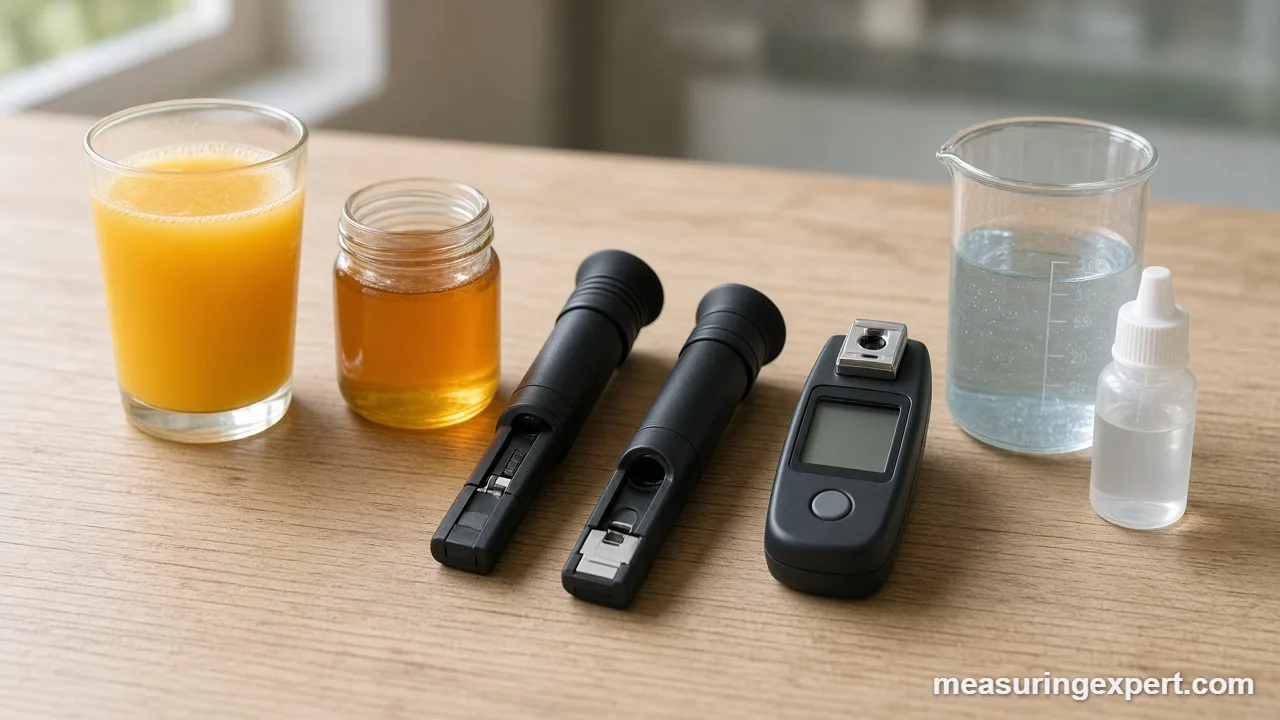
The best refractometer for most people is the Atago PAL-1, a pocket digital meter that reads 0 to 53% Brix to 0.1% from a few drops. However, the right choice depends on the sample: fruit juice and wort, honey, seawater, or engine coolant and battery acid each need their own scale.
In short: buy the Atago PAL-1 for fast digital Brix, an aichose dual-scale model for cheap brewing checks, a honey model for moisture, a salinity model for reef tanks, and Robinair or TRZ for coolant.
As an Amazon Associate, Measuring Expert earns from qualifying purchases. Our picks are based on research, specifications and owner feedback, not paid placement.
Best Overall

Best Budget
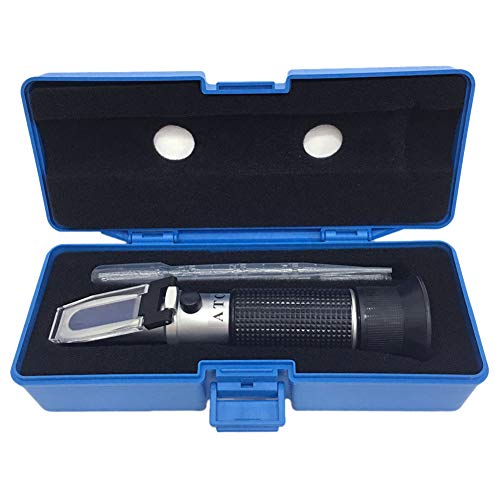
Best Optical Pro

Quick Answer: Best Refractometer by Use
- Fruit, juice and produce checks: Atago PAL-1 digital, 0 to 53% Brix in about 3 seconds.
- Beer and wine on a budget: aichose dual-scale Brix and specific gravity model with ATC.
- Syrup, jam and very sweet samples: Milwaukee MA871, a digital meter rated 0 to 85% Brix.
- Honey moisture: aichose honey refractometer with moisture, Brix and Baume scales.
- Reef and marine tanks: Agriculture Solutions salinity model, 0 to 100 ppt with ATC.
- Car coolant and battery acid: Robinair 75240, or TRZ 4-in-1 if you also check DEF.
On This Page
- Comparison table
- The picks, reviewed
- How we chose
- Which scale you need
- Digital vs optical
- ATC and temperature
- How to take a reading
- Brix to density converter
- Calibration and care
- Honest limits
- FAQ
- Bottom line
Best Refractometer Comparison Table
First, find your sample in the “Best For” column. Next, check the standout feature. Finally, jump to the full review for the details and the trade-offs.
| # | Product | Best For | Standout Feature | Amazon |
|---|---|---|---|---|
| 1 | Atago PAL-1 Digital Pocket Brix Meter | Fast Brix readings | 0.1% resolution, IP65, 2 to 3 drops | View |
| 2 | aichose Dual-Scale Brix and SG Tool with ATC | Homebrew on a budget | Brix and specific gravity in one view | View |
| 3 | Atago MASTER-53 Alpha | Pro optical use | Washable metal body, IP65 | View |
| 4 | Milwaukee MA871 Digital Brix Meter | Syrups and jams | Wide 0 to 85% Brix range | View |
| 5 | aichose Honey Refractometer | Beekeepers | Moisture, Brix and Baume scales | View |
| 6 | Agriculture Solutions Salinity Refractometer | Marine aquariums | 0 to 100 ppt with ATC | View |
| 7 | Robinair 75240 Coolant and Battery Refractometer | Auto shops | Coolant and battery scales from a shop-tool brand | View |
| 8 | TRZ 4-in-1 Antifreeze Refractometer | Coolant plus DEF | Glycol, DEF and battery fluid scales | View |
The 8 Best Refractometer Picks, Reviewed
To begin with, a refractometer measures how much a liquid bends light. Dissolved sugar, salt or glycol all raise that bending, so each tool converts it into a scale you can use. However, the scale is printed for one kind of sample. As a result, the list below is sorted by job, not by price. Also, if your main task is tracking alcohol in beer or wine, see our separate best alcohol refractometer guide.
Best Overall
1. Atago PAL-1 Digital Pocket Brix Meter
Best for: Growers, juice makers, food labs and home cooks who want a quick, unambiguous Brix number.
Atago is the Japanese maker that built the first hand-held refractometer, and the PAL-1 is its pocket digital Brix meter. First, you place 2 to 3 drops on the prism, press the button, and the display shows Brix to 0.1% in about 3 seconds. Because there is no shadow line to judge, two people reading the same sample get the same number. As a result, that alone makes it the best refractometer for anyone who logs results.
In addition, the range of 0 to 53% Brix covers fruit, vegetables, juice, sports drinks and wort. Meanwhile, the IP65 body lets you rinse the prism under a tap. On the other hand, it stops at 53%, so honey and thick syrup need a different tool.
- Range: Brix 0.0 to 53.0%
- Resolution 0.1%, accuracy plus or minus 0.2% Brix
- Sample: 2 to 3 drops; reading in about 3 seconds
- IP65 water resistant; runs on 2 AAA batteries
- Weight: 100 g (3.5 oz), main unit
Pros
- No guessing at a shadow line
- Tiny sample size
- Rinsable IP65 body
- Specs published by the maker
Cons
- Costs far more than optical models
- Tops out at 53% Brix
- Needs batteries
Skip it if: you only check a batch of wort a month, since a low-cost optical tool does that job well, or you measure honey.
Best Budget for Brewing
2. aichose Dual-Scale Brix and SG Tool with ATC
Best for: Homebrewers and home winemakers who want Brix and specific gravity from one drop of wort or must.
In fact, this is the classic optical tool most brewers start with. First, you look through the eyepiece, and the line between light and dark falls on two side-by-side scales: Brix and specific gravity. So, you can read original gravity without converting by hand. Also, the listing states automatic temperature compensation, which corrects small shifts when the sample is warmer or cooler than the calibration point.
However, keep one rule in mind. After fermentation starts, alcohol bends light more than water, so the reading runs high. Therefore, use it for pre-boil and original gravity, and use a hydrometer or a correction formula for final gravity.
- Dual scale: Brix and specific gravity, per the listing
- Automatic temperature compensation (ATC)
- Optical, no batteries
- Made for wort, must and juice
Pros
- Low cost
- Reads SG directly
- Needs only a drop of wort
Cons
- Reads high once alcohol is present
- Shadow line takes practice
- Maker publishes few specs
Skip it if: you mainly need final gravity or alcohol estimates; instead, a hydrometer is simpler for that.
Best Optical Pro
3. Atago MASTER-53 Alpha Hand-Held
Best for: Orchards, vineyards and processors who want a rugged optical tool with published specs and no batteries.
The MASTER-53 Alpha (Cat. No. 2351) covers the same 0 to 53% Brix range as the PAL-1, but you read it through an eyepiece. Also, its smallest division is 0.2% Brix, and Atago states plus or minus 0.2% accuracy. In other words, it is about as accurate as the digital model; you just do the reading yourself.
Moreover, Atago calls the Alpha series washable, with ATC and an IP65 rating. As a result, it suits field work where juice runs everywhere. For example, a grower can test berries in the row and rinse the prism with a squeeze bottle.
- Range: Brix 0.0 to 53.0%
- Minimum scale 0.2%, accuracy plus or minus 0.2% Brix
- Automatic temperature compensation
- Washable design, IP65; metal body
Pros
- No batteries to fail in the field
- Washable, sealed build
- Maker-published accuracy
Cons
- Pricier than generic optical tools
- Reading still depends on your eye
- No honey range
Skip it if: you want a printed log of numbers or you share the tool with untrained staff; otherwise, the PAL-1 removes the judgment call.
Best for Syrups
4. Milwaukee MA871 Digital Brix Meter
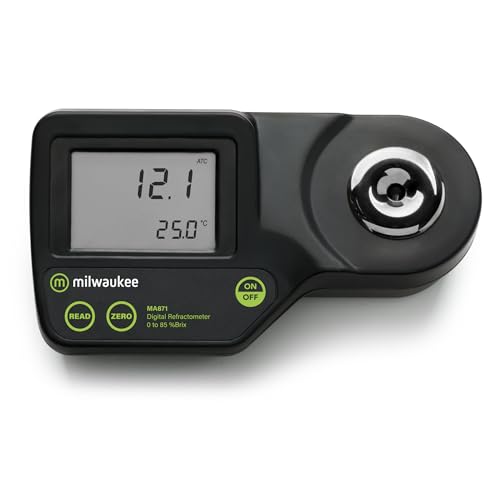
Best for: Jam makers, maple producers, candy kitchens and anyone who measures samples above 53% Brix.
Generally, Milwaukee Instruments builds affordable digital meters for food and water testing. Specifically, the MA871 is its digital Brix model, listed with a 0 to 85% Brix range. That extra headroom matters, because finished maple syrup, jam and concentrates sit well above the range of most pocket meters. Also, a digital readout removes the blurry shadow line that thick, dark samples often cause in optical tools.
On the downside, we could not open a current maker spec sheet for this model, so we list only the range from the listing. So, before you buy, check the resolution and accuracy on the box or manual.
- Range: 0 to 85% Brix, per the listing
- Digital readout
- From an established test-meter brand
Pros
- Covers syrups and jams
- Easy-to-read digital number
- Cheaper than the Atago digital line
Cons
- Fewer published specs
- Needs a battery
- Overkill for beer and juice
Skip it if: your samples never pass 50% Brix; in that case, the PAL-1 or an optical tool is a better fit.
Best for Honey
5. aichose Honey Refractometer (Moisture, Brix, Baume)

Best for: Beekeepers and small honey packers who need to know if a batch is dry enough to bottle.
First, honey is a special case. Indeed, it is so sweet that a normal Brix tool reads off the scale, so honey refractometers use a high band and add a water (moisture) scale. In addition, this aichose model shows moisture, Brix and Baume in one view, per the listing. So, you can read water content directly instead of doing the math.
So why does that number matter? The USDA grade standard for extracted honey sets a minimum of 81.4% soluble solids for Grade A, which its table pairs with 18.6% moisture, measured by refractometer at 20 C (68 F). In short, wet honey can ferment, and this tool is the cheapest way to catch it. Also, for the science behind thick sweeteners, see our page on how dense honey is.
- Scales: moisture, Brix and Baume, per the listing
- Optical, no batteries
- Made for honey, maple syrup and molasses
Pros
- Reads moisture directly
- Low cost for small apiaries
- Also handles syrup and molasses
Cons
- Useless for juice or wort
- Thick honey needs time to spread
- Few published specs
Skip it if: you do not keep bees or make syrup; after all, this tool cannot read low-Brix samples.
Best for Salinity
6. Agriculture Solutions Salinity Refractometer

Best for: Reef keepers and marine aquarists who want a more reliable reading than a swing-arm hydrometer.
In contrast, a salinity refractometer is calibrated for dissolved salt rather than sugar. This model reads 0 to 100 ppt (parts per thousand) with ATC, per the listing. For example, open ocean water averages about 35 ppt. Next to the ppt scale, salinity tools usually show specific gravity too, so you can match whichever number your tank guide uses.
However, accuracy starts with calibration. For example, zero it with distilled water first, and ideally check it with a 35 ppt calibration fluid. Otherwise, a small offset can mislead you about your whole tank. Similarly, for digital options and probe meters, read our best salinity tester roundup.
- Range: 0 to 100 ppt, per the listing
- Automatic temperature compensation
- Made for seawater and marine aquariums
Pros
- More stable than plastic hydrometers
- One drop per test
- No batteries
Cons
- Needs regular calibration
- Not for Brix or coolant
- Fresh water reads zero by design
Skip it if: you keep a freshwater tank, or you want a probe that logs salinity continuously.
Best for Auto Shops
7. Robinair 75240 Coolant and Battery Refractometer

Best for: Mechanics, fleet techs and DIY car owners who test antifreeze and lead-acid battery electrolyte.
First of all, Robinair is a long-standing brand in shop air-conditioning and service tools. Its 75240 is a coolant and battery refractometer, so one drop of coolant shows its freeze protection, and one drop of electrolyte shows its state of charge as specific gravity. Before you test, note which glycol your coolant uses, because ethylene and propylene glycol need different scales.
Also, a refractometer needs only a drop, so you do not draw a full bulb of hot or acidic fluid. Therefore, it is safer and cleaner than a bulb tester. Still, wear eye protection around battery acid.
- Use: engine coolant and battery electrolyte, per the listing
- Optical, no batteries
- Shop-tool brand with service support
Pros
- Covers the two most common shop tests
- Drop-size sample
- Trusted service brand
Cons
- No DEF scale noted in the listing
- Costs more than generic glycol tools
- Not for food samples
Skip it if: you service diesel trucks and need DEF readings too; the TRZ below adds that scale.
Best for Coolant and DEF
8. TRZ 4-in-1 Antifreeze Refractometer

Best for: Diesel owners and small fleets that check coolant, DEF (AdBlue) and battery fluid with one tool.
Specifically, the TRZ 4-in-1 puts four scales in one field of view: ethylene glycol and propylene glycol (freeze point and concentration), DEF or AdBlue, and industrial battery fluid, per the listing. As a result, a diesel owner can check urea strength in the DEF tank and coolant in the radiator during the same stop.
On the other hand, four scales in a small eyepiece are crowded. So, read the correct column carefully, and note which side shows Fahrenheit and which shows Celsius before you write anything down.
- Scales: ethylene glycol, propylene glycol, DEF/AdBlue, battery fluid, per the listing
- Freeze point and concentration readings
- Optical, no batteries
Pros
- Adds a DEF scale
- Low cost
- One drop per test
Cons
- Busy, crowded scale
- Lesser-known brand
- Few published specs
Skip it if: you drive a gas car only; in that case, the Robinair is the cleaner tool for coolant and battery checks.
How We Chose the Best Refractometer Picks
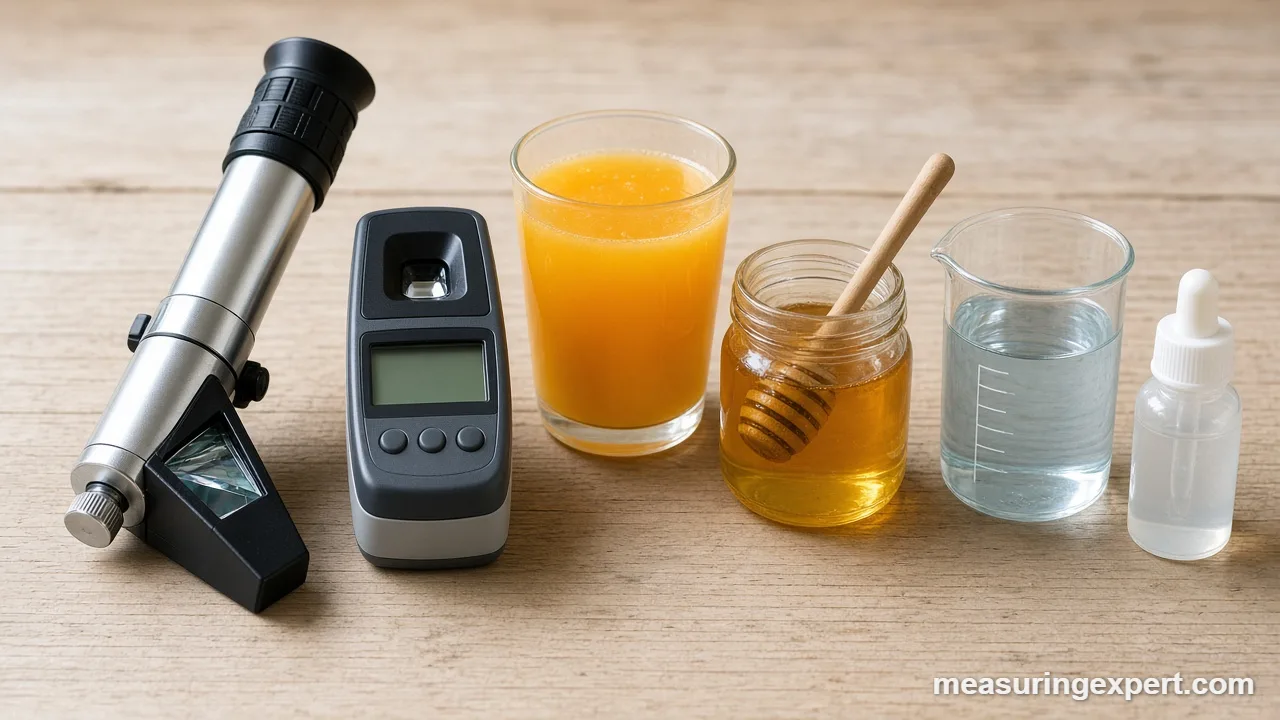
To be clear, we did not run hands-on tests. Instead, we compared maker pages, listings and owner feedback, and then we matched each tool to a real measuring job. In particular, we weighed five points.
- Scale fit: Brix, honey moisture, salinity or glycol, matched to the sample.
- Published specs: range, resolution and accuracy from the maker when available.
- Temperature handling: ATC or a digital sensor, since refractive index shifts with heat.
- Brand: established makers first; at most two models per brand.
- Overlap: few repeats with our alcohol refractometer and salinity tester guides.
For example, Atago publishes the PAL-1 range, resolution, accuracy and IP rating on its PAL-1 product page, so those numbers appear above. Where a maker page was not available, we say “per the listing” and keep the claim narrow.
Which Scale Do You Need? Brix, SG, Salinity or Glycol
First of all, the scale decides what the tool can read. Therefore, choose the scale first and the price second.
| Sample | Scale to buy | What it tells you | Pick above |
|---|---|---|---|
| Fruit, juice, produce | Brix 0 to 32 or 0 to 53% | Sugar by mass, ripeness | PAL-1, MASTER-53 |
| Wort and grape must | Brix plus SG | Original gravity | aichose dual scale |
| Syrup, jam, candy | Brix up to about 85% | Finished sugar level | Milwaukee MA871 |
| Honey | High Brix plus moisture | Water content | aichose honey |
| Seawater, reef tanks | ppt plus SG | Salt level | Agriculture Solutions |
| Coolant, battery, DEF | Glycol, electrolyte SG, urea % | Freeze point, charge, DEF strength | Robinair, TRZ |
Above all, one Brix degree means 1 gram of dissolved solids in 100 grams of solution. In other words, 12% Brix juice holds about 12 g of sugar per 100 g. However, the number equals true sugar only for pure sucrose solutions. Juice also holds acids and minerals, so treat its Brix as a close estimate.
Digital vs Optical: Which Is the Best Refractometer Type?
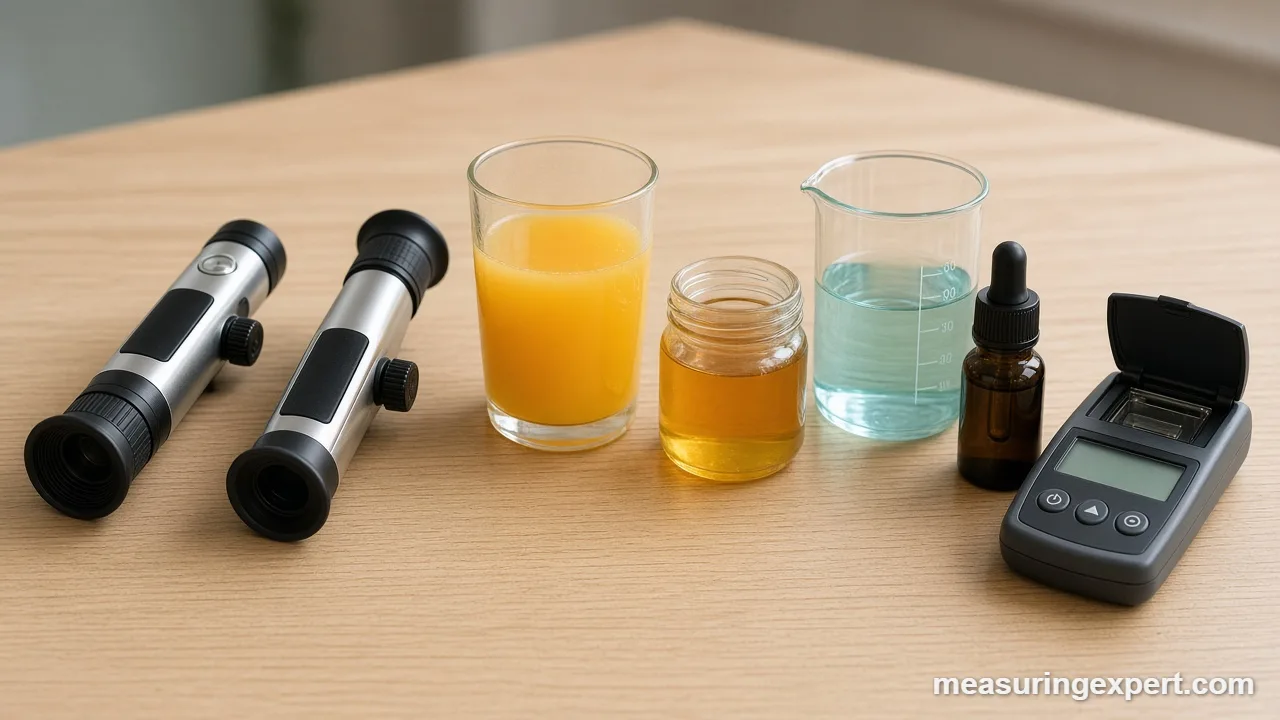
To begin with, an optical (analog) refractometer uses a prism and a lens. Then you hold it to the light and read where the shadow line crosses the scale. By contrast, a digital model shines an LED through the sample and shows a number on a screen.
| Feature | Optical | Digital |
|---|---|---|
| Typical cost | Low | Medium to high |
| Power | None | Batteries |
| Reading | Your eye on a shadow line | Number on a display |
| Typical resolution | 0.2% Brix division on good models | 0.1% Brix |
| Dark or thick samples | Blurry line | Usually clearer |
| Best user | Hobbyists, field checks | Labs, logging, shared tools |
So which should you buy? If you test now and then, an optical tool is enough. On the other hand, if several people record results, a digital unit removes reading bias. Also, for the physics of how light bends at the prism, see our explainer on Snell’s law and refractive index.
ATC and Temperature: Why 20 C (68 F) Matters
First, refractive index changes with temperature. For that reason, Brix scales are referenced to 20 C (68 F). For example, below 10% Brix, a 1 C change shifts the reading by roughly 0.06% Brix. That sounds small; however, a sample 10 C off can move the result by more than half a point.
In practice, automatic temperature compensation (ATC) fixes most of this. Usually, a bimetal strip moves the optics in an analog tool, while a sensor corrects the math in a digital one. Still, ATC works best when the tool and the sample are at the same temperature. Therefore, let a hot wort drop cool on the prism for 30 seconds before you read it.
How to Use a Refractometer, Step by Step
- Let the refractometer and the sample reach room temperature.
- Put 2 or 3 drops of distilled water on the prism and close the cover plate.
- Zero the tool: turn the calibration screw, or press the zero key on a digital model.
- Next, wipe the prism dry with a soft lens cloth.
- Then add 2 or 3 drops of your sample so it covers the whole prism with no bubbles.
- Wait about 30 seconds, then read the shadow line or the display.
- Finally, rinse the prism with clean water, dry it and store the tool in its case.
In addition, take two readings and average them for important batches. However, if the two differ by more than one division, clean the prism and test again.
Brix to Specific Gravity and Density Converter
In practice, brewers often move between Brix, specific gravity and density. First, convert Brix to SG with the table below. Then, enter that SG as g/cm3 in the converter to see kg/m3, lb/gal and lb/ft3, since SG and g/cm3 match closely near room temperature.
| Brix (%) | Approx. SG | Approx. lb/gal |
|---|---|---|
| 5 | 1.020 | 8.51 |
| 10 | 1.040 | 8.68 |
| 12 | 1.048 | 8.75 |
| 15 | 1.061 | 8.86 |
| 20 | 1.083 | 9.04 |
| 25 | 1.106 | 9.23 |
In particular, we used the common brewing formula SG = 1 + Brix / (258.6 – (Brix / 258.2 x 227.1)). For example, 10% Brix gives about 1.040, which matches sucrose tables. Also, our guide on measuring ingredients for brewing beer shows where these numbers fit in a brew day.
Calibration and Care
First, zero the tool with distilled water before each session. Next, for salinity and honey tools, check against a matching standard now and then, because a water zero alone cannot catch a scale error at the high end. Then, clean the prism right after use, before sugar or salt dries on it.
After that, store the refractometer in its case and away from heat. Also, never scratch the prism with a paper towel; a scratch blurs the line for good. Finally, replace digital batteries before a big harvest or brew day.
Honest Limits of the Best Refractometer
Of course, even the best refractometer reads only refractive index. So, it cannot tell sugar from other dissolved solids. For example, fruit acids push the Brix number up slightly. Similarly, alcohol makes a fermenting sample read too high, while it makes a hydrometer read too low.
Also, a refractometer reads one drop. Therefore, a stratified tank, a stirred-in salt mix or a half-mixed radiator can give a reading that is not true for the whole volume. In short, mix well, sample from the middle, and repeat the test. Finally, for certified lab work, use a calibrated bench refractometer or density meter.
Best Refractometer FAQ
What is the best refractometer for home use?
For most homes, the Atago PAL-1 is the easiest to use because it shows a digital Brix number. However, a low-cost optical dual-scale tool is enough for occasional brewing checks.
What does a refractometer measure?
In short, it measures how much a liquid bends light, called refractive index. The tool then converts that value into a scale such as Brix, salinity, honey moisture or freeze point.
What does Brix mean?
One degree Brix equals 1 gram of dissolved solids in 100 grams of solution. So, 12% Brix juice holds about 12 g of sugar per 100 g.
Is digital more accurate than optical?
Not always. In fact, good optical tools reach plus or minus 0.2% Brix, like many digital ones. However, digital models remove reading bias and are easier to share.
Do I need ATC?
Yes, for most users, because Brix scales assume 20 C (68 F), and ATC corrects readings taken at other room temperatures.
Can a Brix scale read honey?
Usually not. Instead, honey sits above the range of most Brix tools, so use a honey model with a moisture scale instead.
Which best refractometer works for saltwater aquariums?
First, use a salinity model calibrated in ppt and specific gravity, such as the Agriculture Solutions tool. Then, calibrate it with a 35 ppt standard for best results.
Can it measure alcohol in beer or wine?
Not directly. Alcohol skews the reading, so you need a correction formula or a hydrometer. Our alcohol refractometer guide covers this in depth.
How do I calibrate the best refractometer?
Put distilled water on the prism at room temperature, then set the scale to zero with the screw or the zero key. Finally, dry the prism before the sample.
Can one tool test coolant and sugar?
No. Each tool prints scales for one kind of sample, so a coolant model cannot give a valid Brix reading, and the reverse is also true.
Bottom Line: The Best Refractometer for Most People
For most buyers, the Atago PAL-1 Digital Pocket Brix Meter is the best refractometer to own. After all, it reads Brix to 0.1% from a few drops, and its IP65 body rinses clean. However, choose the aichose dual-scale tool for cheap brewing checks, a honey model for moisture, a salinity model for reef tanks, and Robinair or TRZ for the garage.
2 thoughts on “8 Best Refractometers for Brix, Honey, Salinity and Coolant (2026)”