
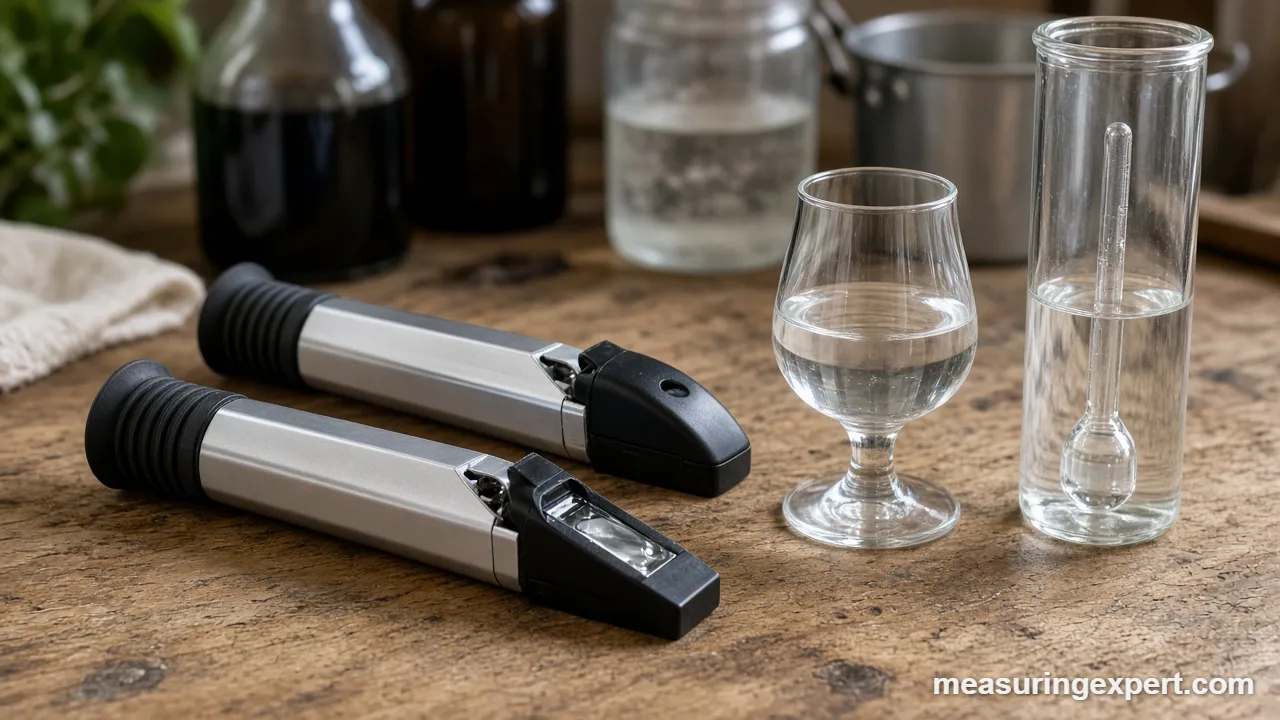
The best alcohol refractometer for most distillers is the Agriculture Solutions 0-80% v/v model, a simple optical tool with ATC. However, it only reads alcohol in a clean mix of water and ethanol. Once sugar is present, as in beer or wine, you need a Brix refractometer plus a hydrometer instead.
In short: Agriculture Solutions for clear spirits, Tiaoyeer for brewers, Milwaukee MA871 for digital readings, and the V-Resourcing wine model on a tight budget.
As an Amazon Associate, Measuring Expert earns from qualifying purchases. Our picks are based on research, specifications and owner feedback, not paid placement.
Best Overall

Best for Brewers
Best Pro
Quick Answer: Which Refractometer Fits Your Drink?
- Clear spirits and lab mixes: the Agriculture Solutions model reads 0-80% v/v in pure water and ethanol.
- A spare spirit scale for less: the V-Resourcing 0-80% model covers the same job.
- Beer wort: the Tiaoyeer dual-scale model shows Brix and specific gravity side by side.
- Digital readings: the Milwaukee MA871 reads 0-85% Brix to 0.1 with IP65 protection.
- Mead and big worts: the Ade Advanced Optics ade055 extends an optical scale to 55% Brix.
- Wine on a budget: the V-Resourcing wine model adds a potential alcohol scale.
- Finished beer or wine: pair any Brix tool with a hydrometer, because alcohol skews the reading.
On This Page
- Comparison table
- The 7 picks, reviewed
- How we chose
- What a refractometer can and cannot tell you
- Spirit, wine and Brix scales compared
- Specs worth reading
- How to read a spirit sample
- Alcohol density converter
- Calibration and care
- FAQ
- Bottom line
Best Alcohol Refractometer Comparison Table
First, find your drink in the Best For column. Then jump to the review for the scale, the range and the trade-offs.
| # | Product | Best For | Standout Feature | Amazon |
|---|---|---|---|---|
| 1 | Agriculture Solutions Alcohol Refractometer | Clear spirits and dilutions | 0-80% v/v scale with ATC | View |
| 2 | Tiaoyeer Dual-Scale Brix Refractometer | Beer wort | Brix and specific gravity on one scale | View |
| 3 | Milwaukee MA871 Digital Brix Refractometer | Digital readings | 0-85% Brix, +/-0.2%, IP65 | View |
| 4 | V-Resourcing Handheld Alcohol Refractometer | A second spirit tool | 0-80% alcohol scale | View |
| 5 | Ade Advanced Optics ade055 Brix Refractometer | Mead and big worts | 0-55% Brix optical scale | View |
| 6 | V-Resourcing Wine Refractometer | Budget winemaking | Brix plus potential alcohol scale | View |
| 7 | aichose Brix Refractometer | Budget homebrew | Dual Brix and gravity scale | View |
The 7 Best Alcohol Refractometer Picks, Reviewed
We start with the true alcohol scales, because they suit spirit work. Next come the Brix tools for wort and must. Finally, we cover two budget models for home wine and beer.
Best Overall
1. Agriculture Solutions Alcohol Refractometer
Best for: hobby distillers, lab users and anyone checking a clean dilution of ethanol and water.
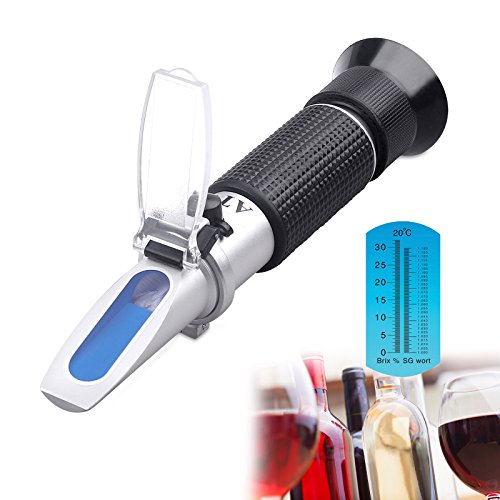
This is a classic optical alcohol refractometer. First, you place a few drops on the prism, close the cover plate and look through the eyepiece. Then the line between light and dark falls on a scale marked in percent alcohol by volume. As a result, you get a reading in seconds from a tiny sample.
The listing gives a 0-80% v/v scale with automatic temperature compensation (ATC). So it covers most distillates once you proof them down. However, the scale assumes the sample holds only ethanol and water. Sugar, glycerol, oils or flavorings shift the reading, so liqueurs and finished wine will read wrong.
- Scale: alcohol percent by volume, listed as 0-80% v/v
- Temperature: ATC, as listed by the seller
- Type: optical, no batteries needed
- Sample: a few drops on the prism
Pros
- Reads alcohol directly on a v/v scale
- Needs only a few drops
- No batteries or app to manage
Cons
- Wrong on anything with sugar or other solids
- The seller does not publish a full accuracy spec
- Reading the shadow line takes practice
Skip it if: you want to know the alcohol in beer, wine, cider or a sweet liqueur.
Best for Brewers
2. Tiaoyeer Dual-Scale Brix Refractometer
Best for: homebrewers who want quick gravity checks on hot-side wort without filling a hydrometer jar.
Strictly speaking, this is not an alcohol scale. Instead, it reads sugar in wort as Brix and as specific gravity. That is exactly what brewers need before fermentation, because original gravity sets the alcohol you can expect. In addition, two drops cool down fast, so you can check runnings during the boil.
According to the listing, the dual scale runs from 1.000 to 1.130 specific gravity and 0-32% Brix, with ATC. After yeast starts working, though, alcohol bends the reading. Therefore, you either plug the original and current Brix into a correction calculator or switch to a hydrometer for final gravity.
- Scales: specific gravity 1.000-1.130 and Brix 0-32%, as listed
- Temperature: ATC, per the seller
- Use: wort and grape juice before fermentation
- Sample: two or three drops
Pros
- Gravity scale saves a conversion step, so no math
- Tiny sample means almost no wort lost
- Handy for checking runnings in the boil
Cons
- Needs a correction once fermentation starts
- Also, it does not read alcohol directly
- No published accuracy figure
Skip it if: you only make spirits and never measure sugar.
Best Pro
3. Milwaukee MA871 Digital Brix Refractometer
Best for: brewers, mead makers and winemakers who want a number on a screen rather than a shadow line.
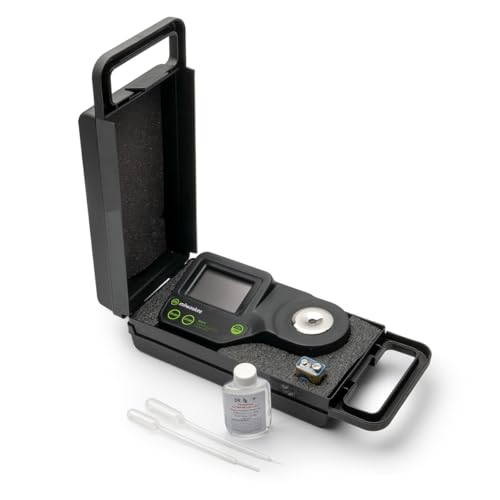
The MA871 is a digital refractometer from Milwaukee Instruments. Specifically, it covers 0 to 85% Brix, so it handles normal wort, grape must, honey musts and priming syrups. Also, the screen removes the guesswork of reading a blurry line by eye. This listing includes the MA800 hard carrying case.
Milwaukee lists +/-0.2% Brix accuracy with 0.1% resolution and a reading in about 1.5 seconds. Moreover, ATC works from 10 to 40 C (50 to 104 F), and the body is rated IP65. As with any sugar scale, though, the reading is for wort and must, so it will not give the alcohol in a finished beer or wine.
- Range: 0-85% Brix
- Accuracy: +/-0.2% Brix; resolution 0.1%
- ATC: 10 to 40 C (50 to 104 F)
- Sample: 100 microliters, about 2 drops; reading in about 1.5 seconds
- Protection: IP65; auto-off after 3 minutes
Pros
- Clear digital readout to 0.1% Brix
- Very wide range for mead and syrups
- Published accuracy and ATC range
Cons
- Costs far more than optical models
- Still needs correction after fermentation
- Brix only, so no gravity scale
Skip it if: you want a spirit scale or you only brew a few batches a year.
Best Value Spirit Scale
4. V-Resourcing Handheld Alcohol Refractometer
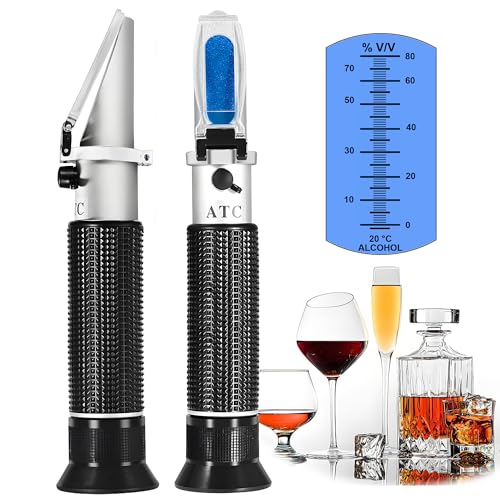
Best for: a second spirit tool for the bench, or a low-cost first try at reading proof.
Like our top pick, this model shows alcohol by volume on a 0-80% scale, according to its listing. Also, it works the same way, with a prism, a cover plate and an eyepiece. So the same rule applies: it is only valid for ethanol and water.
In practice, many distillers keep a refractometer for quick checks and a proof hydrometer for the final number. Because the refractometer uses a few drops, it is handy for sorting fractions. Then the hydrometer confirms the blend in a full jar.
- Scale: 0-80% alcohol by volume, as listed
- Type: optical, handheld
- Calibration: zero with distilled water
Pros
- Same spirit scale at a low cost
- Fast check on a few drops
Cons
- No published accuracy figure
- Invalid on sweet or flavored spirits
- Fine scale lines are hard to read near 80%
Skip it if: you need a legal or labeled proof figure; use a calibrated hydrometer instead.
Best for Mead and Big Worts
5. Ade Advanced Optics ade055 Brix Refractometer

Best for: mead makers and brewers of strong beers who outgrow a 0-32% Brix scale.
Many brewing refractometers stop at 32% Brix, which is fine for normal beer. However, a honey must or a big barleywine can start higher. For that reason, this optical model from Ade Advanced Optics extends the scale to 0-55% Brix, according to the listing, with ATC.
Because it shows Brix only, you convert to gravity yourself or use a calculator. In addition, the wide scale means each division covers more sugar, so small changes are harder to see than on a narrow scale. Again, this is a sugar meter, not an alcohol meter.
- Scale: 0-55% Brix, as listed
- Temperature: ATC, per the listing
- Type: optical, no batteries needed
Pros
- Covers strong musts and syrups
- No batteries to replace
Cons
- No gravity scale
- Wide scale is coarser to read
- Needs correction once alcohol is present
Skip it if: you brew normal-strength beer; a dual-scale tool is easier.
Best Budget for Wine
6. V-Resourcing Wine Refractometer
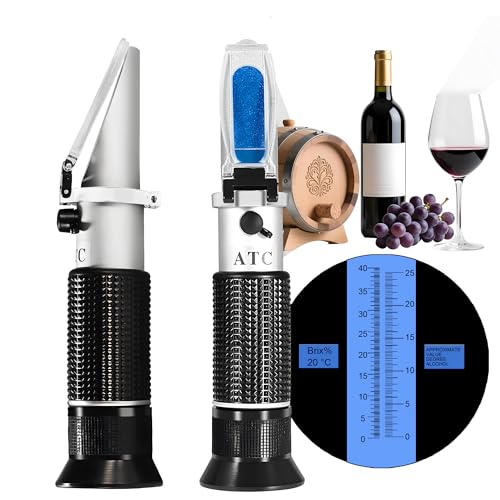
Best for: first-time winemakers who want to know how strong a batch could get.
This optical tool has two scales: Brix for sugar and a potential alcohol scale, listed as 0-40% Brix and 0-25% alcohol. However, note the word potential. The alcohol scale estimates how much alcohol the must could make if all the sugar ferments. In other words, it does not measure the alcohol already in a wine.
Even so, that estimate is useful, because it guides the recipe. For example, it helps you decide whether to add sugar before you pitch the yeast. After that, track the ferment with a hydrometer.
- Scales: Brix 0-40% and potential alcohol 0-25%, as listed
- Use: grape and fruit must before fermentation
- Type: optical with ATC, per the listing
Pros
- Potential alcohol scale helps plan a batch
- Low cost, so easy to start with
Cons
- Easy to mistake for a finished-wine meter
- No published accuracy figure
Skip it if: you need the alcohol in a wine that has already fermented.
Best Budget for Beer
7. aichose Brix Refractometer
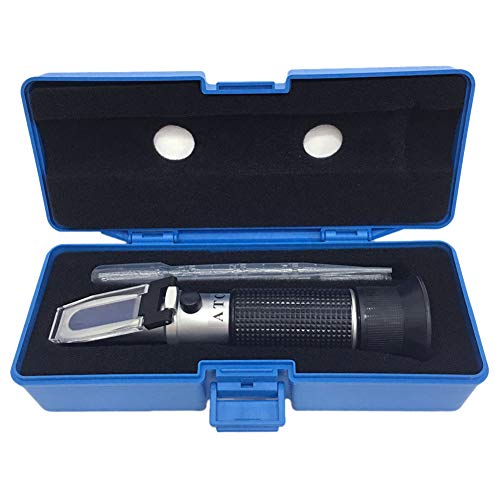
Best for: new homebrewers who want a gravity tool on a small budget.
The aichose model is a dual-scale refractometer with Brix and specific gravity, according to the listing. So it does the same core job as the Tiaoyeer pick, which makes it a fallback when that one is out of stock. In addition, it includes ATC, per the seller.
Before you rely on the gravity scale, check the zero with distilled water. Next, compare one wort reading against a hydrometer to find your wort correction factor. After that, the two tools should agree within a point or two.
- Scales: Brix and specific gravity, as listed
- Temperature: ATC, per the seller
- Type: handheld
Pros
- Gravity scale for wort
- Budget friendly, so a good first tool
Cons
- No published accuracy or range on the maker side
- Needs correction after fermentation starts
Skip it if: you want a digital readout or published specs.
How We Chose the Best Alcohol Refractometer Picks
We did not test these tools in a lab. Instead, our picks are research-based. First, we sorted tools by the scale they actually read: alcohol by volume, Brix, gravity or potential alcohol. Then we matched each scale to the drink it suits, so each pick has a clear job.
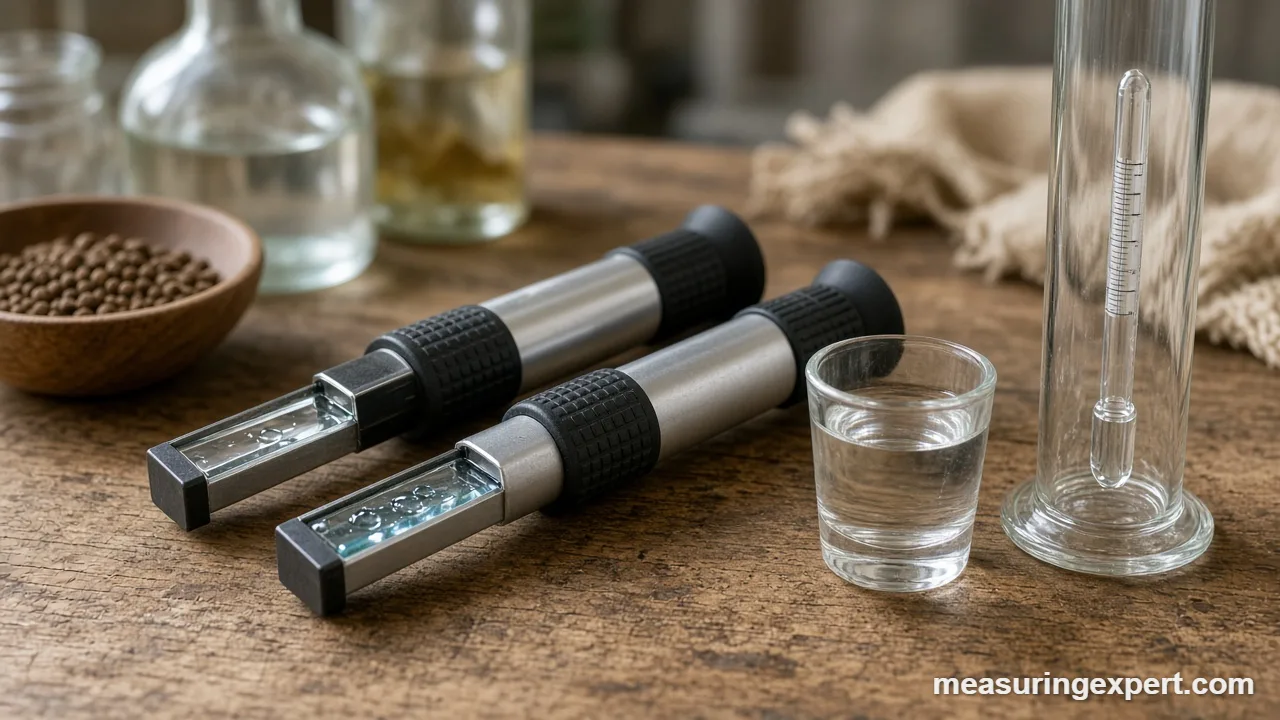
Next, we favored makers that publish range, resolution, accuracy and ATC limits, such as Milwaukee. For low-cost optical models, we only state the scales the seller lists. In addition, we read owner feedback for common problems, such as blurry lines and drift. Finally, we checked the federal rules on how proof is measured, from the eCFR text of 27 CFR Part 30, and Milwaukee’s own MA871 spec page.
What the Best Alcohol Refractometer Can and Cannot Tell You
A refractometer measures refractive index: how much light bends as it passes from the prism into your sample. Both sugar and alcohol raise that index. As a result, the tool cannot tell them apart. Instead, it just sees one number. For the optics behind it, see our guide to Snell’s law and refractive index.
That is why an alcohol scale is only valid in pure ethanol and water. For example, a sweet liqueur reads as stronger than it is, because sugar adds to the bend. Similarly, a Brix reading on fermenting beer reads too high, because the new alcohol adds to the bend while the sugar falls.
A hydrometer, by contrast, works differently. In practice, it floats higher in denser liquid. Alcohol is less dense than water, about 0.789 g/mL versus 0.998 g/mL at 20 C (68 F), so gravity drops as sugar turns into alcohol. Therefore, brewers take an original gravity and a final gravity, then estimate ABV with the common formula ABV = (OG – FG) x 131.25. For example, 1.050 down to 1.010 gives about 5.3% ABV. Our best triple scale hydrometer guide covers those tools.
Spirit, Wine and Brix Scales Compared
Before you buy, check which scale is printed inside the eyepiece. After all, the name on the box can mislead you, so this table sorts the types by what they really measure.
| Scale | What it reads | Valid for | Not valid for |
|---|---|---|---|
| Alcohol % v/v (0-80%) | Ethanol in water | Clear distillate, lab dilutions | Liqueurs, beer, wine, cider |
| Brix | Dissolved sugar by weight | Wort, must, juice before fermentation | Direct alcohol readings |
| Specific gravity | Brix shown as gravity | Original gravity of wort | Final gravity without correction |
| Potential alcohol | Alcohol the sugar could make | Planning a wine batch | Alcohol already in a wine |
| Oechsle / KMW | Must weight, wine scales | Grape must | Spirits |
In short, distillers want the first row, and brewers or winemakers want a Brix-based tool. For a wider look at sugar meters, see our best refractometer roundup.
Specs Worth Reading on Any Refractometer
Range. A spirit scale usually ends at 80% v/v. So proof strong spirit down with distilled water before you read it, then multiply back. A Brix range of 0-32% covers normal beer and wine, while mead and syrups need more.
Resolution and accuracy. Resolution is the smallest step on the scale. Meanwhile, accuracy is how close the reading is to the truth. For example, Milwaukee lists +/-0.2% Brix for the MA871. By contrast, budget optical models rarely publish an accuracy figure at all.
ATC range. Automatic temperature compensation corrects for warm or cool samples, but only within limits. For example, Milwaukee lists 10 to 40 C (50 to 104 F). Outside that window, let the drops settle to room temperature first.
Units. Brix and Plato are nearly the same for wort. In contrast, specific gravity is a ratio to water. Meanwhile, proof in the US is twice the percent alcohol by volume, so 40% ABV is 80 proof.
Durability. Similarly, an IP65 rating means the body is dust tight and resists water jets. Because you rinse the prism often, that rating matters on digital models.
How to Read a Spirit Sample With an Alcohol Refractometer
In general, these steps apply to an optical 0-80% v/v tool and a clean ethanol and water sample.
- Zero the tool. Put two drops of distilled water on the prism, close the plate and turn the calibration screw until the line sits on 0.
- Let the sample cool. Bring the spirit close to room temperature, ideally near 20 C (68 F).
- Dilute if needed. If the spirit may be above 80%, mix it 1:1 with distilled water and note the ratio.
- Apply the drops. Wipe the prism dry, add two or three drops and close the plate so no bubbles remain.
- Wait 30 seconds. This way, ATC and the sample reach the same temperature.
- Read the line. Point the tool at a bright light and read where the blue and white fields meet.
- Clean and record. Finally, rinse with distilled water, dry with a soft cloth and write down the reading.
Alcohol and Water Density Converter
Above all, density is the reason hydrometers work for finished drinks. Use this converter to compare ethanol, water and wort in other units.
Also, our page on how dense alcohol is explains why the mix of ethanol and water shrinks slightly in volume.
Calibration and Care for Your Refractometer
First, zero the tool with distilled water at the start of each session. After all, tap water holds minerals, so it can shift the zero. Next, clean the prism after every sample, because dried sugar or residue blurs the line.
In addition, keep the tool out of the dishwasher and away from solvents. Instead, wipe it with a damp soft cloth, then let it air dry. For brewing, find your wort correction factor once by comparing the refractometer with a hydrometer on the same wort. For reference, many calculators default to about 1.04.
Finally, store the tool in its case. Otherwise, a dropped optical refractometer can knock the scale out of line, so recheck the zero after any knock.
Do: zero with distilled water, read at room temperature, keep your original Brix and use a hydrometer for final gravity.
Don’t: read liqueurs on a spirit scale, trust a raw Brix reading in fermenting beer or treat a potential alcohol scale as a finished-wine meter.
Best Alcohol Refractometer FAQ
What is the best alcohol refractometer for spirits?
For clear distillate, an optical 0-80% v/v tool such as the Agriculture Solutions model is our top pick. However, it only works on ethanol and water. For a legal proof figure, use a calibrated hydrometer and thermometer.
Can a refractometer measure alcohol in beer or wine?
Not directly. That is because sugar and alcohol both bend light, so the reading mixes the two. Instead, take the original Brix before fermentation and the current Brix later, then use a correction calculator, or use a hydrometer.
Why does my refractometer read high after fermentation?
Alcohol raises the refractive index, so it adds to the reading while sugar falls. As a result, a raw Brix figure in fermenting beer overstates the sugar left.
What does potential alcohol mean on a wine refractometer?
In short, it is an estimate of the alcohol the must could reach if all the sugar ferments. It does not measure alcohol already in a wine.
Is a refractometer or hydrometer better for homebrewing?
Use both. For one thing, a refractometer is fast and needs only drops, so it suits wort checks. Meanwhile, a hydrometer reads final gravity without correction, so it is better after fermentation.
Why do alcohol refractometers stop at 80 percent?
The refractive index of ethanol and water mixtures flattens out at high strength, so readings above that point are not reliable. Therefore, dilute strong spirit with distilled water and multiply back.
How do I calibrate the best alcohol refractometer?
Put two drops of distilled water on the prism, close the plate and set the line to zero with the calibration screw. Ideally, do this at about 20 C (68 F) and recheck before each session.
Does ATC make temperature irrelevant?
No. ATC corrects within a stated range, such as 10 to 40 C on Milwaukee models. Also, hot samples change as they cool on the prism, so wait about 30 seconds.
Can I use the best alcohol refractometer on a liqueur?
No. Again, sugar and flavorings bend light too, so the alcohol scale reads high. In that case, the sample must be distilled and restored to volume before you measure it.
How is proof related to ABV?
In the US, proof is twice the alcohol by volume at 60 F (15.6 C). So a 40% ABV spirit is 80 proof.
Bottom Line on the Best Alcohol Refractometer
For clear spirits, the Agriculture Solutions Alcohol Refractometer is the best alcohol refractometer for most people: simple, fast and scaled in percent by volume. For beer and wine, however, pick a Brix tool such as the Tiaoyeer or Milwaukee MA871, and keep a hydrometer for the finished drink.
1 thought on “Best Alcohol Refractometer for Spirits, Beer and Wine (2026)”