

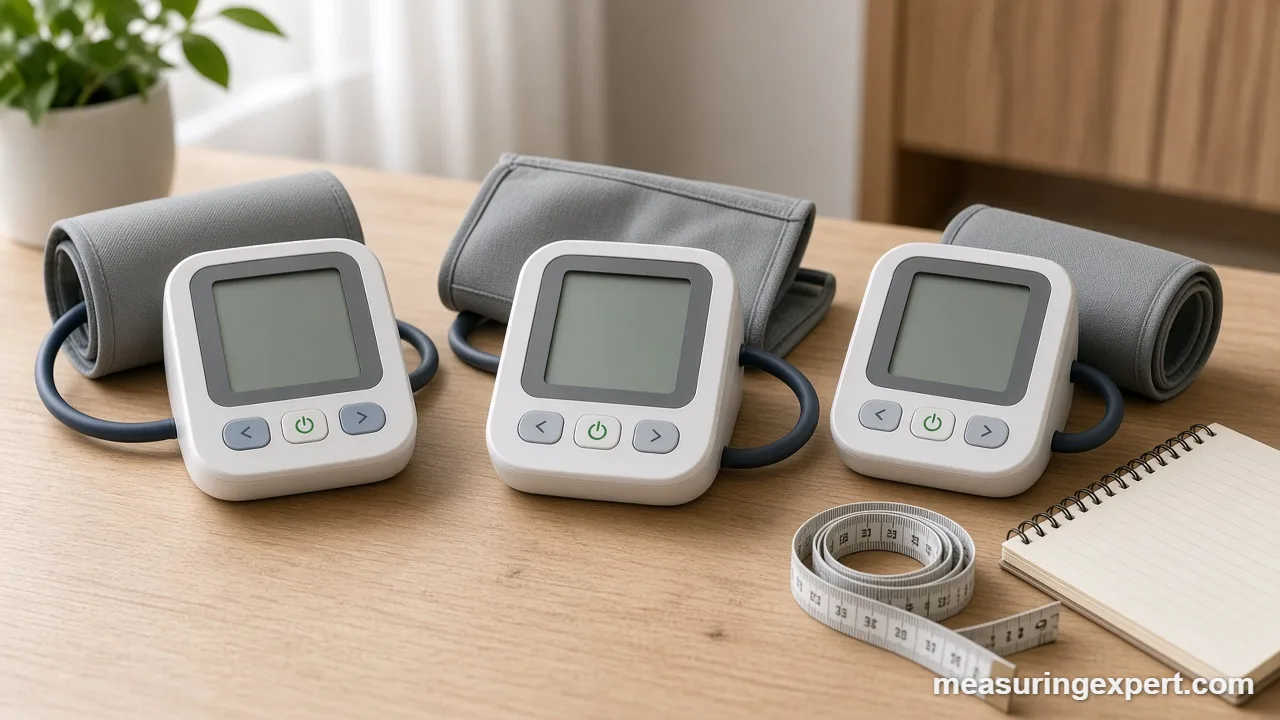
The best blood pressure monitor for most homes is the OMRON Silver (BP5255), an upper-arm model that OMRON says meets U.S. Validated Device Listing accuracy criteria. However, two things decide the right choice for you: a clinically validated device and a cuff that truly fits your arm.
In short: buy the OMRON Silver for everyday use, the iHealth Track for low-cost app logging, and the OMRON Evolv for a compact tube-free design.
As an Amazon Associate, Measuring Expert earns from qualifying purchases. Our picks are based on research, specifications and owner feedback, not paid placement.
Best Overall
Best Budget
Best Compact

Quick Answer: Which Monitor Fits Your Situation?
- Most adults at home: the OMRON Silver BP5255.
- Travel and tight spaces: the OMRON Evolv BP7000.
- Budget app syncing and an XL cuff option: the iHealth Track.
- No batteries to buy: the rechargeable iHealth Neo.
- Two people sharing a budget monitor: the Etekcity TMB-1583-BS.
- Simplest one-button use: the Braun ExactFit 1.
On This Page
- Comparison table
- The picks, reviewed
- How we chose
- What validated means
- Cuff sizing
- How to take a reading
- mmHg and other units
- Common errors
- Honest limits
- FAQ
- Bottom line
Best Blood Pressure Monitor Comparison Table
| # | Product | Best For | Standout Feature | Amazon |
|---|---|---|---|---|
| 1 | OMRON Silver Upper Arm Monitor (BP5255) | Most home users | Meets U.S. VDL accuracy criteria, per OMRON | View |
| 2 | OMRON Evolv Wireless Monitor (BP7000) | Travel and small spaces | Tubeless one-piece design with app sync | View |
| 3 | iHealth Track Smart Upper Arm Monitor | Low-cost Bluetooth logging | Color-coded results, optional XL cuff | View |
| 4 | iHealth Neo Wireless Monitor (BP5S) | Slim, battery-free upkeep | Rechargeable, 200-reading memory | View |
| 5 | Etekcity Smart Blood Pressure Monitor (TMB-1583-BS) | Couples on a budget | 2 users, 90-reading memory, AC or AAA power | View |
| 6 | Braun ExactFit 1 Upper Arm Monitor (BUA5000) | One-button, no-app checks | Large LED display, one-button start | View |
The 6 Best Blood Pressure Monitor Picks, Reviewed
Best Overall
1. OMRON Silver Upper Arm Monitor (BP5255)
Best for: most adults who want a simple, proven upper-arm monitor with an app option and a cuff that fits 9 to 17 inches (about 23 to 43 cm).
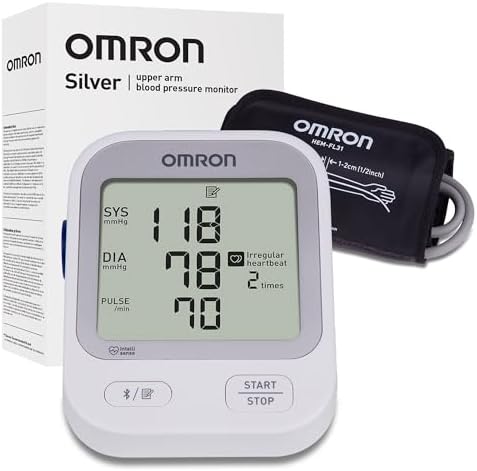
The OMRON Silver is the best blood pressure monitor for most homes because it keeps the basics right. First, it is an upper-arm cuff model, which is the type heart groups advise for home use. Second, OMRON states that the BP5255 meets the U.S. Validated Device Listing (VDL) criteria for clinical accuracy. In other words, its accuracy data was checked against an agreed standard, not just claimed.
The monitor also uses what OMRON calls Advanced Accuracy Technology, and it flags body movement during a reading. In addition, it detects irregular heartbeats and shows an alert. The screen stores 30 readings for one user, while the free OMRON connect app keeps an unlimited log over Bluetooth. So you can start with paper notes and move to the app later.
- Cuff: Easy-Wrap ComFit, 9 to 17 in (about 23 to 43 cm) arm circumference
- Memory: 30 readings on the monitor; unlimited in the OMRON connect app
- Irregular heartbeat alert and body movement detection
- Power: 4 AA batteries included; AC adapter sold separately
- Warranty: 3 years on the monitor, 1 year on the cuff
Pros
- Maker states it meets VDL accuracy criteria
- Wide-range cuff fits most adult arms
- Works with or without a phone
- Movement and irregular heartbeat alerts
Cons
- Only one user profile on the device
- Small on-device memory
- AC adapter costs extra
Skip it if: two people will share it every day; the Etekcity model keeps two separate user logs.
Best All-in-One
2. OMRON Evolv Wireless Monitor (BP7000)
Best for: people who travel or have little storage space and want an OMRON monitor with no hose and no separate display box.
The Evolv puts the display and pump on the cuff itself. Therefore, setup is quick: you slide it on, press start, and read the screen on your arm. Also, it weighs about 0.53 lb (240 g), so it fits easily in a carry-on.
OMRON states its blood pressure accuracy as plus or minus 3 mmHg or 2%, and pulse as plus or minus 5%, and says that meets or exceeds AAMI standards. In addition, it shows an irregular heartbeat indicator and syncs to the OMRON connect app. However, it stores 100 readings for one user only, and it runs on 4 AAA batteries with no AC adapter option.
- Cuff: 9 to 17 in (about 23 to 43 cm), wide-range ComFit
- Accuracy: plus or minus 3 mmHg or 2%; pulse plus or minus 5% (OMRON)
- Memory: 100 readings, single user
- Power: 4 AAA batteries; no AC adapter
- Size: 4.63 x 3.5 x 1 in; 5-year limited warranty
Pros
- Very compact with no loose tube
- Clear accuracy figure from the maker
- App sync over Bluetooth
- Long warranty
Cons
- Single user only
- Batteries only, no wall power
- Costs more than the OMRON Silver
Skip it if: you mostly measure at one desk; the OMRON Silver gives similar core features for less.
Best Budget Smart
3. iHealth Track Smart Upper Arm Monitor
Best for: budget buyers who want a large display plus Bluetooth syncing to a free app.
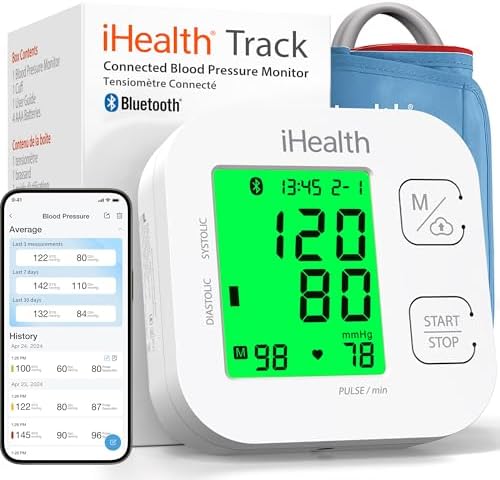
The iHealth Track is a simple upper-arm unit with a large display and color-coded results. In addition, it syncs over Bluetooth to the iHealth app, so you can build a log without typing numbers. Moreover, the monitor itself stores 99 readings.
iHealth sells it with a standard cuff of 8.66 to 16.5 in (22 to 42 cm) or an XLarge cuff of 16.5 to 18.9 in (42 to 48 cm). That choice matters, because a correctly sized cuff is part of accuracy. iHealth also cites FDA 510(k) clearance. However, its product page does not list a numeric accuracy figure, so we rank it below the picks that do.
- Cuffs: standard 8.66 to 16.5 in (22 to 42 cm); XLarge 16.5 to 18.9 in (42 to 48 cm)
- Memory: 99 readings on the device
- Bluetooth sync to the iHealth app
- Color-coded result display
Pros
- Low cost for an app-ready monitor
- Large, readable display
- XL cuff version available
- Works without a phone too
Cons
- No accuracy figure on the maker’s page
- Fewer features than OMRON models
- App is needed for long-term history
Skip it if: you want a model with a published accuracy figure and VDL statement; pick the OMRON Silver.
Best Rechargeable
4. iHealth Neo Wireless Monitor (BP5S)

Best for: people who dislike buying batteries and want a slim monitor that also syncs to Apple Health or Google Fit.
The iHealth Neo has a built-in rechargeable battery that charges over USB, and iHealth rates it at 130 or more readings per charge. It also stores up to 200 readings on the device, which is more than most picks here.
In addition, Bluetooth is optional. When you do pair it, the iHealth MyVitals app can share data with Apple Health, Google Fit and Fitbit. iHealth says the monitor is made according to IEC 80601-2-30 and holds FDA 510(k) clearance. Still, as with the Track, the maker does not give a numeric accuracy figure on its page.
- Cuff: 8.6 to 16.5 in (22 to 42 cm)
- Memory: up to 200 readings on the device
- Power: rechargeable via USB, 130+ readings per charge
- Optional Bluetooth; Apple Health, Google Fit and Fitbit support
- Size: about 5.57 x 2.38 x 0.75 in; about 8.5 oz (240 g)
Pros
- No batteries to replace
- Large on-device memory
- Works with major health apps
- Slim and light
Cons
- No published accuracy figure
- Battery will wear over years
- Only one cuff size listed
Skip it if: you want the strongest accuracy paperwork; OMRON states the Silver meets VDL criteria.
Best for Two Users
5. Etekcity Smart Blood Pressure Monitor (TMB-1583-BS)

Best for: couples on a budget who want two user slots and app syncing to VeSync.
The Etekcity TMB-1583-BS is a budget smart monitor with two user slots and memory for 90 results. Also, it syncs to the free VeSync app, and it runs on 4 AAA batteries or an optional AC adapter.
Etekcity lists pressure accuracy of plus or minus 3 mmHg and a systolic range of 60 to 230 mmHg. However, its product page does not cite a clinical validation study. So check validatebp.org or STRIDE BP for this model before you rely on it for decisions with your clinician.
- Cuff: 8.6 to 16.5 in (22 to 42 cm)
- Accuracy: plus or minus 3 mmHg; pulse plus or minus 5%
- Range: systolic 60 to 230 mmHg, diastolic 40 to 130 mmHg, pulse 40 to 199 bpm
- Memory: 90 results; 2 users
- Power: 4 AAA batteries or AC adapter; 3.3 x 2.9 in LCD
Pros
- Two user slots at a low cost
- App syncing to VeSync
- Large LCD for the price
- Battery or wall power
Cons
- No validation study cited by the maker
- Smaller brand in medical devices
Skip it if: validation matters most to you; choose a monitor that states VDL or ISO validation.
Simplest to Use
6. Braun ExactFit 1 Upper Arm Monitor (BUA5000)
Best for: people who want the simplest possible upper-arm monitor, with no app, no profiles and no menus.
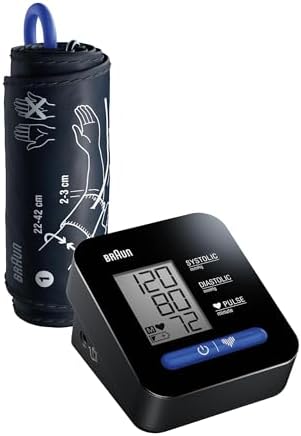
The Braun ExactFit 1 is a basic upper-arm monitor from a well-known personal health brand. First, you wrap the universal cuff and press start. Then the large LED display shows systolic pressure, diastolic pressure and pulse. In addition, Braun shows an AHA indicator arrow next to the result.
However, it is deliberately basic. Specifically, Braun says the memory keeps only your most recent measurement, so you need a paper log or a separate app for history. Also, Braun’s product page does not list an accuracy figure or a validation study. So check the model on validatebp.org or STRIDE BP before you buy it.
- Cuff: universal, 8.6 to 16.5 in (about 22 to 42 cm)
- Display: large LED readout of systolic, diastolic and pulse
- Memory: most recent measurement only
- Power: 4 AA batteries included
Pros
- Very simple for first-time users
- Big, readable LED numbers
- Wide-range cuff fits most arms
- Batteries in the box
Cons
- Stores only the last reading
- No accuracy figure or validation listed by Braun
- No app or Bluetooth
Skip it if: you need a history of readings for your clinician; the OMRON Silver stores 30 and syncs the rest.
How We Chose the Best Blood Pressure Monitor Picks
We did not test these monitors on people or in a lab. Instead, this list is research-based. First, we looked at home monitors a buyer can actually find on Amazon, and we favored established makers such as OMRON, iHealth, Braun and Etekcity. Next, we checked each spec against the maker’s own product page, and we left out any figure we could not confirm.
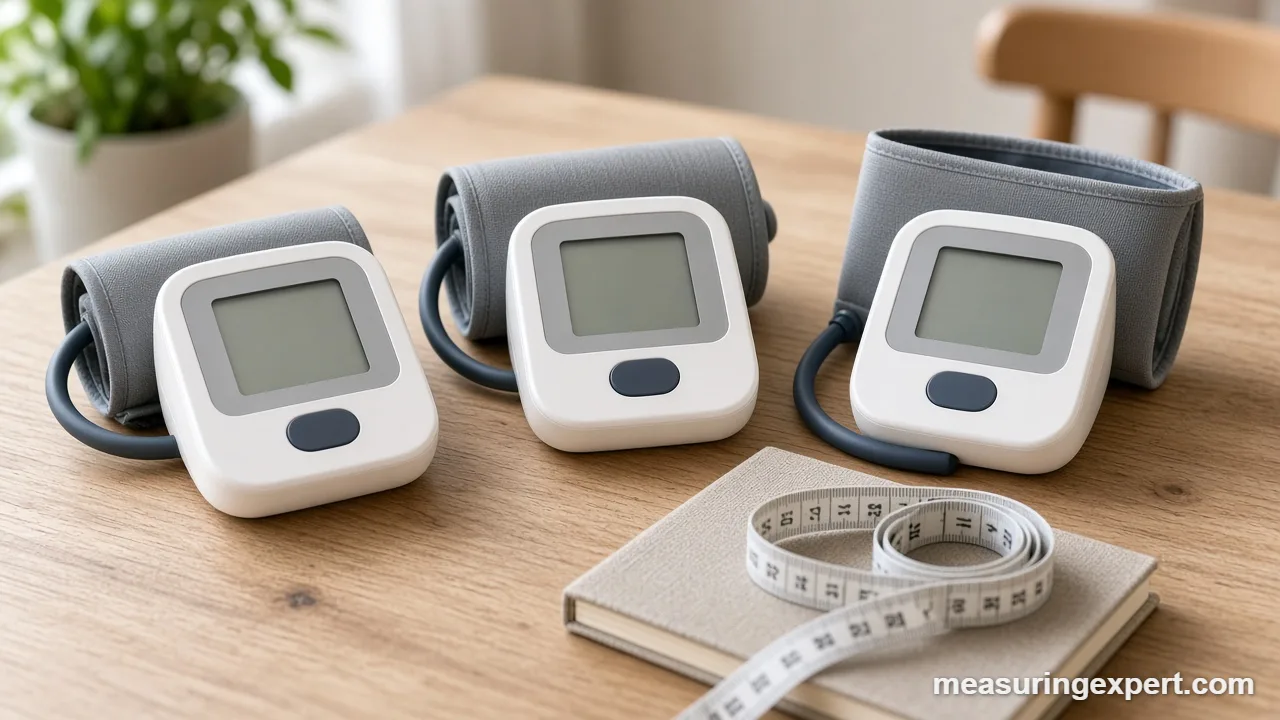
Above all, validation came first. So we ranked monitors whose makers name a validation standard or a Validated Device Listing statement above those that only say “clinically accurate.” We also dropped wrist and finger units from the main picks, because heart groups advise an upper-arm cuff for home use. Finally, we skipped unbranded look-alike listings that do not publish specs.
We also looked for monitors from A&D Medical, Withings and Welch Allyn. However, their monitors were not available through our Amazon product feed when we checked, so they are not ranked here. They are still worth a look at other stores.
- Validation: a named protocol (ISO 81060-2, AAMI, ESH) or a VDL statement.
- Cuff range: the arm circumference each cuff fits, in inches and centimeters.
- Stated accuracy: a published plus or minus figure in mmHg.
- Logging: on-device memory, users and app support.
- Daily use: display size, power options and warranty.
For guidance, we used the American Heart Association page on home monitoring, the U.S. Validated Device Listing at validatebp.org and the STRIDE BP device lists. We also read the CDC guide to measuring blood pressure at home.
What “Clinically Validated” Means for the Best Blood Pressure Monitor
Almost every box says “accurate.” However, validation is a specific test. In a validation study, researchers compare the monitor’s readings with reference readings taken by trained observers on a set group of people. Then they check the errors against a pass rule written into a standard, such as ISO 81060-2.
Two free lists collect the results. First, the Validated Device Listing (VDL) at validatebp.org is supported by the American Medical Association. An independent committee of blood pressure experts reviews each device’s test documents before it is listed. Second, STRIDE BP is an international non-profit founded by hypertension experts. It says it has approved 551 electronic devices out of more than 5,000 on the market.
So how should you use these lists? First, look up the exact model number, not just the brand. For example, two OMRON monitors with similar names can have different status. Also, keep in mind that FDA clearance means a device may be sold in the U.S. Still, it is not the same as an independent accuracy review.
| Claim on the box | What it tells you | How much weight to give it |
|---|---|---|
| Listed on the VDL or STRIDE BP | Experts reviewed a validation study for that model | High |
| Passed ISO 81060-2 or AAMI/ESH protocol | A named test was run; check the year and model | Good |
| FDA cleared | The device may be sold in the U.S. | Helpful, but not proof of accuracy |
| “Clinically accurate” with no detail | A marketing phrase | Low until you verify it |
Cuff Sizing: Fit Matters More Than the Best Blood Pressure Monitor Brand
In fact, a monitor can be validated and still read wrong if the cuff does not fit. The American Heart Association warns that a wrong-size cuff can produce inaccurate readings. As a result, sizing is the measuring step that matters most, and it takes about one minute.
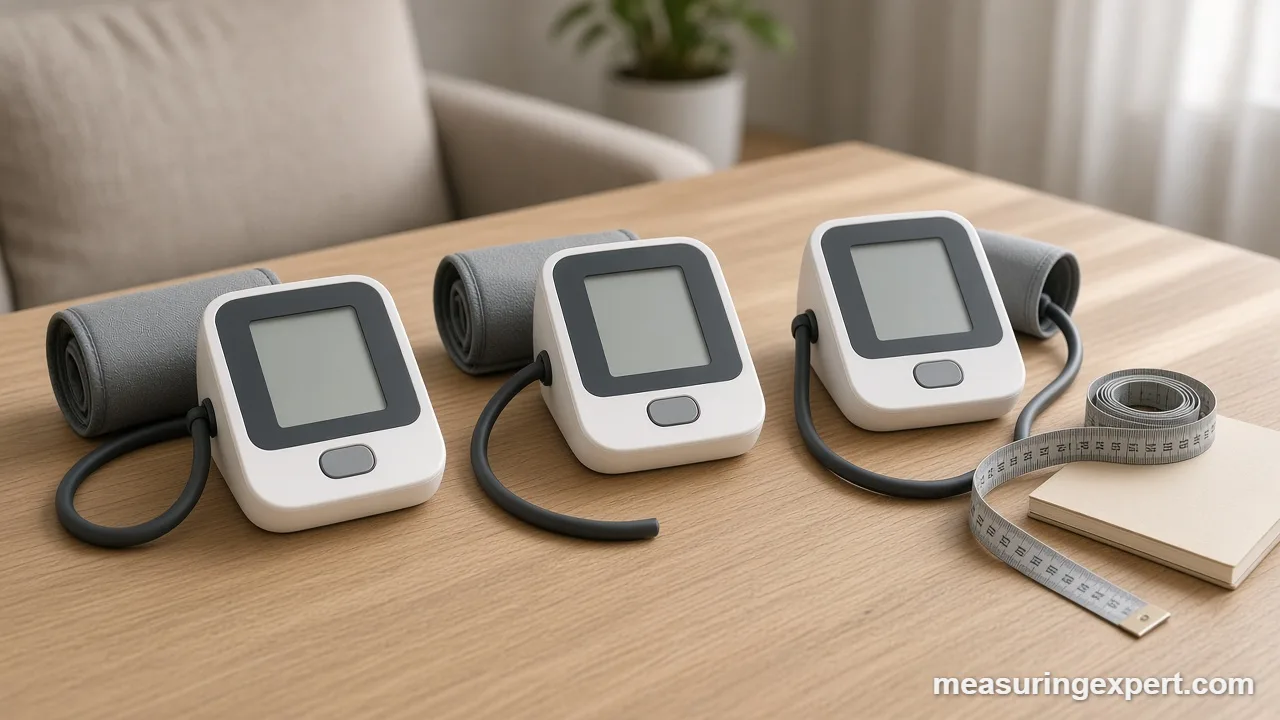
So here is how to measure your arm. First, sit with your arm relaxed at your side. Next, find the point halfway between the tip of your shoulder and your elbow. Then wrap a soft tape measure around the arm at that point, on bare skin, without squeezing. Finally, read the number in inches and centimeters and compare it with the range printed on each cuff.
| Monitor | Cuff range (in) | Cuff range (cm) |
|---|---|---|
| OMRON Silver BP5255 and Evolv BP7000 | 9 to 17 | about 23 to 43 |
| iHealth Neo BP5S | 8.6 to 16.5 | 22 to 42 |
| Etekcity TMB-1583-BS | 8.6 to 16.5 | 22 to 42 |
| Braun ExactFit 1 BUA5000 | 8.6 to 16.5 | about 22 to 42 |
| iHealth Track (standard / XLarge) | 8.66 to 16.5 / 16.5 to 18.9 | 22 to 42 / 42 to 48 |
| A&D UA-789AC (not ranked; for very large arms) | 16.5 to 23.6 | 42 to 60 |
If your measurement falls near the top or bottom of a range, consider a monitor where you sit closer to the middle. Also, very thin arms may need a small cuff; for instance, OMRON sells an optional small cuff for some models. In the same way, you can use our guide to medical units of measurement if the inch and centimeter labels get confusing.
How to Take a Home Reading Step by Step
Similarly, good technique matters as much as the device. The steps below follow the American Heart Association and CDC advice for home readings. However, follow your clinician’s instructions if they differ.
- Prepare for 30 minutes. Avoid caffeine, smoking and exercise for 30 minutes first, and empty your bladder before you start.
- Sit and rest. Sit in a chair with your back supported and feet flat, then rest quietly for at least 5 minutes without talking or using your phone.
- Fit the cuff on bare skin. Wrap the cuff on your bare upper arm with the lower edge just above the bend of the elbow; it should be snug but not tight.
- Support the arm at heart level. Rest your arm on a table so the middle of the cuff sits at heart level; use a pillow under the arm if needed.
- Take two readings. Press start, stay still and silent, then take a second reading about one minute later.
- Record both results. Write down or sync both readings with the date, time and arm, and measure at the same times each day.
Also, take readings at the same times each day, for example before breakfast and in the evening. That way, your log compares like with like. If you track your pulse too, our guide to the best time to check resting heart rate explains why timing matters.
Understanding mmHg and Converting Readings
To begin with, home monitors report pressure in millimeters of mercury (mmHg). That unit comes from old mercury columns, and it is still the standard in clinics. In addition, each reading has two numbers: systolic, the peak pressure as the heart beats, and diastolic, the pressure between beats. Finally, most monitors also show pulse in beats per minute.
However, some medical papers and devices use kilopascals (kPa) instead. Because 1 mmHg equals about 133.322 Pa, 120 mmHg is about 16.0 kPa. Use the converter below to switch units.
Meanwhile, the converter only changes units. It does not tell you whether a number is normal for you; that is a question for your clinician. For more on how the heart’s output is measured, see our explainer on how to measure stroke volume.
Do and Don’t: Common Errors With Home Monitors
In fact, most reading errors come from the setup, not from the device. So it helps to know the usual mistakes.
Do:
- First, use the same arm and the same chair each time.
- Also, keep your feet flat and your back supported.
- In addition, place the cuff on bare skin, not over a sleeve.
- Finally, bring your monitor to a clinic visit so staff can compare it with their device.
Don’t:
- Talk, text or move during the reading, because movement adds error.
- Cross your legs or let your arm hang down.
- Push a rolled-up sleeve above the cuff, since it can squeeze the arm.
- Delete readings you do not like; your clinician needs the full picture.
In addition, change batteries when the low-battery symbol appears, because weak power can cause errors. Similarly, check the cuff and tube for cracks once in a while, and replace a worn cuff with the maker’s own part.
Honest Limits of Any Home Monitor
Even the best blood pressure monitor has limits. First, oscillometric monitors estimate pressure from cuff vibrations, so some heart rhythm problems can make readings less reliable. Second, makers note that implanted devices such as pacemakers can affect results; Withings says this for its BPM Vision. Third, a single reading means little on its own, because pressure changes through the day.
For this reason, a log beats a single number. Also, a home monitor does not replace a clinic visit, and this page does not tell you what any reading means. If a reading worries you, contact your clinician. If you have symptoms such as chest pain, shortness of breath or weakness, call 911.
Best Blood Pressure Monitor FAQ
What is the best blood pressure monitor for home use?
For most people, the OMRON Silver (BP5255) is the best blood pressure monitor for home use. It is an upper-arm model, OMRON states it meets the U.S. VDL accuracy criteria, and its cuff fits arms from 9 to 17 inches.
Are upper arm monitors more accurate than wrist monitors?
In general, yes. The American Heart Association recommends an automatic upper-arm cuff and says wrist and finger monitors are not recommended because they give less reliable readings. Wrist units are also very sensitive to hand position.
How do I know if a monitor is clinically validated?
First, look up the exact model number on validatebp.org, the U.S. Validated Device Listing, or on STRIDE BP. Both lists check that a device passed an accepted validation protocol. Also, note that FDA clearance alone is not the same as independent validation.
How do I measure my arm for a blood pressure cuff?
Use a soft tape measure around the middle of your upper arm, halfway between the shoulder and the elbow, on bare skin. Then pick a cuff whose printed range includes that number, and avoid sitting right at either end of the range if you can.
Why are my readings different on each arm?
A small difference between arms is common. However, a large or repeated difference is worth telling your clinician about. For daily tracking, use the arm your clinician suggests and stick with it.
How often should I check my home monitor against the clinic?
The American Heart Association suggests bringing your monitor to a clinic visit about once a year, or as the maker directs. That way a clinician can compare its readings with office equipment and check your technique.
Is the best blood pressure monitor the one with the most features?
Not really. Accuracy and cuff fit matter far more than apps, colors or voice. In short, pick a validated upper-arm model with the right cuff first, and then choose extra features.
Can I convert mmHg to kPa?
Yes. One mmHg equals about 0.1333 kPa, so 120 mmHg is about 16.0 kPa. The converter on this page does the math for you, and it also shows psi and inHg.
Does the best blood pressure monitor work for people with an irregular heartbeat?
Many monitors flag an irregular heartbeat, but oscillometric readings can be less reliable with some rhythm problems. So ask your clinician whether a home monitor suits you, and which model to use.
What should I do with my readings?
Keep a log with the date, time, arm and both readings, and share it with your clinician. This guide does not interpret readings. Your care team should decide what the numbers mean for you.
Bottom Line on the Best Blood Pressure Monitor
For most readers, the OMRON Silver (BP5255) is the best blood pressure monitor to buy. It is an upper-arm model, OMRON states it meets VDL accuracy criteria, and its wide cuff fits most adult arms. Also, it works with or without the app, so it suits both paper and phone logs.
On the other hand, pick the OMRON Evolv if you travel, or the iHealth Track if you want low-cost app logging with an XL cuff option. Above all, measure your arm first and choose a cuff that fits. Then share your log with your clinician, who can tell you what the numbers mean.