

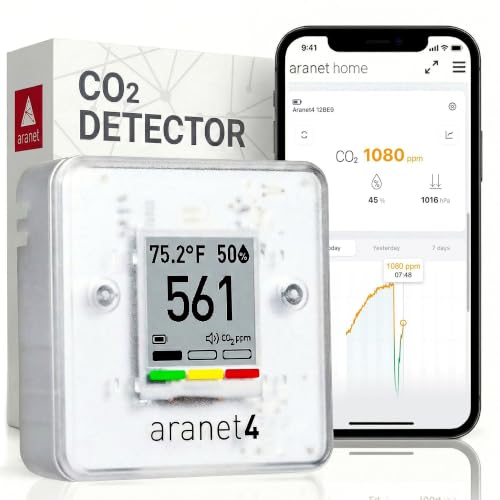
The best CO2 detector for most people is the Aranet4 Home, because its true NDIR sensor reads real carbon dioxide to plus or minus (30 ppm + 3%) and runs for years on batteries. What decides your choice is the sensor type, how you want alerts, and whether you also need particle readings.
In short: buy the Aranet4 Home for accuracy, the INKBIRD IAM-T1 for app data export, and the Airthings View Plus if you also want radon and particle readings.
As an Amazon Associate, Measuring Expert earns from qualifying purchases. Our picks are based on research, specifications and owner feedback, not paid placement.
Best Overall
Best Value
Best Multi-Sensor

Quick Answer: Which CO2 Monitor Fits Your Room?
- Most homes and offices: the Aranet4 Home, because it pairs true NDIR with a multi-year battery.
- NDIR plus data export: the INKBIRD IAM-T1, with a Senseair NDIR sensor and e-ink screen.
- CO2 plus radon and particles: the Airthings View Plus, since it tracks all three.
- Screen-free bedroom tracking: the Airthings Wave Enhance, because it has no display.
- Grow tents and greenhouses: the INKBIRD ICC-500T controller.
- Gas appliances at home: a CO2 monitor is not enough; you also need a carbon monoxide alarm.
On This Page
- Comparison table
- The 5 picks, reviewed
- How we chose
- CO2 vs carbon monoxide
- NDIR vs eCO2 sensors
- What CO2 readings mean
- Specs that matter
- How to test a room
- Calibration and care
- Do and don’t
- Honest limits
- FAQ
- Bottom line
Best CO2 Detector Comparison Table
| # | Product | Best For | Standout Feature | Amazon |
|---|---|---|---|---|
| 1 | Aranet4 Home CO2 Monitor | Most homes, offices and classrooms | True NDIR sensor, e-ink screen, up to 4-year battery | View |
| 2 | INKBIRD IAM-T1 Air Quality Monitor | Value NDIR with e-ink | Senseair NDIR sensor with the same accuracy spec as pricier units | View |
| 3 | Airthings View Plus Air Quality Monitor | CO2 plus radon, particles and VOCs | NDIR CO2, radon and PM2.5 on one e-paper screen | View |
| 4 | Airthings Wave Enhance Air Quality Monitor | Bedrooms and home offices | Screenless NDIR monitor with a glow light, plus noise and light sensors | View |
| 5 | INKBIRD ICC-500T CO2 Controller | Grow tents and greenhouses | Reads CO2 and switches a CO2 source and an exhaust fan | View |
The 5 Best CO2 Detector Picks, Reviewed
Best Overall
1. Aranet4 Home CO2 Monitor
Best for: anyone who wants an accurate, set-and-forget CO2 reading on a desk, nightstand or classroom shelf, with no cables and no subscription.
The Aranet4 Home uses a true NDIR (non-dispersive infrared) sensor, so it measures CO2 by how much infrared light the gas absorbs. As a result, its e-ink screen shows a real concentration in parts per million (ppm), not an estimate built from other gases.
Aranet rates the CO2 range at 0 to 9,999 ppm with an accuracy of plus or minus (30 ppm + 3% of reading). For example, at 1,000 ppm that is about plus or minus 60 ppm. Add a battery life of up to 4 years, and it is the best CO2 detector for most readers.
- Sensor: true NDIR CO2
- CO2 range: 0 to 9,999 ppm
- Accuracy: plus or minus (30 ppm + 3% of reading)
- Temperature: 0 to 50 C (32 to 122 F), plus or minus 0.3 C
- Battery life: up to 4 years; also a Bluetooth link to the Aranet Home app
Pros
- Accuracy spec is among the tightest, so small changes are easy to trust
- Very long battery life, so there is no charging
- E-ink screen also stays dark at night
Cons
- No Wi-Fi, so remote alerts need a phone nearby
- Costs more than some e-ink rivals
- Also, it does not measure particles
Skip it if: you need alerts on your phone while you are away from home; a Wi-Fi or hub-based model fits that better.
Best Value
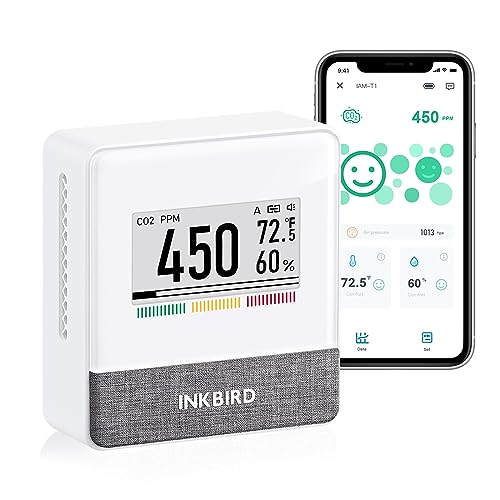
2. INKBIRD IAM-T1 Air Quality Monitor
Best for: buyers who want a genuine NDIR sensor, an e-ink screen and a loud alarm when a room gets stuffy.
The INKBIRD IAM-T1 is the value pick, yet it keeps a real sensor. INKBIRD states that it uses a Swedish Senseair NDIR module and lists the same accuracy as the Aranet4, so on paper it reads CO2 just as tightly.
In addition, the 2.13-inch e-ink screen turns black and a buzzer sounds when CO2 crosses your threshold. It also keeps 30 days of readings that you can export through the app.
- Sensor: Senseair NDIR, so it reads CO2 directly
- CO2 range: 0 to 9,999 ppm
- Accuracy: plus or minus (30 ppm + 3% of reading)
- Sampling: 1, 2, 5 or 10 minutes; also 30 days of stored data
- Power: 2 AA batteries, up to 18 months at 10-minute sampling
Pros
- Same accuracy spec as the Aranet4
- Screen inverts and the buzzer sounds when CO2 passes your limit
- Data export through the app, too
- Bluetooth range is rated up to 100 m (328 ft) in open space
Cons
- Bluetooth only, with no Wi-Fi
- Battery life drops when you use the fastest sampling rate
- Humidity range also tops out at 85% RH
Skip it if: you want the longest possible time between battery changes; the Aranet4 is rated for far longer.
Best Multi-Sensor
3. Airthings View Plus Air Quality Monitor
Best for: homeowners who want CO2 tracked alongside radon, fine particles and VOCs, with Wi-Fi history and no subscription.
The Airthings View Plus covers more than CO2. It pairs an NDIR CO2 sensor with a radon chamber, a laser particle counter for PM2.5, and VOC, humidity, temperature and pressure readings. Consequently, it suits basements and smoky regions.
Airthings rates CO2 at 400 to 5,000 ppm with an optimum accuracy of plus or minus 50 ppm and 3%, after about 7 days of initial calibration. It also reports over Wi-Fi to the free Airthings app.
- CO2: NDIR, 400 to 5,000 ppm, plus or minus 50 ppm and 3% (optimum)
- Radon: 0 to 500 pCi/L (0 to 20,000 Bq/m3)
- PM2.5: laser particle counter, 0 to 1,000 ug/m3
- Display: 2.9-inch e-paper that shows up to four values at once
- Power: 6 AA batteries (up to 2 years) or USB-C; Wi-Fi and Bluetooth LE
Pros
- Radon and CO2 in one unit, so one device covers both
- NDIR CO2, not an eCO2 estimate
- Free app, and no subscription is mentioned
Cons
- CO2 range stops at 5,000 ppm
- Needs about a week to settle after setup, so early readings wander
- Also large for a nightstand
Skip it if: CO2 is the only thing you care about; a dedicated NDIR monitor costs less.
Best for Bedrooms
4. Airthings Wave Enhance Air Quality Monitor

Best for: people who want CO2 tracked in a bedroom or home office without a glowing screen on the nightstand.
The Airthings Wave Enhance takes a different approach: it has no display at all. Instead, you tap it and a colored glow light shows whether the air is good, fair or poor, while the full numbers live in the Airthings app. Besides NDIR CO2, it logs VOCs, noise and light, which helps when you track sleep conditions.
Airthings rates CO2 at 400 to 5,000 ppm with an accuracy of plus or minus 50 ppm and 5%, specified between 500 and 2,000 ppm. On its own it syncs by Bluetooth only, so remote access needs a View series monitor as a hub.
- CO2: NDIR, so readings are direct; 400 to 5,000 ppm
- Accuracy: plus or minus 50 ppm and 5% (500 to 2,000 ppm)
- Extras: VOC, noise (dBA), light (lux), humidity, temperature, pressure
- Sampling: every 5 minutes; also a weekly automatic baseline update
- Power: 2 AA batteries, up to 14 months on Bluetooth
Pros
- No screen to light up a dark bedroom
- Noise and light sensors also add sleep context
- NDIR CO2, plus automatic baseline correction
Cons
- No display, so you need the app for numbers
- Bluetooth only unless you own a View series hub
- Since it samples every 5 minutes, window tests are slow
Skip it if: you want to see the exact ppm at a glance; any of the screen-based picks suits that better.
Best for Grow Rooms
5. INKBIRD ICC-500T CO2 Controller

Best for: growers who add CO2 on purpose and need a meter that also turns a CO2 generator and an exhaust fan on and off.
Grow rooms are the one place where people add CO2 on purpose, so a plain monitor is not enough there. The INKBIRD ICC-500T reads CO2 through its S01 sensor and then acts on it. Specifically, one relay (WORK1) runs a CO2 regulator or generator, while the second relay (WORK2) runs an exhaust fan.
In addition, it shows the measured CO2 (PV) and your set point (SV) at the same time, and it offers programmable high and low CO2 alarms. However, INKBIRD does not state the sensor type or accuracy on its product page, so treat it as a controller first and a precision meter second.
- Outputs: two relays, one for a CO2 regulator or generator and one for an exhaust fan
- Display: dual PV (measured) and SV (set point) readouts
- Alarms: programmable high and low CO2 limits
- Modes: three settable modes
- Startup: about 2 minutes of warm-up before the relays switch
Pros
- Controls CO2 enrichment and venting from one box
- Set point and reading are visible side by side
- High and low alarms also guard against runaway CO2
Cons
- INKBIRD does not publish sensor type or accuracy on its product page
- Not useful as a general room monitor
- Needs a CO2 source and a fan, so it is only half a system
Skip it if: you only want to watch CO2 in a living space; a monitor such as the Aranet4 is simpler.
How We Chose the Best CO2 Detector Picks
We did not run hands-on lab tests; these picks are research-based. First, we read each maker’s product page and only list specs we could confirm there. Next, we weighed owner feedback for problems that spec sheets hide, such as confusing apps. Then we applied these criteria:
- Sensor type: we favored NDIR sensors, because they measure CO2 directly. We rejected units that only report eCO2 estimated from VOC signals.
- Stated accuracy: we preferred makers that publish a figure such as plus or minus (30 ppm + 3%), and we flag the ones that do not.
- Range: at least 5,000 ppm, but ideally 9,999 ppm.
- Calibration: a clear fresh-air method, and ideally both automatic and manual options.
- Use case: one pick per job, with no more than two models per brand.
For reference values, we used the NOAA Global Monitoring Laboratory record of outdoor CO2 and the NIOSH Pocket Guide entry for carbon dioxide for workplace limits.
CO2 vs Carbon Monoxide: Two Different Gases, Two Different Tools
Carbon dioxide (CO2) is the gas you exhale. It builds up when closed rooms fill with people, so a CO2 reading is a stand-in for how much rebreathed air you are sharing. At normal indoor levels, it causes stuffiness rather than poisoning.
Carbon monoxide (CO), on the other hand, comes from incomplete burning of fuel in furnaces, stoves, generators and cars. It is also toxic at low levels and has no smell. Therefore, the only correct tool for CO is a listed carbon monoxide alarm; a CO2 monitor will not react to it. If you have fuel-burning appliances, read our carbon monoxide detector guide as well.
| Carbon dioxide (CO2) | Carbon monoxide (CO) | |
|---|---|---|
| Main indoor source | People breathing, combustion, grow-room enrichment | Faulty or unvented fuel-burning appliances, engines |
| What a reading tells you | How well the room is ventilated, so it guides airflow | Whether there is a poisoning hazard, so it guards your safety |
| Typical tool | NDIR CO2 monitor | Listed CO alarm with a sounder |
NDIR vs eCO2: How a Real CO2 Sensor Works
An NDIR sensor shines infrared light through a small chamber and measures how much of it reaches a detector. CO2 absorbs infrared strongly at a wavelength of about 4.26 micrometers, so more CO2 means less light at the detector. Because it looks for that specific band, it responds to CO2 and very little else.
Many cheap “air quality” gadgets, by contrast, show a CO2 number labeled eCO2 or CO2eq. However, that value is estimated. A metal-oxide (MOX) sensor reacts to VOCs and hydrogen, and software converts that signal into a CO2-like figure. For example, Sensirion lists CO2eq on its SGP30 gas sensor as a processed output next to TVOC. As a result, a cleaning spray or a scented candle can send eCO2 soaring while real CO2 hardly moves. Meanwhile, a crowded room with no odors may show low eCO2 even when real CO2 is high.
| Sensor type | What it senses | Typical stated accuracy | Good for |
|---|---|---|---|
| NDIR | Infrared absorption by CO2 | About plus or minus (30 to 50 ppm + 3 to 5%) | Ventilation checks, classrooms, grow rooms |
| Photoacoustic NDIR | Sound pulses from CO2 heated by pulsed infrared | Similar to NDIR in a smaller module | Compact monitors and smart-home units |
| MOX “eCO2” | VOCs and hydrogen, then converted by software | Not a true CO2 accuracy | Rough odor or VOC trends only |
So before you buy, check the spec sheet for NDIR or photoacoustic. If it only says eCO2 or CO2eq, treat the number as a VOC indicator. If you also want VOCs and particles, a combined indoor air quality monitor with a real CO2 channel covers both.
What CO2 Readings Mean: A ppm Guide
CO2 is measured in parts per million (ppm), which is the number of CO2 molecules in every million molecules of air. Since 10,000 ppm equals 1%, a reading of 1,000 ppm means CO2 makes up 0.1% of the air. Our guide to measurement units in chemistry explains ppm in more depth.
First, outdoor air sets the floor. NOAA reports a monthly mean of 427.55 ppm at Mauna Loa for August 2026, so a well-calibrated monitor should read in the low 400s outside. Indoors, the numbers below are common rules of thumb for ventilation, not legal limits:
| Reading (ppm) | Share of air | What it usually means |
|---|---|---|
| About 420 to 430 | About 0.043% | Outdoor air today |
| Under about 800 | Under 0.08% | Well-ventilated room |
| About 800 to 1,000 | 0.08 to 0.10% | Acceptable, but airflow is limited |
| About 1,000 to 1,500 | 0.10 to 0.15% | Stuffy; add fresh air |
| Above about 1,500 | Above 0.15% | Poor ventilation for the number of people |
| 5,000 | 0.5% | OSHA PEL and NIOSH REL, 8-hour or 10-hour average |
| 30,000 | 3% | NIOSH short-term exposure limit (15 minutes) |
| 40,000 | 4% | NIOSH IDLH value |
Specs That Matter on the Best CO2 Detector
At first, spec sheets look alike. However, a few lines separate a useful instrument from a gadget.
Accuracy. Most makers write accuracy as a fixed part plus a percentage of the reading. So plus or minus (30 ppm + 3%) at 1,000 ppm equals plus or minus 60 ppm, and at 2,000 ppm it equals plus or minus 90 ppm. In comparison, plus or minus (50 ppm + 5%) gives plus or minus 100 ppm at 1,000 ppm. Both are fine for ventilation decisions, but the tighter spec makes small changes easier to trust.
Range. Typically, a range of 400 to 5,000 ppm covers homes and offices. Grow rooms can run higher, so 0 to 9,999 ppm is safer there.
Calibration. Look for automatic baseline correction (ABC) and a manual fresh-air option. Also, check that you can turn ABC off, because it assumes the room reaches fresh air regularly.
Display and alerts. E-ink screens do not glow at night, while backlit LCDs are easier to read in the dark. Also, decide whether you need a buzzer, phone alerts or an exportable log.
How to Test a Room With a CO2 Monitor
A single number tells you little. Instead, a before-and-after test shows where ventilation falls short:
- Calibrate in fresh air. Calibrate outdoors or by an open window, so the monitor reads near 420 ppm first.
- Place it at breathing height. Set the monitor about 1 to 1.5 m (3 to 5 ft) high where people sit or sleep, at least an arm’s length from faces.
- Record a baseline. Note the reading while the room is empty, and then the outdoor value.
- Watch an occupied period. Leave it running through a normal occupied stretch, such as a night of sleep.
- Check the peak and the trend. Generally, a steady rise past 1,000 ppm points to weak ventilation.
- Change one thing and repeat. Open a window or run a fan, then repeat and compare the curves.
Calibration and Care for Long-Term Accuracy
Every NDIR sensor drifts slowly because its light source ages. So most makers build in automatic baseline correction. For example, Aranet says its automatic routine looks for fresh air at about 420 ppm for about 8 hours in each 30-day period, and it recommends a calibration about once a year.
However, a room that never drops to outdoor levels, such as a CO2-enriched grow tent or a bedroom used day and night, can fool the routine into setting a false baseline. In that case, turn ABC off and calibrate by hand: take the monitor outside or to an open window, keep it at least 1 m (3 ft) from your breath, and let it settle for the time the maker gives.
Do and Don’t for CO2 Monitoring
Honest Limits of Even the Best CO2 Detector
Every monitor has limits, so know them before you rely on the numbers. For example:
- CO2 is a proxy. It shows how much exhaled air builds up. However, it does not measure particles, mold, radon or chemical vapors.
- It is not a safety alarm. These units are not CO alarms, smoke alarms or gas-leak detectors, and none of them replace those devices.
- Accuracy depends on calibration. A monitor that has never seen fresh air, or one with a false baseline, can be off by hundreds of ppm.
Best CO2 Detector FAQ
What is the best CO2 detector for home use?
The Aranet4 Home is the best CO2 detector for most homes. It uses a true NDIR sensor rated at plus or minus (30 ppm + 3%), runs for years on batteries and needs no subscription.
Is a CO2 detector the same as a carbon monoxide detector?
No. Carbon dioxide (CO2) is what people exhale, and a CO2 monitor tells you how well a room is ventilated. Carbon monoxide (CO) is a toxic gas from burning fuel, and only a listed CO alarm protects you from it.
What CO2 level is too high indoors?
Outdoor air now sits near 427 ppm. Many ventilation guides treat indoor readings under about 800 ppm as well aired and readings above 1,000 to 1,500 ppm as a sign to open a window or add fresh air. The OSHA 8-hour workplace limit is much higher, at 5,000 ppm.
Why do eCO2 readings differ from NDIR readings?
An eCO2 reading is an estimate. The sensor detects VOCs or hydrogen, and software converts that signal into a CO2-like number. In contrast, an NDIR sensor measures CO2 itself.
How accurate is the best CO2 detector?
Good NDIR monitors list accuracy of about plus or minus (30 ppm + 3% of reading). For example, at 1,000 ppm that equals about plus or minus 60 ppm.
How do I calibrate a CO2 monitor?
Most NDIR monitors calibrate against fresh outdoor air, which sits near 420 ppm. Place the unit outside or by an open window, away from your breath, and start the calibration from the button or app. Finally, let it settle.
Where should I place a CO2 monitor?
First, put it at breathing height where people sit or sleep, about 1 to 1.5 m (3 to 5 ft) off the floor. Also, keep it away from faces, windows and heaters.
Do CO2 monitors work in grow rooms?
Yes, but check the range first. Grow rooms often run CO2 well above 1,000 ppm, so choose a unit that reads to 9,999 ppm. In addition, turn off automatic baseline calibration if the room never drops to fresh-air levels.
Can a CO2 monitor detect a gas leak?
No. A CO2 monitor does not detect natural gas, propane or carbon monoxide. For those hazards, use a combustible gas detector and a CO alarm that meets a recognized safety standard.
Is the best CO2 detector worth it for a bedroom?
Often, yes. Bedrooms with the door shut can climb well past 1,000 ppm overnight, and a monitor shows that pattern clearly. As a result, you can test simple fixes and see the effect.
Bottom Line: The Best CO2 Detector to Buy
For most readers, the Aranet4 Home is the best CO2 detector to buy. It pairs a true NDIR sensor with a tight accuracy spec and a multi-year battery. If you want app data export, the INKBIRD IAM-T1 lists the same accuracy, and the Airthings View Plus is the pick for whole-home air data.
Finally, these monitors tell you when a room needs fresh air. Meanwhile, a separate CO alarm guards against carbon monoxide, and a broader air quality monitor adds particle and VOC readings if you need them.
2 thoughts on “Best CO2 Detector: 5 Real CO2 Monitors for Homes, Bedrooms and Grow Rooms”