

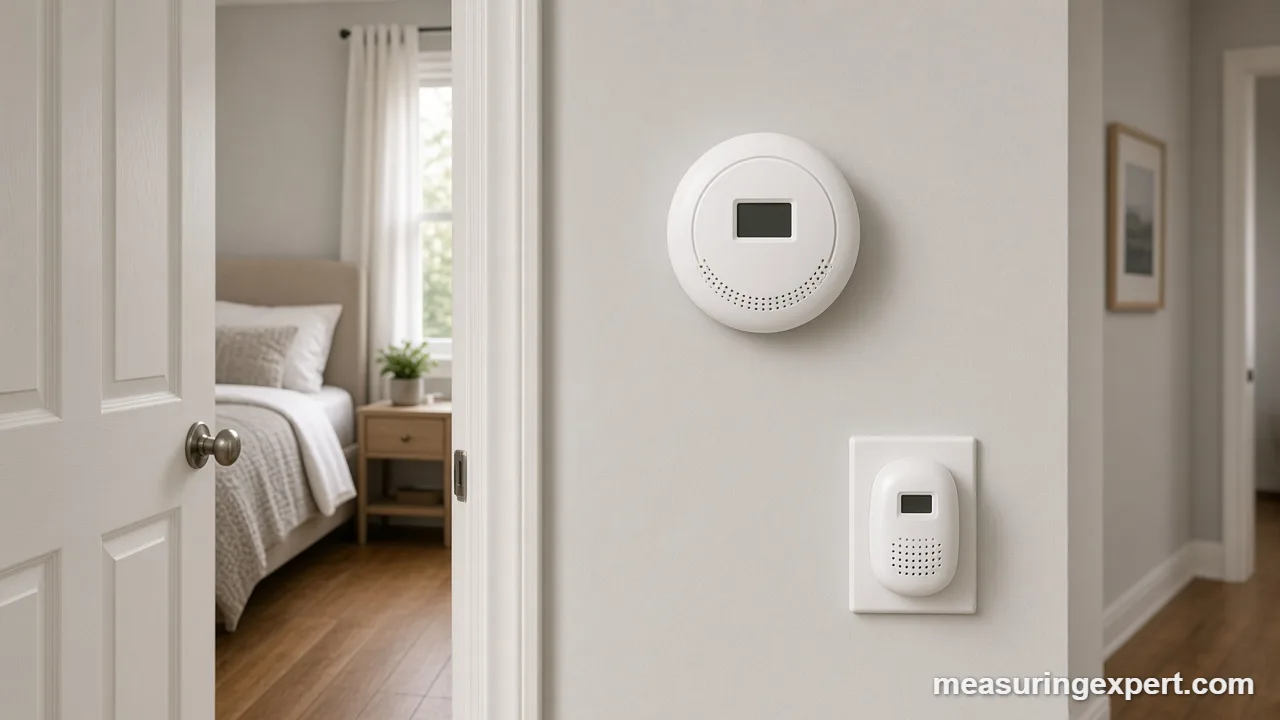
The best CO detector for most homes is the First Alert CO710, a sealed 10-year carbon monoxide alarm with a digital ppm display and peak memory. Still, the right pick depends on power source, whether you need interconnection, and whether you also want natural gas or propane detection.
In short: get the First Alert CO710 for a bedroom hallway, the First Alert CO605 on a tight budget, and the X-Sense SC07-W if you want every alarm in the house to sound together.
As an Amazon Associate, Measuring Expert earns from qualifying purchases. Our picks are based on research, specifications and owner feedback, not paid placement.
Best Overall
Best Budget
Best Interconnected
Quick Answer: The Best CO Detector for Each Home
- First Alert CO710: sealed 10-year battery, ppm display, peak memory and room temperature.
- Kidde COBDL10: a wall-mount 10-year alarm with a backlit display and a 10-year warranty.
- First Alert CO605: a simple plug-in alarm with battery backup for low cost.
- Kidde KN-COEG-3: carbon monoxide plus natural gas or propane in one plug-in unit.
- X-Sense SC07-W: wireless interconnected smoke and CO alarms with a ppm screen.
- Safe-T-Alert 35-742: a 12-volt CO and propane alarm built for RVs.
On This Page
- Comparison table
- The 6 picks, reviewed
- How we chose
- CO is not CO2
- Reading the ppm display
- Where to put a CO alarm
- How to install and test
- Sensor life and end-of-life
- Do and don’t
- Honest limits
- FAQ
- Bottom line
Best CO Detector Comparison Table
First, scan the table to match an alarm to your home. Then read each review for the power source, display and safety listings.
| # | Image | Product | Best For | Standout Feature | Amazon |
|---|---|---|---|---|---|
| 1 |  | First Alert CO710 | Most homes | 10-year sealed battery, ppm display, peak memory | View |
| 2 |  | Kidde COBDL10 | Wall mounting | 10-year battery and 10-year warranty | View |
| 3 |  | First Alert CO605 | Tight budgets | Plug-in power with battery backup | View |
| 4 |  | Kidde KN-COEG-3 | Gas appliances | CO plus natural gas or propane, peak memory | View |
| 5 |  | X-Sense SC07-W | Whole-house coverage | Wireless interconnect, smoke and CO, ppm LCD | View |
| 6 |  | Safe-T-Alert 35-742 | RVs and campers | 12 VDC, UL 2034 and UL 1484 RV listings | View |
The 6 Best CO Detector Picks, Reviewed
Each review covers power, the display, alarm volume and how the unit tells you it has reached the end of its life. In addition, we note what each alarm cannot do.
Best Overall
1. First Alert CO710
Best for: Bedrooms and hallways, because you never change a battery.
The First Alert CO710 is our best CO detector for most homes because it removes the most common failure: a dead or missing battery. Instead, First Alert seals a lithium battery inside for the 10-year life of the alarm. As a result, you cannot borrow its battery for a remote, and it never chirps for a new one.
For a measuring site, the display is the key feature. Specifically, it shows elevated CO levels in parts per million, and it stores recent peak readings for emergency staff. So, if the alarm sounded while you slept, a paramedic can see how high the level went. In addition, the backlit screen can show room temperature, and the alarm sits on a shelf or table with no install.
- Power: built-in 10-year sealed lithium battery
- Sensor: electrochemical CO sensor
- Display: backlit digital, CO in ppm and room temperature
- Memory: recent peak CO level in ppm
- Alarm: 85 dB, end-of-life warning, one test/silence button
Pros
- No battery changes for 10 years
- Peak memory helps responders
- Tabletop use needs no tools
Cons
- The display shows elevated levels, not every low reading
- No interconnect with other alarms
- The whole unit is replaced at end of life
Skip it if: you want all alarms in the house to sound together; choose the X-Sense SC07-W instead.
Best Wall-Mount Digital
2. Kidde COBDL10
Best for: Homeowners who want a 10-year alarm screwed to the wall outside each bedroom.
The Kidde COBDL10 is part of Kidde’s newer CO line. Just like the CO710, it runs on a sealed 10-year lithium battery. However, it is made for the wall, so it stays put and is harder for kids or pets to knock over. In addition, Kidde lists it under UL 2034, 5th edition, and backs it with a 10-year limited warranty.
First, press the button, and the backlit display shows the alarm status, even in a dark hall. Also, Kidde’s brochure says its event memory flags that CO was detected for up to 7 days. Therefore, you can learn about a short CO event that happened while you were at work.
- Power: 10-year sealed lithium battery, included
- Listing: UL 2034, 5th edition
- Alarm: 85 dB at 10 ft (3 m)
- End of life: amber LED blinks twice every 60 seconds with 2 chirps
- Warranty: 10-year limited
Pros
- Long warranty matches the battery life
- Clear, documented end-of-life signal
- Event memory for missed alarms
Cons
- Kidde does not state a peak ppm memory in its brochure
- No interconnect
- Newer model, so less long-term owner feedback
Skip it if: you rent and cannot drill holes, so a tabletop or plug-in alarm suits you better.
Best Budget
3. First Alert CO605
Best for: Renters and first-time buyers who need basic, listed CO protection in more rooms.
Overall, the First Alert CO605 is the simplest alarm here. First, you plug it into a standard outlet, and backup batteries keep it working in a power outage. Also, it uses an electrochemical sensor and an 85-decibel horn, which is the same loudness as our top pick.
Because it costs less, you can buy one for every level of the home. On the other hand, it has no display, so you get an alarm but no ppm number. Also, note that First Alert’s own page mixes the CO605 and CO606 model names, so check the label on the unit you receive.
- Power: plug-in with battery backup
- Sensor: electrochemical
- Alarm: 85 dB
- Signals: low-battery light and chirp; end-of-life signal
Pros
- Low cost per room
- Battery backup during outages
- Nothing to configure
Cons
- No ppm display or peak memory
- Needs a free outlet at a useful height
- Backup batteries need regular changes
Skip it if: you want to see CO levels before they reach the alarm point, because it has no screen.
Best CO Plus Gas
4. Kidde KN-COEG-3
Best for: Homes with a gas range or dryer, since it also senses fuel gas.
In contrast, the Kidde KN-COEG-3 watches for two hazards. First, an electrochemical cell measures carbon monoxide. Second, a heated metal oxide sensor detects natural gas (methane) or propane and alarms before the gas reaches 25% of its lower explosive limit. As a result, the screen shows “GAS” for a gas alarm, so you know which problem to act on.
For CO, the display starts showing a number once the level reaches 30 ppm. In addition, a peak level button recalls the highest reading since the last reset or unplug. Meanwhile, Kidde rates it for 7 years, with an end-of-life alert, and a 9-volt battery keeps it running during an outage.
- Power: 120 VAC plug-in, 9 V battery backup
- Gases: CO, plus natural gas or propane
- Display: CO in ppm from 30 ppm; peak level memory
- Alarm: 85 dB at 10 ft; UL 2034
- Life and warranty: 7-year life, 5-year limited warranty
Pros
- Two hazards in one outlet
- Peak memory with a dedicated button
- Clear “GAS” message
Cons
- Shorter 7-year life than 10-year sealed alarms
- Large at 6.1 x 3.8 x 1.8 in
- Operating range is only 40 to 100 F (4 to 38 C)
Skip it if: you need an alarm for a cold garage or attic, which falls outside its operating range.
Best Interconnected
5. X-Sense SC07-W
Best for: Larger homes where a basement alarm may not be heard in an upstairs bedroom.
By comparison, the X-Sense SC07-W is a combined smoke and CO alarm with a wireless link. In other words, when one unit senses danger, every linked unit sounds. Indeed, CPSC says interconnected alarms are best for exactly this reason. Meanwhile, the LCD shows the CO level in ppm and the battery status.
In fact, each unit has a photoelectric smoke sensor, an electrochemical CO sensor and a sealed 10-year lithium battery. Moreover, Home Depot’s listing says it links up to 18 devices and is certified to UL 217 (9th edition) and UL 2034 (5th edition) through ETL. However, it does not detect propane or natural gas.
- Sensors: photoelectric smoke and electrochemical CO
- Display: LCD with CO ppm and battery status
- Power: sealed 10-year lithium battery; end-of-life chirp at 10 years
- Link: wireless RF interconnect
- Listings: UL 217 Ed. 9 and UL 2034 Ed. 5 (ETL)
Pros
- All alarms sound together with no wiring
- Smoke and CO in one unit
- Visible ppm reading
Cons
- No gas detection
- Combo units are replaced as a whole
- Wireless range depends on walls and floors
Skip it if: your home already has hardwired interconnected alarms, so match those instead.
Best for RVs
6. Safe-T-Alert 35-742
Best for: RV owners who need to replace a factory CO/LP alarm because it has expired.
A home alarm is not the right tool for a motorhome. Instead, the MTI Safe-T-Alert 35-742 runs on 12 VDC and carries UL 2034 and UL 1484 listings for recreational vehicles. So, it covers both carbon monoxide from a generator or furnace and leaking propane.
In terms of power, it draws 108 mA, and it gives a low-voltage warning at 7 volts. Also, the test/reset button mutes the alarm while you ventilate, yet both sensors keep working and it re-alarms if the hazard returns. Finally, it is a flush-mount unit that fits the Safe-T-Alert 30-442 cutout.
- Power: 12 VDC (12 V +/-15%), hardwired
- Gases: CO and propane (LP)
- Listings: UL 2034 and UL 1484 for RVs; CSA 6.19-01
- Size: 6.375 x 2.875 x 1.25 in
- Warranty: one-year limited
Pros
- Built and listed for RV use
- Two sensors in one cutout
- Low-voltage warning
Cons
- Needs 12 V wiring
- No ppm display in the listed specs
- Short one-year warranty
Skip it if: you need a CO alarm for a house; instead, use one of the home models above.
How We Chose the Best CO Detector Picks
We did not lab-test these alarms. Instead, our picks are research-based: maker product pages, spec sheets and manuals, safety listings, and patterns in owner feedback. We also checked that each model is still sold by its maker, so we dropped popular units that are now listed as discontinued.
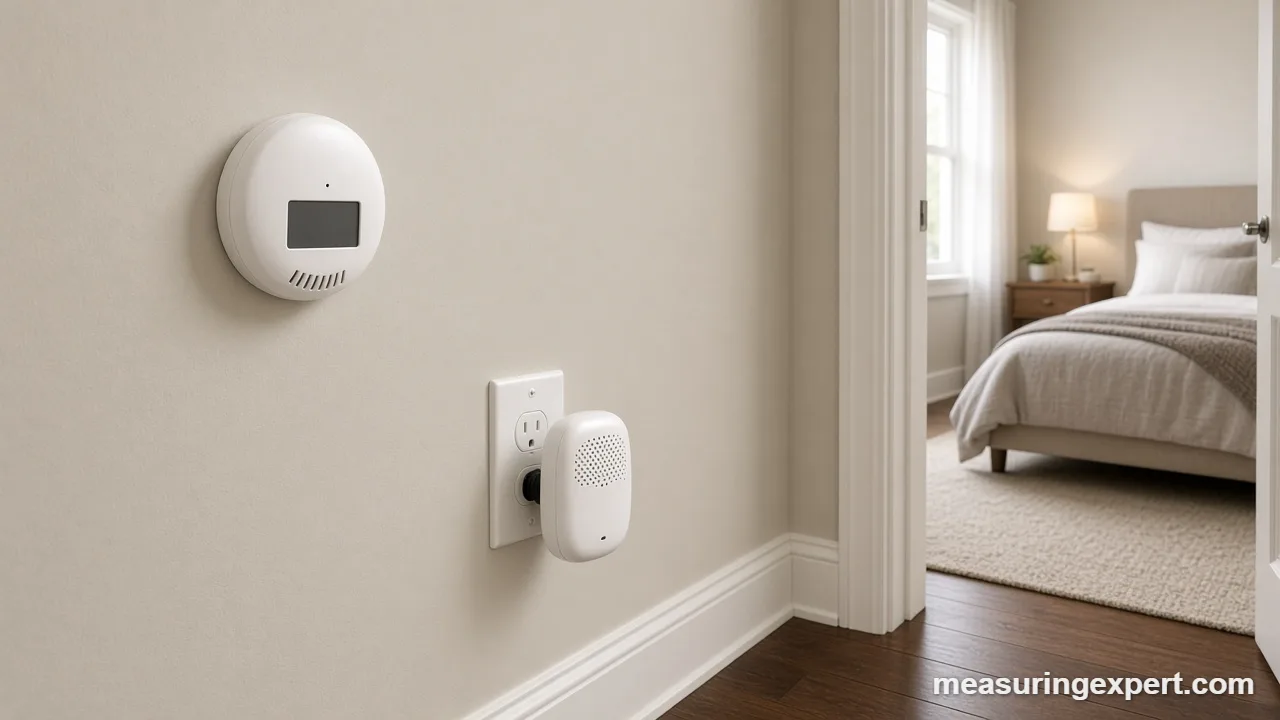
In short, we weighed five things:
- Safety listing: a UL 2034 listing for home CO alarms, plus UL 1484 for gas or RV use.
- Measurement: a digital ppm display and peak memory where the maker documents them.
- Power: sealed 10-year batteries, plug-in units with backup, or 12 VDC for RVs.
- End of life: a clear replacement signal, because CO sensors wear out.
- Distinct use cases: one pick each for bedrooms, budgets, gas appliances, whole-house coverage and RVs, with no more than two per brand.
Our main sources were the First Alert CO710 product page, the Kidde KN-COEG-3 page and its spec sheet, the Kidde COBDL10 brochure, MTI’s 35-742 specs, and the CPSC Carbon Monoxide Information Center.
CO Is Not CO2: Pick the Right Meter
At first the names look alike, but the gases and the meters are very different. For example, carbon monoxide (CO) is a poison made when fuel burns without enough air. By contrast, carbon dioxide (CO2) is what you exhale, and it builds up in stuffy rooms.
| Factor | CO alarm | CO2 monitor |
|---|---|---|
| Gas | Carbon monoxide | Carbon dioxide |
| Main source | Furnaces, stoves, generators, cars | People breathing, poor ventilation |
| Danger | Poisoning, can be deadly | Stuffiness and poor focus at typical indoor levels |
| Sensor | Electrochemical cell | NDIR (infrared) |
| Safety listing | UL 2034 | No life-safety alarm listing |
In short, a CO2 meter will not warn you about carbon monoxide, and a CO alarm will not tell you a room needs fresh air. If ventilation is your goal, see our best CO2 detector guide. For PM2.5, VOCs and humidity as well, read our best air quality monitor roundup.
How a Best CO Detector Reads ppm
CO is measured in parts per million (ppm). So, 100 ppm means 100 CO molecules in every million molecules of air, or 0.01%. For more on this unit, see our guide to measurement units in chemistry.
However, a home alarm does not sound the moment it sees CO. Instead, UL 2034 sets time windows, because the body absorbs CO over time. Therefore, a higher level must trigger the alarm faster.
| CO level | UL 2034 alarm window | What it means |
|---|---|---|
| 30 ppm | Must not alarm within 30 days | Prevents nuisance alarms; many displays start here |
| 70 ppm | 60 to 240 minutes | Long, moderate exposure |
| 150 ppm | 10 to 50 minutes | Serious; act now |
| 400 ppm | 4 to 15 minutes | Dangerous; get out |
That is why the display matters. For example, a reading of 40 ppm will not set off a listed alarm, yet it tells you a fuel appliance needs service. Similarly, peak memory shows how high the level went while you were away or asleep.
Where to Put a CO Alarm
CPSC advises CO alarms on every level of the home and outside sleeping areas, with battery power or battery backup. In addition, NFPA 72 guidance places them outside each sleeping area, on the wall, ceiling or other spot named in the maker’s instructions. Therefore, always read the manual for mounting height.
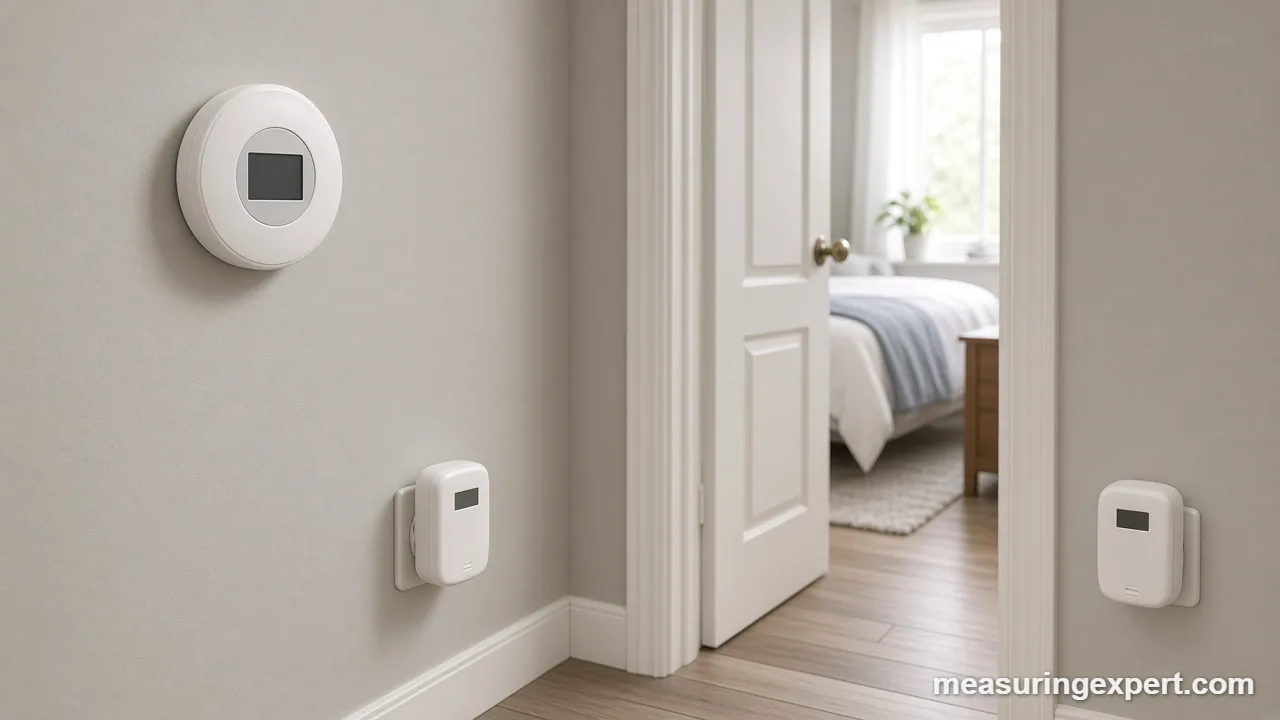
- Sleeping areas: one alarm in the hall outside each group of bedrooms.
- Every level: also the basement, near the furnace room but not inside it.
- Attached garage: an alarm in the room next to the garage door, because exhaust can seep in.
- Keep clear: avoid spots within a few feet of fuel appliances, bathrooms, vents and direct sun, unless the manual says otherwise.
How to Install and Test the Best CO Detector
In general, this routine works for most home CO alarms. Still, follow the manual for your model.
- First, write the install date on the back of the alarm.
- Next, choose a spot outside the sleeping area, away from vents and fuel appliances.
- Then mount the bracket, plug the unit in, or set it on a shelf, as the maker directs.
- Now activate the sealed battery or insert the backup batteries.
- After that, press and hold the test button until the horn sounds.
- Also test every alarm monthly, and check backup batteries regularly.
- Finally, replace the alarm at its end-of-life signal or the date in the manual.
Sensor Life: When a Best CO Detector Wears Out
In fact, an electrochemical CO sensor is a small fuel cell. Over time, its chemistry runs down, so the alarm cannot be trusted forever. For this reason, makers build in an end-of-life signal.
However, the rated life differs by model. For example, Kidde lists 7 years for the KN-COEG-3 and 10 years for the COBDL10. Likewise, the CO710 and SC07-W use 10-year sealed batteries that match the sensor life. At that point, the alarm chirps or flashes a pattern that differs from the low-battery signal. As a result, you should learn both patterns from the manual. Above all, silencing an end-of-life signal does not reset the sensor, so replace the unit.
Do and Don’t for a Best CO Detector
Honest Limits of Home CO Alarms
To begin with, a UL 2034 alarm is built to warn you before most healthy adults feel ill. However, it is not designed to alarm at low levels, so it may stay quiet at 30 ppm. Also, a CO alarm does not replace yearly service of furnaces, boilers and chimneys. Lastly, CO alarms are not smoke alarms unless the label says both, so check what each unit covers.
Best CO Detector FAQ
What is the best CO detector for most homes?
Overall, the First Alert CO710 is our top pick. It has a sealed 10-year battery, an electrochemical sensor, a ppm display and peak memory, so it suits a bedroom hallway.
Do I need a CO detector with a digital display?
No, an alarm without a display still protects you. However, a ppm display and peak memory show low or past CO levels that never set off the alarm, which helps you find a problem early.
Where should a CO alarm go?
CPSC advises one on every level of the home and outside sleeping areas. Then follow the maker’s manual for the exact height and spacing.
What does UL 2034 mean on the best CO detector?
In short, UL 2034 is the US safety standard for residential CO alarms. For instance, it sets alarm time windows, such as 4 to 15 minutes at 400 ppm, and it limits false alarms at low levels.
How long does a carbon monoxide alarm last?
Generally, most last 7 to 10 years. For example, Kidde rates the KN-COEG-3 at 7 years, while the CO710, COBDL10 and SC07-W use 10-year sealed batteries.
Why is my CO alarm chirping?
Usually, a chirp means a low battery or end of life. Check the manual, because the two signals differ, and replace the whole alarm at end of life.
Can a CO2 monitor detect carbon monoxide?
No. CO2 monitors use infrared sensors tuned to carbon dioxide. Instead, you need a UL 2034 CO alarm to detect carbon monoxide.
Is a combination smoke and CO alarm a good idea?
Yes, if you want fewer devices. However, check that it carries both UL 217 and UL 2034 listings, and replace it as one unit at end of life.
Do I need a special CO alarm for an RV?
Yes. Specifically, choose one listed for RV use and powered by 12 VDC, such as the Safe-T-Alert 35-742, which also detects propane.
What should I do when the best CO detector goes off?
First, get everyone outside to fresh air at once, then call 911. Do not go back inside until responders say the home is safe.
Bottom Line: Our Best CO Detector
For most homes, the First Alert CO710 is the alarm to get. After all, it never needs a battery change, it shows ppm and peak levels, and it tells you when to replace it. On the other hand, choose the X-Sense SC07-W for whole-house interconnection, or the Kidde KN-COEG-3 if you also cook or heat with gas.
Black Friday is coming: shop the deals with Prime
2 thoughts on “Best CO Detector: 6 Carbon Monoxide Alarms for Every Home (2026)”