

The best air quality monitor for most homes is the Airthings View Plus, because it reads PM2.5, CO2, VOCs, humidity, temperature and radon in one unit. Still, the right pick depends on your main worry: smoke and dust call for a particle sensor, while stuffy rooms call for a true NDIR CO2 sensor.
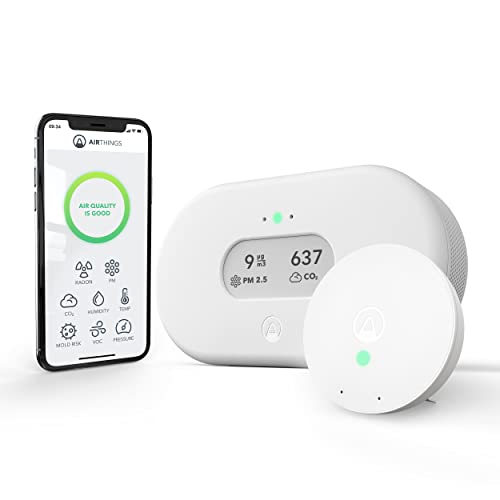
In short: get the Airthings View Plus for whole-home coverage, the GoveeLife H5106 for low-cost smoke tracking, and the Temtop analyzer for handheld spot checks.
As an Amazon Associate, Measuring Expert earns from qualifying purchases. Our picks are based on research, specifications and owner feedback, not paid placement.
Best Overall
Budget Pick

Best Pro
Quick Answer: Best Air Quality Monitor Shortlist
- Airthings View Plus: seven readings, including radon, with an always-on ePaper screen.
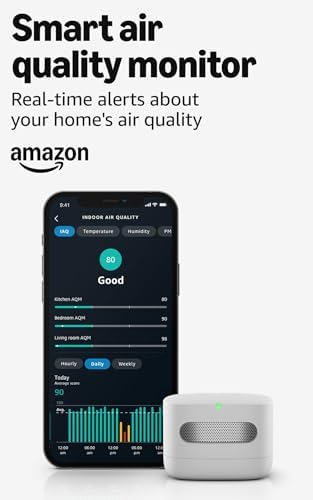
- Amazon Smart Air Quality Monitor: PM2.5, VOC and CO alerts spoken through Alexa.
- GoveeLife H5106: a low-cost, always-on PM2.5 monitor for smoke and dust.
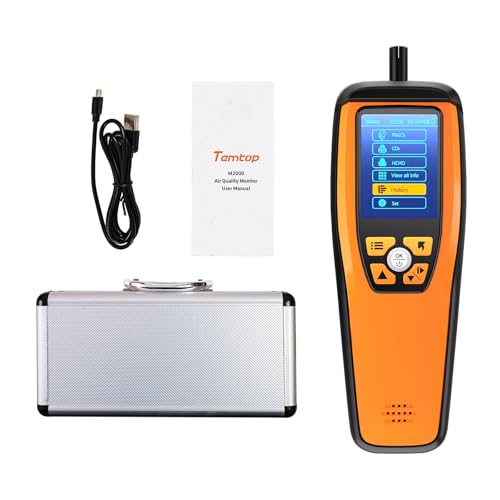
- Temtop Professional Air Quality Analyzer: a handheld CO2 monitor and particle counter.
- Airthings Wave Plus: radon, CO2 and VOC trends on batteries, with no screen.
- Qingping Gen 2 and Aranet4 Home: a PM and CO2 desk display and a CO2 specialist.
On This Page
- Side-by-side chart
- The 7 picks, reviewed
- How we chose
- What each sensor measures
- Reading the numbers
- Placement and setup
- Calibration and care
- Honest limits
- FAQ
- Bottom line
Best Air Quality Monitor Comparison Chart
First, use this chart to match a monitor to your main concern. Then read the reviews for the sensor details behind each pick.
| # | Product | Best For | Standout Feature | Amazon |
|---|---|---|---|---|
| 1 | Airthings View Plus (with Wave Mini) | Most homes | Radon, PM2.5, CO2, VOC, humidity, temperature and pressure | View |
| 2 | Amazon Smart Air Quality Monitor | Alexa homes | Voice alerts for PM2.5, VOC and CO | View |
| 3 | GoveeLife Smart Air Quality Monitor H5106 | Smoke and dust on a budget | Low-cost PM2.5 tracking with an LED display | View |
| 4 | Temtop Professional Air Quality Analyzer | Inspectors and spot checks | CO2 monitor plus particle counter | View |
| 5 | Airthings Wave Plus | Basements and radon checks | Radon plus CO2 and VOC, no screen | View |
| 6 | Qingping Air Quality Monitor Gen 2 | Desks and living rooms | PM2.5, PM10 and CO2 on one screen | View |
| 7 | Aranet4 Home | Ventilation and sleep rooms | True NDIR CO2 sensor with up to 4-year battery life | View |
The 7 Best Air Quality Monitor Picks, Reviewed
We open with the all-in-one home pick. Next come the smart and budget options, then the pro and radon tools, and finally two specialists that fill gaps.
Best Overall
1. Airthings View Plus (with Wave Mini)
Best for: homeowners who want one monitor that covers particles, gases and radon, with a screen you can read across the room.
The View Plus is the best air quality monitor for most homes because it covers nearly every common indoor concern in one box. First, it counts fine particles with a laser sensor. Next, it reads carbon dioxide with a true NDIR sensor, which measures the gas directly instead of guessing from VOC levels. In addition, it tracks VOCs, humidity, temperature, air pressure and radon, a gas no other pick here except the Wave Plus can see.
On the measurement side, Airthings publishes real numbers. For example, the CO2 sensor is rated at +/-50 ppm or +/-3% after a 7-day settling period, and the PM2.5 sensor at +/-(5 ug/m3 + 15%) below 150 ug/m3. It also samples every 5 minutes. Also, the 2.9 in ePaper screen stays on without draining the six AA batteries quickly. A USB-C cable lets it run from the wall and act as a hub, which matters here because this Amazon listing pairs it with a Wave Mini for a second room.
- Sensors: radon, PM2.5, CO2 (NDIR), VOC, humidity, temperature, pressure
- PM2.5 range: 0-1,000 ug/m3, laser particle counter
- CO2 range: 400-5,000 ppm
- Power: 6 AA batteries (up to 2 years) or USB-C
- Works with: Alexa, Google Assistant and IFTTT over 2.4 GHz Wi-Fi
Pros
- Covers particles, CO2, VOC and radon in one unit
- Published accuracy figures for its key sensors
- Runs on batteries or USB-C, so placement is flexible
Cons
- Needs about 7 days before CO2, VOC and radon settle
- No Apple HomeKit support
- The bundle costs more than a single monitor
Skip it if: you only care about wildfire smoke or dust; the GoveeLife H5106 tracks PM2.5 for much less.
Best for Alexa
2. Amazon Smart Air Quality Monitor
Best for: Echo owners who want air alerts announced by Alexa instead of checking a screen.
Amazon’s monitor is the simplest way to add air readings to an Alexa home. It detects PM2.5, VOCs, carbon monoxide, humidity and temperature, and then sends a notification when air quality drops. As a result, you can ask an Echo for the latest reading or build a routine that turns on a smart plug for a fan or purifier.
However, it is a trend tool rather than a lab instrument. It has no CO2 sensor, so it cannot tell you when a bedroom needs fresh air. In addition, it is not a listed carbon monoxide alarm. Therefore, keep a real CO alarm on every level of the home; our guide to the best CO detector covers those.
- Detects: PM2.5, VOCs, carbon monoxide, humidity and temperature
- Alerts: notifications through the Alexa app and Echo devices
- Setup: managed in the Alexa app
- Voice: ask Alexa for the latest reading
Pros
- Easy setup for anyone already using Alexa
- Voice and phone alerts when readings rise
- Covers five readings in a small body
Cons
- No CO2 sensor
- Not a replacement for a listed CO alarm
- Few published accuracy figures
Skip it if: you do not use Alexa; the monitor depends on the Alexa app for its readings.
Best Budget
3. GoveeLife Smart Air Quality Monitor H5106
Best for: renters and first-time buyers who mainly want to see dust, cooking smoke and wildfire smoke.
The H5106 does one job well: it tracks fine particles. In addition, it shows temperature and humidity, and its LED display shows readings at a glance. Because it is wired, it runs all day without battery swaps, which suits a monitor that should log around the clock.
After all, PM2.5 is the reading that changes most during cooking, candle burning and smoke events, so a budget particle monitor often teaches you more than a pricier gas sensor. Still, it does not read CO2 or VOCs. For that reason, pair it with a CO2 meter if you also want to judge ventilation.
- Measures: PM2.5, temperature and humidity
- Display: LED readout
- Power: wired, for continuous logging
- Connectivity: smart monitor that pairs with a phone app
Pros
- Low cost for a connected PM2.5 monitor
- Always-on power for nonstop logging
- Simple display for quick checks
Cons
- No CO2 or VOC sensor
- Needs an outlet nearby
Skip it if: you want to track stuffiness or chemical smells; it only sees particles.
Best Pro
4. Temtop Professional Air Quality Analyzer
Best for: home inspectors, teachers and HVAC techs who want a handheld meter for room-by-room checks.
Temtop sells this handheld as a professional analyzer that pairs a CO2 monitor with a particle counter. In other words, it reads both of the values that change most in a busy room: the gas people breathe out and the particles from cooking, dust and smoke. Because it is portable, you can walk it from a classroom to an office to a basement and compare readings on the spot.
A particle counter reports how many particles of each size it sees, then converts the counts into mass. As a result, it is the right tool when you need to know whether a problem is fine smoke or coarser dust. However, Temtop does not publish a full spec sheet we could verify, so we list only what the listing states. Check the manual for range and tolerance before you rely on it for reports.
- Measures: CO2 plus airborne particles
- Type: handheld particle counter and CO2 monitor
- Use: spot checks across rooms and sites
Pros
- Two key readings in one handheld
- Portable for room-to-room checks
- Particle counts help separate smoke from dust
Cons
- No VOC or radon reading
- No smart home app or voice assistant
- Fewer published specs than Airthings or Aranet
Skip it if: you want a fixed monitor with phone alerts; the Airthings View Plus fits that better.
Best for Radon
5. Airthings Wave Plus

Best for: owners with a basement or a radon concern who also want CO2 and VOC trends.
The Wave Plus is the best air quality monitor for radon-prone homes that do not need particle readings. It tracks radon, CO2, VOCs, humidity, temperature and air pressure. Instead of a screen, it shows a green, yellow or red glow when you wave a hand in front of it, and full graphs live in the Airthings app.
Its CO2 sensor is a true NDIR type rated at +/-30 ppm or +/-3%, which is a tighter spec than many plug-in monitors list. Also, it runs on two AA batteries for up to 16 months in Bluetooth mode, so you can mount it on a wall or ceiling far from any outlet. However, it has no PM2.5 sensor, so it cannot see smoke or dust.
- Sensors: radon, CO2 (NDIR), VOC, humidity, temperature, pressure
- CO2 range: 400-5,000 ppm
- Radon range: 0-500 pCi/L (0-20,000 Bq/m3)
- Battery: 2 AA, about 16 months on Bluetooth
- Size: 4.7 x 1.4 in (12 x 3.6 cm), 7.7 oz (219 g)
Pros
- Continuous radon readings, not a one-time test
- Tight published CO2 accuracy
- Long battery life and wall or ceiling mounting
Cons
- No particle sensor
- No screen; you read numbers in the app
- Bluetooth range is about 30 ft (10 m) without a hub
Skip it if: smoke or dust is your main worry; it has no PM2.5 sensor.
Best Desk Display
6. Qingping Air Quality Monitor Gen 2
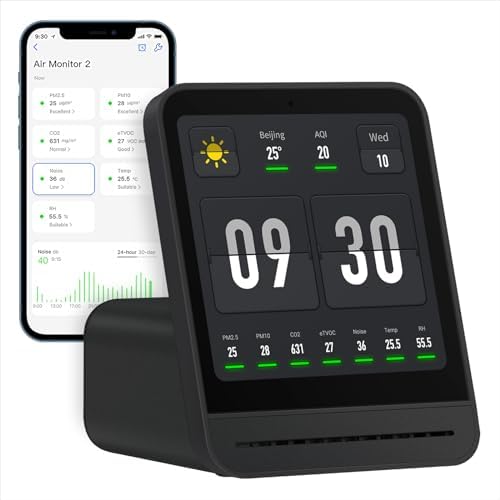
Best for: people who want PM and CO2 numbers on a screen they can read from a desk or shelf.
The Qingping Gen 2 suits anyone who wants to glance at the numbers instead of opening an app. Its Amazon listing names PM2.5, PM10 and CO2 among its readings. As a result, it can show both stuffiness and pollution on one screen, which makes it a good fit for a home office or living room.
In other words, it covers the same two core readings as our top pick, minus radon. Still, Qingping does not publish a spec page we could open, so we do not quote ranges or tolerances. For that reason, treat it as a strong trend monitor and compare readings over days, not single numbers.
- Readings: PM2.5, PM10 and CO2, per its listing
- Form: desktop monitor with a screen
- Use: home office, living room or bedroom trend tracking
Pros
- PM2.5, PM10 and CO2 in one desktop unit
- Screen readings without opening an app
- Covers both ventilation and particle problems
Cons
- No radon reading
- We could not verify published accuracy figures
Skip it if: you need radon data; the Airthings View Plus or Wave Plus covers it.
Best CO2 Accuracy
7. Aranet4 Home
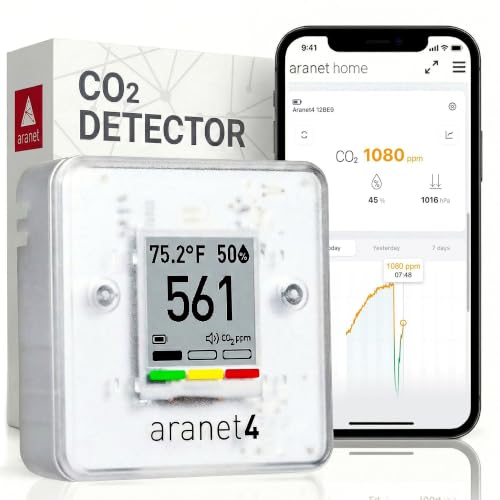
Best for: anyone who wants the most trusted CO2 reading to pair with a particle monitor.
Aranet4 is not a full multi-pollutant monitor. Instead, it is a CO2 specialist, and we include it because CO2 is the best single sign of whether a room gets enough fresh air. Its true NDIR sensor reads 0-9,999 ppm with a rated accuracy of +/-(30 ppm + 3% of reading). In addition, it shows temperature, humidity and air pressure on an E-Ink screen.
The low-power screen and battery design give up to 4 years of runtime, and a buzzer sounds when CO2 passes 1,400 ppm by default. Therefore, it pairs well with the H5106: one covers ventilation, and the other covers particles. For more CO2-only picks, see our best CO2 detector guide.
- CO2: true NDIR, 0-9,999 ppm, +/-(30 ppm + 3%)
- Also shows: temperature (+/-0.3 C), humidity, pressure
- Screen: E-Ink
- Battery: up to 4 years
- Alarm: buzzer, default red level 1,400 ppm
Pros
- Strong published CO2 accuracy
- Battery runs for years
- Readable E-Ink screen with no glare
Cons
- No PM2.5 or VOC sensor
- App settings need Bluetooth range
Skip it if: you want one device for everything; it only covers CO2 and climate.
How We Chose the Best Air Quality Monitor
We did not run hands-on tests, so these picks are research-based. Instead, we read maker spec sheets, EPA indoor air guidance and owner feedback. Then we scored each monitor on the points below.
- Pollutant coverage: we favored units that read PM2.5, CO2, VOC and humidity, because those four explain most indoor air problems.
- Sensor type: a true NDIR CO2 sensor and a laser particle sensor earned extra credit over estimated readings.
- Published accuracy: where a maker lists range and tolerance, we report it; where it does not, we say so.
- Usability: a readable screen, useful alerts and logged history all count, since a monitor only helps if you look at it.
- Variety: we covered smart, budget, pro, radon, desk display and CO2-focused needs, with no more than two models per brand.
Our main sources were the EPA guide to improving indoor air quality, the EPA page on VOCs and indoor air, and spec pages from Airthings and Aranet. We also left out unbranded “16-in-1” listings, because they rarely publish sensor makers or tolerances.
What Each Sensor in an Air Quality Monitor Measures
A monitor is really several small instruments in one case. Each sensor works on a different principle, so it helps to know what each number means and how it is measured.
| Reading | Unit | How it is measured | Common indoor sources |
|---|---|---|---|
| PM2.5 / PM10 | ug/m3 (micrograms per cubic meter) | A laser scatters off particles, and a counter converts the flashes into mass | Cooking, candles, smoke, dust |
| CO2 | ppm (parts per million) | NDIR: infrared light absorbed by CO2 molecules | People breathing in a closed room |
| VOC / TVOC | ppb, index or mg/m3 | Metal oxide sensor that reacts to many gases at once | Paint, cleaners, air fresheners, new furniture |
| Humidity | % RH | Capacitive film that absorbs water vapor | Showers, cooking, drying laundry |
| Radon | pCi/L or Bq/m3 | Diffusion chamber that counts alpha particles | Soil gas entering basements |
Next, two units deserve a closer look. First, ug/m3 is a mass per volume, so it tells you how much particle matter sits in each cubic meter of air. By contrast, ppm is a ratio, like the concentration units explained in our guide to measurement units in chemistry. Similarly, 1 pCi/L equals 37 Bq/m3, which is why a radon reading of 4 pCi/L appears as 148 Bq/m3 on European apps.
Meanwhile, the VOC reading needs the most care. Because a metal oxide sensor reacts to many gases at once, it shows a trend, not the amount of any single chemical. As a result, two brands can show very different VOC numbers in the same room. Use it to spot changes, such as a jump after painting, rather than to compare devices.
Reading the Numbers: What the Best Air Quality Monitor Readings Mean
Of course, numbers only help when you know which ones call for action. The table below pulls together federal figures and common practice. Note that the EPA sets outdoor standards, so indoor targets are guides, not legal limits.
| Reading | Comfortable | Take action | Basis |
|---|---|---|---|
| PM2.5 | Under 9 ug/m3 on average | Over 35 ug/m3 for hours | EPA annual (9.0) and 24-hour (35) outdoor standards |
| CO2 | Under about 1,000 ppm | Over 1,400 ppm | Common ventilation practice; Aranet4 red level |
| Humidity | 30-50% RH | Over 60% RH | EPA mold and moisture guidance |
| Radon | Under 2 pCi/L (74 Bq/m3) | 4 pCi/L (148 Bq/m3) or more | EPA action level |
| VOC | Stable, low baseline | Sharp rise that lasts | Trend only; no single safe number |
For humidity, the EPA mold and moisture guide says to keep it below 60 percent, ideally between 30 and 50 percent. For VOCs, the EPA notes that many are up to ten times higher indoors than outdoors. Therefore, a slow, steady VOC baseline is normal, while a sudden spike points to a product or activity.
Finally, remember what these readings do not cover. CO2 is not carbon monoxide. If you need CO protection, buy a listed alarm, and see our best CO detector guide for options.
How to Place and Set Up an Air Quality Monitor
Above all, placement changes readings more than most buyers expect. So follow these steps to get numbers you can trust.
- Pick the room: Start in the bedroom or the room where you spend the most hours, because that is where exposure adds up.
- Set the height: Place the monitor about 3 to 6 ft (1 to 2 m) off the floor, close to where people breathe.
- Avoid false spikes: Keep it at least 3 ft (1 m) from windows, vents, stoves, candles and humidifiers.
- Let it settle: Leave a new unit in place for a full week so gas sensors finish their warm-up and baseline.
- Log a normal week: Note when readings rise, such as during cooking, cleaning, sleep with the door shut or a smoky day.
- Act on the cause: Use source control first, then ventilation, then filtration, and watch the monitor confirm the change.
Calibration and Care for the Best Air Quality Monitor
Most home monitors calibrate themselves, but they still need help. Good habits keep the readings honest for years.
- CO2 baseline: many NDIR sensors assume the lowest reading of the week is fresh outdoor air near 420 ppm. Therefore, air out the room fully at least once a week so the baseline stays correct.
- Manual calibration: if your model offers it, run it outdoors, away from people, traffic and exhaust.
- Dust: keep the air inlets clear. Lint over a particle sensor inlet can lower PM readings over time.
- Batteries: replace them before they run flat, because low voltage can upset sensor readings.
- Firmware: update app-connected monitors, since makers sometimes refine sensor algorithms.
Honest Limits of Even the Best Air Quality Monitor
Consumer monitors are useful, but they are not lab instruments. For example, low-cost particle sensors can read high in very humid air, because water droplets scatter light like dust. Likewise, VOC sensors cannot name the chemical they detect.
In addition, no home monitor replaces a smoke alarm, a listed CO alarm or a professional radon test before a home sale. Instead, think of a monitor as a guide that tells you when to ventilate, filter or find a source. That is still valuable, because the EPA says source control and ventilation are the main ways to improve indoor air.
Best Air Quality Monitor FAQ
What does the best air quality monitor measure?
A complete home unit measures PM2.5, CO2, VOCs, humidity and temperature. Some add PM10, formaldehyde, carbon monoxide or radon. PM2.5 and CO2 matter most because they change the most in a normal home.
Are cheap air quality monitors accurate?
Cheap PM2.5 monitors can track trends well, because most use similar laser particle sensors. Cheap CO2 readings are less reliable when they come from a VOC sensor instead of a true NDIR sensor. So check the CO2 sensor type before you buy.
What is a good PM2.5 level indoors?
In general, lower is better. The EPA set the annual outdoor PM2.5 standard at 9.0 ug/m3 in 2024, and the 24-hour standard is 35 ug/m3. Indoors, many homes stay under 10 ug/m3 most of the time, with short spikes during cooking.
What CO2 level means a room needs fresh air?
To begin with, outdoor air is roughly 420 ppm. Indoors, many people aim to stay under about 1,000 ppm. Readings above 1,400 ppm, the Aranet4 default red level, usually mean the room needs more ventilation.
Can an air quality monitor detect carbon monoxide?
A few can, such as the Amazon Smart Air Quality Monitor. However, a monitor is not a listed CO alarm. You still need a dedicated CO alarm on every level of the home and near sleeping areas.
Where should I put an air quality monitor?
Place it at breathing height, about 3 to 6 ft (1 to 2 m) off the floor, in the room you use most. Also, keep it away from windows, vents, stoves and humidifiers, because they cause false spikes.
How long does a new monitor take to give good readings?
Particle readings start within minutes. However, gas sensors need longer. Airthings says its CO2, VOC and radon readings need about 7 days to settle, so judge trends after the first week.
What humidity should I keep indoors?
The EPA advises keeping indoor humidity below 60 percent and ideally between 30 and 50 percent. Higher levels feed mold and dust mites, while very dry air irritates skin and sinuses.
Do I need radon detection in an air quality monitor?
You need it if you have a basement, ground-floor bedrooms or live in a radon-prone area. In that case, the Airthings View Plus or Wave Plus gives continuous radon readings instead of a one-time test kit.
Does an air purifier replace an air quality monitor?
No. A purifier removes particles, while a monitor tells you whether it is working. Also, purifiers do little for CO2, so a monitor shows when you need to open a window instead.
Bottom Line: Our Best Air Quality Monitor Pick
For most homes, the Airthings View Plus is the best air quality monitor, because it pairs a laser PM2.5 sensor and a true NDIR CO2 sensor with VOC, humidity and radon readings. On a tight budget, start with the GoveeLife H5106 for particles. If you need a handheld for spot checks, choose the Temtop analyzer instead.
2 thoughts on “Best Air Quality Monitor for Home: 7 Indoor Picks for PM2.5, CO2 and VOC”