

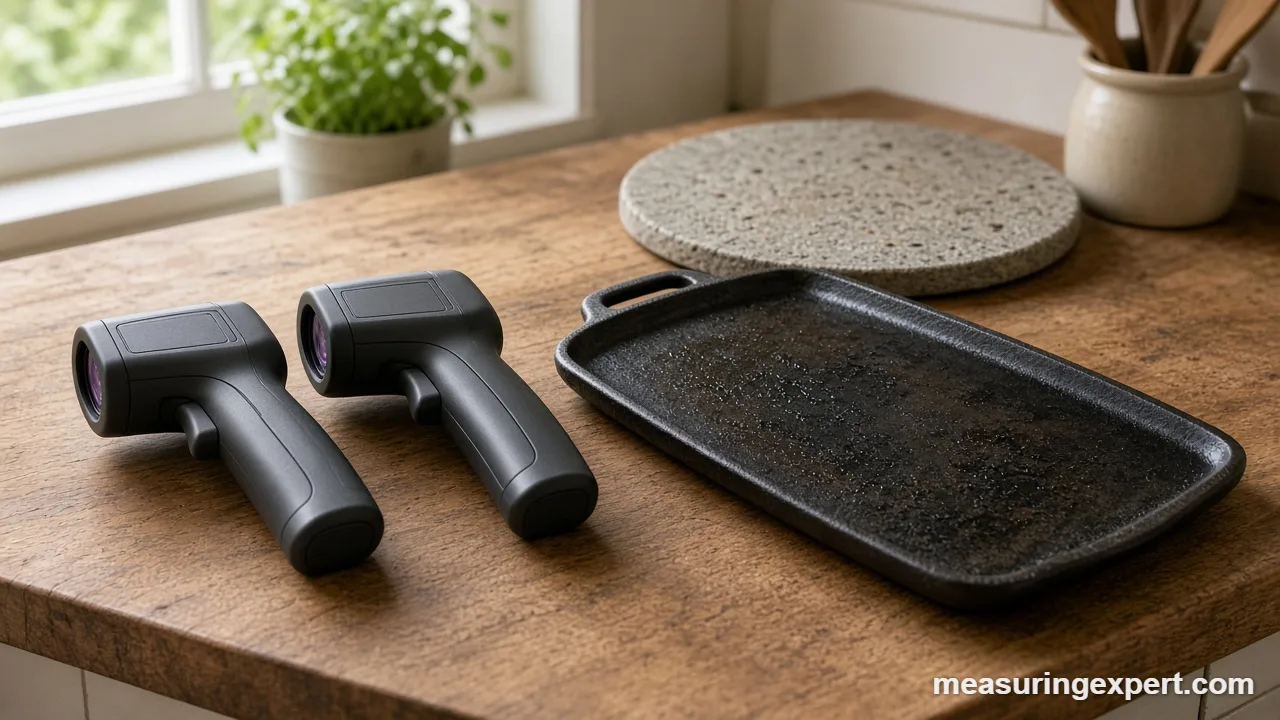
The best infrared surface thermometer for most homes is the ThermoPro TempScan TP450, because its 16:1 distance-to-spot ratio and adjustable emissivity give honest readings on pans, stones and grills. What decides your choice is spot size, emissivity control, top temperature and whether you also need a food probe.
In short: get the ThermoPro TP450 for most jobs, the Etekcity 774 Upgrade on a budget, and the Fluke 62 MAX for trade work.
As an Amazon Associate, Measuring Expert earns from qualifying purchases. Our picks are based on research, specifications and owner feedback, not paid placement.
Best Overall

Best Budget

Best Pro
Quick Answer: Which IR Gun Should You Buy?
- Most kitchens and home projects: the ThermoPro TP450, because it has a 16:1 spot ratio.
- Lowest outlay: the Etekcity Lasergrip 774 Upgrade, if your surfaces are dull or dark.
- HVAC, electrical and plant work: the Fluke 62 MAX, because it is rated IP54.
- Grilling with doneness checks: the ThermoPro TP420, which adds a probe.
- Pizza ovens: the Etekcity Lasergrip 1080, which reads to 1,130 F.
- Targets far away: the Klein IR10, because of its 20:1 ratio.
- Fever checks: none of these; use a medical thermometer instead.
On This Page
- Comparison table
- The 7 picks, reviewed
- How we chose
- Distance-to-spot ratio explained
- Emissivity explained
- Other specs that matter
- How to take a reading
- Why IR guns are not for body temperature
- Temperature converter
- Honest limits
- FAQ
- Bottom line
Best Infrared Surface Thermometer Comparison
| # | Product | Best For | Standout Feature | Amazon |
|---|---|---|---|---|
| 1 | ThermoPro TempScan TP450 Dual-Laser Infrared Thermometer | Kitchens, grills and home projects | 16:1 distance-to-spot ratio and dual lasers | View |
| 2 | Etekcity Lasergrip 774 Upgrade | Quick everyday surface checks | 12:1 ratio at a low outlay | View |
| 3 | Fluke 62 MAX Infrared Thermometer | HVAC, electrical and plant work | IP54 rating and 3 m drop rating | View |
| 4 | ThermoPro TempScan TP420 2-in-1 Infrared Thermometer with Probe | Surface and internal food temps | IR gun plus fold-out meat probe | View |
| 5 | Etekcity Lasergrip 1080 Infrared Thermometer | Pizza stones and hot griddles | Reads up to 1,130 F | View |
| 6 | Klein Tools IR10 Dual-Laser Infrared Thermometer | Ceilings, ducts and distant targets | 20:1 ratio plus a K-type probe input | View |
| 7 | Klein Tools IR1 Infrared Thermometer | Simple HVAC and electrical checks | Fast 0.25 s response and 2 m drop rating | View |
The 7 Best Infrared Surface Thermometer Picks, Reviewed
We start with kitchen guns, then move to trade tools. Also, every spec below comes from the maker’s own product page, and we left out any figure we could not confirm.
Best Overall
1. ThermoPro TempScan TP450 Dual-Laser Infrared Thermometer
Best for: home cooks, griddle and pizza-oven owners, and DIYers who want one gun that handles most jobs well.
To begin with, the TP450 is now sold under the TempPro TempScan name, but it is the same ThermoPro dual-laser gun. We rank it first because it pairs a tight 16:1 distance-to-spot ratio with adjustable emissivity. As a result, it reads a small spot from a safe distance, and you can tune it for different surfaces.
Two lasers also help. Instead of one dot that marks only the center, the pair shows roughly how wide the measured spot is. So, you can see when you are too far back from a small pan. For these reasons, it is the best infrared surface thermometer for most homes.
- Range: -58 to 1,022 F (-50 to 550 C)
- Distance-to-spot ratio: 16:1
- Emissivity: adjustable 0.10 to 1.00 (default 0.95)
- Listed accuracy: plus or minus 3 F (1.5 C) in the spec table
- Response: 500 ms; power: 2 AAA cells
Pros
- Tightest spot ratio among the home-kitchen picks
- Dual lasers outline the target area
- Adjustable emissivity for pans, stone and steel
Cons
- The maker’s page lists accuracy two ways, plus or minus 3 F and 1.5 percent
- Tops out at 1,022 F, short of the hottest wood-fired ovens
- No probe, so it cannot check doneness inside food
Skip it if: you need internal meat temperatures; instead, the TP420 below adds a fold-out probe.
Best Budget
2. Etekcity Lasergrip 774 Upgrade
Best for: first-time buyers who want quick readings on griddles, freezers, tires and drafty windows.
First of all, the Lasergrip 774 Upgrade is the simple, low-cost choice. Etekcity lists a 12:1 distance-to-spot ratio, so at 12 in (30 cm) it reads a spot about 1 in (2.5 cm) wide. In fact, that is the same ratio as many guns that cost more.
However, emissivity is fixed at 0.95. Still, that suits food, painted metal, wood, rubber and seasoned cast iron. In contrast, it will read low on shiny stainless steel or foil unless you add a strip of matte tape. Also, Etekcity states it is for objects only, not people or animals.
- Range: -58 to 842 F (-50 to 450 C)
- Distance-to-spot ratio: 12:1
- Emissivity: fixed at 0.95
- Accuracy: plus or minus 3.6 F (2 C) up to 212 F; plus or minus 2 percent above
- Resolution: 0.1 F/C; response 500 ms or less; 2 AAA cells
Pros
- Low outlay for a 12:1 spot ratio
- Simple trigger-and-read use
- 0.1 degree resolution on screen
Cons
- Fixed emissivity, so shiny metal reads low
- 842 F ceiling is too low for many pizza ovens
- Single laser marks only the center
Skip it if: you cook on a pizza stone above 850 F; instead, the Lasergrip 1080 reaches higher.
Best Pro
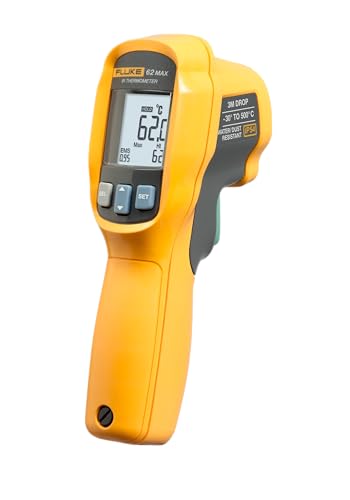
3. Fluke 62 MAX Infrared Thermometer
Best for: technicians who need a tough gun with clearly published specs for motors, panels, ducts and bearings.
Unlike the kitchen guns, the Fluke 62 MAX is built for job sites. It carries an IP54 rating against dust and splashes, and Fluke rates it for a 3 m (9.8 ft) drop. In addition, its accuracy spec is among the tightest on this list.
On the other hand, its spot ratio is 10:1, which is wider than the kitchen guns. Still, Fluke calculates the ratio at 90 percent energy, a stricter and clearly stated method. As a result, the number is honest. Emissivity adjusts from 0.10 to 1.00, so you can match painted panels or bare metal.
- Range: -22 to 932 F (-30 to 500 C)
- Accuracy: plus or minus 1.5 C (2.7 F) or 1.5 percent, whichever is greater
- Distance-to-spot ratio: 10:1 at 90 percent energy
- Emissivity: adjustable 0.10 to 1.00
- IP54; 3 m drop; about 10 hours on one AA cell
Pros
- Tight, clearly defined accuracy spec
- IP54 sealing and a 3 m drop rating
- Spot ratio stated at 90 percent energy
Cons
- Wider 10:1 spot than the 12:1 and 16:1 guns
- Also costs more than the kitchen picks
- 932 F ceiling limits pizza-oven use
Skip it if: you only cook; in that case, a kitchen gun with a higher ceiling will serve you better.
Best for Cooking
4. ThermoPro TempScan TP420 2-in-1 Infrared Thermometer with Probe

Best for: grillers and bakers who want a surface gun and an instant-read probe in one tool.
Of course, an infrared gun only sees the surface. The TP420 solves that by adding a fold-out probe for internal temperatures. So, you can check the griddle with the laser, then probe the burger to confirm it is done.
On the infrared side, it offers a 12:1 ratio, a range up to 1,022 F (550 C) and adjustable emissivity. Meanwhile, the probe covers -58 to 572 F (-50 to 300 C) with a listed accuracy of plus or minus 1.8 F (1 C). Therefore, it is the best infrared surface thermometer for cooks who also care about food safety.
- IR range: -58 to 1,022 F (-50 to 550 C)
- Probe range: -58 to 572 F (-50 to 300 C)
- IR accuracy: plus or minus 3 F (1.5 C); probe: plus or minus 1.8 F (1 C)
- Distance-to-spot ratio: 12:1; emissivity 0.10 to 1.00
- Response: IR 500 ms, probe 2 to 3 s
Pros
- One tool for surface and internal temperatures
- Probe answers the doneness question an IR gun cannot
- Adjustable emissivity
Cons
- Single laser marks only the center
- Probe reads to 572 F, not oven-air temperatures
- Bulkier than a plain gun
Skip it if: you never cook meat; then a plain gun like the TP450 is simpler.
Best for Pizza Ovens
5. Etekcity Lasergrip 1080 Infrared Thermometer
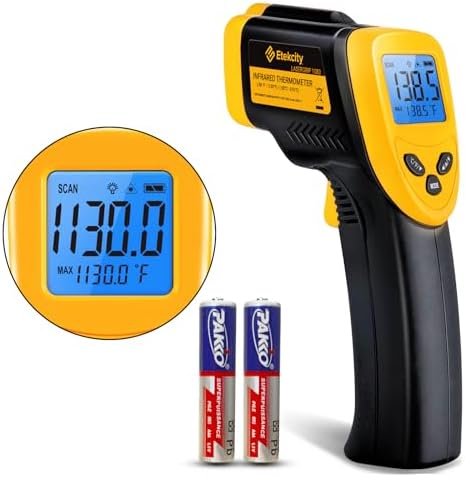
Best for: pizza-oven owners and smokers who need a higher ceiling than the basic guns.
The Lasergrip 1080 is the step up from the 774. Above all, it reaches 1,130 F (610 C), which covers most home pizza ovens. It also adds adjustable emissivity from 0.1 to 1.0.
Meanwhile, the spot ratio stays at 12:1. So, stand back from a hot oven mouth only as far as the spot allows. At 24 in (61 cm), it reads a spot about 2 in (5 cm) wide, which still fits on a pizza stone.
- Range: -58 to 1,130 F (-50 to 610 C)
- Accuracy: plus or minus 2 percent or 2 C (3.6 F)
- Distance-to-spot ratio: 12:1
- Emissivity: adjustable 0.1 to 1.0
- Response: 500 ms or less; 2 AAA cells
Pros
- Higher ceiling for pizza stones
- Adjustable emissivity
- Same easy trigger design as the 774
Cons
- Percent-based accuracy widens at high heat
- Single laser, so the spot edge is a guess
- No probe for internal temps
Skip it if: your cooking stays below 800 F; in that case, the 774 Upgrade covers that for less.
Best Long Range
6. Klein Tools IR10 Dual-Laser Infrared Thermometer

Best for: HVAC and electrical workers who read vents, lights and panels from a ladder or the floor.
Above all, the IR10 has the widest reach here, thanks to a 20:1 distance-to-spot ratio. For example, from 6 ft (1.8 m) it reads a spot about 3.6 in (9 cm) wide. A 10:1 gun would see a spot twice that size from the same place.
Klein also adds dual lasers, an IP54 rating, a 3 m drop rating and a K-type thermocouple input for contact readings. In addition, it has min, max, average and difference modes plus high and low alarms. Finally, Klein states it is not for use on people or animals.
- Range: -40 to 1,200 F (-40 to 650 C)
- Distance-to-spot ratio: 20:1
- IR accuracy: plus or minus 3 F or 1.5 percent, whichever is greater (at 32 F and up)
- Emissivity: adjustable 0.1 to 1.0
- IP54; 3 m drop; one 9V cell, about 8 hours
Pros
- Longest reach on the list
- Probe input for contact checks
- Rugged IP54 body and alarms
Cons
- More features than a home cook needs
- Uses a 9V battery, so spares cost more
- Larger and heavier than the kitchen guns
Skip it if: you only check pans at arm’s length; after all, any 12:1 gun does that.
Best Basic for Trades
7. Klein Tools IR1 Infrared Thermometer
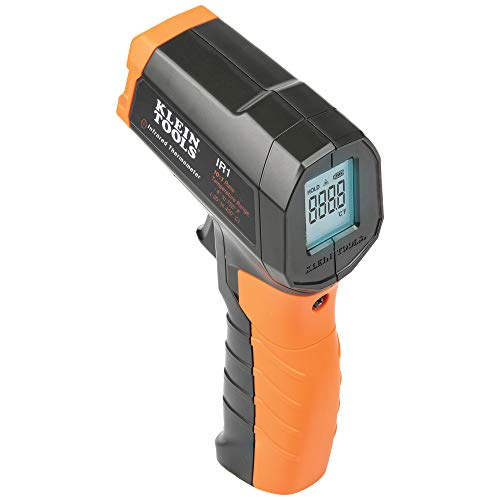
Best for: electricians and homeowners who want a plain, tough gun for breakers, vents and pipes.
The IR1 is Klein’s no-frills model. For example, it uses a 10:1 ratio, fixed 0.95 emissivity and a single laser. Still, it responds in under 0.25 s, holds the reading automatically and survives a 2 m (6.6 ft) drop.
Its range ends at 752 F (400 C), so it is not a pizza-oven tool. Instead, it fits breaker panels, HVAC registers, water heaters and frozen pipes. Because emissivity is fixed, tape a matte patch on bare copper or aluminum first.
- Range: -4 to 752 F (-20 to 400 C)
- Accuracy: plus or minus 4 F or 2 percent above freezing
- Distance-to-spot ratio: 10:1
- Emissivity: fixed at 0.95
- Response under 0.25 s; 2 m drop; one 9V cell
Pros
- Very quick response
- Auto-hold and backlit display
- Tough enough for a tool bag
Cons
- Fixed emissivity, so shiny metal needs tape
- Wider 10:1 spot than most picks
- 752 F ceiling, so no pizza ovens
Skip it if: you need adjustable emissivity for shiny metal; instead, the IR10 or Fluke 62 MAX has it.
How We Chose the Best Infrared Surface Thermometer
We did not run hands-on tests. Instead, these picks are research-based. First, we read spec pages from ThermoPro (TempPro), Etekcity, Fluke and Klein Tools. Next, we checked those claims against measurement guidance from Fluke. Finally, we read owner feedback for patterns such as drift, weak lasers and early failures.
In short, these were the main criteria:
- Distance-to-spot ratio: a higher ratio reads a smaller spot from the same distance, so we favored 12:1 and above for kitchens.
- Emissivity control: an adjustable setting ranked higher, because it lets you correct for different surfaces.
- Stated accuracy: we also wanted a clear tolerance in degrees or percent, not vague claims.
- Range: pizza ovens need a high ceiling, while freezers need a low floor.
- Build: drop ratings, IP ratings and battery type also matter for trade use.
In addition, we capped each brand at two picks. We also left out unbranded clones, because they rarely publish specs you can check.
Distance-to-Spot Ratio: How Close You Need to Be
First, every infrared gun reads a circle, not a point. In turn, the distance-to-spot ratio (D:S) tells you how big that circle is. For instance, a 12:1 gun reads a spot 1 in wide when held 12 in away. So, the spot grows as you step back.
Luckily, the math is simple: spot width = distance / ratio. Also, it works in inches or centimeters. Next, the table below shows the result for the ratios on this list.
| D:S ratio | At 12 in (30 cm) | At 24 in (61 cm) | At 36 in (91 cm) | At 6 ft (1.8 m) |
|---|---|---|---|---|
| 8:1 | 1.5 in (3.8 cm) | 3.0 in (7.6 cm) | 4.5 in (11.4 cm) | 9.0 in (22.9 cm) |
| 10:1 | 1.2 in (3.0 cm) | 2.4 in (6.1 cm) | 3.6 in (9.1 cm) | 7.2 in (18.3 cm) |
| 12:1 | 1.0 in (2.5 cm) | 2.0 in (5.1 cm) | 3.0 in (7.6 cm) | 6.0 in (15.2 cm) |
| 16:1 | 0.75 in (1.9 cm) | 1.5 in (3.8 cm) | 2.25 in (5.7 cm) | 4.5 in (11.4 cm) |
| 20:1 | 0.6 in (1.5 cm) | 1.2 in (3.0 cm) | 1.8 in (4.6 cm) | 3.6 in (9.1 cm) |
Why Spot Size Changes the Reading
Here is why it matters. If the spot is bigger than your target, the gun averages the target with whatever surrounds it. For example, aim a 10:1 gun at a 2 in (5 cm) burger from 3 ft away, and the 3.6 in spot also takes in the cooler grate. As a result, the reading comes out low.
Fluke’s advice in its guide to infrared thermometer results is to get close enough that the measured area is no larger than your target. In practice, aim for a target at least twice the spot width. Also, note that a single laser marks only the center of the spot, not its edge. In contrast, dual-laser guns, such as the TP450 and Klein IR10, show the width better.
One more detail: makers define the spot in different ways. Fluke, for example, states its ratio at 90 percent energy. However, some budget brands do not say. So, treat two guns with the same ratio as roughly, not exactly, equal.
Emissivity and the Best Infrared Surface Thermometer
Emissivity is how well a surface gives off infrared energy, on a scale from 0 to 1. For example, a perfect emitter is 1.0. Generally speaking, most foods, paint, wood, rubber, plastic and seasoned cast iron sit near the top of the scale. That is why most guns default to 0.95.
In contrast, shiny metal has low emissivity. In other words, it gives off little of its own infrared energy and reflects heat from the room instead. Consequently, a gun set to 0.95 under-reads polished stainless steel, foil or bare aluminum, sometimes by a wide margin.
Still, you have two ways to fix this:
- Change the surface: put a strip of matte electrical tape or flat paint on the metal, wait for it to reach the same temperature, and read the tape. This works with any gun, including fixed 0.95 models.
- Change the setting: on a gun with adjustable emissivity, lower the value for the material. However, published values vary with finish and temperature, so this is less reliable than tape.
So, when you shop for the best infrared surface thermometer, check whether emissivity is fixed or adjustable. For instance, a fixed 0.95 gun is fine for food, griddles and painted parts. Meanwhile, an adjustable gun is worth it if you read bare metal often.
Other Specs to Compare
In addition to spot size and emissivity, a few more numbers separate a good gun from a frustrating one.
| Spec | What it means | What to look for |
|---|---|---|
| Range | Lowest and highest temperature it reads | At least 900 F (482 C) for pizza ovens; below 0 F (-18 C) for freezers |
| Accuracy | Allowed error, in degrees or percent of reading | About plus or minus 2 to 4 F at kitchen temperatures |
| Resolution | Smallest step on the screen | 0.1 degree is common; it does not mean 0.1 degree accuracy |
| Response time | How fast the reading settles | 500 ms or faster |
| Modes | Min, max, average, difference, alarms | Max mode helps because it finds hot spots quickly |
| Build | IP rating and drop rating | IP54 and a 2 to 3 m drop rating for trade use |
Also, read accuracy specs carefully. Many are “degrees or percent, whichever is greater.” For example, plus or minus 2 percent is only about 1 F at 50 F, but 14 F at 700 F. Therefore, expect wider error at pizza-oven heat.
How to Use the Best Infrared Surface Thermometer
In general, these steps apply to every gun on this list. Still, check your manual for model-specific settings.
- Check the spot size. First, find your gun’s distance-to-spot ratio and divide your distance by it, so you know how wide the spot is.
- Set the emissivity. Next, leave it at 0.95 for food, paint and dull surfaces, or put matte tape on shiny metal.
- Get close enough. Then move in until the target is at least twice as wide as the spot.
- Aim straight on. Hold the gun square to the surface and avoid steam, smoke and glass in the path.
- Scan, then read. Sweep slowly across the area, then hold on the hottest or coldest point to read it.
- Confirm with a probe. Finally, for food doneness, check the inside with a probe thermometer.
For food, the surface number tells you when a pan or stone is ready. However, it says nothing about the center of a roast. For that, see our guide on how to use a digital thermometer for cooking.
Why IR Surface Guns Are Not for Body Temperature
This point matters, so we will be direct. An infrared surface thermometer is not a fever thermometer. Instead, it is built and calibrated to read objects such as pans, ducts and engines. In fact, Etekcity says its 774 Upgrade is for objects only, and Klein says the IR10 is not for people or animals.
By contrast, medical non-contact thermometers are a different device. The FDA treats them as medical devices, as its page on non-contact infrared thermometers explains. Specifically, they are designed to estimate body temperature from the forehead, and they follow their own use rules.
So, if you need to check a fever, use a medical thermometer instead. Our guide to the best thermometer for body temperature compares oral, ear and forehead models.
Infrared Thermometer Temperature Converter
Most guns switch between F and C with a button. Still, recipes and manuals mix the two, so this converter helps.
In short, the formula is C = (F – 32) / 1.8, and F = C x 1.8 + 32. For more oven conversions, see our Fahrenheit to Celsius baking chart.
Honest Limits of Any Infrared Surface Thermometer
Admittedly, infrared guns are fast and handy. Even so, they have real limits:
- Surface only: they never read inside food, pipes or walls.
- No reading through glass: instead, you read the oven window, not the oven.
- Steam and smoke: both absorb infrared energy and pull readings down.
- Shiny metal: it also under-reads unless you fix emissivity.
- Sudden temperature changes: moving a gun from a cold garage to a warm kitchen can skew readings until it adjusts.
If you need to see heat across a whole wall or panel, a thermal camera does that job better. Our guide to the best thermal imaging camera covers those.
Best Infrared Surface Thermometer FAQ
What is the best infrared surface thermometer for most people?
For most homes, the ThermoPro TempScan TP450 is the best infrared surface thermometer, thanks to its 16:1 spot ratio, dual lasers and adjustable emissivity. On a budget, the Etekcity Lasergrip 774 Upgrade is a solid pick.
Can I use an infrared surface thermometer to take body temperature?
No. Surface guns are calibrated for objects, and several makers state they are not for people or animals. Instead, use a medical thermometer made for fever checks.
What does distance-to-spot ratio mean?
It is the distance from the target divided by the width of the spot the gun reads. So, a 12:1 gun reads a spot about 1 in wide from 12 in away, and about 3 in wide from 36 in away.
What emissivity setting should I use?
Start at 0.95, the usual default, for food, paint, wood, rubber and seasoned cast iron. For shiny metal, add matte tape and read the tape, because a low setting is only a rough fix.
Why does my best infrared surface thermometer read low on stainless steel?
Shiny metal has low emissivity and reflects heat from the room. As a result, the gun sees less infrared energy and under-reads. Matte tape or flat paint on the spot fixes it.
Can an infrared gun tell me if meat is done?
No. It reads only the surface. Therefore, use a probe thermometer in the thickest part, or pick a 2-in-1 model like the ThermoPro TP420.
Can the best infrared surface thermometer read through glass?
No. Glass blocks the infrared wavelengths these guns use, so you read the glass, not what is behind it. Open the oven door or remove the lid first.
How accurate is an infrared surface thermometer?
Most list about plus or minus 2 to 4 F at kitchen temperatures, or 1.5 to 2 percent of the reading when hot. However, a wrong emissivity setting or too large a spot can add far more error.
Does steam or smoke affect readings?
Yes. Steam, smoke and dust absorb infrared energy and can lower the reading. So, wait for the air to clear or move closer to the surface.
How do I check if my infrared thermometer is accurate?
Point it at a glass of stirred ice water with plenty of crushed ice; the water surface should read close to 32 F (0 C). Also, compare it with a calibrated probe on a matte surface.
Bottom Line on the Best Infrared Surface Thermometer
For most homes, the ThermoPro TempScan TP450 is the best infrared surface thermometer. Its 16:1 spot ratio lets you read small pans from a safe distance, and adjustable emissivity keeps readings honest. Meanwhile, the Etekcity 774 Upgrade suits tight budgets, and the Fluke 62 MAX suits the trades. Just remember that none of them can take a fever reading.
3 thoughts on “Best Infrared Surface Thermometer: 7 Picks for Cooking, HVAC and Shop Work”