

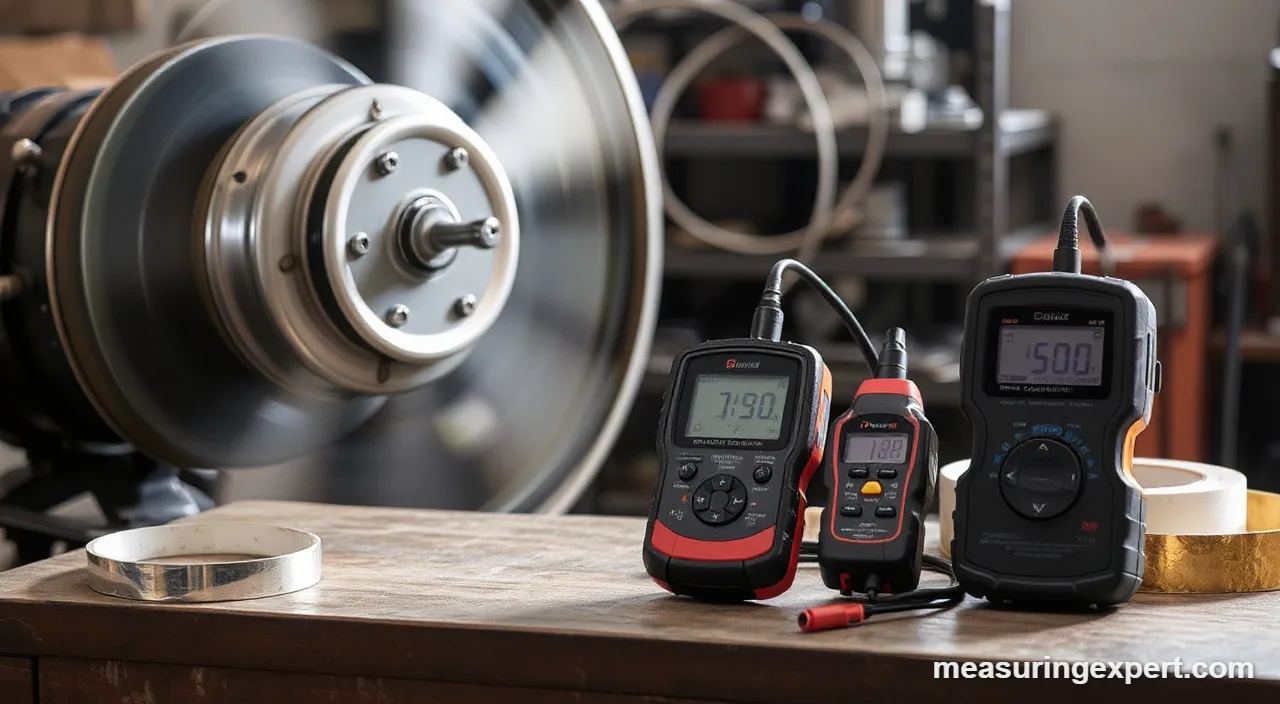
The best handheld tachometer for most workshops is the Extech RPM10, which reads shafts by contact, reads taped targets by laser up to 99,999 rpm, and adds an infrared thermometer. However, a small laser-only meter such as the Extech 461920 is enough if every target can take a piece of reflective tape.
In short: pick the Extech RPM10 for an all-in-one tool, the UNI-T UT372D for logging, and the Extech 461920 for a pocket laser tach.
As an Amazon Associate, Measuring Expert earns from qualifying purchases. Our picks are based on research, specifications and owner feedback, not paid placement.
Best Overall
Best Smart Pick

Quick Answer: Best Handheld Tachometer by Job
- Best all-rounder: Extech RPM10, with contact, laser and infrared temperature.
- Phone app and stored readings: UNI-T UT372D, with contact and laser modes.
- Pocket laser tach: Extech 461920, which reads 2 to 99,999 rpm from tape.
- Contact kit with adapters: Amprobe TACH-20 or the Electronic Specialties photo/contact model.
- Fans, motors and spindles: any laser model, using reflective tape.
- Belts, rollers and conveyors: a contact model with a measuring wheel for surface speed.
On This Page
- Best Handheld Tachometer Comparison Table
- The 6 Best Handheld Tachometer Picks, Reviewed
- How We Chose the Best Handheld Tachometer
- Best Handheld Tachometer Types: Laser, Contact and Combo
- Handheld Tachometer vs Dash Tachometer
- Reading Range and Accuracy on a Handheld Tachometer
- RPM Math: Surface Speed, Hertz and Motor Speed
- How to Use a Handheld Tachometer
- Do and Don’t With a Handheld Tachometer
- What the Best Handheld Tachometer Still Cannot Tell You
- Best Handheld Tachometer FAQ
- Bottom Line: The Best Handheld Tachometer to Buy
Best Handheld Tachometer Comparison Table
For example, each pick has one row below. Then the reviews explain the specs and the trade-offs.
| # | Product | Best For | Standout Feature | Amazon |
|---|---|---|---|---|
| 1 | Extech RPM10 Combination Tachometer with Infrared Thermometer | Contact, laser and IR temperature in one meter | 0.5 to 20,000 rpm contact, 10 to 99,999 rpm photo, IR thermometer | View |
| 2 | UNI-T UT372D 2-in-1 Tachometer | Contact and laser modes with Bluetooth app | +/-0.02% +1 digit, 10 stored groups, Bluetooth | View |
| 3 | Amprobe TACH-20 Contact and Non-Contact Tachometer | Contact and laser combo with six adapters | 1 to 99,999 rpm non-contact, 600 mm range, +/-0.02% listed | View |
| 4 | Electronic Specialties PRO Laser Photo/Contact Tachometer | Laser tach with three contact adapters | 0 to 99,999 rpm, +/-0.05% +1 digit, 10-record memory | View |
| 5 | Electronic Specialties PRO Laser Photo Tachometer | Laser tach with minimum, maximum and last memory | Up to 99,999 rpm, +/-0.05% +1 digit | View |
| 6 | Extech 461920 Mini Laser Photo Tachometer and Counter | Pocket laser photo tach and revolution counter | 2 to 99,999 rpm, +/-0.05%, 151 g | View |
The 6 Best Handheld Tachometer Picks, Reviewed
Generally, this guide covers handheld meters that you point at, or press against, a rotating part. Also, if you need to check temperature, our infrared surface thermometer guide covers dedicated models. For shaking and imbalance, see our article on how to measure vibration.
Best Overall
1. Extech RPM10 Combination Tachometer with Infrared Thermometer
Best for: Maintenance techs and shop owners who want contact, laser and temperature checks in one tool.
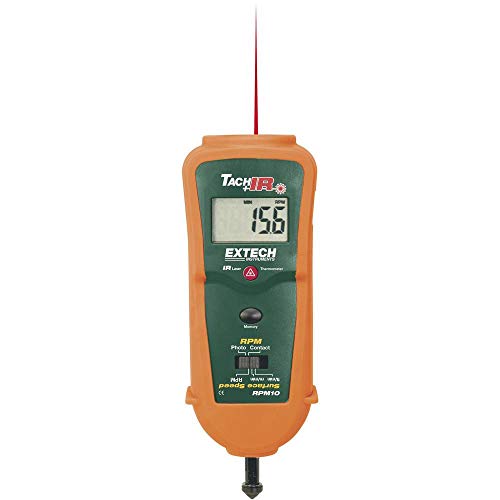
Overall, the Extech RPM10 is the best handheld tachometer here for most workshops because it covers the three checks a maintenance job usually needs. First, a contact tip reads shafts directly. Next, a laser photo mode reads rotating parts from a distance. Finally, an infrared thermometer checks bearing or motor housing temperature without touching it.
Specifically, Extech lists the same accuracy for both RPM modes, which is unusual and useful. In addition, the contact mode reads surface speed in feet per minute or meters per minute when you fit one of the supplied wheels. Note that the product page gives an infrared range but no separate accuracy figure and no distance-to-spot ratio, so treat temperature readings as a quick screen. Therefore, use a dedicated thermometer when you need a documented value.
- Contact RPM: 0.5 to 20,000 rpm; photo (laser) RPM: 10 to 99,999 rpm
- RPM accuracy in both modes: +/-(0.05% of reading + 1 digit); maximum resolution 0.1 rpm
- Contact surface speed: 0.2 to 6,560 ft/min (0.05 to 1,999.9 m/min)
- Infrared thermometer: -4 to 600 F (-20 to 315 C)
- Four AA batteries; 8.5 x 2.6 x 1.5 in (216 x 66 x 38 mm), 10.6 oz (300 g); two-year warranty
Pros
- Contact, laser and IR temperature in one tool
- Same stated accuracy in both RPM modes
- Wheels, reflective tape and a case are included
Cons
- IR accuracy and spot ratio are not listed
- Larger and heavier than a photo-only meter
- Four AA cells are needed
Skip it if: you only read reflective-tape targets, because a smaller photo-only meter costs less and weighs less.
Best Smart Pick
2. UNI-T UT372D 2-in-1 Tachometer
Best for: Technicians who want contact and laser modes, stored readings and a phone app.
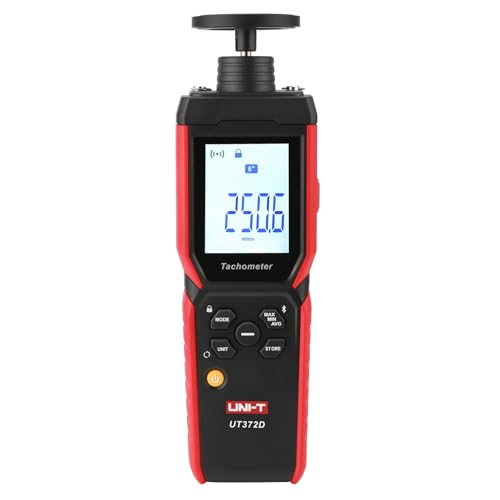
In fact, the UNI-T UT372D is a compact meter that reads by laser and by contact. For example, in optical mode it reads 1 to 99,999 rpm at 50 to 500 mm from the target. In contact mode it reads 1 to 19,999 rpm and shows surface speed for a wheel, which suits belts and rollers. Moreover, the optical mode handles fans and spindles.
Moreover, it stores 10 groups of readings and links to a phone app over Bluetooth, which makes logging easier than copying numbers by hand. However, we found these specs on a retailer page and a manual excerpt rather than on a UNI-T page, so confirm them on the Amazon listing before you buy. Otherwise, you may find a spec that differs.
- Optical RPM 1 to 99,999 at 50 to 500 mm; contact RPM 1 to 19,999
- Accuracy +/-0.02% +/-1 digit (retailer page)
- Contact surface speed up to 1,999 m/min with a 0.1 m wheel; length mode to 99,999
- MAX/MIN/AVG/HOLD, unit conversion, 10 stored groups and a Bluetooth app
- Three AAA batteries; 176 x 63 x 38 mm, about 181 g; one-year warranty listed
Pros
- Contact and laser modes
- Stored readings and Bluetooth app
- Tight stated accuracy
Cons
- Specs came from a retailer page
- Contact mode tops out at 19,999 rpm
- Warranty listed as one year
Skip it if: you want a maker-published datasheet, since we could not open one for this model.
Best Combo with Adapters
3. Amprobe TACH-20 Contact and Non-Contact Tachometer
Best for: Shop users who switch between shafts, wheels and tape targets.
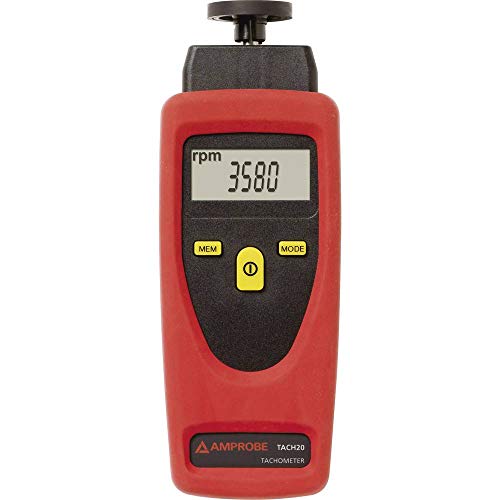
Overall, Amprobe’s TACH-20 pairs a contact mode with an optical mode, and a distributor listing says it ships with six adapters. Also, that matters because contact tachs need the right tip for the job: cones for shaft centers, wheels for surface speed and a concave tip for shaft ends. Besides, the optical beam works up to 600 mm, which is longer than the 1.6 ft distance Extech lists for the 461920.
On the other hand, we found the specs on a distributor page rather than on Amprobe’s own page, and that page flags the item as nonstock. Therefore confirm the range, accuracy and included accessories on the Amazon listing and in the user manual before you buy. The +/-0.02% figure appears in the distributor’s title and the page gives no further accuracy detail.
- Contact RPM: 19 to 19,999 rpm; non-contact (infrared beam) RPM: 1 to 99,999 rpm
- Contact surface speed: 0.1 to 1,999 m/min (0.4 to 6,550 ft/min)
- Accuracy listed as +/-0.02%; optical working distance up to 600 mm
- Two AA batteries; 7.0 x 2.5 x 1.0 in (17.8 x 6.4 x 2.5 cm)
- Distributor lists six adapters, a carrying case, reflective tape and a manual
Pros
- Long 600 mm optical range
- Contact and non-contact modes
- Adapters and case listed with the kit
Cons
- Specs came from a distributor, not the maker
- Distributor marks it nonstock
- Contact mode starts at 19 rpm
Skip it if: you want a maker-published datasheet today, because we could not open one for this model.
Best Kit with Contact Heads
4. Electronic Specialties PRO Laser Photo/Contact Tachometer
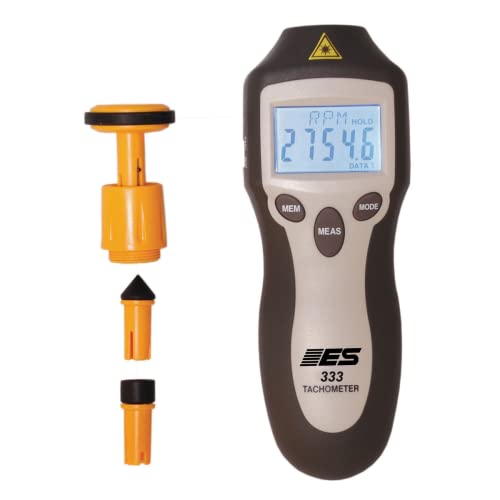
Best for: Shops that want a laser tach plus contact adapters in a zippered case.
Electronic Specialties sells a laser tachometer that also takes contact heads, and this listing matches its photo/contact model. Overall, retailer pages describe a 0 to 99,999 rpm range, a 5-digit backlit display and a 0.5-second sampling time. Also, a 9 V battery, three contact adapters, tape and a zippered case come in the kit.
In addition, it keeps minimum, maximum and average values in a memory of 10 records. Meanwhile, the retailer page does not list a working distance or a surface speed range, so check those before you rely on it. Otherwise, you may find a gap in the specs. We matched the Amazon title to this model by its features, so confirm the model number on the listing.
- Range 0 to 99,999 rpm; accuracy +/-0.05% plus 1 digit
- Resolution 0.1 rpm up to 999 rpm and 1 rpm above 1,000 rpm
- Five-digit backlit LCD; 0.5-second sampling; Min/Max/Avg memory for 10 records
- One 9 V battery included
- Zippered case, three contact adapters, reflective tape and instructions
Pros
- Laser plus contact adapters
- Memory for minimum, maximum and average
- Case and tape included
Cons
- Distance and surface speed are not listed
- Model matched by title and features
- Needs a 9 V battery
Skip it if: you need a stated laser distance or surface speed range, because the retailer page omits both.
Best Laser-Only Memory Meter
5. Electronic Specialties PRO Laser Photo Tachometer
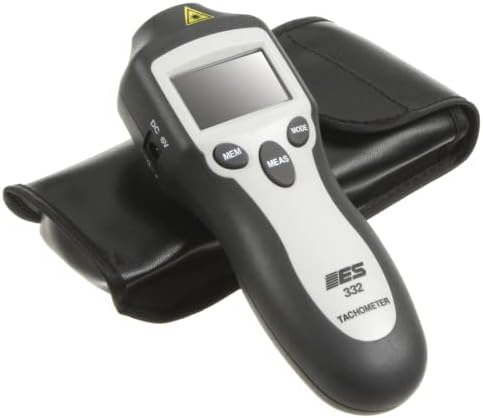
Best for: Users who read taped targets and want stored maximum, minimum and last values.
Similarly, this Electronic Specialties meter is the laser-only sibling of the kit above. Likewise, retailers list a range up to 99,999 rpm and an accuracy of +/-0.05% plus 1 digit. Also, the 5-digit backlit LCD and a memory for the maximum, minimum and last reading make it practical for repeat checks.
However, the listings we opened disagree on laser distance. Likewise, one says up to 6 feet with a Class II laser, while another gives 50 to 500 mm. Therefore treat the longer figure with caution and test the real working distance on your own target. We matched the Amazon title to this model, so confirm it on the listing.
- Range up to 99,999 rpm (listings start at 0 or 2.5 rpm); accuracy +/-0.05% plus 1 digit
- Five-digit backlit LCD; stores maximum, minimum and last reading
- Laser distance: listings conflict (50 to 500 mm versus up to 6 ft)
- One 9 V battery, a case and reflective tape listed in the kit
- Warranty: one year of repair coverage on one retailer page
Pros
- Memory for maximum, minimum and last
- Backlit display
- Case and tape included
Cons
- Distance specs conflict between listings
- Start of range varies by listing
- No contact mode
Skip it if: you need contact or surface speed readings, since this model reads by laser only.
Best Compact Laser Tach
6. Extech 461920 Mini Laser Photo Tachometer and Counter
Best for: Hobbyists and technicians who read fans, motors and spindles with reflective tape.
Generally, the 461920 does one job: it reads RPM from a distance with a laser and reflective tape. As a result, that focus keeps it small, at 5.3 oz (151 g), and easy to carry in a toolbag. In addition, it is quick to set up. Besides RPM, it counts revolutions from 1 to 99,999, which helps when you want a total rather than a rate.
However, it has no contact mode, so it cannot read a shaft end or a wheel’s surface speed. Also, Extech lists a laser target distance of 1.6 ft, and the page does not mention memory. Meanwhile, the 9 V battery is easy to find, and the maker includes reflective tape in the box.
- Photo (strobe) RPM: 2 to 99,999 rpm; revolution count 1 to 99,999
- Basic accuracy +/-0.05%; resolution up to 0.1 rpm
- Laser target distance: 1.6 ft (about 0.5 m)
- One 9 V battery; 6.2 x 2.3 x 1.6 in (160 x 60 x 42 mm), 5.3 oz (151 g)
- Two-year warranty; includes reflective tape and manual
Pros
- Compact and light
- Wide 2 to 99,999 rpm range
- Counts revolutions as well as speed
Cons
- No contact mode or surface speed
- Short 1.6 ft target distance
- Memory is not listed on the maker page
Skip it if: you need to read speed on a shaft with no room for tape, since a contact tach suits that job better.
How We Chose the Best Handheld Tachometer
We did not test these meters ourselves. Instead, we compared manufacturer pages, a distributor listing and published guidance, and we kept only specs we could confirm. In addition, several well-known laser tachometers could not be matched to a working Amazon listing in our product feed, so this guide has six picks rather than eight. Consequently, the list is shorter than usual.
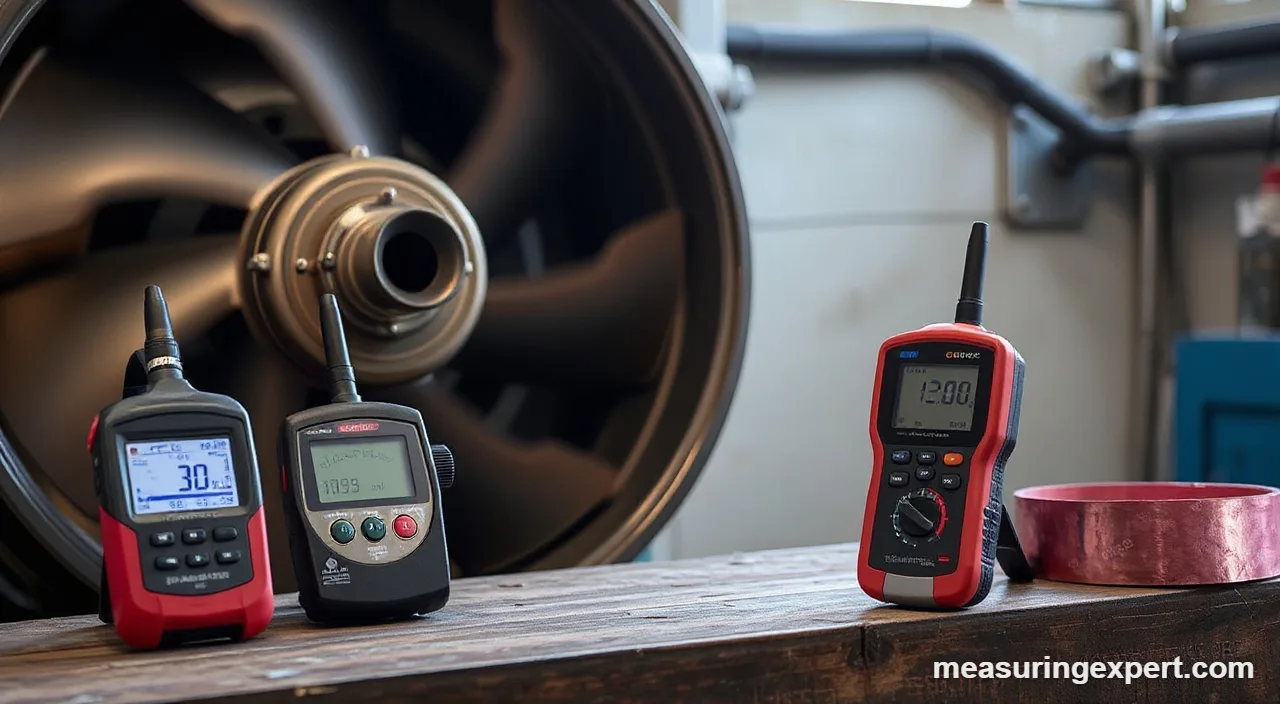
- True handheld use: each pick reads rpm from a rotating part by laser or contact, so mounted hour meters and dash gauges are out.
- Published range and accuracy: picks with clear rpm limits and an accuracy figure ranked higher.
- Measurement features: contact surface speed, revolution counting and a temperature check added value.
- Included accessories: reflective tape, wheels and adapters make a meter usable on day one.
For the spec details, we used the Extech RPM10 and Extech 461920 product pages, plus Extech’s photo and contact tachometer measurement guide on TEquipment.
Best Handheld Tachometer Types: Laser, Contact and Combo
Overall, handheld tachometers fall into three groups. Therefore, the best handheld tachometer for you depends on what the target looks like and whether you can reach it.
| Type | How it reads | Strength | Weakness |
|---|---|---|---|
| Laser (photo) | Counts reflections from tape on the part | No contact; safe distance | Needs tape and good aim |
| Contact | A tip or wheel touches the shaft or surface | Gives surface speed and length | Needs access to the part |
| Combo | Offers both modes in one body | One tool for most jobs | Larger and often costlier |
Clip-on inductive tachometers for small engines are a separate group, so we left them out of this list. However, they are worth a look for small-engine work.
Handheld Tachometer vs Dash Tachometer
Specifically, many shoppers who search for a tachometer want a gauge for a car or motorcycle dashboard. Instead, that is a mounted instrument, and it shows engine speed from the ignition or sensor signal. However, a handheld tachometer is different, because you carry it to the machine and read a rotating part directly.
Therefore, use a handheld meter on a lathe spindle, fan, pump or motor shaft. Otherwise, a dash gauge swap needs an in-vehicle tach, which this guide does not cover. Instead, look for an in-vehicle tach.
Reading Range and Accuracy on a Handheld Tachometer
In fact, three specs matter most: the rpm range, the accuracy and the working distance. Therefore, the table lists what the makers publish for our picks.
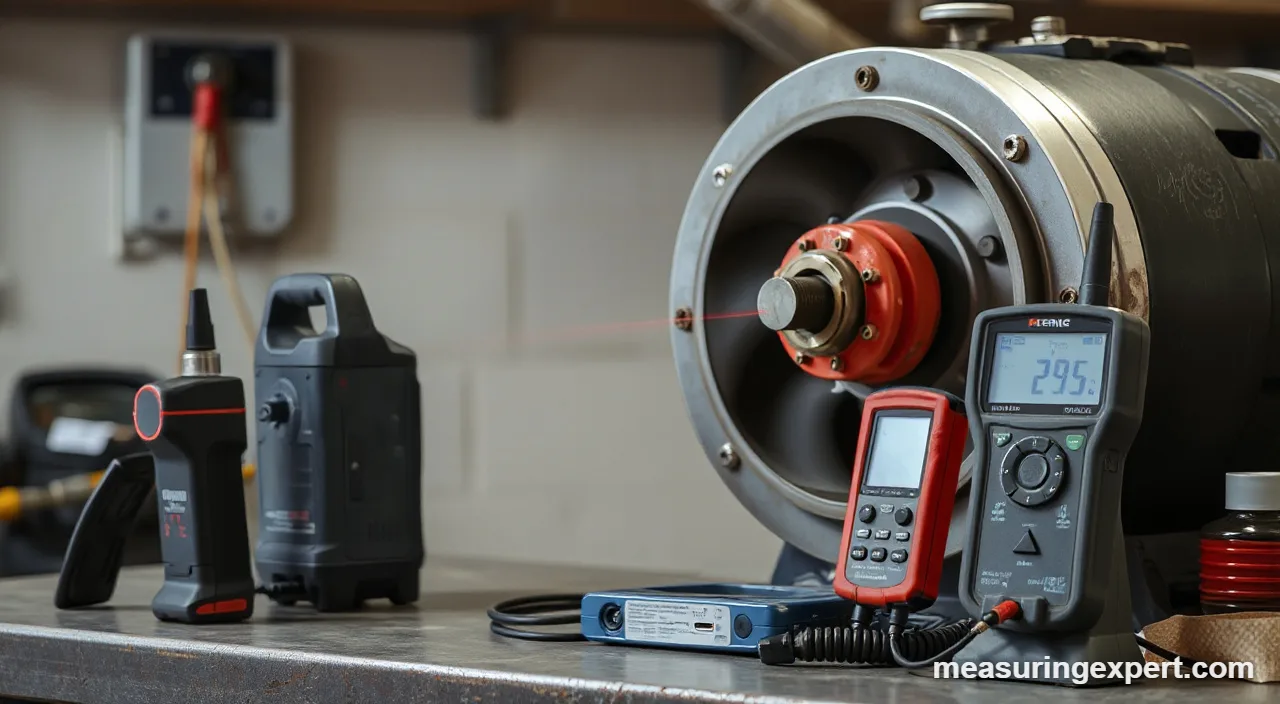
| Meter | RPM range | Accuracy | Distance (laser) |
|---|---|---|---|
| Extech RPM10 | Contact 0.5 to 20,000; photo 10 to 99,999 | +/-(0.05% + 1 digit) | Not listed |
| UNI-T UT372D | Contact 1 to 19,999; optical 1 to 99,999 | +/-0.02% +1 digit (retailer page) | 50 to 500 mm |
| Extech 461920 | Photo 2 to 99,999 | +/-0.05% | 1.6 ft (about 0.5 m) |
| Amprobe TACH-20 | Contact 19 to 19,999; non-contact 1 to 99,999 | +/-0.02% (distributor listing) | Up to 600 mm |
| Electronic Specialties PRO models | Up to 99,999 | +/-0.05% +1 digit | Listings conflict |
First, check that the range covers your slowest and fastest targets. For example, a meter that starts at 10 rpm cannot read a gearbox output turning at 5 rpm. Next, look at the accuracy statement. A percentage of reading is easier to compare than a fixed error in rpm.
RPM Math: Surface Speed, Hertz and Motor Speed
Overall, a tachometer gives rpm, but many jobs need a different unit. Here are the conversions you will use most.
- Surface speed: multiply pi, the diameter and the rpm. A 150 mm wheel at 3,000 rpm moves at about 1,414 m/min (23.6 m/s, or 4,638 ft/min).
- Hertz: divide rpm by 60. For example, 3,000 rpm equals 50 Hz.
- Radians per second: multiply rpm by 2 pi and divide by 60. So 3,000 rpm is about 314.2 rad/s.
Motor speed also follows the mains frequency and the number of poles. Also, synchronous speed in rpm equals 120 times the frequency divided by the number of poles. However, real induction motors run a little slower than this value because of slip. For example, a 4-pole motor on 60 Hz mains turns slightly under 1,800 rpm.
| Poles | Synchronous rpm at 60 Hz | Synchronous rpm at 50 Hz |
|---|---|---|
| 2 | 3,600 | 3,000 |
| 4 | 1,800 | 1,500 |
| 6 | 1,200 | 1,000 |
Thus, a reading far from these values is a useful clue, such as a slipping belt or a heavy load. For more on rotation and force, see our guide to torque in mechanical systems.
How to Use a Handheld Tachometer
So, these steps suit most laser and contact meters. Also, always follow your own tachometer’s manual first. Otherwise, you may miss a model-specific step.
- First, identify the target: a shaft end, a pulley, a fan hub or a flat rotating face.
- Next, choose the mode: use the laser on a taped surface, or fit the right contact tip for a shaft end or wheel.
- Then, for laser readings, stick a small square of reflective tape near the outer edge, and cover shiny metal with black tape or paint first.
- After that, aim the beam so it crosses the tape on every turn, and hold the meter steady at the distance the maker recommends.
- Alternatively, for contact readings, press the tip lightly and squarely against the rotating part, and keep your fingers clear.
- Finally, wait for the reading to settle, then record the rpm and the load condition.
- Afterward, compare the result with the expected speed from the nameplate, and repeat once to confirm.
Also, Extech’s guide adds that bright ambient light can interfere with the beam, so shading the target may help.
Do and Don’t With a Handheld Tachometer
What the Best Handheld Tachometer Still Cannot Tell You
Generally, a tachometer tells you how fast a part turns, and nothing more. In addition, it cannot find the cause of a vibration, an imbalance or a failing bearing. In addition, a stated accuracy is not a calibration certificate. If readings drive safety or quality decisions, send the meter for calibration at a set interval, as explained in our measurement tool calibration guide. Safety first: stop and lock out a machine before you reach into it, and ask a qualified technician if you are unsure. Otherwise, a small mistake can cause an injury.
Best Handheld Tachometer FAQ
What is the best handheld tachometer for most people?
The Extech RPM10 is the best handheld tachometer for most workshops, because it combines contact and laser RPM with an infrared thermometer. However, the Extech 461920 is the better choice if you only read reflective-tape targets.
What is the difference between a laser and a contact tachometer?
A laser (photo) tachometer reads speed from a distance by counting reflections from a piece of tape on the target. A contact tachometer touches the shaft or wheel with a tip. As a result, laser tachs suit moving or hard-to-reach parts, and contact tachs also give surface speed.
Can I use a handheld tachometer on a car engine?
Handheld meters read exposed rotating parts, so they suit shafts, fans, pulleys and motors. A dash tachometer is a different instrument that shows crankshaft speed from the engine’s signal. Therefore a handheld meter is not a replacement for a dash gauge.
How do I use reflective tape with a laser tachometer?
Stick a small square of tape on the rotating part, near the outer edge. If the part is shiny, cover it with black tape or paint first so only the tape reflects. Then aim the beam so it crosses the tape on every turn.
How far can a laser tachometer be from the target?
It depends on the model. Extech lists 1.6 ft (about 0.5 m) for the 461920, and the distributor listing for the Amprobe TACH-20 gives 600 mm. Bright light and a small tape square both shorten the practical distance.
How accurate are handheld tachometers?
The picks here list accuracy from +/-0.05% (Extech) to +/-0.02% (Amprobe, as listed by a distributor). In practice, accuracy depends on a good tape reflection, a steady aim and a calibrated meter.
Why does my tachometer read double or half the real speed?
The meter may count more than one reflection per turn, or it may miss some turns. Use a single clean tape square, check the aim, and compare the reading with the expected speed. For example, a 4-pole motor on 60 Hz mains should run a little under 1,800 rpm.
How do I convert RPM to surface speed?
Multiply the wheel or shaft circumference by the rpm. Surface speed equals pi times diameter times rpm, so a 150 mm wheel at 3,000 rpm gives about 1,414 m/min (4,638 ft/min). Contact tachs with a measuring wheel show this directly.
Do handheld tachometers need calibration?
Yes, if you rely on them for quality or safety records. Some makers sell NIST-certified versions, and a calibration lab can check yours against a reference. See our measurement tool calibration guide for the basics.
Is it safe to use a tachometer on a running machine?
Only with care. Keep hands, sleeves and cords clear of rotating parts, follow your site’s lockout and guarding rules, and prefer a non-contact reading when a guard or shaft end is hard to reach.
Bottom Line: The Best Handheld Tachometer to Buy
For most buyers, the Extech RPM10 is the best handheld tachometer. It reads rpm by contact and by laser, shows surface speed and checks temperature, all with a stated accuracy of +/-(0.05% + 1 digit). However, choose the UNI-T UT372D if you want stored readings and an app, and the Extech 461920 if you only read taped targets.