

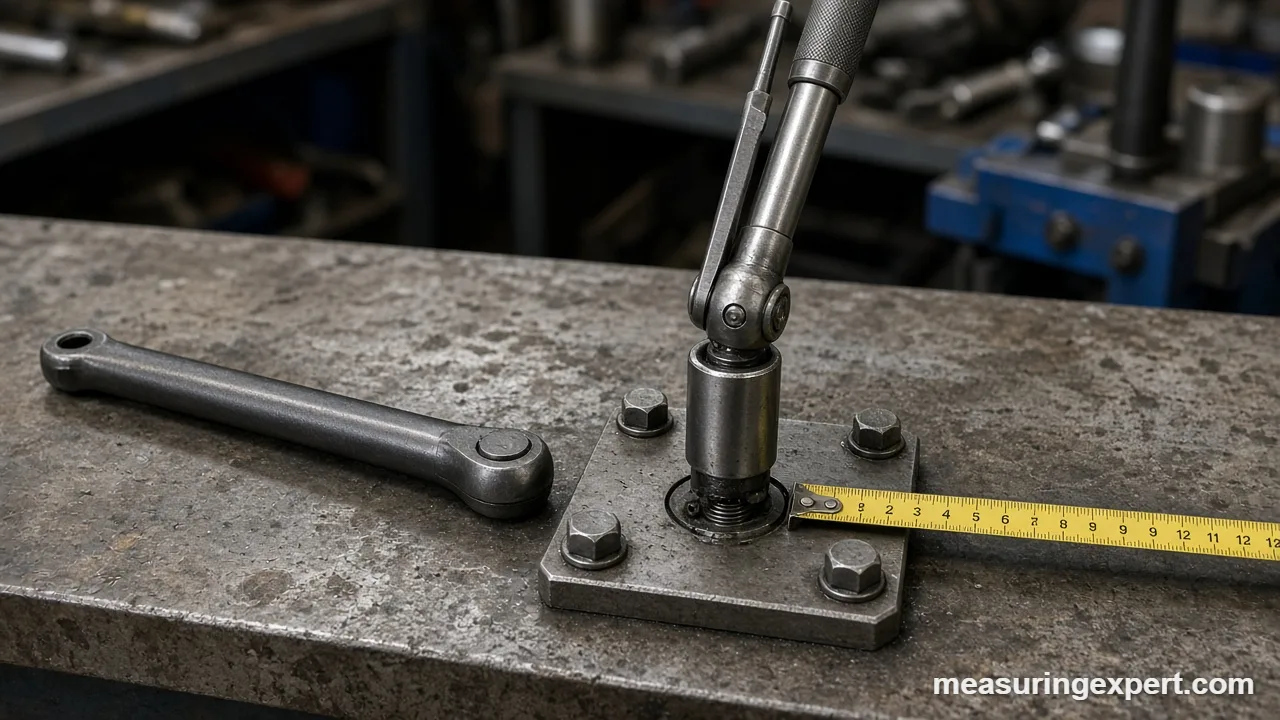
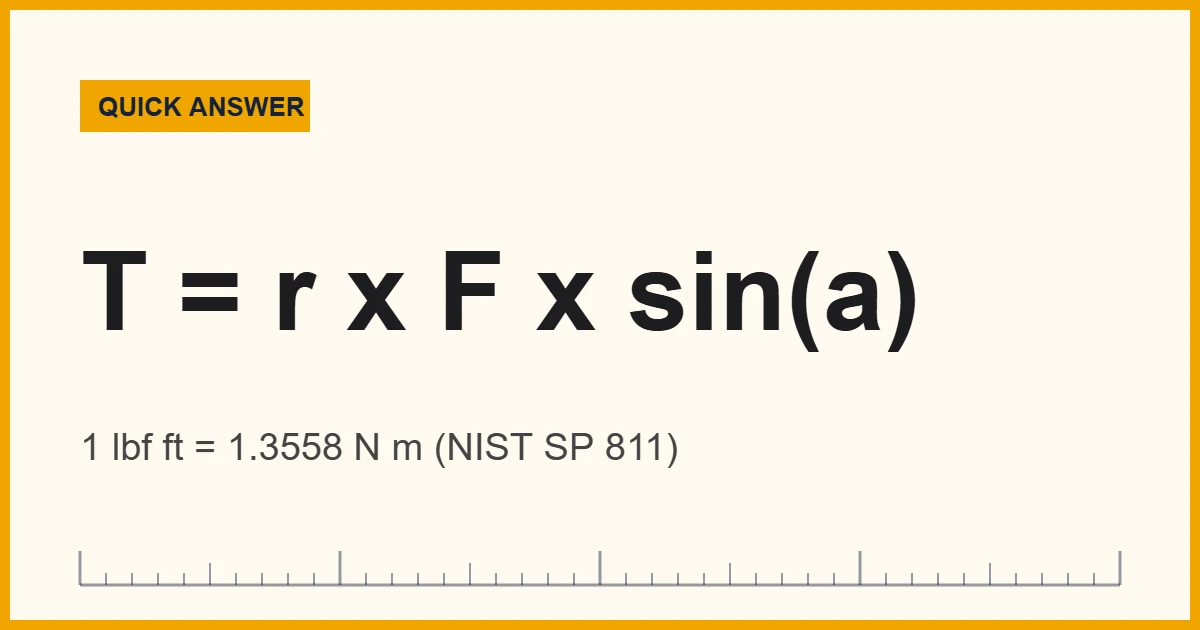
To calculate torque, multiply the force by the lever arm length and by the sine of the angle between them: tau = r x F x sin(theta). For example, 200 N pushed at a right angle on a 0.3 m wrench gives 60 N m, which is about 44.25 lbf ft, because 1 lbf ft equals 1.3558 N m.
Torque is a twisting force. It is what turns a bolt, spins a motor shaft, and lets a long breaker bar loosen a rusted lug nut that a short wrench cannot move. As a result, mechanics, engineers and DIYers meet it every day, usually as a number stamped in a service manual: “tighten to 80 lbf ft” or “25 N m”.
The good news is that you only need three numbers to calculate torque: how hard you push, how far from the pivot you push, and the angle of the push. After that, the math takes seconds. However, measuring torque in the real world is a separate job, and it calls for a torque wrench, a torque sensor or a dynamometer.
In short: torque equals force times distance when you push straight across the handle, and less than that when you push at an angle.
The units come from official definitions, not rules of thumb. For example, the US National Institute of Standards and Technology lists 1 pound-force foot as 1.355818 newton meters in its SP 811 conversion tables, and every conversion on this page uses that factor.
Below, you will first find a lever-arm converter, then the formula, unit tables, worked examples, the link between torque and power, and finally a step-by-step guide to measuring torque with a wrench.
Convert Your Lever Arm Before You Calculate Torque
Torque math only works when force and distance use matching units: newtons with meters, or pounds-force with feet. So, measure your wrench or lever from the center of the bolt to the middle of your hand, enter it below, and read it in meters or feet.
Then multiply the converted length by your force. For instance, a 12 in handle is 0.3048 m, so 100 N at a right angle gives 30.48 N m.
How to Calculate Torque: The Formula
Torque (the Greek letter tau) is the cross product of the lever arm and the force. So, for everyday work, that becomes one line:
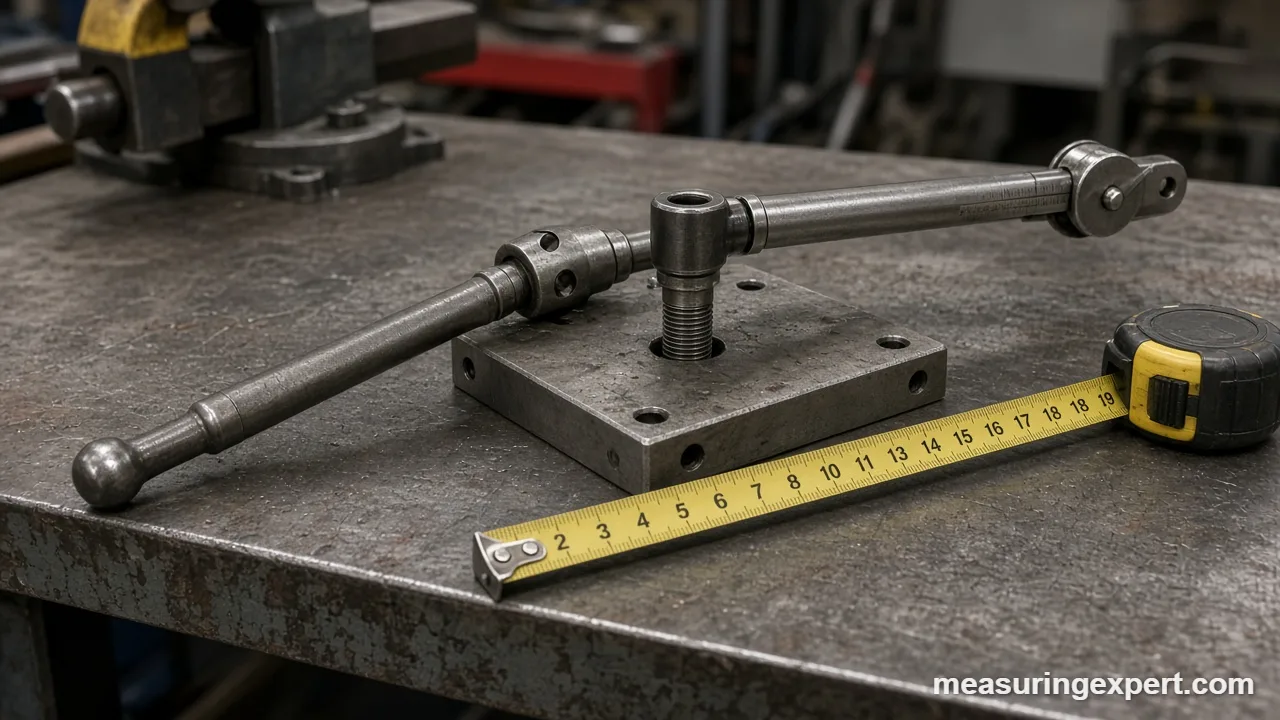
- r is the lever arm: the straight-line distance from the pivot (the bolt center) to where the force acts.
- F is the force you apply, in newtons (N) or pounds-force (lbf).
- theta is the angle between the lever arm and the direction of the force.
When you push at a right angle (90 degrees), sin(theta) equals 1, so the formula shrinks to tau = r x F. In fact, that is the case most torque specs assume. However, if you pull at 60 degrees, sin(60) is about 0.866, so you only get about 87% of the torque. Similarly, at 30 degrees you get half. Finally, pushing straight along the handle (0 degrees) produces no torque at all.
Another way to calculate torque is to use the perpendicular distance from the pivot to the line of the force (the moment arm). The result is the same, because that distance already equals r x sin(theta).
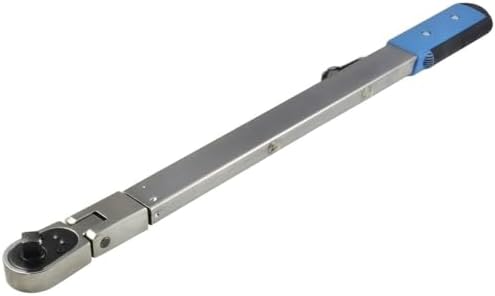
Recommended Torque Wrenches for Measuring Torque
A calculation tells you what torque a force should produce. A torque wrench, by contrast, tells you what torque you actually applied to a fastener. First, match the wrench range to your work: most car lug nuts sit in the middle of a 1/2 in drive wrench, while bike and small engine bolts need a 1/4 in or 3/8 in drive. Next, look for scales in both N m and lbf ft. Also, check that the maker states its accuracy and which standard it follows. The picks below are based on manufacturer specs and buyer reports, not our own testing.


As an Amazon Associate, Measuring Expert earns from qualifying purchases.
Key Takeaways
- Torque = lever arm x force x sin(angle); at 90 degrees it is simply arm x force.
- The SI unit is the newton meter (N m); in the US, however, lbf ft and lbf in are common.
- 1 lbf ft = 1.3558 N m, and 1 N m = 0.7376 lbf ft = 8.851 lbf in.
- Power (kW) = torque (N m) x rpm / 9549, so torque and speed together set power.
- Click, beam and digital torque wrenches measure applied torque; in contrast, sensors measure it on spinning shafts.
- An extension in line with the wrench changes the reading, so adjust the setting.
- Have a torque wrench checked by a calibration lab about once a year or every 5,000 cycles.
Torque Units: N m, lbf ft and lbf in
The newton meter is the SI unit of torque. Meanwhile, US service manuals mostly use pound-force feet (often written ft-lb or lb-ft) and, for small bolts, pound-force inches. However, torque in N m is not the same thing as energy in joules, even though the units look alike. For this reason, NIST and the BIPM recommend writing torque as N m, not J.
| Unit | Equals (N m) | Where you see it |
|---|---|---|
| 1 newton meter (N m) | 1 | SI, metric manuals, most digital wrenches |
| 1 pound-force foot (lbf ft) | 1.355818 | US car and truck specs, lug nuts |
| 1 pound-force inch (lbf in) | 0.1129848 | Small engines, bikes, electrical terminals |
| 1 ounce-force inch (ozf in) | 0.007061552 | Small motors, servos |
| 1 kilogram-force meter (kgf m) | 9.80665 | Older Japanese and European manuals |
N m to lbf ft Chart
Here is a quick N m to lbf ft chart, computed from the exact NIST factor and rounded to two decimals.
| Newton meters | Pound-force feet | Pound-force inches |
|---|---|---|
| 1 N m | 0.74 lbf ft | 8.9 lbf in |
| 5 N m | 3.69 lbf ft | 44.3 lbf in |
| 10 N m | 7.38 lbf ft | 88.5 lbf in |
| 20 N m | 14.75 lbf ft | 177.0 lbf in |
| 25 N m | 18.44 lbf ft | 221.3 lbf in |
| 50 N m | 36.88 lbf ft | 442.5 lbf in |
| 100 N m | 73.76 lbf ft | 885.1 lbf in |
| 150 N m | 110.63 lbf ft | 1,327.6 lbf in |
| 200 N m | 147.51 lbf ft | 1,770.1 lbf in |
| 300 N m | 221.27 lbf ft | 2,655.2 lbf in |
Going the other way, 25 lbf ft is 33.90 N m, 50 lbf ft is 67.79 N m, 80 lbf ft is 108.47 N m, and 100 lbf ft is 135.58 N m. For more on the metric unit itself, see our guide to what Nm means in measurement.
Worked Examples: Calculate Torque Step by Step
These examples use the same three inputs every time. So, once you have done one, the rest follow the same pattern.
Example 1: Calculate torque on a metric wrench
You push with 200 N on a wrench, 0.30 m from the bolt, square to the handle. Therefore tau = 0.30 x 200 x sin(90) = 60 N m. Then, dividing by 1.3558 gives about 44.25 lbf ft.
Example 2: The same push at an angle
Next, suppose the push is at 60 degrees to the handle. Since sin(60) is about 0.866, tau = 0.30 x 200 x 0.866 = 51.96 N m. In other words, the awkward angle costs you about 8 N m.
Example 3: Calculate torque in US units
Now consider a 40 lbf pull on an 18 in breaker bar. First convert 18 in to 1.5 ft. Then tau = 1.5 x 40 = 60 lbf ft, which is about 81.35 N m.
Example 4: Force needed for a lug nut spec
Suppose the manual says 100 lbf ft and your wrench is 18 in long. To find the force, rearrange the formula: F = tau / r = 100 / 1.5 = 66.7 lbf. Likewise, in metric that is 135.58 N m over 0.4572 m, or about 296.5 N.
Example 5: Torque with an extension
A crowfoot or extension that sticks out in line with the handle makes the lever longer. To calculate torque settings in this case, use: setting = target x L / (L + E), where L is the wrench length and E is the added length. For instance, with a 50 lbf ft target, a 15 in wrench and a 3 in crowfoot, set the wrench to 50 x 15 / 18 = 41.7 lbf ft. However, if the extension points at 90 degrees to the handle instead, no correction is needed.
Torque and Power: How RPM Fits In
Torque alone does not tell you how much work a motor or engine does per second. Power does, because power is torque times angular speed: P = tau x omega, with omega in radians per second. Because one revolution is 2 x pi radians and a minute has 60 seconds, the practical shop formulas are:
P (kW) = T (N m) x rpm / 9549P (hp) = T (lbf ft) x rpm / 5252
The constant 9549 is 60,000 / (2 x pi), and 5252 is 33,000 / (2 x pi). For example, a motor making 300 N m at 3,000 rpm delivers 300 x 3,000 / 9549 = 94.2 kW. Also, that same torque is about 221.3 lbf ft, which gives 126.4 hp. Similarly, if you know the power and speed, you can calculate torque by turning the formula around: T = P x 9549 / rpm.
| People often confuse | What it really is | Unit |
|---|---|---|
| Torque | A twisting force about an axis | N m, lbf ft |
| Work or energy | Force moved through a distance | J (joule), ft lbf |
| Power | Work done per second (torque x angular speed) | W, kW, hp |
| Clamp force (preload) | The tension a tightened bolt creates | N, lbf |
In particular, that last row matters. After all, torque is only a stand-in for bolt tension, which is what really holds parts together. For a deeper look at how materials respond to that load, see how to measure stress and strain in materials.
How to Measure Torque With a Torque Wrench
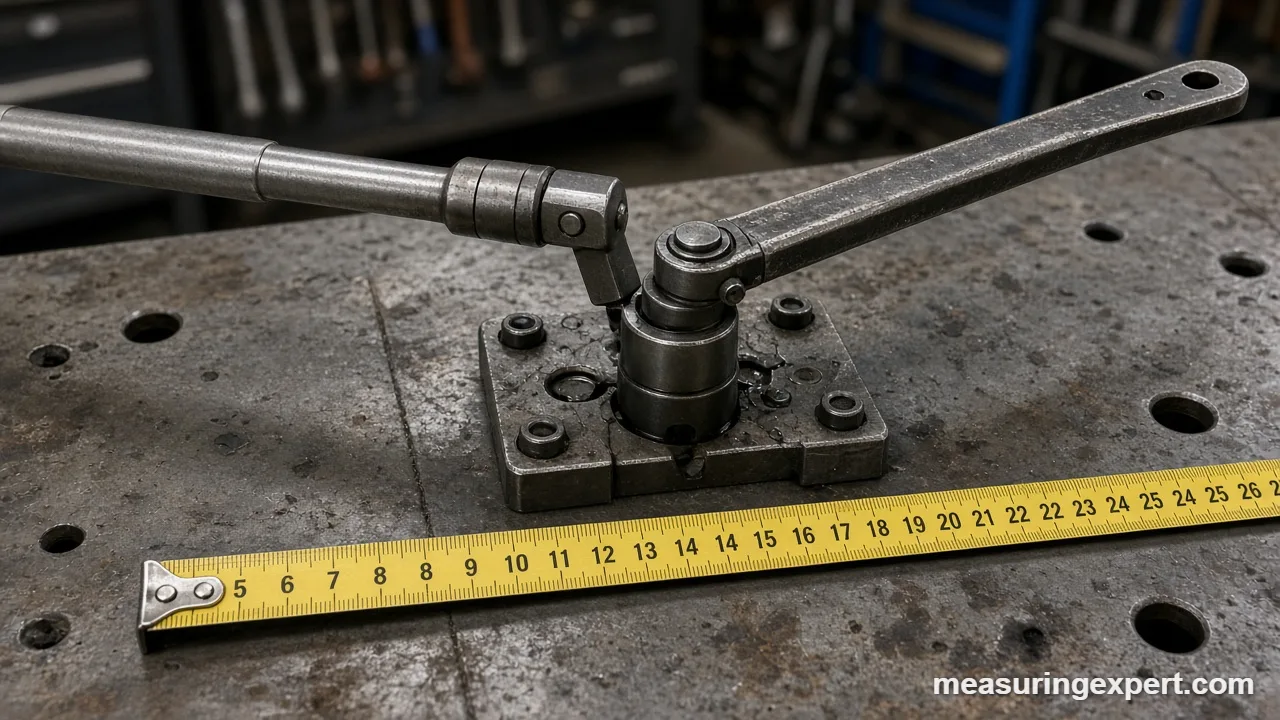
Once you calculate torque on paper, the next job is to apply it accurately. These steps fit a click-type wrench, the most common kind; beam and digital wrenches follow the same idea.
- Find the spec. Look up the torque value and units in the service manual, and note whether threads should be dry or lubricated.
- Clean the threads. Remove dirt and old thread locker, because friction changes how much torque becomes clamp force.
- Set the wrench. Release the handle lock, turn it until the main and micrometer scales show the value, then lock it.
- Snug the fastener first. Run the bolt or nut down with a regular wrench first, without reaching the final value.
- Pull smoothly. Hold the handle at its grip mark and pull square to the handle in one slow, steady motion.
- Stop at the click. Release as soon as the wrench clicks or the digital unit beeps; do not pull again.
- Follow the pattern. On wheels and flanges, tighten in a star pattern and in two or three stages.
- Store it at the lowest setting. After the job, wind a click wrench down to its minimum to relax the spring.
Which Tool Should You Use to Measure or Calculate Torque?
In general, hand tools measure the torque you apply to a fastener. Torque sensors and transducers, on the other hand, measure torque on a shaft, a motor or a test rig, often while it spins.
| Tool | How it works | Good for | Watch out for |
|---|---|---|---|
| Click (micrometer) wrench | A spring-loaded cam releases with a click at the set value | Cars, bikes, general shop work | Store at lowest setting; needs regular calibration |
| Beam wrench | A pointer shows how far the main beam bends | Cheap, simple, no spring to wear | You must read the scale square-on while pulling |
| Digital (electronic) wrench | A strain gauge reads torque and shows it on a screen | Unit switching, peak hold, angle mode on some models | Batteries; usually costs more |
| Torque screwdriver | Slips or clicks at a set value | Electronics, firearms scopes, small screws | Low range only |
| Rotary torque sensor (transducer) | Strain gauges on a shaft send a signal through slip rings or wireless telemetry | Motors, gearboxes, test benches | Needs a readout and careful alignment |
| Reaction (static) sensor | Measures twisting on a fixed mount | Torque wrench testers, bench checks | Measures only when parts do not spin |
| Dynamometer | Loads an engine or motor and reads torque at each speed | Engine and motor performance curves | Professional equipment |
For example, a torque wrench tester is simply a reaction sensor with a display. Shops use one to check wrenches between full calibrations, because a wrench that has been dropped can drift without any sign.
Static vs Dynamic Torque
Static torque acts on something that is not turning yet, like a seized nut or a lid you are twisting. Dynamic torque, on the other hand, acts on something that is already spinning, like a drive shaft or a fan. Hand wrenches handle the first kind. In contrast, dynamic torque needs a rotary sensor or a dynamometer, because the reading changes with speed and load. Meanwhile, breakaway torque, the torque at which a stuck fastener first moves, sits between the two and is usually higher than the turning torque that follows.
Do and Don’t When You Measure Torque
Do
- Check the units on the spec and the wrench.
- Pull at the grip mark, square to the handle.
- Recheck the setting before each new spec.
- Correct for in-line extensions and crowfoot adapters.
- Keep a log of calibration dates.
Don’t
- Use the wrench below about 20% of its range.
- Add a cheater pipe to a torque wrench.
- Jerk the handle or pull past the click.
- Lubricate threads the spec says to leave dry.
- Assume ft-lb and in-lb are interchangeable.
Honest Limits When You Calculate Torque
The formula is exact, but the inputs rarely are. To begin with, your hand position on the handle can shift the lever arm by a centimeter or two, so the result can change a few percent. In addition, most click wrenches are only specified to around plus or minus 4% of the reading within their working range, and the ISO 6789-1 standard sets the rules makers test against. As a result, a reading of 100 N m really means “roughly 96 to 104 N m”.
However, there is a bigger catch. Most of the torque you apply goes into friction under the bolt head and in the threads, and only a small share becomes clamping force. Because of that, lubricant, plating and dirt can change the final bolt tension a lot even when the wrench reads perfectly. For this reason, critical joints use torque-plus-angle methods or measure bolt stretch directly.
When to Call a Professional
In general, for lug nuts, spark plugs and bike parts, a decent wrench and the manual are enough. However, some jobs deserve an expert. First, cylinder heads, connecting rods and other torque-to-yield bolts need exact angle steps and often new bolts. Next, wheels on trucks, trailers and aircraft follow strict procedures. Finally, structural steel and pressure equipment use specified bolting methods. In that case, use a qualified mechanic or engineer, and send your torque wrench to an accredited calibration lab rather than guessing whether it still reads true.
Frequently Asked Questions
How do you calculate torque from force and distance?
Multiply the force by the distance from the pivot, then by the sine of the angle between them. At a right angle the sine is 1, so 50 N on a 0.4 m lever gives 20 N m.
What is the formula for torque?
Torque equals r x F x sin(theta), where r is the lever arm, F is the force and theta is the angle between them.
How many N m is 1 lbf ft?
One pound-force foot equals about 1.3558 N m. Conversely, 1 N m equals about 0.7376 lbf ft or 8.851 lbf in.
How do you calculate torque from horsepower and RPM?
Use T (lbf ft) = hp x 5252 / rpm. In metric, use T (N m) = kW x 9549 / rpm. For example, 100 kW at 4,000 rpm is about 238.7 N m.
Can you calculate torque without a torque wrench?
Yes. For example, hang a known weight or use a luggage scale on a lever of known length, then multiply force by distance. It works for estimates; however, a torque wrench is far more reliable for real fasteners.
How do I calculate torque settings when using an extension?
For an extension in line with the handle, set the wrench to target x L / (L + E), where L is the wrench length and E is the extension length. At 90 degrees to the handle, no correction is needed.
Is ft-lb the same as lb-ft?
For torque, yes. In other words, both mean pound-force feet. Some engineers use ft-lb for energy and lb-ft for torque, so check the context.
What is the difference between static and dynamic torque?
Static torque acts on a part that is not turning, such as a bolt being tightened. In contrast, dynamic torque acts on a spinning part, such as a motor shaft, and needs a rotary sensor to measure.
How accurate is a click torque wrench?
Many click wrenches are specified to about plus or minus 4% of the reading within their working range. Therefore, check the maker’s spec sheet and have it calibrated regularly.
How often should a torque wrench be calibrated?
A common rule is once a year or every 5,000 cycles, whichever comes first, and right away after a drop. However, follow the maker’s schedule if it differs.
Calculate Torque: The Bottom Line
To calculate torque, multiply force by lever arm and by the sine of the angle. At a right angle that is simply force times distance, and 1 lbf ft is 1.3558 N m. Add rpm and you also get power, using the 9549 or 5252 constants.
Finally, remember that a calculation is only the plan. A calibrated torque wrench, used smoothly and square to the handle, is what puts that number on the bolt. So convert your lever arm with the tool above, check your units twice, and follow the manual for anything safety-critical.
1 thought on “How to Calculate Torque and Measure It: Formula, Units and Examples”