

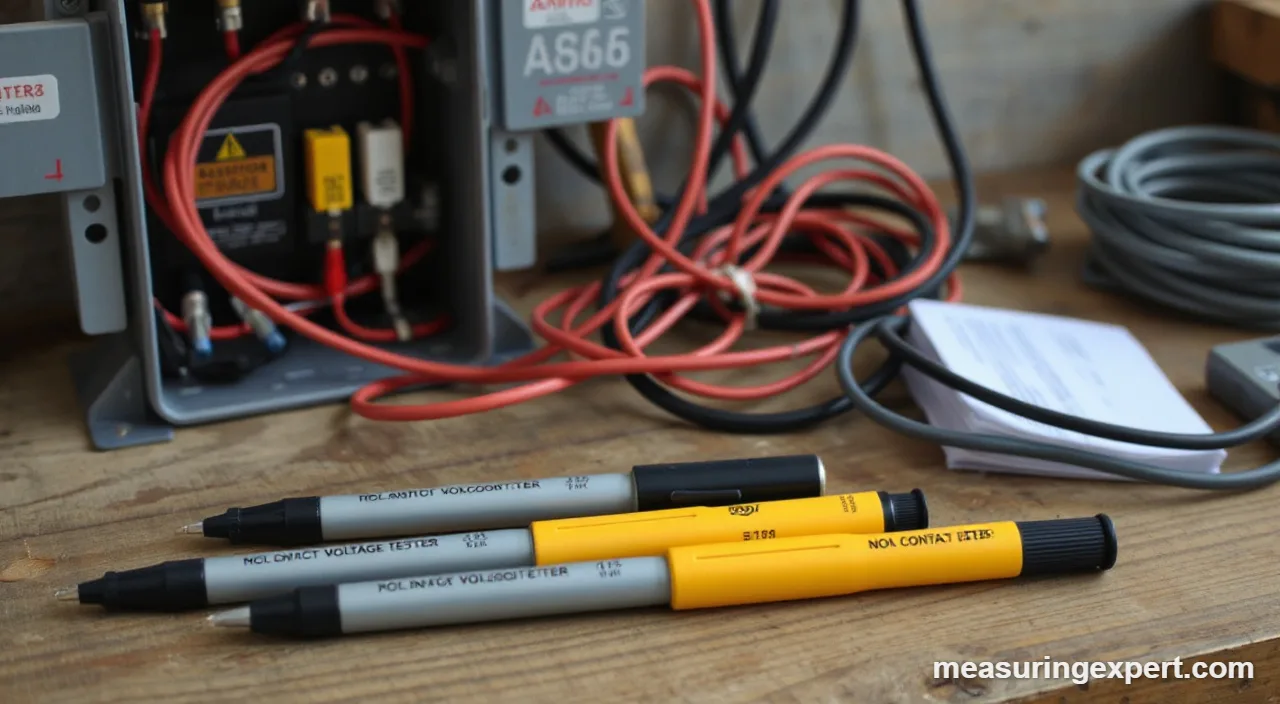
The best non-contact voltage tester for most people is the Klein NCVT-3P, a CAT IV 1000 V pen that senses 12 to 1000 V AC in two ranges. However, the right pick depends on your wiring: low-voltage work needs a pen that starts near 12 to 24 V, and hazardous or wet sites call for the CEM or Bosch models.
In short: choose the Klein NCVT-3P for general use, the Fluke 1AC II for a simple self-testing pen, and the Bosch GVD1000-17 for rugged work.
As an Amazon Associate, Measuring Expert earns from qualifying purchases. Our picks are based on research, specifications and owner feedback, not paid placement.
Best Overall

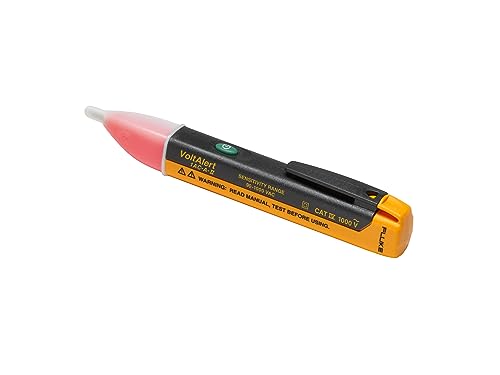
Simplest Pick
Rugged Pick

Quick Answer: Best Non-Contact Voltage Tester by Job
- Best all-rounder: Klein NCVT-3P, with two ranges from 12 to 1000 V AC.
- Simplest pen: Fluke 1AC II, which has no settings and a continuous self-test.
- Wet or dusty sites: Bosch GVD1000-17, sealed to IP67.
- Hazardous-area marking: CEM AC-15EX, which lists an ATEX Ex ib marking.
- Tight spaces and dark panels: Southwire 40126N, with two flashlights.
- HVAC work: Klein NCVT-4IR, which adds an infrared thermometer.
On This Page
- Best Non-Contact Voltage Tester Comparison Table
- The 6 Best Non-Contact Voltage Tester Picks, Reviewed
- How We Chose the Best Non-Contact Voltage Tester
- How the Best Non-Contact Voltage Tester Senses Voltage
- Voltage Range and CAT Rating: Matching a Non-Contact Voltage Tester to Your Wiring
- How to Use the Best Non-Contact Voltage Tester Safely
- Do and Don’t When Checking for Voltage
- Care and Battery Checks for Your Voltage Pen
- What the Best Non-Contact Voltage Tester Still Cannot Do
- Best Non-Contact Voltage Tester FAQ
- Bottom Line: The Best Non-Contact Voltage Tester to Buy
Best Non-Contact Voltage Tester Comparison Table
Each pick has one row below. Then the reviews that follow explain the specs and the trade-offs.
| # | Product | Best For | Standout Feature | Amazon |
|---|---|---|---|---|
| 1 | Klein Tools NCVT-3P Dual Range Pen | Homeowners and pros wanting one dual-range pen | 12 to 1000 V AC, CAT IV 1000 V, flashlight | View |
| 2 | Fluke 1AC II VoltAlert | No-setting pen with continuous self-test | 90 to 1000 V AC, CAT IV 1000 V, Voltbeat self-test | View |
| 3 | Bosch GVD1000-17 | Rugged pen with 24 V mode | IP67, vibration alert, 24 to 1000 V AC | View |
| 4 | CEM AC-15EX | Pen with ATEX marking and IP67 | 12 to 1000 V AC, ATEX Ex ib marking, IP67 | View |
| 5 | Southwire 40126N Dual Range Tester | Dual flashlights and 24 V range | 24 to 600 V AC, two flashlights, CAT IV 600 V | View |
| 6 | Klein Tools NCVT-4IR with Infrared Thermometer | NCV pen plus infrared thermometer | 12 to 1000 V AC, -30 to 250 C IR reading, laser pointer | View |
The 6 Best Non-Contact Voltage Tester Picks, Reviewed
First, this list covers pen-style detectors only. For outlet testers, breaker finders and continuity testers, see our electric circuit tester guide. For actual voltage readings, our digital multimeter picks are the right next tool.
Best Overall
1. Klein Tools NCVT-3P Dual Range Pen
Best for: Homeowners and electricians who want one pen that covers both 12 V and 120/240 V work.
The Klein NCVT-3P is the best non-contact voltage tester for most people because it combines two sensitivity ranges with a safety rating you can trust. Standard mode covers 70 to 1000 V AC, which suits outlets, switches and panels. Low-voltage mode drops to 12 to 70 V AC, so it can also find power on doorbell, thermostat and landscape lighting wiring.
In addition, the tip shows a green light when it sees no voltage, and a beep and light signal when it does. Also, Klein built in a flashlight that works on its own, which helps when you are reaching into a dark box.
- Range: 12 to 1000 V AC overall (12 to 70 V low mode, 70 to 1000 V standard mode)
- Frequency range 50 to 500 Hz; rated CAT IV 1000 V
- Visual and audible alerts, with a green light for no voltage
- Two AAA batteries included; Klein lists 125 hours of battery life and auto power-off
- Drop rating 6.6 ft (2 m); 5.7 in (14.5 cm) long and 1.9 oz (54 g)
Pros
- Two ranges cover mains and low-voltage wiring
- CAT IV 1000 V rating
- Independent flashlight
Cons
- Shows presence only, not a voltage value
- Klein lists no ingress rating on the page we opened
- Auto power-off means you must wake it before each check
Skip it if: you want a signal-strength display or an infrared thermometer, because this pen has neither.
Best for Simplicity and Self-Test
2. Fluke 1AC II VoltAlert
Best for: Pros and cautious DIYers who want a no-setting pen from a long-standing test-tool brand.
Overall, Fluke’s 1AC II is the simplest pen on this list. There is no range switch to forget, because it has one job: warn you when a 90 V or higher AC field is present. Meanwhile, a red LED lights at the tip, and the pen beeps unless you turn the beeper off.
Moreover, Fluke says the pen runs a continuous self-test it calls Voltbeat. That feature matters because the biggest risk with any pen is trusting a dead one. However, the trade-off is sensitivity. Its 90 V threshold therefore means low-voltage control wiring will not trigger it, so see our electric circuit tester guide for how it fits into a wider kit.
- Detection from about 90 V to 1000 V AC (Fluke also sells a 200 V version and a 20 to 90 V version)
- Rated CAT IV 1000 V; frequency range 45 to 405 Hz
- Red tip LED plus a beeper that can be switched off
- Two AAA alkaline batteries included
- Two-year warranty; the datasheet we opened gives no drop rating
Pros
- Nothing to set, so fewer user mistakes
- Continuous self-test
- Two-year warranty
Cons
- Will not sense 12 V to 24 V wiring
- No flashlight
- Drop rating is not published on the datasheet
Skip it if: you work on thermostat or doorbell circuits, since a 90 V threshold is too high for them.
Best Rugged Pick
3. Bosch GVD1000-17
Best for: Tradespeople who work outdoors or in wet, dusty spaces and want a 24 V mode.
Bosch built the GVD1000-17 for jobsite abuse. First, its sealed body carries an IP67 rating, which means dust-tight and protected against temporary immersion. In addition, the housing is reinforced with TPE and rated for drops of about 6 ft (2 m).
Furthermore, you pick between two ranges: 24 to 1000 V AC for sensitive work and 90 to 1000 V AC for normal mains checks. Alerts come as a color LED (green, orange or red), sound and vibration. As a result, you still get a warning when noise or poor light hides the display. Finally, Bosch lists an automatic self-test every five seconds.
- Ranges: 24 to 1000 V AC and 90 to 1000 V AC; rated CAT IV 1000 V
- IP67 sealing; TPE-reinforced housing, about 6 ft (2 m) drop rating
- Green, orange and red LED plus audio and vibration alerts
- Self-test about every 5 seconds; built-in flashlight
- Two AAA batteries included; one-year warranty, extended a year if registered within eight weeks
Pros
- IP67 sealing for wet and dusty sites
- Vibration alert helps in loud shops
- A 24 V sensitive range
Cons
- Longer and bulkier than a slim pen
- Alerts rely on batteries for sound and vibration
- Warranty is one year unless you register it
Skip it if: you want the lowest possible threshold, since the 24 V mode starts higher than 12 V pens.
Best for Hazardous-Area Marking
4. CEM AC-15EX
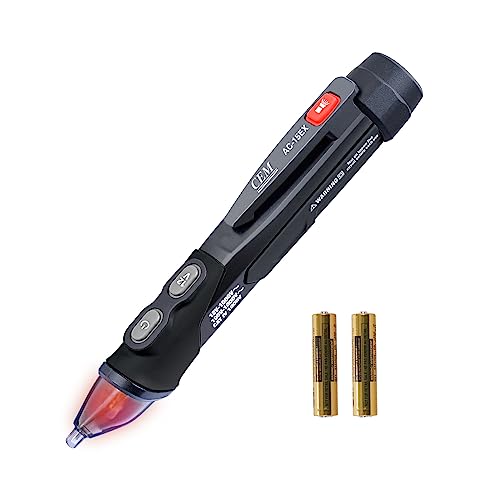
Best for: Technicians who need a pen marked for potentially explosive atmospheres.
CEM sells the AC-15EX as a dual-range pen with an explosion-protection marking. For example, the datasheet we opened lists the conformity code II 2 G Ex ib op is IIB T4 Gb under ATEX certificate Presafe 17 ATEX 9668X. The page does not call the pen explosion-proof, so read the certificate before you use it in a classified area.
On the other hand, most home users will never need that marking. For them the useful parts are the two ranges and the clear indicators. First, hold the 12 V button to drop into low-voltage mode, where the green light turns yellow. Also, three beeps and a dark green light warn that the battery is low.
- High range 100 to 1000 V AC; low range 12 to 1000 V AC with the button held
- 50/60 Hz; rated CAT IV 1000 V, double insulated
- IP67 when the battery cap is fitted correctly; operating range 0 to 50 C (32 to 122 F)
- Flashlight that shuts off after about five minutes
- Two AAA batteries; three beeps signal a low battery
Pros
- 12 V low range plus a 100 V standard range
- Hazardous-area marking is listed
- IP67 sealing
Cons
- Marking details need checking against the certificate
- Needs a button hold for the low range
Skip it if: you want a pen with a latching low-voltage mode, because this one needs the button held.
Best for Dark Spaces
5. Southwire 40126N Dual Range Tester

Best for: Electricians who often work in attics, crawl spaces and panel interiors.
The Southwire 40126N has two lights, a high-power rear light and a forward-facing light. In addition, its two ranges cover 24 to 600 V AC and 100 to 600 V AC, and a yellow LED shows when low-voltage mode is on.
However, the ceiling is lower than the Klein, Bosch and CEM pens. Southwire rates this tester CAT IV 600 V, and it detects up to 600 V. Still, that is fine for homes and light commercial work, but not for 480 V-class gear on a 1000 V rating. We matched the Amazon listing to this model by its title, which mentions dual flashlights and CAT IV 600, so confirm the model number on the page.
- Ranges: 24 to 600 V AC and 100 to 600 V AC
- Rated CAT IV 600 V and listed by UL and CUL
- Green ready light, flashing red light with beeper for voltage, yellow light for low-voltage mode
- Two flashlights; auto power-off after 5 minutes of inactivity
- 6.23 in (15.8 cm) long and 0.16 lb (0.07 kg); battery type not stated on the page
Pros
- Two flashlights
- Low range starts at 24 V
- UL and CUL listed
Cons
- 600 V ceiling
- Battery type not stated on the maker page
- Low mode is a button toggle
Skip it if: you service equipment above 600 V, because the detection range ends there.
Best for HVAC
6. Klein Tools NCVT-4IR with Infrared Thermometer

Best for: HVAC techs and facility staff who want voltage and surface temperature in one pocket tool.
The NCVT-4IR adds a spot infrared thermometer to a standard NCV pen. Specifically, Klein lists a 4:1 distance-to-spot ratio and a range of -22 to 482 F (-30 to 250 C), with 0.1 degree resolution. Also, a laser pointer and backlit LCD help you aim at a motor housing, duct or breaker lug.
Note that this Amazon listing is a bundle that adds a Klein 32614 precision screwdriver set. Therefore check what ships with the pen when you order. In addition, Klein does not publish an accuracy figure for the thermometer on its product page, so treat readings as a quick screen and confirm critical temperatures with a contact probe.
- Voltage range 12 to 1000 V AC, 50 to 500 Hz; rated CAT IV 1000 V
- IR range -22 to 482 F (-30 to 250 C), 4:1 spot ratio, 0.1 degree resolution
- IP54; 6.6 ft (2 m) drop rating
- Two AAA batteries; about 134 hours average, 64 hours of continuous IR use
- 6.25 in (15.9 cm) long and 2 oz (57 g)
Pros
- Voltage and temperature checks in one tool
- Backlit LCD and laser pointer
- CAT IV 1000 V rating
Cons
- IR accuracy is not published
- Listing is a bundle, so verify the contents
- Larger than a basic pen
Skip it if: you only need voltage detection, because the thermometer adds cost you will not use.
How We Chose the Best Non-Contact Voltage Tester
We did not test these pens ourselves. Instead, we compared manufacturer pages, datasheets and listings, and we kept only specs we could confirm. Several otherwise good pens could not be matched to a working Amazon listing, so this guide has six picks rather than eight.
- Stated safety rating: a published CAT rating ranked above an unrated pen.
- Range and sensitivity: pens with a published low-voltage threshold scored higher.
- Self-test and alerts: we favored pens that check themselves and signal in more than one way.
- Distinct uses: general, simple, rugged, hazardous-area, lighting and HVAC, with no more than two models per brand.
For the safety guidance, we used the Electrical Construction & Maintenance article on the benefits and drawbacks of noncontact voltage testers, plus the Klein NCVT-3P and Bosch GVD1000-17 product pages.
How the Best Non-Contact Voltage Tester Senses Voltage
A non-contact voltage tester detects the electric field around an energized AC conductor. In practice, the pen’s sensor acts like one plate of a capacitor and the wire acts like the other. This is called capacitive coupling, and it lets the pen sense a field through insulation without touching metal.
The key point is what the pen reports. It tells you that a field is present, but it does not display volts, and it cannot separate a 24 V signal from a 240 V one. For a number, you need a multimeter, as covered in our digital voltmeter guide.
Insulation thickness, distance from the source, battery condition and nearby energized wires all change what the pen senses. Consequently, a pen can stay quiet on a live wire, or beep on a dead one that sits beside a live cable.
Voltage Range and CAT Rating: Matching a Non-Contact Voltage Tester to Your Wiring
Two specs decide whether a pen fits your wiring: its detection threshold and its safety category. The table shows how the pens in this guide compare.
| Pen | Detection range (AC) | Safety rating |
|---|---|---|
| Klein NCVT-3P | 12 to 70 V low mode; 70 to 1000 V standard | CAT IV 1000 V |
| Fluke 1AC II | About 90 to 1000 V | CAT IV 1000 V |
| Bosch GVD1000-17 | 24 to 1000 V or 90 to 1000 V | CAT IV 1000 V |
| CEM AC-15EX | 12 to 1000 V low; 100 to 1000 V standard | CAT IV 1000 V |
| Southwire 40126N | 24 to 600 V or 100 to 600 V | CAT IV 600 V |
| Klein NCVT-4IR | 12 to 1000 V | CAT IV 1000 V |
First, think about the lowest voltage you need to find. For example, a doorbell or thermostat circuit runs at 24 V or less, so a pen with a 90 V threshold will stay silent there. Next, think about the highest voltage you will meet. A 1000 V rating leaves more margin than a 600 V one.
The category number matters because it describes where in an electrical system the tool is meant to be used. CAT IV covers the origin of an installation, such as the service entrance, and CAT III covers distribution wiring such as panels and outlets. A CAT IV rating therefore gives you headroom for the work most people do. Our multimeter guide explains the same ratings in more depth.
How to Use the Best Non-Contact Voltage Tester Safely
These steps suit most pens. However, always follow your own tester’s manual first.
- Check the tester on a known live source, such as an outlet you have verified with a multimeter, and confirm it beeps and lights up.
- Next, turn off the circuit at the breaker or switch, and keep your lockout and tagout steps in place.
- Select the right range: use low-voltage mode for 12 to 24 V wiring and standard mode for 120 or 240 V.
- Then hold the tip against or close to the wire, outlet slot or terminal you want to check, and keep your fingers behind the finger guard.
- Watch the light and listen for the beep. No signal means no field was sensed, which does not yet prove the circuit is dead.
- Finally, confirm the result with a multimeter across the exact points you plan to touch.
- Test the pen on the known live source again to prove it still works, then start the job.
Similarly, the same test-before-you-trust habit applies to every instrument you own. For more on keeping tools accurate, see our guide to measurement tool calibration.
Do and Don’t When Checking for Voltage
Care and Battery Checks for Your Voltage Pen
Most failures come from weak batteries. Therefore, replace the two AAA cells at the first sign of a dim light or a missing beep, and remove them if you store the pen for months. In addition, keep the tip clean and dry, so debris cannot build up around the sensor.
Finally, retire any pen that has taken a hard fall.
What the Best Non-Contact Voltage Tester Still Cannot Do
In short, a pen is a screening tool. It cannot measure voltage, it cannot prove a circuit is de-energized, and it cannot replace lockout and tagout. In addition, nearby energized conductors can fool it. Safety first: if a job involves service panels, high-voltage equipment or anything you do not fully understand, hire a licensed electrician. Therefore, never rely on a pen alone when your hands are going near bare conductors.
Best Non-Contact Voltage Tester FAQ
What is the best non-contact voltage tester for home use?
The Klein NCVT-3P is the best non-contact voltage tester for most homes. It covers 12 to 1000 V AC, so it works on outlets and on low-voltage wiring, and it has a CAT IV 1000 V rating.
How does the best non-contact voltage tester work?
It senses the electric field around an energized AC conductor through capacitive coupling, so it never has to touch metal. As a result, it shows only that a field is present. It does not measure the voltage.
Can the best non-contact voltage tester prove a wire is dead?
No. A silent pen is not proof of a de-energized circuit. Insulation thickness, distance, weak batteries and nearby conductors can all reduce sensitivity, so confirm with a multimeter and follow your lockout procedure.
Why does my voltage pen beep on a wire that is off?
Because of capacitive coupling, nearby energized wires can couple a field into the wire you are checking. Moreover, a pen set to a low-voltage range reacts to weaker fields. Move the tip away, switch to the standard range and test again.
Which voltage range should the best non-contact voltage tester have?
First, pick a pen with a low range near 12 to 24 V if you work on doorbells, thermostats or landscape lighting. A pen that starts at 90 V suits mains-only work, but it will miss low-voltage circuits.
Can a voltage pen detect DC voltage?
The pens in this guide are specified in volts AC, so they are not meant for DC circuits such as car or solar wiring. Therefore, use a multimeter for DC.
What does CAT IV 1000 V mean on a voltage pen?
In short, it is a measurement category and voltage rating from the safety standard for test equipment. CAT IV covers the origin of an installation, such as the service entrance, and the 1000 V figure is the highest working voltage for that category. A CAT IV 1000 V pen carries a suitable rating for panels and outlets.
How often should I check my voltage pen?
First, test it on a known live source before each use, and again after you finish checking a circuit. As a result, that habit catches a dead battery or a failed sensor before it fools you.
Is a cheap non-contact voltage tester safe to use?
It can be, if it carries a recognized CAT rating and passes your known-live test. However, some listings show no rating at all. Therefore pick a pen from a maker that publishes its range, CAT rating and drop rating.
What is the difference between a non-contact voltage tester and a multimeter?
In short, a pen only tells you whether an AC field is present, while a multimeter measures the actual voltage. Therefore use the pen to find live conductors quickly and the multimeter to confirm a circuit is de-energized.
Bottom Line: The Best Non-Contact Voltage Tester to Buy
For most buyers, the Klein NCVT-3P is the best non-contact voltage tester. It covers both low-voltage and mains work, carries a CAT IV 1000 V rating and adds a flashlight. However, choose the Fluke 1AC II for a simple pen, the Bosch GVD1000-17 for rugged sites, and always confirm with a multimeter before you touch a wire. For stud scanning that also warns about live wires, see our stud finder guide.