

The best digital multimeter for most people is the Fluke 117, a True RMS meter rated CAT III 600 V with built-in non-contact voltage detection. However, the right pick depends on where you measure. Safety category, accuracy and the functions you need matter far more than brand or price.
In short: choose the Fluke 117 for home and electrical work, the Klein MM325 on a tight budget, and the Fluke 87V for industrial panels and motor drives.
As an Amazon Associate, Measuring Expert earns from qualifying purchases. Our picks are based on research, specifications and owner feedback, not paid placement.
Best Overall

Best Budget
Best Pro

Quick Answer: The Best Digital Multimeter for Each Job
- Fluke 117: True RMS, CAT III 600 V, VoltAlert and a low-impedance mode for ghost voltage.
- Klein MM325: a simple manual-ranging meter rated CAT III 600 V with a 6.6 ft drop rating.
- Fluke 87V: CAT IV 600 V and CAT III 1000 V, with a low-pass filter for motor drives.
- KAIWEETS HT118A: a 6000-count True RMS meter listed at CAT III 1000 V and CAT IV 600 V.
- AstroAI TRMS 6000-Count: a budget True RMS meter with temperature and capacitance.
- Klein MM460S: a smart mode that picks voltage, resistance or continuity for you.
- UNI-T UT61D+ and AstroAI AM33D: a USB-logging bench meter and a basic starter meter.
On This Page
- Comparison table
- The 8 picks, reviewed
- How we chose
- CAT safety ratings explained
- Specs that decide accuracy
- How to measure voltage safely
- Ohm’s law calculator
- Care and calibration
- Honest limits
- FAQ
- Bottom line
Best Digital Multimeter Comparison Table
First, use this table to narrow the list by job. Next, read the reviews for the safety rating and accuracy details behind each pick.
| # | Product | Best For | Standout Feature | Amazon |
|---|---|---|---|---|
| 1 | Fluke 117 | Most homeowners and electricians | CAT III 600 V, VoltAlert, LoZ mode | View |
| 2 | Klein Tools MM325 | Tight budgets | CAT III 600 V, 6.6 ft drop rating | View |
| 3 | Fluke 87V IMSK kit | Industrial and HVAC pros | CAT IV 600 V, low-pass filter, 400 A clamp | View |
| 4 | KAIWEETS HT118A | Value with a high CAT rating | CAT IV 600 V listing, NCV, flashlight | View |
| 5 | AstroAI TRMS 6000-Count | Budget True RMS | Temperature, capacitance and frequency | View |
| 6 | Klein Tools MM460S | Ease of use | Smart mode with no dial turning | View |
| 7 | UNI-T UT61D+ | Electronics hobbyists | USB data output, 40 Hz-10 kHz bandwidth | View |
| 8 | AstroAI AM33D | Beginners and low-voltage projects | Simple 2000-count layout | View |
The 8 Best Digital Multimeter Picks, Reviewed
Each review lists the safety category first, because it limits where you can use the meter. After that, we cover accuracy, resolution and the extra functions.
Best Overall
1. Fluke 117
Best for: homeowners, electricians and HVAC techs who work on 120 V and 240 V circuits.
The Fluke 117 is our best digital multimeter pick because it balances safety, accuracy and speed. For example, Fluke rates it CAT III 600 V under IEC 61010-2-033, so it suits outlets, panels and fixed wiring in a home. It also shows 6,000 counts and, in addition, uses True RMS for AC volts and amps. As a result, it reads dimmers, LED drivers and variable loads more faithfully than an average-responding meter.
In particular, two features stand out on the job. First, VoltAlert gives a non-contact check before you touch a wire. Second, the selectable low-impedance (LoZ) mode drains “ghost” voltage that can show on open circuits. Fluke lists DC accuracy of +/-(0.5% + 2 counts), so a 12 V battery reads within about +/-0.08 V.
- Safety: CAT III 600 V (IEC 61010-2-033)
- Display: 6,000 counts plus a 33-segment bar graph
- AC volts: True RMS, +/-(1.0% + 3) up to 500 Hz
- Current: up to 10 A AC or DC
- Power: one 9 V battery, about 400 hours typical; 3-year warranty
Pros
- Built-in non-contact voltage check
- LoZ mode cuts false ghost readings
- Clear published accuracy specs
Cons
- No temperature function
- Not rated for CAT IV service-entrance work
- Costs more than hobby meters
Skip it if: you only test batteries and small electronics, because a cheaper meter will do that job.
Best Budget
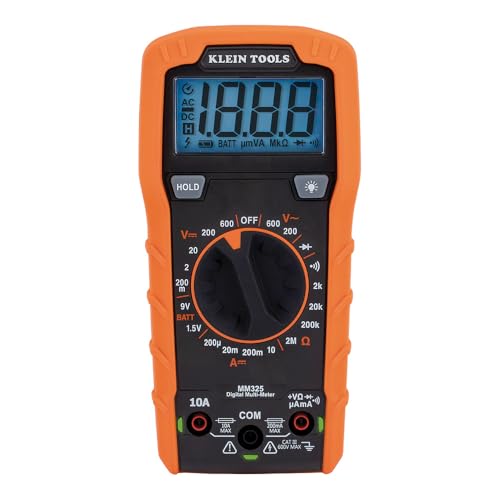
2. Klein Tools MM325
Best for: DIYers who need a safe basic meter for outlets, batteries and continuity.
The Klein MM325 is a manual-ranging meter, so you turn the dial to the range you expect. Admittedly, that takes a little practice. In return, however, the layout is simple and the meter carries a CAT III 600 V rating. Klein also lists a 6.6 ft (2 m) drop rating and a backlit display for dark cabinets.
However, the specs are basic. For instance, the display shows 2,000 counts, and Klein lists voltage accuracy of +/-2%. On a 120 V outlet, that means a reading within about +/-2.4 V, which is fine for a yes or no check. Also, current is DC only, up to 10 A.
- Safety: CAT III 600 V; leads have CAT III/CAT IV safety caps
- Display: 2,000 counts, backlit
- Ranges: 600 V AC/DC, 10 A DC, 2 megohms
- Power: 2 x AAA with auto power-off
Pros
- Proper CAT III rating at a low cost
- Rugged 6.6 ft drop rating
- Easy layout for first-time users
Cons
- Manual ranging only
- No AC current
- Not True RMS
Skip it if: you need AC amps, capacitance or accurate readings on variable-speed loads.
Best Pro
3. Fluke 87V (IMSK Kit)
Best for: industrial electricians and techs working on motors, drives and service equipment.
First of all, the Fluke 87V carries CAT IV 600 V and CAT III 1000 V ratings. In plain terms, you can use it at the service entrance and on 480 V three-phase gear. Fluke states it withstands spikes above 8,000 V. Its low-pass filter also tames the noise from variable frequency drives (VFDs), which often confuses other meters.
On top of that, accuracy is a clear step up. Fluke lists DC volts at +/-(0.05% + 1), and a high-resolution mode shows 19,999 counts. In addition, Peak Capture records events as short as 250 microseconds. This IMSK kit adds an i400 current clamp for AC current up to 400 A, plus a temperature probe. Fluke also backs the meter with a lifetime warranty.
- Safety: CAT IV 600 V and CAT III 1000 V
- DC accuracy: +/-(0.05% + 1); 19,999-count high-resolution mode
- Frequency: up to 200 kHz
- Temperature: -200 to 1,090 C (-328 to 1,994 F), excluding the probe
- Battery: about 400 hours typical (alkaline, no backlight)
Pros
- Highest safety rating on this list
- Low-pass filter for VFD readings
- Excellent DC accuracy
Cons
- Expensive for home use
- More functions than most DIYers need
- No non-contact voltage sensor
Skip it if: you never open a panel or work on motors; the Fluke 117 covers home wiring well.
Best Value
4. KAIWEETS HT118A
Best for: DIYers and car owners who want lots of functions at a moderate cost.
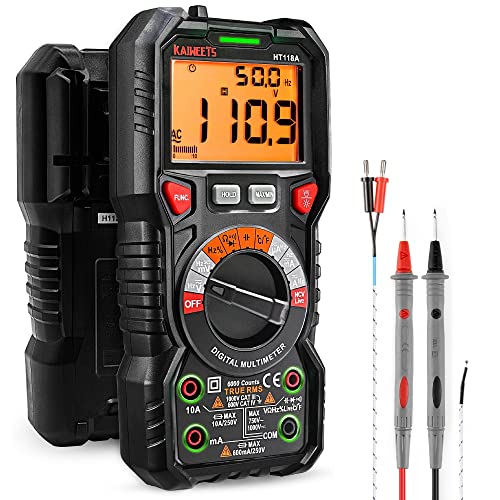
The KAIWEETS HT118A is an auto-ranging, 6,000-count True RMS meter. KAIWEETS lists it at CAT III 1000 V and CAT IV 600 V, which is unusual at this level. Plus, it adds non-contact voltage detection, a backlit screen and a flashlight on the back. Therefore, it works well under a dashboard or a sink.
In addition, its spec table lists up to 1,000 V DC and 750 V AC, plus 10 A AC/DC. Meanwhile, a K-type thermocouple covers -40 to 1,000 C (-40 to 1,832 F). Note that budget brands rarely publish third-party lab listings, so treat the CAT label as the maker’s claim.
- Safety: CAT III 1000 V and CAT IV 600 V (maker listing)
- Display: 6,000 counts, auto-ranging, True RMS
- Extras: NCV alarm, flashlight, temperature probe
- Capacitance up to 100 mF; resistance up to 60 megohms
Pros
- High listed CAT rating for the cost
- Useful flashlight and NCV
- Wide set of functions
Cons
- Maker’s voltage specs conflict in places
- Less detailed accuracy data than Fluke
Skip it if: your job site requires a meter with an independent lab listing, such as UL or CSA.
Best Budget True RMS
5. AstroAI TRMS 6000-Count Multimeter

Best for: hobbyists who want True RMS, temperature and capacitance for little money.
This AstroAI meter shows 6,000 counts and offers both auto and manual ranging. According to its manual, it is rated CAT III 600 V and CAT II 1000 V. So it suits household outlets and appliance work, but not service-entrance panels. The manual lists DC accuracy of +/-(0.8% + 3) on the 6 V to 600 V ranges.
Besides volts and amps, it also measures capacitance, frequency and temperature. The manual gives a temperature range of -40 to 1,370 C (-40 to 2,000 F) with a thermocouple. Also, note the 10 A limit: readings above 5 A should last under 10 seconds.
- Safety: CAT III 600 V, CAT II 1000 V (manual)
- Display: 6,000 counts, True RMS
- Resistance up to 60 megohms
- Power: one 9 V battery; auto power-off after about 15 minutes
Pros
- True RMS at a budget level
- Temperature and capacitance included
- Manual range lock when you need it
Cons
- Time limits on high current
- Looser accuracy than the Fluke models
- No non-contact voltage sensor
Skip it if: you work on panels daily; a CAT III meter from Fluke or Klein is the safer tool.
Easiest to Use
6. Klein Tools MM460S
Best for: occasional users who do not want to choose ranges or functions.
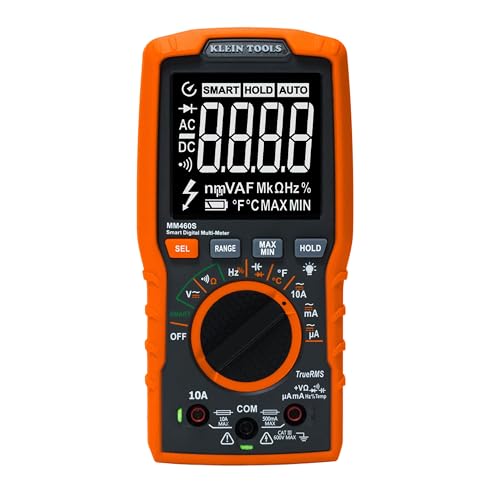
The Klein MM460S has a smart mode that switches between voltage, resistance and continuity on its own. As a result, you can probe a circuit without turning the dial. Also, Klein rates it CAT III 600 V, and it shows 4,000 counts with True RMS. In addition, Lead-Alert warns when a lead sits in the wrong jack.
Even so, it still covers the extras. Klein lists 10 A AC/DC, 50 megohms, capacitance to 4,000 uF and a thermocouple for -40 to 1,000 C (-40 to 1,832 F). In addition, the meter carries a 6.5 ft (2 m) drop rating. Klein does not publish accuracy figures on the product page, though, so check the manual.
- Safety: CAT III 600 V
- Display: 4,000 counts, True RMS, auto-ranging
- Smart mode, Lead-Alert, Min/Max and Data-Hold
- Power: 3 x AAA (included)
Pros
- Smart mode speeds up checks
- Lead-Alert prevents a common mistake
- Temperature probe included
Cons
- Accuracy not on the product page
- Lower count than the 6,000-count meters
Skip it if: you need fine resolution for electronics or a CAT IV rating.
Best for Electronics
7. UNI-T UT61D+

Best for: electronics hobbyists, students and repair benches.
The UNI-T UT61D+ is a 6,000-count True RMS meter with a feature most hobby meters lack: USB data output. As a result, you can log readings to a computer, which helps when you track battery drain or a slow sensor drift. Moreover, UNI-T lists the UT61+ series at CAT III 1000 V and CAT IV 600 V.
The datasheet gives an AC bandwidth of 40 Hz to 10 kHz, so it reads AC signals well above the 60 Hz line frequency. In addition, it adds non-contact voltage detection with a sound and light alarm. Meanwhile, it runs on four AAA batteries. If you want even finer resolution, the sister UT61E+ shows 22,000 counts.
- Safety: CAT III 1000 V and CAT IV 600 V (maker datasheet)
- Display: 6,000 counts, True RMS
- AC bandwidth: 40 Hz to 10 kHz
- USB data output and NCV alarm
Pros
- USB logging for long tests
- Strong listed safety rating
- Wide AC bandwidth
Cons
- Bulkier than pocket meters
- Accuracy data harder to find than Fluke’s
Skip it if: you mainly test outlets; data logging will not help there.
Best for Beginners
8. AstroAI AM33D
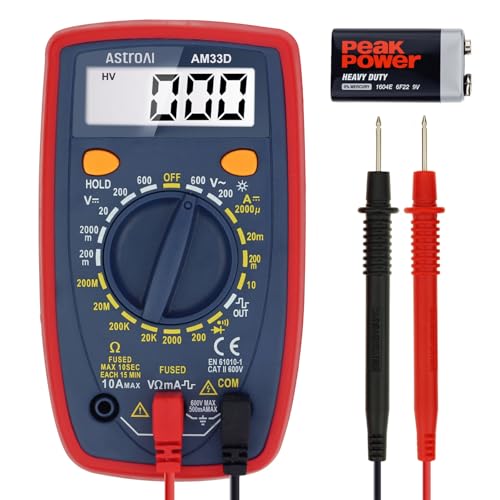
Best for: students and beginners working on batteries, toys and low-voltage projects.
The AstroAI AM33D is a small 2,000-count meter with manual ranging. Specifically, it measures AC/DC volts, DC current, resistance, continuity and diodes. Overall, that is enough to learn the basics. However, AstroAI rates it CAT II 600 V and CAT III 300 V, which is lower than every other pick here.
So keep it away from breaker panels. Instead, use it for 9 V batteries, AA cells, LED strips and hobby circuits. Also, it weighs about 5.3 oz (150 g) and runs on one 9 V battery.
- Safety: CAT II 600 V, CAT III 300 V
- Display: 2,000 counts, manual ranging, backlight
- Functions: volts, DC amps, ohms, continuity, diodes
Pros
- Very simple to learn
- Light and compact
- Fine for battery checks
Cons
- Low CAT III rating
- No AC current or capacitance
- Not True RMS
Skip it if: you plan to test household wiring or panels.
How We Chose the Best Digital Multimeter Picks
We did not bench-test these meters. Instead, our picks are research-based. First, we read each maker’s spec page, manual or datasheet, including the Fluke 117 product page, the Fluke 87V specifications and the Klein MM460S page. Next, we compared owner feedback for reliability patterns.
After that, we scored each meter on five points:
- Safety: the IEC 61010 CAT rating and voltage, as published by the maker.
- Accuracy: a stated +/-(% + counts) figure, because vague claims cannot be checked.
- Resolution: display counts and auto or manual ranging.
- Functions: True RMS, AC current, capacitance, temperature, NCV and LoZ.
- Fit: a distinct use, so that no two picks overlap.
Equally, we skipped listings with no brand, no model number or no safety rating. Also, we kept the list to two meters per brand. If you mainly want hands-free ranging, see our auto-ranging multimeter guide.
CAT Ratings: The First Thing the Best Digital Multimeter Needs
A multimeter’s CAT rating comes from IEC 61010, the safety standard for electrical test equipment. Specifically, handheld meters fall under part 2-033 of that standard. In practice, the rating tells you where on a power system the meter can survive a voltage spike. That matters because a lightning strike or a motor switching off can send a surge far above the normal line voltage.
| Category | Where it applies | Examples |
|---|---|---|
| CAT II | Plug-in loads and outlet circuits | Appliances, power tools, wall outlets |
| CAT III | Building distribution and fixed wiring | Breaker panels, lighting circuits, hardwired motors |
| CAT IV | Origin of the installation | Service entrance, utility meter, outdoor feeders |
Two rules help. First, a higher category beats a higher voltage in the same category. For example, CAT IV 600 V is tougher than CAT III 600 V. Second, the leads count too. Therefore, your test leads need a rating at least as high as the meter’s, or the weaker part sets the limit.
Specs That Decide a Digital Multimeter’s Accuracy
Once safety is settled, the numbers below decide how much you can trust a reading.
Counts and resolution
Simply put, counts set the largest number a range can show. A 6,000-count meter reads up to 5.999 V on its 6 V range, so it resolves 1 mV there. In contrast, a 2,000-count meter must jump to the 20 V range at 2 V and loses a digit. Therefore, more counts help with electronics, batteries and sensors.
Accuracy
Makers write accuracy as +/-(percent of reading + counts). For example, the Fluke 117 lists AC volts at +/-(1.0% + 3). At 120.0 V, 1% is 1.2 V and 3 counts of 0.1 V add 0.3 V. So the true value sits within +/-1.5 V. By comparison, the Fluke 87V lists DC at +/-(0.05% + 1), which is about +/-0.016 V on a 12 V battery.
True RMS
Average-responding meters assume a clean sine wave. However, LED drivers, dimmers and VFDs distort the waveform. Instead, a True RMS meter computes the real heating value, so it stays accurate on those loads. Check the AC bandwidth too, because readings fade above it.
Useful extras
First, LoZ mode removes ghost voltage on open circuits. Second, NCV gives a quick warning before you touch a wire. Meanwhile, temperature, capacitance and frequency help with HVAC and electronics work. For a refresher on the unit itself, see our guide to the voltage symbol and unit.
How to Measure Voltage With a Digital Multimeter
In general, this routine works for outlets and batteries. Always follow the maker’s manual for your meter.
- Inspect the meter and leads for cracks, bare metal or loose tips before every use.
- Next, plug the black lead into COM and the red lead into the V jack.
- Set the dial to AC volts for outlets or DC volts for batteries; pick a range above the expected value on manual meters.
- Then test the meter on a known live source first, because you need to know it works.
- After that, touch the black probe to neutral or negative, then the red probe to hot or positive.
- Read the display, then remove the red probe first and the black probe last.
- Finally, recheck the meter on the known source to confirm it still works.
That last step matters. Electricians call the full routine “live-dead-live,” and it guards against a dead meter giving a false zero.
Ohm’s Law Calculator for Multimeter Readings
Use this tool to check readings. For example, enter a measured voltage and resistance to find the expected current and power.
Keeping the Best Digital Multimeter Accurate
A meter drifts slowly with age, heat and rough handling. Therefore, pros send meters out for calibration on a fixed schedule, often once a year. At home, on the other hand, a simple check works. Compare readings on a fresh battery or a known reference against a second trusted meter.
Also, replace a low battery early, because weak batteries can skew readings. Likewise, store the meter dry and away from heat. Finally, replace fuses only with the exact type in the manual, since the fuse is part of the safety design. Our article on calibration in measurement tools explains why traceable checks matter.
Honest Limits of Any Multimeter
A multimeter measures one point at one moment. So it can miss short dips unless it has a peak or min/max mode. Likewise, it cannot show a waveform the way an oscilloscope does. In addition, most meters measure current only up to 10 A through the leads. Above that, however, a clamp meter is safer and easier.
Similarly, an outlet tester or circuit tester can be faster for simple wiring checks. Our electric circuit tester guide covers those tools.
Best Digital Multimeter FAQ
What is the best digital multimeter for home use?
For most homes, the Fluke 117 is the strongest pick. It is rated CAT III 600 V, uses True RMS and adds non-contact voltage detection. On a tight budget, the Klein MM325 also carries a CAT III 600 V rating.
What CAT rating do I need for household outlets?
CAT II covers plug-in loads and outlets, but CAT III 600 V is the safer choice for home use. It also covers breaker panels and fixed wiring, so one meter handles more jobs.
Is True RMS worth it?
Yes, if you measure modern loads. LED drivers, dimmers, chargers and variable-speed motors distort the AC waveform. A True RMS meter reads those loads accurately, while an average-responding meter can be off.
What does 6000 counts mean on a multimeter?
It means the display can show up to 5,999 on a range. For example, the 6 V range reads up to 5.999 V. More counts give finer resolution before the meter switches range.
Is auto-ranging better than manual ranging?
Auto-ranging is faster and easier because the meter picks the range. Manual ranging is cheaper and can hold a range steady. Most people prefer auto-ranging for everyday work.
Can a cheap model be the best digital multimeter for you?
It can, if it has a real CAT rating that fits your work and good leads. However, very cheap meters may list ratings without independent testing. Look for a lab mark such as UL, CSA or ETL when you work near panels.
How accurate does the best digital multimeter need to be?
For outlets and batteries, about 1 to 2% is enough. For electronics and sensor work, look for 0.5% or better on DC volts plus a high count display.
What is the best digital multimeter for car batteries?
Any meter with a DC volts range and decent resolution works. The KAIWEETS HT118A is a good value pick because it adds a temperature probe and a flashlight for engine bays.
How often should a multimeter be calibrated?
Many professionals calibrate once a year. At home, compare it against a second meter or a known reference now and then, and send it out if readings disagree.
Why does my multimeter show voltage on a dead wire?
That is often ghost voltage coupled from nearby live wires. A meter with a low-impedance mode, such as the Fluke 117, drains that coupling so you see a true zero.
Bottom Line: Our Best Digital Multimeter Pick
For most readers, the Fluke 117 is the best digital multimeter. It pairs a CAT III 600 V rating with True RMS, VoltAlert and LoZ mode, so it handles home wiring safely. If you work on service equipment or drives, step up to the Fluke 87V. On a budget, the Klein MM325 still gives you a proper CAT III rating.
7 thoughts on “8 Best Digital Multimeters of 2026: CAT-Rated Picks for Every Job”