

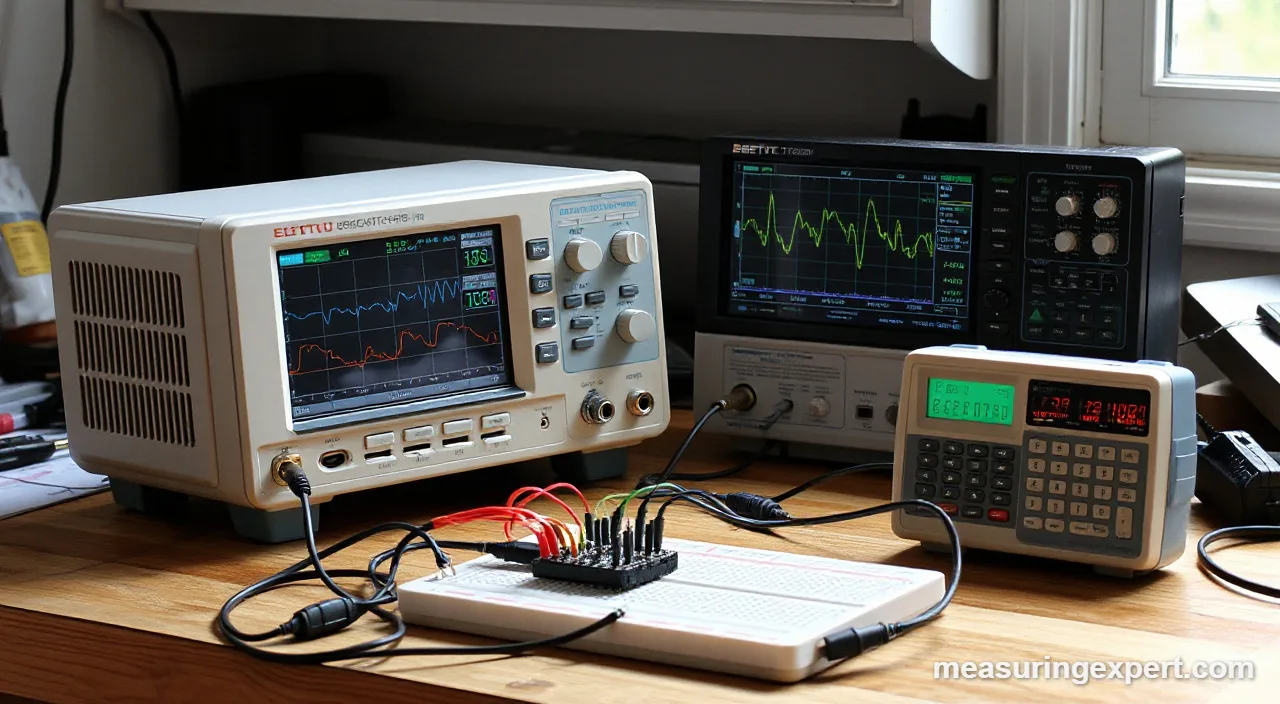
The best oscilloscope for hobbyists is the Siglent SDS1104X HD, which offers four channels, 100 MHz of bandwidth and a 12-bit converter for detailed traces. However, the right choice depends on your budget, how fast your signals are and whether you want a bench or handheld scope.
In short: pick the Siglent for a long-term bench scope, the Hantek DSO2C10 for a low-cost start, and the OWON HDS320S when you need a handheld.
As an Amazon Associate, Measuring Expert earns from qualifying purchases. Our picks are based on research, specifications and owner feedback, not paid placement.
Best Overall
Best Budget Bench

Best Handheld

Quick Answer: Best Oscilloscope for Hobbyists by Need
- One scope for years: Siglent SDS1104X HD, with four 12-bit channels.
- Lowest-cost bench scope: Hantek DSO2C10, with 100 MHz on two channels.
- Four channels on a budget: UNI-T UPO1054, at 50 MHz.
- Handheld with real speed: OWON HDS320S, at 200 MHz.
- Pocket scope for slow signals: FNIRSI DSO152 or the 3-in-1 FNIRSI 2C53T.
- Bigger touch screen: Rigol DHO1104, with upgrade licenses.
On This Page
- Best Oscilloscope for Hobbyists: Comparison Table
- The 8 Best Oscilloscope for Hobbyists Picks, Reviewed
- How We Chose the Best Oscilloscope for Hobbyists
- Best Oscilloscope for Hobbyists: Specs Explained
- Best Oscilloscope for Hobbyists by Type: Bench or Handheld
- How to Take Your First Measurement
- Probes, Grounding and Safe Habits
- Do and Don’t for Beginners
- Limits of the Best Oscilloscope for Hobbyists
- FAQ
- Bottom Line: Best Oscilloscope for Hobbyists
Best Oscilloscope for Hobbyists: Comparison Table
Every pick gets one row below. The reviews then explain the specs, the trade-offs and who each scope suits.
| # | Product | Best For | Standout Feature | Amazon |
|---|---|---|---|---|
| 1 | Siglent SDS1104X HD | Four-channel bench work and decoding | 12-bit, 2 GSa/s, up to 100 Mpts | View |
| 2 | Rigol DHO914S | Four 12-bit channels at 125 MHz | 125 MHz, 12-bit, 1 Mwfms/s | View |
| 3 | Hantek DSO2C10 | Low-cost 100 MHz first scope | 100 MHz, 2 channels, 8 Mpts | View |
| 4 | UNI-T UPO1054 | Cheap four channels with deep memory | 50 MHz, 4 channels, 2 GSa/s | View |
| 5 | Rigol DHO1104 | 10.1-inch touch screen and upgrade path | 100 MHz, 12-bit, 50 Mpts | View |
| 6 | FNIRSI 2C53T | Pocket scope, meter and generator | 50 MHz, 250 MS/s, 3-in-1 | View |
| 7 | OWON HDS320S | 200 MHz handheld with a 30 MHz generator | 200 MHz, 1 GSa/s, 3-in-1 | View |
| 8 | FNIRSI DSO152 | Tiny low-speed learning scope | 200 kHz, 2.5 MSa/s, pocket size | View |
The 8 Best Oscilloscope for Hobbyists Picks, Reviewed
This list covers oscilloscopes only: bench, handheld and pocket models. If you mainly need to read volts, amps and resistance, see our best digital multimeter guide instead. Likewise, for plain voltage checks, our auto-ranging multimeter picks are simpler tools. Also, the picks below are research-based and use manufacturer or retailer specifications we checked.
Best Overall
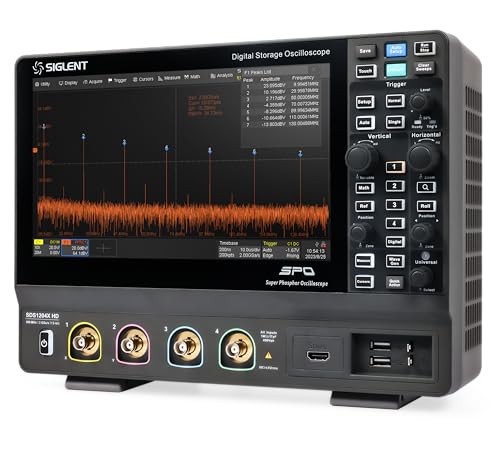
1. Siglent SDS1104X HD
Best for: Hobbyists who want a four-channel bench scope that will not feel limiting for years.
The SDS1104X HD is the pick we would hand to a hobbyist who plans to keep one scope for a long time. First, it has four analog channels, 100 MHz of bandwidth and a 12-bit converter, so small signals on top of a large one show more detail than on an 8-bit instrument. As a result, it handles ripple on a power rail or a sensor output a few millivolts tall well.
In addition, deep memory lets you zoom into a long capture without losing the sample rate. Retailer listings also describe 16 digital channels for mixed-signal work, so check which probes and options come in the bundle you buy. Meanwhile, the price sits well above the budget scopes below, which is the main trade-off.
- Bandwidth 100 MHz, 4 analog channels
- Vertical resolution 12 bits
- Sample rate 2 GSa/s; memory up to 100 Mpts
- Waveform capture up to 120,000 wfm/s in normal mode, 500,000 wfm/s in sequence mode
- Listed with 16 digital channels for mixed-signal use (verify what ships with your bundle)
Pros
- 12-bit resolution shows fine detail
- Four channels for buses and power rails
- Very deep memory for long captures
Cons
- Costs far more than entry-level scopes
- Display size is listed inconsistently by retailers
- More scope than a casual user needs
Skip it if: you only probe a few low-speed signals, because a cheaper handheld covers that job.
Best 12-Bit Step-Up
2. Rigol DHO914S

Best for: Makers who want four 12-bit channels and a fast waveform rate from a well-known brand.
Overall, the DHO914S offers four channels and 125 MHz of bandwidth, which is more than enough for Arduino, Raspberry Pi and most logic work. The S model also adds Bode plot analysis, which helps when you tune a power supply loop or test a filter.
Also, Rigol lists a very high waveform capture rate, so brief glitches have a better chance of showing up on screen. However, its 1.25 GSa/s sample rate is lower than the Siglent’s 2 GSa/s, which matters most for fast single-shot events.
- Bandwidth 125 MHz, 4 analog channels
- Vertical resolution 12 bits
- Real-time sample rate 1.25 GSa/s
- Memory depth up to 50 Mpts
- Waveform capture up to 1 Mwfms/s; Bode analysis on S models
Pros
- 12-bit resolution at 125 MHz
- Fast waveform capture rate
- Bode plot support on the S model
Cons
- Pricier than 8-bit scopes with similar bandwidth
- Sample rate is lower than the Siglent pick
- Display size is not stated on the Rigol page
Skip it if: you only need two channels, since the DHO800 family covers that for less (check availability).
Best Budget Bench Scope
3. Hantek DSO2C10
Best for: Beginners who want a real 100 MHz bench scope at a modest cost.
Overall, the DSO2C10 is a straightforward two-channel scope with a 7-inch screen and 100 MHz of bandwidth. It is an 8-bit instrument, so it will not resolve tiny signals as well as the 12-bit models. Even so, it has a proper trigger system, which makes it a good learning tool.
On the other hand, it has no built-in signal generator. Therefore, you will need a separate source if you want to test filters or amplifiers. For checking microcontroller pins, audio signals and power supply ripple, though, it does the job.
- Bandwidth 100 MHz, 2 channels
- Vertical resolution 8 bits
- Sample rate 1 GSa/s, shared between the channels
- Memory depth 8 Mpts
- 7-inch display, not a touch screen; no built-in generator
Pros
- Proper trigger system on a 7-inch screen
- 100 MHz is plenty for hobby digital work
- Simple two-channel design is easy to learn
Cons
- 8-bit vertical resolution
- No signal generator
- Sample rate is shared across both channels
Skip it if: you want to see millivolt-level detail, because a 12-bit model resolves it better.
Best Value Four-Channel
4. UNI-T UPO1054

Best for: Hobbyists who want four channels and deep memory without paying for 100 MHz.
Overall, the UPO1054 gives you four channels, a 7-inch screen and a very high waveform capture rate for a 50 MHz scope. For example, for hobby work such as I2C, SPI, UART and PWM motor control, 50 MHz is usually enough. In addition, the built-in decoders for RS232, I2C and SPI save you from counting bits by eye.
The listing does not state the converter resolution, so we do not claim a bit depth. As a result, check the datasheet before you compare its noise performance with the 12-bit models. Meanwhile, UNI-T quotes a noise floor below 100 uVrms, which is a useful number to keep in mind.
- Bandwidth 50 MHz, 4 channels
- Sample rate up to 2 GSa/s; memory up to 56 Mpts
- Waveform capture up to 500,000 waveforms/s
- Vertical scale 500 uV/div to 20 V/div; 7-inch 800 x 480 display
- RS232, I2C and SPI decoding; 36 automatic measurements
Pros
- Four channels at a modest bandwidth
- Built-in serial decoding
- Deep memory for the class
Cons
- 50 MHz limits fast logic edges
- ADC bit depth is not listed
- Lowest bandwidth among the bench models here
Skip it if: you plan to probe fast clock signals, because 50 MHz will round off the edges.
Best Touch-Screen Pick
5. Rigol DHO1104

Best for: Enthusiasts who want a large touch screen and room to upgrade.
First, the DHO1104 is the larger sibling in Rigol’s DHO line. Also, Rigol lists a 10.1-inch HD touch screen, four channels, 12-bit resolution and 2 GSa/s of real-time sampling.
Moreover, Rigol sells license upgrades that raise the bandwidth of the 100 MHz models to 200 MHz and extend memory to 100 Mpts. Keep in mind that upgrades add cost, so compare the total before you buy.
- Bandwidth 100 MHz, 4 channels
- Vertical resolution 12 bits
- Real-time sample rate 2 GSa/s
- Memory 50 Mpts standard; 100 Mpts upgrade available
- 10.1-inch HD touch screen; 50 kwfms/s standard capture rate
Pros
- Large touch screen
- 12-bit resolution with 2 GSa/s
- Bandwidth and memory upgrades are available
Cons
- Standard capture rate is 50 kwfms/s
- Costs more than the 50 MHz and 100 MHz bench options here
- Upgrades are paid licenses
Skip it if: you want the cheapest route to four channels, since the UNI-T costs less.
Best 3-in-1 Handheld
6. FNIRSI 2C53T
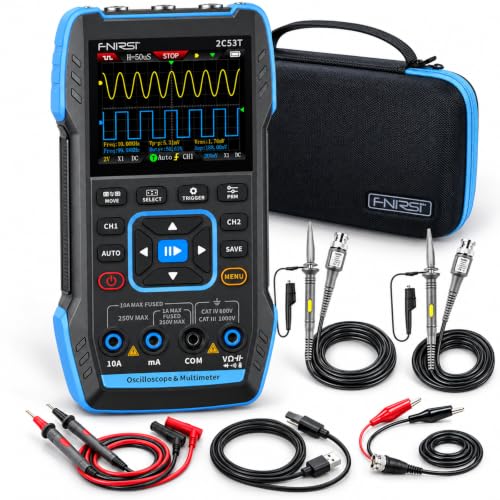
Best for: Hobbyists who want a pocket scope, multimeter and signal source in one battery tool.
First, the 2C53T combines a two-channel scope, a 20,000-count true RMS multimeter and a DDS signal generator in one handheld case. It runs from a 3000 mAh lithium battery and charges over USB-C, so you can carry it to a car, a workshop or a client site.
However, its specs show the limits of a pocket tool. For example, the memory is only 1 Kpts, and the 2.8-inch screen is small. Therefore, treat it as a quick fault-finder and learning tool rather than a replacement for a bench scope.
- Bandwidth 50 MHz, 2 channels
- Sample rate 250 MS/s; memory depth 1 Kpts
- 2.8-inch color LCD, 320 x 240
- Multimeter 4.5 digits, 20,000 counts, true RMS
- DDS generator: 13 waveforms, 0 to 50 kHz, up to 3 V amplitude
Pros
- Three instruments in one pocket-sized unit
- USB-C rechargeable
- Handy generator for testing audio and sensors
Cons
- Only 1 Kpts of memory
- Small low-resolution screen
- Generator tops out at 50 kHz
Skip it if: you need to capture long, fast digital streams, because the memory is too short.
Best Handheld Bandwidth
7. OWON HDS320S
Best for: Hobbyists and technicians who need 200 MHz in a handheld.
First, the HDS320S pairs a 200 MHz, two-channel scope with a multimeter and an arbitrary waveform generator. Also, the 3.5-inch color screen is described as readable outdoors, and the unit runs from an 18650 lithium cell. For a handheld, 200 MHz is high, so it can follow faster signals than the other pocket tools here.
In addition, the generator reaches 30 MHz, which is useful for testing amplifiers and filters. Nevertheless, the record length is only 8k points. As a result, long captures at high sample rates are limited, so you will zoom in on short events rather than study long ones.
- Bandwidth 200 MHz, 2 channels; sample rate 1 GSa/s
- Record length 8k; refresh up to 10,000 waveforms/s
- 3.5-inch color LCD; USB Type-C interface
- Multimeter 20,000 counts, true RMS; up to 750 V AC and 1000 V DC listed
- Generator up to 30 MHz, 14-bit, 125 MSa/s, up to 5 Vpp
Pros
- 200 MHz bandwidth in a handheld
- Real arbitrary waveform generator
- Runs from a common 18650 cell
Cons
- Short 8k record length
- Small screen
- CAT rating is not stated in the listing we checked
Skip it if: you plan to measure mains or other hazardous voltage, because the listing does not state a safety category.
Best Pocket Starter
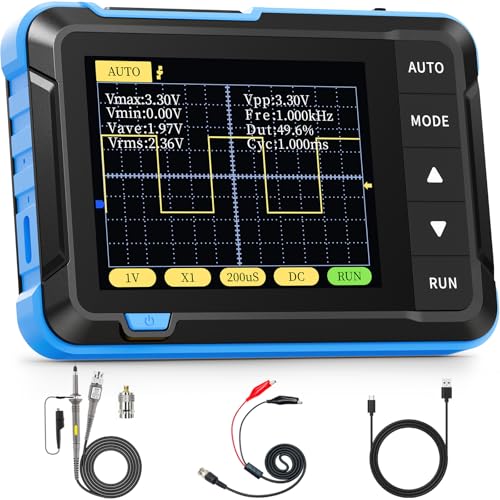
8. FNIRSI DSO152
Best for: Absolute beginners and car or audio tinkerers on a tight budget.
Overall, the DSO152 is a small, simple scope with 200 kHz of bandwidth and a 2.5 MSa/s sample rate. Therefore, it is enough to watch audio signals, sensor outputs, PWM at low frequencies and many automotive signals. However, it is not suited to microcontroller clocks or fast serial buses.
Even so, it is a low-risk way to learn what a trace, a trigger and a timebase are. Furthermore, a 1000 mAh battery gives about four hours of use, according to the retailer listing, and it charges over USB.
- Bandwidth 200 kHz; real-time sample rate 2.5 MSa/s
- 2.8-inch LCD, 320 x 240
- Vertical sensitivity 10 mV/div to 20 V/div
- Input up to +/-40 V at X1 and +/-400 V at X10 per listing
- 1000 mAh battery, about 4 hours; alligator clip probe included
Pros
- Pocket sized and simple
- Good for audio and slow signals
- Low-cost way to learn the basics
Cons
- 200 kHz is far too slow for digital buses
- Small screen
- Short battery life
Skip it if: you work with I2C, SPI or UART signals, because their edges are much faster than 200 kHz.
How We Chose the Best Oscilloscope for Hobbyists
We did not bench-test these scopes. Instead, we compared manufacturer pages, retailer listings and independent reviews, and we kept only the specs we could confirm.
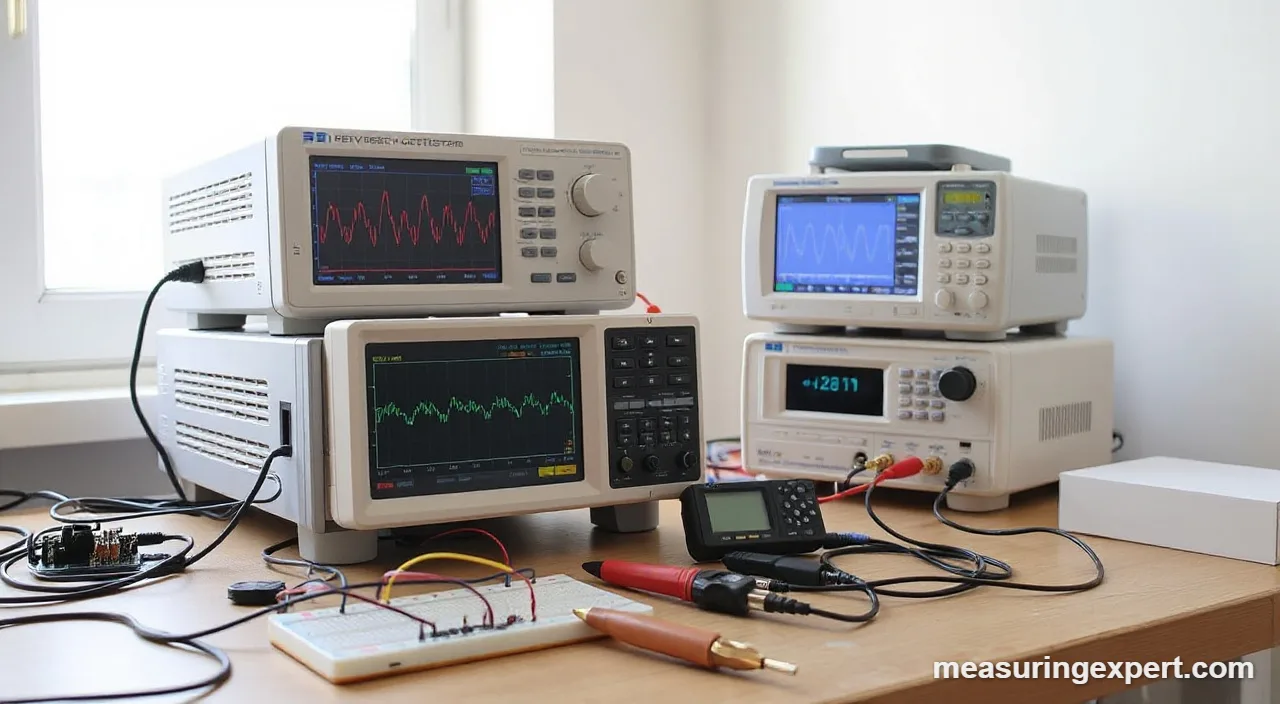
- Real oscilloscope function: each pick has a trigger, a timebase and adjustable volts per division.
- Bandwidth that fits hobby signals: from 200 kHz for audio up to 200 MHz for fast logic.
- Sample rate and memory: enough to show the signal without heavy distortion.
- Distinct use cases: bench, handheld, budget and step-up, with no more than two models per brand.
Also, our main technical reference was the Tektronix primer on evaluating oscilloscopes. Specs for the Rigol DHO models came from the Rigol DHO900 and DHO1000 pages.
Best Oscilloscope for Hobbyists: Specs Explained
Choosing the best oscilloscope for hobbyists comes down to four numbers, because each one limits what the scope can show you. Therefore, it helps to know what they mean.
Bandwidth: how fast a signal the scope can follow
Bandwidth is the frequency at which a sine wave appears at about 70.7% of its true amplitude, also called the -3 dB point. Tektronix therefore suggests a scope with roughly five times the bandwidth of your fastest signal, which keeps amplitude error under about 2%. For example, a 20 MHz signal calls for about 100 MHz.
Rise time: the edge speed you can trust
Also, for scopes under 1 GHz, rise time is roughly 0.35 divided by the bandwidth. A 100 MHz scope therefore has a rise time near 3.5 ns. As a result, it cannot show a digital edge faster than that accurately.
Sample rate and memory: how much detail you keep
First, sample rate is how many readings the scope takes each second. The Nyquist limit of twice the signal frequency is only a minimum, so aim for at least 2.5 times the highest frequency with smooth interpolation. Memory then sets how long you can capture at that rate, because capture time equals record length divided by sample rate. For instance, 8 Mpts at 1 GSa/s covers 8 ms.
Vertical resolution: how finely voltage is measured
For example, an 8-bit converter has 256 levels, while a 12-bit one has 4096. Also, more levels help when you look at a small ripple riding on a large signal. However, resolution is only one part of accuracy, because noise and the analog front end also matter.
Best Oscilloscope for Hobbyists by Type: Bench or Handheld
Each style suits a different workflow, so the table summarizes the trade-offs.
| Type | Strength | Weakness | Examples here |
|---|---|---|---|
| Benchtop | Large screen, knobs, deep memory, more channels | Bulky and needs mains power | Siglent SDS1104X HD, Rigol DHO914S, Hantek DSO2C10, UNI-T UPO1054, Rigol DHO1104 |
| Handheld | Battery powered, includes a multimeter, portable | Small screen, short memory | OWON HDS320S, FNIRSI 2C53T |
| Pocket starter | Low cost and easy to learn | Very low bandwidth | FNIRSI DSO152 |
How to Take Your First Measurement
These steps work on any scope in this list.
- First, connect the probe to the scope and set the probe switch to 10X, then match that setting in the channel menu.
- Next, attach the probe tip to the scope’s calibration output and clip the ground lead to its ground terminal.
- Press auto-set, then adjust the probe’s compensation trimmer until the square wave has flat tops.
- After that, clip the probe ground to the circuit ground before you touch the tip to any test point.
- Next, touch the tip to the signal and adjust the volts per division until the trace fills most of the screen.
- Set the time per division so you see two to five cycles, then set the trigger level near the middle of the waveform.
- Finally, use cursors or automatic measurements to read frequency, peak-to-peak voltage and rise time.
If you want to go further, our guide to how to measure vibration explains frequency and sampling in a real-world setting. In addition, the voltage symbol and unit article covers the units you will read on the screen.
Probes, Grounding and Safe Habits
The probe is part of the measurement system, according to Tektronix, so a poor probe setup can spoil a good scope. In addition, most passive probes switch between 1X and 10X. Moreover, the 10X setting loads the circuit less and is the right default for most hobby work. Always compensate the probe on the scope’s calibration output, because a badly compensated probe rounds or overshoots square edges.
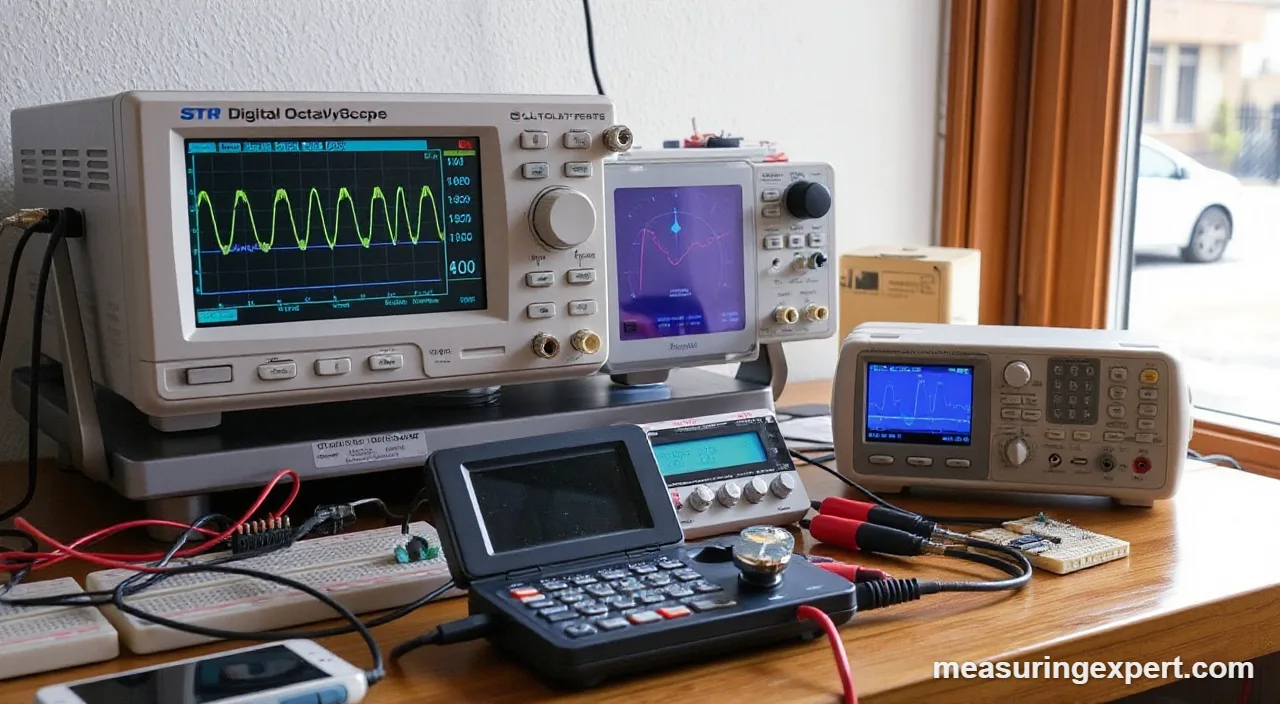
Also, keep the ground lead short, since a long lead adds ringing on fast edges. Moreover, remember that most bench scopes tie the probe ground to earth. Therefore, never clip it to a live mains conductor. Instead, use an isolated measurement tool and read the manual for your scope’s rated voltage and probe category.
Do and Don’t for Beginners
Limits of the Best Oscilloscope for Hobbyists
A scope shows a voltage over time, nothing more. For example, it does not measure current directly, and it will not tell you whether a part is good unless you know what the signal should look like. In addition, treat bandwidth and sample rate claims as upper limits. Some entry-level scopes also share the sample rate between channels, which lowers the real speed when both inputs are active. Finally, mains and other hazardous circuits need the right safety category, and the listings for several of these tools do not state one.
FAQ
What is the best oscilloscope for hobbyists?
For most people, the Siglent SDS1104X HD is the best oscilloscope for hobbyists who want one long-term scope, thanks to its four channels and 12-bit converter. However, the Hantek DSO2C10 costs far less and still gives you 100 MHz.
How much bandwidth does the best oscilloscope for hobbyists need?
A common rule is to pick a scope with about five times the bandwidth of your fastest signal. For example, Arduino and sensor work usually needs only 50 MHz. However, for fast logic edges, 100 MHz or more is safer.
Is a handheld the best oscilloscope for hobbyists who are beginners?
Yes, for many tasks. A handheld like the OWON HDS320S can follow fast signals and also reads voltage as a multimeter. On the other hand, its small screen and short memory make long captures harder.
What does sample rate mean on an oscilloscope?
Sample rate is how many readings per second the scope takes. In practice, the Nyquist minimum of twice the signal frequency is rarely enough, so aim for at least 2.5 times the highest frequency, and more for single events.
Is a 12-bit model the best oscilloscope for hobbyists?
It can be. A 12-bit converter has 4096 levels instead of 256, so it resolves small details better. As a result, ripple and noise on a power rail are easier to see, though you pay more for it.
Do I need a USB oscilloscope or a standalone one?
First, a standalone scope works without a computer and has dedicated controls. In contrast, a USB model uses your PC as the screen. Therefore, standalone is simpler for a bench, while USB suits tight budgets and travel.
What probes come with an oscilloscope?
Most include passive probes with a 1X and 10X switch. Because it loads the circuit less, use 10X for most work, and compensate the probe first.
How often should an oscilloscope be calibrated?
For example, labs often calibrate yearly. At home, check probe compensation often and compare readings against a trusted meter.
Can I use an oscilloscope to measure mains voltage?
Not safely with a typical grounded bench scope. Its probe ground is tied to earth, so connecting it to a live conductor can cause a short. Instead, use an isolated tool with the right safety category, or ask a qualified electrician.
How many channels should the best oscilloscope for hobbyists have?
For example, two channels cover most beginner work, such as comparing an input and an output. However, four channels help when you debug buses, motor drivers or power sequencing, because you can see several signals at once.
Bottom Line: Best Oscilloscope for Hobbyists
For most buyers, the Siglent SDS1104X HD is the best oscilloscope for hobbyists who want one scope that will last. In short, it combines four channels, 100 MHz and 12-bit resolution. However, the Hantek DSO2C10 is the smarter start if budget matters, and the OWON HDS320S is the right choice for a handheld.