

The voltage symbol in US textbooks and circuit diagrams is V, and the unit of voltage is the volt, which also uses the symbol V. However, international standards prefer an italic U for the quantity, and E often marks a battery’s electromotive force. In short, 1 volt equals 1 joule per coulomb, or 1 watt per ampere.
Find Voltage, Current or Resistance With Ohm’s Law
Fill in any two boxes and the calculator works out the third, plus the power in watts. For example, a 12 V battery across a 6-ohm load drives 2 A and delivers 24 W.
Voltage is the electrical “push” between two points. More precisely, it is the energy each unit of charge gains or loses as it moves from one point to the other. For example, a water analogy helps: voltage acts like the pressure difference in a pipe, current is the flow, and resistance is how narrow the pipe is.
However, the confusing part is that one letter does two jobs. On a battery label, “9 V” uses V as the unit symbol. In the formula V = I x R, by contrast, V stands for the quantity itself. So the same letter can mean “voltage” or “volts” depending on where you see it.
The US National Institute of Standards and Technology (NIST) lists the volt in its Guide to the SI, Table 3 as the SI unit of electric potential difference, with the symbol V, equal to one watt per ampere (W/A). Below, you will find a prefix chart, the other letters textbooks use, and a safe way to measure voltage at home.
Voltage Symbol vs Unit Symbol: Why There Are Two V’s
Style guides solve the double-V problem with fonts. First, the quantity symbol is printed in italic (V or U), because it stands for a value that can change. Next, the unit symbol is printed upright (V), because it is a fixed name. Therefore “V = 9 V” reads as “the voltage equals nine volts.” However, handwritten notes and plain-text labels lose the italics, so context has to do the work.
| Symbol | What it means | Where you see it |
|---|---|---|
| V (italic) | Voltage or potential difference (the quantity) | US textbooks, Ohm’s law, most English-language schematics |
| V (upright) | The volt (the unit) | Battery labels, meter dials, spec sheets |
| U | Voltage, the internationally standardized quantity symbol | European textbooks and IEC/ISO documents |
| E or emf | Electromotive force of a source such as a battery cell | Physics problems, older electrical texts |
| ΔV | Change in electric potential between two points | Physics courses |
| v or v(t) (lowercase) | Instantaneous voltage that varies with time | AC circuit analysis |
In other words, the voltage symbol you pick depends on your textbook, but the unit is always the volt. Similarly, a German manual that writes U = 230 V means exactly what a US one means by V = 230 V.
Volt Prefix Chart: From Microvolts to Megavolts
Real voltages span a huge range, so SI prefixes keep the numbers readable. In addition, each row below uses exact powers of ten. Also, feel free to print this chart and tape it inside a toolbox lid.
| Unit | Symbol | In volts | Typical example |
|---|---|---|---|
| Microvolt | µV (uV) | 0.000001 V | Brain signals (EEG) and thermocouple steps |
| Millivolt | mV | 0.001 V | A resting nerve cell, about -70 mV |
| Volt | V | 1 V | An AA cell, 1.5 V |
| Kilovolt | kV | 1,000 V | Local power distribution lines |
| Megavolt | MV | 1,000,000 V | Lightning and particle accelerators |
Note the case: lowercase m means milli (one thousandth), while capital M means mega (one million). As a result, 5 mV and 5 MV differ by a factor of one billion.
Recommended Tools for Measuring Voltage
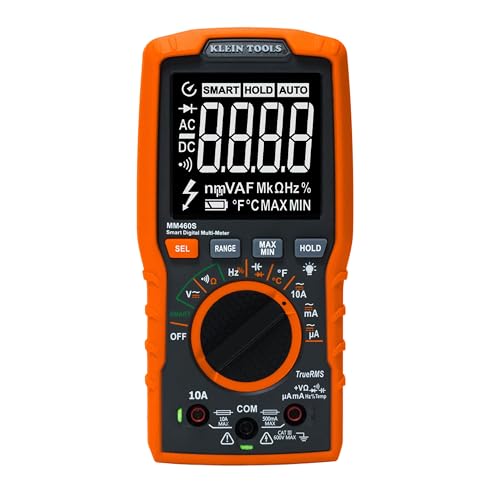
A digital multimeter reads voltage directly, and a non-contact tester tells you whether a wire is live before you touch it. For home use, look for a CAT III rating for household circuits, auto-ranging, and a clear AC/DC display. In addition, a pen-style tester is worth keeping in your pocket even if you own a meter.




As an Amazon Associate, Measuring Expert earns from qualifying purchases.
For side-by-side picks, see our guides to the best digital multimeters and the best digital voltmeters.
What the Volt Means in SI Units
The volt is a derived SI unit, so you can write it several equivalent ways:
- Energy per charge: 1 V = 1 joule per coulomb (J/C).
- Power per current: 1 V = 1 watt per ampere (W/A).
- Ohm’s law form: 1 V = 1 ampere x 1 ohm.
- SI base units: 1 V = 1 kg m2 s-3 A-1.
Since May 20, 2019, the SI rests on seven defining constants, including the Planck constant h and the elementary charge e. Because both now have exact values, the Josephson constant 2e/h is exact too, at about 483,597.848 GHz per volt. As a result, national labs use that effect in superconducting chips to realize the volt with extraordinary precision.
Where the Voltage Symbol and the Volt Came From
The unit honors Alessandro Volta, the Italian physicist who built the voltaic pile in 1800. In fact, his stack of zinc and silver discs, separated by brine-soaked cloth, gave the first steady electric current. Later, in 1861, the British engineers Latimer Clark and Charles Bright proposed the name “volt.” Then, in 1881, the International Electrical Congress in Paris adopted it as the unit of electromotive force. Meanwhile, the letter V as a voltage symbol simply follows the word “voltage,” which is why English-language books favor it.
The old version of this page said Volta “invented the battery,” which is close but loose. Strictly speaking, he invented the first electrochemical battery that delivered continuous current, and modern cells still work on the same principle.
Voltage Symbol on Multimeters and Schematics
On a multimeter dial, the voltage symbol comes with extra marks that tell you the type of current. Read them before you plug in the probes:
| Marking | Meaning | Use it for |
|---|---|---|
| V with a solid line over a dashed line (or VDC) | Direct current (DC) volts | Batteries, car electrics, USB, solar panels |
| V~ or VAC | Alternating current (AC) volts | Wall outlets and household wiring |
| mV | Millivolt range | Sensors, thermocouples, small signals |
| Circle with + and – (schematic) | DC voltage source | Circuit diagrams |
| Circle with a sine wave (schematic) | AC voltage source | Circuit diagrams |
Similarly, on schematics, a battery appears as long and short parallel lines, and the long line is the positive terminal. Next to it, a label such as “V1 = 9 V” combines the voltage symbol with the unit symbol.
How to Measure Voltage With a Multimeter
First, you measure voltage across two points, with the meter in parallel. Here is the safe order for a battery or other low-voltage DC source:
- Inspect the leads. Check the probes and wires for cracks or exposed metal, and replace damaged leads.
- Plug in the leads. Black goes in the COM jack and red in the jack marked V (often shared with the ohm symbol).
- Choose DC or AC volts. Turn the dial to the V with a straight line for batteries, or V~ for outlets, on a range above the voltage you expect.
- Touch the probes across the source. Hold black on the negative terminal and red on the positive one.
- Read the display. A minus sign only means the probes are reversed; the size of the number is still correct.
- Remove red first, then black. Afterward, return the dial to OFF to save the battery.
For example, a fresh AA alkaline cell typically reads a little above 1.5 V. A healthy, fully charged car battery at rest reads about 12.6 V, because it has six cells of about 2.1 V each. For battery-specific checks, our battery tester guide covers load testing as well.
Typical Voltages You Will Meet
In general, these values help you sanity-check a reading. If a number lands far outside the expected range, recheck the dial setting first.
| Source | Nominal voltage | AC or DC |
|---|---|---|
| AA or AAA alkaline cell | 1.5 V | DC |
| Lithium coin cell (CR2032) | 3 V | DC |
| USB port (standard) | 5 V | DC |
| Rectangular “9 V” battery | 9 V | DC |
| Car battery, charged and resting | about 12.6 V | DC |
| US and Canada wall outlet | 120 V (240 V for dryers and ranges) | AC, 60 Hz |
| UK and most of Europe | 230 V | AC, 50 Hz |
AC values on meters and labels are RMS (root-mean-square) values. Thus a 120 V outlet actually peaks near 170 V, but it delivers the same heating power as 120 V DC would.
Do and Don’t With Voltage Readings
Do
- Set the dial before the probes touch anything.
- Keep fingers behind the probe guards.
- Use a meter rated CAT III for home wiring.
- Write the unit with every number, such as 230 V.
- Test a known live source to confirm your meter works.
Don’t
- Leave the red lead in the amp (A) jack while measuring volts.
- Confuse mV with MV, or a lowercase v with the unit.
- Work on a circuit because a single tester stayed silent.
- Probe outlets with wet hands or while standing on a wet floor.
- Assume a European “U” means something other than voltage.
Honest Limits of Voltage Readings and Symbols
To begin with, notation is not fully universal. Some books use E for any source voltage, others reserve it for emf, and a few use V for both potential and potential difference. So always check the textbook’s own key. Readings also have limits. For instance, a basic meter is accurate to a fraction of a percent plus a few digits, so 12.62 V and 12.64 V may be the same voltage. Moreover, cheap meters that are not “true RMS” can misread non-sine AC from dimmers or inverters. Finally, a battery’s open-circuit voltage says little about its capacity; a weak cell can read fine until a load pulls it down.
When Accuracy and Safety Really Matter
For a TV remote, of course, a rough reading is fine. However, three situations call for more care. First, household mains at 120 V or 240 V can kill, so only a correctly rated meter belongs near an outlet. Second, electric vehicles and solar arrays use hundreds of volts DC, which need trained hands. Third, lab and calibration work needs a meter with a current calibration certificate, as explained in our guide to units of measurement in physics.
Voltage Symbol FAQs
What is the voltage symbol?
In US books and schematics, the voltage symbol is V, printed in italics in formulas. Internationally, standards prefer U. Either way, the unit is the volt.
What is the SI unit of voltage?
The SI unit of voltage is the volt, symbol V. One volt equals one joule per coulomb, or one watt per ampere.
Why is the voltage symbol sometimes U instead of V?
ISO and IEC standards use U for voltage, so European textbooks and manuals write U = 230 V. In other words, it means the same quantity as V.
What does E stand for in electricity?
E usually stands for electromotive force (emf), the voltage a source such as a battery produces with no current flowing.
Is the voltage symbol the same as the volt symbol?
The letter is the same, but the job differs. Italic V is the quantity, while upright V is the unit, so V = 9 V means the voltage is nine volts.
Who is the volt named after?
It honors Alessandro Volta, who built the voltaic pile in 1800. The name was adopted in 1881 by the International Electrical Congress.
How many millivolts are in a volt?
There are 1,000 millivolts (mV) in 1 volt. Likewise, 1 kilovolt (kV) equals 1,000 volts.
What voltage symbol does a multimeter use for AC and DC?
AC volts appear as V~ or VAC. DC volts show a V with a solid line above a dashed line, or VDC.
What is the difference between voltage and current?
Voltage is the push, measured in volts. Current is the flow of charge, measured in amperes (A). By Ohm’s law, V = I x R.
Does a lowercase v mean something different?
In circuit analysis, a lowercase v usually marks an instantaneous voltage that changes with time, such as v(t) in an AC circuit. It is never correct as the unit symbol.
Voltage Symbol and Unit: The Bottom Line
To sum up, the voltage symbol is V in most English-language material and U in international standards, while the unit is always the volt, V. One volt is one joule per coulomb, and prefixes such as mV and kV cover tiny and huge values.
Next time you see “V = 12 V,” read it as “the voltage is twelve volts.” Then use the Ohm’s law calculator above to turn any two of voltage, current and resistance into the third, and keep a rated meter between you and anything plugged into the wall.