

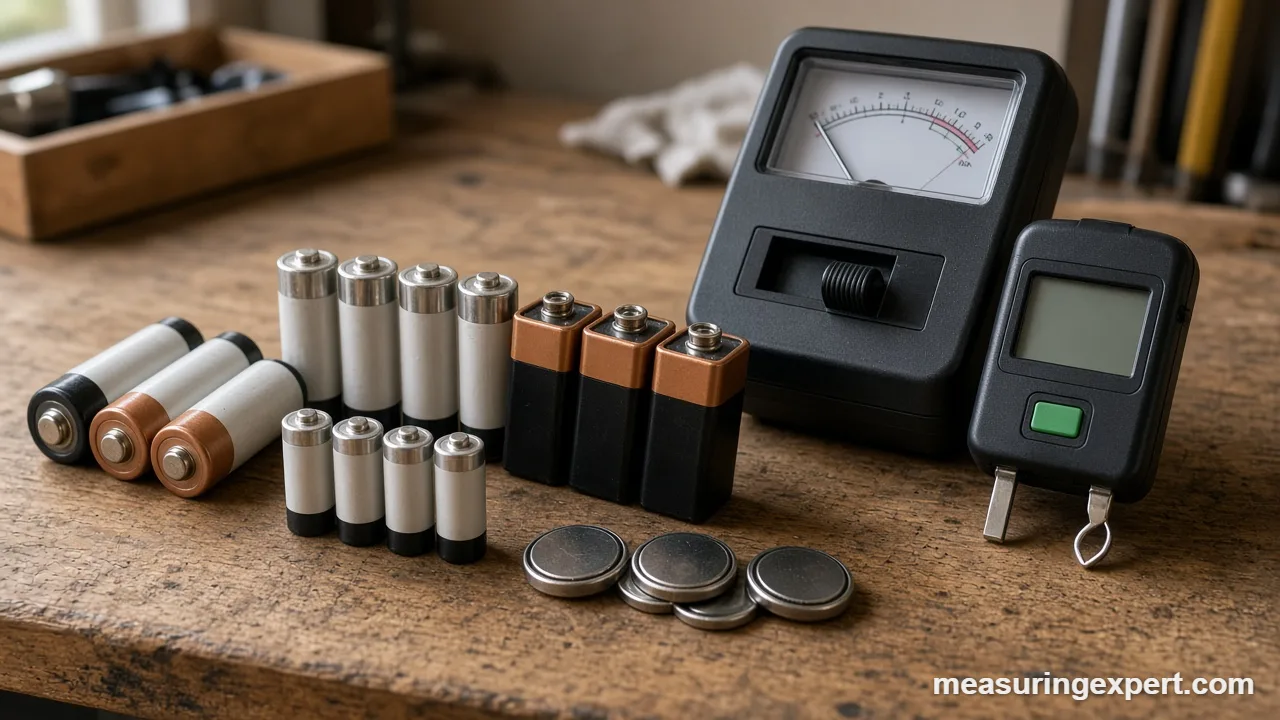
The best battery tester for most homes is the Amprobe BAT-250, because it checks AA, AAA, C, D, 9V and 1.5V button cells under a real load and needs no battery of its own. What decides your pick is whether you want a quick good/low verdict, an exact voltage, or capacity and resistance data.
In short: get the Amprobe BAT-250 for loaded checks, the La Crosse 911-65557 for a digital voltage readout with coin cells, and the FNIRSI HRM-10 if you want internal resistance numbers.
As an Amazon Associate, Measuring Expert earns from qualifying purchases. Our picks are based on research, specifications and owner feedback, not paid placement.
Best Overall

Best Digital

Quick Answer: Which Battery Checker Do You Need?
- A drawer full of mixed AA, AAA and 9V cells: the Amprobe BAT-250, since it loads each cell before it reads.
- Coin cells such as CR2032: the La Crosse 911-65557, because it also reads 3V button cells.
- Camera cells such as CR123A and CRV3: the Tenergy T-333 LCD checker.
- Lantern, photo and odd sizes up to 22.5V: the Gardner Bender GBT-500A with test leads.
- Real capacity in mAh for rechargeables: the SkyRC NC2200 for NiMH AA and AAA, or the XTAR VC4SL for Li-ion.
- Internal resistance and cell matching: the FNIRSI HRM-10.
- A 12V car, boat or RV battery: skip this list and see our best battery load tester guide instead.
On This Page
- Side-by-side table
- The 8 picks, reviewed
- How we chose
- Tester types compared
- Voltage, load and resistance explained
- Load current calculator
- How to test a battery
- What the readings mean
- Do and don’t
- Honest limits
- FAQ
- Bottom line
Best Battery Tester Comparison Table
| # | Product | Best For | Standout Feature | Amazon |
|---|---|---|---|---|
| 1 | Amprobe BAT-250 | Mixed household cells | Tests under a set load, needs no battery | View |
| 2 | La Crosse 911-65557 | Digital readout plus coin cells | Shows volts, reads N cells and 3V buttons | View |
| 3 | FNIRSI HRM-10 | Internal resistance and matching | Four-wire AC 1 kHz test, rated plus or minus 0.5% | View |
| 4 | Tenergy T-333 | Camera lithium cells | LCD checker that lists CR123A, CR2 and CRV3 | View |
| 5 | Gardner Bender GBT-500A | Odd sizes, lantern and photo cells | 1.5V to 22.5V range with test leads | View |
| 6 | SkyRC NC2200 | NiMH AA and AAA capacity | Refresh and Analyze mode with resistance readout | View |
| 7 | XTAR VC4SL | Everyday rechargeable users | Four-bay charger with a capacity test | View |
| 8 | Tenergy 5-in-1 Cell Meter | RC and hobby battery packs | Per-cell voltage and resistance for lithium packs | View |
The 8 Best Battery Tester Picks, Reviewed
Best Overall
1. Amprobe BAT-250 Battery Tester
Best for: households that want a fast, honest answer on AA, AAA, C, D and 9V cells without fussing over numbers.
The Amprobe BAT-250 is the best battery tester for most homes because it does what cheap checkers skip: it puts the cell under a load first. Amprobe lists a nominal 4 ohm load for 1.5V cells and 215 ohm for 9V cells. As a result, a tired alkaline that still shows a healthy open-circuit voltage will sag and land in the yellow or red zone.
Also, the needle sits on a color scale. For 1.5V sizes, Amprobe marks good above 1.0V, low at 0.9V and replace below 0.9V. Similarly, for 9V cells, good starts above 6.5V and replace sits below 5.3V. In addition, the cradle holds each cell steady, so readings repeat well.
- Tests: AAA, AA, C, D, 9V and 1.5V button cells
- Load: about 4 ohms (1.5V) and 215 ohms (9V)
- Display: analog needle on a green, yellow and red scale
- Power: no batteries required
- Size: 110 x 74 x 29 mm (4.3 x 2.9 x 1.1 in), about 50 g (0.11 lb)
Pros
- Real load test, so weak cells show up
- Also, there is no internal battery to run flat
- Clear thresholds that the maker publishes
Cons
- No numeric voltage readout
- Not rated for 3V lithium coin cells
- Also, it gives no capacity figure
Skip it if: you mostly check CR2032 coin cells or you want an exact voltage on a screen.
Best Digital
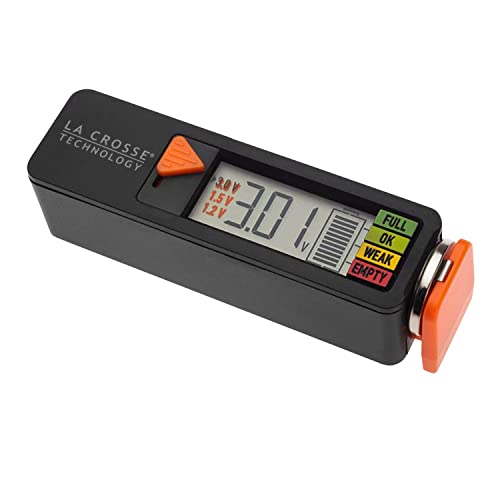
2. La Crosse 911-65557 Digital Battery Tester
Best for: people who like a number on a screen and who also swap coin cells in remotes, scales and key fobs.
The La Crosse 911-65557 shows both a charge status and the voltage in volts. That matters, because a number lets you compare two cells side by side. For example, a 1.52V AA and a 1.38V AA both pass a simple check, yet the second one has far less left.
In addition, La Crosse lists AAA, AA, C, D, N and 9V sizes, plus 3.0V button cells. Furthermore, it covers rechargeable, alkaline and lithium chemistries. However, the maker does not publish its test load, so treat the screen as a guide and not a lab figure.
- Tests: AAA, AA, C, D, N, 9V and 3.0V button cells
- Chemistries: alkaline, rechargeable and lithium
- Display: digital, with charge status and volts
- Use: one battery at a time; never test leaking cells
Pros
- Voltage shown as a number, so you can compare cells
- Reads 3V coin cells and the rare N size
- Compact enough for a kitchen drawer
Cons
- Test load is not published
- Also, it checks only one cell at a time
- No capacity or resistance data
Skip it if: you need a loaded test you can trust on high-drain AA cells; the Amprobe is the safer call there.
Best Pro
3. FNIRSI HRM-10 Internal Resistance Tester
Best for: hobbyists who build packs, match cells or want to know why a battery that “reads fine” still dies early.
The FNIRSI HRM-10 measures internal resistance as well as voltage. To do this, it uses true four-wire (Kelvin) probes and a 1 kHz AC signal, so lead resistance does not pollute the result. In short, it shows how much a cell will sag under current, which a voltage-only checker cannot do.
FNIRSI rates it at plus or minus 0.5%, with ranges up to 100V DC and 200 ohms. In addition, it has a sorting mode with your own limits, user calibration and stored records. Therefore it suits anyone matching 18650 or NiMH cells for a pack.
- Method: four-wire Kelvin, AC 1 kHz
- Voltage range: 0 to 100V DC
- Resistance range: 0 to 200 ohms (20 milliohm lowest range)
- Accuracy: plus or minus 0.5%
- Power: 1,000 mAh rechargeable cell, USB Type-C charging
Pros
- Measures the number that predicts sag under load
- Four-wire method cancels lead resistance, so readings stay clean
- Sorting mode speeds up cell matching
Cons
- Overkill for checking remote-control AAs
- However, probe tips take practice on small cells
- Never use on AC or above 100V DC
Skip it if: you just want a green or red verdict on household cells.
Best for Camera Cells
4. Tenergy T-333 Universal Battery Tester
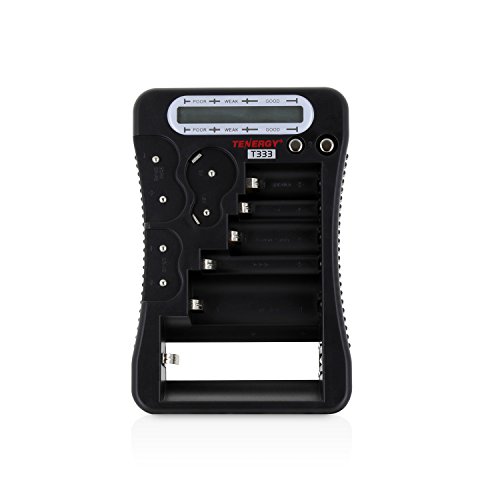
Best for: photographers, flashlight users and anyone with a box of lithium camera cells next to the usual AAs.
The Tenergy T-333 is a small LCD checker with an unusually long size list. Tenergy names AA, AAA, C, D and 9V, plus the lithium camera formats CR123A, CR2, CRV3, 2CR5 and CRP2, and button cells. As a result, one tool covers both the junk drawer and the camera bag.
However, Tenergy does not publish a test load or an accuracy figure for it. Therefore, treat it as a fast sorting tool: it splits clearly good cells from clearly dead ones. For a borderline AA, confirm with a loaded tester such as the Amprobe.
- Tests: AA, AAA, C, D and 9V
- Camera lithium: CR123A, CR2, CRV3, 2CR5 and CRP2
- Also: button cells
- Display: LCD
Pros
- Covers camera lithium formats most checkers skip
- LCD is easy to read at a glance
- Also small enough for a camera bag
Cons
- No published load or accuracy spec
- Shows status, not a lab-grade value
- Contacts can feel loose on tiny buttons
Skip it if: you need to trust a borderline reading before a trip or an important event.
Best for Odd Sizes
5. Gardner Bender GBT-500A Analog Battery Tester
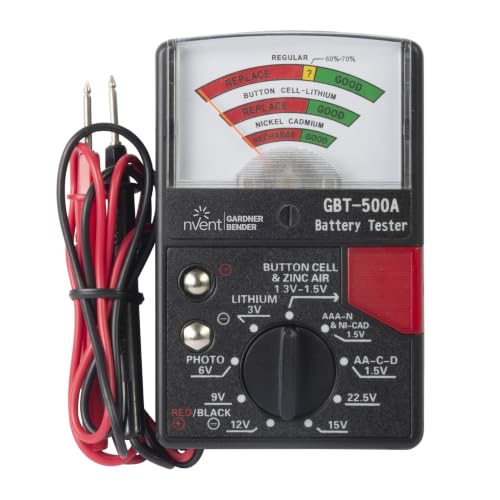
Best for: workshops, camps and collectors with lantern cells, photo batteries and sizes that do not fit a cradle.
Gardner Bender rates the GBT-500A from 1.5V button cells to 22.5V photo and lantern cells. Instead of a fixed cradle, it uses test leads, so you can reach odd terminals such as spring tops on a 6V lantern battery. Meanwhile, the analog scale gives a plain good or bad reading.
Because it reads so many voltages, you must first pick the right scale for each cell. However, that is a small trade for one tester that handles almost any small battery in a toolbox.
- Range: 1.5V button cells to 22.5V photo and lantern cells
- Display: analog meter with a good/bad indicator
- Connection: test leads, so cell shape does not matter
Pros
- Widest range of battery voltages on this list
- Leads reach odd terminals because they are flexible
- No screen or internal battery to fail
Cons
- Easy to read the wrong scale
- Also, there is no digital value
- Leads are slower than a cradle for AAs
Skip it if: you only test AA and AAA cells; a cradle tester is faster.
Best AA/AAA Analyzer
6. SkyRC NC2200 Charger and Analyzer

Best for: homes that run rechargeable NiMH AA and AAA cells in remotes, game controllers and toys and want the real capacity in mAh.
A voltage checker cannot tell you how much energy a rechargeable holds. Instead, the SkyRC NC2200 charges a cell, discharges it at a set current and counts the mAh. Its Refresh and Analyze mode does this automatically, and the screen also shows voltage, current and internal resistance for each of the four slots.
Meanwhile, discharge runs from 0.1 to 1.0A and ends at 0.9V per cell, so results compare well from one test to the next. In addition, an optional Bluetooth dongle adds app graphs. As a result, it is the easiest way to find the one weak AA that keeps killing a set of four.
- Sizes and chemistry: AA and AAA, NiMH and NiCd
- Slots: 4, each independent
- Charge: 0.2 to 2.2A; discharge 0.1 to 1.0A to 0.9V
- Screen: voltage, current, capacity, internal resistance and time
- Power: 12V/2A adapter included
Pros
- True capacity test, not an estimate
- Internal resistance shown per slot
- Break-in mode for new or long-stored cells
Cons
- AA and AAA NiMH or NiCd only
- However, a full analyze cycle takes hours
- App needs a dongle sold separately
Skip it if: your batteries are single-use alkalines or Li-ion flashlight cells.
Best Charger-Tester
7. XTAR VC4SL Charger with Capacity Test

Best for: households that run Eneloop-style NiMH or 18650 flashlight cells and want a simpler capacity check.
The XTAR VC4SL is mainly a four-bay charger. However, XTAR adds a capacity test mode, so it can measure what a rechargeable really holds. It charges 1.2V NiMH and 3.6/3.7V Li-ion cells, and XTAR says it fits protected 21700 cells too.
Charge current runs from 0.25 to 3A, and it takes power over USB Type-C. Therefore it is an easy upgrade from a basic charger if you also want to find the weak cell in a set.
- Bays: 4, each with its own LCD status
- Chemistries: 1.2V NiMH and 3.6/3.7V Li-ion
- Charge current: 0.25 to 3A per bay
- Input: USB Type-C, with QC3.0 support
Pros
- Charger and capacity tester in one
- Handles both NiMH and Li-ion
- Also, USB-C power is easy to find
Cons
- Fewer settings than a full lab analyzer
- No app or data export
- Does not test alkaline, coin or 9V cells
Skip it if: you need detailed logs or LiFePO4 support.
Best for RC Packs
8. Tenergy 5-in-1 Intelligent Cell Meter

Best for: RC drivers and drone pilots who need per-cell numbers on a multi-cell pack at the field.
The Tenergy 5-in-1 plugs into a pack’s balance connector and shows each cell’s voltage, the lowest cell and the gap between highest and lowest. For lithium packs, it also shows each cell’s internal resistance and an estimated charge from 0 to 99%. Next, it can balance cells and discharge a pack at 180 mA for storage.
Overall, it reads 2 to 7 cell LiPo, LiFePO4 and Li-ion packs, plus 4 to 7 cell NiMH and NiCd packs. Moreover, it runs off the battery under test, so there is nothing to charge.
- Packs: 2S to 7S lithium; 4 to 7 cell NiMH and NiCd
- Readings: per-cell voltage, cell spread, estimated charge
- Extras: per-cell resistance (lithium), balancing, 180 mA discharge, servo test
- Power: taken from the pack under test
Pros
- Per-cell view catches one bad cell in a pack
- No batteries needed, because the pack powers it
- Balancer and servo tester built in
Cons
- Not for single AA, 9V or coin cells
- However, percent charge is only an estimate
- Discharge runs are short and need cool-downs
Skip it if: you never use multi-cell hobby packs.
How We Chose the Best Battery Tester Picks
We did not run hands-on tests. Instead, we built this list from research: maker spec pages, battery datasheets and patterns in owner feedback. First, we kept only testers whose makers publish what they measure. Next, we gave extra weight to loaded tests and published thresholds, because an unloaded voltage can flatter a tired cell.
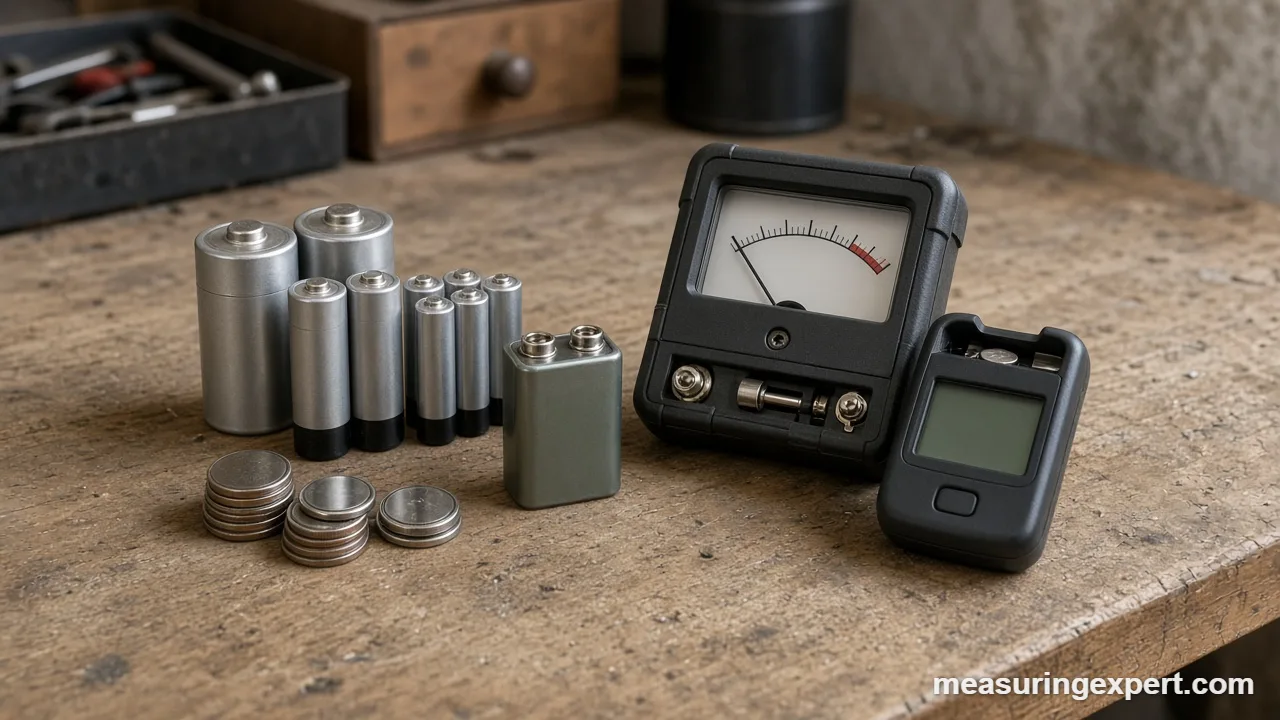
In addition, we wanted one clear job per pick. So the list runs from a quick household checker to resistance meters and capacity analyzers. Finally, we left out car battery tools, since 12V lead-acid batteries need a different test, and we cut listings with no brand or no spec data.
Sources we opened include the Amprobe BAT-250 page, FNIRSI, SkyRC, XTAR, La Crosse, Gardner Bender and Tenergy spec pages and listings, and the Energizer E91 AA alkaline datasheet and CR2032 lithium coin datasheet.
Best Battery Tester Types Compared
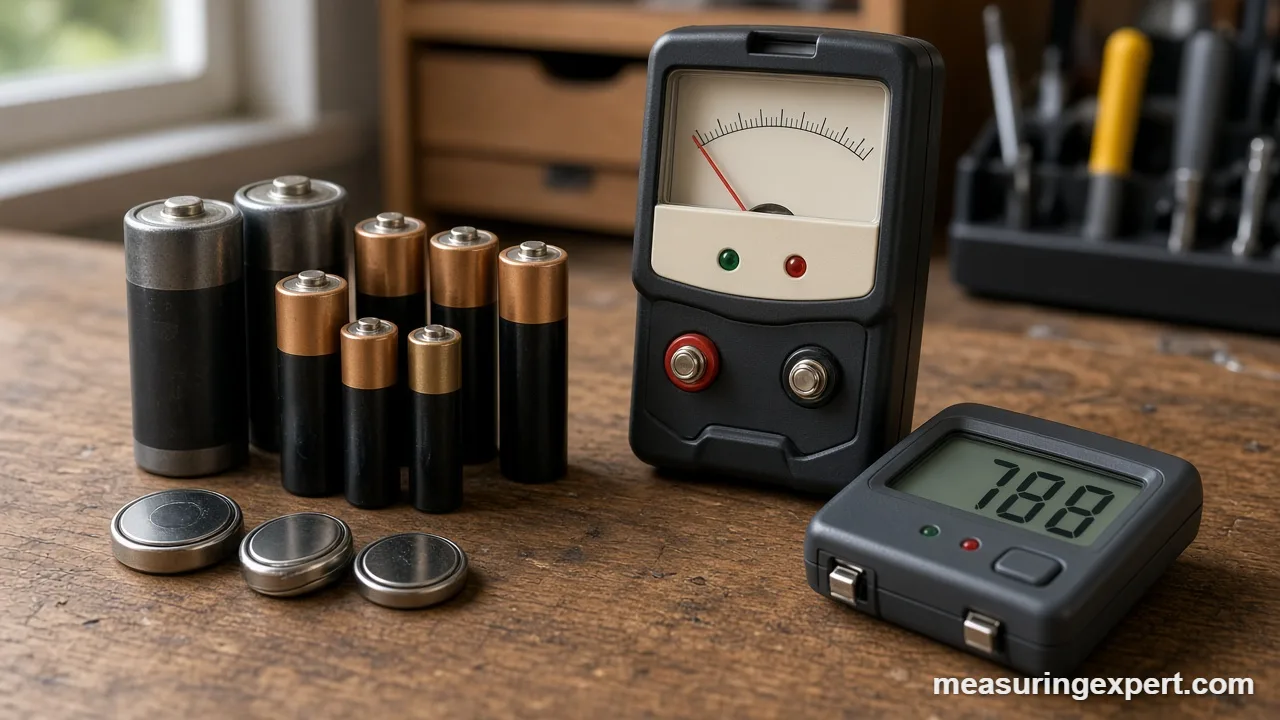
Not every battery tester measures the same thing. In fact, the four main types answer four different questions, so match the type to your question.
| Type | What it measures | Good for | Main weakness |
|---|---|---|---|
| Loaded analog checker | Voltage while a resistor draws current | Alkaline AA to D and 9V | No exact number |
| Digital voltage checker | Voltage, often with little or no load | Coin cells, quick sorting | Can pass a weak cell |
| Internal resistance meter | Voltage and AC resistance | Matching cells, finding aged rechargeables | Needs reference values to judge |
| Charger-analyzer | Real capacity in mAh by discharge | NiMH and Li-ion rechargeables | Slow; not for single-use cells |
For most homes, a loaded checker covers the everyday jobs. However, if you run rechargeables, a capacity test is the only way to see real aging.
Voltage, Load and Resistance: The Measurement Side
First, every battery has an open-circuit voltage, the reading with nothing connected. A fresh alkaline AA is rated 1.5V nominal, while a fresh CR2032 is rated 3.0V. If you want a refresher on the unit itself, our guide to the voltage symbol and unit covers it.
However, the catch is internal resistance. Energizer lists a fresh E91 AA at about 150 to 300 milliohms. So when current flows, that resistance drops some voltage inside the cell. As a result, the terminal voltage falls under load, and it falls further as the cell ages and its resistance climbs.
That is why a loaded test is more honest. For example, the Amprobe draws about 1.5V / 4 ohm = 0.375 A from an AA. A worn cell that shows 1.45V open circuit might drop to near 1.1V at that current, which pushes the needle toward the yellow zone.
Resolution vs accuracy on a battery tester
To begin with, resolution is the smallest step the screen shows, such as 0.01V. Accuracy, on the other hand, is how close that number sits to the true value. So a screen with three decimals is not automatically accurate; check whether the maker publishes an accuracy spec, as FNIRSI does.
Why a voltmeter alone can mislead
For example, a digital multimeter draws almost no current, so it reads open-circuit voltage. That is useful, yet it can pass a cell that collapses in a camera flash. If you already own one, see our digital multimeter picks for models that read to 0.001V, and pair the reading with a loaded check.
Battery Load Current Calculator
Next, use Ohm’s law to see how hard a tester loads a cell. Enter the voltage and the load resistance, and the calculator gives the current and power. For instance, try 1.5V and 4 ohms, then 9V and 215 ohms.
The last row matches the 400 ohm pulse load that Energizer uses in its CR2032 pulse test. Clearly, a coin cell needs a much lighter load than an AA.
How to Use the Best Battery Tester Correctly
- Inspect the cell. First, look for leaks, swelling or crusty terminals, and set any damaged cell aside for recycling.
- Clean the contacts. Next, wipe both ends with a dry cloth, because dirt adds resistance and lowers the reading.
- Pick the right slot or scale. Then choose 1.5V, 3V or 9V, since the wrong scale gives a false verdict.
- Seat the cell firmly. After that, press the slider or leads so both ends touch, and watch for a steady reading.
- Read within a few seconds. Also, do not hold a loaded tester on the cell for long, as the load slowly drains it.
- Label and sort. Finally, mark cells as good, low or replace, and keep weak ones for low-drain devices like clocks.
Reading Results From the Best Battery Tester
Use these rough guides for open-circuit readings at room temperature. However, always follow your tester’s own scale first, because loads differ.
| Battery | Nominal | Fresh (open circuit) | Replace around |
|---|---|---|---|
| Alkaline AA, AAA, C, D | 1.5V | About 1.5 to 1.6V | Below 0.9V under load (Amprobe scale) |
| Alkaline 9V | 9V | About 9V or a little more | Below 5.3V under load (Amprobe scale) |
| NiMH AA, AAA | 1.2V | About 1.3 to 1.4V just off the charger | Use a capacity test instead |
| Lithium coin CR2032 | 3.0V | About 3V or a little more | 2.0V is the datasheet cutoff |
Note, however, that a NiMH cell reads 1.2V for most of its life, so a 1.5V scale makes good NiMH cells look low. Instead, judge rechargeables by capacity in mAh.
Battery Testing Do and Don’t
For car, boat and RV batteries, a cranking load tester is the right tool; our battery load tester guide covers those.
Honest Limits of Even the Best Battery Tester
In short, a quick checker gives a snapshot, not a forecast. It cannot say how many hours a cell will last in your device, because that depends on the device’s draw. In addition, lithium cells tend to hold a fairly steady voltage for much of their life, so a voltage check says little about how much is left.
Calibration also drifts over time. Therefore, check your tester now and then against a fresh cell or a meter you trust; our note on calibration in measurement tools explains why.
Battery Tester FAQ
What is the best battery tester for household batteries?
The Amprobe BAT-250 is the best battery tester for most homes. It loads each AA, AAA, C, D or 9V cell before it reads, uses a clear color scale and needs no battery of its own.
Are digital battery testers more accurate than analog ones?
Not by default. Admittedly, a digital screen shows more decimals, yet accuracy depends on the circuit and the load. In fact, a loaded analog tester can judge an alkaline cell better than an unloaded digital one.
Can the best battery tester check CR2032 coin cells?
Yes, if it has a 3V slot. The La Crosse 911-65557 lists 3V button cells, while the Amprobe BAT-250 covers only 1.5V buttons.
Why does a battery read good on a multimeter but fail in my device?
A multimeter draws almost no current, so it reads open-circuit voltage. However, under a real load, internal resistance drags the voltage down. As a result, a tired cell can pass the meter and still fail.
Can I use a battery tester on rechargeable batteries?
Yes, but read it carefully. NiMH cells sit near 1.2V, so a 1.5V scale makes them look low. For a true answer, use a capacity tester such as the SkyRC NC2200 or XTAR VC4SL.
Does the best battery tester drain the battery?
Only slightly, and only during the test. A loaded tester draws current for a few seconds, which costs a tiny share of capacity. However, do not leave a cell sitting in a loaded tester.
What voltage means an AA battery is dead?
Amprobe marks 1.5V cells for replacement below 0.9V under load. Also, Energizer’s AA capacity tests run down to 0.8V, so cells near that level have almost nothing left.
Can a household battery tester check a car battery?
No. Instead, a 12V car battery needs a cranking load or conductance test. Use a dedicated car battery load tester instead of a small cell checker.
How often should I test my batteries?
First, test stored cells before trips, storms or events, and check smoke alarm and flashlight cells a few times a year. For rechargeables, run a capacity test every few months.
Is the best battery tester worth it for a few batteries?
Usually, yes. After all, a low-cost tester stops you from tossing good cells and from loading dead ones into a flashlight. So it often pays for itself in saved batteries.
Bottom Line: The Best Battery Tester to Buy
For most readers, the Amprobe BAT-250 is the best battery tester to buy. That is because it loads each cell, uses published thresholds and never needs a battery. If you want numbers and coin cells, the La Crosse 911-65557 is the digital pick, and the FNIRSI HRM-10 suits anyone who matches cells.
Finally, if your batteries are rechargeable, a capacity analyzer such as the SkyRC NC2200 tells you far more than any quick checker.
2 thoughts on “Best Battery Tester for AA, 9V and Coin Cells: 8 Picks for 2026”