

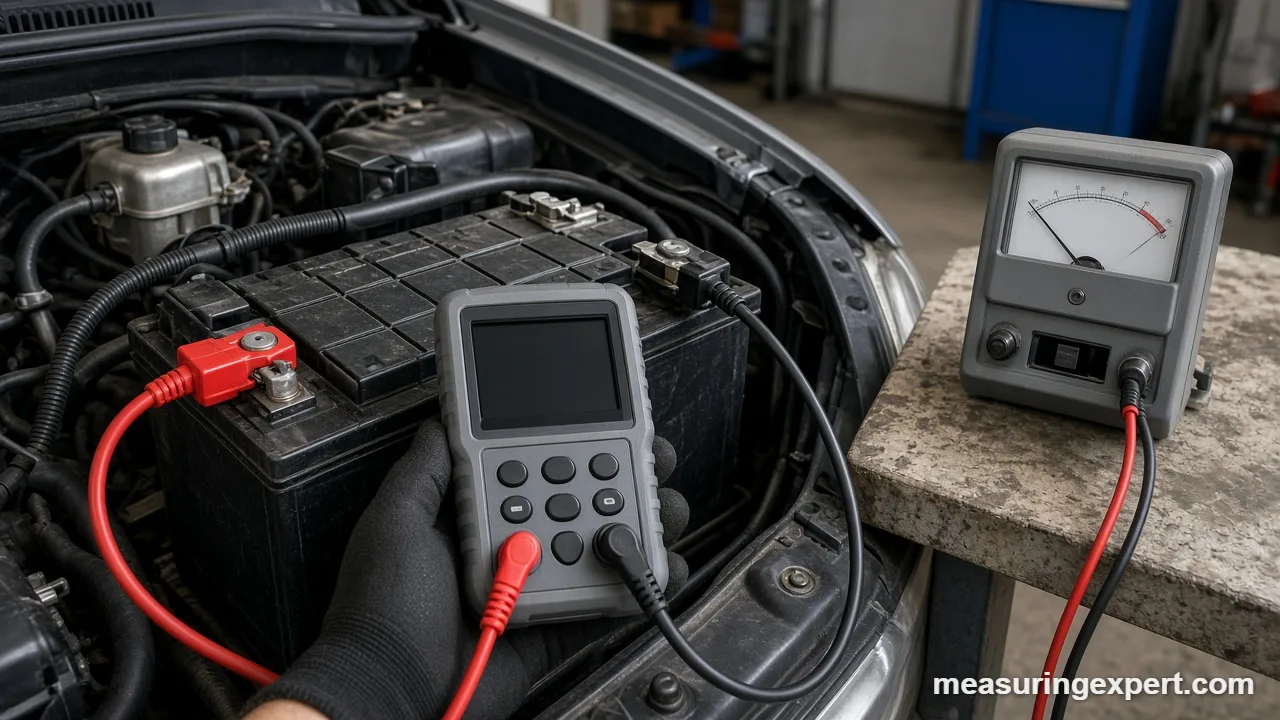
The best battery load tester for most drivers is the TOPDON BT100, a 12V handheld that checks battery health, cranking and charging in one hookup. However, the right pick depends on one choice: a conductance tester for quick, safe checks, or a true high-current load tester such as the OTC 3181 for shop-grade proof.
In short: get the TOPDON BT100 for everyday checks, the ANCEL BA101 on a tight budget, and the OTC 3181 when you want a real 130 A load test.
As an Amazon Associate, Measuring Expert earns from qualifying purchases. Our picks are based on research, specifications and owner feedback, not paid placement.
Best Overall

Best Budget

Best Pro Load Tester

Quick Answer: Which Battery Load Tester Fits You?
- Everyday 12V checks: TOPDON BT100, with battery, cranking and charging tests.
- Real load, pro style: OTC 3181, which pulls 130 A from 6V or 12V batteries.
- Lowest cost digital: ANCEL BA101, with ten rating standards.
- Printed reports: TOPDON BT600, with a thermal printer and 24V system tests.
- Most data: KONNWEI KW208, which graphs voltage and shows resistance in mOhm.
- Light 6V/12V load tool: Schumacher BT-100, at 1.1 lb.
- Key rule: charge the battery to at least 12.4 V before any test, or the result will read low.
On This Page
- All picks side by side
- The 8 picks, reviewed
- How we chose
- Conductance vs load testers
- CCA and rating standards explained
- Voltage targets and pass marks
- Load and resistance calculator
- How to load test a car battery
- Do and Don’t
- Honest limits
- FAQ
- Bottom line
Best Battery Load Tester Comparison Table
Here is each pick in one row; the reviews below explain the specs.
| # | Product | Best For | Standout Feature | Amazon |
|---|---|---|---|---|
| 1 | TOPDON BT100 | Most DIY car owners | Battery, cranking and charging tests in one handheld | View |
| 2 | OTC 3181 130 Amp Heavy-Duty Load Tester | Shops and true load testing | 130 A load on 6V and 12V batteries | View |
| 3 | ANCEL BA101 | First-time buyers on a budget | Ten rating standards and multi-language menus | View |
| 4 | TOPDON BT600 | Shops that hand customers a report | Built-in thermal printer and 3.5 in color screen | View |
| 5 | KONNWEI KW208 | Owners who like to see data | Voltage waveform and mOhm readout on a color screen | View |
| 6 | FOXWELL BT100 Pro | AGM, spiral and gel battery owners | Built for flooded, AGM flat, AGM spiral and gel | View |
| 7 | Schumacher BT-100 Load Tester | Powersport and marine owners | 100 A load at 12V, 50 A at 6V, only 1.1 lb | View |
| 8 | SOLAR 1852 100 Amp Load Tester | Garages wanting a sturdy fixed-load unit | Color-coded meter and 18 in cable reach | View |
The 8 Best Battery Load Tester Picks, Reviewed
This list covers 6V, 12V and 24V vehicle batteries. For AA, AAA, 9V and coin cells, see our household battery tester picks instead.
Best Overall
1. TOPDON BT100
Best for: Drivers who want a quick yes or no on a 12V car, truck, boat or motorcycle battery, plus a look at the alternator.
For most people, the TOPDON BT100 is the best battery load tester to keep in the garage, even though it is technically a conductance tester. Also, it runs three tests from one pair of clamps. The battery test reports state of health, state of charge and internal resistance.
Next, the cranking test logs the starting voltage and the cranking time while you start the engine. Finally, the charging test checks the alternator, the regulator and the connections with the engine running. Also, TOPDON gives 13.2 to 15 V as the normal loaded charging window and 100 mV or less as normal ripple.
- Works on 12V lead-acid batteries in cars, SUVs, trucks, ATVs, motorcycles and boats
- Battery test: state of health, state of charge and internal resistance
- Cranking test: starting voltage and cranking time
- Charging test: normal loaded voltage 13.2 to 15 V; ripple 100 mV or less
Pros
- No heat, no sparks and no drain on the battery
- Also checks the starter and alternator
- Small enough for a glove box
Cons
- 12V batteries only
- Conductance estimates CCA instead of pulling a real load
- No printer or saved reports
Skip it if: you work on 6V classics or 24V trucks, because it is a 12V-only tool.
Best Pro Load Tester
2. OTC 3181 130 Amp Heavy-Duty Load Tester
Best for: Mechanics and serious DIYers who want a real high-current load test instead of an electronic estimate.
The OTC 3181 is the classic answer if you want an honest load test. Instead of measuring conductance, it pulls 130 A from the battery through a heavy resistor. As a result, a weak cell cannot hide, because the voltage sags under the real current. In addition, OTC says a test takes about 10 seconds.
On the measurement side, the meter reads 0 to 16 V and has a zero adjust, so you can trim the needle before each test. In addition, it handles both 6V and 12V batteries, and the clamps fit top-post and side-post terminals.
- Load: 130 A fixed
- Batteries: 6V and 12V
- Meter: 0 to 16 V with zero adjust and an extra-large face
- Test time: about 10 seconds
Pros
- Real current draw finds weak cells
- Works on 6V tractors and classics
- No batteries or software to maintain
Cons
- Needs a charged battery to give a fair result
- Load coil gets hot and needs cool-down time
- Analog needle means no stored data
Skip it if: you only want a quick check on one modern car, since a handheld conductance tester is easier.
Best Budget
3. ANCEL BA101
Best for: Budget-minded owners who still want a digital CCA reading and the right rating standard for their battery label.
Overall, the ANCEL BA101 is a simple, low-cost digital tester that covers the basics well. For example, it estimates the actual cold cranking amps, reports battery health and flags common faults in the starting and charging systems. Also, ANCEL lists ten rating standards, from CCA and SAE to EN, DIN, IEC and JIS.
In addition, it accepts an input of 9 to 15 V and covers batteries from 30 to 220 Ah.
- System voltage: 12V; input range 9 to 15 V
- Capacity range: 30 to 220 Ah
- Standards: CCA, BCI, CA, MCA, JIS, DIN, IEC, EN, SAE and GB
- Battery types: flooded, deep-cycle marine, VRLA/MF, SMF, AGM and gel
Pros
- Covers almost every rating standard
- Very small and light
- Tests the charging and starting systems too
Cons
- 12V only
- Basic monochrome-style results
- EFB batteries are not on the stated list
Skip it if: you drive a start-stop car with an EFB battery and want the type listed by the maker.
Best With Printer
4. TOPDON BT600

Best for: Shops, fleet techs and mobile mechanics who need a printed report and 24V system checks.
In short, the BT600 takes the BT100 idea and adds what a shop needs. First, results show on a 3.5 in color screen. Then the built-in thermal printer prints a report right after the test. Also, TOPDON says it uses conductance testing to report the actual CCA and the state of health.
Importantly, the battery test itself is for 12V batteries. However, the cranking and charging tests also cover 24V lead-acid systems, which helps with trucks and buses that use two batteries in series.
- Battery test: 12V lead-acid
- Cranking and charging tests: 12V and 24V systems
- Display: 3.5 in color screen
- Built-in thermal printer for instant reports
Pros
- Printed reports build customer trust
- Covers 24V starting and charging systems
- Large color screen is easy to read
Cons
- Battery test is still 12V only
- Paper rolls are an ongoing cost
- Overkill for one family car
Skip it if: you test only your own car, since the BT100 covers the same 12V battery test.
Best Color Display
5. KONNWEI KW208

Best for: Hands-on owners who want internal resistance in milliohms and a live voltage graph during cranking.
Above all, the KW208 shows more raw data than most testers in its class. For example, it displays internal resistance in milliohms (mOhm), a life percentage and a voltage waveform on a color TFT screen.
On the spec sheet, KONNWEI lists a 100 to 2000 CCA range for the CCA, BCI, CA, MCA, SAE and EN standards, and 100 to 1400 for DIN and IEC. In addition, it covers EFB and spiral AGM batteries, which matters for start-stop cars.
- Range: 100 to 2000 CCA (CCA, BCI, CA, MCA, SAE, EN); 100 to 1400 (DIN, IEC); JIS sizes
- Battery types: flooded, VRLA/MF, SMF, AGM flat and spiral, EFB and gel
- Shows internal resistance (mOhm), life percentage and voltage waveform
- Input: 8 to 16 V; no internal battery needed
Pros
- Most data per test in this list
- Lists EFB support for start-stop cars
- Records and replays past tests
Cons
- 12V systems only
- Will not work below 32 F (0 C) per the spec
- More screens to learn than a 3-LED tester
Skip it if: you test batteries outdoors in freezing weather, because the rated operating range starts at 32 F.
Best for AGM and Gel
6. FOXWELL BT100 Pro

Best for: Owners of AGM, spiral-wound or gel batteries who want a tester designed around those types.
FOXWELL designed its BT100 line for 12V flooded, AGM flat plate, AGM spiral and gel batteries. That focus matters, because a conductance tester must know the battery type to judge the reading. So picking the right type keeps the result honest.
Besides that, the tester reports battery health and charge status and flags common faults. However, FOXWELL publishes most of its detailed spec table as an image, so we could not confirm the CCA range from a text source.
- Battery voltage: 12V
- Battery types: flooded, AGM flat plate, AGM spiral and gel
- Reports battery health and charge status
- Flags common battery faults
Pros
- Type menu covers AGM spiral cells
- Simple, focused 12V battery check
- Long-running product line from an established maker
Cons
- Fewer published specs than rivals
- No printer
- Not for 6V or 24V batteries
Skip it if: you need 24V truck tests or printed reports.
Best Lightweight Load Tester
7. Schumacher BT-100 Load Tester

Best for: Owners of motorcycles, ATVs, boats and older 6V vehicles who want a real load test in a light tool.
The BT-100 puts a 100 A load on a 12V battery or a 50 A load on a 6V battery. Then you read the result on an analog meter. In addition, Schumacher rates it for batteries up to 1,000 cranking amps, with a stated range of 200 to 1,000 CCA (SAE).
Beyond the battery test, it also checks charging system output and starter motor draw. Also, the tool weighs only 1.1 lb (0.5 kg). However, the cable reach is short, at 0.83 ft.
- Load: 100 A at 12V; 50 A at 6V
- Range: 200 to 1,000 CCA (SAE); up to 1,000 CA
- Tests: battery health, charging system and starter draw
- Weight: 1.1 lb (0.5 kg); size 6.75 x 15.13 x 3.5 in
Pros
- Real load test at a low weight
- Handles both 6V and 12V
- Simple rocker switch operation
Cons
- Very short cable reach
- Analog meter is harder to read precisely
- 6-month warranty is short
Skip it if: your battery is over 1,000 CCA, such as a large diesel truck battery.
Best Shop-Grade 100 A Tester
8. SOLAR 1852 100 Amp Load Tester

Best for: Home garages and small shops that want a rugged 100 A tester with longer leads than the Schumacher.
The SOLAR 1852 comes from Clore Automotive, a long-time maker of shop battery tools. Like the Schumacher, it applies a fixed 100 A load and works on 6V and 12V batteries. However, it is heavier at 5.0 lb (2.3 kg), and the cables reach 18 in.
Next, Clore calibrates the meter for batteries up to 1,000 CCA. In addition, the full-size meter has a color-coded, graduated scale, so you can judge the result at a glance.
- Load: 100 A fixed
- Batteries: 6V and 12V, up to 1,000 CCA
- Meter: full-size, color-coded graduated scale
- Cable reach: 18 in (46 cm)
Pros
- Longer leads than most compact load testers
- Color zones make results quick to read
- Solid shop-grade build
Cons
- Heavier than the Schumacher
- Fixed load cannot match half-CCA test rules
- No digital readout or memory
Skip it if: you want test numbers you can save, since the meter is analog.
How We Chose the Best Battery Load Tester Picks
We did not run hands-on tests for this guide. Instead, our picks are research-based. First, we read the product and spec pages from TOPDON, ANCEL, KONNWEI, FOXWELL, OTC, Schumacher and Clore Automotive. For example, the OTC 3181 product page gives the load, meter range and test time. Next, we weighed owner feedback on false results and clamp quality.
Then we scored each model on five points:
- Test method: a real resistive load, or a conductance estimate of CCA.
- Voltage coverage: 6V, 12V and 24V support for the battery and the system tests.
- Rating standards: CCA, SAE, EN, DIN, IEC and JIS, so the tester matches your label.
- Battery types: flooded, AGM, EFB and gel, since each one reads differently.
- Usability: clamp fit, cable reach, screen, printer and published specs.
In addition, we capped each brand at two picks, and we left out unbranded listings and models that their makers no longer list.
Conductance vs Load: Picking the Best Battery Load Tester Type
“Battery load tester” covers three quite different tools. So decide on the method first, and only then compare brands.
| Type | How it measures | Good for | Watch out for |
|---|---|---|---|
| Conductance (digital) tester | Sends a small AC signal and measures conductance, the inverse of internal resistance, then estimates CCA | Fast checks, AGM and EFB batteries, cranking and charging tests | An estimate, not a real load; needs the right battery type and standard |
| Fixed-load tester | Pulls a set current, such as 100 A or 130 A, through a resistor coil while a meter shows voltage | Proving a battery can deliver real current; 6V and 12V | Coil gets hot; cannot scale the load to the battery size |
| Adjustable carbon pile | Squeezes carbon discs to set any load, often up to hundreds of amps, with volt and amp meters | Shop tests at half the CCA rating; large and 24V batteries | Heavy, costly and needs care to avoid sparks and heat |
Note that many people call any load tester a “carbon pile”. However, the compact 100 A and 130 A tools in this list use a fixed resistor. By contrast, a true carbon pile, such as the SOLAR 1876, offers a variable load up to 1,000 A and tests batteries to 2,000 CCA, but it weighs 25.6 lb (11.6 kg). So for home garages, a conductance tester plus a light fixed-load tool is plenty.
As a result, many shops use both: a quick conductance check first, then a load test to confirm a borderline result.
CCA Explained Before You Buy the Best Battery Load Tester
To begin with, cold cranking amps (CCA) is the rating most testers compare against. Under the SAE method, CCA is the current a new, fully charged 12V battery can deliver at 0 F (-17.8 C) for 30 seconds while staying at or above 7.2 V. That is, in fact, 1.2 V per cell across six cells. In other words, CCA tells you how hard the battery can crank a cold engine.
Other ratings on the label work differently:
- CA or MCA (cranking amps, marine cranking amps): the same idea, but measured at 32 F (0 C). So the CA number is always higher than the CCA number for the same battery.
- EN, DIN, IEC and JIS: European, German, international and Japanese standards. They use different test times and end voltages, so the numbers do not convert one to one.
Therefore, always set your tester to the standard printed on the label. For example, a battery labeled 600 EN tested on the SAE setting will look weaker or stronger than it really is.
Moreover, every battery has a small internal resistance, usually a few milliohms in a healthy car battery. So when the starter pulls current, that resistance causes a voltage drop inside the battery. As plates sulfate and age, the resistance rises, so the voltage sags more under load. That is why both test methods work: a load tester sees the sag directly, while a conductance tester measures the resistance that causes it.
Pass Marks to Use With the Best Battery Load Tester
Before any load test, check the resting voltage with a meter. For this step, a basic voltmeter or one of our best digital multimeter picks works well. Then use the table below for a flooded 12V battery that has rested for a few hours at about 80 F (27 C). AGM batteries read slightly higher, so follow the maker’s chart for those.
| Resting voltage | Approximate state of charge | Ready to load test? |
|---|---|---|
| 12.65 V or more | 100% | Yes |
| 12.45 V | 75% | Yes, the minimum for a fair test |
| 12.24 V | 50% | No, charge it first |
| 12.06 V | 25% | No, charge it first |
| 11.89 V or less | Discharged | No; charge, then retest |
The half-CCA rule for carbon pile testers
Next comes the classic carbon pile rule used in many service manuals. Apply a load equal to half the CCA rating for 15 seconds. For example, a 600 CCA battery gets a 300 A load. At 70 F (21 C) or warmer, the voltage at the end of the 15 seconds should stay at or above 9.6 V. In colder weather, the pass mark drops, because chemistry slows down.
| Battery temperature | Minimum voltage after 15 s at half CCA |
|---|---|
| 70 F (21.1 C) and above | 9.6 V |
| 60 F (15.6 C) | 9.5 V |
| 50 F (10.0 C) | 9.4 V |
| 40 F (4.4 C) | 9.3 V |
| 30 F (-1.1 C) | 9.1 V |
| 20 F (-6.7 C) | 8.9 V |
| 10 F (-12.2 C) | 8.7 V |
| 0 F (-17.8 C) | 8.5 V |
However, fixed 100 A and 130 A testers do not follow the half-CCA rule. Instead, read the color band on the meter for your battery size, as the manual explains. Finally, with the engine running, a healthy charging system usually reads about 13.2 to 15 V at the battery, which is the window TOPDON uses on the BT100. For more on volts as a unit, see our voltage symbol and unit guide.
Battery Load and Internal Resistance Calculator
In fact, Ohm’s law links the numbers a battery load tester shows. First, the current through a fixed load equals the voltage divided by the load resistance. For example, a 0.12 ohm coil on 12 V draws 100 A and turns 1,200 W into heat. That is why load coils get hot so fast. Similarly, if the battery voltage drops 0.5 V under a 100 A load, its internal resistance is about 0.005 ohm, or 5 mOhm. Fill in any two boxes below.
How to Use the Best Battery Load Tester Step by Step
These steps cover both tester types, so follow your manual where it differs.
- Put on safety glasses and gloves, and keep sparks and flames away, because batteries can vent hydrogen gas.
- Check the resting voltage with a meter, and charge the battery if it reads below about 12.4 V.
- Remove surface charge after charging by switching on the headlights for about one minute, or let the battery rest for a few hours.
- Read the battery label and note the rating number, the standard (CCA, EN, DIN and so on) and the battery type.
- Connect the red clamp to the positive post and the black clamp to the negative post, and make sure both bite clean metal.
- On a conductance tester, select the battery type and standard, enter the rating, and start the test; on a load tester, apply the load for 10 to 15 seconds and read the meter at the end.
- Run the cranking test while someone starts the engine, then the charging test with the engine at idle.
- Let a load tester cool before you repeat a test, then recharge the battery fully.
Finally, if a result is borderline, charge fully and retest the next day.
Battery Testing Do and Don’t
Honest Limits of Even the Best Battery Load Tester
Of course, no tester can predict exactly when a battery will die. A conductance reading is an estimate, and it can mislead on a battery that is badly discharged or has a single shorted cell. Meanwhile, a fixed-load test shows only one current at one moment.
Also, keep in mind that a weak battery is not always the root cause. For example, a parasitic drain, a slipping belt or a failing alternator can flatten a good battery again and again. So if a new battery keeps failing, test the charging system and the key-off current draw too.
Best Battery Load Tester FAQ
What is the best battery load tester for most drivers?
For most drivers, the TOPDON BT100 is the best pick. It tests 12V battery health, cranking and charging from one hookup, and it does not heat up or drain the battery.
Is a conductance tester as good as a carbon pile load tester?
For quick checks, yes. A conductance tester estimates CCA from internal resistance, so it is fast and safe. However, a real load test shows how the battery handles high current.
What does CCA mean on a car battery?
CCA means cold cranking amps. Under the SAE method, it is the current a fully charged 12V battery can deliver at 0 F (-17.8 C) for 30 seconds while staying at or above 7.2 V.
What voltage should a battery hold during a load test?
With a load equal to half the CCA rating for 15 seconds, a 12V battery should stay at or above 9.6 V at 70 F (21 C). In colder weather, the pass mark is lower, down to about 8.5 V at 0 F.
Do I need to charge the battery before testing it?
Yes. Charge it to at least about 12.4 V first, or the test will read low. Also, remove surface charge by running the headlights for about a minute or letting the battery rest.
Can a battery load tester check the alternator?
Many can. For example, the TOPDON BT100 and the Schumacher BT-100 include a charging test. With the engine running, a healthy system usually reads about 13.2 to 15 V.
Can I test AGM and EFB batteries?
Yes, but set the tester to the right type. AGM and EFB batteries have lower internal resistance than flooded ones, so a conductance tester needs the correct type to judge them. The KONNWEI KW208 lists EFB support.
Can a battery load tester check 6V or 24V batteries?
Some can. The OTC 3181, Schumacher BT-100 and SOLAR 1852 test 6V and 12V batteries. Meanwhile, the TOPDON BT600 also runs cranking and charging tests on 24V systems.
Is load testing a battery safe?
It is safe if you follow the manual. Wear eye protection, keep sparks away, connect the clamps before switching on the load, and never test a frozen, swollen or leaking battery. Also, let a load tester cool between tests.
How is this different from a household battery tester?
A household tester checks AA, AAA, 9V and coin cells. By contrast, a battery load tester works on vehicle batteries that deliver hundreds of amps.
Bottom Line: The Best Battery Load Tester to Buy
For most drivers, the TOPDON BT100 is the best battery load tester to buy. It checks the battery, the starter and the alternator from one hookup, and it never heats up or drains the battery. However, choose the OTC 3181 if you want a real high-current load test, or the TOPDON BT600 if customers need a printed report.
1 thought on “Best Battery Load Tester for Car Batteries (2026): 8 Picks and a CCA Guide”