

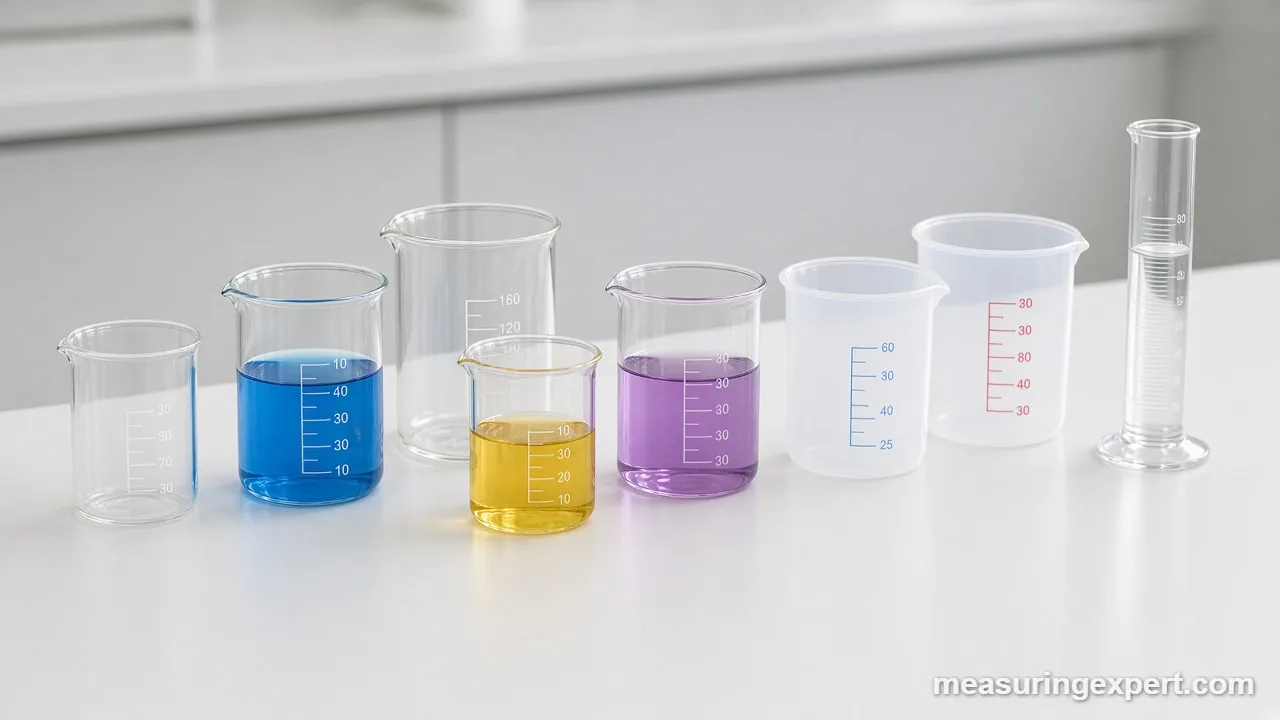
The best laboratory beakers for most home labs, classrooms and hobby benches come in the Karter Scientific six-size borosilicate 3.3 set. However, the right pick depends on heat, chemicals and breakage risk. Also remember that beaker lines are approximate, so use a graduated cylinder or volumetric flask when volume really matters.
In short: Karter Scientific set for most people, PYREX 1000-1L for serious glassware, Bel-Art polypropylene for a cheap shatter-resistant option, and the Eisco kit if you also need Class A cylinders.
As an Amazon Associate, Measuring Expert earns from qualifying purchases. Our picks are based on research, specifications and owner feedback, not paid placement.
Best Overall
Best Budget

Best Pro Glass

Before you shop for the best laboratory beakers, one honest point. A beaker is a mixing and heating vessel first and a measuring tool second. Its printed lines help you get close, but they are not meant for exact work. For that reason, this guide also explains when to reach for other glassware.
Best Laboratory Beakers: Quick Answer
- Most people: the Karter Scientific set gives you six borosilicate sizes from 10 mL to 1,000 mL.
- Serious lab glass: the PYREX 1000-1L has a double scale in 50 mL steps and a large marking spot.
- Classroom bulk: a 12-pack of KIMAX 400 mL beakers covers a whole bench of students.
- Titration and stirring: the PYREX 1060-1L tall form beaker reduces splashing.
- Real accuracy too: the Eisco nine-piece kit adds three ASTM Class A graduated cylinders.
- Clear plastic: the Nalgene PMP beaker looks like glass and is autoclavable.
- Tight budget or young students: Bel-Art and Eisco polypropylene beakers shrug off drops.
On This Page
- Comparison table
- The 8 picks, reviewed
- How we chose
- Borosilicate 3.3, PP and PMP
- How accurate are beaker lines?
- Volume converter
- How to read a beaker
- Heating, cleaning and care
- FAQ
- Bottom line
Best Laboratory Beakers Compared
First, decide between glass and plastic, because that choice narrows the best laboratory beakers fast. Then use the table to jump to the review that fits your bench.
| # | Product | Best For | Standout Feature | Amazon |
|---|---|---|---|---|
| 1 | Karter Scientific 6-Size Set | Home labs and students | Six borosilicate sizes, 10 to 1,000 mL | View |
| 2 | PYREX 1000-1L Griffin | Professional labs | Double scale and extra-large marking spot | View |
| 3 | KIMAX 14000-400 (12-pack) | Classrooms | Twelve matching 400 mL beakers | View |
| 4 | PYREX 1060-1L Tall Form | Titration and stirring | Tall Berzelius shape with spout | View |
| 5 | Eisco 9-Piece Glassware Set | Measuring accurately | Includes Class A graduated cylinders | View |
| 6 | Nalgene PMP Griffin 250 mL | Clear plastic | Glass-like clarity, autoclavable | View |
| 7 | Bel-Art Polypropylene 600 mL | Budget and kids | Pack of four shatter-resistant beakers | View |
| 8 | Eisco Polypropylene 1,000 mL | Large plastic batches | Raised graduations every 20 mL | View |
The 8 Best Laboratory Beakers, Reviewed
Here are the best laboratory beakers in detail. We cover the glass picks first, since most chemistry work starts there. After that, we move to three plastic beakers for teaching, field work and anything that might hit the floor.
Best Overall
1. Karter Scientific 3.3 Boro Griffin Low Form Beaker Set
Best for: home chemists, homeschoolers and students who want one set that covers almost every job.
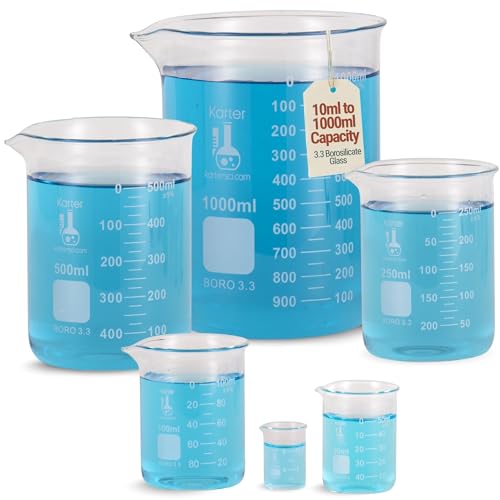
This set leads our best laboratory beakers list because it solves the size question in one purchase. You get six Griffin low form beakers, from a tiny 10 mL cup to a full liter. As a result, you can dissolve a pinch of salt or heat a large water bath without buying more glass. In addition, the glass is borosilicate 3.3, so it handles a hot plate far better than kitchen glass.
On the measuring side, treat the printed lines as a guide. For example, the 1,000 mL beaker is fine for “about 600 mL of water”, but a recipe that needs 600.0 mL belongs in a graduated cylinder. Also, the smallest sizes have few lines, so they work best for holding samples rather than measuring them.
- Sizes: 10, 50, 100, 250, 500 and 1,000 mL, so one set covers most jobs
- Material: 3.3 borosilicate glass
- Style: Griffin low form with a pouring spout
- Six beakers in total, because you get one of each size
Pros
- Covers small samples and also large batches
- Borosilicate glass suits hot plates
- Low form shape is stable on a bench
Cons
- Lines are approximate, like every beaker
- Only one of each size, so there are no spares
- However, glass breaks if dropped on hard floors
Skip it if: you need many identical beakers for a class, or the users are young children.
Best Pro Glass
2. PYREX 1000-1L Griffin Low Form Beaker
Best for: university, industrial and serious hobby labs that want name-brand borosilicate glass.
PYREX is the benchmark brand in lab glass, and the 1000-1L is its classic one-liter Griffin beaker. According to Corning’s product page, it has a double metric scale from 50 to 1,000 mL in 50 mL steps. Corning also notes the uniform wall thickness, which balances thermal shock resistance with strength.
Notably, Corning itself says the scale shows approximate content. That is an honest label; in fact, it applies to every beaker on this list. Even so, the extra-large marking spot is handy, because you can write a sample name or date on the glass with a pencil.
- Capacity: 1 L with a double scale, 50 to 1,000 mL
- Graduation step: 50 mL
- Size: about 158 mm (6.2 in) tall and 108 mm (4.3 in) wide
- Extra-large marking spot and pouring spout
- Reference standard: ASTM E960 (Griffin beakers)
Pros
- Trusted brand with uniform walls
- Double scale, so it reads from either side
- Large writable marking area
Cons
- However, you get only one beaker and one size
- Coarse 50 mL steps for small volumes
Skip it if: you mostly work with volumes under 100 mL.
Best for Classrooms
3. KIMAX 14000-400 Griffin Beaker, 12-Pack

Best for: teachers and lab managers who need a stack of identical beakers.
KIMAX is the other big American lab glass name, now part of DWK Life Sciences. This listing is a case of twelve 400 mL Griffin low form beakers with a double capacity scale. Because every student gets the same beaker, results are easier to compare across the room. In addition, 400 mL is a useful middle size for water baths, simple reactions and rinsing.
The listing gives 25 mL graduations from 50 to 325 mL. In other words, the top of the beaker is left unmarked as headspace, so you are not tempted to fill it to the brim. As a result, it encourages safe stirring and heating.
- Capacity: 400 mL, 12 per pack
- Graduations: 25 mL steps, 50 to 325 mL, double scale
- Style: Griffin low form with spout
- Brand: KIMAX borosilicate lab glass
Pros
- Twelve matching beakers, so a whole class is covered
- Finer 25 mL steps than the 1 L PYREX
- Unmarked headspace limits spills
Cons
- However, twelve is too many for one person at home
- One size only
Skip it if: you only need two or three beakers.
Best Tall Form
4. PYREX 1060-1L Tall Form Berzelius Beaker
Best for: titrations, magnetic stirring and any job where splashing is a problem.
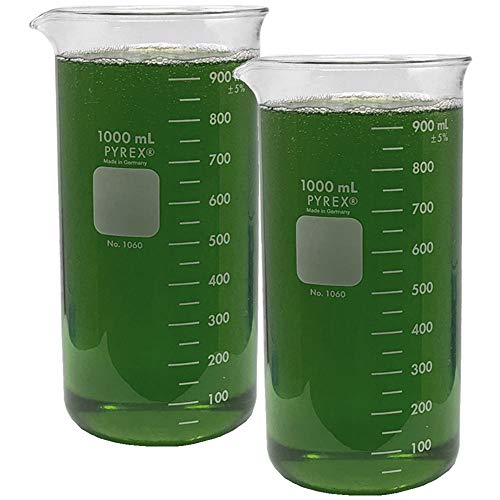
In short, a tall form beaker trades width for height. As a result, liquid sits deeper, so a stir bar or swirling is less likely to throw drops over the rim. Corning’s page lists the 1060-1L at about 187 mm (7.4 in) tall and 89 mm (3.5 in) wide, with 50 mL graduations from 50 to 950 mL. In addition, this Amazon listing is a pack of two.
Also, the narrower column makes a level line a little easier to judge than in a wide beaker. Still, the scale is approximate, so the advice stays the same: measure in a cylinder, then pour into the tall beaker to work.
- Capacity: 1 L, graduated 50 to 950 mL in 50 mL steps
- Size: about 187 mm tall and 89 mm wide
- Style: tall form Berzelius with spout
- Pack of two
Pros
- Less splashing during stirring
- Smaller footprint on a crowded bench
- Two beakers per pack
Cons
- However, the taller shape tips more easily
- Also harder to reach inside to clean
Skip it if: you mainly heat liquids on a hot plate, where a low form beaker is more stable.
Best for Accuracy
5. Eisco 9-Piece Laboratory Glassware Set
Best for: students and makers who need beakers plus a way to measure volume properly.
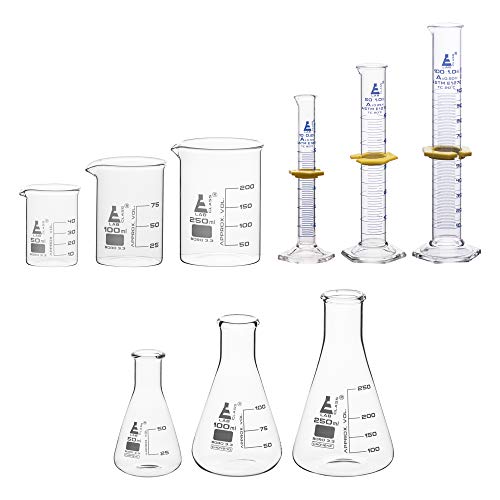
This kit is the honest answer to “I need beakers for measuring.” It includes three low form beakers and three Erlenmeyer flasks, but the real value is the three ASTM Class A graduated cylinders. According to Eisco’s product page, all nine pieces are borosilicate 3.3, and they ship in a fitted foam case.
So you measure in the 10, 50 or 100 mL cylinder, and then you mix or heat in the beaker. As a result, that simple habit removes most of the error a beaker adds. Moreover, the foam case keeps the cylinders safe between uses.
- Beakers: 50, 100 and 250 mL low form with white graduations
- Flasks: 50, 100 and 250 mL Erlenmeyer
- Cylinders: 10, 50 and 100 mL, ASTM Class A, with protective collars
- Material: borosilicate 3.3 glass, foam storage case
Pros
- Class A cylinders for real measurement
- Three glassware types in one kit
- Foam case protects every piece
Cons
- However, the largest beaker is only 250 mL
- Fewer beakers than a beaker-only set
Skip it if: you already own graduated cylinders and only want more beakers.
Best Clear Plastic
6. Nalgene PMP Griffin Low Form Beaker, 250 mL
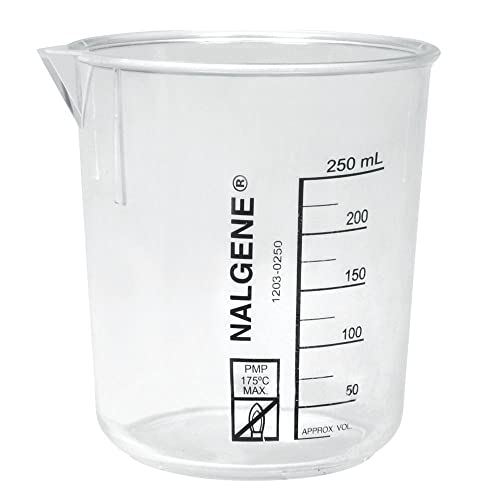
Best for: labs that want plastic safety without losing the see-through look of glass.
Most plastic beakers are cloudy. In contrast, this Nalgene beaker is made of PMP (polymethylpentene), which Thermo Fisher describes as having the transparency of glass. It is also autoclavable and rated for continuous use at 150 C (302 F), with short service to 175 C (347 F).
For measurement, it carries silk-screened lines every 25 mL from 25 to 250 mL. In addition, Thermo Fisher says it meets ISO/DIN 7056 for plastic labware. However, PMP is a little more brittle than polypropylene, so it can crack if dropped. Also, never put it over an open flame.
- Material: PMP (polymethylpentene), transparent
- Graduations: 25 to 250 mL in 25 mL steps
- Heat: 150 C continuous, 175 C intermittent; autoclavable
- Standard: ISO/DIN 7056; single no-drip spout
Pros
- Clear like glass, easy to see liquid
- Also lighter and safer than glass
- Handles autoclave cycles
Cons
- More brittle than polypropylene
- No open flame or direct burner heat
- Some solvents attack plastics; check a chart
Skip it if: you heat on a burner or work with strong organic solvents.
Best Budget
7. Bel-Art Polypropylene Griffin Beakers, 600 mL (4-Pack)
Best for: kids, classrooms, garages and anyone who drops things.
Bel-Art (SP Scienceware) makes plain, tough polypropylene beakers that survive the floor. For example, this listing is a pack of four 600 mL Griffin low form beakers with 100 mL graduations. Because polypropylene does not shatter, it is the safest choice for young students and for mixing in the garage or workshop.
On the other hand, 100 mL steps are coarse, and the translucent plastic makes the line harder to read than glass. So use these for mixing, rinsing and holding, then measure in a cylinder when it counts.
- Capacity: 600 mL, four per pack
- Graduations: 100 mL steps
- Material: polypropylene, Griffin low form
Pros
- Shatter-resistant for kids and classes
- Four beakers per pack
- Light and therefore easy to store
Cons
- Coarse 100 mL graduations
- Translucent, so lines are harder to read
- Not for open flame or hot plates
Skip it if: you need to heat liquids directly.
Best Large Plastic
8. Eisco Polypropylene Beakers, 1,000 mL (3-Pack)

Best for: mixing larger batches of solutions, nutrients or cleaning baths.
When you need a full liter and do not want glass, this three-pack is a sensible step up from the Bel-Art beakers. According to Eisco, the graduations are raised every 20 mL. Raised marks do not wear off with scrubbing, unlike printed ones. In addition, the beakers are autoclavable and rated from -20 to 135 C (-4 to 275 F).
Also, the tapered spout pours cleanly into a funnel or bottle. Still, the plastic is translucent, so read the level at eye height with good light behind it.
- Capacity: 1,000 mL, pack of three
- Graduations: raised, every 20 mL
- Temperature: -20 to 135 C; autoclavable
- Material: polypropylene with tapered spout
Pros
- Raised marks never rub off
- Finer 20 mL steps for its size
- Big capacity, yet without glass weight
Cons
- Translucent walls
- However, too large for small samples
Skip it if: you mostly handle under 250 mL.
How We Chose the Best Laboratory Beakers
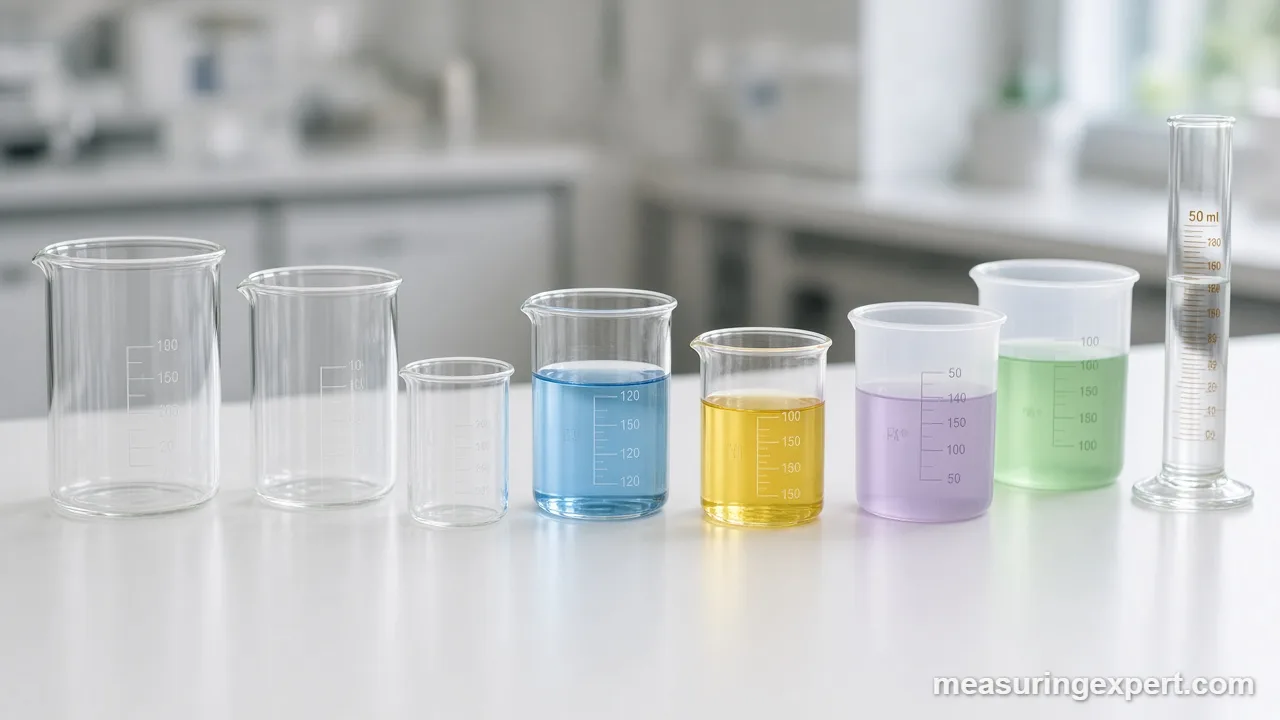
We did not run hands-on tests on the best laboratory beakers. Instead, our picks are research-based. First, we limited the list to established lab brands such as PYREX, KIMAX, Nalgene, Bel-Art, Eisco and Karter Scientific, with at most two products per brand. Next, we checked each spec against the maker’s product page where one was available, or against the detailed listing otherwise. Finally, we left out unbranded sets and novelty “beaker” mugs.
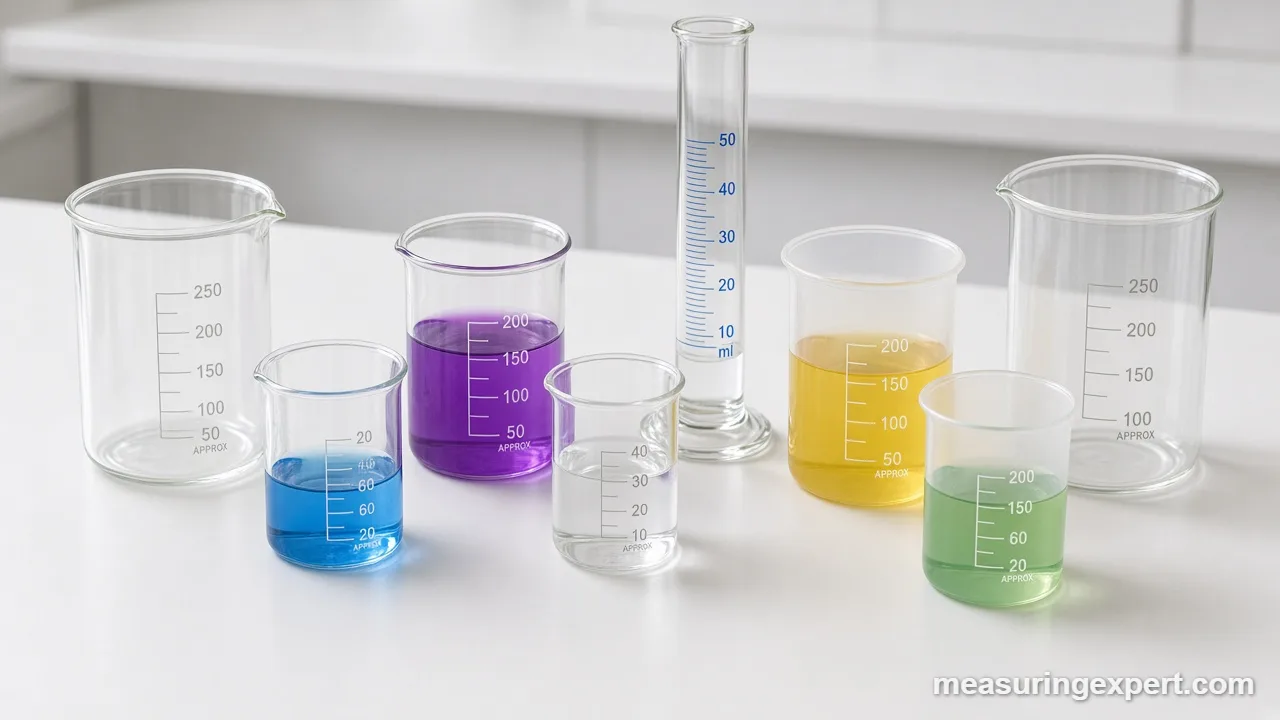
After that, we scored each beaker on five points:
- Material: borosilicate 3.3 for heat, or PP and PMP for impact safety.
- Graduation quality: step size, double scales and how long the marks last.
- Size range: whether the beaker or set fits real tasks.
- Shape: low form for heating and stability, or tall form for stirring.
- Honest fit: whether the product suits home, school or professional use.
Best Laboratory Beakers by Material: Borosilicate 3.3, PP and PMP
Material matters more than brand when you compare the best laboratory beakers. In short, glass wins on heat and chemicals, while plastic wins on drops. The table below sums up the trade-offs.
| Material | Clarity | Heat | Breakage | Good for |
|---|---|---|---|---|
| Borosilicate 3.3 glass | Clear | Hot plates and burners with care | Shatters if dropped | Heating, most acids, solvents |
| Polypropylene (PP) | Translucent | Autoclavable; no flame | Very tough | Kids, mixing, bases, field work |
| PMP (polymethylpentene) | Glass-like | Autoclavable; no flame | Can crack if dropped | Clear plastic needs, warm work |
The “3.3” in borosilicate 3.3 refers to its low thermal expansion, about 3.3 millionths per degree Celsius. Because it expands so little, it resists cracking when heated, which is why lab glass uses it. Ordinary soda-lime glass expands roughly three times as much, so it is far more likely to crack on a hot plate.
Plastic beakers are different, and three of the best laboratory beakers here are plastic for good reason. Polypropylene is cheap and almost unbreakable, but it is cloudy and softens at high heat. By contrast, PMP looks clear, yet it is more brittle. Also, both plastics can be attacked by some organic solvents, so check a chemical resistance chart before you pour.
How Accurate Are the Best Laboratory Beakers?
However, this is the part most product listings skip. Beaker graduations are approximate. Even the best laboratory beakers are often cited as being within about +/-5% of the marked volume, and many cheaper beakers make no accuracy claim at all. In fact, Corning labels its own PYREX beaker scales as approximate content.
For example, here is what +/-5% means in practice:
| Line you fill to | Possible error (+/-5%) | Real volume could be |
|---|---|---|
| 100 mL | 5 mL | 95 to 105 mL |
| 250 mL | 12.5 mL | 237.5 to 262.5 mL |
| 400 mL | 20 mL | 380 to 420 mL |
| 600 mL | 30 mL | 570 to 630 mL |
| 1,000 mL | 50 mL | 950 to 1,050 mL |
So which glassware should you use instead? It depends on how close you need to be:
- Rough volumes, mixing, heating: a beaker is fine.
- Better than about 1%: a graduated cylinder, ideally Class A. See our guide to measuring volume with a graduated cylinder.
- One exact volume, such as a standard solution: a Class A volumetric flask.
- Small exact amounts: a volumetric or graduated pipette; here is how to use a pipette.
For a broader comparison, our article on the best glassware to measure volume ranks every common piece by precision.
Beaker Volume Converter
Beakers are marked in milliliters. Therefore, if a recipe or protocol uses US units, convert here. For example, 250 mL is about 8.45 US fluid ounces, or a little over one US cup.
Keep in mind that the conversion is exact, but the beaker line is not. In other words, a converted 8.45 fl oz still carries the beaker’s approximate error.
How to Read a Beaker Correctly
Good technique will not make even the best laboratory beakers precise. However, it keeps your reading as close as the glass allows. Follow these steps:
- First, set the beaker on a flat, level surface.
- Then pour slowly until the liquid nears the line you want.
- Bend down so your eye is level with the liquid surface.
- Read the bottom of the curved meniscus for water-based liquids.
- Next, add or remove liquid with a dropper to reach the line.
- If the volume matters, pour it into a graduated cylinder to check.
- Finally, write the volume down with its approximate error.
Heating, Cleaning and Care
Care decides how long the best laboratory beakers last. Borosilicate is tough, but it is not magic. For example, a chipped rim or a scratch can become the start of a crack under heat. So inspect glass before each heating job and retire any chipped beaker.
Do
- Heat glass gradually on a hot plate or wire gauze.
- Leave headspace; fill no more than about two-thirds when heating.
- Wash with lab detergent and a soft brush, then rinse with distilled water.
- Use a pencil on the marking spot instead of tape.
Don’t
- Put a hot beaker on a cold, wet bench.
- Heat plastic beakers on a burner or hot plate.
- Scrub graduations with abrasive pads, since printed marks wear off.
- Store food or drinks in lab beakers.
Best Laboratory Beakers FAQ
What are the best laboratory beakers for home use?
For most home labs, a borosilicate 3.3 set such as the Karter Scientific six-size set is the best start. It covers 10 mL to 1,000 mL and handles hot plate heating.
Are beakers accurate for measuring volume?
Not very. Beaker lines are approximate, often around +/-5%, so use a graduated cylinder or a volumetric flask when the volume matters.
What does borosilicate 3.3 mean?
It is borosilicate glass with a thermal expansion of about 3.3 millionths per degree Celsius. Because it expands so little, it resists cracking under heat.
Are the best laboratory beakers glass or plastic?
Glass is better for heating and most chemicals. However, polypropylene is safer for kids and field work because it does not shatter.
What is the difference between PP and PMP beakers?
Polypropylene is translucent and very tough. In contrast, PMP is almost as clear as glass but more brittle, so it can crack if dropped.
Can the best laboratory beakers go on a hot plate?
Borosilicate glass beakers can, if you heat them gradually. Plastic beakers should never go on a hot plate or flame.
What is a Griffin beaker?
A Griffin beaker is the common low form beaker with a spout. Its height is about one and a half times its width, so it is stable on a bench.
When should I use a tall form beaker?
Use a tall form beaker for titrations and stirring. The deeper liquid column reduces splashing.
How do I read a beaker meniscus?
Get your eye level with the liquid and read the bottom of the curve for water-based liquids. A dark card behind the beaker helps.
Do the best laboratory beakers need calibration?
No, beakers are not calibrated instruments. If you need a verified volume, use Class A glassware, which is made to a stated tolerance.
Bottom Line: Our Best Laboratory Beakers Pick
For most buyers, the Karter Scientific 3.3 Boro Griffin Low Form Beaker Set is the best choice, because six borosilicate sizes cover almost every bench job. Meanwhile, labs that want name-brand glass should choose the PYREX 1000-1L, and anyone working with kids should start with Bel-Art polypropylene. Above all, measure in a cylinder and use the beaker to mix and heat.
2 thoughts on “Best Laboratory Beakers: 8 Glass and Plastic Picks for 2026”