

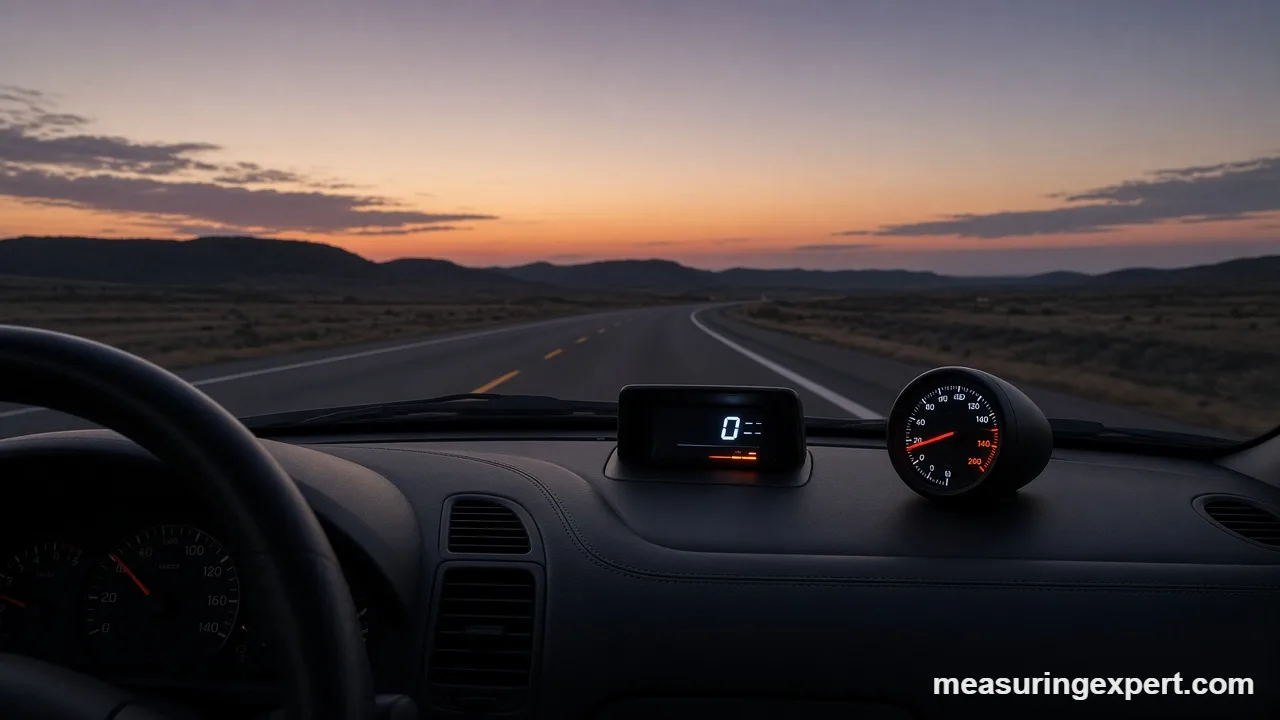
The best GPS speedometer for most cars is the Pyle PHUD19, a plug-in dash display that shows satellite speed, distance, voltage and heading. However, the right choice depends on where it goes: a simple USB head-up display for daily driving, or a wired in-dash gauge such as the AutoMeter 4480 for custom builds.
In short: pick the Pyle PHUD19 for most cars, the VJOYCAR G20 on a budget, and the AutoMeter 4480 when you want a real gauge in the dash.
As an Amazon Associate, Measuring Expert earns from qualifying purchases. Our picks are based on research, specifications and owner feedback, not paid placement.
Best Overall
Best Budget

Best In-Dash Gauge

Quick Answer: Which GPS Speedometer Should You Get?
- Most cars: Pyle PHUD19, a dash HUD with speed, voltage, compass and 0-100 timing.
- Tight budget: VJOYCAR G20, a USB plug-in with large MPH digits, so it is easy to read.
- Classic dash: AutoMeter 4480, a 0-140 mph analog gauge driven by GPS.
- Track and data: AEM 30-0313, with a 0-5 V output for loggers.
- Trucks and RVs: Kingneed 6.2 in display with odometer and overspeed alarm.
- Boats and ATVs: ELING 85 mm gauge, 0-80 MPH with an odometer.
- Key fact: GPS speed ignores tire size and gear ratio, so it often reads a little lower than a factory speedometer.
On This Page
- All picks side by side
- The 8 picks, reviewed
- How we chose
- GPS vs wheel-based speed
- Why your speedometer reads high
- HUD, dash gauge or app
- Specs that matter
- Speed unit calculator
- How to set up and check one
- Honest limits
- FAQ
- Bottom line
Best GPS Speedometer Picks at a Glance
Here is every pick in one row; then the reviews explain each spec.
| # | Product | Best For | Standout Feature | Amazon |
|---|---|---|---|---|
| 1 | Pyle PHUD19 Smart HUD Display | Most drivers who want a dash HUD | 2.6 in color LCD with compass, voltage and 0-100 timing | View |
| 2 | VJOYCAR G20 Plug-In HUD | Low-cost plug-and-play speed readout | Large green MPH digits, USB plug and play | View |
| 3 | AutoMeter 4480 Ultra-Lite Gauge | Hot rods, swaps and custom dashes | 0-140 mph analog sweep with GPS trip data | View |
| 4 | AEM 30-0313 X-Series Gauge | Race cars and data loggers | 0-160 mph digital gauge with 0-5 V output and CAN link | View |
| 5 | Kingneed 6.2 in Truck Display | Trucks, RVs and big cabs | 6.2 in extended display with odometer and overspeed alarm | View |
| 6 | Shkalacar Large-Font HUD | Drivers who switch between MPH and km/h | Large-font LED, MPH and KM/H | View |
| 7 | ELING 85 mm Speed Gauge | Boats, ATVs, UTVs and motorcycles | 0-80 MPH (0-120 km/h) gauge with 8 backlight colors | View |
| 8 | ELING 2 in Round Gauge Kit | Golf carts, sailboats and small dashes | 2 in round gauge for 12 V or 24 V systems | View |
The 8 Best GPS Speedometer Options, Reviewed
This list covers plug-in head-up displays (HUDs) and wired in-dash gauges for cars, trucks, motorcycles and boats. If you only need a quick reading, a phone can work too; see our speed app guide for that route.
Best Overall
1. Pyle PHUD19 Smart HUD Display
Best for: Drivers who want a bright, easy-to-read speed display on the dash without wiring into the car.
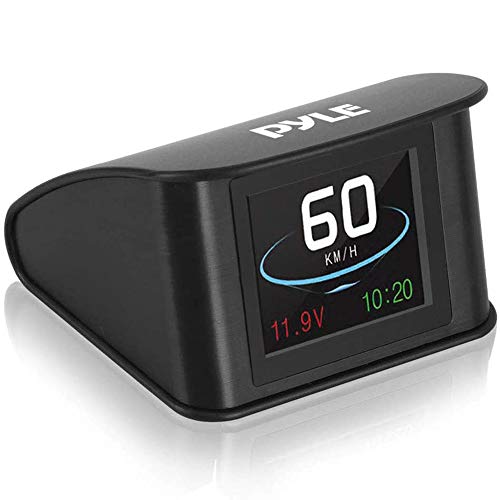
Overall, the Pyle PHUD19 is the best GPS speedometer for most cars because it covers the basics well and adds data a driver will actually use. First, it shows speed on a 2.6 in multi-color LCD. Next, it adds distance, trip time, battery voltage and a GPS direction compass. In addition, Pyle lists light sensors for automatic brightness, plus eight manual brightness levels.
For measurement fans, the timing features stand out. For example, the unit can time a 400 m run and a 0-100 sprint in seconds. In addition, it switches between MPH and KPH, and it turns on and off with the ignition through the included lighter-socket USB cable.
- Display: 2.6 in multi-color LCD, 8 brightness levels plus auto light sensors
- Data: speed, distance, trip time, voltage and GPS compass
- Units: switchable MPH or KPH
- Power: 9 to 16 V DC (12 V nominal) via lighter-socket USB cable, 8.2 ft lead
- Size: 2.87 x 2.68 x 1.81 in (73 x 68 x 46 mm); 0.41 lb (186 g)
Pros
- Established brand with a published spec sheet
- Voltage readout doubles as a basic charging check
- Acceleration timing for 400 m and 0-100 runs
Cons
- Dash display, not a windshield projection
- Alarm is only rated at 30 dB or higher
- Needs a clear sky view, like every GPS unit
Skip it if: you want the speed reflected onto the windshield glass, since this is a dash-top screen.
Best Budget
2. VJOYCAR G20 Plug-In HUD
Best for: Drivers of older cars, work trucks or cars with a broken speedometer who just want a clear MPH number.
Simply put, the VJOYCAR G20 does one job: it shows your GPS speed in large MPH digits. As a result, it is a good fit when the factory speedometer is broken, hard to read, or wrong after a tire change. Also, it plugs into a USB port, so setup takes a few minutes.
Because it is so simple, there is little to learn. On the other hand, the listing describes an MPH display only.
- Speed source: GPS
- Display: single-color green digits, MPH
- Power: USB cable, plug and play
- Also fits trucks, not just cars
Pros
- Very simple to set up and read
- No wiring into the vehicle
- Low cost backup for a faulty speedometer
Cons
- MPH only per the listing
- Few extra features
- Single-color display
Skip it if: you drive mostly in km/h countries, or if you also want trip data and alarms.
Best In-Dash Gauge
3. AutoMeter 4480 Ultra-Lite Gauge
Best for: Builders who want a real analog gauge in the dash that reads GPS speed and never needs a gear or tire calibration.
The AutoMeter 4480 is the pro choice if you want a GPS speedometer that looks like a classic gauge. For example, it sweeps 0 to 140 mph on a 3 3/8 in (86 mm) silver face, and a stepper motor drives the pointer. Also, because it reads GPS, an engine swap, a new rear-end ratio or bigger tires do not throw it off.
In addition, it does more than show speed, because AutoMeter lists latitude and longitude with heading, a compass, time and date, trip and total distance, an hour meter and peak speed.
- Range: 0 to 140 mph, full sweep
- Size: 3 3/8 in (86 mm) round, silver face and bezel
- GPS data: latitude, longitude, heading and compass
- Logs: trip distance, total distance, hour meter, peak speed, time and date
- Stepper motor pointer; illuminated
Pros
- No calibration for tire size or gear ratio
- Classic analog look with digital data
- Peak speed and hour meter built in
Cons
- Needs a 3 3/8 in dash hole and wiring
- Far more costly than a HUD
- Check what is in the box for your listing before you order
Skip it if: you only want a plug-in display for a daily driver, since this gauge needs a proper install.
Best for Track Cars
4. AEM 30-0313 X-Series Gauge
Best for: Track-day drivers and tuners who want GPS speed on a small gauge and also want to send it to a data logger or ECU.
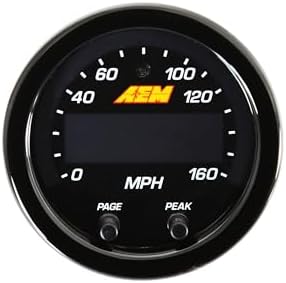
In short, the AEM X-Series GPS speedometer is a measuring instrument as much as a gauge. First, it reads 0 to 160 mph on a 2 1/16 in (52 mm) digital display, with 24 green outer LEDs for a quick visual read. Also, it tracks ground speed, heading and altitude.
Moreover, for data work, it has a 0-5 V analog output for an engine management system or logger. In addition, it links to AEM ECUs over AEMnet CAN, which adds track mapping.
- Range: 0 to 160 mph
- Size: 2 1/16 in (52 mm) round, black face
- Outputs: 0-5 V analog and AEMnet CAN
- Tracks ground speed, heading and altitude
- US or metric units; auto-dimming
Pros
- Small 52 mm size fits a pod or pillar
- Feeds GPS speed to a logger
- Wide 160 mph range
Cons
- No trip meter
- Track mapping needs an AEM ECU
- Digital look will not suit a classic dash
Skip it if: you want an odometer or trip meter, because AEM lists neither.
Best Large Display
5. Kingneed 6.2 in Truck Display

Best for: Truck, RV and van drivers who sit far from the dash and therefore want a big, wide readout.
First, the Kingneed unit trades a compact shape for a wide 6.2 in display, which helps in a tall cab where a tiny HUD sits far away. Also, the listing names an odometer, a trip meter, course (heading) and an overspeed alarm, and it switches between MPH and KMH.
Because it adds its own odometer, it is handy on a vehicle whose original odometer has failed. However, a GPS odometer counts satellite distance, not wheel turns. As a result, it will not match the vehicle odometer exactly.
- Display: 6.2 in extended digital screen
- Data: speed, odometer, trip meter and course
- Also has an overspeed alarm
- Units: MPH or KMH
Pros
- Large digits are easy to read from far away
- Odometer and trip meter included
- Overspeed alarm helps in work vehicles
Cons
- Takes up more dash space
- Brand publishes few detailed specs
- GPS distance will differ slightly from the vehicle odometer
Skip it if: you want a small unit instead, one that hides on the dash.
Best for Motorcycles
6. Shkalacar Large-Font HUD

Best for: Riders and drivers who want a compact large-font speed display that works on a car, SUV, truck or motorcycle.
The Shkalacar HUD keeps things small and bright. In fact, it shows GPS speed in a large-font LED readout and switches between KM/H and MPH. Therefore, it suits drivers who cross borders or own an import whose speedometer reads in the other unit.
Since the listing names cars, trucks, SUVs and motorcycles, it is one of the few picks here that also makes sense on a bike with a hard-to-read stock gauge.
- Display: LED, large font
- Units: KM/H and MPH
- Speed source: GPS
- Listed for cars, trucks, SUVs and motorcycles
Pros
- Unit switch for MPH and km/h
- Compact and bright
- Low cost, so easy to try
Cons
- Few published specs
- No trip data listed
- Mounting on a bike takes planning
Skip it if: you also need trip logs, alarms or a compass.
Best for Boats and ATVs
7. ELING 85 mm Speed Gauge

Best for: Owners of boats, ATVs, UTVs and project vehicles that have no wheel sensor or a hard-to-source speedometer cable.
The ELING gauge is a full 85 mm (3 3/8 in) GPS speedometer for vehicles that do not have a usable wheel sensor. For example, a boat has no wheels at all, so GPS is the natural way to read speed over the ground. Also, it includes an odometer.
In addition, the scale runs 0 to 80 MPH (0 to 120 km/h), which suits most boats, ATVs and slow utility vehicles.
- Size: 85 mm (3 3/8 in) gauge
- Range: 0 to 80 MPH (0 to 120 km/h)
- Also has an odometer
- 8 backlight colors
- Listed for cars, motorcycles, boats, ATVs and UTVs
Pros
- Standard 85 mm size fits common gauge holes
- Works where there is no wheel speed signal
- Also offers backlight color choice
Cons
- 80 MPH top limits fast cars
- Needs a wired install
- GPS speed on water is speed over ground, not through the water
Skip it if: your vehicle regularly runs above 80 mph, because the scale stops there.
Best Compact Gauge
8. ELING 2 in Round Gauge Kit

Best for: Golf cart, sailboat and small utility vehicle owners who have room only for a small round gauge.
If a full 85 mm gauge will not fit, the ELING 2 in kit is the compact option. It is a round GPS speedometer with a digital odometer, and it runs on 12 V or 24 V systems. As a result, it fits golf carts, club cars, sailboats and small yachts.
- Size: 2 in (52 mm) round
- Power: 12 V or 24 V systems
- Also has a digital odometer
- Listed for sailboats, yachts, club cars and golf carts
Pros
- Fits small gauge holes and pods
- Works on 12 V and 24 V
- Second ELING size for tight dashes
Cons
- Small digits are harder to read at a glance
- Needs a wired install
- Scale varies by listing
Skip it if: you need a big readout for highway speeds instead.
How We Chose the Best GPS Speedometer Picks
To be clear, we did not bench-test these units. Instead, our picks are research-based. First, we read the original roundup on this page and kept its focus on vehicle speed displays. Next, we compared published specs from manufacturers and large parts retailers, and we read owner feedback for patterns.
Then we scored each candidate on five points:
- Speed source: it must read speed from satellites, not from a wheel sensor or the OBD port.
- Readability: digit size, brightness control and also night dimming.
- Published specs: we favored makers that state range, size, units and power. Where a spec was not published, we left it out.
- Fit: plug-in units for daily drivers, and also standard gauge sizes (52 mm and 85 mm) for custom dashes.
- Variety: no more than two picks per brand, and one clear job for each pick.
Finally, we checked the federal accuracy rule for truck speedometers in 49 CFR 393.82 and the civil GPS performance data on GPS.gov.
GPS Speed vs Wheel-Based Speedometers
A factory speedometer does not measure speed directly. Instead, it counts how fast a wheel, axle or transmission output shaft turns. Then it multiplies that rate by an assumed tire size, so a different tire size shifts the reading by the same percentage. Our guide on how speedometers measure speed covers the sensor side.
By contrast, a GPS speedometer works in a completely different way. First, the receiver tracks signals from several satellites. Most receivers then work out velocity from the Doppler shift of those signals, and some also compare position fixes over time. As a result, the reading does not depend on tire size, tire wear, tire pressure or gear ratio.
How close is it? For reference, GPS.gov notes that good single-frequency receivers reach about 2.2 m (7.1 ft) horizontal position accuracy 95% of the time. Even so, speed from Doppler is usually much tighter than that, and a well-placed receiver on open road can read within a fraction of a mile per hour. However, accuracy drops when the sky view is blocked. Therefore, tunnels, parking garages, deep city canyons and dense tree cover all make the number lag or jump.
| Factor | Wheel-based speedometer | GPS speedometer |
|---|---|---|
| What it measures | Wheel or shaft rotation | Satellite signals (speed over ground) |
| Tire size or wear | Changes the reading | No effect |
| Gear or axle swap | Needs recalibration | No effect |
| Tunnels and garages | Works normally | Loses signal or lags |
| Wheel spin on ice or sand | Reads too high | Reads true ground speed |
| Response time | Instant | Short delay, often about 1 s |
Why the Best GPS Speedometer Reads Lower Than Your Dash
For example, many owners install a GPS unit and see it read 2 or 3 mph below the car. In most cases, however, the GPS is right and the factory gauge is high on purpose. Specifically, UN ECE Regulation 39, used in Europe and many other markets, says a speedometer must never show less than the true speed. However, it may show up to 10% more, plus 4 km/h. So at a true 80 km/h, a legal dash can read anywhere from 80 to 92 km/h.
Meanwhile, in the US, the rule for buses and trucks is simpler. Specifically, under 49 CFR 393.82, the speedometer must be accurate within plus or minus 5 mph (8 km/h) at 50 mph (80 km/h). In other words, that is a 10% window either way.
On top of that, tires add more error. For instance, if you move from a 26.5 in (673 mm) tall tire to a 28 in (711 mm) tire, the car covers 5.7% more ground per turn. As a result, when the dash shows 60 mph, you are really doing about 63.4 mph.
| Dash shows | True speed if dash reads 3% high | True speed with 5.7% larger tires |
|---|---|---|
| 30 mph (48 km/h) | 29.1 mph (46.9 km/h) | 31.7 mph (51.0 km/h) |
| 45 mph (72 km/h) | 43.7 mph (70.3 km/h) | 47.5 mph (76.5 km/h) |
| 60 mph (97 km/h) | 58.3 mph (93.7 km/h) | 63.4 mph (102.0 km/h) |
| 70 mph (113 km/h) | 68.0 mph (109.4 km/h) | 74.0 mph (119.0 km/h) |
Finally, to find your own error, divide the dash reading by the GPS reading at a steady speed on a flat, open road. For example, 65 on the dash and 62 on GPS means the dash reads about 4.8% high.
HUD, Dash Gauge or Phone: Which GPS Speedometer Type?
In general, there are three common ways to get GPS speed in a vehicle.
| Type | Install | Best for | Trade-off |
|---|---|---|---|
| Plug-in HUD or dash display | USB or lighter socket, minutes | Daily drivers, rentals, broken speedometers | Cable on the dash; smaller digits |
| In-dash GPS gauge | Wired, gauge hole or pod | Hot rods, swaps, boats, ATVs | More work and cost |
| Phone app | None | Occasional checks | Phone mount, battery drain, distraction |
Also, note the difference between GPS and OBD2 head-up displays. For instance, an OBD2 HUD plugs into the diagnostic port and copies the car’s own speed signal. Therefore, it repeats any tire-size error. A GPS unit, by contrast, gives you an independent check.
Specs to Compare Before You Buy a GPS Speedometer
Above all, these are the specs that actually change what you see.
- Speed range: make sure the top of the scale is above your fastest speed. For example, an 80 MPH gauge is fine for a boat but not for a highway car.
- Units: look for an MPH and km/h switch if you cross borders. Boaters may also want knots; see our knot guide for the conversion.
- Display size and brightness: a larger screen helps in tall cabs. Also, auto-dimming keeps the display from glaring at night.
- Gauge size: in-dash gauges come in standard sizes such as 2 1/16 in (52 mm) and 3 3/8 in (86 mm). So measure the hole or pod first.
- Power: plug-in units use USB or a 12 V socket. Meanwhile, wired gauges may list 12 V only, or 12 V and 24 V for trucks and boats.
- Extras: odometer, trip meter, compass, overspeed alarm, peak speed and data outputs.
Speed Unit Calculator for Your GPS Speedometer
First, use this converter to switch a reading between mph, km/h, knots and meters per second. For example, enter the GPS reading and compare it with your dash.
How to Set Up and Check Your New Unit
In practice, a good install matters as much as the unit itself.
- Pick a spot with a clear view of the sky, such as the front of the dash, away from metal trim and heated or metal-coated glass.
- Mount the unit with its pad or bracket so it cannot slide, and keep it out of the airbag zone and your view of the road.
- Route the power cable under trim, then plug it into a USB port or 12 V socket; for an in-dash gauge, wire it to switched power and ground per the manual.
- Park outside and wait for the first satellite fix, which can take a few minutes the first time.
- Set the unit to MPH or km/h, then set the brightness, the overspeed alarm and any other options you need.
- Drive on a flat, straight, open road at a steady speed, then compare the GPS reading with your dash at 30, 45 and 60 mph.
- Write down the difference at each speed, so you know how far your factory speedometer reads high.
Honest Limits of Satellite Speed
Overall, GPS speed is accurate, but it is not perfect. First, it needs satellites, so it drops out in tunnels and garages. Next, many units update about once per second. As a result, the number trails a hard launch or hard braking by a moment. In addition, some receivers ignore height, so on a steep grade they can read slightly low.
Also, a plug-in unit is not a legal replacement for a factory speedometer in every case. So check your local rules before you rely on one as your only gauge. Finally, a GPS reading is good evidence of your speed, but it does not override a police radar or lidar reading; our article on speed and velocity explains why direction matters in these measurements.
Best GPS Speedometer FAQ
What is the best GPS speedometer for a car?
For most cars, the Pyle PHUD19 is the best GPS speedometer. Also, it plugs into a 12 V socket, shows speed in MPH or km/h, and adds distance, voltage, a compass and 0-100 timing.
Is satellite speed more accurate than a car speedometer?
Usually, yes. That is because a car speedometer reads wheel rotation and is set to read a little high, while GPS measures speed over the ground. However, GPS needs a clear view of the sky to stay accurate.
Why does the best GPS speedometer read lower than my dash?
In short, most factory speedometers read high on purpose. For example, UN ECE Regulation 39 allows up to 10% plus 4 km/h over, but never under. Also, worn or smaller tires push the dash reading higher.
Do bigger tires affect GPS speed readings?
No. Bigger tires make a wheel-based speedometer read low. However, a GPS unit measures ground speed from satellites. So it shows the true speed after a tire or gear change.
Does the best GPS speedometer work in tunnels?
No. That is because a GPS unit needs satellite signals, so it loses speed in tunnels and parking garages. It also lags under heavy tree cover and between tall buildings, then recovers once the sky is clear.
What is the difference between a GPS HUD and an OBD2 HUD?
First, a GPS HUD reads speed from satellites, so it is independent of the car. By contrast, an OBD2 HUD copies the car’s own speed signal from the diagnostic port, so it repeats any speedometer error.
Can I use the best GPS speedometer on a boat?
Yes. For example, a GPS gauge such as the ELING 85 mm model shows speed over ground on a boat. However, a current changes speed through the water, so a paddlewheel log may show a different number.
Does the best GPS speedometer need calibration?
In general, most GPS units need no calibration, because they do not use tire size. Instead, set the units and alarm, then use the GPS reading to check how far your dash speedometer reads high.
Can a GPS unit replace a broken speedometer?
It can work as a practical readout, and many owners use one that way. Still, rules differ by state and country, so check whether your vehicle must keep a working factory speedometer.
How do I convert mph to km/h?
First, most units have a unit switch in the menu. To convert by hand, multiply mph by 1.609344. For example, 60 mph equals 96.56 km/h, or about 52.14 knots.
Bottom Line on the Best GPS Speedometer
For most drivers, the Pyle PHUD19 Smart HUD Display is the best GPS speedometer to buy. Also, it plugs in, reads satellite speed in MPH or km/h, and adds voltage, heading and acceleration timing. However, choose the VJOYCAR G20 if you just need a cheap, clear number, or the AutoMeter 4480 if you are building a dash.