

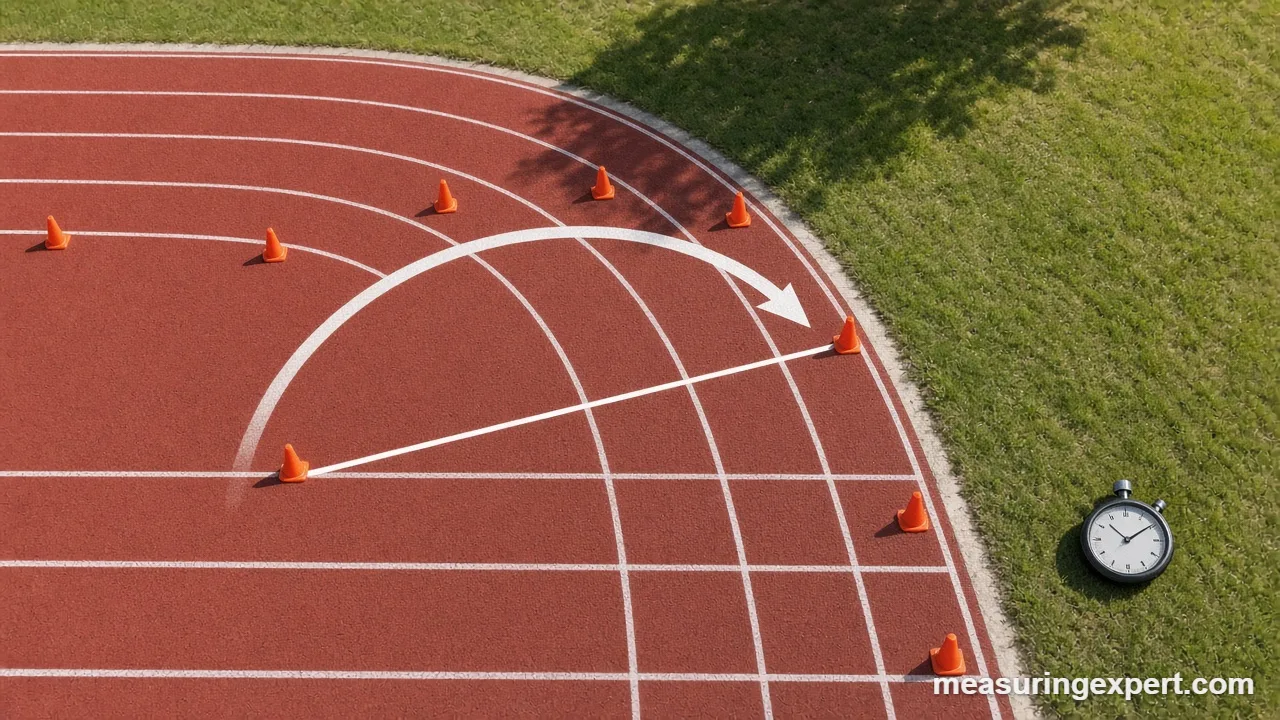
Speed and velocity are calculated with the same kind of formula, but from different inputs. Speed is distance divided by time, so it has size only. Velocity is displacement divided by time, so it also has a direction. As a result, a round trip can have a high average speed but zero average velocity.
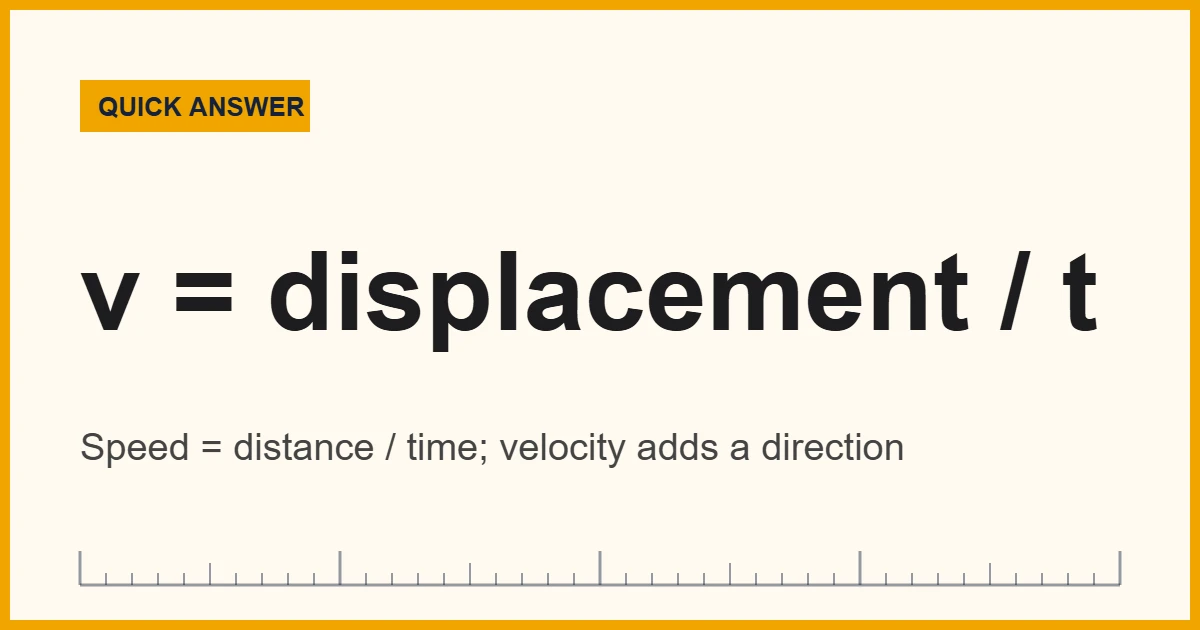
Ask most people how fast a car is going and they will give you one number, such as 60 mph. That number is a speed. A physicist, a pilot or a navigator often needs more, though: 60 mph heading north is not the same motion as 60 mph heading south. That extra piece of information, the direction, is what turns a speed into a velocity.
The two words sound interchangeable in everyday talk, so it is easy to mix them up in homework, sports data or travel planning. The math itself is simple. The hard part is choosing the right input: the total path you covered, or the straight-line change in position from start to finish.
In short: use distance for speed and displacement for velocity, then divide by the same elapsed time. Both come out in the same units, such as meters per second, kilometers per hour or miles per hour. However, only velocity carries a direction, such as “26.7 mph north”.
What the Physics Textbooks Say
The OpenStax physics textbook, a free peer-reviewed text from Rice University, defines average speed as distance over time and average velocity as displacement over time. It also uses a round-trip drive to show how the two results can differ completely. Meanwhile, the SI Brochure from the International Bureau of Weights and Measures lists the meter per second as the SI unit for both quantities.
Below, you will find a unit converter, side-by-side tables, five worked examples and a short checklist you can follow for any problem.
Convert Speed and Velocity Units
Enter a value and pick its unit. The converter shows the same rate in meters per second, kilometers per hour, miles per hour, knots and feet per second. Because velocity uses the same units as speed, it works for both; just keep the direction label next to your velocity result.
Recommended Tools for Measuring Speed
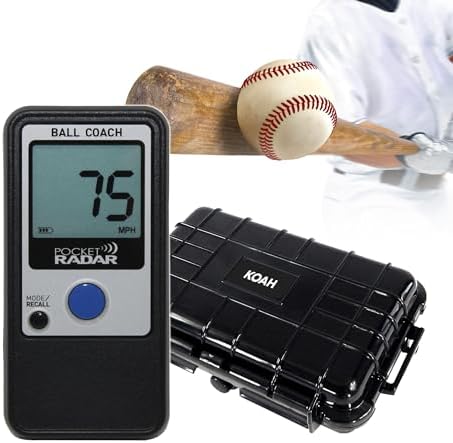
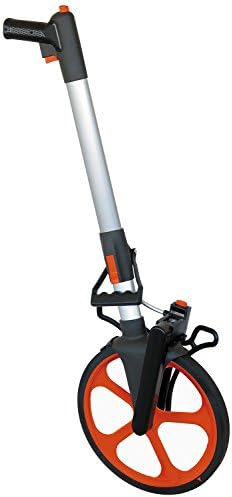
To calculate either quantity from real measurements, you need two inputs: a reliable length and a reliable time. First, a measuring wheel gives you an accurate course length for a walking, running or rolling test. Next, a stopwatch with a large display handles the timing. Finally, a sports radar reads the speed of a ball or a runner directly, which is useful for checking your own calculations.


As an Amazon Associate, Measuring Expert earns from qualifying purchases.
Key Takeaways
- Average speed = total distance / elapsed time; it is a scalar (size only).
- Average velocity = displacement / elapsed time; it is a vector (size plus direction).
- A round trip that ends where it started always has zero average velocity.
- The size of average velocity is never larger than average speed.
- Instantaneous speed is the size of instantaneous velocity at that moment.
- Both use the same units: m/s in SI, plus km/h, mph, knots and ft/s.
- Constant speed on a curve still means a changing velocity, so the object is accelerating.
Speed and Velocity Side by Side
Here is the whole comparison in one table. Notice that the formulas share the same structure; only the top of the fraction changes.
| Feature | Speed | Velocity |
|---|---|---|
| Type of quantity | Scalar (magnitude only) | Vector (magnitude and direction) |
| Average formula | distance / time | displacement / time |
| Depends on the path? | Yes, every meter of the route counts | No, only start and end positions count |
| Can it be negative? | No, it is zero or positive | Its components can be negative (for example, -5 m/s means 5 m/s in the negative direction) |
| Round trip result | Positive | Zero |
| What a car shows | The speedometer | Speedometer plus compass heading |
| SI unit | m/s | m/s, plus a direction |
So a weather report that says “winds from the west at 15 mph” is really giving you a velocity. By contrast, a sign that reads “speed limit 65” gives only a speed, since it applies whichever way you drive. For a deeper look at how size and direction combine, see our guide to speed, direction and vectors.
Distance vs Displacement: The Real Difference
Almost every mistake with speed and velocity starts here. Distance is the full length of the path you actually traveled. Displacement, on the other hand, is the straight arrow from your starting point to your ending point, with a length and a direction.

| Trip | Distance | Displacement |
|---|---|---|
| One lap of a 400 m track | 400 m | 0 m |
| 3 km east, then 4 km north | 7 km | 5 km, about 53.1 degrees north of east |
| 30 mi north, then 10 mi south | 40 mi | 20 mi north |
| Straight 100 m sprint | 100 m | 100 m along the track |
As the table shows, distance and the size of displacement match only when you move in a straight line without turning back. Any detour, turn or return trip makes the distance longer. That is why average speed is always equal to or greater than the size of average velocity.
Speed and Velocity Worked Examples
Each example below uses the same two formulas. Work through them in order, because they build from simple to tricky.

Example 1: the round trip (zero velocity). You drive 3 km to a store and 3 km back home, and the whole trip takes 30 minutes (0.5 h).
Average speed = 6 km / 0.5 h = 12 km/h, about 7.46 mph.
Average velocity = 0 km / 0.5 h = 0 km/h, because you ended where you started.
Example 2: one lap of a track. A runner completes one 400 m lap in 100 seconds.
Average speed = 400 m / 100 s = 4 m/s, about 8.95 mph. Average velocity is again 0 m/s, since the finish line is also the start line.
Trickier Examples With Direction Changes
Example 3: there and partly back. A car drives 30 mi north in 0.5 h, then 10 mi south in 0.25 h.
Distance = 40 mi and total time = 0.75 h, so average speed = 40 / 0.75 = 53.3 mph (85.8 km/h).
Displacement = 30 – 10 = 20 mi north, so average velocity = 20 / 0.75 = 26.7 mph north (42.9 km/h north).
Example 4: a two-direction walk. You walk 3 km east, then 4 km north, in 1.25 h.
Average speed = 7 km / 1.25 h = 5.6 km/h (3.48 mph).
Next, find the displacement with the Pythagorean theorem: the square root of (3 squared + 4 squared) = 5 km. Its direction is about 53.1 degrees north of east. Therefore average velocity = 5 / 1.25 = 4 km/h (2.49 mph), about 53.1 degrees north of east.
The Average Speed Trap
Example 5: the averaging trap. You drive to a town at 60 mph and return on the same road at 40 mph. Your average speed is not 50 mph.
Say the town is 120 mi away. The trip out takes 2 h and the trip back takes 3 h. So average speed = 240 mi / 5 h = 48 mph. Average velocity, once again, is zero.
Example 5 catches many students. You spend more time at the slower speed, so the slower leg pulls the average down. In fact, the result does not depend on the 120 mi figure; any distance gives 48 mph.
Average vs Instantaneous Speed and Velocity
Everything so far has been an average over a whole trip. However, you can also ask how fast something is moving at one exact moment. That is the instantaneous value.
Instantaneous velocity is the velocity over a time interval so short that it shrinks toward zero. In calculus terms, it is the derivative of position with respect to time. Instantaneous speed is simply the size of that velocity, without the direction. For this reason, the two always share the same number at any single instant, even though their trip averages can differ a lot.
| Value | What it describes | Everyday example |
|---|---|---|
| Average speed | Total distance / total time | Trip computer: “average 48 mph” |
| Average velocity | Displacement / total time | Ship log: “net 12 knots northeast” |
| Instantaneous speed | Rate at one moment, no direction | Speedometer needle |
| Instantaneous velocity | Rate and direction at one moment | GPS speed plus heading |
Here is a classic case. A car circling a track at a steady 60 mph has constant speed. Its direction keeps changing, though, so its velocity keeps changing too. As a result, the car is accelerating the whole time, even with the speedometer locked on 60.
Similarly, you can work backward from velocity to speed but not always the other way. Our article on finding speed from velocity explains when that works.
Units for Speed and Velocity
Both quantities measure length per unit of time, so they share every unit. The SI unit is the meter per second (m/s). In daily life, however, you will see km/h on road signs in most countries, mph in the US and UK, knots at sea and in the air, and feet per second in ballistics and engineering.
| Unit | Equal to 1 m/s | Where it is used |
|---|---|---|
| Meters per second (m/s) | 1 | Science, SI |
| Kilometers per hour (km/h) | 3.6 | Road traffic outside the US |
| Miles per hour (mph) | 2.237 | US and UK roads |
| Knots (kn) | 1.944 | Marine and aviation (1 knot = 1.852 km/h) |
| Feet per second (ft/s) | 3.281 | Engineering, ballistics |
For example, 60 mph equals 96.56 km/h or 26.82 m/s, because 1 mile is exactly 1.609344 km. For a velocity, keep the direction with the converted number: 20 mi north per 0.75 h becomes 42.9 km/h north.
How to Calculate Speed and Velocity Step by Step
Follow these steps for any average speed or velocity problem.
- Write down the elapsed time. Use the full trip time, including stops, in one unit such as seconds or hours.
- Add up the distance. Total the length of every leg of the route; this is the input for speed.
- Find the displacement. Draw one arrow from start to finish, then measure its length and direction, using the Pythagorean theorem for two-direction trips.
- Divide distance by time. The result is the average speed, with no direction attached.
- Divide displacement by time. The result is the average velocity; write the direction next to it.
- Convert and check. Use the converter above for other units, and confirm that the velocity number is not larger than the speed.
Do and Don’t When Calculating Speed and Velocity
Do
- Use the total elapsed time, stops included.
- Keep all lengths and times in matching units.
- Pick a positive direction (for example, north or right) and stay with it.
- Label every velocity with a direction or a sign.
- Check that the size of velocity is not bigger than speed.
Don’t
- Average two speeds by simple arithmetic unless the times were equal.
- Use distance when the question asks for velocity.
- Assume zero velocity means the object never moved.
- Mix minutes and hours in one formula.
- Call constant speed on a curve “no acceleration”.
Honest Limits of These Formulas
The formulas on this page give averages. They cannot tell you how fast someone moved at a given minute, only the overall rate. Also, real measurements carry error. A stopwatch started by hand typically adds a fraction of a second of reaction time, which matters for short sprints. A GPS track can wander by several meters, so its distance often runs slightly long.
In addition, the examples treat motion as straight lines on a flat surface. Over long distances on Earth, displacement follows the curve of the planet, and navigators use great-circle math instead. Finally, everything here is classical physics; at speeds near the speed of light, relativity changes how velocities add.
When to Ask an Expert
For homework and everyday trips, the steps above are enough. Some situations need professional tools and training, though. Traffic accident reconstruction, for instance, relies on certified specialists who combine skid marks, crush data and vehicle records. Likewise, police radar and lidar units need regular calibration under their manufacturer’s procedures. For engineering design, such as machine safety speeds or vehicle braking, work with a licensed engineer who can apply the correct standards.
Frequently Asked Questions
What is the main difference between speed and velocity?
Speed tells you how fast something moves. Velocity tells you how fast and in which direction. Speed is a scalar; velocity is a vector.
How do you calculate average speed?
Divide the total distance traveled by the total time taken. For example, 6 km in 0.5 h is an average speed of 12 km/h.
How do you calculate average velocity?
Divide the displacement, the straight-line change in position, by the total time, and state the direction. For example, 20 mi north in 0.75 h is about 26.7 mph north.
Why is the velocity of a round trip zero?
You end where you started, so your displacement is zero. Zero displacement divided by any time is zero average velocity, even though your average speed was positive.
Can speed and velocity be the same number?
Yes. If an object moves in a straight line without turning back, its distance equals the size of its displacement. In that case the average speed equals the size of the average velocity.
Can velocity be negative?
Yes. A negative sign shows direction along a chosen axis. For example, -5 m/s means 5 m/s in the negative direction. Speed itself is never negative.
Do speed and velocity use the same units?
Yes. Both use length per time: m/s in SI, as well as km/h, mph, knots and ft/s. A velocity also needs a direction.
Is instantaneous speed the same as instantaneous velocity?
Instantaneous speed is the size of instantaneous velocity. They share the same number at any moment, but only velocity includes the direction.
Can an object have constant speed but changing velocity?
Yes. A car driving around a circular track at a steady 60 mph has constant speed, but its direction changes, so its velocity changes and it is accelerating.
Why is average speed not the average of two speeds?
You spend more time at the slower speed. Going 60 mph out and 40 mph back over the same road gives 48 mph overall, not 50 mph.
Speed and Velocity: The Bottom Line
To sum up, speed and velocity share a formula shape and a set of units, but they answer different questions. Speed divides the whole path length by time and ignores direction. Velocity divides the straight-line displacement by time and always includes a direction, which is why a round trip has zero average velocity.
So when you solve a problem, sketch the route, total the distance, draw the displacement arrow and divide both by the same time. Then use the converter at the top of this page to switch between m/s, km/h, mph, knots and ft/s.
2 thoughts on “Speed vs Velocity: How to Calculate Each One (With Worked Examples)”