


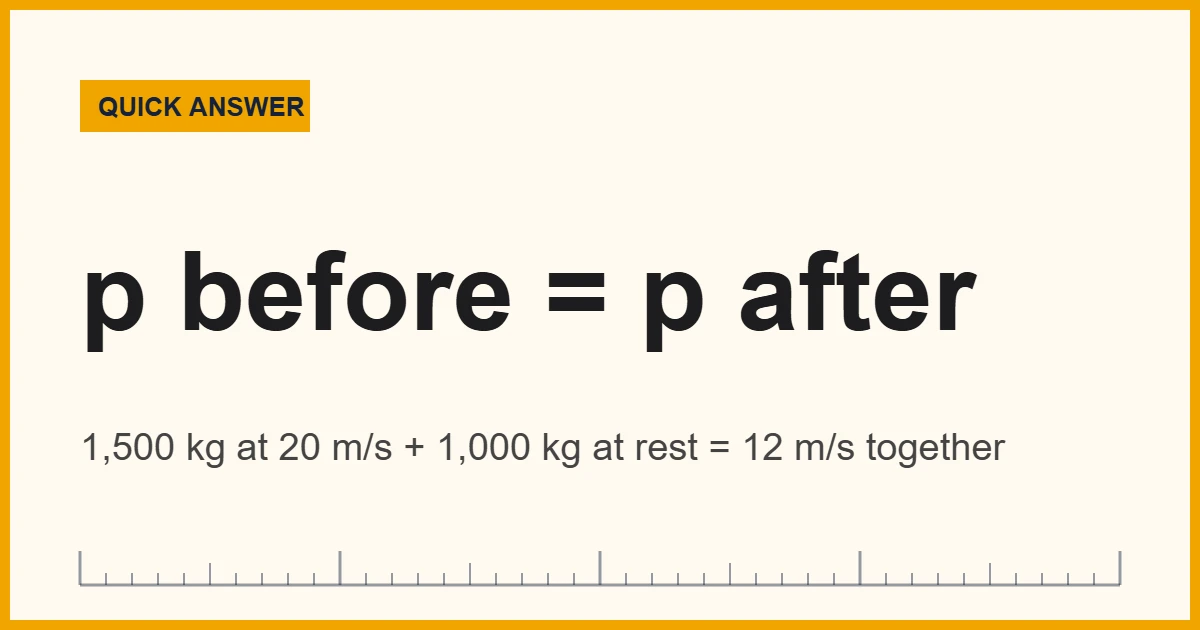
To find the speed after a collision, use conservation of momentum: total momentum before the crash equals total momentum after it. For example, a 1,500 kg car at 20 m/s that hits and sticks to a parked 1,000 kg car moves off at 12 m/s (about 27 mph). For angled hits, solve the x and y directions separately.
Physics students meet this problem in almost every mechanics course. However, it is also the core of real crash reconstruction, billiards, and even rocket docking. The question always has two parts: how fast does each object move afterward, and in which direction?
The good news is that one rule does most of the work. Momentum is mass times velocity, and in a collision it is shared, not lost. So if you know the masses and the speeds going in, you can work out the speed after a collision for a stuck-together crash right away. For a bouncy crash, you need one more fact: either that kinetic energy is conserved, or how “bouncy” the hit was.
In short: write down the momentum before, set it equal to the momentum after, and solve. In addition, treat direction with signs in a straight line, and with x and y components on a flat surface.
This guide follows the method taught in the free OpenStax textbook University Physics, Volume 1, which defines elastic, inelastic and perfectly inelastic collisions. Its section on collisions in two dimensions also explains the component method used further down.
The earlier version of this page had two formula errors. First, the final-velocity equation for object 2 was wrong. Second, the car formula mixed up speed and speed squared. Both are corrected below, and every example has been recomputed.
Convert Your Speed After a Collision to mph or km/h
Momentum math works best in SI units, so you will usually get an answer in meters per second. Then type that answer below to see it in km/h, mph, feet per second and knots.
This page has no dedicated momentum calculator, so the converter only handles units. Instead, do the momentum step by hand with the formulas below, and then convert the result here.
Recommended Tools for Measuring Collision Speed
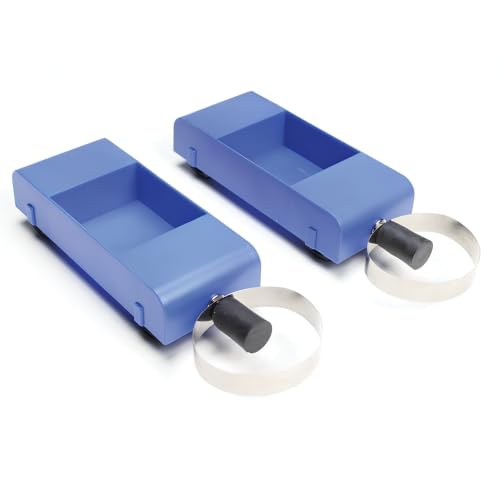
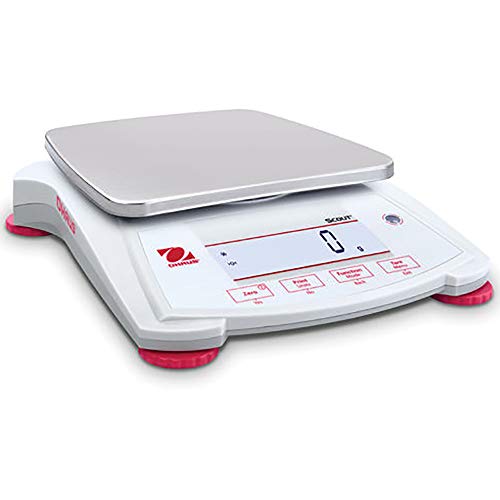
To check a collision in a lab or on a field, you need three numbers: mass, speed before, and speed after. A radar gun measures ball speeds directly. Meanwhile, a balance gives cart masses, a stopwatch times a cart over a measured track, and a scientific calculator handles the square roots and inverse tangents in 2D problems.



As an Amazon Associate, Measuring Expert earns from qualifying purchases.
Key Takeaways
- Momentum (p = m x v) is conserved in every collision, as long as no outside force acts during the hit.
- Kinetic energy is conserved only in elastic collisions.
- If the objects stick together, the shared velocity is total momentum divided by total mass.
- Direction comes from the sign in 1D and from the angle of the x and y components in 2D.
- The coefficient of restitution e runs from 0 (stick together) to 1 (perfectly elastic).
- Real car crashes add friction, crush and spin, so experts combine momentum with skid and crush evidence.
Elastic vs Inelastic: How Collision Type Changes Speed After a Collision
Every collision conserves momentum. What changes from one type to the next is how much kinetic energy turns into heat, sound and bent metal. As a result, the type tells you which second equation to use.

| Collision type | Momentum | Kinetic energy | Coefficient of restitution (e) | Everyday example |
|---|---|---|---|---|
| Elastic | Conserved | Conserved | e = 1 | Billiard balls, air-track gliders with magnets (close to elastic) |
| Inelastic | Conserved | Partly lost | 0 < e < 1 | A bouncing ball, most sports impacts |
| Perfectly inelastic | Conserved | Maximum loss | e = 0 | Cars that lock together, a dart hitting a board |
The coefficient of restitution compares how fast the objects separate with how fast they approached: e = (v2f – v1f) / (v1i – v2i). So an e of 0.6 means they fly apart at 60 percent of their closing speed.
Speed, Velocity and Momentum Are Not the Same Thing
Mixing these three up causes most wrong answers. In particular, momentum uses velocity, which has a direction, not plain speed.
| Quantity | Has direction? | SI unit | Role in a collision |
|---|---|---|---|
| Speed | No | m/s | The size of the velocity; what a speedometer or radar gun reads |
| Velocity | Yes | m/s | Speed plus direction; signs or components carry the direction |
| Momentum | Yes | kg m/s | Mass times velocity; the total stays constant through the hit |
| Kinetic energy | No | joules (J) | One half m v squared; conserved only if the hit is elastic |
For a fuller comparison, see our guide to calculating speed vs velocity. Similarly, if you want to see how mass feeds into speed outside of collisions, read how to use mass to find speed.
How to Find Speed After a Collision in One Dimension
Use these steps for any head-on or straight-line collision. Then use the converter above to turn the answer into mph or km/h.
- Choose a positive direction. Call one way positive, for example east or to the right. Any velocity the other way gets a minus sign.
- List the masses and starting velocities. Write m1, v1i, m2 and v2i in kilograms and meters per second.
- Add up the momentum before. Compute p = m1 v1i + m2 v2i, keeping the signs.
- Identify the collision type. Decide whether the objects stick (e = 0), bounce perfectly (e = 1), or have a known e in between.
- Apply the matching formula. Use the shared-velocity formula for sticking, or the restitution formulas for bouncing.
- Read the direction from the sign. A positive answer moves in your positive direction; a negative one moves the opposite way.
- Check your result. Confirm that total momentum after equals total momentum before, and that kinetic energy did not increase.
The formulas behind step 5 are short. For a perfectly inelastic hit, both objects share one velocity:
For any value of e, including the elastic case e = 1, the two final velocities are:
v2f = (m1 v1i + m2 v2i + m1 e (v1i – v2i)) / (m1 + m2)
With e = 1, these reduce to the textbook elastic formulas: v1f = ((m1 – m2) v1i + 2 m2 v2i) / (m1 + m2), and v2f = ((m2 – m1) v2i + 2 m1 v1i) / (m1 + m2).
Worked Examples in a Straight Line
Each example below uses the steps above. Also, every number was recomputed and checked against momentum before and after.
| Case | Before | After | Kinetic energy |
|---|---|---|---|
| Cars lock together (e = 0) | 1,500 kg at +20 m/s (44.7 mph); 1,000 kg at rest | Both at +12 m/s (43.2 km/h, 26.8 mph) | 300 kJ to 180 kJ (40% lost) |
| Lab carts, elastic (e = 1) | 2 kg at +3 m/s; 1 kg at rest | 2 kg cart +1 m/s; 1 kg cart +4 m/s | 9 J to 9 J (none lost) |
| Balls head-on (e = 0.6) | 0.5 kg at +4 m/s; 0.3 kg at -2 m/s | 0.5 kg ball +0.4 m/s; 0.3 kg ball +4.0 m/s | 4.6 J to 2.44 J (47% lost) |
Take the first row. The momentum before is 1,500 x 20 = 30,000 kg m/s. Next, divide by the total mass of 2,500 kg, and the shared velocity is 12 m/s in the original direction. In the third row, the light ball reverses: it came in at -2 m/s and leaves at +4.0 m/s. So the separation speed is 3.6 m/s, which is 0.6 times the 6 m/s closing speed, exactly as e predicts.
Speed After a Collision in Two Dimensions (Direction Too)
When objects meet at an angle, momentum is conserved separately along x and along y. Because of this, a 2D problem is really two 1D problems that you combine at the end.

- Split each starting velocity into components: vx = v cos(angle) and vy = v sin(angle).
- Add the x momentum of both objects, then add the y momentum.
- For a stuck-together crash, divide each total by the combined mass to get vx and vy.
- Find the speed with the Pythagorean theorem: v = square root of (vx squared + vy squared).
- Find the direction with the inverse tangent: angle = arctan(vy / vx), measured from the x axis.
Here is an example. A 1,200 kg car heads east at 15 m/s (54 km/h, 33.6 mph). At the same time, a 1,800 kg SUV heads north at 10 m/s (36 km/h, 22.4 mph). They lock together. The east momentum is 1,200 x 15 = 18,000 kg m/s, and the north momentum is 1,800 x 10 = 18,000 kg m/s. Dividing each by 3,000 kg gives 6 m/s east and 6 m/s north. So the wreck moves at 8.49 m/s (30.5 km/h, 19.0 mph), 45 degrees north of east. Meanwhile, kinetic energy drops from 225 kJ to 108 kJ, a 52 percent loss.
For more practice with components, see how to find speed and direction of a vector.
Glancing Hits: The Billiard Ball Case
In an elastic 2D collision, you have four unknowns (two speeds, two angles) but only three equations: x momentum, y momentum and energy. Therefore you need one measured fact, usually one of the outgoing angles.
Billiards gives a neat special case. When a ball hits an equal-mass ball at rest elastically and off-center, the two leave at 90 degrees to each other. For example, if the cue ball rolls in at 2 m/s and the object ball leaves 30 degrees off the original line, the object ball moves at 2 cos 30 = 1.73 m/s. The cue ball, in turn, leaves at 2 sin 30 = 1.0 m/s, 60 degrees off the line on the other side. Real balls spin and roll, so table results drift a little from this ideal.
Real Car Crashes: Why Speed After a Collision Is Harder
Textbook problems give you the speeds before the hit and ask for the speeds after. Crash investigators usually face the reverse. They see where the cars ended up and work backward.
First, they estimate the speed right after impact from the post-crash slide. If a vehicle skids a distance d to a stop, its speed after the collision is about v = square root of (2 mu g d), where mu is the tire-road friction coefficient and g is 9.80665 m/s squared. For instance, with mu = 0.7 and a 10 m slide, v is about 11.7 m/s (42.2 km/h, 26.2 mph). Next, they feed those post-impact speeds and directions into the momentum equations to find the speeds before impact.
The old version of this page gave “final speed = initial speed – (2 x acceleration x distance)”. That is wrong, because the kinematics equation works with squared speeds: v^2 = u^2 – 2 a d. Our guide to calculating speed from stopping distance walks through that equation in detail.
Do and Don’t
Do
- Pick a positive direction before writing any numbers.
- Convert everything to kg and m/s first.
- Handle x and y momentum separately in 2D.
- Check momentum before and after as a final test.
- Convert the result to mph or km/h only at the end.
Don’t
- Assume kinetic energy is conserved unless the hit is elastic.
- Drop minus signs on velocities that point backward.
- Add speeds at an angle as if they were in a line.
- Trust an answer where kinetic energy goes up.
- Mix grams with kilograms in one equation.
Honest Limits of the Momentum Method
Conservation of momentum is exact, but it only holds for an isolated system. During a real impact, tire friction, a curb or a wall can push on the objects. In most crashes the impact lasts a fraction of a second, so those outside forces change the momentum very little. Still, over a long slide or a hit against a fixed object, they matter a lot.
The coefficient of restitution is also not a fixed property of a material. Instead, it changes with impact speed, temperature and the exact contact point. Finally, the formulas here treat objects as points. As a result, they ignore spin, which takes some of the energy in billiards, golf and car crashes. For homework and lab carts, these limits rarely matter. For real crash analysis, however, they are why experts use specialized software and physical evidence.
When to Call a Professional
If you need to know how fast vehicles were going in a real crash, for insurance, a claim or a legal case, contact an accredited accident reconstructionist. They combine scene measurements, vehicle crush profiles and event data recorder downloads, which a hand calculation cannot replace. Similarly, for engineering design involving impacts, work with a licensed engineer.
Speed After a Collision: FAQs
How do you find speed after a collision?
Set total momentum before equal to total momentum after. If the objects stick, divide total momentum by total mass. If they bounce, also use energy conservation (elastic) or the coefficient of restitution.
How do you find the direction of motion after a collision?
In one dimension, the sign of the final velocity gives the direction. In two dimensions, find the x and y velocity components and use arctan(vy / vx) to get the angle.
What is the speed after a collision if two objects stick together?
It is (m1 v1 + m2 v2) / (m1 + m2), using signed velocities. For example, 1,500 kg at 20 m/s hitting 1,000 kg at rest gives 12 m/s.
Is kinetic energy conserved in a collision?
Only in an elastic collision. In inelastic collisions, some kinetic energy becomes heat, sound and deformation, while momentum is still conserved.
How do you find v1 and v2 after a collision?
Use v1f = (m1 v1i + m2 v2i + m2 e (v2i – v1i)) / (m1 + m2) and v2f = (m1 v1i + m2 v2i + m1 e (v1i – v2i)) / (m1 + m2), with e = 1 for elastic and e = 0 for sticking.
Can the speed after a collision be higher than before?
Yes, for one object. A light object hit by a heavy one can leave faster than the heavy one was moving. Total kinetic energy, however, cannot increase without an energy source such as an explosion.
How do you estimate a car’s speed after a collision?
Investigators use the post-crash slide distance: v = square root of (2 mu g d). With a friction coefficient of 0.7 and a 10 m slide, that is about 11.7 m/s, or 26 mph.
What does the coefficient of restitution tell you?
It is the ratio of separation speed to approach speed. A value of 1 means perfectly elastic, 0 means the objects stick, and values in between are partly bouncy.
Why does speed after a collision need vectors in 2D?
Momentum has direction, so it is conserved along x and along y separately. Adding speeds at an angle as plain numbers gives the wrong answer.
What units should I use for collision problems?
Use kilograms for mass and meters per second for velocity, so momentum comes out in kg m/s. Then convert the final speed to mph or km/h if you need to.
Bottom Line
Finding speed and direction after a collision comes down to one law and one choice. The law is conservation of momentum, applied along each direction. The choice is the collision type, which tells you whether objects share one velocity, bounce elastically, or follow a known coefficient of restitution.
So set up your signs or components, solve, and check that momentum balances. Then use the converter at the top of the page to express the answer in mph or km/h. For real crashes, finally, treat any hand calculation as a learning tool and leave the official numbers to a reconstruction expert.