

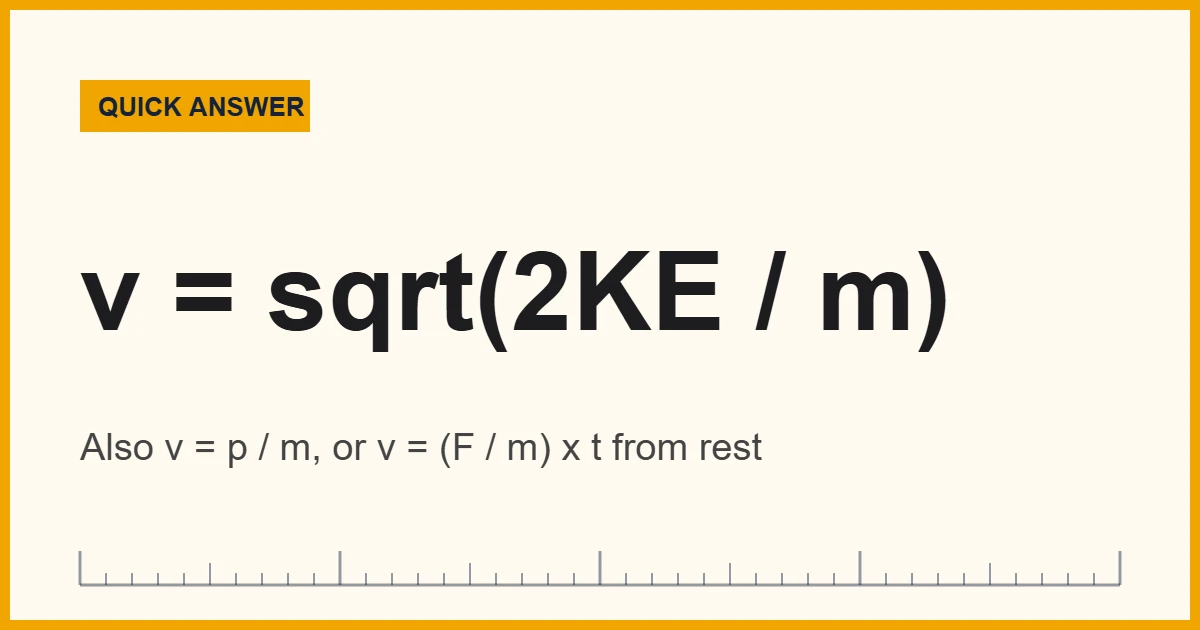
To use mass to find speed, you always need a second quantity. With kinetic energy, speed is v = sqrt(2KE/m). If you know momentum instead, v = p/m. And for a steady force acting for a known time, v = (F/m) x t from rest. Use kilograms, joules, newtons and seconds, and the answer comes out in meters per second.
Physics homework often hands you a mass and asks for a speed. At first that looks impossible, and in a sense it is: a 2 kg cart can sit still or roll at 10 m/s, and its mass stays the same either way. However, mass becomes very useful the moment you pair it with energy, momentum or force. In those formulas it sets how hard it is to get an object moving, so it controls the speed you can calculate.
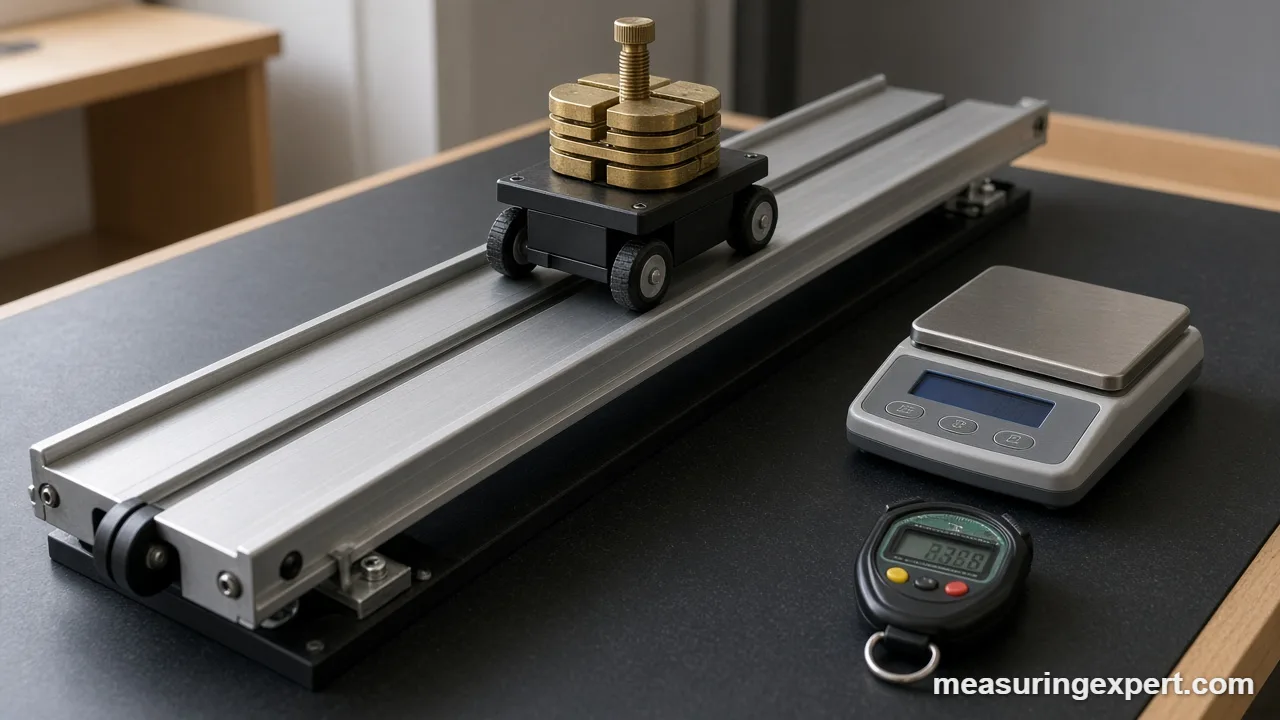
This guide shows you how to use mass to find speed with the three formulas that actually work. You will also see five worked examples, a unit table, and a step list you can follow on any problem. First, though, here is the short version.
In short: speed never comes from mass alone. Instead, you divide momentum by mass, divide twice the kinetic energy by mass and take the square root, or divide force by mass to get acceleration and then multiply by time. Each route needs one more measured number besides the mass.
Where These Speed Formulas Come From
These relationships are standard textbook physics. For example, the free OpenStax University Physics text defines kinetic energy as K = 1/2 mv^2, measured in joules. Similarly, NASA Glenn Research Center’s guide to Newton’s second law defines momentum as mass times velocity and shows how F = m x a follows from it.
Finally, once you have a result in meters per second, the converter below turns it into km/h and mph, so you can tell whether the number makes sense.
Convert Your Result From m/s to km/h and mph
Every formula on this page gives speed in meters per second when you use SI units. Type that value below, and the converter shows the same speed in kilometers per hour and miles per hour. For example, 25 m/s is 90 km/h, or about 55.9 mph.
Recommended Lab Tools for Using Mass to Find Speed
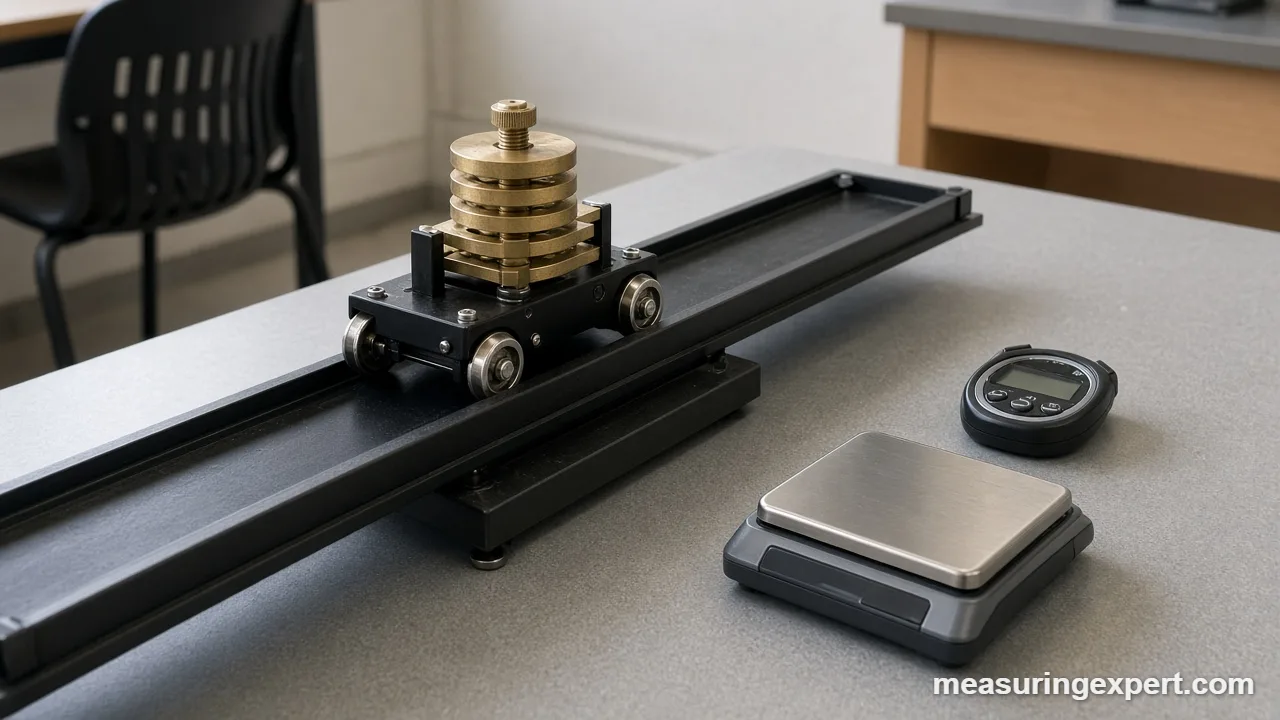
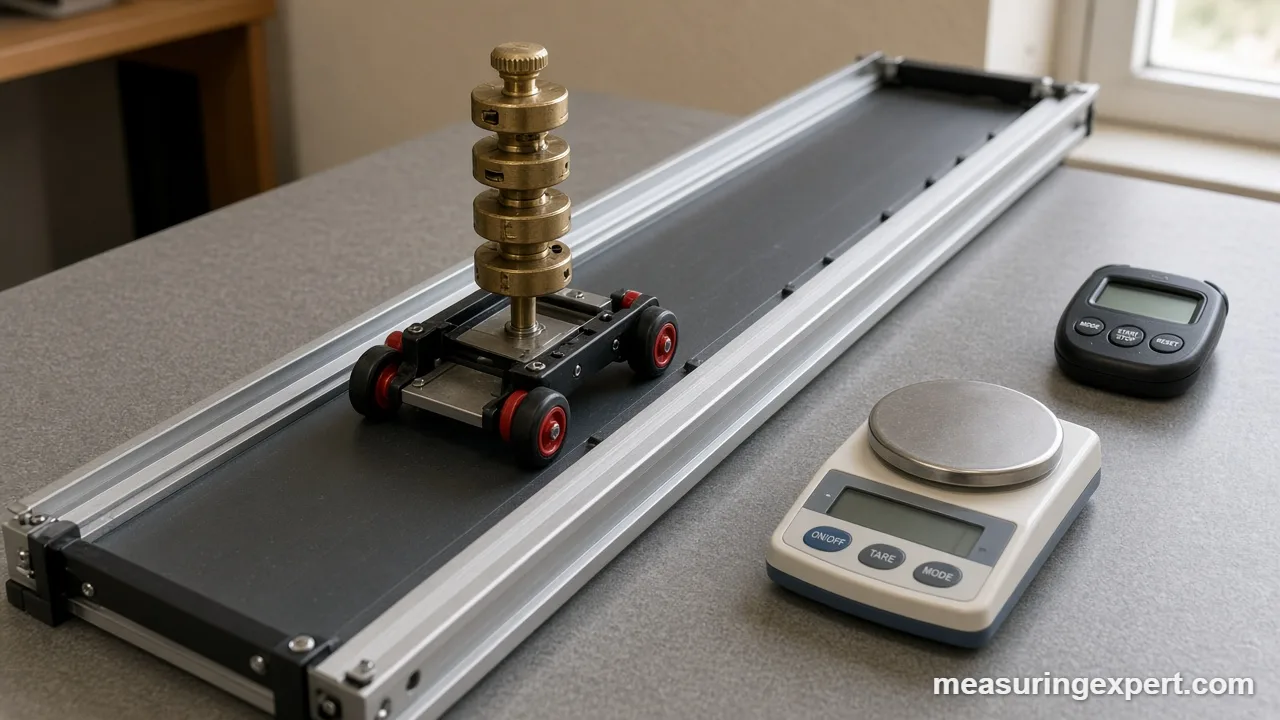
If you want to check these formulas with real objects, you need three things: a known mass, something that moves, and a way to time it. A low-friction dynamics cart gives you the moving mass. Next, a photogate or lab timer measures how fast it passes a point. Also, a Hall’s car kit with slotted weights lets you change the mass and watch the speed respond. The picks below come from established classroom brands and are based on manufacturer specs and buyer reports.
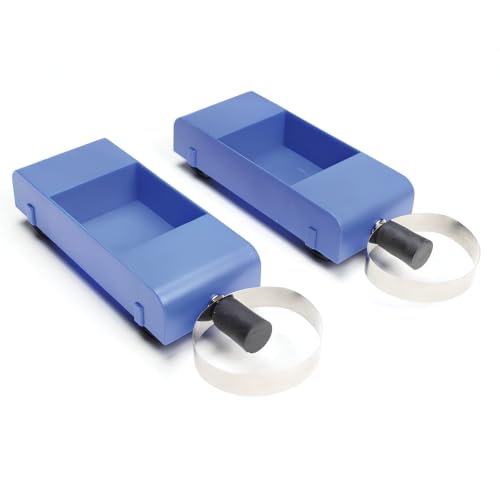

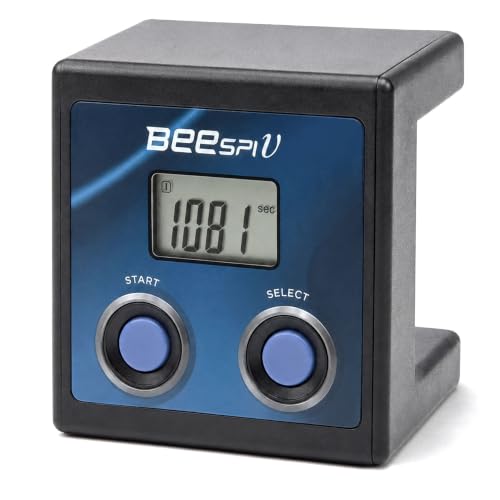


As an Amazon Associate, Measuring Expert earns from qualifying purchases.
Key Takeaways
- Mass alone never tells you speed; you also need energy, momentum, or force plus time.
- Kinetic energy route: v = sqrt(2KE/m).
- Momentum route: v = p/m.
- Steady force route: a = F/m, then v = v0 + a x t.
- Work in kilograms, joules, newtons, meters and seconds to get m/s.
- Convert grams to kilograms first; forgetting this is the most common error.
- For a dropped object without air drag, mass cancels out: v = sqrt(2gh).
Can You Use Mass to Find Speed on Its Own?
No. Mass measures how much matter an object contains and how strongly it resists a change in motion. Speed, by contrast, describes how fast it is moving right now. For example, a parked truck and a highway truck have the same mass, yet their speeds are very different. So any method that claims to use mass to find speed is really using mass together with something else.
That “something else” usually comes from one of three places. First, a problem may tell you the energy of motion (kinetic energy). Second, it may give you momentum, often from a collision. Third, it may describe a push or pull that acts for a known time. In each case, mass converts that quantity into a speed. In other words, mass acts like an exchange rate between energy, momentum or force and the motion you can see.
Three Formulas That Use Mass to Find Speed
Each formula below rearranges a standard physics law so that speed sits alone on one side. Pick the one that matches the data you have.
From kinetic energy: v = sqrt(2KE/m)
Kinetic energy is KE = 1/2 x m x v^2. Multiply both sides by 2, divide by m, and take the square root. As a result, you get v = sqrt(2 x KE / m). Because mass sits under the square root, four times the mass at the same energy gives half the speed, not a quarter.
Using momentum: v = p/m
Momentum is p = m x v, so v = p / m. Overall, this is the simplest route. For instance, doubling the mass at the same momentum halves the speed. Also, momentum has units of kilogram meters per second (kg m/s), so dividing by kilograms leaves meters per second.
With force and time: v = v0 + (F/m) x t
Newton’s second law says F = m x a, so acceleration is a = F/m. If that steady force acts for a time t, the speed changes by a x t. Therefore v = v0 + (F / m) x t, where v0 is the starting speed (zero if the object starts at rest). This only holds when the net force stays constant; friction must be included in F.
| You know | Formula for speed | Units in | Watch out for |
|---|---|---|---|
| Mass + kinetic energy | v = sqrt(2KE/m) | kg, J | Forgetting the 2 or the square root |
| Mass + momentum | v = p/m | kg, kg m/s | Mixing grams with kilograms |
| Mass + net force + time | v = v0 + (F/m)t | kg, N, s | Using total force instead of net force |
| Height of a fall only | v = sqrt(2gh) | m, m/s^2 | Mass cancels; air drag ignored |
Worked Examples: Using Mass to Find Speed
All results below come from the formulas above, computed to four significant figures, with mph and km/h added so you can picture them.
| Problem | Working | Speed |
|---|---|---|
| Baseball, 0.145 kg, KE = 120 J | sqrt(2 x 120 / 0.145) | 40.68 m/s (146.5 km/h, 91.0 mph) |
| Car, 1,500 kg, p = 37,500 kg m/s | 37,500 / 1,500 | 25 m/s (90 km/h, 55.9 mph) |
| Lab cart, 2 kg, net force 6 N for 3 s from rest | (6 / 2) x 3 | 9 m/s (32.4 km/h, 20.1 mph) |
| Bullet, 8 g, KE = 2,000 J | sqrt(2 x 2,000 / 0.008) | 707.1 m/s (2,546 km/h, 1,582 mph) |
| Ball dropped 5 m (any mass) | sqrt(2 x 9.80665 x 5) | 9.903 m/s (35.65 km/h, 22.15 mph) |
Next, look at the bullet line. Its mass is 8 grams, so you must enter 0.008 kg. If you typed 8 instead, the answer would drop to about 22 m/s, which is clearly wrong for a rifle bullet. For real-world numbers, see our guide to how fast a bullet travels.
Getting the Units Right
In fact, most wrong answers come from units, not from algebra. The SI units fit together so that kilograms, joules and newtons give meters per second with no extra factors. Mix in grams, kilojoules or hours, though, and the result goes off by a factor of 10, 1,000 or 3,600.
| Quantity | SI unit | Common trap | Fix |
|---|---|---|---|
| Mass | kilogram (kg) | Grams or pounds | g / 1,000; lb x 0.45359237 |
| Kinetic energy | joule (J = kg m^2/s^2) | Kilojoules | kJ x 1,000 |
| Momentum | kg m/s | g cm/s | Divide by 100,000 |
| Force | newton (N = kg m/s^2) | Pound-force | lbf x 4.448222 |
| Speed | m/s | Needing mph or km/h | m/s x 3.6 = km/h; m/s / 0.44704 = mph |
If you weigh your object in the lab, our guide to tools used to measure mass explains which balance or scale gives the precision you need.
How to Use Mass to Find Speed in Any Problem
- List what you know. Write down the mass and every other given value with its unit.
- Convert to SI units. Change grams to kilograms, kilojoules to joules, and minutes to seconds.
- Choose the formula. Energy points to v = sqrt(2KE/m), momentum to v = p/m, and force with time to v = v0 + (F/m)t.
- Substitute and solve. Enter the numbers and keep a few extra digits until the end.
- Round the answer. Match the number of significant figures in your given data.
- Check it. Plug the speed back into the original formula, then convert to mph with the converter above to see if it is realistic.
When Mass Cancels Out: Falling Objects
However, some problems give you a mass you do not need. When an object falls from rest, its potential energy m x g x h turns into kinetic energy 1/2 x m x v^2. Because m appears on both sides, it cancels, and v = sqrt(2gh). So a 1 kg rock and a 10 kg rock dropped 5 m both hit at about 9.9 m/s, if air drag is small. Galileo’s point still holds in the lab: in a vacuum, heavy and light objects fall together.
In real air, however, mass does matter for light, wide objects. A feather reaches a low terminal speed because drag soon balances its small weight. Meanwhile, a steel ball keeps speeding up much longer. In short, the formula above works well for dense objects over short drops.
Similarly, ramps follow the same rule. On a smooth incline, a cart’s speed at the bottom depends on the height it drops, not on its mass. Friction in the wheels changes this a little, which is one reason lab results rarely match theory exactly.
Do and Don’t
Do
- Convert every value to SI units first.
- Write the formula before you plug in numbers.
- Use the net force, after subtracting friction.
- Check the answer by working backward.
- Compare the result with a familiar speed in mph.
Don’t
- Expect a speed from mass by itself.
- Forget the square root in the energy formula.
- Treat weight in newtons as mass in kilograms.
- Use E = mc^2 for everyday moving objects.
- Round halfway through a calculation.
Honest Limits
First of all, these formulas describe ideal motion. In practice, friction, air drag and rolling resistance take energy away, so a real cart rolls slower than v = sqrt(2KE/m) predicts. Also, the force formula assumes a steady force; a hand push or a rocket that burns fuel changes over time, and then you need calculus or measured data. Near the speed of light, classical kinetic energy fails and relativistic formulas take over, but that only matters for particles, not cars or balls. Finally, a calculated speed is only as good as the mass and energy you start with. For that reason, labs measure speed directly with light gates and then compare it with theory.
When to Ask an Expert
Generally, classroom problems are safe to work through on your own. On the other hand, some questions carry real consequences: vehicle crash reconstruction, the energy of a projectile, machine guarding, or a falling-load hazard on a job site. In those cases, ask a licensed engineer, an accident reconstruction specialist, or your physics teacher to review the numbers, and follow OSHA and manufacturer guidance for any equipment.
Mass to Find Speed: Frequently Asked Questions
Can you use mass to find speed without any other information?
No. Mass alone does not tell you how fast something moves. You also need kinetic energy, momentum, or a net force and the time it acts.
What is the formula to use mass to find speed from kinetic energy?
Use v = sqrt(2KE/m), with KE in joules and m in kilograms. The answer is in meters per second.
How do I use mass to find speed from momentum?
Divide momentum by mass: v = p/m. For example, 37,500 kg m/s divided by 1,500 kg gives 25 m/s, or about 55.9 mph.
How do force and time give speed?
Divide the net force by mass to get acceleration, then multiply by time and add any starting speed: v = v0 + (F/m)t.
Does a heavier object fall faster?
Not without air drag. A dropped object reaches v = sqrt(2gh), so mass cancels. In real air, light and wide objects slow down more because of drag.
Why does my answer come out far too small or too large?
Usually the mass is in grams instead of kilograms, or the energy is in kilojoules instead of joules. Convert to SI units before you calculate.
Is E = mc^2 a way to use mass to find speed?
No. In E = mc^2, c is the fixed speed of light. It links mass and rest energy, not the speed of an everyday moving object.
How is mass related to speed?
For the same energy or momentum, a heavier object moves slower. At the same speed, a heavier object carries more momentum and more kinetic energy.
What units should I use?
Use kilograms, joules, newtons, meters and seconds. Those give speed in m/s; multiply by 3.6 for km/h or divide by 0.44704 for mph.
How can I measure speed in a lab to check my answer?
Time the object with a photogate or light gate over a known distance, then divide distance by time. Compare that with your calculated value.
Using Mass to Find Speed: The Bottom Line
To sum up, you can use mass to find speed only when you pair it with another quantity. With kinetic energy, v = sqrt(2KE/m). Using momentum, v = p/m. Given a steady net force, v = v0 + (F/m)t. Convert to kilograms, joules, newtons and seconds first, and the answer lands in meters per second.
After that, check the result by working backward and by converting it to mph or km/h with the converter above. If the number looks unrealistic, look at the units first; a gram-to-kilogram slip is the usual culprit.
3 thoughts on “How to Use Mass to Find Speed: Kinetic Energy, Momentum and Force Formulas”