

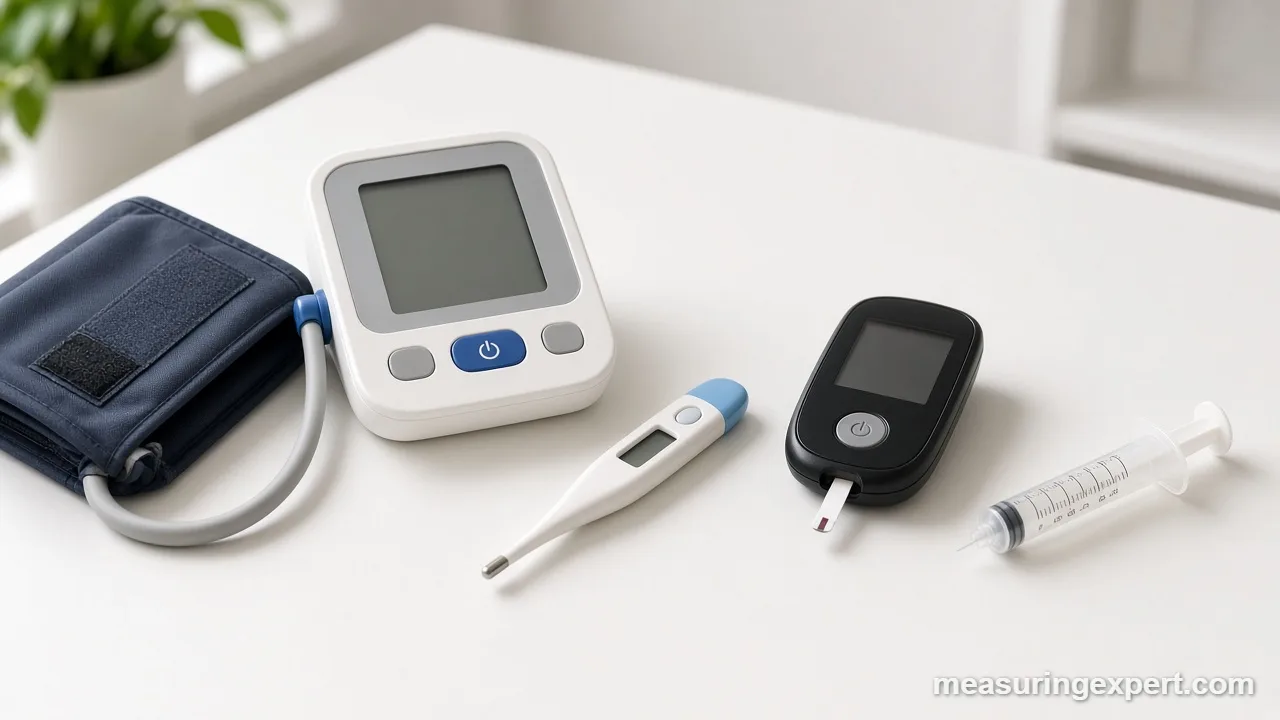
Medical units tell you how much of something is present. A milligram (mg) is 1/1,000 of a gram, and a microgram (mcg) is 1/1,000 of a milligram. A milliliter (mL) measures liquid volume. Lab results use mg/dL in the US or mmol/L elsewhere, vitamins may use IU, and blood pressure uses mmHg.
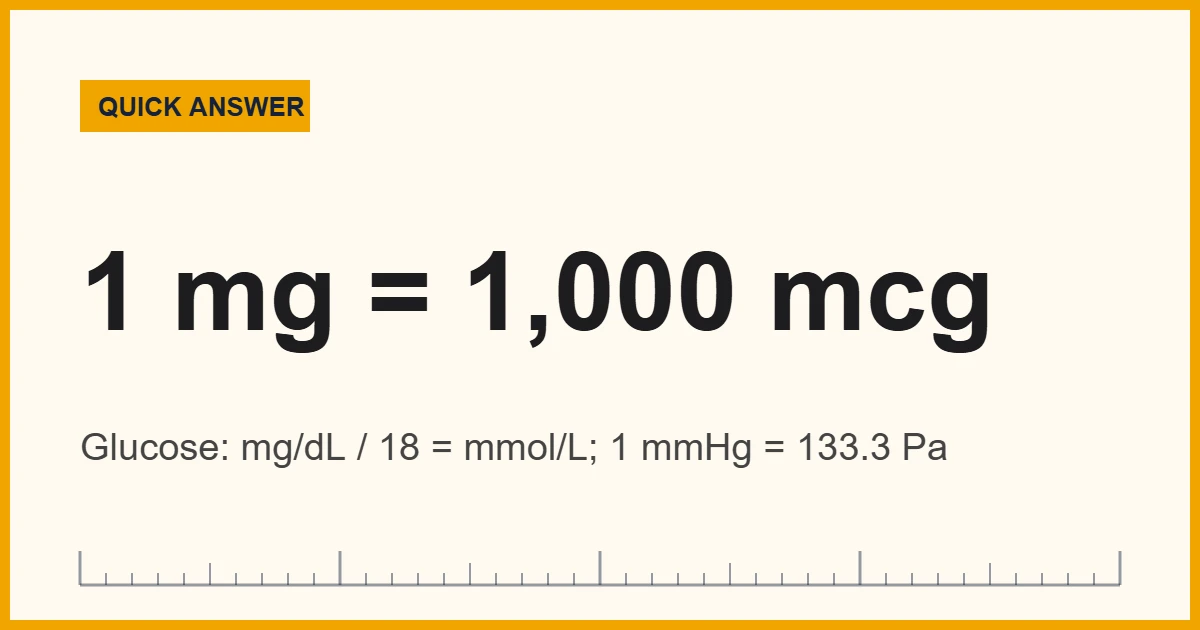
Open a prescription label, a vitamin bottle or a blood test report, and you will see a crowd of small abbreviations. Each one, however, answers a different question. For example, mg and mcg describe mass, mL describes volume, and mg/dL describes concentration. Meanwhile, IU describes biological activity, and mmHg describes pressure.
The trouble, though, is that these abbreviations look alike. A single letter separates mg from mcg, yet one is 1,000 times bigger than the other. Similarly, a lab value of 100 mg/dL and a value of 5.6 mmol/L can describe exactly the same blood sugar. So reading medical units correctly is less about math and more about knowing what each symbol stands for.
In short: medical units fall into five families. Mass (mg, mcg, g, kg), volume (mL, L), concentration (mg/dL, mmol/L, mEq/L), activity (IU, units) and physical readings (mmHg, degrees, beats per minute) cover almost everything you will meet outside a hospital.
Where Medical Units Come From
Most of these units come from the International System of Units (SI), which is maintained internationally and documented in the US by the National Institute of Standards and Technology (NIST). For instance, NIST’s SI conversion table defines the conventional millimeter of mercury as about 133.322 pascals. As a result, every blood pressure reading in mmHg converts to an exact SI pressure.
This guide explains each unit, shows the conversions that come up most, and flags the abbreviations that safety groups say cause errors. However, it does not give dosing advice. For any medicine, follow the label and your pharmacist or doctor.
Convert mg, mcg and Grams
First, enter an amount and choose its unit. The converter then shows the same mass in micrograms, milligrams, grams, grains and ounces, using exact definitions (1 g = 1,000 mg = 1,000,000 mcg). It converts units only; it cannot tell you how much of any medicine to take.
Recommended Tools for Home Health Measurements
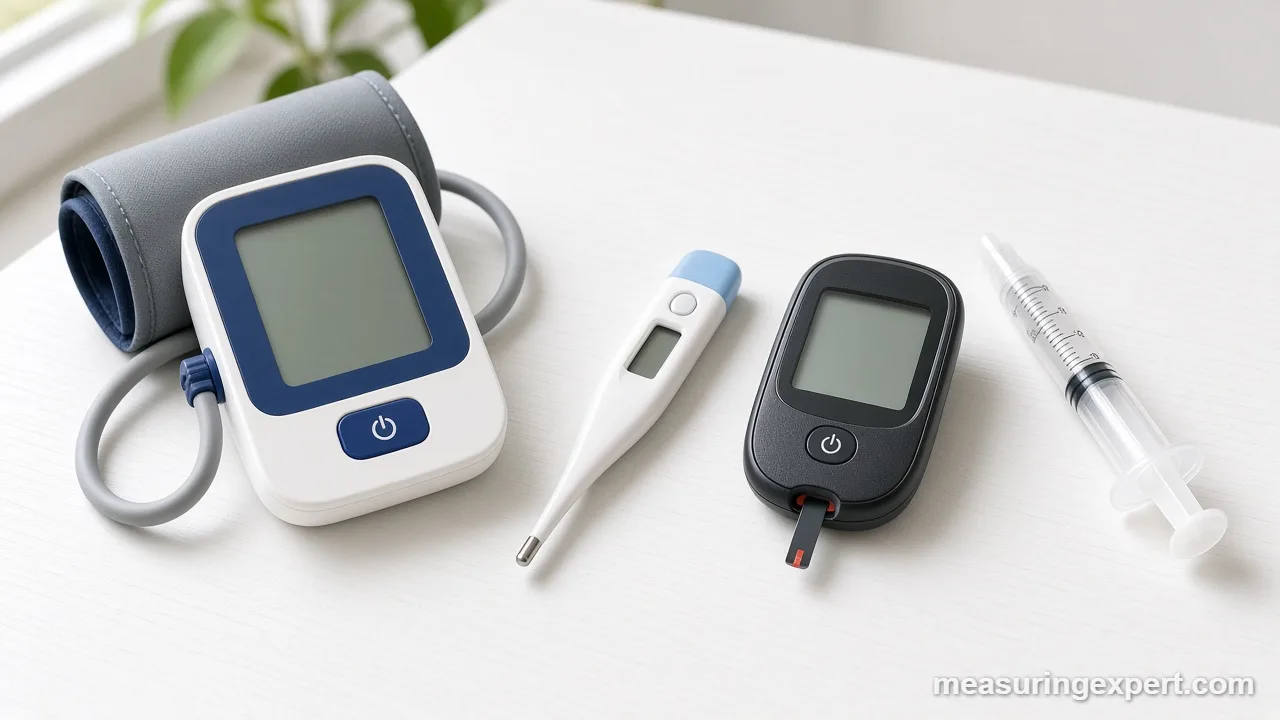
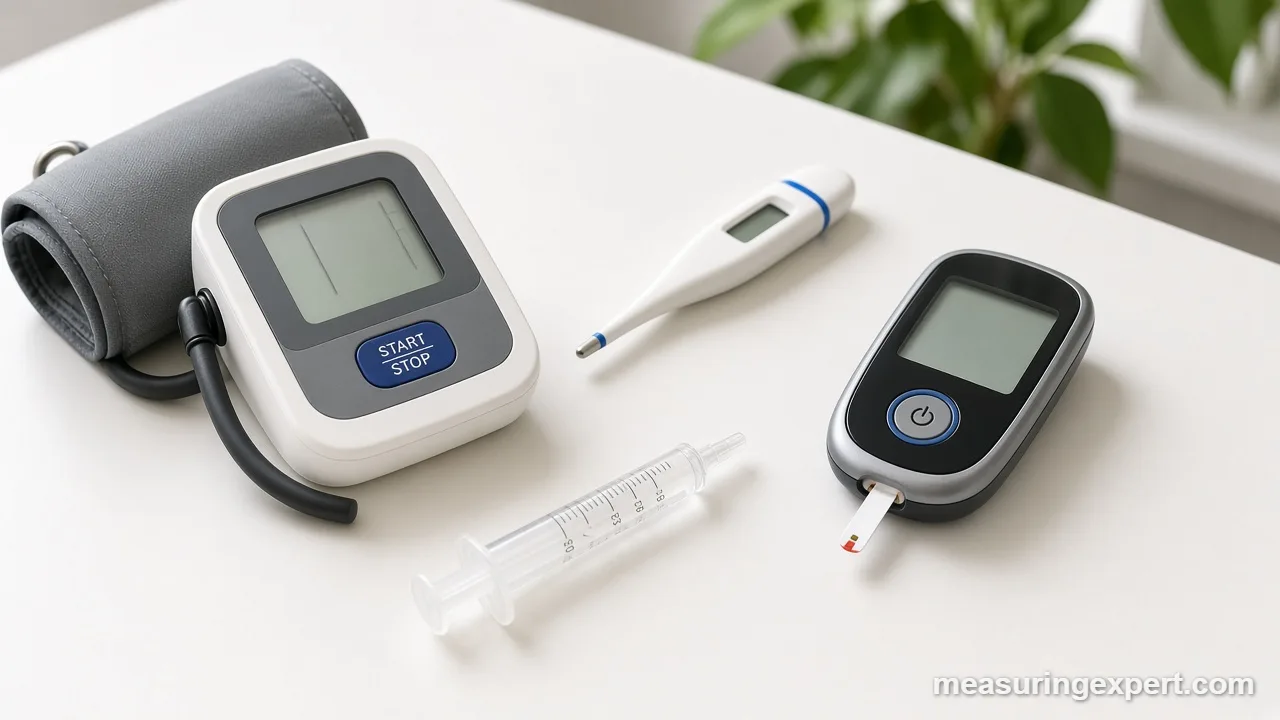
A few well-made devices make home readings easier to trust. First, an upper-arm blood pressure monitor reads in mmHg and is the type most clinicians prefer for home use. Next, a digital thermometer lets you switch between Fahrenheit and Celsius. Finally, an oral syringe or a dosing cup marked in mL is far more consistent than a kitchen spoon for liquid medicine. These picks are based on manufacturer specs and buyer reports, not our own testing.


As an Amazon Associate, Measuring Expert earns from qualifying purchases.
Key Takeaways
- 1 gram = 1,000 milligrams (mg) = 1,000,000 micrograms (mcg).
- Safety groups prefer “mcg” over the Greek symbol, which can be misread as “mg”.
- One milliliter (mL) equals one cubic centimeter (cc), but “mL” is the safer label.
- To turn blood glucose in mg/dL into mmol/L, divide by about 18.
- An IU measures activity, so each substance has its own IU-to-mass factor.
- Blood pressure in mmHg converts to kilopascals: 120 mmHg is about 16.0 kPa.
- Kitchen spoons are not dosing tools; use the device that comes with the medicine.
Medical Units of Mass: mg, mcg, g and kg
First, most tablets and capsules list their strength as a mass. The SI prefixes do all the work here, because each step down is a factor of 1,000. Therefore, moving from grams to milligrams to micrograms only shifts the decimal point three places each time.
| Unit | Symbol | Equals | Where you see it |
|---|---|---|---|
| Kilogram | kg | 1,000 g (about 2.2046 lb) | Body weight on charts |
| Gram | g | 1,000 mg | Nutrition labels, larger amounts |
| Milligram | mg | 0.001 g | Most tablet strengths |
| Microgram | mcg (µg) | 0.001 mg | Vitamins D and B12, some hormones |
| Nanogram | ng | 0.001 mcg | Some lab tests |
The gap between mg and mcg is the one that matters most. For example, 0.5 mg is the same as 500 mcg, and 25 mcg is only 0.025 mg. Our guide to what mcg means walks through more mcg-to-mg examples. In addition, the converter above handles any value in either direction.
Volume in Medical Units: mL, cc and L
Liquid medicines, IV fluids and syringes measure volume. In practice, the milliliter is the standard. One milliliter is exactly one cubic centimeter, so 5 mL and 5 cc describe the same amount of liquid. You can read more in our explainer on what cc stands for.
Even so, many pharmacies and hospitals now write only “mL”. The reason is practical: a handwritten “cc” can be mistaken for “u” or “00”. Likewise, US dosing devices for oral liquids are marked in mL, because household teaspoons and tablespoons vary widely in size.
Meanwhile, the liter (L) appears in larger contexts, such as fluid intake, lung volumes in breathing tests, and the “per liter” part of many lab results. Since 1 L = 1,000 mL, a value per liter is easy to scale.
Medical Units of Concentration: mg/dL vs mmol/L
Blood tests rarely report a plain mass. Instead, they report how much of a substance sits in a set volume of blood. In other words, the number is a concentration, and two systems compete. US labs often use mass per deciliter (mg/dL), while most other countries use the SI unit, millimoles per liter (mmol/L).
First, a deciliter is one tenth of a liter, or 100 mL. If the “dL” part is new to you, see what the measurement dL means. A mole, by contrast, counts molecules rather than weighing them. Because each substance has its own molecular weight, the conversion factor changes from test to test.
| Test | mg/dL to mmol/L | Example |
|---|---|---|
| Glucose (molar mass about 180.16 g/mol) | divide by about 18.02 | 100 mg/dL = about 5.55 mmol/L |
| Total cholesterol (about 386.65 g/mol) | divide by about 38.67 | 200 mg/dL = about 5.17 mmol/L |
| Creatinine (mg/dL to µmol/L) | multiply by about 88.4 | 1.0 mg/dL = about 88.4 µmol/L |
To illustrate, here is how the glucose factor works. Specifically, one millimole of glucose weighs about 180.16 mg, and a liter holds 10 deciliters. So 100 mg/dL is 1,000 mg per liter, and 1,000 divided by 180.16 gives about 5.55 mmol/L. In other words, you can check any factor yourself if you know the molar mass.
Electrolytes add one more unit: milliequivalents per liter (mEq/L). For ions with a single charge, such as sodium and potassium, 1 mmol/L equals 1 mEq/L. For calcium and magnesium, however, which carry two charges, 1 mmol/L equals 2 mEq/L.
IU and Units: Medical Units of Activity
Some substances are measured by what they do in the body rather than by how much they weigh. That is the idea behind the International Unit (IU) and the plain “unit” used for insulin and heparin. Consequently, there is no single IU-to-milligram factor. Instead, each substance has its own.
| Substance | Relationship | Source |
|---|---|---|
| Vitamin D | 1 mcg = 40 IU | NIH Office of Dietary Supplements |
| Insulin (U-100) | 100 units in each mL of that product | Product labeling |
| Other vitamins and drugs | Factor depends on the exact form | Product label or pharmacist |
For example, the vitamin D factor is easy to use. According to the NIH vitamin D fact sheet, 1 mcg of vitamin D equals 40 IU, and the FDA requires food labels to list vitamin D in mcg. So a label showing 25 mcg also describes 1,000 IU; it is the same amount written two ways.
Pressure: mmHg and cmH2O
Blood pressure is still reported in millimeters of mercury (mmHg), a unit from the days of glass mercury gauges. A reading such as 120/80 means 120 mmHg at the heartbeat (systolic) and 80 mmHg between beats (diastolic). Modern digital monitors have no mercury, yet they keep the same unit so readings stay comparable.
| mmHg | kPa | psi | cmH2O |
|---|---|---|---|
| 80 | 10.67 | 1.55 | 108.8 |
| 90 | 12.00 | 1.74 | 122.4 |
| 120 | 16.00 | 2.32 | 163.1 |
| 140 | 18.67 | 2.71 | 190.3 |
These values use 1 mmHg = 133.322 Pa and 1 cmH2O = 98.0665 Pa, both from NIST. Also, breathing equipment and spinal fluid tests often use centimeters of water (cmH2O), where 1 mmHg is about 1.36 cmH2O. For an accurate home reading, follow the monitor’s manual on cuff size, posture and rest time, because those affect the number more than any rounding does.
Temperature, Heart Rate and Body Weight
Finally, a few everyday readings round out the list. Body temperature appears in degrees Fahrenheit in the US and degrees Celsius almost everywhere else; to convert, multiply Celsius by 1.8 and add 32. For example, 37.0 degrees C equals 98.6 degrees F, and 38.0 degrees C equals 100.4 degrees F.
Next, heart rate and breathing rate are counts per minute, written as bpm or breaths/min. Similarly, oxygen saturation is a percentage (SpO2). Body weight, meanwhile, is usually charted in kilograms, because many medicines are prescribed per kilogram of body weight. Since 1 kg is about 2.2046 lb, mixing up pounds and kilograms changes a weight by more than double. That is why many hospitals record weight in kilograms only.
How to Read Medical Units on a Label or Lab Report
- Find the number and its unit together. A number without a unit is meaningless, so look for mg, mcg, mL, mg/dL or mmol/L right beside it.
- Identify the family. Decide whether the unit is mass, volume, concentration, activity or pressure, because each family converts differently.
- Check the prefix carefully. Next, confirm whether it says mg or mcg, mL or L; each prefix step is a factor of 1,000.
- Look for a “per” part. Liquids often state strength as mg per mL (for example, 250 mg/5 mL), so the mass depends on the volume.
- Convert only with a known factor. Use the converter above for mass, or a stated factor such as 40 IU per mcg for vitamin D.
- Confirm with a professional. Finally, ask a pharmacist if anything about the unit or the amount is unclear.
Abbreviations That Cause Errors
Some ways of writing medical units are known to cause mistakes. The Joint Commission, which accredits US hospitals, keeps an official “Do Not Use” list for exactly this reason. Its entries, along with related advice from medication safety groups, are summarized below.
| Avoid | Why | Write instead |
|---|---|---|
| U or u | Mistaken for 0, 4 or cc | unit |
| IU | Mistaken for IV or 10 | International Unit |
| Trailing zero (5.0 mg) | Decimal missed, read as 50 | 5 mg |
| No leading zero (.5 mg) | Decimal missed, read as 5 | 0.5 mg |
| Greek µg | Mistaken for mg | mcg |
| cc | Mistaken for u or 00 | mL |
Overall, the pattern is clear: every error on the list multiplies or divides an amount by 10 or more. As a result, clear writing of medical units is one of the simplest safety habits in health care.
Do and Don’t With Medical Units
Do
- Read the unit as carefully as the number.
- Compare products only after converting to one unit.
- Measure liquid medicine with an mL syringe or cup.
- Keep a list of your own lab units for future tests.
- Ask the pharmacist when a label looks unfamiliar.
Don’t
- Assume mg and mcg are interchangeable.
- Use kitchen spoons as dosing devices.
- Apply a glucose factor to a different test.
- Convert insulin units into milliliters yourself.
- Change any dose based on a conversion you did at home.
Honest Limits of Unit Conversions
Conversion factors are exact for mass, volume and pressure, because they come from definitions. Concentration factors, however, depend on molar mass, and published factors are rounded. For that reason, two charts may show 5.5 or 5.6 mmol/L for the same glucose value. IU factors are even narrower: they apply to one form of one substance, and they do not carry over to anything else.
Lab reference ranges also differ between laboratories, methods and patient groups. So the numbers on this page explain the units; they do not tell you whether a result is normal for you. Similarly, home devices have their own accuracy limits, which the manufacturer states in the manual.
When to Ask a Professional About Medical Units
Ask a pharmacist, nurse or doctor whenever a unit on a prescription is unclear, when a refill shows a different strength or unit than before, or when a lab report uses units you cannot match to your chart. Likewise, call for help if a liquid medicine came without a dosing device. After all, a pharmacist can explain medical units on any label in a few minutes, and that check costs nothing.
Frequently Asked Questions
What are the most common medical units?
The most common are mg and mcg for mass, mL for volume, mg/dL or mmol/L for lab concentrations, IU or units for biological activity, and mmHg for blood pressure.
Is mcg bigger than mg?
No. A microgram is 1,000 times smaller than a milligram, so 1 mg equals 1,000 mcg.
Are mL and cc the same?
Yes. One milliliter equals one cubic centimeter. Many pharmacies write only mL because a handwritten cc can be misread.
How do I convert glucose from mg/dL to mmol/L?
Divide the mg/dL value by about 18. For example, 100 mg/dL is about 5.55 mmol/L. To go the other way, multiply mmol/L by about 18.
Why do medical units differ between countries?
The US kept mass-based lab units such as mg/dL, while most other countries adopted SI units such as mmol/L. Both describe the same results in different ways.
Can you convert IU to mg?
Only for a specific substance. Vitamin D, for example, uses 1 mcg = 40 IU, but other vitamins and drugs have different factors.
What does mmHg mean on a blood pressure reading?
It means millimeters of mercury, a pressure unit. One mmHg is about 133.322 pascals, so 120 mmHg is about 16.0 kPa.
What does mEq/L mean?
It means milliequivalents per liter, a unit for electrolytes. For sodium and potassium it equals mmol/L; for calcium and magnesium it is twice the mmol/L value.
Can I use a teaspoon for liquid medicine?
No. Kitchen spoons vary in size. Use the oral syringe or dosing cup that comes with the medicine, marked in mL.
Which medical units are most often confused?
Mg and mcg are the classic pair, followed by mg/dL and mmol/L on lab reports and pounds and kilograms for body weight.
Medical Units: The Bottom Line
To sum up, medical units fall into a handful of families. Mass uses mg and mcg, volume uses mL, lab concentrations use mg/dL or mmol/L, activity uses IU or units, and blood pressure uses mmHg. As soon as you know which family a unit belongs to, most conversions become a simple multiply or divide.
Still, a correct conversion is not a dosing decision. Use the converter above to understand a label, and then let the medicine’s own instructions and your pharmacist or doctor guide the amount.
1 thought on “Medical Units of Measurement Explained: mg, mcg, mL, mg/dL vs mmol/L, IU and mmHg”