

A mcg measurement is a microgram, one-millionth of a gram. So 1 mcg = 0.001 mg = 0.000001 g, and 1,000 mcg make 1 milligram. The SI symbol is a Greek mu plus g, often typed as ug. US supplement labels use mcg for vitamin D, vitamin B12 and folate.
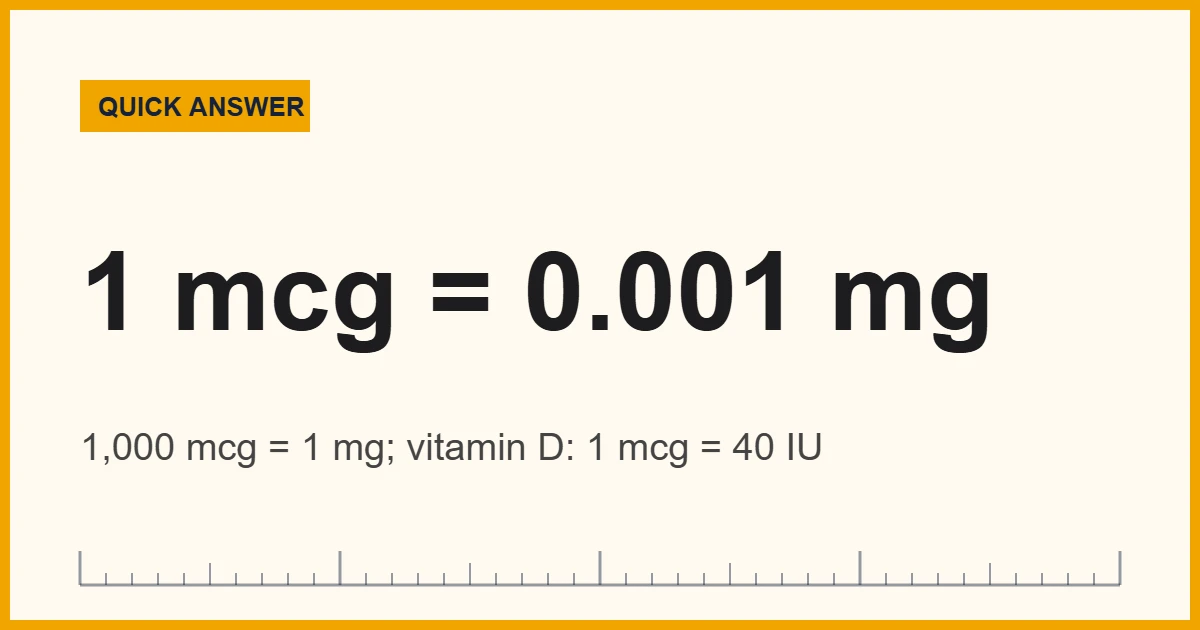
Convert mcg to mg, Grams and Grains
First, enter an amount and choose its unit. The converter then applies the exact metric prefixes, so every step is a clean factor of 1,000. In addition, it shows grains and ounces for anyone who works with US customary weights.
Usually, people first meet the letters “mcg” on a vitamin bottle. For instance, you read “25 mcg” next to vitamin D, and then you wonder whether that is a lot or a little. In short, that mcg measurement is very little by weight. In fact, a microgram is so small that a whole year of daily 25 mcg servings adds up to about 9 milligrams, which is less than a single grain of rice weighs.
Above all, the name comes from the metric prefix micro, which means one-millionth. For example, the US National Institute of Standards and Technology (NIST) lists micro in its table of SI prefixes with the factor 10 to the power of minus 6. Therefore, a microgram is one-millionth of a gram, just as a micrometer is one-millionth of a meter.
Next, you will find a ladder chart, the reasons labels prefer mcg over ug, real label examples, and finally the vitamin D link between mcg and IU.
The mcg Measurement on the Metric Ladder
Generally, metric mass units climb in steps of 1,000. As a result, moving between them only shifts the decimal point three places. So to go from mcg to mg, divide by 1,000. Likewise, to go from mg to grams, divide by 1,000 again.
| Unit | Symbol | In grams | In micrograms |
|---|---|---|---|
| Nanogram | ng | 0.000000001 g | 0.001 mcg |
| Microgram | mcg (µg) | 0.000001 g | 1 mcg |
| Milligram | mg | 0.001 g | 1,000 mcg |
| Grain | gr | 0.06479891 g | 64,798.91 mcg |
| Gram | g | 1 g | 1,000,000 mcg |
| Ounce (avoirdupois) | oz | 28.349523125 g | 28,349,523.125 mcg |
| Kilogram | kg | 1,000 g | 1,000,000,000 mcg |
Printable tip: save this ladder as a screenshot, because it settles almost every label question. Also, for the gram rung in everyday terms, see how much 1 gram is.
mcg Measurement Symbols: mcg, ug and µg
In practice, three spellings name the same unit. First, µg is the official SI symbol, built from the Greek letter mu. Second, ug is a keyboard workaround, because many systems cannot type mu. Third, mcg is the form that medicine and US labels use.
| Written as | Where you see it | Value |
|---|---|---|
| µg | Science papers, SI documents, European labels | 1 microgram |
| ug | Lab printouts, spreadsheets, air-quality data | 1 microgram |
| mcg | US supplement labels, prescriptions, pharmacy notes | 1 microgram |
| mg | Most drug strengths and minerals | 1,000 micrograms |
So why does the mcg measurement win on US packaging? Mainly because of safety. For example, a blurred or handwritten mu can look like an “m”, and then a microgram amount gets read as milligrams, a 1,000-fold jump. For that reason, US labels spell it mcg. If you want the full story of the ug spelling, read our guide on what a ug measurement is.
How Small Is a 1 mcg Measurement?
Of course, a microgram is far too small to see or feel. So to picture it, start with a US dollar bill. For example, according to the Bureau of Engraving and Printing, a note weighs about 1 gram. In other words, that one bill weighs roughly 1,000,000 mcg. Then cut it into a million equal specks, and each speck is about one microgram.
Here is another way to think about it, too. A grain, the old apothecary and bullet unit, is 64.79891 mg by definition. Consequently, one grain equals 64,798.91 mcg, and a single microgram is about 0.0000154 grain. Similarly, an ounce holds more than 28 million micrograms.
This is also why nobody checks a mcg measurement at home. Instead, manufacturers measure them in labs, often by mixing a tiny amount of a vitamin into a much larger amount of filler so each tablet gets the right share.
mcg Measurement on Supplement Labels
US Supplement Facts and Nutrition Facts panels use the mcg measurement for several nutrients, because the amounts in a serving are so small. Meanwhile, the %DV column compares each amount with the Daily Value that the FDA sets for labels. Below, the table shows common label nutrients and their Daily Values, as listed in the NIH Office of Dietary Supplements (ODS) fact sheets. Again, these are label reference numbers, not personal advice.
| Nutrient | Label unit | Daily Value (adults and children 4+) | Same amount in mg |
|---|---|---|---|
| Vitamin D | mcg (IU may follow in parentheses) | 20 mcg | 0.02 mg |
| Vitamin B12 | mcg | 2.4 mcg | 0.0024 mg |
| Folate | mcg DFE | 400 mcg DFE | 0.4 mg DFE |
Why folate says “mcg DFE”
Folate, however, adds a twist. This is because your body absorbs the folic acid in supplements and fortified foods better than the folate found naturally in food. Therefore, labels convert everything to dietary folate equivalents (DFE). The NIH ODS folate fact sheet explains that 1 mcg DFE equals 1 mcg of food folate, or 0.6 mcg of folic acid taken with food. As a result, 400 mcg of folic acid counts as about 667 mcg DFE. On labels the FDA rounds the factor to 1.7, so the panel shows 680 mcg DFE with “400 mcg folic acid” in parentheses.
mcg Measurement vs IU for Vitamin D
Previously, vitamin D bottles used International Units (IU), which describe biological activity, not weight. Today, however, US labels must show vitamin D in mcg, and many brands add the IU figure in parentheses. The NIH ODS vitamin D fact sheet gives the link: 1 mcg of vitamin D equals 40 IU. So divide IU by 40 to get mcg, or multiply mcg by 40 to get IU.
| Vitamin D in IU | Vitamin D in mcg | Math |
|---|---|---|
| 400 IU | 10 mcg | 400 / 40 |
| 600 IU | 15 mcg | 600 / 40 |
| 800 IU | 20 mcg | 800 / 40 |
| 1,000 IU | 25 mcg | 1,000 / 40 |
| 2,000 IU | 50 mcg | 2,000 / 40 |
| 5,000 IU | 125 mcg | 5,000 / 40 |
How to Read a mcg Measurement on a Label
- Find the unit first. First, look at the letters after the number and confirm mcg, ug, mg or IU before you read the amount.
- Look for a qualifier. Next, check for DFE or RAE, which mark an adjusted amount instead of a plain weight.
- Check the serving size. Also, the amount is per serving, and a serving may be two tablets or gummies.
- Convert to one unit. Then divide mcg by 1,000 for mg, or type the number into the converter above.
- Compare products with %DV. In addition, the %DV column already does the math against the label Daily Value.
- Ask about anything unclear. Finally, a pharmacist can confirm a smudged or unusual unit in seconds.
Recommended Scales for Small Weights
To be clear, no home scale can weigh one microgram. Even so, a sensitive pocket scale is useful for powders, jewelry, hobby work and reloading at the milligram level. For example, a 0.01 g scale reads in steps of 10 mg, or 10,000 mcg. A 0.001 g scale, by contrast, reads in 1 mg steps, which is 1,000 mcg. Meanwhile, a 0.0001 g analytical balance reaches 0.1 mg, or 100 mcg. Above all, look for a calibration weight, a tare button and a lid that blocks drafts.


As an Amazon Associate, Measuring Expert earns from qualifying purchases.
We chose these based on manufacturer specs and buyer reports, not hands-on testing.
Units People Confuse With a mcg Measurement
Unfortunately, small print makes several units look alike next to a mcg measurement. Also, some of them do not measure weight at all. Therefore, this table sorts them out.
| Unit | What it measures | Relation to mcg |
|---|---|---|
| mg (milligram) | Mass | 1 mg = 1,000 mcg |
| ng (nanogram) | Mass | 1,000 ng = 1 mcg |
| mcg DFE | Folate adjusted for absorption | Not a plain weight of folic acid |
| mcg RAE | Vitamin A activity | Adjusted for the source of vitamin A |
| IU | Biological activity | Factor depends on the nutrient; 40 IU = 1 mcg for vitamin D |
| mL (milliliter) | Volume | No fixed relation; depends on the liquid and its strength |
For a wider view of the units on prescriptions and pharmacy labels, see our overview of medical units of measurement.
Do and Don’t With Micrograms
Do
- First, read the unit before the number.
- Treat mcg, ug and the mu symbol as equal.
- Use the %DV column when comparing brands.
- Divide by 1,000 to turn mcg into mg.
- Confirm any unclear unit with a pharmacist.
Don’t
- Assume mg and mcg are close in size, because they differ 1,000-fold.
- Apply the vitamin D IU factor to other vitamins.
- Expect a kitchen scale to weigh micrograms.
- Read the DFE number as an extra dose.
- Change how you take a product based on unit math alone.
Honest Limits of mcg Math
To begin with, the conversions on this page are exact, because metric prefixes are definitions. However, label amounts are not exact in the same way. For one thing, supplement makers work within manufacturing tolerances, and some nutrients slowly break down during storage, so the real content of a tablet can differ from the printed figure. In addition, DFE and RAE values are adjusted estimates based on average absorption, not weights you could check on a balance. In short, mcg measurement math tells you what the label means, not exactly what is in the bottle.
When Accuracy Really Matters
For most label reading, a quick divide-by-1,000 turns any mcg measurement into mg. Still, a few cases call for extra care. First, prescription drugs dosed in micrograms, such as some thyroid medicines, leave no room for an mcg and mg mix-up. Second, liquid products list an amount per mL, so the strength matters as much as the volume. Third, products for children often use different serving sizes. In every case, follow the label and use the measuring device that comes with the product.
Frequently Asked Questions
What does mcg stand for?
Mcg stands for microgram, one-millionth of a gram. It is the same unit as ug and the SI symbol made from the Greek letter mu and g.
How many mcg are in 1 mg?
There are 1,000 mcg in 1 milligram. To convert mcg to mg, divide by 1,000; for example, 500 mcg is 0.5 mg.
Is a mcg measurement bigger than mg?
No. A microgram is 1,000 times smaller than a milligram, so 1 mcg equals 0.001 mg.
Are mcg and ug the same?
Yes. Both mean microgram. However, US labels use mcg because a handwritten or blurred mu symbol can be mistaken for mg.
How many IU is 1 mcg of vitamin D?
According to the NIH Office of Dietary Supplements, 1 mcg of vitamin D equals 40 IU. So 25 mcg is 1,000 IU and 50 mcg is 2,000 IU.
Can I use the vitamin D factor for other vitamins?
No. The 40 IU per mcg factor is only for vitamin D. In contrast, vitamins A and E have their own conversions.
What does mcg DFE mean on a folate label?
DFE means dietary folate equivalents. Specifically, it adjusts folic acid for better absorption, so 400 mcg of folic acid appears as about 680 mcg DFE on a label.
How many mcg are in a gram?
There are 1,000,000 mcg in 1 gram, because micro means one-millionth.
Why is vitamin B12 given as a mcg measurement?
Simply put, the amounts are tiny. For example, the label Daily Value for vitamin B12 is 2.4 mcg, which is only 0.0024 mg, so micrograms keep the numbers readable.
Can a kitchen scale weigh a mcg measurement?
No. Kitchen scales usually read to 1 g or 0.1 g. Similarly, jewelry scales stop at 1 mg. Only laboratory microbalances approach single micrograms.
The mcg Measurement in a Nutshell
To sum up, a microgram is one-millionth of a gram: 1,000 mcg make a milligram and 1,000,000 mcg make a gram. In other words, whether a label says mcg, ug or uses the mu symbol, the value is the same.
For vitamin D, remember that 40 IU equal 1 mcg, and for folate, read the DFE number as an adjusted figure. Then, whenever the math feels tricky, use the converter at the top of this page and leave dosing questions to a pharmacist or doctor.
3 thoughts on “What Is a mcg Measurement? Micrograms, mg and IU Explained”