

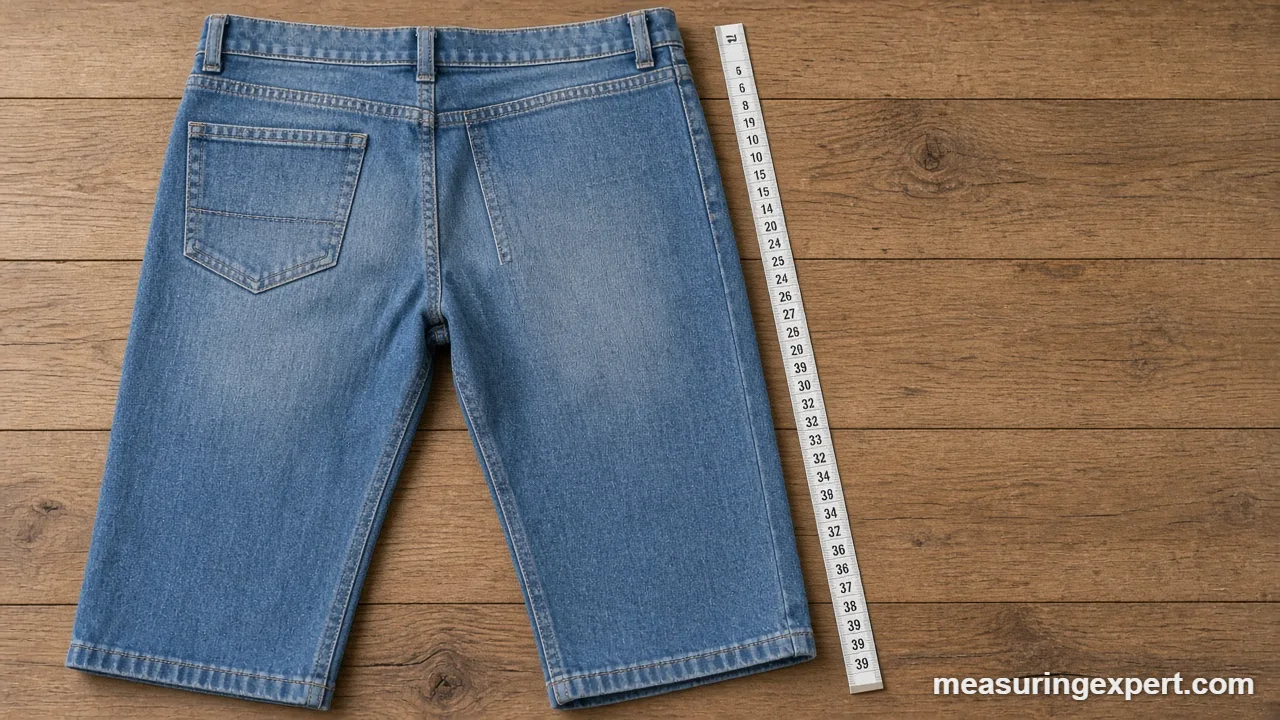
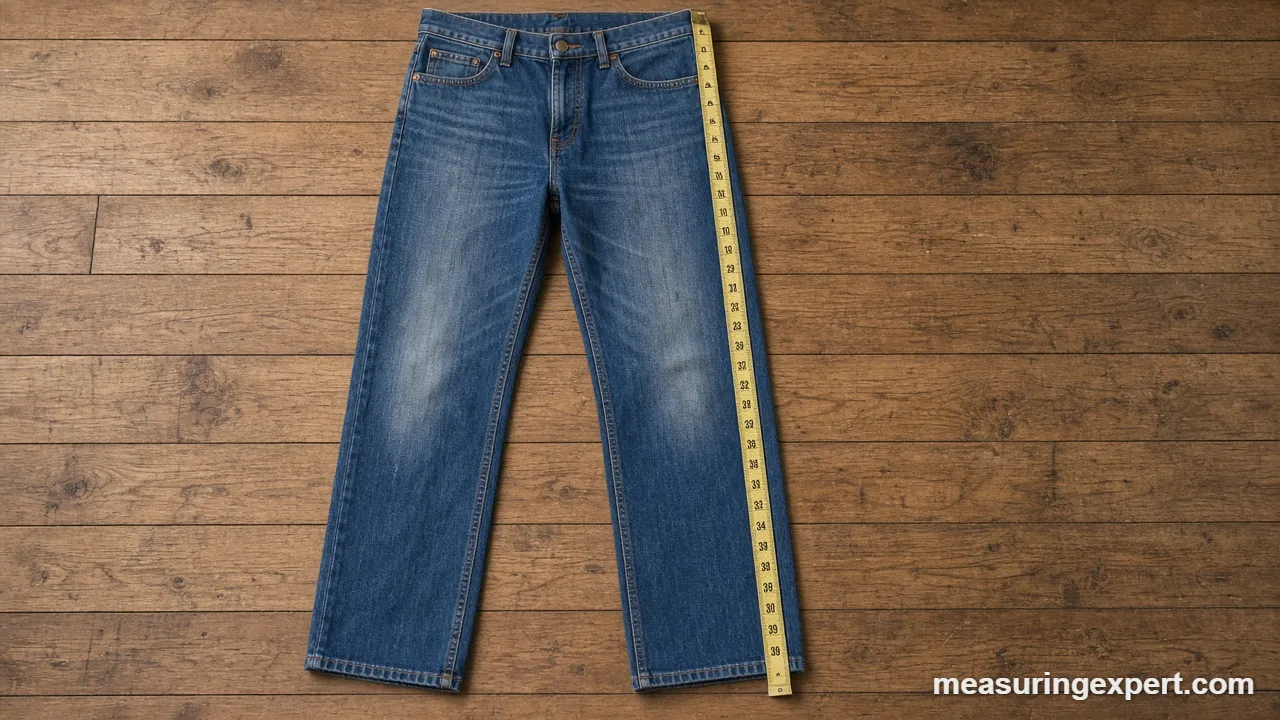
An outseam measurement is the length of a pair of pants along the outside of the leg, from the top of the waistband straight down to the bottom of the hem. Because it includes the rise, the outseam is always longer than the inseam. On your body, measure from your natural waist down the side of the leg.
Most people know their waist size and maybe their inseam. The outseam, by contrast, is the number that tells you the full length of the pants from top to bottom. Also, it shows up on tailoring forms, dress trouser size charts, workwear specs and many online product pages, often right next to the inseam.
In plain terms, the outseam is the side length of the pants. First, you lay the pants flat, find the side seam, and measure from the upper edge of the waistband to the lower edge of the hem. That single number therefore captures two things at once: how long the leg is and how high the pants sit on your body. As a result, two pairs with the same inseam can have very different outseams if one is high-rise and the other is low-rise. So comparing the outseam of a new pair with the outseam of pants you already like is one of the quickest ways to predict how the new pair will hang, especially when you shop online and cannot try them on first.
Outseam, Inseam and Rise in One Line
In short: inseam tells you leg length, rise tells you where the waist sits, and the outseam is roughly the two added together.
The International Organization for Standardization publishes ISO 8559-1, a standard that defines how body measurements for clothing sizes are taken, so that brands and pattern makers work from the same reference points. Meanwhile, the inch itself is an exact unit: the US National Institute of Standards and Technology (NIST) lists 1 inch as exactly 2.54 cm.
Below, you will find a converter, a comparison with the inseam, step-by-step methods for pants and for your body, and a few honest limits of the number.
Convert Your Outseam Measurement to Centimeters
First, enter your outseam in inches, or switch the unit to centimeters. The converter then uses the exact factor of 2.54 cm per inch and also shows the nearest 1/16 inch, which helps when a European size chart or a tailor works in the other system.
Recommended Tape Measures for Measuring Pants
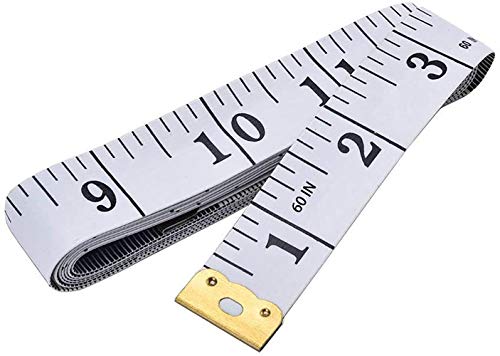
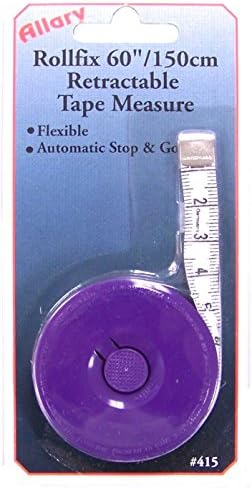
A soft tailor’s tape is the right tool here. It lies flat along a seam, bends around the waistband edge without slipping, and will not scratch fabric. In addition, look for inches on one side and centimeters on the other, clear 1/8 inch marks, and metal end tips that will not fray. Also, a 60 inch tape covers almost any outseam, while a longer tape is handy for tall adults or for measuring to the floor.




As an Amazon Associate, Measuring Expert earns from qualifying purchases.
- The outseam runs along the outer side seam, from the top of the waistband to the hem.
- It is always longer than the inseam, because it also covers the rise.
- As a rough check, outseam minus inseam is close to the rise of the pants.
- Measuring a pair of pants you like is more repeatable than measuring your body.
- A body outseam starts at your natural waist, not where your pants happen to sit.
- One inch is exactly 2.54 cm, so a 42 inch outseam is 106.68 cm.
- Round to the nearest 1/4 or 1/2 inch, then check the brand’s own chart.
Outseam Measurement vs Inseam vs Rise
In other words, these three numbers describe the same pair of pants from different angles. However, size charts sometimes use them loosely, so it helps to see them side by side.
| Measurement | Starts at | Ends at | What it tells you |
|---|---|---|---|
| Outseam | Top edge of the waistband, at the side | Bottom edge of the hem | Total length of the pants |
| Inseam | Crotch seam | Bottom edge of the hem | Leg length only |
| Front rise | Crotch seam | Top edge of the waistband, at the front | How high the pants sit |
| Outside leg (body) | Natural waist, at the side | Ankle or floor | Your body’s side length, for patterns and tailoring |
For example, the inseam is the one most US jeans list in the size, such as the 30 in 32×30. For the full story on that number, see our guide to the inseam measurement. Similarly, British charts call it the inside leg measurement.
How to Take an Outseam Measurement on Pants
This is the most reliable method, because fabric on a table does not move or breathe. First, pick a pair whose length and rise you already like, ideally the same style you plan to buy.
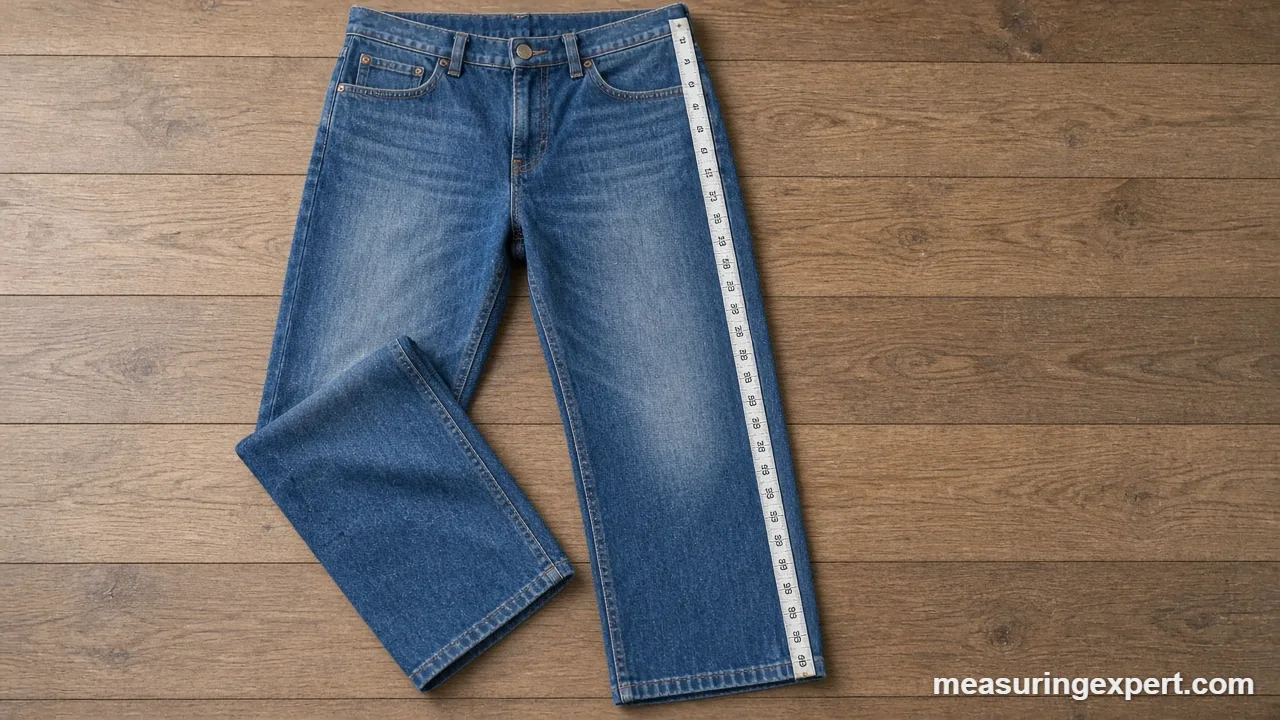
- Lay the pants flat. Place them face up on a table and button or zip them closed.
- Smooth out the leg. Pat the fabric so the side seam lies straight, with no folds or bunching.
- Find the side seam. Locate the seam on the outer edge of one leg, where the front and back panels meet.
- Anchor the tape at the waistband. Hold the end of the tape at the top edge of the waistband, right where the side seam meets it.
- Run the tape to the hem. Keep it flat on the seam, and then read the length at the bottom edge of the hem.
- Record and repeat. Write the number down, measure the other leg too, and use the average if the two differ.
How to Measure Your Outseam on Your Body
When you have no pants that fit, measure yourself instead. Above all, a helper makes this far easier, since bending to read the tape changes your posture.
- Dress lightly. Wear thin, close-fitting clothes, and stand barefoot on a hard floor.
- Locate your natural waist. It is the narrowest part of your torso, usually just above the belly button.
- Hold the tape at the side. Place the end on your hip line at waist height and let the tape hang straight down the outside of your leg.
- Choose an end point. Read at the ankle bone for a standard trouser length, or at the floor for a full outside leg.
- Then subtract for lower-rise styles. If you prefer pants that sit below the waist, take off the distance between your natural waist and where you wear them.
Our guide on how to measure your waist for pants explains where the natural waist sits and how it differs from the waistband line.
Where the Outseam Measurement Is Used
You will not see the outseam in most jeans sizes, yet it matters in several places:
- Dress trousers and suits. Tailors often note the outseam because it sets where the hem breaks over the shoe.
- Shorts. Some brands list a short’s outseam to show the total length, since a high rise and a short inseam can look similar on paper.
- Workwear and uniforms. Spec sheets for coveralls and work pants frequently list both inseam and outseam.
- Kids’ clothing. Children grow mostly in the legs. As a result, parents often compare the outseam of old and new pants.
- Sewing and pattern making. Similarly, patterns use the outside leg to check the full length before cutting fabric.
Estimating an Outseam Measurement From Other Numbers
If a size chart lists only the inseam and the rise, you can estimate the outseam yourself. First, add the two. Next, allow for the fact that the side seam follows a slightly different path than the front rise. For example, pants with a 32 inch inseam and a 10 inch front rise will usually have an outseam of roughly 41 to 42 inches. Still, treat that as an estimate, not an exact figure.
| Outseam (in) | Outseam (cm) | Outseam (in) | Outseam (cm) |
|---|---|---|---|
| 36 | 91.44 | 42 | 106.68 |
| 38 | 96.52 | 43 | 109.22 |
| 39 | 99.06 | 44 | 111.76 |
| 40 | 101.60 | 45 | 114.30 |
| 41 | 104.14 | 46 | 116.84 |
To convert the other way, divide centimeters by 2.54. Thus 105 cm is about 41.34 inches and 110 cm is about 43.31 inches. Alternatively, you can print this chart, or simply use the converter at the top of the page.
Common Outseam Measurement Mistakes
In general, most errors come from where the tape starts and where it stops. Watch out for these:
- Starting at the bottom of the waistband. The outseam includes the waistband; therefore, begin at its top edge.
- Following the curve of the hip. On the body, let the tape drop straight down instead of hugging the hip.
- Using a steel tape on fabric. A rigid tape lifts off the seam and adds length, so use a soft one.
- Pulling the tape tight. Vinyl tapes can stretch slightly; hold them snug, not taut.
- Mixing up garment and body numbers. Label your notes clearly as “pants” or “body”.
Do and Don’t for Outseam Measurements
- Measure pants you already like.
- Keep the tape flat on the side seam.
- Write down inseam and rise too.
- Check each brand’s size chart.
- Note the shoes you plan to wear.
- Begin below the waistband.
- Stretch a soft tape tight.
- Compare a body outseam with a garment outseam.
- Assume all brands use the same rise.
- Read the tape while bending over.
Honest Limits of the Outseam Measurement
The outseam is a useful total. However, it hides how that total is split. For instance, a high-rise pair with a short inseam and a low-rise pair with a long inseam can share the same outseam and still fit completely differently. Also, brands draft their patterns differently, so the side seam may sit slightly forward or back on the leg. Fabric matters too, because stretch denim relaxes with wear while rigid cotton may shrink. Finally, a self-measurement can easily be off by half an inch (1.27 cm) depending on posture. Therefore, use the outseam together with the inseam and rise, never on its own.
When to See a Tailor
For jeans and casual pants, a home measurement is usually enough. However, a tailor is worth it for suits, formal trousers and wedding clothes, where the length over the shoe is a style choice. Moreover, a tailor will measure with your actual shoes on and can adjust the hem to the exact length you want. In addition, if one leg is longer than the other, ask for each side to be measured separately.
For the inner leg number, our step-by-step guide on how to measure inseam covers the body method in detail.
Outseam Measurement FAQs
What is an outseam measurement?
It is the length of pants along the outer side seam, from the top of the waistband to the bottom of the hem. On the body, it runs from the natural waist down the side of the leg.
Is the outseam the same as the inseam?
No. In fact, the inseam runs along the inside of the leg from the crotch to the hem. The outseam runs along the outside from the waistband to the hem, so it is always longer.
Why is the outseam longer than the inseam?
Because it also covers the rise, the section between the crotch and the top of the waistband. Outseam minus inseam is roughly equal to the rise.
How do I take an outseam measurement on jeans?
First, lay the jeans flat, find the outer side seam, and run a soft tape from the top edge of the waistband straight down to the bottom of the hem.
Does the outseam include the waistband?
Yes. Start the tape at the very top edge of the waistband, not at the seam underneath it.
How many centimeters is a 42 inch outseam?
A 42 inch outseam is 106.68 cm, because one inch is exactly 2.54 cm. A 40 inch outseam is 101.60 cm.
Can I work out the outseam from the inseam?
Only roughly. First, add the rise to the inseam for an estimate. Then confirm it on the brand’s size chart or by measuring a similar pair.
Should I measure the outseam with shoes on?
For a body measurement, stand barefoot for a consistent number. When hemming formal trousers, however, a tailor will usually check the length with your shoes on.
Is an outseam measurement useful for shorts?
Yes. It shows the total length of the shorts, which helps when two styles have the same inseam but different rises.
What tool is best for measuring the outseam?
A soft tailor’s tape with inch and centimeter scales. Also, it lies flat on the seam and will not damage the fabric.
Outseam Measurement: The Bottom Line
In summary, the outseam is the full side length of a pair of pants, from the top of the waistband to the hem. Since it includes the rise, it is always longer than the inseam, and the difference between the two tells you roughly how high the pants will sit.
So lay a favorite pair flat, measure the side seam with a soft tape, and note the inseam at the same time. Then use the converter above to switch between inches and centimeters, and compare both numbers with the brand’s chart before you buy.
2 thoughts on “What Is an Outseam Measurement? How to Measure Pants and Your Body”