
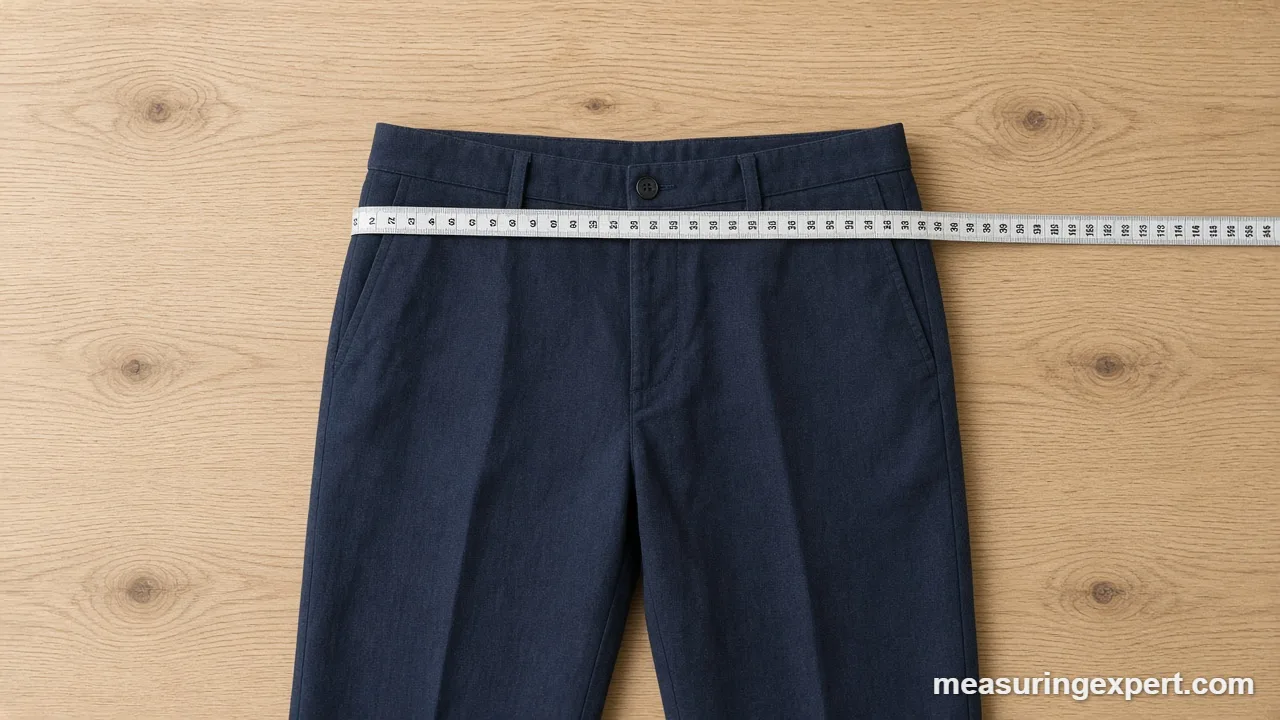
To measure waist for pants, wrap a soft tape around your body exactly where the waistband will sit, keep it level and snug, and read it after a normal breath out. For a pair you already own, lay it flat, measure straight across the closed waistband and double the number.
Most people learn one waist measurement, usually the narrowest point above the belly button, and then wonder why pants in that size feel wrong. The reason, however, is simple. Your natural waist and the place your pants actually ride are often two different lines on your body, and the gap between them can be several inches. In addition, many brands cut their pants larger than the number on the label, so even a perfect body measurement can point you to the wrong size.
This guide focuses only on pants sizing. First, it shows where to place the tape for low, mid and high rise styles. Next, it explains how to check a waistband laid flat, why that number gets doubled, and how vanity sizing skews labels. Finally, you will find a size chart in inches and centimeters for men and women.
In short: measure where you wear your pants, not where a fitness chart says your waist is, and then compare that number with the brand’s own chart.
However, sizing is not fully standardized. ASTM International publishes body measurement tables for women’s misses sizes 00 to 20, but the standard itself says it is a baseline that designers adjust for fabric, ease and style. As a result, two brands can sell very different garments under the same size.
So treat your tape measurement as the fixed reference and the size label as a brand’s translation of it. Above all, that mindset solves most fit problems.
Convert Your Pants Waist From Inches to Centimeters
For example, many size charts, especially European and Asian ones, list the waist in centimeters. Type your measurement below and the converter shows it in centimeters, millimeters and feet. Because 1 inch is exactly 2.54 cm, a 32 inch waist equals 81.28 cm.
Recommended Tools to Measure Waist for Pants
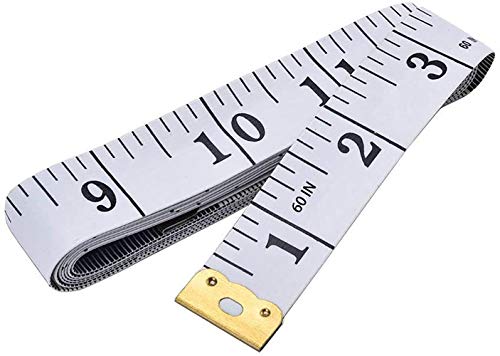
In fact, a flexible tailor’s tape is the only tool you really need. Look for a 60 inch (150 cm) tape with inches on one side and centimeters on the other, so you can read either chart without converting. Also, a fiberglass tape holds its length better than cheap vinyl, which can stretch over time. A retractable model, meanwhile, is easy to keep in a drawer or travel bag.




As an Amazon Associate, Measuring Expert earns from qualifying purchases.
Key Takeaways
- Measure around the line where the waistband will actually sit, not only at your natural waist.
- Your natural waist is the narrowest point, usually above the belly button; most jeans sit lower.
- Keep the tape level, snug but not tight, and read it after a normal breath out.
- To check pants you own, measure the closed waistband flat edge to edge, then multiply by 2.
- Also, labels often run small: a pair marked 36 can measure several inches more around.
- Next, convert with 1 inch = 2.54 cm when a chart lists centimeters.
- Always finish with the brand’s own size chart, because sizing is not standardized.
Natural Waist vs Where Your Pants Sit
Your natural waist is the narrowest part of your torso. For example, you can find it by bending to one side: the crease that forms is the spot. For most adults it sits an inch or two above the belly button. Dress pants for men in the past were cut to sit here, and many high-rise women’s styles still are.
However, most modern jeans and chinos ride lower. A mid-rise pair usually sits at or just below the belly button, while a low-rise pair rests near the top of the hip bones. Because the body is usually wider at the hips than at the natural waist, each lower line gives a bigger number. For example, someone with a 31 inch natural waist might measure 33 or 34 inches where their jeans sit.
| Pants rise | Where the waistband sits | Where to wrap the tape |
|---|---|---|
| High rise | At or near the natural waist | The narrowest point, about 1 to 2 in above the navel |
| Mid rise | At or just below the navel | Level with the belly button or slightly under it |
| Low rise | On top of the hip bones | Across the upper hip bones, about 2 to 4 in below the navel |
| Dress trousers (men) | Usually just below the navel | Where you wear your belt with those trousers |
How to Measure Waist for Pants on Your Body
First, you need a soft tape, a mirror, and about two minutes. Wear thin underwear or leggings only, because jeans or a sweater under the tape add bulk you will not have under new pants.
- Stand relaxed. Keep your feet together and your stomach in its normal position; do not suck in.
- Find the line. Pick the height where the waistband will sit, using the rise table above as a guide.
- Wrap the tape. Start at your navel or side, pass the tape around your back, and bring it to the front.
- Check that it is level. Use the mirror so the tape stays parallel to the floor all the way around, especially across your back.
- Adjust the tension. The tape should touch your skin all the way around without pressing in; one finger should slide under it.
- Read after a normal breath out. Note the number where the zero end meets the tape, and round up to the next half inch.
- Repeat once. Then measure again and use the average if the two readings differ.
Once you have a number, write down where you measured it (“mid rise, at navel”). That way, you can measure waist for pants the same way next time and compare results fairly.
How to Measure Waist for Pants Laid Flat (the x2 Method)
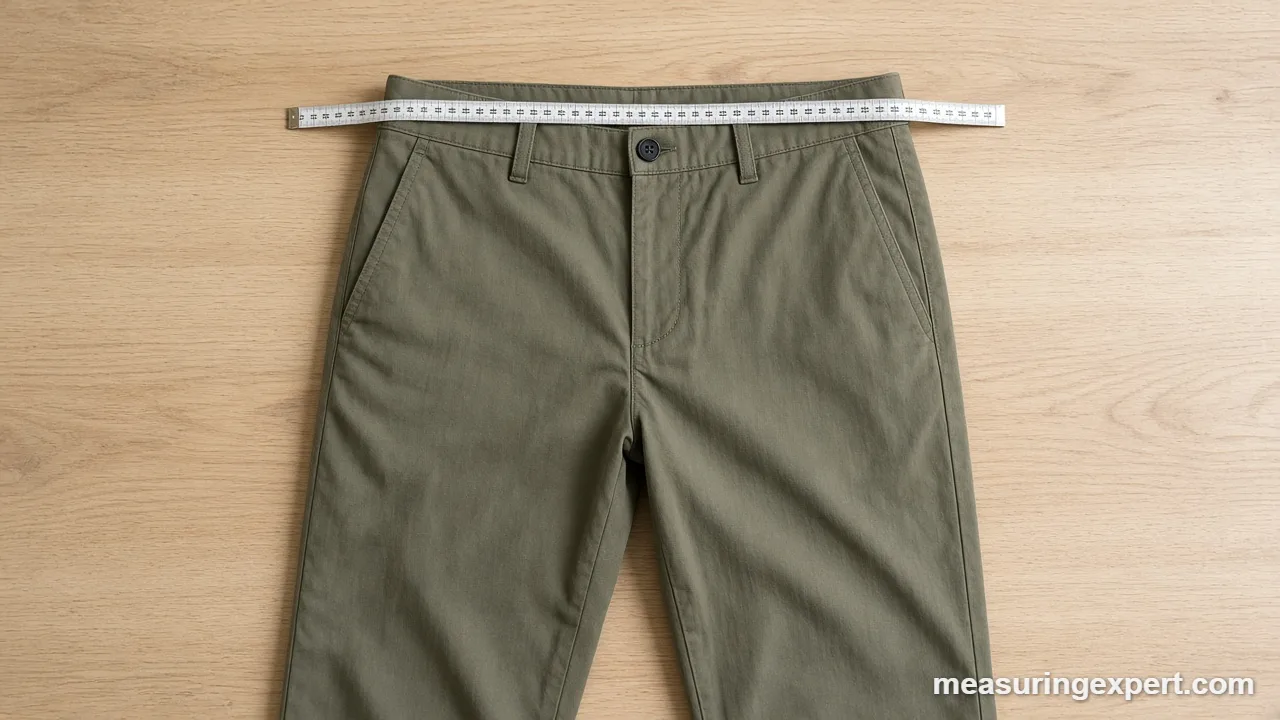
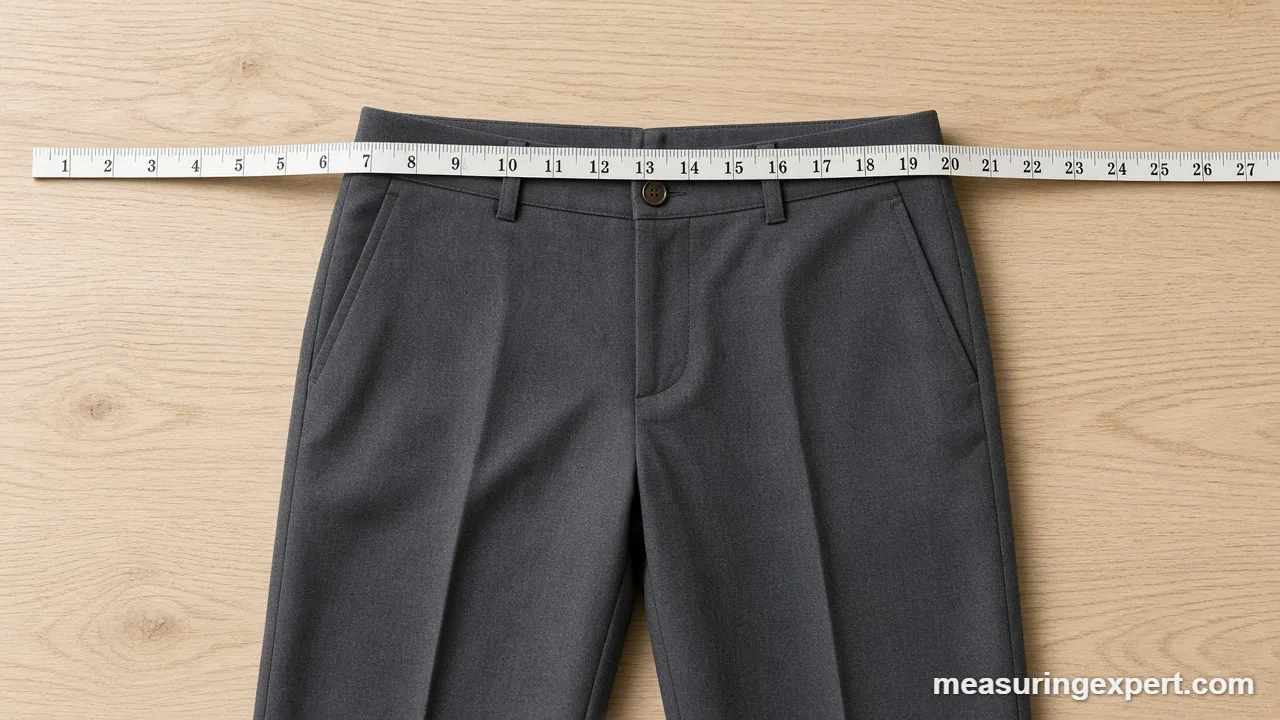
Online size charts, however, often list garment measurements instead of body measurements. In that case, measuring a pair you already own is the quickest way to compare. The method is simple; however, the details matter.
- Button and zip the pants so the waistband is closed.
- Lay them face up on a table and smooth out wrinkles without stretching the fabric.
- Measure straight across the top edge of the waistband, from one side fold to the other.
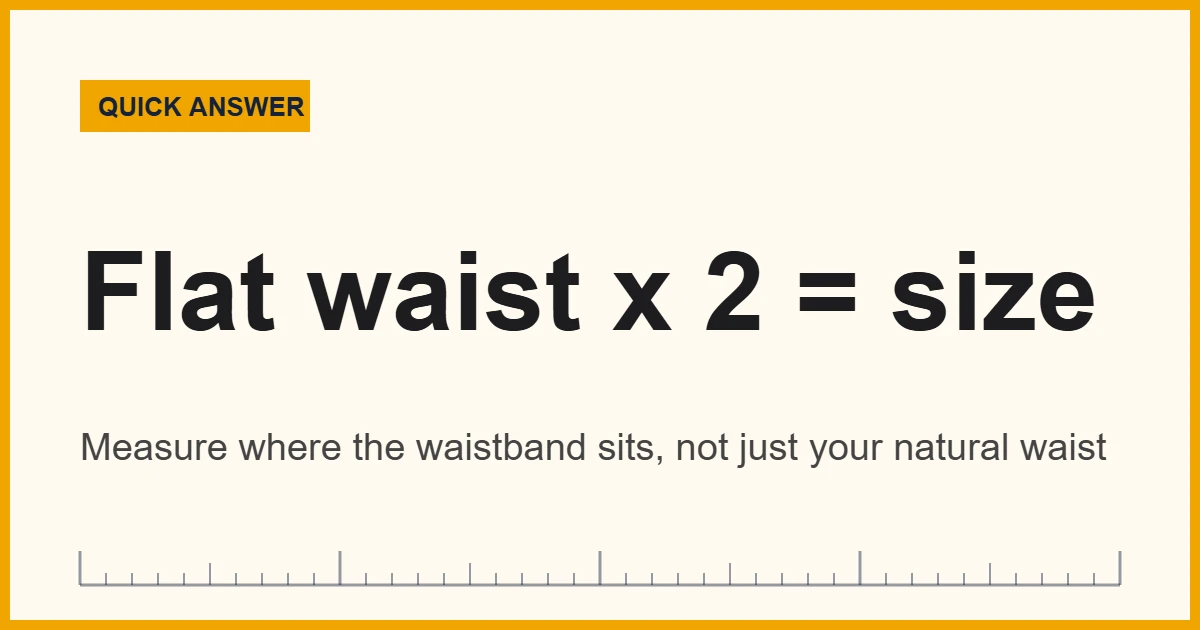
- Double that number to get the full circumference.
For example, a waistband that measures 16.5 inches flat is about 33 inches around, or 83.8 cm. Similarly, 17 inches flat gives 34 inches around. This is the same reason sellers list a “flat” or “half” waist: it is the one measurement you can take without wrapping the garment.
| Flat waistband | Full waist (x2) | Full waist (cm) |
|---|---|---|
| 14 in | 28 in | 71.1 cm |
| 15 in | 30 in | 76.2 cm |
| 16 in | 32 in | 81.3 cm |
| 17 in | 34 in | 86.4 cm |
| 18 in | 36 in | 91.4 cm |
| 19 in | 38 in | 96.5 cm |
| 20 in | 40 in | 101.6 cm |
While the pants are on the table, it is also a good moment to check leg length. Our guides to what an inseam measurement is and how outseam is measured explain the other two numbers on most pants tags.
Why the Label and Your Tape Disagree: Vanity Sizing
If you measure waist for pants carefully and the label still seems off, the label is probably the problem. Many brands cut pants larger than the stated size, a practice known as vanity sizing. It flatters shoppers, and it also helps more people fit into a given size.
The gap, moreover, can be large. In 2010, for instance, a writer for Esquire measured men’s pants all labeled with a 36 inch waist. According to Marketplace’s report on those measurements, one pair measured 37 inches and another measured 41 inches around, a 5 inch difference hiding behind the same tag.
Part of the reason is also history. At first, men’s trousers sat at the natural waist. As styles moved lower, the waistband moved onto a wider part of the body, yet the size numbers stayed the same. Therefore, a modern “32” is often a garment that measures 33 to 34 inches around.
Pants Size Chart in Inches and cm
Use these charts as a starting point, then confirm with the brand. For example, men’s pants usually name the waist directly in inches. Women’s pants, by contrast, use numbered sizes, and the waist for each size changes from brand to brand.
Men’s Pants Waist Sizes
| Label size | Body waist at pants line (in) | Body waist (cm) | Flat waistband, true to size (in) |
|---|---|---|---|
| 28 | 28 | 71.1 | 14 |
| 30 | 30 | 76.2 | 15 |
| 32 | 32 | 81.3 | 16 |
| 34 | 34 | 86.4 | 17 |
| 36 | 36 | 91.4 | 18 |
| 38 | 38 | 96.5 | 19 |
| 40 | 40 | 101.6 | 20 |
| 42 | 42 | 106.7 | 21 |
Many brands make the actual garment 1 to 2 inches bigger than the label, so a pair marked 32 may lay flat at 16.5 or 17 inches. In other words, that is normal.
Women’s Pants Waist Sizes (Typical US Misses)
| US size | Typical body waist (in) | Typical body waist (cm) |
|---|---|---|
| 0 | 23 to 24 | 58 to 61 |
| 2 | 24.5 to 25 | 62 to 64 |
| 4 | 26 | 66 |
| 6 | 27 to 27.5 | 69 to 70 |
| 8 | 28 to 29 | 71 to 74 |
| 10 | 29.5 to 30.5 | 75 to 77.5 |
| 12 | 31 to 32 | 79 to 81 |
| 14 | 33 to 34 | 84 to 86 |
These ranges reflect common retail charts, which usually list the natural waist. So if you wear low or mid rise styles, check whether the brand’s chart gives a “waist” or a “low waist” value before choosing.
Men’s vs Women’s Sizing: What the Number Means
A men’s “32 x 30” tag means a 32 inch waist and a 30 inch inseam, at least in name. Women’s numbers, however, work differently. A size 8, for example, is a code that maps to a waist, hip and rise combination chosen by the brand, so it has no direct link to inches.
| Question | Men’s pants | Women’s pants |
|---|---|---|
| What the size number is | Waist in inches (nominal) | A code (0, 2, 4…) or letters (S, M, L) |
| Typical measuring line | Where the belt sits, often below the navel | Natural waist on most charts; rise varies by style |
| Other key numbers | Inseam | Hip, rise and inseam |
| Vanity sizing | Common, often 1 to 3 in | Common, and it varies widely by brand |
Because women’s pants also need to fit the hips, measure your hips at their fullest point too. Then pick the size that fits the larger of the two numbers and have the other area tailored if needed.
Do and Don’t When You Measure Waist for Pants
Do
- First, measure on the line where the waistband will rest.
- Also, keep the tape level all the way around.
- Next, read it after a normal, relaxed breath out.
- Then write down the number and where you took it.
- Finally, compare with the brand’s chart every time.
Don’t
- Suck in your stomach or pull the tape tight, because the number will come out too small.
- Measure over jeans, belts or thick clothing, because they add bulk.
- Trust a label size from a different brand, since sizing varies.
- Forget to double a flat waistband reading, because that halves the size.
- Use a metal tape, since it will not follow your body.
Honest Limits When You Measure Waist for Pants
A tape measure gives you a precise number, yet fit depends on more than one number. For one thing, the waist changes during the day: after a big meal, it can measure noticeably larger than in the morning. Fabric also matters, since stretch blends forgive small errors and rigid denim does not. Moreover, rise, seat and thigh shape decide whether the waistband stays where you measured. In short, your waist measurement narrows your choice to one or two sizes; trying them on, or checking garment measurements, picks the winner.
When to See a Tailor
If your waist and hip measurements point to different sizes, or if a waistband gaps at the back when the seat fits, a tailor can help. For instance, taking in a waist by an inch or two is a routine job. Letting it out depends on the seam allowance, so ask before buying pants a size too small. Likewise, for suits and dress trousers, a tailor will measure you on the line where those trousers are meant to sit, which is often higher than your jeans.
Frequently Asked Questions
Where do I measure waist for pants?
Measure around the line where the waistband will sit. That is the natural waist for high rise pants, the belly button for mid rise, and the top of the hip bones for low rise.
Is a 32 waist pant really 32 inches?
Often not. Many brands cut a size 32 to measure about 33 to 34 inches around, so check the garment measurements or measure a pair flat.
How do I measure waist for pants I already own?
Button the pants, lay them flat, measure straight across the top of the waistband from edge to edge, and multiply by 2.
Why double the flat number when you measure waist for pants?
A flat waistband shows only the front half. Doubling it therefore adds the back half, which gives the full circumference.
Should I measure waist for pants over clothes?
No. Measure over thin underwear or bare skin, because thicker layers add bulk and make the number too large.
Is my natural waist the same as my pants size?
Not usually. Most jeans sit below the natural waist, where the body is wider, so your pants size is often 1 to 3 inches more than your natural waist.
What is vanity sizing in pants?
Vanity sizing means a brand makes pants larger than the size on the label. A pair marked 36, for example, may measure 37 to 41 inches around.
How do I convert my waist from inches to cm?
Multiply inches by 2.54. A 30 inch waist is 76.2 cm, and a 34 inch waist is 86.36 cm.
What size is a 28 inch waist in women’s pants?
On many US charts, a 28 to 29 inch natural waist is about a size 8, but brands differ, so always check their chart.
Can I measure waist for pants without a tape?
Yes. For example, wrap a string or phone charger cable around the line, mark where it meets, then lay it along a ruler or a printed tape to read the length.
The Bottom Line on Pants Waist Sizing
To measure waist for pants accurately, measure the line where you wear them, keep the tape level and relaxed, and note where you took it. For pants you own, measure the closed waistband flat and double it. Those two numbers tell you more than any label.
Next, remember that sizes are a brand’s interpretation. Use the converter above when a chart is in centimeters, compare with the brand’s garment measurements, and allow an inch or two for vanity sizing. Then finish the job by checking your inseam, and you will order the right pair far more often.
1 thought on “How to Measure Waist for Pants: Natural Waist, Flat Method and Size Chart”