
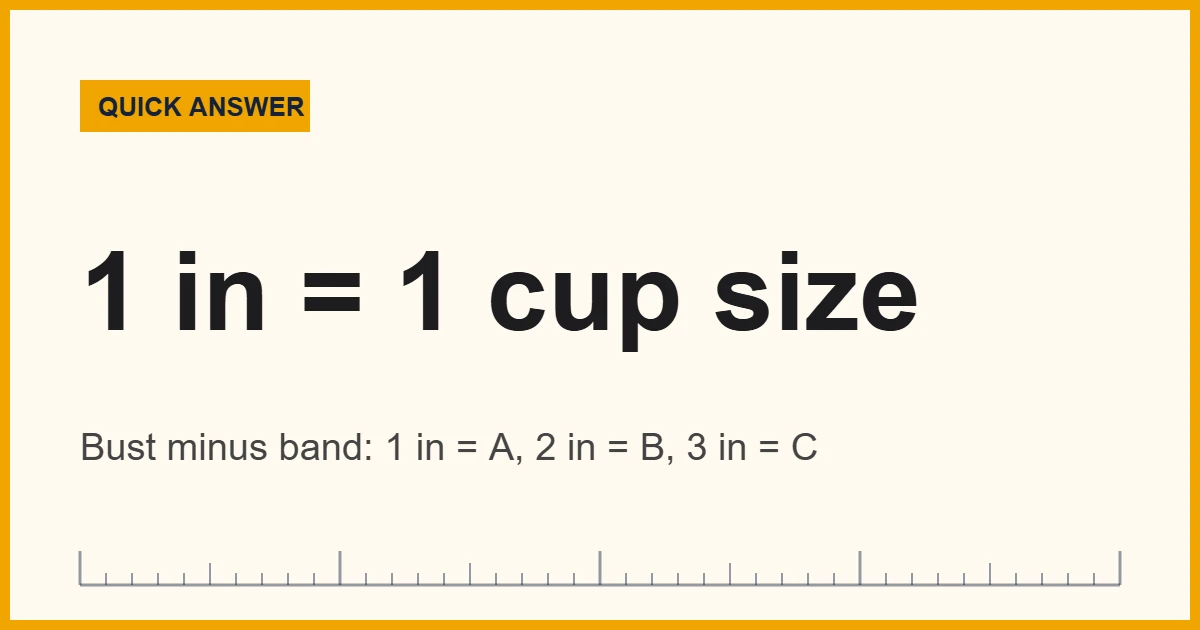
To measure bra size, wrap a soft tape snugly under the bust and round to the nearest whole inch for the band. Then measure loosely around the fullest part of the bust and subtract the band: each inch of difference is one cup (1 in = A, 2 in = B, 3 in = C).
A bra that fits feels like nothing at all. Instead, the band stays level, the cups lie smooth, and the straps rest without digging in. A bra that does not fit, on the other hand, rides up, gaps, pinches or slides all day. Fortunately, when you measure bra size with two tape readings at home, you get very close to the right size, and a few fit checks in the mirror finish the job.
The method rests on two numbers: your underbust (the band) and your bust (the fullest point). In other words, the band number is your underbust in inches, rounded. The cup letter, in turn, comes from the gap between the two numbers. That is why a 34C and a 38C hold very different volumes even though both are “C cups”.
In short: the band is a measurement, the cup is a difference, and the letter only means something next to its band number.
Why the Way You Measure Bra Size Matters
The method you use to round the band matters more than most guides admit. For example, a study by researchers at the University of Portsmouth, published in the journal Ergonomics in 2012, found that the traditional method (adding inches to the underbust) overestimated band size and underestimated cup size compared with professional fit criteria. So this guide uses the modern direct method first and then explains the older one.
Below, you will find a converter, the step-by-step method, a cup chart, sister sizes, a US vs UK vs EU size table and the fit checks that confirm your result.
Convert Your Tape Reading Between Inches and Centimeters
Most US charts used to measure bra size work in inches, while EU and many international brands use centimeters. So enter your underbust or bust reading below to switch between the two. One inch equals exactly 2.54 cm, the definition the US National Institute of Standards and Technology (NIST) has used since 1959.
Recommended Tape Measures to Measure Bra Size
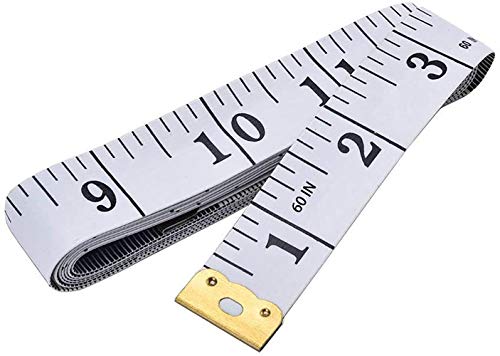
A soft, flexible tape is the only tool you need. First, choose one at least 60 inches long, so it wraps around the bust with room to spare. Next, look for inches on one side and centimeters on the other, which lets you use US and EU charts without converting. Also, replace any vinyl tape that has stretched or frayed, because a worn tape reads short.




As an Amazon Associate, Measuring Expert earns from qualifying purchases.
Key Takeaways
- The band comes from your underbust, measured snugly and level.
- The cup comes from bust minus band: 1 inch per cup letter.
- Round the underbust to the nearest whole inch; for an odd number, try the even sizes on both sides.
- The older “plus four” method adds 4 or 5 inches and often gives a band that is too big.
- Sister sizes (34C, 36B, 32D) share roughly the same cup volume.
- US, UK and EU letters match up to D and then split apart.
- Your tape gives a starting size; fit checks in the mirror confirm it.
How to Measure Bra Size Step by Step
To measure bra size accurately, stand in front of a mirror, so you can check that the tape stays level at the back. Ideally, wear a thin, unpadded bra that fits reasonably well, or measure over a light top. Then work through these steps.
- Stand up straight and relax. Let your arms hang at your sides and breathe normally.
- Measure the underbust. Wrap the tape around your ribcage directly under the bust, keep it level all the way around and pull it snug but comfortable.
- Read and round the band. Exhale, read the number in inches and round it to the nearest whole inch. If it is odd, note both even sizes next to it.
- Measure the bust. Wrap the tape around the fullest part of the bust, again level at the back, but this time loosely, so it rests on the skin without pressing in.
- Repeat the bust reading leaning forward. Bend forward at the hips to about 90 degrees and measure again; use the larger number if the two differ by more than an inch.
- Subtract to find the cup. Take the bust number minus the band number and match the difference to the cup chart below.
- Try the size on. Finally, check the fit on the loosest hook and adjust with sister sizes if needed.
Band Rounding Methods: Direct vs Plus Four
Two methods are still in use, and they give very different band numbers from the same tape reading. Because of that, it helps to know which one a brand chart assumes before you measure bra size with it.
The direct method uses the underbust as it is. You round to the nearest whole inch, and since most bras come in even band sizes, an odd result means trying the even size above and below. Most current fit guides from specialist retailers work this way.
The plus four method dates from older bras made with less stretch. You add 4 inches to an even underbust or 5 inches to an odd one. As a result, the band often ends up too loose, and the cup letter comes out too small to compensate.
| Underbust / bust | Direct method | Plus four method |
|---|---|---|
| 30 in / 34 in (76.2 / 86.36 cm) | 30D | 34AA |
| 31 in / 36 in (78.74 / 91.44 cm) | 32D (or 30DDD) | 36AA |
| 34 in / 37 in (86.36 / 93.98 cm) | 34C | 38 with a cup smaller than AA |
| 38 in / 44 in (96.52 / 111.76 cm) | 38DDD (UK 38E) | 42B |
Clearly, the difference is not small. For instance, a 31-inch underbust can end up as a 32D by one method and a 36AA by the other. Therefore, if a size from an old chart feels loose in the band and gapes at the cups, the direct method is usually the better place to start.
Measure Bra Size Cups: The Inch Difference Chart
Once you measure bra size for the band, subtract that number from your bust measurement. Then each inch of difference moves you up one cup letter. However, the letters after D differ between countries, so this chart shows US, UK and EU letters side by side.
| Bust minus band | US cup | UK cup | EU cup |
|---|---|---|---|
| Less than 1 in (under 2.5 cm) | AA | AA | AA |
| 1 in (2.54 cm) | A | A | A |
| 2 in (5.08 cm) | B | B | B |
| 3 in (7.62 cm) | C | C | C |
| 4 in (10.16 cm) | D | D | D |
| 5 in (12.7 cm) | DD (E) | DD | E |
| 6 in (15.24 cm) | DDD (F) | E | F |
| 7 in (17.78 cm) | G | F | G |
| 8 in (20.32 cm) | H | FF | H |
| 9 in (22.86 cm) | I | G | I |
| 10 in (25.4 cm) | J | GG | J |
Above all, US letters past DD vary the most between brands. Some label 6 inches DDD and others F, so read the brand chart. Similarly, a half-inch difference usually rounds up to the next letter, although trying both is the surest check.
Also, the bust reading itself is easy to get wrong. If you want more detail on tape placement, our guide on what a bust measurement is and how to take it covers posture and common errors.
Sister Sizes: Same Cup Volume, Different Band
First of all, a cup letter is relative to its band. So when you go up one band size and down one cup letter, the cup holds about the same volume on a wider frame. As a result, these neighboring sizes are called sister sizes, and they help when a band feels too tight or too loose but the cups fit.
| Go down a band (up a cup) | Your size | Go up a band (down a cup) |
|---|---|---|
| 30D | 32C | 34B |
| 32D | 34C | 36B |
| 34DD | 36D | 38C |
| 36DDD | 38DD | 40D |
| 38G | 40DDD | 42DD |
For example, if your 34C fits the cups well but the band rides up at the back, a 32D keeps the same cups on a firmer band. In contrast, if the band digs in, a 36B gives you more room around the ribcage. Sister sizing works best one step at a time; two steps away, the cup shape and wire width start to change.
US vs UK vs EU: How Bra Size Systems Differ
When you measure bra size at home, the result is usually in US terms. Brands from other countries, however, label bands and cups differently, so the same body can wear three different labels.
| US / UK band | EU band | France / Spain band | Australia band |
|---|---|---|---|
| 30 | 65 | 80 | 8 |
| 32 | 70 | 85 | 10 |
| 34 | 75 | 90 | 12 |
| 36 | 80 | 95 | 14 |
| 38 | 85 | 100 | 16 |
| 40 | 90 | 105 | 18 |
- US and UK bands use the same inch numbers, so a US 34 and a UK 34 match.
- UK cups use doubled letters (DD, FF, GG, HH) and skip I, so a US DDD is usually a UK E.
- EU bands are numbered in centimeters and step by 5. EU cups run in single letters (E, F, G) with no doubles.
- French and Spanish bands add 15 to the EU number, so EU 75 becomes 90.
Overall, the band table follows the usual label conversions that brands print. Even so, each brand cuts its patterns a little differently, so treat a converted size as a starting point and check it on the body.
Fit Checks After You Measure Bra Size
A tape gives you a number; the mirror tells you whether the number works. So put the bra on, fasten it on the loosest hook, adjust the straps, and run through these checks.
- Level band. The band sits straight across your back, at the same height as the front.
- Snug band. You can slide about two fingers under it, but not your whole hand. If it rides up, try a smaller band.
- Flat center. The center panel between the cups (the gore) rests flat against your breastbone.
- Smooth cups. No overflow at the top or sides, and no wrinkles or gaps. Overflow points to a bigger cup; gaps point to a smaller one or a different style.
- Wires in place. Underwires follow the crease under the bust and sit on the ribs, not on breast tissue.
- Comfortable straps. They stay put without digging. Most support should come from the band, not the shoulders.
Then move around. Raise your arms, sit down and bend over; if the band lifts or the cups shift, try a sister size. Also, keep in mind that bands loosen with wear, which is why a new bra should fit on the loosest hook.
Do and Don’t When You Measure Bra Size
Do
- Keep the tape level all the way around.
- Pull the underbust tape snug, not tight.
- Hold the bust tape loose against the skin.
- Check the brand chart for the right method.
- Remeasure after weight change or pregnancy.
Don’t
- Measure over a padded or push-up bra.
- Assume a C cup means one fixed volume.
- Add inches unless the brand says so.
- Rely on an old, stretched vinyl tape.
- Ignore the fit just because the label matches.
Honest Limits of Tape-Based Sizing
When you measure bra size with a tape, the two readings describe a circumference, not a shape. For example, breasts with the same measurements can be full at the top, full at the bottom, wide-set or close-set, and each shape suits different cups. Moreover, band elastic, wire width and cup depth all differ between brands. That is why a calculated size can be right for one bra and wrong for the next.
In addition, rounding adds its own error. A reading of 32.5 inches can be called 32 or 33, and that half inch shifts both the band and the cup. Similarly, the bust measurement changes with posture, breathing and the bra you wear while measuring. In short, the number you calculate is a strong first guess. The fit checks above are what confirm it, and research on bra fitting supports giving them more weight than the tape alone.
If you are curious how other body circumferences are measured and compared, our article on ideal girth measurements explains waist and hip readings with the same tape technique.
When to See a Professional Fitter
For most people, it is enough to measure bra size at home. Still, a trained fitter in a specialist lingerie store can help in several situations:
- Your size falls outside most charts, for example a very small band with a large cup.
- Your two sides differ noticeably; a fitter can suggest styles with adjustable or removable padding.
- You need a specialist bra, such as nursing, post-surgery or high-impact sports support.
- Nothing fits after trying the measured size and both sister sizes.
In addition, see a doctor if you notice persistent pain, a new lump, skin changes or any other change in the breast. After all, a bra fitter is not a medical professional, and fit problems should never delay a check-up.
Frequently Asked Questions
How do I measure bra size at home without help?
Stand in front of a mirror with a soft tape. Measure snugly under the bust for the band, then loosely around the fullest part. Subtract the band from the bust; each inch is one cup letter.
Should I round my band measurement up or down?
Round to the nearest whole inch. Because most bras come in even band sizes, an odd number means trying the even size above and the even size below to see which band feels snug but comfortable.
Do I add 4 inches to my underbust?
Only if the brand chart tells you to. The plus four method comes from older, less stretchy bras and often gives a band that is too loose and a cup that is too small.
What cup size is a 3 inch difference?
A 3 inch difference between bust and band is a C cup in US, UK and EU sizing. For example, a 37 inch bust with a 34 inch underbust gives a 34C.
What are sister sizes when you measure bra size?
Sister sizes share about the same cup volume on a different band. Go up one band and down one cup, or down one band and up one cup. For example, 34C, 36B and 32D are sisters.
Is a US DD the same as a UK DD?
Yes, both mean a 5 inch difference. After that, the labels split: a US DDD is usually a UK E, and a US G is usually a UK F.
How do I convert a US bra size to EU?
For the band, use the usual label conversion: 32 becomes 70, 34 becomes 75 and 36 becomes 80. EU cups match US and UK up to D, then run E, F, G. Always check the brand chart.
Should I measure bra size with or without a bra on?
A thin, unpadded bra gives the most useful bust reading because it holds the tissue in a natural position. Avoid padded or push-up bras, which add inches.
How often should I measure bra size?
Remeasure whenever your bras start to feel different, after weight change, pregnancy or nursing, and roughly once a year otherwise. Bands also stretch with wear, so fit changes even when your body does not.
Why does my measured size not fit?
Brands cut bands and cups differently, and breast shape matters as much as size. Try the measured size on the loosest hook, then a sister size, before deciding the measurement was wrong.
Bra Size: The Bottom Line
To sum up, a correct size starts with two measurements and one subtraction: underbust for the band, bust minus band for the cup, one letter per inch. The direct method gives a firmer, more accurate band than adding inches, and sister sizes let you fine-tune the band without changing cup volume.
Finally, remember that letters drift between US, UK and EU systems after D, so always check the brand’s own chart. Then trust the mirror: a level band, a flat center panel and smooth cups mean you have found your size.
2 thoughts on “How to Measure Bra Size at Home: Band, Cup, Sister Sizes and Fit Checks”