


To find the volume of a solid with a regular shape, measure its edges, radius or height with a ruler or caliper, then use the formula for that shape. For example, a cube is side x side x side, a cylinder is pi x radius squared x height, and a sphere is 4/3 x pi x radius cubed. The answer comes out in cubic units.
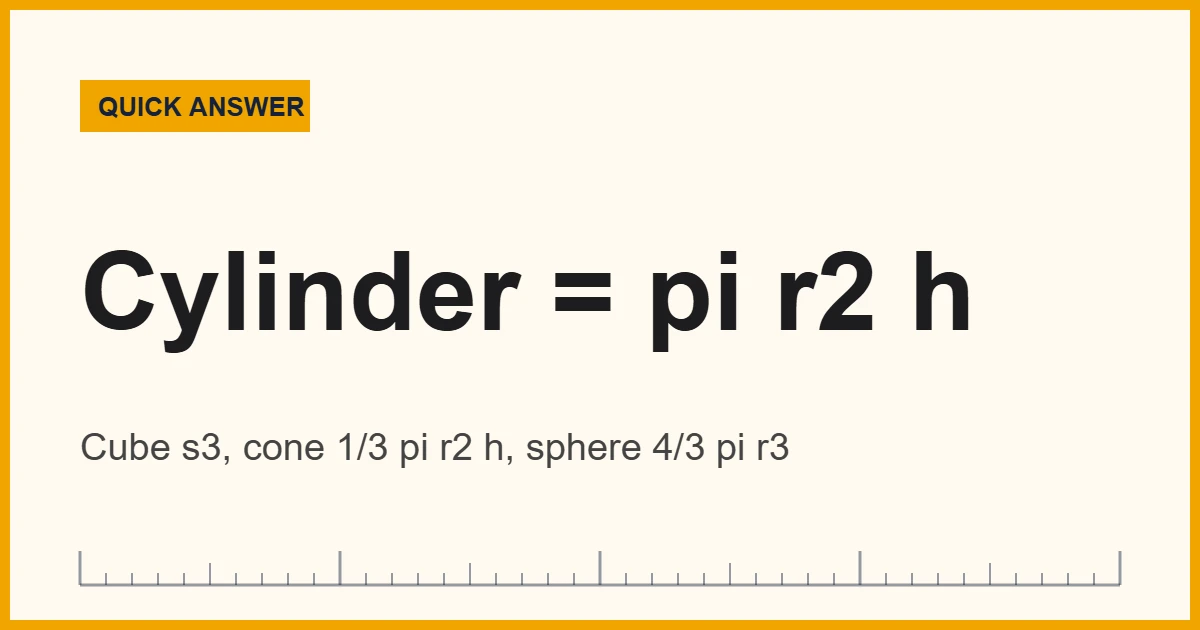
Every solid takes up space, and volume, in other words, tells you how much. For a box, a can, a ball or an ice cream cone, you do not need water or special lab gear. Instead, a few careful length measurements and the right formula give you the answer. Because the shapes are regular, the math does all the hard work.
In short: identify the shape, measure the dimensions the formula needs, keep every measurement in the same unit, and then multiply. If the object has no simple shape, such as a rock or a key, switch to water displacement. Our guide to measuring the volume of an irregular object walks through that method step by step.
Which Units the Volume of a Solid Comes In
The unit you get depends on the unit you measured with. So inches give cubic inches, and centimeters give cubic centimeters. The US National Institute of Standards and Technology (NIST) explains on its SI units for volume page that the cubic meter is the SI unit of volume. It also notes that one liter equals one cubic decimeter and one milliliter equals one cubic centimeter. As a result, a solid’s volume in cm3 converts straight to mL with no math at all.
Below, you will find a converter, a formula table, a worked example for each shape and a simple step list. After that, we cover the mistakes that throw answers off and the limits of measuring by hand.
Convert a Solid’s Volume From cm3 to mL, Liters and Gallons
First, work out the volume in cubic centimeters with the formulas below. Then enter that number here. Next, the converter shows the same volume in milliliters, liters, US fluid ounces, cups, quarts and gallons. It does not list cubic inches, so multiply cubic inches by 16.387064 to get cm3 before you start.
For example, a cylinder with a 3 cm radius and a 10 cm height holds about 282.74 cm3. That equals 282.74 mL, or roughly 9.56 US fluid ounces.
Recommended Tools for Measuring a Solid’s Dimensions
Good formulas need good measurements. So, for small parts, a digital caliper reads lengths and diameters to about a hundredth of a millimeter. Meanwhile, a steel rule with fine graduations handles blocks and boxes. For furniture, tanks or rooms, however, a tape measure is faster. Finally, a graduated cylinder lets you check a small solid’s answer by displacement.
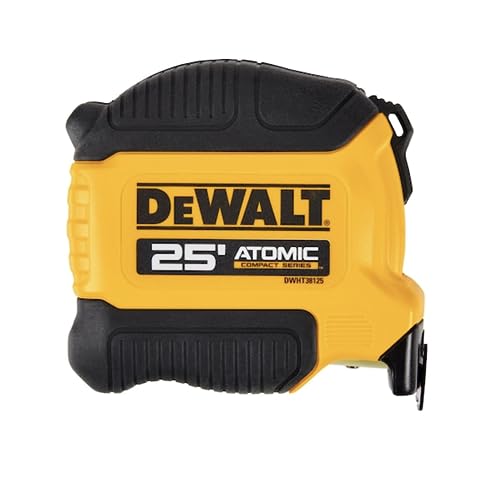
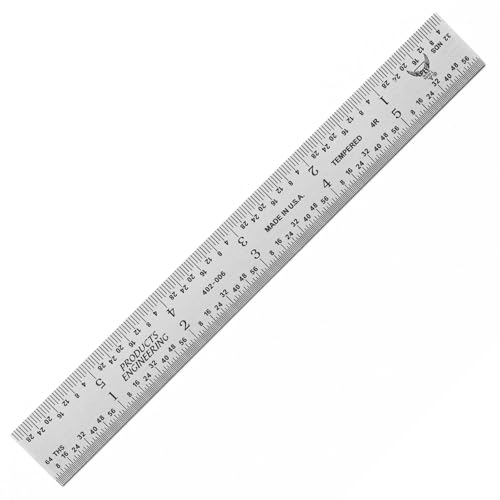



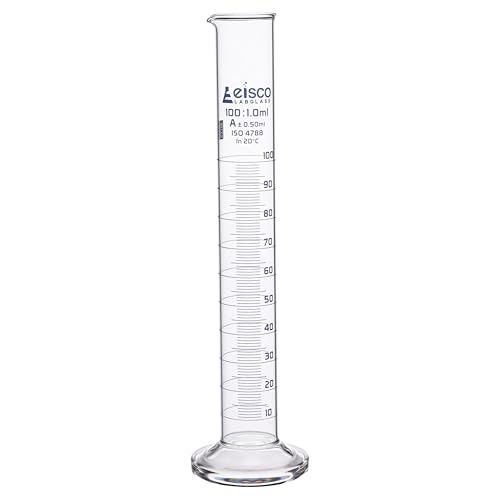
As an Amazon Associate, Measuring Expert earns from qualifying purchases.
- Volume measures the space a solid fills, in cubic units such as cm3, in3 or ft3.
- Regular shapes need only lengths: edges, radius and height.
- Prisms and cylinders share one idea: base area x height.
- A cone holds one third of a cylinder with the same base and height.
- The sphere formula uses the radius cubed, so a small radius error grows fast.
- Always halve the diameter to get the radius before you start.
- Irregular objects need water displacement instead of a formula.
Volume of a Solid: Formulas at a Glance
At first glance, each regular shape has its own formula. Still, most of them follow one pattern: find the area of the base, then multiply by the height. Cones and pyramids take one third of that, because they taper to a point.
| Shape | Formula | What to measure |
|---|---|---|
| Cube | V = s3 | One edge (s) |
| Rectangular prism (box) | V = l x w x h | Length, width, height |
| Any prism | V = B x h | Base area (B), height between the two bases |
| Cylinder | V = π x r2 x h | Radius (half the diameter), height |
| Cone | V = 1/3 x π x r2 x h | Base radius, vertical height |
| Pyramid | V = 1/3 x B x h | Base area, vertical height |
| Sphere | V = 4/3 x π x r3 | Radius (half the diameter) |
Volume of a Solid: Worked Examples for Each Shape
The examples below use round numbers, so you can check each step yourself. In addition, every result shows a metric or US equivalent.
Cube
A cube has six equal square faces, so one measurement is enough. For example, take a wooden block with 3-inch edges. Then its volume is 3 x 3 x 3 = 27 cubic inches. Since one cubic inch is exactly 16.387064 cm3, the block fills about 442.45 cm3.
Rectangular and Triangular Prisms
Similarly, a prism has two identical, parallel ends and flat sides between them. For a box, the end is a rectangle, so the volume is length x width x height. For instance, a shoebox measuring 12 x 8 x 6 inches holds 576 cubic inches, or about 9.44 liters.
Volume of a Solid Cylinder
A cylinder is simply a prism with a circular base. First, measure the diameter across the widest point, halve it to get the radius, and measure the height. A rod with a 3 cm radius and a 10 cm height gives pi x 32 x 10 = about 282.74 cm3. Likewise, in US units, a can with a 2-inch radius and a 6-inch height holds about 75.40 cubic inches.
Cone
A cone shares the cylinder’s base but narrows to a tip. So it holds exactly one third as much. With the same 3 cm radius and 10 cm height, the cone holds about 94.25 cm3. Also, be sure to use the vertical height, measured straight down from the tip, not the slanted side.
Volume of a Solid Sphere
A sphere needs only its radius, but that radius gets cubed. For a ball with a 5 cm radius, the result is 4/3 x pi x 125 = about 523.60 cm3. Meanwhile, a ball with a 4.7-inch radius holds about 434.89 cubic inches, or roughly 7.13 liters.
How to Find the Volume of a Solid, Step by Step
In general, this method works for any regular shape in the table above.
- Name the shape. Decide whether the solid is a cube, prism, cylinder, cone, pyramid or sphere.
- Pick one unit. Choose inches or centimeters and stick with it for every measurement.
- Measure the dimensions. Read edges, diameter and height with a caliper, ruler or tape, ideally twice.
- Convert diameter to radius. Halve any diameter before it goes into a round-shape formula.
- Apply the formula. Multiply carefully, and keep pi to at least five digits.
- Label and convert the answer. Write the cubic unit, then use the converter above for mL, liters or gallons.
Cubic Units and Conversions
Because volume has three dimensions, unit changes get cubed too. One foot is 12 inches, yet one cubic foot is 12 x 12 x 12 = 1,728 cubic inches. Likewise, one meter is 100 centimeters, but one cubic meter is 1,000,000 cm3.
| Unit | Metric value | US value |
|---|---|---|
| 1 cubic centimeter (cm3) | 1 mL | 0.0610 in3 |
| 1 cubic inch (in3) | 16.387064 mL (exact) | 0.554 US fl oz |
| 1 liter | 1,000 cm3 | 61.02 in3 |
| 1 US gallon | 3.785 L | 231 in3 (exact) |
| 1 cubic foot (ft3) | 28.32 L | 1,728 in3, about 7.48 US gal |
| 1 cubic yard (yd3) | 0.7646 m3 | 27 ft3 |
| 1 cubic meter (m3) | 1,000 L | 35.31 ft3 |
For more on liquid units, see how to measure the volume of a liquid, which covers cylinders, pipettes and meniscus readings.
Volume vs Capacity vs Surface Area
These three ideas often get mixed up, especially in homework and packaging questions. However, each one answers a different question.
| Term | What it tells you | Typical units |
|---|---|---|
| Volume | The space the solid itself fills | cm3, in3, ft3, m3 |
| Capacity | How much a hollow container can hold inside | mL, L, fl oz, gal |
| Surface area | The total area of the outer faces | cm2, in2, ft2 |
For example, a thick-walled mug has a larger outer volume than its inside capacity. So, to find what it holds, measure the inside diameter and depth instead of the outside.
Do and Don’t When Measuring a Solid
Do:
- Measure each dimension at least twice and average the readings.
- Use a caliper for anything smaller than your palm.
- Write the unit next to every number.
- Check a small answer by displacement in a graduated cylinder.
Don’t:
- Plug a diameter into a formula that asks for a radius.
- Use the slant height of a cone or pyramid.
- Round pi to 3 or round dimensions before you multiply.
- Mix inches, feet and centimeters in one calculation.
What About Irregular Objects?
Formulas only work when the shape matches one in the table. A rock, a bolt or a seashell, by contrast, has no neat formula. In that case, sink the object in water and read how far the level rises. As a result, the rise in milliliters equals the volume in cubic centimeters. Our full guide on the volume of irregular objects covers graduated cylinders, overflow cans and the weighing method. For the glassware itself, see what tools measure volume.
Meanwhile, some objects combine shapes. For instance, a silo is a cylinder with a cone or half-sphere on top. In that case, split it into simple parts, find the volume of each solid part, and then add them together.
Honest Limits of Measuring Volume by Formula
Of course, a formula is only as good as the numbers you feed it. Because volume multiplies three lengths, small errors add up. For example, a 1% error in a sphere’s radius becomes about a 3% error in its volume. Also, real objects are rarely perfect. For instance, cans have rolled rims, boxes bulge, and balls are not perfectly round. In short, the result describes an ideal shape, so treat it as a close estimate. Finally, hollow objects need inside measurements if you care about what they hold, not the space they take up.
When to Call a Professional
For schoolwork, cooking and DIY projects, a ruler and these formulas are enough. Still, some jobs carry real money or safety risk. For example, concrete pours, fuel or chemical tanks, and shipping charges based on cubic size all deserve a second check. In those cases, a contractor, a tank calibration service or a metrology lab can measure precisely and document the result.
Frequently Asked Questions
How do you find the volume of a solid?
Identify its shape, measure the dimensions the formula needs, and apply that formula. For a box, multiply length x width x height. For irregular objects, use water displacement instead.
What is the formula for the volume of a cube?
Volume equals the edge length cubed, or s x s x s. A cube with 4 cm edges holds 64 cm3.
How do you find the volume of a cylinder?
Multiply pi by the radius squared and then by the height. A cylinder with a 3 cm radius and 10 cm height holds about 282.74 cm3.
Why is a cone one third of a cylinder?
A cone tapers evenly from its base to a point. Calculus shows that this taper leaves exactly one third of the volume of a cylinder with the same base and height.
What is the formula for the volume of a sphere?
Volume equals 4/3 x pi x radius cubed. A ball with a 5 cm radius holds about 523.60 cm3.
Is the volume of a solid the same as its capacity?
No. Volume is the space the solid fills. Capacity is what a hollow container holds inside, so it depends on the inside dimensions.
What units measure the volume of a solid?
Cubic units, such as cubic centimeters, cubic inches, cubic feet and cubic meters. One cubic centimeter equals one milliliter.
How many cubic inches are in a cubic foot?
There are 1,728 cubic inches in a cubic foot, because 12 x 12 x 12 = 1,728.
What tool measures the dimensions of a small solid?
A digital caliper works best for small parts, because it reads diameters and edges to a fraction of a millimeter. A steel rule suits larger blocks.
What if my object is not a regular shape?
Split it into simple shapes and add their volumes. If that is not possible, sink it in water and measure how much the level rises.
Volume of a Solid: The Bottom Line
To sum up, finding the volume of a solid with a regular shape comes down to three steps: name the shape, measure it in one unit, and use the right formula. For instance, cubes and prisms multiply base area by height. Cylinders do the same with a circle, cones take a third, and spheres use the radius cubed.
Then use the converter at the top to turn cubic centimeters into milliliters, liters or gallons. And when the object has no simple shape, switch to water displacement, which handles rocks, tools and anything else a formula cannot.
2 thoughts on “How to Find the Volume of a Solid: Formulas for Cubes, Prisms, Cylinders, Cones and Spheres”