

We measure volume in cubic units because volume fills three directions at once: length, width and height. A cubic unit is a cube whose edges are one unit long, so a volume tells you how many of those cubes fit inside. For example, a box 3 ft by 2 ft by 2 ft holds 12 cubic feet.
Length uses plain units such as inches or meters. Area uses square units, because a flat surface spreads in two directions. Volume adds a third direction, so its unit picks up a third factor and becomes a cube. That small exponent, the “3” in cm3 or ft3, carries the whole idea.
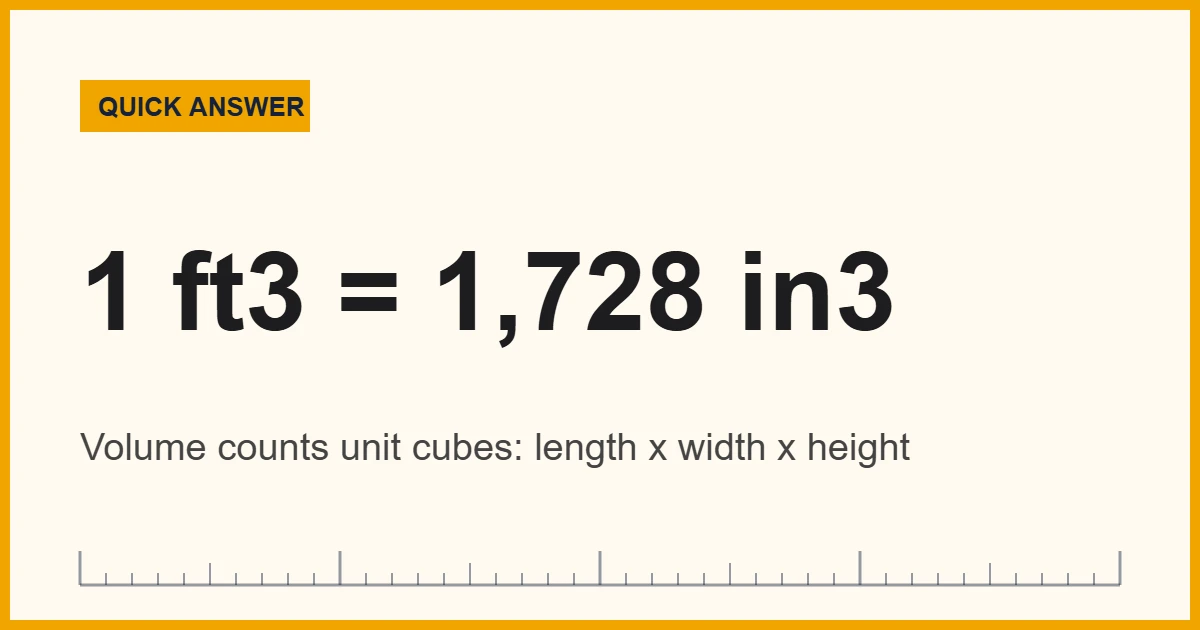
The same logic explains why cubic units convert in a way that surprises people. One foot is 12 inches, yet one cubic foot is 1,728 cubic inches, because you multiply by 12 three times (12 x 12 x 12). Likewise, one cubic meter holds 1,000,000 cubic centimeters, not 100.
In short: a length counts unit sticks, an area counts unit tiles, and a volume counts unit cubes. Every volume formula, from a simple box to a sphere, ends with three lengths multiplied together, so the answer always comes out in cubic units.
The official measurement system agrees. The US National Institute of Standards and Technology (NIST) lists volume as an SI derived unit, the cubic meter (m3), built directly from the meter. Even the liter is just a special name: NIST explains that 1 liter is one cubic decimeter and 1 milliliter is one cubic centimeter.
Below, you will find a converter, a chart of common cubic units, a step-by-step method for finding any volume, and finally the mistakes that trip up students, DIYers and shoppers alike.
Convert Cubic Centimeters to Liquid Units
Enter a volume in cubic centimeters (cc or cm3). The converter then shows the same amount in milliliters, liters, fluid ounces, cups, quarts and gallons, using exact US definitions.
Recommended Tools for Measuring in Cubic Units
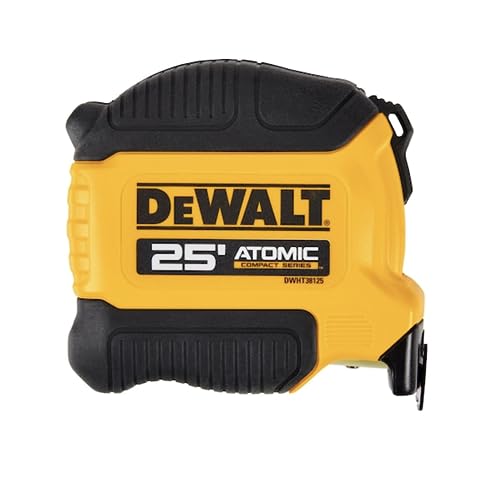
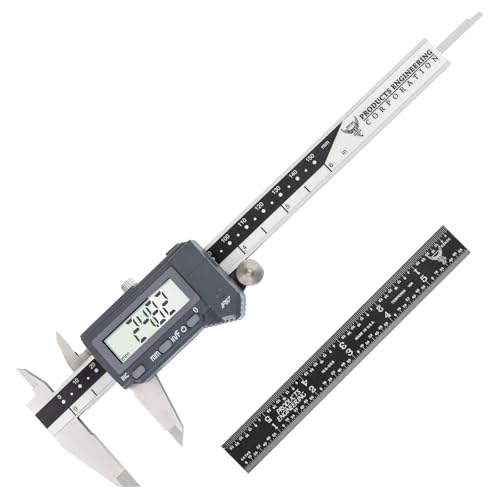
You only need a few tools to find a volume in cubic units. First, a reliable tape measure or ruler gives you the three lengths. Next, calipers help with small objects where a millimeter matters. Finally, a set of unit cubes makes the idea visible for students, because you can literally stack the cubes and count them.


As an Amazon Associate, Measuring Expert earns from qualifying purchases.
Key Takeaways
- Volume fills three dimensions, so its unit is a length cubed: in3, ft3, cm3, m3.
- A cubic unit is a cube with 1-unit edges; volume counts how many fit inside.
- Area uses square units (two dimensions); volume uses cubic units (three).
- Conversions get cubed too: 1 ft3 = 1,728 in3 and 1 yd3 = 27 ft3.
- Metric links neatly: 1 cm3 = 1 mL, and 1,000 cm3 = 1 L.
- A US gallon is defined as exactly 231 cubic inches.
- Doubling every side of a box makes its volume 8 times larger.
What Cubic Units Really Count
Picture a sugar cube that measures exactly 1 centimeter on every edge. That little block is one cubic centimeter. Now imagine filling a shoebox with such blocks, layer by layer, with no gaps. The number of blocks you need is the volume of the box in cubic centimeters.
So a volume is really a count. Just as a ruler counts how many unit lengths fit along an edge, a volume counts how many unit cubes fit inside a space. Choose a bigger cube, such as one with 1-foot edges, and the count gets smaller, but the space itself stays the same. That is why every volume needs its unit attached: “12” means nothing until you say 12 cubic feet or 12 cubic inches.
Teachers often start here for a good reason. When students build a rectangular prism from unit cubes, they can see that 3 cubes long, 2 cubes wide and 2 layers high gives 12 cubes. As a result, the formula length x width x height stops being a rule to memorize and becomes a shortcut for counting.
Why Three Lengths Give You Cubic Units
Each time you multiply by another length, the unit picks up another power. One length in feet stays in feet. Multiply two lengths, and feet x feet gives square feet. Multiply a third, and you get feet x feet x feet, or cubic feet. In other words, the exponent in the unit simply records how many directions the quantity spreads in.
| Quantity | Directions | Unit shape | Example units | Everyday example |
|---|---|---|---|---|
| Length | 1 | A unit stick | in, ft, cm, m | Height of a door |
| Area | 2 | A unit square (tile) | in2, ft2, cm2, m2 | Floor to carpet |
| Volume | 3 | A unit cube | in3, ft3, cm3, m3 | Space inside a fridge |
This rule holds for every shape, not only boxes. For instance, a cylinder’s volume is pi x radius x radius x height, which is three lengths multiplied (pi has no unit). Similarly, a sphere’s volume is 4/3 x pi x radius x radius x radius. Our guide to the volume of a solid walks through each formula with worked examples, so here we focus on why the answers always land in cubic units.
Scientists use this idea, called dimensional analysis, to catch errors. If a formula you wrote for volume produces square units, then a length is missing somewhere. Likewise, if it produces units to the fourth power, you multiplied one length too many.
Common Cubic Units Chart
These are the cubic units you will meet most often, with their exact relationships. Because the inch is defined as exactly 25.4 mm, every customary-to-metric value below follows from that one number.
| Cubic unit | Symbol | Equals | Metric value | Typical use |
|---|---|---|---|---|
| Cubic centimeter | cm3, cc | 1 mL | 0.001 L | Medicine, engines, lab work |
| Cubic inch | in3 | 16.387064 cm3 | about 16.39 mL | Engine size, small boxes |
| Cubic decimeter | dm3 | 1,000 cm3 | 1 L | Bottles, the liter itself |
| Cubic foot | ft3 | 1,728 in3 | about 28.32 L | Fridges, freezers, storage |
| Cubic yard | yd3 | 27 ft3 | about 0.7646 m3 | Concrete, mulch, soil |
| Cubic meter | m3 | 1,000,000 cm3 | 1,000 L | Shipping, water bills, rooms |
One cubic meter is also about 35.31 cubic feet. For the liquid side of the family (cups, pints, quarts and imperial gallons), see our full list of units of volume.
Why Conversions Between Cubic Units Get Cubed
Here is the mistake almost everyone makes once. You know 1 foot = 12 inches, so you assume 1 cubic foot = 12 cubic inches. Instead, a cube 1 foot on each side measures 12 inches by 12 inches by 12 inches, so it holds 12 x 12 x 12 = 1,728 cubic inches.
The same pattern applies everywhere. Since 1 yard is 3 feet, 1 cubic yard is 3 x 3 x 3 = 27 cubic feet. Since 1 meter is 100 centimeters, 1 cubic meter is 100 x 100 x 100 = 1,000,000 cubic centimeters. Therefore, the rule is simple: cube the length factor, and never use it just once.
Scaling works the same way. If you double every edge of a box, its floor area grows 4 times (2 x 2), but its volume grows 8 times (2 x 2 x 2). Triple every edge, and the volume grows 27 times. Engineers and biologists call this the square-cube relationship, and it explains why a large ice block melts more slowly than the same ice crushed: the big block has far less surface for each cubic unit inside.
How to Find a Volume in Cubic Units
This method works for any box-shaped space, from a drawer to a moving truck. Then, for curved shapes, swap step 4 for the right formula.
- Pick one unit. Decide on inches, feet, centimeters or meters before you measure, and stick with it.
- Measure the length. Run a tape along the longest inside edge and write the number down with its unit.
- Measure the width and height. Measure at right angles to the length, again on the inside if you want capacity.
- Multiply the three numbers. Length x width x height gives the volume, for example 3 ft x 2 ft x 2 ft = 12 ft3.
- Write the cubic unit. Add the “3” or the word “cubic” so nobody mistakes the result for an area.
- Convert if needed. Use the cubed factor (1,728 for ft3 to in3) or the converter above for liters and gallons.
For shapes that have no simple formula, such as a rock or a toy, water displacement is easier. Our guide on measuring the volume of an irregular object shows how to read the rise in water as cubic centimeters.
Cubic Units vs Liters, Gallons and Cups
Liquid units look like a separate system, yet most of them are cubic units in disguise. For example, the liter is exactly one cubic decimeter, and the milliliter is exactly one cubic centimeter. That is why a doctor’s “5 cc” and a pharmacist’s “5 mL” mean the same dose.
US customary units also trace back to a cube. By definition, one US liquid gallon is exactly 231 cubic inches, which works out to 3.785411784 liters. Consequently, one cubic foot holds about 7.48 US gallons, a handy number for sizing aquariums, pools and water tanks.
| Liquid unit | In cubic units | Exact or rounded |
|---|---|---|
| 1 milliliter | 1 cm3 | Exact |
| 1 liter | 1 dm3 = 1,000 cm3 | Exact |
| 1 US fluid ounce | about 1.805 in3 (29.57 cm3) | Rounded |
| 1 US gallon | 231 in3 | Exact |
| 1 cubic foot | about 7.48 US gallons (28.32 L) | Rounded |
So why keep both? Mostly habit and convenience. Liquids take the shape of their container, so people pour them by the cup or liter. Solid spaces, by contrast, have edges you can measure, so cubic units fit them naturally. For cylinders such as tanks and cans, see how to measure cylinder volume.
Do and Don’t When Working in Cubic Units
Do
- Convert every length to the same unit before multiplying.
- Cube the conversion factor when you change cubic units.
- Measure inside dimensions when you want capacity.
- Label answers with in3, ft3, cm3 or m3.
- Round only at the end of the calculation.
Don’t
- Mix inches and feet in one multiplication.
- Divide cubic feet by 3 to get cubic yards.
- Confuse square feet (floor) with cubic feet (space).
- Assume a box’s outside size equals its usable volume.
- Treat fluid ounces as a weight.
Honest Limits of Measuring in Cubic Units
A formula is only as good as the lengths you feed it. Because volume multiplies three measurements, small errors compound. For example, if each edge of a 10 cm cube reads 1% too long, the volume comes out about 3% too high. In addition, real objects are rarely perfect boxes: walls bulge, corners round off, and lids take up space. A fridge rated at 20 cubic feet, meanwhile, usually counts total interior space, not the shelf space you can actually fill.
Loose materials add another catch. A cubic yard of gravel or soil settles and compacts once you spread it, so suppliers and installers often add extra. Finally, cubic units measure space, not weight. A cubic foot of water weighs about 62.4 lb, whereas a cubic foot of feathers weighs a tiny fraction of that, so you need density to go from one to the other.
When to Call a Professional
Most volume questions are simple math. Still, a few jobs deserve an expert. For instance, a structural engineer or concrete contractor should size large pours, footings and retaining walls, because ordering too little concrete mid-pour causes weak joints. Likewise, a pool or HVAC professional can size pumps, chemicals and air handling from room or pool volume, and a calibration lab can certify tanks and containers used for trade or billing.
For school work, a teacher can confirm whether an answer needs cubic units or capacity units such as liters.
Frequently Asked Questions
Why is volume measured in cubic units instead of square units?
Square units cover a flat surface in two directions. Volume also has height, so it needs a unit that fills three directions: a cube. That is why volume uses cubic units such as cm3 or ft3.
What is a cubic unit?
A cubic unit is a cube whose edges are each one unit long, such as 1 inch or 1 centimeter. A volume tells you how many of these cubes fit inside a space.
How many cubic inches are in a cubic foot?
There are 1,728 cubic inches in a cubic foot, because 12 x 12 x 12 = 1,728.
How many cubic feet are in a cubic yard?
There are 27 cubic feet in a cubic yard, because 3 x 3 x 3 = 27.
Is a cubic centimeter the same as a milliliter?
Yes. One cubic centimeter (cm3 or cc) equals exactly 1 milliliter, and 1,000 cm3 equals 1 liter.
What is the SI unit of volume?
The SI unit of volume is the cubic meter (m3). The liter is a special name for the cubic decimeter, which is one thousandth of a cubic meter.
Do liquids have cubic units too?
Yes. Liquid units are cubic units with different names. A liter is 1 dm3, a milliliter is 1 cm3, and a US gallon is exactly 231 cubic inches.
Why does doubling the sides make the volume eight times bigger?
Volume multiplies three lengths. If each one doubles, the volume grows by 2 x 2 x 2, which is 8.
How do you write cubic units?
Write the length unit with a raised 3, such as cm3, in3 or m3, or write the word cubic, as in cubic feet. Older labels may use cu ft or cc.
How do you convert cubic feet to gallons?
Multiply cubic feet by about 7.48 to get US gallons. For example, 10 cubic feet holds about 74.8 US gallons.
Cubic Units: The Bottom Line
To sum up, volume uses cubic units because it fills three directions, and every volume is a count of how many 1-unit cubes fit inside. That is why every formula multiplies three lengths, and why conversion factors get cubed: 1,728 cubic inches in a cubic foot, 27 cubic feet in a cubic yard, and a million cubic centimeters in a cubic meter.
So when you measure your next box, room or tank, keep one unit throughout, multiply the three lengths, and label the answer with its cube. Then, if you need liters or gallons, the converter at the top of the page handles the rest.
1 thought on “Why Do We Measure Volume in Cubic Units? The Simple Reason”