

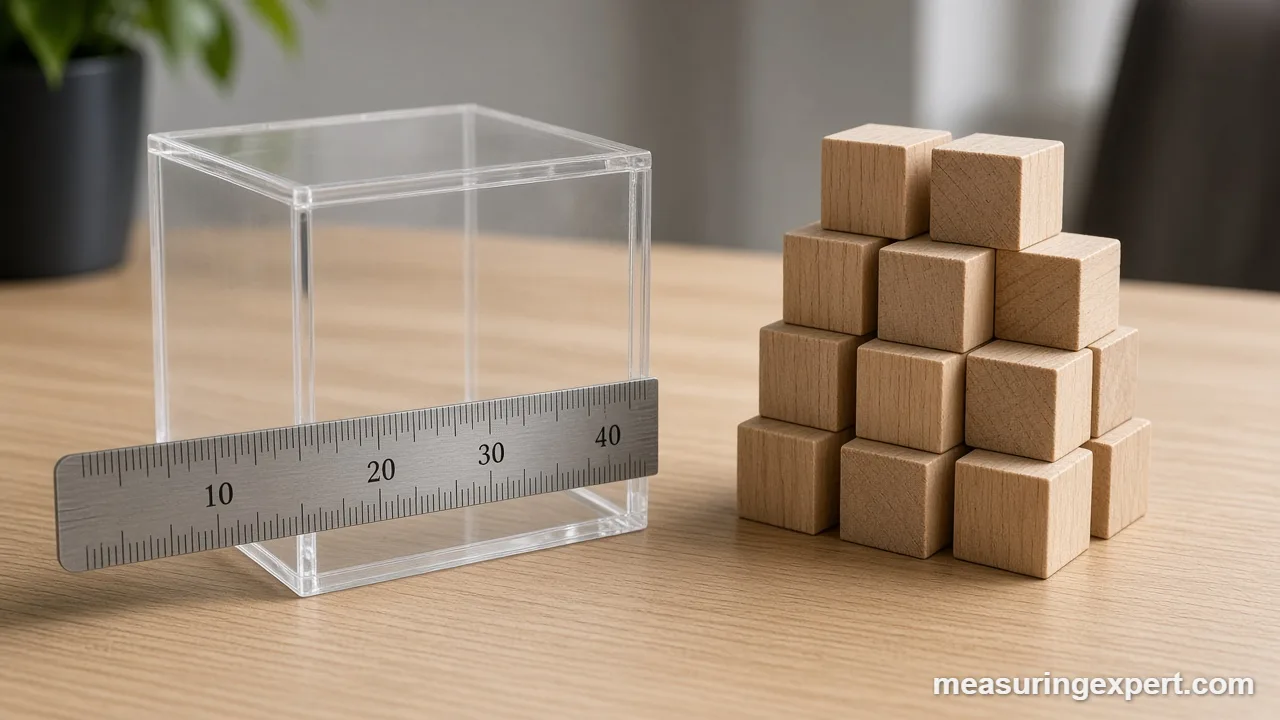
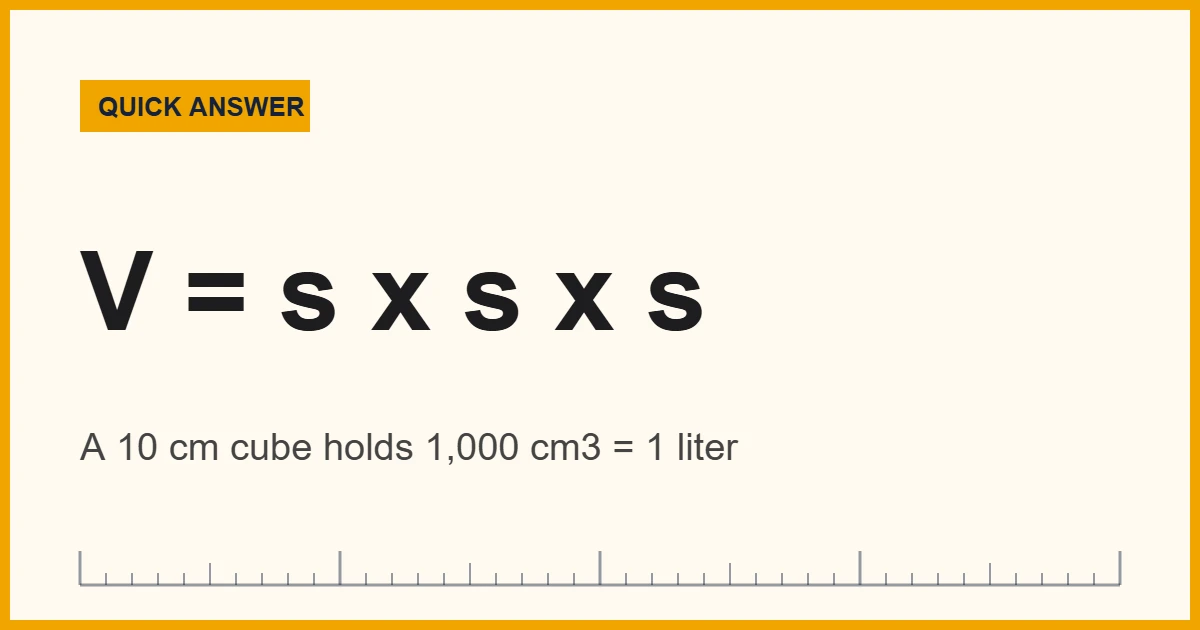
The volume of a cube is its edge length multiplied by itself three times: V = s x s x s, or s cubed. So a 3-inch cube holds 27 cubic inches, and a 10 cm cube holds 1,000 cm3, which is exactly 1 liter. Because all 12 edges are equal, you only need to measure one edge carefully.
Convert a Cube’s Volume to Liters and Gallons
First cube your edge length in centimeters (for example, 10 x 10 x 10 = 1,000). Next, type that number of cubic centimeters below. The converter then shows the same space in milliliters, liters, fluid ounces, cups, quarts and US gallons, using the exact NIST definitions.
A cube is a box with six identical square faces. As a result, its length, width and height are all the same number. Because of that, this single fact turns the usual box formula into a shortcut. Instead of three measurements, you take one and multiply it by itself twice.
You meet cubes everywhere: dice, sugar cubes, ice trays, shipping boxes, planter boxes and the 1-liter model cubes used in classrooms. In each case, however, the question is the same. So how much space is inside, or how much will it hold?
The answer always comes out in cubic units, such as cubic inches (in3), cubic feet (ft3) or cubic centimeters (cm3). For example, the US National Institute of Standards and Technology (NIST) explains on its SI volume page that a liter is simply a special name for a cubic decimeter, a cube 10 cm on each side. If you want the bigger picture first, our guide to why volume is measured in cubic units covers the idea step by step.
The Volume of a Cube Formula, Explained
V = s x s x s = s3
Here, s is simply the length of one edge. The small raised 3 means “cubed”, so you multiply the edge by itself three times. In other words, it is the regular box formula, length x width x height, with all three numbers equal.
Why three times? For example, think of stacking. A 3-inch cube has a bottom layer of 3 x 3 = 9 one-inch blocks. Then three of those layers stack up, so 9 x 3 = 27 blocks in total. Since each block is one cubic inch, it follows that the cube holds 27 cubic inches.
This also explains why volume grows so fast. If you double the edge, the volume becomes 2 x 2 x 2 = 8 times larger. Similarly, triple the edge and the volume jumps 27 times.
Volume of a Cube Chart for Common Edge Lengths
This chart lists the volume for whole-number edges. In addition, it gives a metric or liquid equivalent so you can picture the size. Also, values are exact or rounded to two decimals.
| Edge (s) | Volume (s3) | Equivalent |
|---|---|---|
| 1 cm | 1 cm3 | 1 mL |
| 2 cm | 8 cm3 | 8 mL |
| 5 cm | 125 cm3 | 125 mL |
| 10 cm | 1,000 cm3 | 1 L |
| 1 in | 1 in3 | 16.39 cm3 |
| 2 in | 8 in3 | 131.10 cm3 |
| 3 in | 27 in3 | 442.45 cm3 |
| 4 in | 64 in3 | 1,048.77 cm3 |
| 6 in | 216 in3 | 3.54 L |
| 12 in (1 ft) | 1,728 in3 (1 ft3) | 28.32 L |
| 3 ft (1 yd) | 27 ft3 (1 yd3) | 0.76 m3 |
| 1 m | 1 m3 | 1,000 L |
Also, want a copy for the workbench or classroom? Print this page; the chart fits on one sheet.
Recommended Tools for Measuring a Cube’s Edges
First, the tool you need depends on the size of the cube. For small parts and dice, a digital caliper reads to a hundredth of a millimeter. For boxes and blocks, by contrast, a rigid steel rule is quicker. Also, a graduated cylinder lets you check the answer by water displacement, which is handy for irregular objects too.



As an Amazon Associate, Measuring Expert earns from qualifying purchases.
How to Measure the Volume of a Cube Step by Step
- Check that it is a real cube. Measure three edges that meet at one corner; they should match.
- Pick one unit. First decide on inches or centimeters, and then stick with it.
- Measure an edge carefully. Hold the rule flat against the face, and then read straight on, not at an angle.
- Repeat on two more edges. If the readings differ slightly, then average them.
- Cube the edge. Multiply it by itself three times, or enter s^3 on a calculator.
- Write the cubic unit. Then convert with the tool above if you need liters or gallons.
Volume of a Cube Examples: 1 Inch, 1 Foot, 1 Meter, 10 cm
These four cubes are worth knowing by heart, because most other conversions build on them.
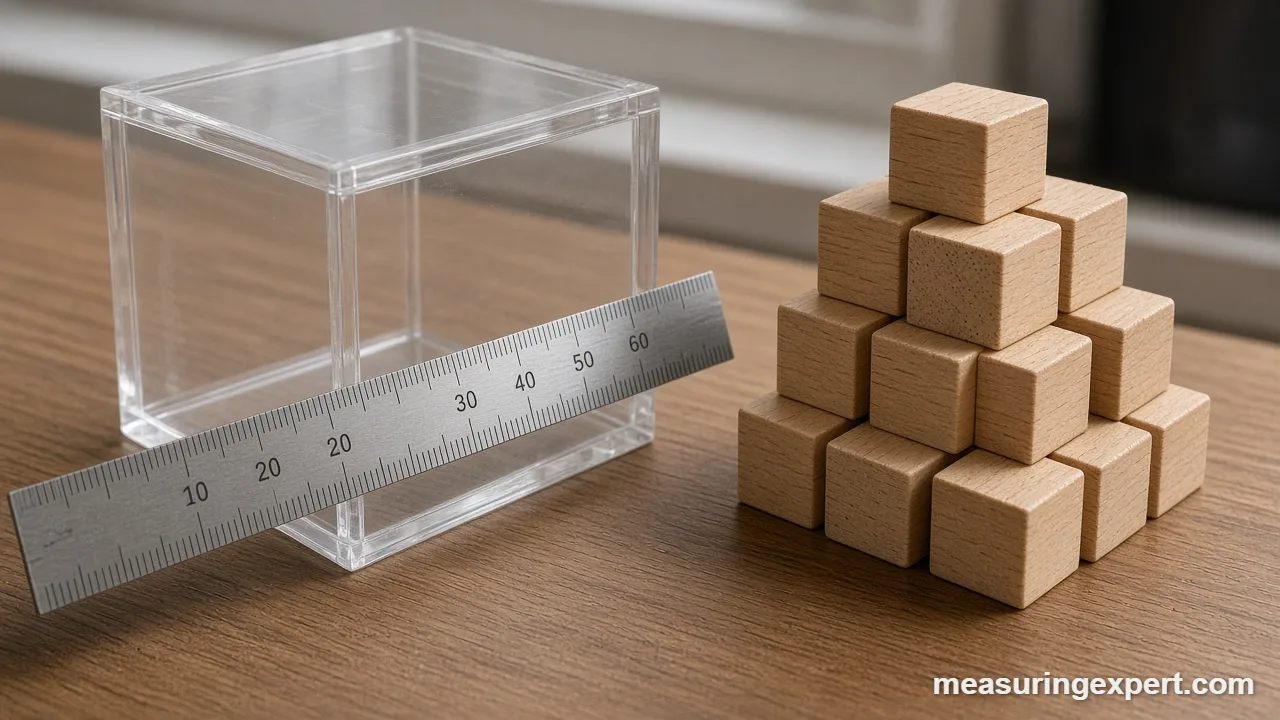
A 1-inch cube. The volume is 1 x 1 x 1 = 1 cubic inch. Since 1 inch is exactly 2.54 cm, it also equals 2.54 x 2.54 x 2.54 = 16.387064 cm3, or about 16.39 mL. That is a little over half a fluid ounce (0.554 fl oz).
A 1-foot cube. One foot is 12 inches, so the volume is 12 x 12 x 12 = 1,728 cubic inches. As a result, that makes 1 cubic foot, which equals about 28.32 liters or 7.48 US gallons.
A 1-meter cube. Next, the result is 1 cubic meter, the SI unit of volume. Because 1 m is 100 cm, it holds 100 x 100 x 100 = 1,000,000 cm3, which is 1,000 liters or about 264.17 US gallons.
A 10 cm cube. Finally, 10 x 10 x 10 = 1,000 cm3, and that is exactly 1 liter. As a result, a liter of water would fill this cube to the brim, and at room temperature it weighs very close to 1 kg.
One more mixed example: a planter box 1.5 feet on each side holds 1.5 x 1.5 x 1.5 = 3.375 cubic feet. So you would need about 3.4 cubic feet of potting mix, or roughly 95.6 liters.
Converting the Volume of a Cube Between Units
First, here is the trap. There are 12 inches in a foot, but there are not 12 cubic inches in a cubic foot. Instead, you cube the length factor too: 12 x 12 x 12 = 1,728. In fact, the same rule applies to every unit pair.
| Length factor | Cubic factor | Why |
|---|---|---|
| 1 ft = 12 in | 1 ft3 = 1,728 in3 | 12 x 12 x 12 |
| 1 yd = 3 ft | 1 yd3 = 27 ft3 | 3 x 3 x 3 |
| 1 m = 100 cm | 1 m3 = 1,000,000 cm3 | 100 x 100 x 100 |
| 1 dm = 10 cm | 1 dm3 = 1,000 cm3 = 1 L | 10 x 10 x 10 |
| 1 in = 2.54 cm | 1 in3 = 16.387064 cm3 | 2.54 x 2.54 x 2.54 |
| 1 ft = 0.3048 m | 1 ft3 = 0.0283168 m3 | 0.3048 cubed |
These factors match the official ones in NIST Special Publication 811, Appendix B.9. Also, a US gallon is defined as exactly 231 cubic inches, so a cube needs edges of about 6.14 inches to hold one gallon.
Finding the Side Length From the Volume of a Cube
Sometimes you know the volume of a cube and need the edge. For example, you may want a box that holds exactly 2 liters. In that case, take the cube root: s = the cube root of V.
- 64 in3 gives an edge of 4 inches, because 4 x 4 x 4 = 64.
- 1,000 cm3 gives 10 cm, so a 1-liter cube is 10 cm wide.
- 2,000 cm3 (2 L) gives about 12.6 cm.
- 500 cm3 gives about 7.94 cm.
On most phone calculators, turn the phone sideways and look for the cube-root key (it may be shown as x^(1/y) with y = 3). Alternatively, raise the number to the power 0.3333. Finally, check your answer by cubing it again.
Cube vs Rectangular Box: Which Formula Applies?
A cube is a special case of a rectangular box, also called a cuboid or rectangular prism. So the box formula always works on a cube, but the cube shortcut only works when every edge is equal.
Cube. All edges equal. Also, it has six square faces. Volume = s x s x s. One measurement is enough, although checking three is smart.
Rectangular box. However, length, width and height can differ. Volume = l x w x h. You need all three measurements, for instance 10 x 6 x 4 in = 240 in3.
For boxes, tanks and other solids, see our guide to the volume of a solid. It covers cylinders, spheres and odd shapes measured by water displacement.
Do and Don’t When You Find Cube Volume
Do
- Measure three edges and compare them.
- Also, use one unit for every number.
- Write the answer in cubic units.
- Measure inside edges for containers.
Don’t
- Multiply by 3 instead of cubing.
- Convert after cubing with a length factor.
- Round the edge before you cube it.
- Assume a box is a cube without checking.
Honest Limits: Why Measured Volume Is Never Exact
Cubing magnifies small errors in the volume of a cube. In fact, a 1% mistake in the edge becomes about a 3% mistake in the volume, because 1.01 cubed is 1.0303. So a ruler read to the nearest 1/16 inch is fine for a shipping box, but not for a lab sample.
In addition, real objects are imperfect. For instance, dice have rounded corners, wooden blocks swell with humidity, and cardboard bulges. Therefore, for anything that is not a true cube, a water-displacement check in a graduated cylinder gives a better reading. After all, the rise in water level, in mL, equals the volume in cm3.
Finally, keep extra digits until the last step. Rounding 2.54 to 2.5 before cubing, for example, makes a cubic inch look like 15.6 cm3 instead of 16.39 cm3, an error of nearly 5%.
When Accuracy Really Matters
For a homework problem or a planter, a ruler and the volume of a cube formula are enough. However, some jobs need more care. For example, concrete forms and soil orders are sold by the cubic yard, so a small error across a big pour costs real money. Similarly, lab work and machining often need a caliper or a calibrated vessel.
FAQs About the Volume of a Cube
What is the formula for the volume of a cube?
The formula is V = s x s x s, written as s cubed. Multiply the length of one edge by itself three times, and give the answer in cubic units.
Do I need length, width and height for a cube?
No. All three are equal in a cube, so one edge length is enough. Still, measuring three edges confirms the shape really is a cube.
How many cubic inches are in a cubic foot?
There are 1,728 cubic inches in a cubic foot, simply because 12 x 12 x 12 = 1,728.
Is the volume of a cube with 10 cm sides really 1 liter?
Yes. A 10 cm cube holds 1,000 cubic centimeters, and a liter is defined as one cubic decimeter, which is exactly 1,000 cm3.
How do you find the side of a cube from its volume?
Simply take the cube root of the volume, because cubing and cube roots undo each other. For example, the cube root of 125 cm3 is 5 cm, since 5 x 5 x 5 = 125.
What happens to the volume of a cube if you double the side?
It becomes 8 times larger, because 2 x 2 x 2 = 8. Similarly, tripling the side makes it 27 times larger.
What tool is best for measuring a small cube?
A digital caliper is best for small cubes such as dice or metal blocks. For larger boxes, however, a rigid steel rule or tape measure works well.
How many liters are in a cubic foot?
One cubic foot is about 28.32 liters, or in other words about 7.48 US gallons.
Can I measure cube volume with water?
Yes. First, lower the cube into a graduated cylinder partly filled with water. The rise in the water level in milliliters equals the volume in cubic centimeters.
Is the surface area of a cube the same as its volume?
No. Surface area is 6 x s x s and is measured in square units, while volume is s x s x s in cubic units. In fact, they only share the same number for a 6-unit cube.
Bottom Line
To find the volume of a cube, measure one edge, multiply it by itself three times, and label the answer in cubic units. Above all, remember the anchors: 1 ft3 = 1,728 in3, 1 in3 = 16.39 cm3, and a 10 cm cube is exactly 1 liter. Also, convert lengths before cubing, and use the converter above when you need liquid units.