

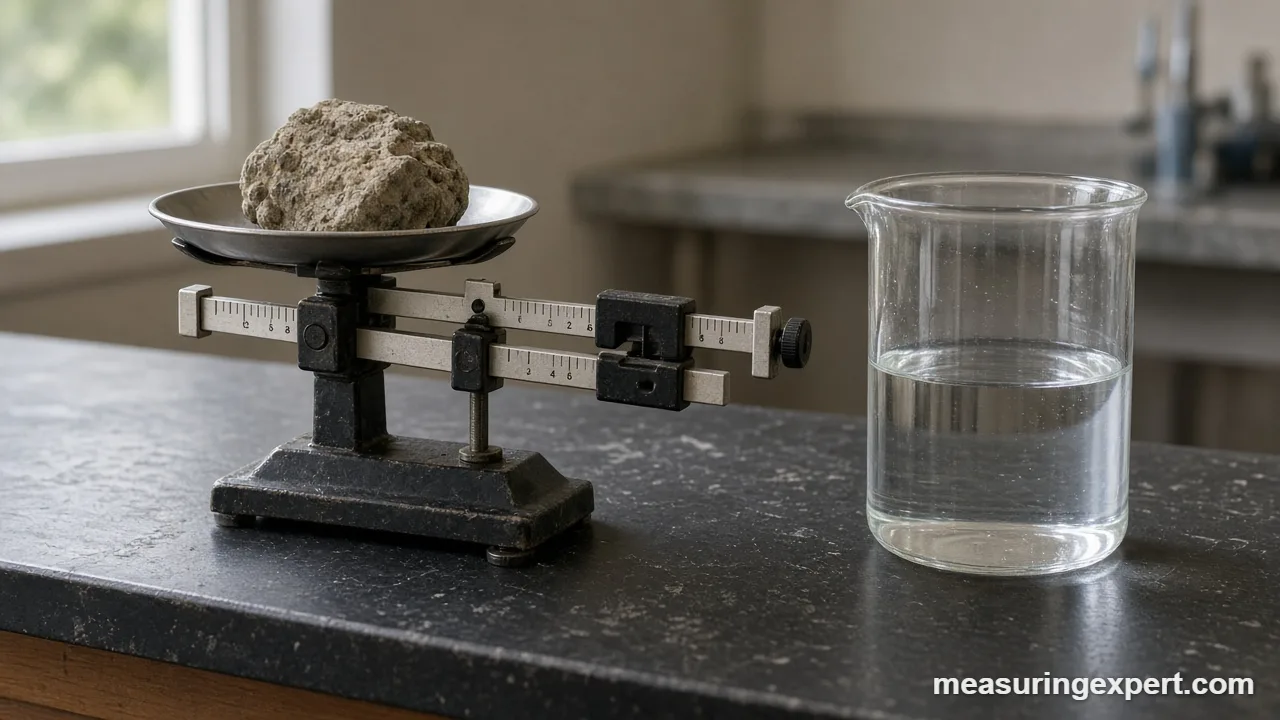
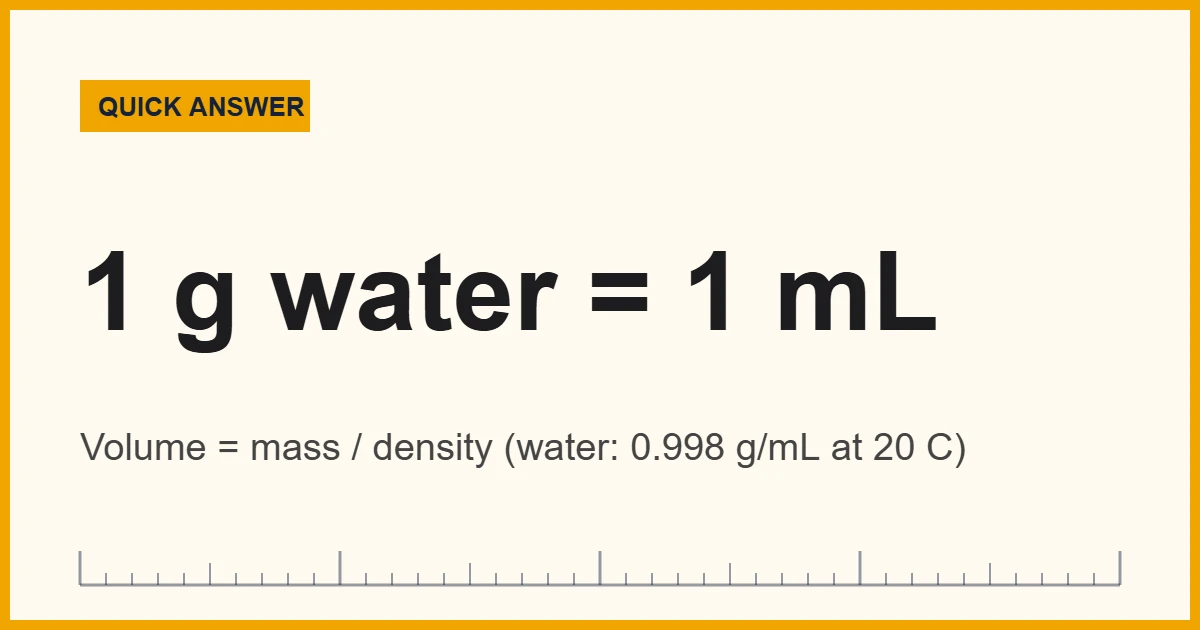
A triple beam balance cannot measure volume directly, because it measures mass. However, you can still find volume with it. Divide the mass by a known density (V = m / density), or weigh the water an object displaces: 1 gram of water is about 1 mL (1.002 mL at 68 F / 20 C).
Why a Triple Beam Balance Reads Mass, Not Volume
The question comes up in almost every middle school and high school science lab. Typically, the teacher hands out a rock, a metal cylinder or a cup of liquid, and the worksheet asks for its volume. Meanwhile, the only instrument on the bench is a triple beam balance. So is the balance the wrong tool?
Strictly speaking, yes: a triple beam balance compares the mass on its pan against sliding weights (called riders or poises), so every reading is in grams, not milliliters. Still, mass and volume are linked by density, and that link turns the balance into a surprisingly accurate volume tool. If you already know what the object is made of, you can divide its mass by its density. If you do not know the material, you can weigh the water it pushes aside instead, because pure water has a density of almost exactly 1 gram per milliliter. As a result, one careful reading on the balance can give you the volume of an irregular object to within a few tenths of a milliliter.
In short: the balance gives you mass, density gives you the bridge, and water gives you a free density standard you can trust.
The US Geological Survey (USGS) explains that the density of water is roughly 1 gram per milliliter, peaking at 0.99984 g/mL at 39.2 F (4 C) and dropping slightly as the water warms. For that reason, this small change is the only correction you need for most classroom work.
Below, you will also find a converter, a step-by-step method for each approach, a guide to reading the beams, and the honest limits of what a 0.1 g balance can tell you about volume.
Turn Grams of Displaced Water Into a Triple Beam Balance Volume
Once you have weighed the displaced water, enter the grams as milliliters below (1 g of water is about 1 mL). The converter then shows the same volume in cubic centimeters, liters, US fluid ounces and spoons. For a more exact answer at room temperature, first divide your grams by 0.9982, which is the density of water at 68 F (20 C).
Note that this tool is a unit converter, so it does not apply the temperature correction for you. However, the difference is only about 0.2 percent at room temperature, which is smaller than the 0.1 g reading limit for objects under about 50 mL.
Recommended Tools for Finding Mass and Volume
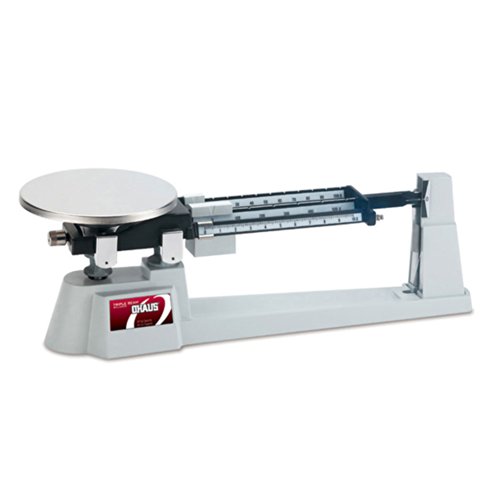
For this kind of lab work, you need two things: a mechanical balance that reads to 0.1 g and a graduated cylinder to check your answer. First, the Ohaus triple beam models below are the classic school balances, with a 610 g capacity and 0.1 g readability according to the manufacturer’s manual. Next, a glass or plastic graduated cylinder set lets you compare the weighing method against a direct volume reading, which is a good habit in any lab report.


As an Amazon Associate, Measuring Expert earns from qualifying purchases.
Key Takeaways
- A triple beam balance measures mass in grams; it never reads volume directly.
- Volume equals mass divided by density: V = m / density.
- Water is the easy reference: 1 g of water fills about 1 mL (1.002 mL at 20 C).
- To find the volume of an irregular solid, weigh the water it displaces or the buoyant push it gets.
- For liquids, weigh an empty container, add the liquid, and subtract.
- Read the beams by adding the three rider positions, largest to smallest.
- With 0.1 g readability, small objects (under about 5 mL) carry a 2 percent or larger uncertainty.
What a Triple Beam Balance Measures (and What It Does Not)
Students often treat mass, weight and volume as the same thing, since everyday language mixes them up. In science, however, they are separate quantities with separate units, and the balance only handles one of them.
| Quantity | What it describes | Common units | Tool that measures it |
|---|---|---|---|
| Mass | How much matter an object contains | g, kg, oz, lb | Triple beam balance, digital balance |
| Weight | The force of gravity on that mass | newtons, pounds-force | Spring scale |
| Volume | How much space the object takes up | mL, cm3, L, fl oz | Graduated cylinder, ruler (regular shapes), overflow can |
| Density | Mass packed into each unit of volume | g/mL, g/cm3, kg/m3 | Calculated: mass / volume |
Because a triple beam balance compares masses against its riders, it gives the same reading on the Moon as on Earth. A spring scale, by contrast, would read about one sixth as much there. That is why the balance is the standard mass tool in school labs. For a wider look at mass instruments, see our guide to the tools used to measure mass.
How to Read a Triple Beam Balance
Before you can turn mass into volume, you need a clean mass reading. On a common school model such as the Ohaus 700 series, the three beams carry different step sizes. According to the Ohaus triple beam manual, one beam moves in 100 g steps up to 500 g, another in 10 g steps up to 100 g, and the front beam slides smoothly from 0 to 10 g in 0.1 g marks.
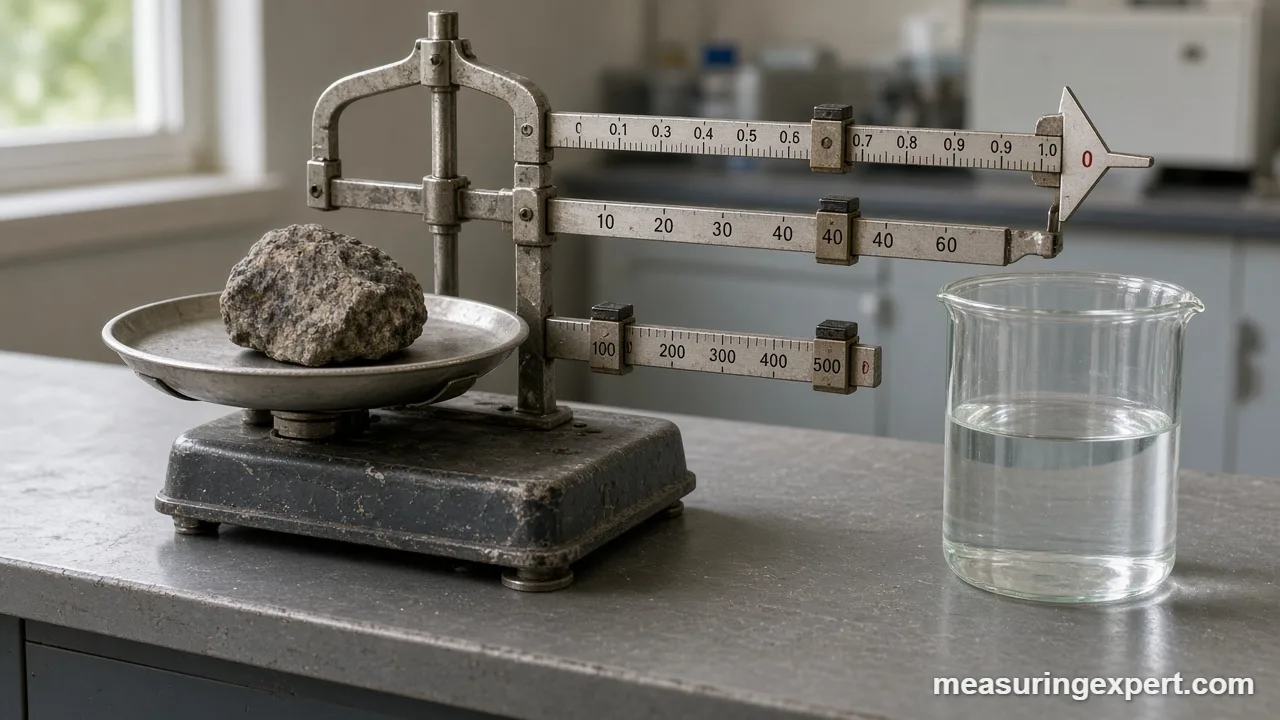
| Beam | Range | Step | Example reading |
|---|---|---|---|
| Hundreds beam | 0-500 g | 100 g notches | 300 g |
| Tens beam | 0-100 g | 10 g notches | 40 g |
| Front (ones) beam | 0-10 g | 0.1 g marks | 6.7 g |
| Total | 300 + 40 + 6.7 = 346.7 g | ||
First, slide all riders to zero with the pan empty and check that the pointer lines up with the zero mark. If it does not, then turn the zero-adjust knob until it does. Next, place the object on the pan and move the largest rider out one notch at a time. When the pointer drops below zero, step back one notch. Then repeat with the tens rider, and finally slide the front rider until the pointer rests on zero. Lastly, add the three numbers, and you have the mass.
How to Find Volume With a Triple Beam Balance and Water
This is the method to use for rocks, keys, bolts and other irregular solids that do not dissolve or float. It works because the object pushes up on the water exactly as hard as the water it displaces weighs (Archimedes’ principle). So the balance reading rises by the mass of that displaced water.
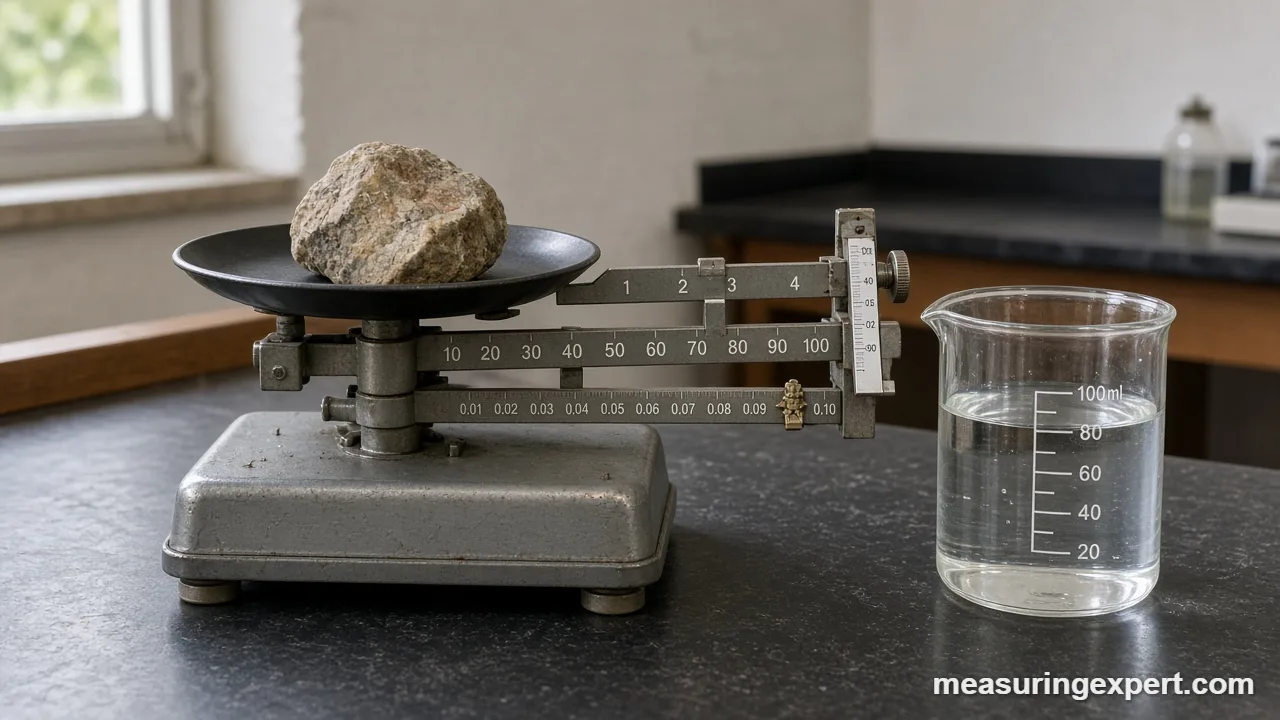
- Zero the balance. Check the pointer with an empty pan and adjust the knob if needed.
- Weigh a beaker of water. Place a beaker about half full of room-temperature water on the pan and record the mass, for example 182.4 g.
- Hang the object on a thin thread. Lower it into the water until it is fully under the surface, without touching the bottom or sides.
- Weigh again. Hold the thread still and rebalance the riders; for example, the reading rises to 199.6 g.
- Subtract the two readings. Here, 199.6 – 182.4 = 17.2 g of displaced water.
- Convert grams to milliliters. Divide by the water density: 17.2 / 0.9982 = 17.23 mL, so the object’s volume is about 17.2 cm3.
As a bonus, weigh the object itself (say 46.5 g) and you also get its density: 46.5 / 17.23 = 2.70 g/cm3, which is typical of granite. In addition, if you prefer the overflow-can version, fill a spout cup to the brim, drop the object in, catch the spill in a pre-weighed beaker, and weigh the water you caught. Our guide on finding the volume of an irregular object covers the cylinder version of the same idea.
Find Volume From a Known Density
If you already know the material, you do not need water at all. Instead, weigh the object and divide by the published density of that material.
For example, a solid aluminum block that reads 54.0 g on the balance has a volume of 54.0 / 2.70 = 20.0 cm3, because aluminum is about 2.70 g/cm3 (see how dense aluminum is). Similarly, a 39.4 g steel bolt at about 7.85 g/cm3 takes up roughly 5.0 cm3.
However, this method is only as good as the density value. For instance, alloys, hollow parts, paint and trapped air all change the real density, so a pure, solid sample works best. When in doubt, check your answer with the water method above.
Use a Triple Beam Balance to Get the Volume of a Liquid
Liquids are easier, since you can pour them. First, weigh an empty, dry container. Next, add the liquid and weigh again. Then subtract to get the mass of the liquid alone, and finally divide by its density.
| Liquid | Typical density | Mass weighed | Volume |
|---|---|---|---|
| Water at 68 F (20 C) | 0.9982 g/mL | 24.5 g | 24.54 mL |
| Water at 77 F (25 C) | 0.9970 g/mL | 24.5 g | 24.57 mL |
| Vegetable oil (approximate) | about 0.92 g/mL | 46.0 g | about 50.0 mL |
The water densities come from a standard water density table. For oils, syrups and other liquids, the density varies by brand and temperature, so treat the result as an estimate unless you have a measured value.
Triple Beam Balance vs Graduated Cylinder: Which Method Should You Use?
Overall, each method has a sweet spot. A quick comparison makes the choice easier:
| Method | Best for | Main error source |
|---|---|---|
| Balance + known density | Pure, solid materials (metals, glass) | Wrong or approximate density value |
| Balance + displaced water | Irregular solids, rocks, small parts | Air bubbles, thread volume, 0.1 g limit |
| Balance + liquid in container | Liquids with a known density | Temperature, wet container |
| Graduated cylinder only | Quick liquid or displacement readings | Reading the meniscus, cylinder resolution |
In many classes, the weighing method beats the cylinder. A 100 mL cylinder is usually marked every 1 mL, while the balance resolves 0.1 g, which equals about 0.1 mL of water. So for a mid-sized rock, the triple beam balance often gives a sharper volume than the cylinder does. Want to compare? See how to measure volume with a graduated cylinder.
Triple Beam Balance Do and Don’t
Do
- Zero the balance before every session.
- Use room-temperature water and note the temperature.
- Keep the pan dry and wipe up spills right away.
- Repeat each reading and average the results.
- Record units: grams for mass, mL or cm3 for volume.
Don’t
- Expect the balance to read volume on its own.
- Drop heavy objects onto the pan.
- Let the submerged object touch the beaker.
- Use the water method on salt, sugar or anything that dissolves.
- Oil the knife edges or bearings.
Honest Limits of the Weighing Method
A school triple beam balance reads to 0.1 g, so every volume you derive carries at least about 0.1 mL of uncertainty. For example, for a 50 mL object, that is only 0.2 percent. For a 5 mL pebble, however, it grows to 2 percent, and for a 1 mL bead it reaches 10 percent. In other words, the smaller the object, the less you should trust the last digit.
Temperature matters too, but less than most people think. At 68 F (20 C), 1 g of water fills 1.0018 mL; at 77 F (25 C), it fills 1.0030 mL. Next to the 0.1 g reading limit, that correction is small for most homework. Also, the thread you hang the object from displaces a little water of its own, so use the thinnest thread that will hold the object. Finally, objects that float, soak up water (like wood or sponge) or dissolve need a different approach, such as a sinker weight or a non-water liquid with a known density.
When to Use a Lab or Calibration Service
For coursework and hobby projects, a triple beam balance and a beaker of water are plenty. Even so, some jobs need more. For example, gemstone identification, precious-metal testing, quality control on manufactured parts and any measurement you must certify all call for an analytical balance with a density kit, a calibrated pycnometer, or an accredited calibration lab. Likewise, if your balance gives readings that drift or will not zero, have it checked against certified test masses instead of guessing.
Frequently Asked Questions
Can a triple beam balance measure volume directly?
No. Instead, it measures mass in grams. You can calculate volume from that mass by dividing by density, or by weighing the water an object displaces.
What does a triple beam balance measure?
It measures mass, the amount of matter in an object, usually to the nearest 0.1 g on a school model.
How do you find volume with a triple beam balance?
Weigh a beaker of water, submerge the object on a thread without touching the sides, and weigh again. The increase in grams equals the displaced water, and each gram is about 1 mL.
Is 1 gram of water exactly 1 mL?
Almost. Near 39 F (4 C), 1 g of water fills 1 mL to within about 0.02 percent; at 68 F (20 C), it fills about 1.0018 mL.
What is the formula for volume from mass?
Volume equals mass divided by density (V = m / density). With grams and g/cm3, the answer comes out in cubic centimeters, which are the same as milliliters.
How do I read a triple beam balance?
Slide the riders out from largest to smallest until the pointer rests on zero. Then add the three beam readings, for example 300 g + 40 g + 6.7 g = 346.7 g.
What is the capacity of a triple beam balance?
Common Ohaus school models handle 610 g, or about 21.5 oz, on the beams alone. With attachment weights, the manual lists a total capacity of 2,610 g, about 5.75 lb.
Why use a triple beam balance instead of a graduated cylinder for volume?
Resolution. Because the balance reads 0.1 g, it resolves about 0.1 mL of water, while many 100 mL cylinders are marked only every 1 mL.
Can I find the volume of something that floats?
Yes, with an extra step. First, tie on a sinker, measure the sinker’s displacement alone, measure both together, and subtract.
Does water temperature change the result?
Slightly. Warm water is a little less dense, so dividing by 0.9982 at 20 C or 0.9970 at 25 C gives a more exact volume than assuming 1 g per mL.
Bottom Line
To sum up, the balance is a mass instrument, not a volume one. Even so, with density as the bridge, it becomes one of the most precise volume tools in a school lab. In practice, weigh the displaced water for irregular solids, divide by a known density for pure materials, and subtract container masses for liquids.
Finally, remember the 0.1 g limit. For large objects the method is excellent, while for tiny ones a more sensitive balance is the better choice. Then use the converter above to turn your grams of water into milliliters, cubic centimeters or fluid ounces.