

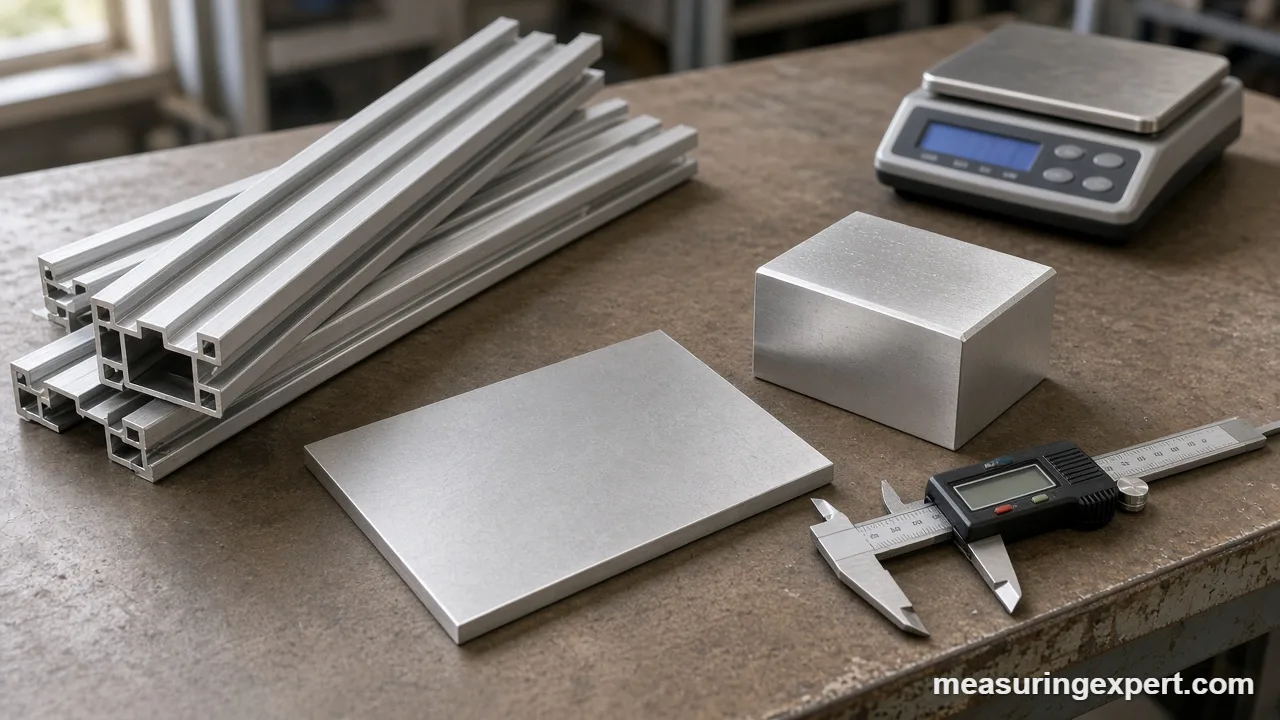
How dense is aluminum? Pure aluminum has a density of 2.70 g/cm3 at room temperature, which equals 2,700 kg/m3, 0.0975 lb/in3 or about 168.6 lb/ft3. Common alloys stay close: 6061 is also about 2.70 g/cm3, while 7075 is about 2.81 g/cm3. As a result, aluminum weighs roughly one third as much as steel.
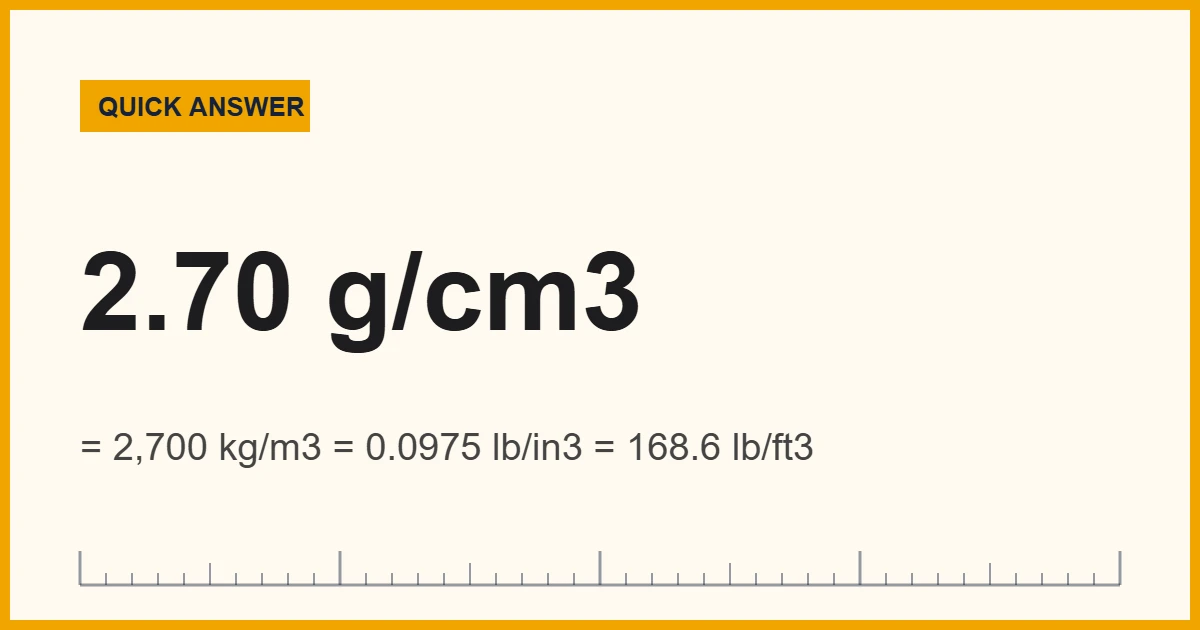
Convert Aluminum Density Between Units
The converter starts at 2.70 g/cm3, the value for pure aluminum and 6061. Type a different number, for example 2.81 for 7075, and pick the unit you have. It then shows kilograms per cubic meter, pounds per cubic inch, pounds per cubic foot and pounds per US gallon.
To begin with, density tells you how much mass fits into a given volume. For metals, therefore, it decides how heavy a part will be once you know its size. As a result, machinists, welders, boat builders and students all end up asking the same question about aluminum. In short, a block of aluminum is light for its size, but it still sinks in water, because water has a density of only about 1.00 g/cm3.
Above all, the figure of 2.70 g/cm3 is the standard reference value. For instance, the Royal Society of Chemistry lists aluminum at 2.70 g/cm3 in its periodic table data, with a melting point of about 660.3 degrees C (1,220.6 degrees F). Below, you will find the value in every common unit, the numbers for popular alloys, a side-by-side with steel and titanium, and finally a simple way to check a part yourself.
How Dense Is Aluminum in Every Common Unit?
Simply put, all of these values describe the same thing: 2.70 grams in every cubic centimeter. In addition, each one comes from that figure and the exact definitions of the inch (25.4 mm), the pound (453.59237 g) and the US gallon (3.785411784 L).
| Unit | Pure aluminum (2.70 g/cm3) | Where you see it |
|---|---|---|
| Grams per cubic centimeter (g/cm3) | 2.70 | Chemistry, physics, data sheets |
| Grams per milliliter (g/mL) | 2.70 | Lab work (1 mL = 1 cm3) |
| Kilograms per cubic meter (kg/m3) | 2,700 | Engineering, SI calculations |
| Kilograms per liter (kg/L) | 2.70 | Casting and melting |
| Pounds per cubic inch (lb/in3) | 0.0975 | US machining and CAD |
| Pounds per cubic foot (lb/ft3) | 168.6 | Structural and shipping estimates |
| Pounds per US gallon (lb/gal) | 22.53 | Molten metal and scrap volume |
| Specific gravity (water = 1) | 2.70 | Quick comparisons |
So what does that look like in real objects? First, a solid 10 cm (about 3.94 in) cube weighs 2,700 g, or about 5.95 lb. Next, a 4 x 8 ft sheet that is 1/4 in thick holds 1,152 cubic inches, so it weighs about 112 lb. Finally, a 1 in diameter rod that is 12 in long weighs about 0.92 lb. Also, you can print this chart or bookmark the converter above for later.
Recommended Tools for Checking Metal Density
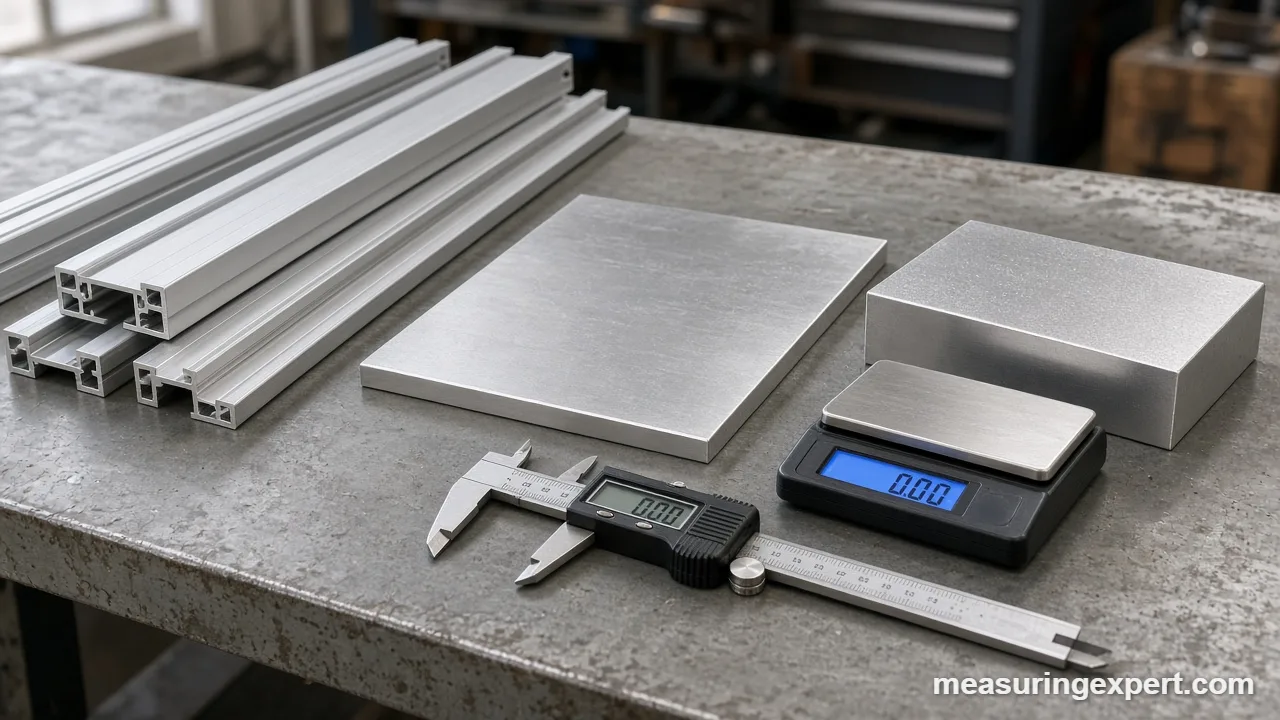
First of all, you only need two measurements to find density: mass and volume. Therefore, a precise scale and a way to measure size are the core tools. For example, a digital caliper handles regular shapes such as bars, plates and tubes. For odd shapes, however, a glass graduated cylinder lets you measure volume by water displacement. Also, a 0.01 g scale suits small samples, while a kitchen scale covers larger offcuts.


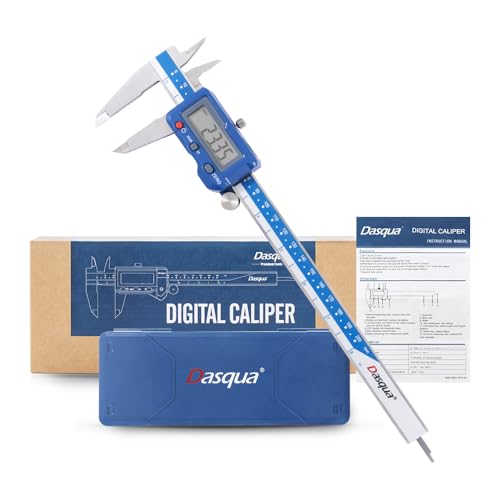

As an Amazon Associate, Measuring Expert earns from qualifying purchases.
How Dense Is Aluminum Alloy? 6061, 7075 and More
In fact, most aluminum you buy is an alloy, not the pure metal. Moreover, alloying elements shift the density a little in either direction. For example, magnesium is lighter than aluminum, so magnesium-rich 5052 comes out slightly less dense. Zinc and copper, by contrast, are much heavier, which is why 7075 and 2024 are a few percent denser than pure aluminum.
| Alloy | Main additions | g/cm3 | lb/in3 | Typical use |
|---|---|---|---|---|
| 1100 (commercially pure) | None (99%+ Al) | 2.71 | 0.0979 | Foil, trim, chemical equipment |
| 3003 | Manganese | 2.73 | 0.0986 | Cookware, tanks, roofing |
| 5052 | Magnesium | 2.68 | 0.0968 | Marine panels, fuel tanks |
| 6061 | Magnesium, silicon | 2.70 | 0.0975 | Frames, fittings, machined parts |
| 6063 | Magnesium, silicon | 2.69 | 0.0972 | Window frames, extrusions |
| 2024 | Copper | 2.78 | 0.1004 | Aircraft skins, fasteners |
| 7075 | Zinc, magnesium, copper | 2.81 | 0.1015 | Aircraft parts, high-strength gear |
Of course, these are typical published values at room temperature. The ASM data sheet for 6061-T6, for instance, lists 2.70 g/cc and 0.0975 lb/in3. Similarly, many US references round the 7075 figure to 0.102 lb/in3. Either way, the gap between 6061 and 7075 is about 4%, so a 7075 part weighs about 4% more than the same part in 6061.
How Dense Is Aluminum Compared With Steel and Titanium?
In particular, this is where aluminum earns its reputation. Carbon steel is about 7.85 g/cm3, so aluminum is roughly 34% as dense, or close to one third. Titanium, on the other hand, sits in the middle at about 4.51 g/cm3. In other words, aluminum is about 60% as dense as titanium, and titanium is about 57% as dense as steel. For the full picture on those two metals, see our guides to how dense steel is and how dense titanium is.
| Metal | g/cm3 | lb/in3 | lb/ft3 | Compared with aluminum |
|---|---|---|---|---|
| Magnesium | 1.74 | 0.0629 | 108.6 | About 0.64x |
| Aluminum (pure, 6061) | 2.70 | 0.0975 | 168.6 | 1x |
| Aluminum 7075 | 2.81 | 0.1015 | 175.4 | About 1.04x |
| Titanium Ti-6Al-4V | 4.43 | 0.1600 | 276.6 | About 1.64x |
| Titanium (pure) | 4.51 | 0.1629 | 281.6 | About 1.67x |
| Carbon steel | 7.85 | 0.2836 | 490.1 | About 2.9x |
| Stainless steel 304 | 8.00 | 0.2890 | 499.4 | About 3.0x |
| Copper | 8.96 | 0.3237 | 559.4 | About 3.3x |
| Lead | 11.34 | 0.4097 | 707.9 | About 4.2x |
| Gold | 19.3 | 0.6973 | 1,204.9 | About 7.1x |
At the same time, the heavy end of the table shows how light aluminum really is. For instance, a piece of gold weighs about seven times as much as the same piece of aluminum. Lead, meanwhile, is a bit over four times as dense. Likewise, our posts on how dense gold is and how dense lead is walk through those metals in the same units.
Density vs Weight vs Strength: What People Mix Up
People often say aluminum is “light”, but that word can mean several different things. Because of that, it helps to separate them.
| Term | What it really means | Aluminum example |
|---|---|---|
| Density | Mass per unit volume; a material property | 2.70 g/cm3 for pure aluminum |
| Weight | How heavy one specific object is | A 1 in x 12 in rod weighs about 0.92 lb |
| Specific gravity | Density divided by the density of water | 2.70, because the units cancel |
| Strength | How much load a material carries before it yields or breaks | Varies widely by alloy and temper, so check the data sheet |
| Strength-to-weight ratio | Strength divided by density | That is why 7075 competes with some steels in aircraft |
So a low density does not mean a weak metal. Instead, it means you can use a thicker section for the same weight. In fact, that is the main reason aircraft, bicycle frames and truck bodies use so much aluminum.
How to Measure the Density of an Aluminum Part
You can check a sample at home or in a school lab. Besides, the method works for any solid that does not absorb water.
- Clean and dry the sample. Remove oil, chips and loose paint, since they add mass without adding metal.
- Weigh it. Put the part on a tared digital scale, then write down the mass in grams.
- Find the volume of a regular shape. For a block, multiply length x width x height in centimeters. Similarly, for a rod, use pi x radius squared x length.
- Or use water displacement for odd shapes. Note the water level in a graduated cylinder, lower the part in on a thread, and read the new level. As a result, the difference in mL equals the volume in cm3.
- Divide mass by volume. For example, a 54 g block with a volume of 20 cm3 gives 54 / 20 = 2.70 g/cm3.
- Compare the result. A value between about 2.6 and 2.85 g/cm3 fits aluminum. Anything near 7.8 points to steel instead.
Do and Don’t When Working With Aluminum Density
Do
- Use the alloy value, such as 2.81 for 7075, when weight matters.
- Keep units consistent, for example grams with cm3 and pounds with in3.
- Measure several dimensions, then average them.
- Also add a margin for coatings, fasteners and welds.
- Finally, check your math with the converter above.
Don’t
- Mix up lb/in3 and lb/ft3, because they differ by a factor of 1,728.
- Assume temper changes the weight of a part, since it does not.
- Trust displacement readings until you remove air bubbles from the part.
- Use bulk scrap density to estimate solid weight, because loose scrap holds air.
- Round 0.0975 lb/in3 up to 0.1 for precise work, since that adds about 2.6%.
Honest Limits of These Numbers
In general, a density table gives you a reference value, not a guarantee for every bar in your shop. First, alloy chemistry varies within each grade, so the third decimal place can move. Second, temperature matters a little: aluminum expands as it warms, so its density drops by about 0.5% between 20 and 100 degrees C. Meanwhile, molten aluminum is lighter still, at roughly 2.38 g/cm3 near its melting point. Third, castings can contain small pores, which pull the average down. For everyday weight estimates, 2.70 g/cm3 is accurate enough; for aerospace weight budgets, however, engineers use the exact value from the mill certificate.
When Accuracy Really Matters
For a garage project, for example, a 1% error in density hardly matters. Still, some jobs deserve more care:
- Shipping and lifting. Because a full pallet of plate adds up quickly, crane and forklift limits apply to the real weight.
- Aircraft, drones and racing parts. Even small errors add up across hundreds of parts, so they change the balance and the payload.
- Quoting and buying metal. Suppliers often sell by weight, so the right alloy value keeps estimates honest.
- Identifying unknown scrap. Density narrows down the metal, but it cannot tell 6061 from 6063.
How Dense Is Aluminum? Frequently Asked Questions
How dense is aluminum in g/cm3?
In short, pure aluminum has a density of 2.70 g/cm3 at room temperature. That is the same as 2.70 g/mL, because one milliliter equals one cubic centimeter.
How dense is aluminum in lb/in3?
Aluminum is about 0.0975 lb/in3. In other words, that is about 168.6 lb/ft3 or 22.53 lb per US gallon.
What is the density of aluminum in kg/m3?
The density of aluminum is about 2,700 kg/m3. However, common alloys range from about 2,680 kg/m3 for 5052 to 2,810 kg/m3 for 7075.
How dense is aluminum 6061?
6061 aluminum is about 2.70 g/cm3, or 0.0975 lb/in3, so it is practically the same as pure aluminum.
Is 7075 aluminum heavier than 6061?
Yes, slightly. 7075 is about 2.81 g/cm3 against 2.70 g/cm3 for 6061, so the same part weighs about 4% more in 7075.
How dense is aluminum compared with steel?
In short, aluminum is roughly one third as dense as steel. Carbon steel is about 7.85 g/cm3, so steel weighs about 2.9 times as much as aluminum for the same volume.
Is aluminum lighter than titanium?
Yes. Titanium is about 4.51 g/cm3, so aluminum is about 60% as dense. Titanium alloys are stronger, though, so the lighter part depends on the design.
Does aluminum float in water?
No. Solid aluminum is 2.70 times as dense as water, so it sinks. A foil boat or a hollow can floats only because of the air it holds.
How dense is aluminum foil?
In fact, aluminum foil has the same density as the metal itself, about 2.7 g/cm3. It feels light only because it is extremely thin.
Does temperature change the density of aluminum?
Yes, a little. Aluminum expands as it warms, so its density falls by about 0.5% from 20 to 100 degrees C. Molten aluminum is about 2.38 g/cm3.
How Dense Is Aluminum: The Bottom Line
To sum up, pure aluminum and 6061 sit at 2.70 g/cm3, which is 2,700 kg/m3, 0.0975 lb/in3 or 168.6 lb/ft3. Meanwhile, 7075 is about 2.81 g/cm3. That makes aluminum about one third as dense as steel and about 60% as dense as titanium, so it remains the go-to metal when weight matters.
Finally, if you need a different unit, the converter at the top of this page does the math. Then, for a quick weight estimate, multiply the volume of the part by the density for its alloy, and add a small margin for coatings and hardware.
1 thought on “How Dense Is Aluminum? Density of Pure Aluminum, 6061 and 7075 in Every Unit”