

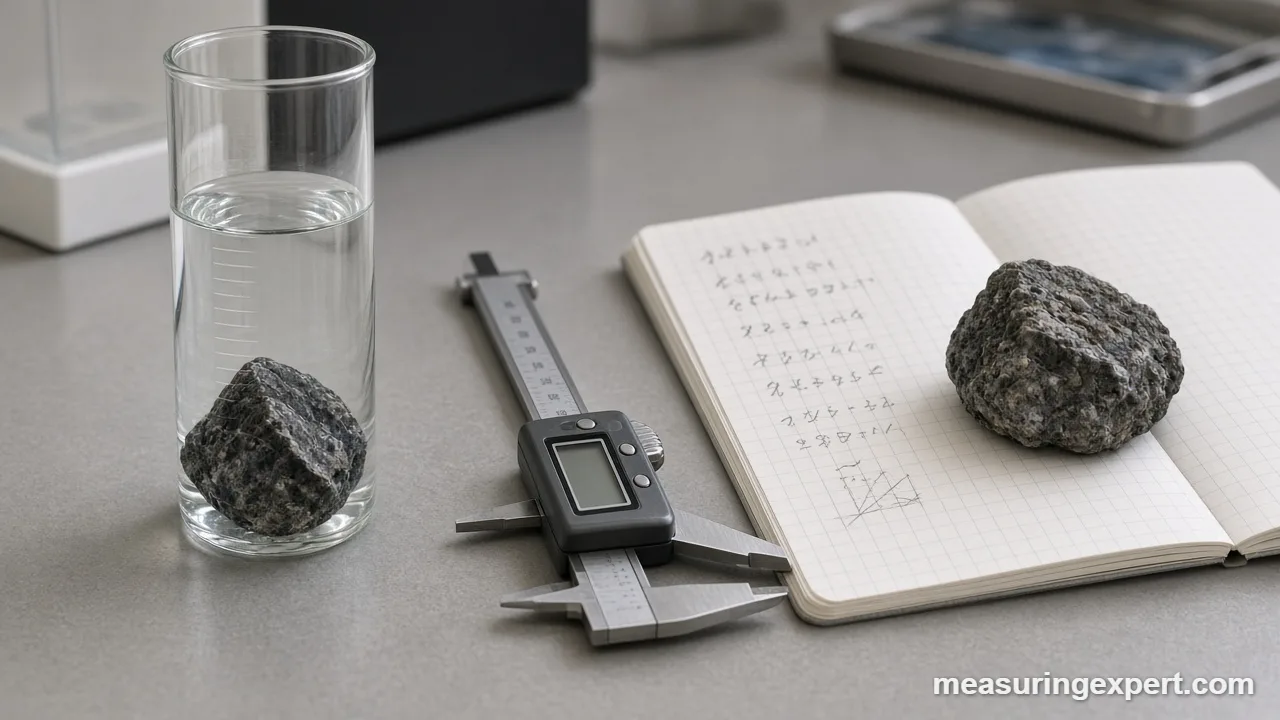
The main limits of indirect volume measurement are simple: formulas assume perfect shapes, small length errors grow when you cube them (1% on a side becomes about 3% on volume), displacement readings suffer from meniscus, bubbles and absorbent or floating objects, and density-based volume is only as good as the density you assume.
Most volumes in daily life never go into a measuring cup. Instead, you measure a length, a water level or a mass, and then you calculate the volume. That is what indirect volume measurement means. It is fast and often the only practical option. However, every step between the object and the final number adds a little error, and some steps multiply it.
This guide looks at where those errors come from and how big they get. For example, you will see why a 1 mm slip on a ruler matters far more for a marble than for a moving box, and why a reading that looks clean on a graduated cylinder can still be several percent off.
In short: calculated and indirect methods are only as good as their weakest input. So, if you know which input dominates, you can fix the right thing instead of buying a fancier tool for the wrong job.
The error math here follows the law of propagation of uncertainty described by the US National Institute of Standards and Technology in NIST Technical Note 1297. Meanwhile, the water densities come from the USGS Water Science School table, which lists 0.99802 g/cm3 at 21 C (70 F).
Convert Results From Indirect Volume Measurement
Once you have a calculated volume, you often need it in other units. Enter your result in milliliters or cubic centimeters below. As a result, you get liters, US fluid ounces and US cups at once. Remember that 1 mL equals exactly 1 cubic centimeter (cc).
This page has no shape calculator, so do the formula step first (for example, length x width x height). Then convert the answer here. Also keep the same number of significant figures as your weakest measurement.
Recommended Tools for Indirect Volume Measurement
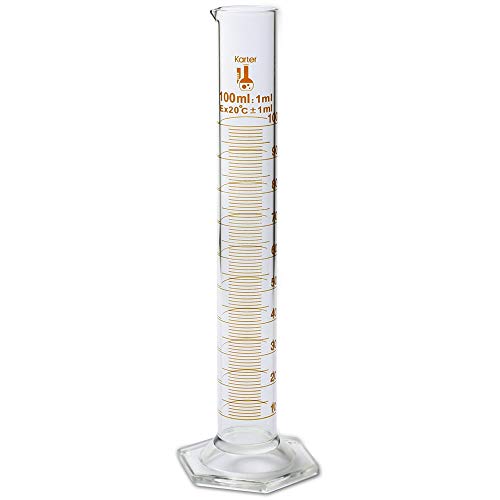
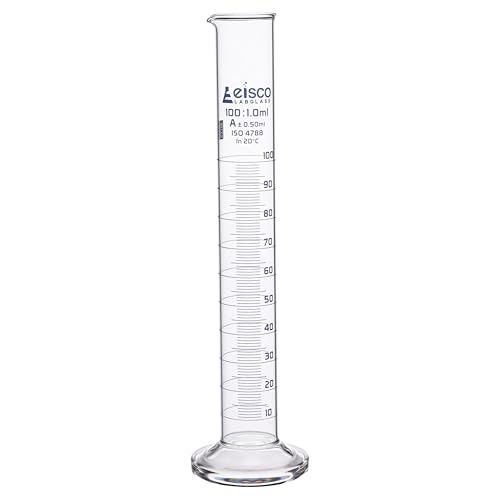
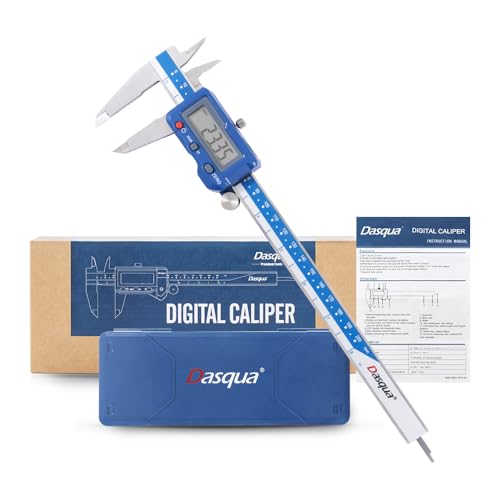
Better inputs shrink every error downstream. A digital caliper reads lengths to 0.01 mm, which cuts the cube effect sharply on small parts. A Class A graduated cylinder and an overflow can make displacement more repeatable. Finally, a milligram scale helps when you derive volume from mass and density. These picks rely on manufacturer specs and buyer reports.


As an Amazon Associate, Measuring Expert earns from qualifying purchases.
Key Takeaways
- Shape formulas assume perfect cubes, spheres and cylinders; real objects have rounded edges, dents and tapers.
- Relative error in a length triples for a cube or sphere volume and doubles for a cylinder’s diameter.
- Rounding a 5 cm side to the nearest whole centimeter can shift a cube’s volume by roughly 30%.
- Displacement needs two readings, so reading errors add up on small volume changes.
- Absorbent, floating or air-trapping objects break the displacement method unless you adjust for them.
- Water is not exactly 1 g/mL; at room temperature, assuming 1.000 adds about 0.2% error.
- Density-derived volume carries the full error of the density you assume, often several percent for alloys.
Direct, Calculated and Indirect Methods Compared
People often lump these methods together. In practice, each one has its own weak spot. A direct method reads volume off a scale, as with a pipette or a measuring cup. A calculated method measures dimensions and plugs them into a formula. Other indirect methods infer volume from something else, such as displaced water or mass.
| Method | What you actually measure | Main source of error | Typical use |
|---|---|---|---|
| Direct reading | Liquid volume on a graduated scale | Tolerance of the glassware, meniscus reading | Liquids in labs and kitchens |
| Formula (calculated) | Length, width, height or diameter | Shape assumption, length error raised to a power | Boxes, tanks, rooms, machined parts |
| Water displacement | Rise in liquid level or overflow volume | Two readings, bubbles, absorbent or floating objects | Rocks, odd parts, small solids |
| Mass and density | Mass on a scale plus an assumed density | Uncertainty in the assumed density | Metal parts, liquids by weight |
| Gas law | Pressure, temperature and amount of gas | Ideal gas assumption, temperature reading | Gas cylinders, lab gas collection |
For the most accurate tools for each job, see our ranking of the most accurate volume measurement tools. If your object has no regular shape at all, our guide on the volume of an irregular object walks through displacement in detail.
Why Shape Formulas Fall Short
Every volume formula describes an ideal shape. Real objects are never quite ideal. A cardboard box bulges, a can has a rolled rim, and a ball bearing may be slightly out of round. So, the formula answers a slightly different question than the one you asked.
Some common gaps between the formula and the object:
- Rounded corners. A box with rounded edges holds less than length x width x height suggests.
- Taper. Buckets, cups and many tanks get wider toward the top, so a single diameter misleads you.
- Wall thickness. Outside dimensions give the outer volume, not the space inside a container.
- Hidden voids. Castings and 3D prints may contain air pockets that no tape measure can see.
As a rule, the formula error does not shrink with a better ruler. Instead, you need a better model, such as splitting the object into simpler shapes, or a different method like displacement.
How Error Grows in Indirect Volume Measurement
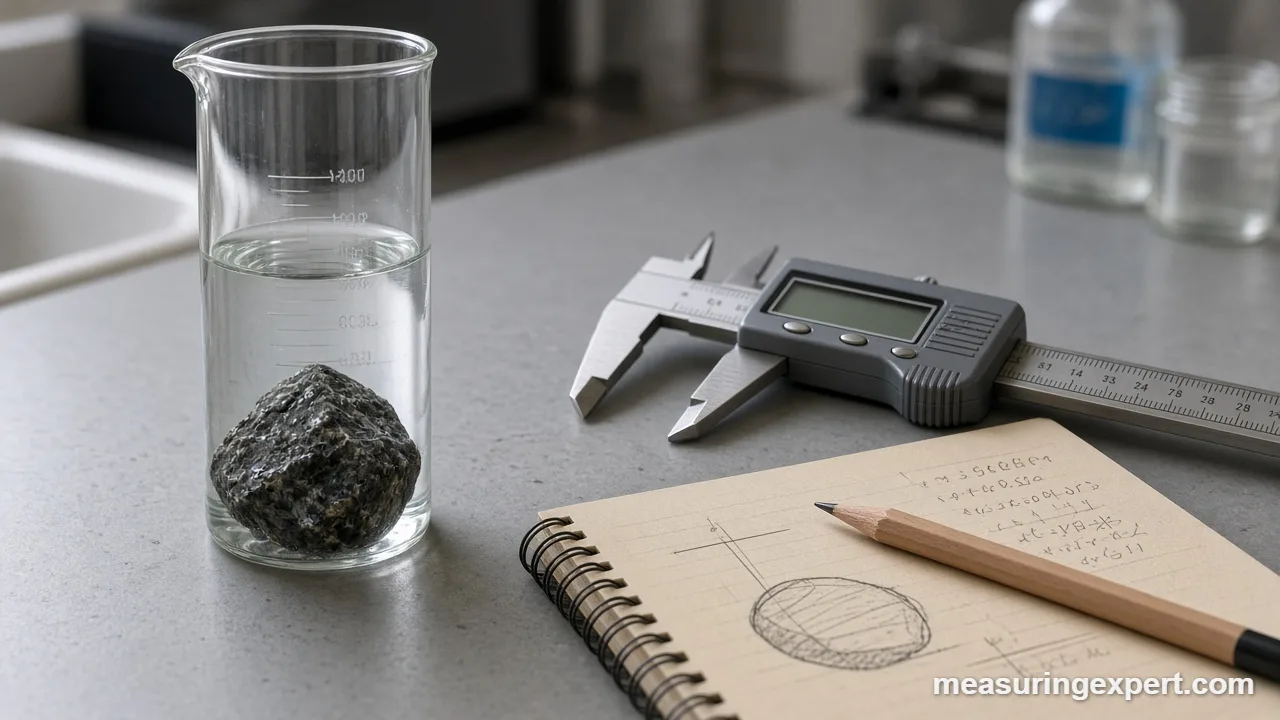
Here is the key idea. When a formula multiplies measured lengths, their relative errors add up. When a length is raised to a power, its relative error is multiplied by that power. Therefore, the cube and the sphere, which use one length cubed, triple the relative error of that length.
Cube: V = s^3, so dV/V = 3 x (ds/s)
Sphere: V = (pi/6) x d^3, so dV/V = 3 x (dd/d)
Cylinder: V = (pi/4) x d^2 x h, so dV/V = 2 x (dd/d) + (dh/h)
Box: V = L x W x H, so dV/V = (dL/L) + (dW/W) + (dH/H)
These sums give the worst case, when all errors push the same way. For independent random errors, NIST combines them as a root sum of squares instead. For example, three independent 1% errors on a box give about 1.7% combined, while the worst case is 3%. A cube is different, because you measure one side and cube it, so the full 3% applies.
| Shape | Error in the length | Error in the volume |
|---|---|---|
| Cube (one side cubed) | 1% | about 3% |
| Sphere (diameter cubed) | 1% | about 3% |
| Cylinder (diameter) | 1% on diameter only | about 2% |
| Cylinder (height) | 1% on height only | about 1% |
| Box, three separate sides | 1% on each side | 1.7% (random) to 3% (worst case) |
| Cube, side rounded to nearest cm | 5 cm +/- 0.5 cm (10%) | about 30% (91 to 166 cm3) |
The last row shows why significant figures matter. If you round a 5 cm side to the nearest centimeter, the true volume could sit anywhere from 91.1 to 166.4 cm3. In other words, a rough ruler can make a precise-looking answer meaningless.
Worked Uncertainty Examples
Each example below uses real arithmetic, so you can follow the same steps with your own numbers. All lengths use metric units, with US equivalents where helpful.
Example 1: A Box Measured With a Ruler
A small box measures 10 cm x 12 cm x 8 cm (about 3.9 x 4.7 x 3.1 in). A millimeter ruler gives roughly +/- 0.1 cm on each side. The volume is 960 cm3, or about 32.5 US fl oz.
The relative errors are 1%, 0.83% and 1.25%. Added together, the worst case is about 3.1%, or +/- 30 cm3. Combined as independent errors, the result is about 1.8%, or +/- 17 cm3. So, report the box as 960 +/- 20 cm3, not 960.0 cm3.
Example 2: A Ball Bearing and the Cube Rule
A steel ball measures 2.00 cm across, and your caliper reading carries +/- 0.02 cm. Its volume is (pi/6) x 2.00^3 = 4.19 cm3. However, a 1% diameter error becomes about 3% in volume, which is +/- 0.13 cm3. In fact, the range runs from 4.06 to 4.32 cm3. That is why small round parts need a caliper or micrometer rather than a ruler.
Example 3: A Cylinder Where Diameter Dominates
A can measures 10.0 cm in diameter and 20.0 cm tall, each +/- 0.1 cm. Its volume is (pi/4) x 10^2 x 20 = 1,571 cm3 (about 53 US fl oz). The diameter error counts twice (2 x 1% = 2%), while the height adds only 0.5%. As a result, the worst case is 2.5% (+/- 39 cm3) and the random estimate is about 2.1% (+/- 32 cm3). If you want a better answer, improve the diameter reading first.
Example 4: Displacement in a Graduated Cylinder
You drop a stone into a 100 mL cylinder. The level rises from 50.0 mL to 62.0 mL, so the stone displaces 12.0 mL. A Class A 100 mL cylinder carries a tolerance of about +/- 0.5 mL, and you read the scale twice.
In the worst case, the two reading errors add to +/- 1.0 mL, which is 8.3% of 12 mL. Treated as independent, they combine to about +/- 0.7 mL, or 5.9%. In contrast, the same stone in a 25 mL cylinder with finer marks would give a much tighter result. Thus, displacement works best when the object fills a good share of the cylinder.
Example 5: Volume From Mass and Density
An aluminum part weighs 250.0 g. If you assume pure aluminum at 2.70 g/cm3, the volume is 250.0 / 2.70 = 92.6 cm3. However, many aluminum alloys run closer to 2.8 g/cm3. With 2.80 g/cm3, the same part works out to 89.3 cm3, a 3.6% difference. Meanwhile, the scale error (0.1 g in 250 g, or 0.04%) barely matters. In short, the assumed density is the weak link, not the scale.
Displacement Pitfalls in Indirect Volume Measurement
Displacement looks foolproof, since the water wraps around any shape. Still, several effects quietly bend the result.
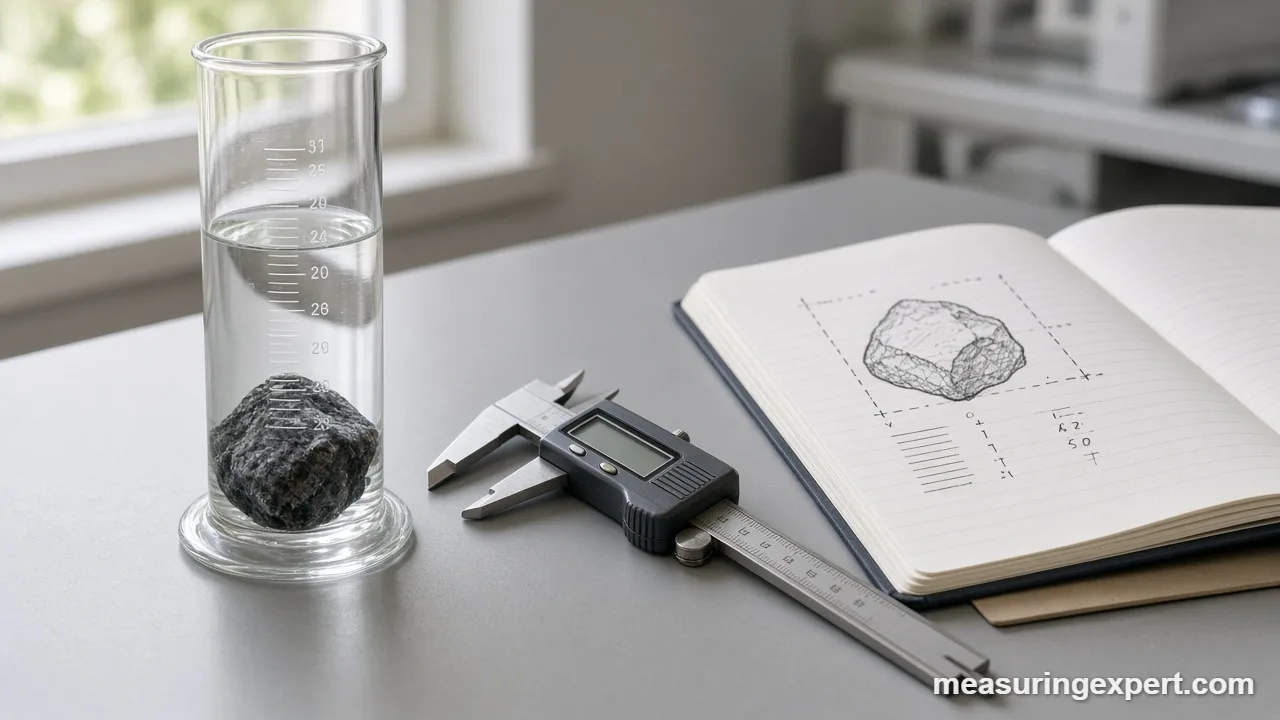
- Absorbent objects. Wood, sponge, cork, unglazed clay and some stones soak up water. The level then rises less than it should. So, seal the object with a thin coat of wax or plastic wrap, or measure quickly and note the drift.
- Floating objects. Anything less dense than water floats with part of its volume above the surface. Push it fully under with a thin wire or pin, and subtract the small volume of the part of the wire that goes under.
- Meniscus and parallax. Water curves up the glass wall. Read the bottom of the curve with your eye level to the mark. In a cylinder about 28 mm across, each millimeter of height holds about 0.6 mL, so a small viewing angle error adds up fast.
- Air bubbles. Bubbles clinging to the object add false volume. A single 5 mm bubble adds about 0.065 mL. Tap the object or tilt it gently to free them.
- Splashing and wet walls. Drops left on the glass above the waterline lower the reading. Lower the object on a thread instead of dropping it.
- Dissolving objects. Salt, sugar and some minerals dissolve in water. Use a liquid they do not dissolve in, such as vegetable oil for sugar cubes.
For a step-by-step pipette technique that reduces meniscus errors on small volumes, see our guide on how to use a pipette.
Temperature, Density and Gas Volume
Temperature affects almost every indirect method. First, liquids expand as they warm. Water reaches its maximum density near 4 C (39 F) and drops to 0.99802 g/cm3 at 21 C (70 F), according to the USGS. So, if you weigh 100.00 g of water at room temperature and call it 100 mL, you are off by about 0.2%. The true volume is about 100.2 mL.
Second, glassware itself expands slightly. Most volumetric glass carries a calibration temperature, usually 20 C, printed on it. As a result, very hot or cold liquids give readings that drift from the marked value.
Third, gas volume depends strongly on temperature and pressure. The ideal gas law works well for air near room conditions. However, it drifts for dense gases, high pressures and low temperatures, where real gases deviate from ideal behavior. Therefore, always record the temperature and pressure next to any gas volume.
| Water temperature | Density (g/cm3) | Volume of 100.00 g of water |
|---|---|---|
| 4 C (39 F) | 1.00000 | 100.00 mL |
| 21 C (70 F) | 0.99802 | 100.20 mL |
| 100 C (212 F) | 0.95865 | 104.31 mL |
How to Reduce Error in Indirect Volume Measurement
These steps work for formula and displacement methods alike. Follow them in order, because the early steps tell you where to spend effort.
- Pick the right method. Use a formula for regular shapes, displacement for irregular solids, and mass with a known density for uniform materials.
- Find the dominant input. Check which length is cubed or squared, or which reading is smallest, since it drives most of the error.
- Use a finer tool for that input. Switch from a ruler to a caliper, or from a large cylinder to a smaller one with finer marks.
- Measure several times. Take three to five readings at different spots and average them, which also reveals taper or bulges.
- Control temperature. Work near 20 C (68 F) and note the temperature of any liquid you use.
- Remove bubbles and seal porous objects. Tap off bubbles and coat absorbent items before displacement.
- Calculate and round honestly. Compute the volume, estimate its uncertainty with the rules above, and round to match it. Then use the converter above for other units.
Do and Don’t
Do
- Measure small parts with a caliper.
- Read the meniscus at eye level.
- Average several readings.
- Write down the temperature.
- Report an uncertainty with the result.
Don’t
- Round lengths before you cube them.
- Drop objects into the cylinder.
- Assume water is exactly 1 g/mL.
- Use a pure-metal density for an alloy.
- Trust a formula for a tapered container.
Honest Limits of Indirect Volume Measurement
No method removes every error, and some limits stay with you no matter what. A formula cannot know about hidden voids. Displacement cannot measure a powder or an object that dissolves in every handy liquid. Likewise, a density-based volume inherits any uncertainty in the material’s composition.
Systematic errors are the trickiest, because averaging does not cancel them. For example, a cylinder that reads 1 mL high reads high every time. Our guide on measurement bias explains how to spot and correct that kind of consistent offset. Finally, the uncertainty estimates on this page assume you know the tolerance of each tool. If you do not, treat the smallest scale division as a rough lower limit.
When to Call a Calibration Lab
Home and classroom work rarely needs outside help. However, some jobs do. If a volume feeds a legal sale, a medical dose, a regulated test or a pressure vessel, the measurement needs traceable calibration. In that case, an accredited calibration lab can certify glassware, tanks and flow meters against national standards.
Likewise, call a licensed engineer or surveyor for fuel tanks, concrete pours and large storage volumes, where a few percent error costs real money.
FAQ: Indirect Volume Measurement Questions
What is indirect volume measurement?
It means finding volume from other measurements, such as dimensions in a formula, the water an object displaces, or its mass divided by its density, instead of reading volume directly.
Why does a 1% length error become 3% in volume?
A cube or sphere volume uses one length cubed. Relative errors multiply by the power, so 1% on the side or diameter becomes about 3% on the volume.
Is water displacement more accurate than a formula?
For irregular shapes, usually yes. For regular shapes measured with a caliper, a formula is often better, because displacement needs two scale readings with their own errors.
How do you measure the volume of an object that floats?
Push it fully under the surface with a thin pin or wire, read the level, and subtract the small volume of the submerged part of the pin.
What are the main limits of indirect volume measurement for porous objects?
Porous objects absorb water, so the level rises less than it should. Seal them with wax or plastic wrap first, or use a liquid they do not absorb.
Does temperature affect indirect volume measurement?
Yes. Water at 21 C has a density of 0.99802 g/cm3, so weighing water and assuming 1 g/mL adds about 0.2% error, and gas volumes change far more.
How many significant figures should a calculated volume have?
Match your least precise measurement. If a side is only known to the nearest centimeter, a volume written to three decimal places claims precision you do not have.
Why is density-derived volume often less accurate than expected?
The assumed density is usually the weak link. For example, aluminum alloys range from about 2.7 to 2.8 g/cm3, which shifts the volume by several percent.
How can I make indirect volume measurement more accurate at home?
Use a caliper for small parts, a narrow graduated cylinder for displacement, average several readings, remove bubbles, and keep everything near room temperature.
Do air bubbles really change a displacement reading?
They do. A single 5 mm bubble adds about 0.065 mL, so several bubbles on a small object can shift the result by a noticeable percentage.
Bottom Line on Indirect Volume Measurement
To sum up, calculated and indirect methods work well when you respect their limits. Shape formulas assume ideal geometry, cubed lengths triple their error, displacement suffers from bubbles, meniscus reading and absorbent objects, and density-based volume depends on a density you often only estimate.
So, find the input that drives the error and improve that one first. Then report your volume with an honest uncertainty, and use the converter near the top of this page to express it in liters, fluid ounces or cups.